The University of San Francisco The University of San Francisco
USF Scholarship: a digital repository @ Gleeson Library | Geschke
USF Scholarship: a digital repository @ Gleeson Library | Geschke
Center
Center
Master's Theses Theses, Dissertations, Capstones and Projects
2000
The Relationship Between Perceived Availability of Mentors,
The Relationship Between Perceived Availability of Mentors,
Expressed Need for Mentoring, and Student Satisfaction Among
Expressed Need for Mentoring, and Student Satisfaction Among
African American and Hispanic American Graduate Students
African American and Hispanic American Graduate Students
Denise Lutcher
Follow this and additional works at: https://repository.usfca.edu/thes
The University of San Francisco
THE RELATIONSHIP BETWEEN PERCEIVED AVAILABILITY OF MENTORS, EXPRESSED NEED FOR MENTO RING, AND STUDENT SATISFACTION
AMONG AFRICAN AMERICAN AND HISPANIC AMERICAN GRADUATE STUDENTS
A Dissertation
Presented to
The Faculty of the School of Education
Counseling Psychology Program
In Partial Fulfillment
Of the Requirements for the Degree
Doctor of Psychology
by
Denise~er
candidate's dissertation committee and approved by the
members of the committee, has been presented to and
accepted by the Faculty of the School of Education in partial
fulfillment of the requirements for the degree of Doctor of
Psychology. The content and research methodologies
presented in this work rewesent the work of the candidate alone.
, / . /.•
Date
ACKNOWLEDGEMENTS
To accomplish this dissertation involved enormous support and encouragement from
many wonderful people whom I want to acknowledge.
First, I would like to acknowledge my husband, Harold Hadley, who passed away two
years before completion. It was his support and faith in my ability to actually do this very big
thing that got me through the rough spots. I pressed through largely as a tribute to his memory.
I would also like to acknowledge Dr. Jill Steinberg, an extraordinary women of courage
and a dear friend who simply would not allow me to give up; Dr. Joan Avis, my chair, who
went above and beyond the call so many times I knew she was gift from God; Dr. Patricia Busk,
who helped me understand how the pieces needed to fit together; and Dr. Elena Flores who
simply made me believe it was possible.
A very special acknowledgement is accorded to my boss, Pat Robertson and my work
family at CityTeam Ministries who prayed for me and never lost faith.
Also, a very special thank you to Dr. Bernice Johnson, my twin sister and best friend,
whom I owe far more to than I could ever express on paper. Her support and confidence never
wavered. I could not have done this without her.
Most importantly, I am grateful to God for never leaving my side and for the awesome
privilege of representing Him.
TABLE OF CONTENTS
Page
ACKNOWLEDGEMENTS ________________________________________________________________________________________________________________ ii
TABLE OF CONTENTS---iii
LIST OF TABLES_·---v
CHAPTER L INTRODUCTION. ________________________________________________________________________________________________________________ 2 Problem Statement·--- 8
Background and Need for the Study ___________________________________________________________________________________ l4 Purpose of the Study ____________________________________________________________________________________________________________ 18 Theoretical Rationale 18 Research Questions ... ---23
Definition ofTerms ______________________________________________________________________________________________________________ 24 IL REVIEW OF THE LITERATURE ____________________________________________________________________________________ 26 Historical Overview on Mentoring _____________________________________________________________________________________ 26 Student Satisfaction _____________________________________________________________________________________________________________ 30 Ethnicity and the Mentoring Process __________________________________________________ . _______________________________ 32 Retention in Higher Education ____________________________________________________________________________________________ 39 III. METHODOLOGY ______________________________________________________________________________________________________________ 45 Sample ---46
Recruitment and Survey Distribution·---47
Demographics·---48
Protection ofHuman Subjects _____________________________________________________________________________________________ 49 Procedure·---49
Instrumentation ____________________________________________________________________________________________________________________ 51 Data Analysis _______________________________________________________________________________________________________________________ 55 IV. RESULTS--- 60
Research Questions·---60
Research question 1 ... ---60
Research question 2 .... ---61
Research question 3 ________________ --- _______________________________________________ 61 Research question 4---68
Research question 5 _______________________________________________________________________________________ 68 Research question 6---·---···----·69
Research question 7 ... 69
Research question 8 ... 70
Research question 9 ... 71
Page
V. DISCUSSION, RECOMMENDATIONS, AND IMPLICATIONS ... 79
Discussion ... 79
Limitations ... 90
Implications ... 92
Recommendations for Future Research ... 94
Conclusions 97 REFERENCES ... IOl APPENDICES ... 113
A. Researcher's Letter to Instructors and Club Leaders ... ) 13
B. Postcard for Respondent's to Request Summary Data ... ) 15
C. Instrument Used in this StudY ... ) 17
D. Cover Letter to Participants in this StudY ... .125
E. Summary ofResponses to Section IV ofQuestionnaire ... )27
Table Page
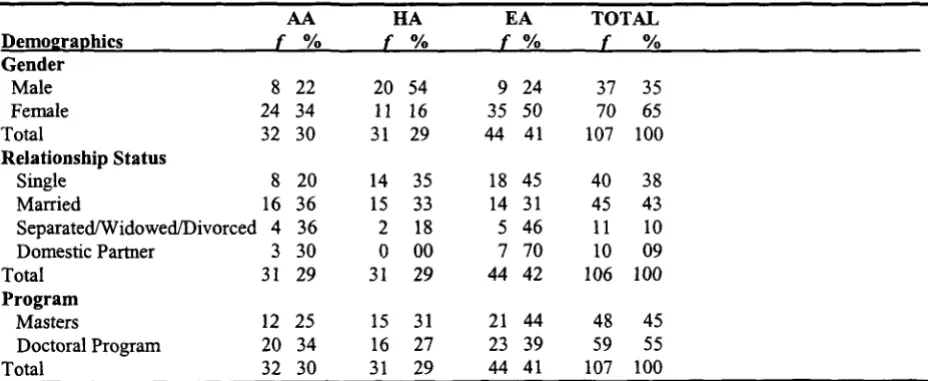
1. Frequency and Percentage for Demographic Characteristics ofRespondents ___ , ___ , _____________ _48
2. Means, Minimums, Maximums, and Standard Deviations for Age by Ethnic GrouP ... 49
3. Means, Standard Deviations, and t-test Results for Perceived Availability
Measures by Ethnic Group ... 61
4. Means, Standard Deviations, and t-test Results for Expressed Need Measures
by Ethnic Group ... 61
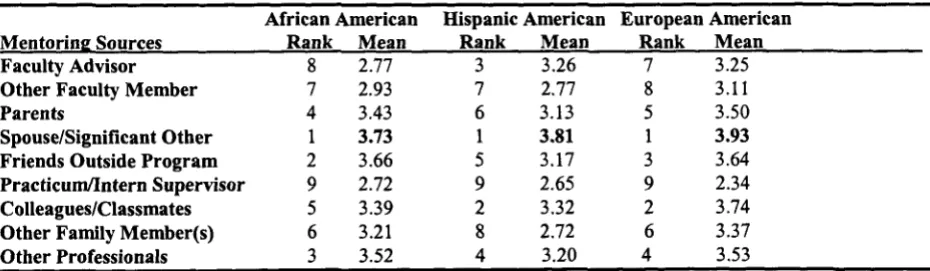
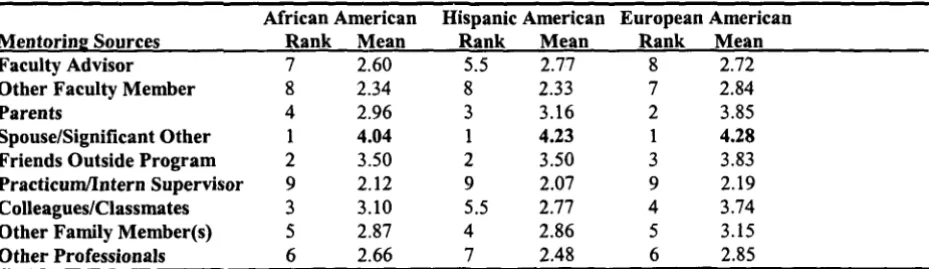
5. Rank Order of Balancing Personal and Professional Demands Weighted Sums
by Ethnic Group _________ ,_ .. _________ , ___________ ... ---·-·---·---.. ---62
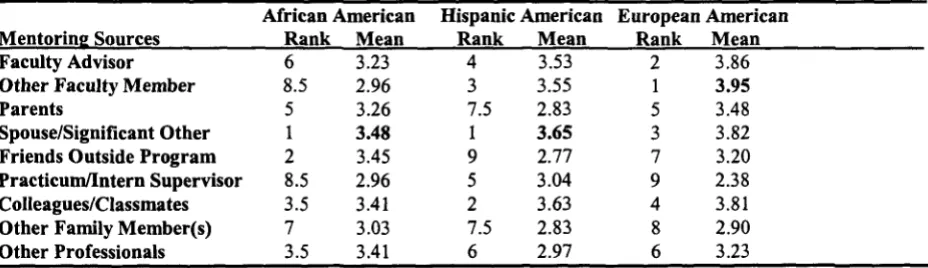
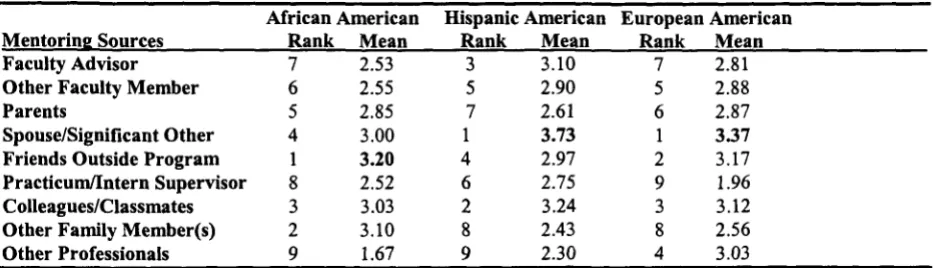
6. Rank Order of Enhancement of Technical Skills and/or Intellectual
Development Weighted Sums by Ethnic Group ... 63
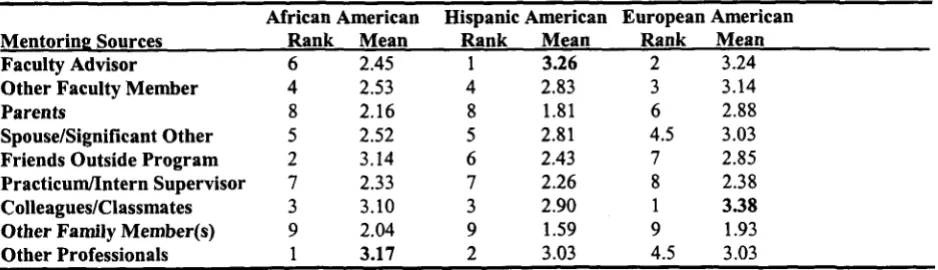
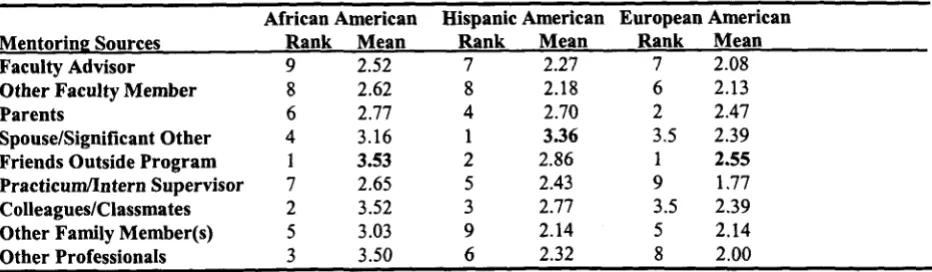
7. Rank Order ofProviding Emotional Support and Positive Feedback
Weighted Sum by Ethnic Group ... 64
8. Rank Order of Introduction to "Professional Politics" Weighted Sums
by Ethnic Group ______ , _______________ , ___ .. ________________________ , ____________________________________________________________ , ____ 64
9. Rank Order of Provides Opportunity to Discuss Fears, Anxieties, and
Uncertainties Weighted Sums by Ethnic GrouP ... ______ 65
10. Rank Order ofProvision of"Good Press" Weighted Sums by Ethnic GrouP ... 66
11. Rank Order of Providing Help Moving from Student to Colleague or
Peer Status Weighted Sums by Ethnic GrouP ... 67
12. Rank Order ofProviding Shield from "Bad Press" Weighted Sums
by Ethnic Group---.. --.. ·---.. ·---·---.. ---67
13. Pearson Product Moment Coefficient Correlation Between Perceived
Availability and Expressed and Satisfaction Levels ... 68
14. Means, Standard Deviations, and t-test Results for Expressed Need Measures
Comparing Combined African American and Hispanic American Students
with European American Students ... 70
Table
15. Means, Standard Deviations, and t-test Results for Perceived Availability
Measures Comparing Combined African American and Hispanic American
Page
Students with European American Students_ .... ______ ,, ____ .. , _______ , .. ____ , __ , ______ ,, ___ .. __ .. ______ , _____ .. 71
16. Pearson Product Moment Coefficients Correlation Between Perceived Availability
and Expressed and Satisfaction Levels for African American and Hispanic
American Students Combined as Compared with European American Students ______________ , _ _71
17. Means, Standard Deviations, and t-test Results for Satisfaction by Formal Mentoring
Participation and No Formal Mentoring Participation _________ ,_, _____________ ,, ______________ .. _______ , _____ 72
18. Means, Standard Deviations, and t-test Results for Satisfaction Level by Formal
Mentoring Participation and No Formal Mentoring Participation by Ethnic Group ______________ 73
19. Rank Order ofMentoring Function for Faculty Advisor Mentoring Source by Formal
Mentoring Participation and No Formal Mentoring Participation by Ethnic Group_, ________ ,_75
Chapter I
Introduction
The value of men to ring both as a means of assisting men tees in progressing through
critical developmental phases (Chaney, Muraskin, Cahalan, & Goodwin, 1998; Gould, 1978;
Katz & Hartnell, 1976; Kuh & Thomas, 1983; Levinson, Darrow, & Klein, 1978; Schlossberg,
1984, 1989; Sherman, Giles, & Williams-Green, 1994) and as a means of increasing
undergraduate students' satisfaction with their academic environment (Astin, 1982; Benjamin &
Hollings, 1997; Oliver, Moore, Schoen, & Scarmon, 1990; Schlossberg, Waters, & Goodman,
1995) has been established firmly. Overcoming the complex nature of issues, concerns, and
challenges, adult learners in the academic environment must face requires adaptation skills
including advanced study skills, socialization skills, research skills, and the ability to exploit
networking contacts. Perhaps nowhere is the complex nature of issues, concerns and challenges
more apparent than in the academic environment of graduate school. Adult developmental
theorists agree that the tasks involved in moving through the transition phases of graduate school
are inherently challenging (Kuh & Thomas, 1983; Schlossberg, 1984, 1989; Schlossberg et al.,
1995; Sherman et al., 1994).
What many agree to be challenging to graduate students, in general, may be especially
problematic for ethnic minority graduate students. Historically, the psychosocial climate of a
those from culturally-diverse backgrounds (Shocket, 1985; Sodano & Baler, 1983). The
connection between climate and mentoring in post-baccalaureate settings remains understudied,
as does the possible link between mentoring and student satisfaction.
The legacy of famous and productive mentoring relationships has been traced back as far
as Socrates and Plato, Medici and Michelangelo, and Freud and Jung (Wright, 1987). In 800
B.C., Mentor, an associate of King Odysseus, was given the task of guiding and teaching
Odysseus' son, Telemachus, to become the next king (Carruthers, 1992; Murdaugh, 1993). Over
the years, the relationship has been defined in many ways, ranging from who a mentor is to what
a mentor does.
The developmental psychologist Daniel Levinson and his colleagues (Levinson, Darrow,
Klein, Levinson & McKee, 1978) maintained that the mentor-protegee relationship "is one ofthe
most developmentally important relationships a person can have in early adulthood" (p. 97).
Levinson et al., (1978) considered the failure to experience a mentoring relationship "a waste of
talent, a loss to the individuals involved and an impediment to constructive social change" (p.
97).
The traditional one-on-one mentor-protegee relationship espoused by Levinson inspired
research focused on descriptions of who a mentor is (Bogat & Redner, 1985; Douvan, 1976) versus
what a mentor does. This view was limited in that it failed to look at how other individuals may
provide guidance, support, or other assistance traditionally associated with mentors. Many
criticisms of the earlier work point out the vague definitions used to describe the mentoring
function (Hunt & Michael, 1983; Hurley, 1988; Merriam, 1983; Speizer, 1981).
incidence and importance of mentoring began to emerge in the early 1980s (Hunt & Michael,
1983; Speizer, 1981). Behaviorally-focused descriptions that operationally define mentoring
were less common with the exception ofK.ram's (1980, 1983, 1985) delineation ofmentoring
roles or functions into psychosocial and vocational components. Kram's proposed classes of
mentor functions are role modeling, acceptance and confirmation, and counseling and friendship.
Schockett and Haring-Hidore (1985) built upon Kram's work by providing behavioral
descriptors that more accurately describe the components of mentoring, specifically role
modeling, encouraging, counseling, being a transitional figure, educating, consulting, coaching,
sponsoring, and protecting. In a study of 144 students (82% undergraduate, 18% graduate), they
developed a model depicting eight functions of a mentor--four psychosocial and four vocational.
Psychosocial functions were associated with developing a sense of identity, competence, and
self-worth. Vocational functions described those behaviors that helped protegees to adjust in
their chosen field.
The link between satisfaction with one's academic program and retention in higher
education has been established (Bean, 1986; Graham, 1995; Livengood, 1992; Pike, 1991). Pike
developed a model showing the relationship between background characteristics, coursework,
involvement, performance, and satisfaction. He concluded that obtaining high grades through
academic achievement and satisfaction with school are highly correlated. Livengood (1992)
sampled 125 freshmen students at Vanderbilt University for a study designed to predict who
would succeed in college. The results of the study suggested that satisfaction is critical to
students completing a 4-year degree. Schuh, Whitt, and Kuh (1991), describing the value of
seek the environment that is perceived as meeting their needs. Satisfaction positively relates to
persistence, social integration, and student-faculty integration" (p. 51).
There is substantial support both for the value of personal satisfaction with career choice
and satisfaction with academic programs (Astin, 1982; Barger & Mayo-Chamberlain, 1983;
Benjamin & Hollings, 1997; Koseke & Koseke, 1991; Oliver, Moore, Schoen, & Scarmon, 1990;
Pike, 1993), and the value ofmentoring for students and young professionals in business and
undergraduate settings (Decoster & Brown, 1982; Hennig & Jardim, 1977; Heppner, Wright, &
Berry, 1990; Kanter, 1977; Kram, 1985; Redmond, 1990). The connection between mentoring
and student satisfaction, particularly in postbaccalaureate settings, is understudied, as is the
connection between mentoring and student satisfaction among African American and Hispanic
American graduate students.
The late 1980s saw a stagnation in formalized mentoring programs both in industry and in
academia after some researchers challenged the value of mentoring (Hurley, 1988; Merriam et
al., 1987). A study of graduate psychology students conducted by Cronan-Hillix et al. (1986)
reported that only 53% of the graduate students (n=90) surveyed had a mentor. The primary
reason cited for not having a mentor was inability to find a satisfying mentor, and the second
most frequent reason for not having a mentor was that the program did not encourage mentoring.
Bettencourt, Bol, and Frazier (1994) surveyed 235 chairpersons at colleges and universities.
Their results indicated that formal mentoring programs are rare, with less than 6% reporting the
existence of a formal program. The reasons there are so few formal mentoring programs are not
funding of formalized mentorirrg programs may provide one explanation. Many institutions
including colleges and universities also experienced significant cuts in staffing during the decade
1980 to 1990. The cuts may have reduced the availability of mentors, as faculty were required to
assume an increased workload. The availability of mentoring relationships can be problematic
especially for ethnic minority students. Blake (1995), in a qualitative analysis of 9 African
American professional women, many of whom were pioneers in their fields, found that these
women experienced frustration regarding the lack of available mentors in the workplace.
As the increased focus and interest in formal mentoring programs sparked by Levinson et
al., (1978) stalled, the work ofthose looking at how nontraditionally-defined forms ofmentoring
are established and nurtured emerged. Kram and Isabella (1985) conducted a biographical
interview study of 50 working professionals assigned as peer mentoring dyads. They examined
how peer mentoring relationships provide an important alternative to formal mentoring by giving
support in the areas ofpsychosocial and career development. Barone (1988, 1990) cited the need
for research connecting specific behaviors of mentoring others such as the provision of emotional
support and encouragement, and technical skills enhancement, to specific outcomes such as
increased satisfaction with academic program and the reduction of stress. She also presented a
case for researching the connection, if any, between specific behaviors commonly practiced by
mentors and the expressed needs of protegees.
Results of the few empirical studies conducted in educational settings indicate that
formally arranged faculty mentors improves student's employment possibilities (Cameron, 1978),
professional skills (Bova & Phillips, 1984), professional growth (Harris & Brewer, 1986), and
offers benefits for the mentor as well as the mentee (O'Neil, 1981 ). Faculty mentors have
reported that their own growth continues when they mentor students (Busch, 1985). Faculty
mentoring is most often differentiated from faculty advising in the literature by the existence of a
structured, developmentally-focused program where students are matched with a faculty member
who provides support and encouragement, both professional and personal, above and beyond the
traditional confines of faculty advising. For ethnic minority students, support and encouragement
may involve celebrating academic achievements, advice on balancing personal obligations and
academic demands, social interaction outside of the academic arena, and friendship.
What remains noticeably absent is comprehensive mentoring and student satisfaction
research on culturally-different individuals (Bowman, Kite, Branscombe, & Williams, 1999;
Graham, 1995; Wright, 1987). Although only a few studies have examined the impact of racial
or ethnic minority status on the prevalence and patterns of mentoring protegee relationships
(Carden, 1990), mentoring was found by Smith and Davidson (1992), in a study of 298 African
American graduate and professional students at a large, public, predominately
European-American, Midwestern university, to be a statistically significant predictor of professional
development among African American students.
Further, student satisfaction has been found to influence several educational outcome
factors and all levels of educational experiences (Pascarella, 1980), including academic
performance (Bean & Bradley, 1984). Additional research supporting student satisfaction as an
important outcome variable links satisfaction to a variety of other variables, most notably
academic achievement (Bean & Bradley, 1986), learning and development (Pike, 1993), and
relationship between mentoring and student satisfaction among ethnic minority graduate
students, specifically to determine whether African American and Hispanic American graduate
students who self-identify as having mentors are more likely than those without mentors to have
a positive (i.e., satisfying) educational experience. The study addresses both the incidence and
the importance of mentoring using a behavioral model developed by Schockett and
Haring-Hildore (1985) and modified by Barone (1990).
Problem Statement
Although approximately half of European American college students graduate 6 years
after entering college, only one-fourth of all ethnic minority students do so (Kobrak, 1992). The
numbers of African American students successfully completing graduate studies programs
declined steadily during the decade 1980 to 1990, with African American male enrollment and
completion showing the greatest decline (Allen, 1988; Stewart, 1991). Although Hispanic
American student enrollment has shown some increase, it has not kept pace with their
representation in the population during the decade 1980 to 1990 (National Center for Educational
Statistics, 1986). During the 1980s, the Hispanic American population increased by 38.7% and
the African American population by 21.6% (U.S. Census Bureau, 1990). With European
Americans increasing by only 7% during this same time period, the result is a rapidly changing
complexion of the United States populace. In 1990, African Americans, Asian Americans, and
Hispanic Americans made up 40% of the California population. United States Census Bureau
projections held that African American, Asian Americans, and Hispanic Americans made up
over 46% of the California population in 1995 and over 47% in 1997 (California State
over 50% of the California citizenry (Jones & Clifford, 1990).
The National Coalition of Advocates for Students (1988) estimated that by the year 2050,
one in three US residents will be non-European. They predict education will be impacted
significantly by the changing demographics in that a greater number of ethnic minority students
will pursue college degrees. Although this may be true, it is important to understand that
enrollment, in and of itself, even at the undergraduate level, is no guarantee that students will
obtain the degree they seek. Historically, although ethnic minorities had greater access to
postsecondary education, actual degree attainment for non-Asian American minorities lagged
50% to 75% behind their European American peers by the end of the 1980s (Farley & Allen,
1989). More recent U.S. Department ofEducation statistical reports confirm 1997 actual
post-secondary degree attainment for this group was still 50% to 75% behind their European
American peers (National Center for Educational Statistics, 1997), indicating only marginal
increases in degree attainment.
Kobrak's (1992) report on African American student enrollment and retention rates
indicates that from 1966 to 1976, the proportion of African American undergraduate students
enrolled increased from 5% to 10% of the overall college population. Meanwhile, the proportion
of African Americans who completed 4 or more years of college rose from 4% in 1970 to 8% in
1980. Kobrak (1992) explained that the outlook was extremely optimistic, with many experts
predicting that the trend in increased enrollment and retention of ethnic minority students would
continue. Unfortunately, the trend did not continue. The decade 1980 to 1990 evidenced a
decline in both overall undergraduate enrollment and degree completion (Kobrak, 1992). Orfield
American students actually dropped by 12% after 1978. The data from 1990 to 1995 indicated
no significant improvement in undergraduate degree attainment for African American or
Hispanic American students as compared with their European American counterparts. Of the
bachelor's degrees conferred in 1991, only 6% where earned by African Americans (n=65,341),
6.4% in 1992 (n=72,326), 6.7% in 1993 (n=77,872), 7.2% in 1994 (n=83,576), and 7.5% in 1995
(n=87,203). Bachelor's degrees conferred upon Hispanic American students during the same
period were only 3.4% in 1991 (n=36,612), 3.6% in 1992 (n=40,761), 3.9% in 1993 (n=45,376),
4.3% in 1994 (n=50,241), and 4.7% in 1995 (n=54,201). In comparison, European American
students accounted for approximately 80% of the undergraduate degrees conferred each year
during the years 1990 through 1995. (U.S. Department of Education, 1999).
Because an undergraduate degree is a necessary prerequisite for graduate-school
admission, the drop in enrollment and completion at the undergraduate level has implications for
graduate-school enrollment and degree completion. In 1990, only 2% of Hispanic American and
4% of African American students were reported to have completed their graduate programs
(Brown, 1997). The U.S. Department ofEducation (1990) reported the proportion of doctoral
degrees earned by African Americans was 3.9% in 1978, 3.9% in 1980, 3.6% in 1984, 3.1% in
1986, 3.0% in 1988, 3.1% in 1990, 3.8% in 1995, 3.7% in 1996, and 4.1% in 1997.
Doctoral degree attainment for Hispanic Americans shows a similar trend toward
stagnation. In 1980, the number of doctoral degrees attained was 1.4% in 1980, 2.0% in 1984,
2.2% in 1986, 1.8% in 1988,2.1% in 1990,2.2% in 1995, and 2.2% in 1996. In 1997 only2.4%
(n=l,098) of doctoral degrees and 3.7% (n=15, 187) ofmaster's degrees were earned by Hispanic
master's degrees earned by European American students (U.S. Department of Education, 1999).
Even when the number of Hispanic American students who obtained professional-school degree
attainment is combined with those students who obtained doctoral degrees, the percentage
reported is only 3.6% (U.S. Bureau ofthe Census, 1999).
In order to empower students with the knowledge and confidence to grow academically,
socially, and professionally, to reduce alienation, and to facilitate retention efforts, it is important
to examine how students perceive and adjust to the challenges they face in higher education.
Students may leave universities before graduation for reasons other than academic ones. Many
African American and Hispanic American students may be the first generation in their families to
seek a higher-education degree (Chaney, Muraskin, Cahalan, & Goodwin, 1998). The family and
friends with whom they have shared common experiences in the past may be ill equipped to
support and encourage them adequately in this unfamiliar endeavor (Jay & D'Augelli, 1991;
Quintana, Vogel, & Ybarra, 1991 ). Economic demands may require these students to retain
part-or even full-time employment while attempting to complete their degree (Chaney et al.,1998).
African American and Hispanic American students may be expected to bond with peers and
function within student organized cohort study teams with students they have little in common
with and have difficulty relating to (Astin, 1975; Beal & Noel, 1980; Webb, 1987). Working
closely with an academic advisor or dissertation chair may be a new and intimidating experience.
Historically, the psychosocial climate of a university setting has been found to have a tremendous
effect on student perceptions, especially those from culturally-diverse backgrounds (Schockett,
1985; Sodano & Baler, 1983). The connection between climate and student satisfaction in
The focus of diversity training within graduate programs commonly begins and ends
with courses designed to teach the dominant culture how to interact more effectively with
minority culture. Little, if any, focus is placed on equipping minority individuals to navigate
more expertly in unfamiliar territory. Results of research suggest that programs designed to
reduce alienation should focus on the reduction of social estrangement (Credle & Dean, 1991;
Kobrak, 1992; Suen, 1983).
Early reports on mentoring in university settings at the undergraduate level show that
planned mentoring can be effective in helping underrepresented individuals to succeed in
unfamiliar systems (Burke, 1984; Fagenson, 1989; Noe, 1988). Researchers indicate providing
mentoring for undergraduate students also addresses several of the causes of student attrition and
delayed graduation, including the lack of proper academic preparation for college, the lack of
knowledge about or access to social or academic resources, and the absence of a comfortable
psychosocial milieu for matriculation (Gavin, 1989; Stampen & Cabrera,1988).
Relative to graduate students, effective mentoring involves not only the transfer of
academic skills, attitudes, and behaviors but also a level of interaction, trust, and communication.
The result is a psychological comfort that empowers students with the knowledge and
confidence to grow academically and socially regardless of the environment (Merriam, 1983).
Merriam indicated that, if this growth occurs, graduate students will perceive their educational
experience to be more positive (i.e., satisfying) and, therefore, be more likely to remain at the
university until graduation, thus meeting the needs of the university to address the problem of
retention. Graham (1995) surveyed 502 criminology students at Fresno City College to explore
13 less satisfied with their educational experience were more likely to drop out of school than
students who were more satisfied, (b) older students were more likely to be satisfied with their
educational experience, and (c) Hispanic American students were more likely to be satisfied than
African American, European American, or Asian American students.
Further, when one considers the decreasing numbers of African American and Hispanic
American graduate students who fail to obtain their degrees successfully (Kobrak, 1992), issues
of retention become even more critical for those formulating policy and programs in upper
degree educational programs. Studies consistently have shown that new students are at risk for
psychological problems and moderate to major crises during their first semesters of graduate
school (Goplerud, 1980; Halleck, 1976; Kuh & Thomas, 1983; Valdez, 1982). Developmental
relationships at the graduate student level are believed to require a different level of
understanding and guidance than relationships at the undergraduate level. Bowman et al. (1999)
cited the need to interact with professors and other senior level professionals coupled with a lack
of interpersonal relationships and the presence of challenges, such as increased financial
pressure, make the transition from undergraduate to graduate student especially problematic.
Bowman et al. (1999) stated "any attempt to complete graduate school without a sponsor, a
mentor, or some type of support system may doom the student to a difficult process, if not
failure" (p. 31 ).
Social support has been identified by other researchers as a mediating variable in the
stress graduate students experienced during their first semesters and on the number of emotional
and physical problems they report (Goplerud, 1980; Hite, 1985; O'Neil & Mingie, 1988).
college campuses lack adequate support, including help with professional development (Smith &
Davidson, 1992), support in finding role models (Gibson & Cordova, 1999), and assistance in
overcoming class differences (Hoyt, 1999). Summarizing members of the National Conference
on Graduate Education's opinions related to the value of psychosocial support in graduate
school, Bickman (1987) concluded that student socialization and social support play a "critical
role .. .in successful transition from undergraduate student to psychologist" and that "the most
powerful mechanisms for socialization are faculty and student role models" (p. 1 082). Further,
"the combination of support and challenge by mentors is, when in proper balance, the most
effective form of faculty influence" (p.l 082).
Mentoring is one form of social support that has been shown to give students the
impression that the university is a place where faculty, staff, and administrators care (Redmond,
1990). The perception that those in power care has been linked with perceived satisfaction and
positive psychosocial adjustment among ethnic minority students in university settings (Dillard,
1989). Redmond found that having a mentor to edit papers, interpret bureaucratic jargon, or
provide a respected third opinion in situations requiring mediation, increases the probability of
successful student matriculation. The possible link of satisfaction to mentoring and ethnicity in
education settings deserves further investigation.
Background and Need for the Study
Research indicates that decreasing numbers of ethnic minority students completing
university degrees provide a rationale for research on college students' perceived satisfaction
(Dillard, 1989). Mentoring, as relates to satisfaction, in the academic community continues to be
though officially committed to fostering intellectual and personal development of students,
provides mentoring that is generally limited in quantity and poor in quality" (p. 334).
15
The literature generally is void with respect to the special issues ethnic minorities face in
regard to mentoring, particularly in the academic arena (Graham, 1992; Nobles & Godard, 1984).
Wilde and Schau (1991) speak to the paucity of studies dealing with mentoring in
post-baccalaureate educational settings and agree the majority of the empirical studies focus, instead,
on the corporate or business environment. Far too often, as was the case in Wilde and Schau's
(1991) study ofmentee's perceptions ofmentoring in graduate schools of education, even when
researchers opt to include the ethnic minority population, ethnicity cannot be included as a
variable because "too few ethnic minority professors and students [are] identified" (p.168).
Merriam, Thomas, and Zeph (1987) identified only 26 empirical studies utilizing graduate
student populations in their review of the literature on mentoring in education. A detailed search
of the literature revealed only 12 additional studies had been published in the decade following
Merriam et al.'s review.
Despite the limited amount of research on graduate student populations, mentoring has
been found to provide major benefits, including the enhancement of career and professional
development, the building and maintenance of a professional network as well as personal
benefits such as increased competence and self-esteem in these populations (Bowman et al.,
1999; Crosby, 1999; Gibson & Cordove, 1999; Hoyt, 1999; Wright & Wright, 1987). Steele
(1991) suggested that attention, support, and caring from faculty maybe as important as subject
content and argue that mentoring may be an effective means of communicating attention,
by Wilde and Schau ( 1991) dramatically spoke to the value of the mentor-protegee relationship
from the student's perspective stating, "the never faltering faith by the mentor in the mentee can
pull [students] through the graduate maze" (p. 205).
Many individuals who begin graduate-level programs leave prior to obtaining their degree
(Allen, 1988; Stewart, 1991). Among doctoral students, the All-But-Dissertation phenomenon of
completing all degree requirements, save the dissertation, then disappearing into obscurity is a
dreaded pitfall that has given rise to articles, books, and most recently on-line computer services
(Dean, 1998). Progressing through the arduous task of completing a dissertation can be an
isolating and self-defeating event. Perceived satisfaction would likely be affected by a student's
inability to progress forward toward graduation (Dillard, 1989; Redmond, 1990).
The All-But-Dissertation Survival Guide, a free e-mail newsletter, describes the effects of
Parkinson's Law, a phenomenon in which work expands to fill the time available, on obtaining a
doctoral degree. Dean ( 1998) explained how the combination of a massive task such as
dissertation writing and extended amounts of unstructured time is one in which Parkinson's Law
can operate unfettered. The longer students delay, the more embarrassing it is and the higher
quality product the students feel pressured to produce. As a consequence, they are not just
getting behind, they are getting "geometrically'' behind, and the amount of work that needs to be
done seems insurmountable. Invariably, the absence of objectivity and focus increases feelings
of social isolation. There is a natural reluctance to contact peers for fear of having to report on
the lack of progress. The isolation continues and eventually students lacking confidence and
motivation to proceed leave school without the degree. This type of social-isolation process
graduate students of color, many of whom struggle to survive in a university setting from day
one due to a combination of stressors including financial pressures, lack of peer and faculty
support, and the absence of available role models (Sherman, Giles, & Williams-Green, 1994).
17
A meta-analytic review of 44 studies exploring Hispanic American students'
psychological adjustment to postsecondary education revealed that compared with European
Americans, Hispanic American students scored higher on the average on academic and financial
stress measures and valuing of education (Quintana, Vogel, & Ybarra, 1991). Quintana et al.
noted that African American students generally score significantly higher on the average than
Hispanic American students on social-isolation measures.
The presence of a mentor who takes personal interest in a graduate student's career and
provides guidance and assistance could prove to make a critical difference. Graduate students
with mentors have been found to be more productive than those without mentors (Cronin-Hillix,
Cronin-Hillix, Davidson, & Gensheimer, 1986). Graduate students with mentors also have
reported benefits of increased confidence to try new behaviors, more effective communication
skills, and increased ability to access the political workings of organizations (Bova & Phillips,
1984; Schmidt & Wolfe, 1980). The possible link between mentoring and student satisfaction
among African American and Hispanic American graduate students has not been studied
adequately; therefore, it is expected that the results of this study would add a needed perspective
to the literature on mentoring. If a link is revealed between mentoring and student satisfaction,
this could pave the way for future research into whether or not students with higher perceived
satisfaction are more likely to attain their graduate degree, as suggested by the literature that
Purpose of the Study
The purpose of this study is (a) to contribute to the understanding of the relationship
between nientoring and student satisfaction among graduate students and (b) to investigate
whether African American and Hispanic American graduate students who have self-identified as
having mentors are more likely to have a positive (i.e., satisfying) educational experience than
those students without mentors. The study addresses both the incidence and the importance of
mentoring.
Having a mentor contributes positively to a student's career, opportunity structure, goal
attainment, and self-esteem (Gavin, 1989; Merriam, 1983; Stampen & Cabrera, 1988).
Mentoring is also an attractive approach to meeting the needs of students who are most at risk of
leaving the university before graduation (Redmond, 1990). It is not known how research
findings on mentoring among college graduate students relate to ethnic minority students in
general and African American and Hispanic American students in particular. The responses of
African American, Hispanic American, and European American graduate students are compared
with each other, thereby building upon prior studies of related issues by looking at the variable of
ethnicity. Further, graduate students are surveyed regarding their perceived satisfaction with the
graduate-school experience, mentoring availability, mentoring need, numbers of mentors, and
types of mentors.
Theoretical Rationale
The application of adult development theory to the transition phases of graduate school is
supported by several theorists. Kuh and Thomas (1983) first examined the application of adult
19 students experience developmental transitions or tasks characteristic of the respective
chronological age periods described in popular adult development theories. They collected data
related to developmental tasks characteristic of young adults ages 22 to 40 from a sample of 40
students at a Midwestern university. Four developmental themes emerged from graduate
students' responses: (a) redefinition of self, (b) purposeful independence, (c) exploration versus
maintenance of a stable life pattern, and (d) the dream. The researchers concluded that adult
development processes identified in the early literature (Gould, 1978; Katz & Hartnett, 1976;
Levinson et al., 1978) generally were applicable to graduate students. Although Kuh and
Thomas' research was developed nearly 20 years ago, the developmental framework they utilized
was consistent with the developmental periods outlined by more recent theorists (Schlossberg,
1984, 1989; Schlossberg, Waters, & Goodman, 1995), thereby supporting the applicability of
Kuh and Thomas' theory for a new generation of graduate students.
The composite developmental framework utilized by Thomas and Kuh (1983) delineated
three distinct developmental periods. In the first developmental period, termed "the Novice
Adult" (ages 22 to 28): (a) life dreams are formed, (b) life-style is dominated by societal
expectations or "shoulds," (c) a struggle takes place between autonomous experimentation and
establishment of intimacy with significant others, (d) goals for career and family life are
identified, (e) the need to establish a home base independent of the family of origin is
experienced, and (f) the need for a stable life plan competes with a desire to experiment with
alternative behavioral styles.
The second developmental period, termed "rethinking adulthood" (ages 29 to 32), is
the following period. Here individuals view themselves as in transition. They reconsider and
revise goals made in the earlier period.
The third period outlined is designated "the differentiated, responsible adult" (ages 33 to
40). Tasks characteristic of this phase are (a) evidence of an "internal" orientation (defined as
assuming ownership for one's behavior), (b) greater responsibility assumed in work roles, (c) a
deepened understanding of the commitments made in earlier periods and evaluation of those
commitments, (d) awareness and expression of a fuller range of emotions, and (e) the experience
of conflict between the desire for increased autonomy and societal affirmation of the importance
of one's vocational role. As characterized by Schlossberg (1989), this is the period during which
most adult learners are enrolled in graduate-degree programs.
Schlossberg (1984, 1989) contended that adult students pass through a developmental
phase termed "a transition" that alters their roles, relationships, routines, and assumptions at
home, in their communities, and in the educational setting itself. She defined the three phases of
the developmental transition process as (a) moving into the learning environment, (b) moving
through the learning environment, and (c) moving on from the learning environment toward a
new beginning. Consistent with Thomas and Kuh's (1982) developmental phases, graduate
students would most likely be operating in either phase one or phase two.
The developmental tasks one must complete differ according to the transition phase. In
phase one, moving into, the individual has to become familiar with the rules, regulations, norms,
and expectations ofthe new system. Students who have had little difficulty mastering the
challenges of undergraduate education find themselves starting all over again in graduate school.
21 greater degree of separation from their peers (Sherman, Giles, & William-Green, 1994 ).
In phase two, moving through, students must confront issues ofbalance in an effort to
integrate their studies with other areas of their life. This phase can be a very difficult phase,
lasting several years, during which the individual may question seriously whether the decision to
complete graduate school is worth the effort (Schlossberg, 1989). Schlossberg identified several
underlying issues associated with this phase including: (a) the need to be seen as an individual,
(b) the need to cope with competing demands for time and energy from family and work, (c) the
desire to master new skills, (d) a sense ofbelonging, and (e) a need to matter to the institution.
Schlossberg (1989) described adult learners as "finding ways to feel supported and
challenged during their learning journey" (p. 88). She asserted that the primary focus of student
development specialists and programs must be to establish programs that will help adult learners
(a) "hang in there" (p. 88), (b) balance competing demands, (c) tolerate the stresses of an
academic environment, (d) maintain a positive perspective, (e) master skills, and (f) gain a new
sense of self.
Building upon Schlossberg's earlier work, Schlossberg, Waters, and Goodman (1995)
developed a three-part transition model that described the transition process and the changing
reactions an individual may experience over time. Schlossberg et al. stressed the importance of
understanding the meaning transition has for the individual involved. In order to do so, they
proposed that "we need to examine the type of transition (anticipated, unanticipated, or
non-event), the context ofthe transition (relationship of person to transition, setting in which the
transition occurs), and the impact of the transition on the individual's life (on relationships,
The first part of the Schlossberg et al. (1995) transition model is Transition Identification
and Transition Process. In this initial phase, the type of change is specified (e.g., a doctoral
student's transition from structured classes to independent dissertation writing), the degree to
which the particular transition changes the client's life is specified (e.g., the need for more study
time, additional trips to the library, etc.), and where the adult is in the transition is defined (i.e.,
moving in, moving through, or moving out).
Part ll of the model involves identifying coping resources. The individual's assets and
liabilities are assessed in the areas of the person's situations, self, support, and strategies. For
example, the situation might include the need to work full-time and serve as primary care-giver
for children while attempting to complete graduate school. Self could include an assessment of
emotional, physical, spiritual, and psychological strength. Support might include extended
family, mentors, or peers. Strategies would involve plans or proposals to maximize assets and
overcome liabilities toward the ultimate goal of moving out of the transition. Part ill is where
resources identified in Part ll are strengthened and new strategies are used. Schlossberg et al.
( 1995) emphasized that although "some transitions are out of our control, we can control the way
we manage them--we can strengthen our resources" (p. 27).
Overcoming the complex nature of the issues, concerns, and challenges adult learners in
the academic environment must face requires adaptation and courage (Crosby, 1999; Schlossberg
et al., 1995). Collectively, the developmental theorists reviewed would appear to agree that the
tasks inherent in moving through the transition phases of graduate school fit into a developmental
Research Questions
The research questions below reflect the two main purposes of the study: (a) to better
understand the perceptions of African American and Hispanic American graduate students
relative to the experience ofbeing mentored, and (b) to investigate whether African American
and Hispanic American graduate students who self-identify as having mentors are more likely to
have positive (i.e., satisfying) educational experiences than African American and Hispanic
American students without mentors. The major research questions were as follows:
Question 1: What is the difference between perceived availability of individuals defined
as mentors for African American and Hispanic American graduate students during graduate
school?
Question 2: What is the difference between expressed need for mentors by African
American and Hispanic American graduate students?
Question 3: What mentoring sources ("mentors") provide which functions associated
with mentoring?
Question 4: What is the relationship between perceived availability of and expressed
need for mentoring among African American graduate students and among Hispanic American
graduate students?
Question 5: Are satisfaction levels during graduate school in direct relation to perceived
availability, to expressed need, or to some interaction of the two among African American and
Hispanic American students?
Question 6: How do satisfaction levels in direct relation to perceived availability and to
Hispanic American graduate students?
Question 7: Is there a statistically significant difference in expressed need for the
mentoring function among African American and Hispanic American graduate students as
compared with European American graduate students?
Question 8: Is there a statistically significant difference in the perceived availability of
mentors for African American and Hispanic American graduate students as compared with
European American graduate students?
Question 9: Is the relationship between satisfaction levels during graduate school and
perceived availability or expressed need for mentoring greater for African American and
Hispanic American graduate students as compared with European American graduate students?
Definition of Terms
Mentoring: Since the early to mid 1980s researchers have attempted to define
operationally the term "mentoring" in behavioral terms (Busch, 1985; Clawson, 1985;
Jordan-Irvine, 1986; Shockett & Haring-Hidore, 1985). In this study, mentoring referred to a person
who took a special interest in the graduate student's career and served the function of guiding or
sponsoring the student through personal and academic issues (Wilde & Schau, 1991).
Student Satisfaction: Satisfaction is defined by Benjamin and Hollings (1995) as "a
multidimensional construct involving the interaction among personal, interpersonal, sociological
and contextual factors and/or processes" (p. 574). In this study, student satisfaction refers to the
degree that students perceive their basic needs are being fulfilled, as measured by the survey
instrument constructed for the study.
Hispanic American: The term Hispanic American encompasses both persons (male and
female) of Spanish origin or decent and those who designate themselves as Latino or Latina,
Mexican, Mexican-American, Chicano or Chicana, Puerto Rican, Boricua, Cuban, Central
American, Dominican, or other Spanish or Hispanic (Atkinson et al., 1993).
African American: The term African American encompasses persons (male and female)
originally of African decent, who are non-Latin and born in America. This includes those who
designate themselves as Black, Afro-American, and Negro (Boyd-Franklin, 1989).
Graduate Student: The US Department of education defines graduate student as an
individual enrolled in a post secondary educational program at an institution of higher learning.
(U.S. Department of Education, 1999). In this study, graduate student includes Masters and
Doctoral-level students.
Summary
As the data indicate, the numbers of African American and Hispanic American students
obtaining graduate degrees is disproportionate to the number of those individuals in the general
population (U.S. Bureau ofthe Census, 1990, 1996, 1999a). There is potential significance in
understanding whether there is a link of satisfaction to mentoring and ethnicity in graduate level
education settings. The use ofmentoring as an effective tool for improving students'
employment possibilities (Cameron, 1978), professional skills (Bora & Phillups, 1984),
professional growth (Harris & Brewer, 1986), and satisfaction with their degree program
(Graham, 1995) has been firmly established. How mentoring, a form of social support, might
affect student satisfaction among ethnic minority graduate students has yet to be fully
Chapter II
Review of the Literature
The review of the literature draws upon a variety of psychological research. A case is
made for studying the possible link between mentoring and student satisfaction among African
American and Hispanic American graduate students by examining the history and evolution of
both traditionally and nontraditionally defined forms of mentoring and how race factors into the
mentoring process. The link between student satisfaction and outcome variables is examined by
reviewing research in this area. Finally, research related to retention in higher education is
reviewed.
Historical Overview on Mentoring
In their pioneering work on mentoring, Levinson and his colleagues reported the results
of an extensive longitudinal study of the life cycles of 40 men including business executives,
academicians, biologists, novelists, and blue- and white-collar industrial workers. They defined
a mentor as "a transitional figure who invites and welcomes a young man into the adult world,
serves as guide, teacher and sponsor, and gives his blessings to the novice and his dream"
(Levinson et al., 1978, p. 97).
Levinson et al.'s (1978) primary focus was on the developmental importance of the
mentoring relationship. Data revealed that (a) two-thirds of the sample had mentors, (b) mentors
were, on average, 8 to 15 years older than their protegees, (c) mentor-protegee relationships
lasted between 2 and 3 years, (d) at most the relationship lasted 8 to 10 years, and (e) both
termination of the relationship.
Levinson et al. (1978) described several functions mentors serve. Among them were (a)
teacher--defined as enhancing skills and intellectual development, (b) sponsor--defined as using
influences to facilitate the protegee's entry and advancement in the work world, (c) host and
guide--defined as acquainting the protegee with a new occupational world and its values,
customs, resources, and cast of characters, (d) exemplar--defined as role modeling virtues,
achievements, and lifestyles, (e) counselor--defined as providing moral support in times of stress,
and (f) facilitator of protegee's dream--defined as fostering and helping the protegee to define his
or her dream about how best to live his [or her] life (p. 98).
In contrast to Levinson et al.'s (1978) developmental perspective, organizational
sociologist Kanter's (1977) conceptualization ofthe mentor-protegee relationship, which she
termed the sponsorship relationship, stressed the instrumental nature of alliance. Her contention,
supported by Henning and Jardim (1977) and Phillips (1978), was in part responsible for
sparking a wide-ranging affirmative action movement in the early 1980s aimed at increasing
representation of competent female and minority employees in top-level positions in academia by
encouraging the formation of sponsorship or mentoring relationships.
In 1985, Kram proposed two basic types ofmentoring functions. The first type, career (or
vocational) functions, involves sponsorship, exposure and visibility, coaching, protection, and
challenging assignments. The second type is a class of psychosocial mentor functions that
coincide with Levinson et al., (1976) and Kanter's (1977) perspectives. The psychosocial
mentoring functions include role modeling, acceptance and confirmation, and finally counseling
outside the organization. Kram's work is pivotal in that it is one of the few empirical studies at
that time which focussed on mentoring behaviors. Many researchers feel Kram's work has
remained the classic publication in the area of developmental relationships, because she
"consolidated available theories and empirical studies and systematized concepts" regarding what
a mentor does (Crosby, 1999, p. 7). Kram conducted an in-depth qualitative study of 18 pairs of
junior and senior managers employed by a New England utility company, supplemented by a
qualitative study of peer pairs. Kram's summary on mentoring in the workplace suggests that the
environment, both internal (i.e., within the mentor and protegee individually and between them
as a dyad) and external (i.e., within their shared social milieu), strongly influences whether a
mentor protegee relationship will form, and, if it does, (a) how comprehensive, mutual, powerful
and complementary it will be, (b) how long it will last, and (c) what combination of career and
psychosocial functions it will support (K.ram, 1985). The earlier work of DeCoster and Brown
(1982) supported Kram's premise of two distinct classes of mentor functions in higher
education: (a) "prescriptive" functions that involve instructional concerns (paralleling Kram's
career functions) and (b) "facilitative" functions that transcend educational variables to encounter
the student in all his or her adult dimensions, paralleling Kram's psychosocial function.
One of the challenges inherit in reviewing the historical literature on mentoring is the
number of different, unspecified definitions of the term "mentor" (Hunt & Michael, 1983;
Speizer, 1981). Merriam (1983) criticized much of the mentoring research for the lack ofbasic
definitions, citing Stein's (1981) work in which 27 distinct phrases defining "mentor" are
identified. Although Speizer (1981) stressed that mentoring involved a behavioral component of
mentoring in more global terms; he defined a mentor as a teacher, sponsor, host and guide,
exemplar, counselor, provider of moral support, and facilitator of the mentee's dream (Levinson
et al., 1978). Kram (1985) defined mentor in similar terms, as one who serves as a role-model,
friend, and counselor and who accepts and helps the protegee develop a positive and secure
self-Image.
O'Neil's (1981) definition ofmentoring delineated both mentor and mentee benefits.
Mentoring is defined as "the complex process where personal, role, and situational factors
interact between an older (more experienced) professional person and a younger (less
experienced) professional person that includes the parameters of mutuality, comprehensiveness,
and congruence" (p. 14). Bova and Phillips (1982) operationally-defined mentor in behavioral
terms as one who (a) encourages the dreams and supports the career aspirations of their protegee,
(b) provides opportunities for their protegee to observe and participate in their work, and (c)
helps their protegee to become aware of the unwritten rules and politics involved in the
profession.
Jordan-Irvine (1986) developed a detailed empirical definition ofmentorship using a
sample of 64 beginning teachers. She had the participants endorse the relative importance of 26
previously-defined master-teacher job functions (on a 4-point scale), once in the beginning of the
school year and again halfway through the year. The 10 mentor functions Jordan-Irvine found
endorsed consistently were providing introductions, providing explanations of school policies,
providing procedures, clarifying routines, sharing information, providing recommendations to
reference books and professional magazines, providing evaluation, and being available before
Wilde and Schau (1991) combined O'Neil's psychosocial emphasis on mutuality and
comprehensiveness with Levinson's traditional emphasis on career development. They defined
mentor as an experienced professional who takes personal interest in a graduate student's career
and provides guidance and assistance to the student. According to Wilde and Schau's definition,
the student, or mentee, then learns from the mentor and assists him or her in various activities.
By the late 1980s, the initial burst of interest in mentoring and related topics was ending
and although the early foundations of mentoring research struggled to define mentoring, there is
agreement in the literature that mentoring has both psychosocial and vocational components
(Crosby, 1999).
Student Satisfaction
Student satisfaction with academic programs has been found to influence several
educational outcome factors and all levels of educational experience (Pascarella, 1980), including
academic performance (Bean & Bradley, 1984). Additional research supporting student
satisfaction as an important outcome variable links satisfaction to a variety of other variables,
most notably academic achievement (Bean & Bradley, 1986), learning and development (Pike,
1993), and program completion (Koseke & Koseke, 1991).
In their work with advisor and advisee issues in doctoral education, Bargar and
Mayo-Chamberlain (1983) found that graduate students are often disappointed in the quality and level
of their educational environment and the amount of their interactions with faculty. Frequent
interaction with faculty has been found to be related more strongly to satisfaction with college
than any other type of involvement or any other student or instructional characteristic (Astin,
31 faculty members are more likely than other students who interact less frequently to express
satisfaction with all aspects of their institutional experience including student friendships, variety
of courses, and intellectual environment. A follow-up study of counselor education master's
degree graduates cited interaction with faculty as the most meaningful aspect of the program
(Oliver, Moore, Schoen, & Scannon, 1990). In their review of the literature on student
satisfaction educational outcome factors, Hazier and Carney (1993) concluded that both
undergraduate and graduate students who are satisfied with their program and faculty are more
likely to be successful.
Benjamin and Hollings (1997) approached student satisfaction from a theoretical
perspective. They conceived of satisfaction as a multidimensional construct involving the
interaction among personal, interpersonal, sociological, and contextual factors or processes.
Quality of student life (QSL) was defined operationally in terms of two dependent measures: (a)
life satisfaction and (b) campus satisfaction. Their study surveyed 512 third- and fourth-year
undergraduate students at the University of Guelph in Ontario, Canada, with a response rate of
51% (n
=
266). On average, subjects were mostly female (65%), full-time students, ranging inage from 21 to 25 years old. The study measured student satisfaction with life (L-Sat) and with
school (C-Sat). They found that students were more likely to be satisfied with social areas than
academic ones and that only 31% were satisfied with department advising and 43% were
satisfied with program counseling. Benjamin and Hollings stressed the need for institutions to
pay greater attention to factors that effect student satisfaction. They contend that "given the
traditional relationship between student satisfaction, academic success, and retention, it makes
(p. 583).
Ethnicity and the Mentoring Process
The majority of the literature on ethnicity and mentoring focuses on individuals working
in industry rather than in academia. Wright and Wright (1987) concluded, from their review of
the literature describing the role of mentors in the career development of young professionals,
that mentoring is more likely to occur in business than in academia because of the pronounced
hierarchical structure. They stressed that the business structure encourages and often necessitates
that individuals seek out more experienced workers to aid them in their growth and development
within the company. By way of contrast, Wright and Wright viewed academics as an arena
where everyone is supposed to be on their own.
Understanding the availability and quality of mentoring relationships as these relate to
ethnicity has been found to be of considerable importance. Fagenson's (1989) study of 518
business professionals found that career mobility and opportunity, recognition, and promotion
rates were higher among those who were mentored.
Dreher and Cox (1996) examined compensation attainment and the establishment of
mentoring relationships among a group of 1,430 African American and Hispanic American
Masters in Business Administration (MBA) graduates. The researchers looked at how ethnicity,
gender, and mentoring experiences account for compensation outcomes among MBA graduates.
They postulated that ethnicity and gender represent individual difference dimensions of
considerable importance when attempting to understand existing opportunity structures within
the business environment. They concluded that European American males have the advantage
developmental relationships with individuals who are similar to themselves. According to
Dreher and Cox, other European American males will be integrated more fully into networks of
influential decision makers than either female counterparts or male counterparts of other ethnic
backgrounds. The premise was supported in that African American and Hispanic American
MBAs were approximately 68% less likely than their European American counterparts to
establish mentoring relationships with European American men. The researchers viewed the
absence of a mentoring relationship as a distinct disadvantage in that the ethnic-minority
managers were not afforded the opportunity to form developmental relationships with those most
likely to hold (or have access to those who hold) positions of power and influence in
contemporary companies. Dreher and Cox concluded mentoring improves opportunity
dimensions such as access to information, visibility, and perceived competence for ethnic
minorities and women. Chao, Waltz, and Gardner's (1992) field study of 576 alumni from a large
Midwestern university (n=373) and a small private university (n=203) underscored the link
between mentors selection of protegees with whom they can identify and the mentors'
willingness to develop the relationship and devote attention to the mentee.
Ibarra (1995) conducted research as part of a larger study of the internal networks of
middle managers in four Fortune 500 firms (n=63). The data indicate that minorities need both
the survival skills and support systems that come with relationships with minority managers and
the instrumental career support that comes with alliances with European American (or
nonminority) managers in order to succeed. Despite the data that indicate the need for support
from minority and nonminority managers, developing Ibarra's "best of both worlds" mentoring