Patron: Her Majesty The Queen Rothamsted Research Harpenden, Herts, AL5 2JQ
Telephone: +44 (0)1582 763133 Web: http://www.rothamsted.ac.uk/
Rothamsted Research is a Company Limited by Guarantee Registered Office: as above. Registered in England No. 2393175. Registered Charity No. 802038. VAT No. 197 4201 51. Founded in 1843 by John Bennet Lawes.
Rothamsted Repository Download
A - Papers appearing in refereed journals
Gudelj, I., Van Den Bosch, F. and Gilligan, C. A. 2004. Transmission
rates and adaptive evolution of pathogens in sympatric heterogeneous
plant populations. Proceedings of the Royal Society B: Biological
Sciences. 271 (1553), pp. 2187-2194.
The publisher's version can be accessed at:
•
https://dx.doi.org/10.1098/rspb.2004.2837
The output can be accessed at:
https://repository.rothamsted.ac.uk/item/893yq/transmission-rates-and-adaptive-evolution-of-pathogens-in-sympatric-heterogeneous-plant-populations
.
© 24 September 2004, Royal Society Publishing.
Published online24 September 2004
Transmission rates and adaptive evolution of
pathogens in sympatric heterogeneous
plant populations
I. Gudelj
1, F. van den Bosch
1and C. A. Gilligan
2 1Biomathematics Unit, Rothamsted Research, Harpenden, Hertfordshire AL5 2JQ, UK
2
Department of Plant Sciences, University of Cambridge, Downing Street, Cambridge CB2 3EA, UK
Diversification in agricultural cropping patterns is widely practised to delay the build-up of virulent races that can overcome host resistance in pathogen populations. This can lead to balanced polymorphism, but the long-term consequences of this strategy for the evolution of crop pathogen populations are still unclear. The widespread occurrence of sibling species and reproductively isolated sub-species among fungal and oomycete plant pathogens suggests that evolutionary divergence is common.
This paper develops a mathematical model of host–pathogen interactions using a simple framework of two hosts to analyse the influences of sympatric host heterogeneity on the long-term evolutionary behaviour of plant pathogens. Using adaptive dynamics, which assumes that sequential mutations induce small changes in pathogen fitness, we show that evolutionary outcomes strongly depend on the shape of the trade-off curve between pathogen transmission on sympatric hosts. In particular, we determine the conditions under which the evolutionary branching of a monomorphic into a dimorphic population occurs, as well as the conditions that lead to the evolution of specialist (single host range) or generalist (multiple host range) pathogen populations.
Keywords:pathogen evolution; transmission rates; host heterogeneity; trade-offs; adaptive dynamics; sibling species
1. INTRODUCTION
It has long been recognized that monocultures of genetically uniform crops impose strong selection pressures on pathogens to overcome host resistance to infection (Leonard 1977). This has led to an agricultural strategy of diversification, involving spatial and temporal hetero-geneity in cropping patterns to delay the build-up of viru-lence races in pathogen populations that can overcome host resistance. Although this is known to promote balanced polymorphism in pathogens where there is a sim-ple gene-for-gene interaction with the host (Frank 1993), the long-term consequences of diversifying cropping pat-terns for the evolution of crop pathogen populations are still unclear. We do not know how introducing host diver-sity into the landscape affects evolutionary divergence towards specialist or generalist pathogens, or even to a switch from pathogenicity on one host to another. The widespread occurrence of sibling species and reproduc-tively isolated sub-species amongst fungal and oomycete plant pathogens (Brasier 1987) suggests that evolutionary divergence is common. Many of these species are listed in Brasier (1987): they include many common and widely dis-tributed, economically important plant pathogens with host-specificformae speciales, including powdery mildews, rusts and species ofFusariumandPhytophthora; they also include pathogens with host-specific anastomosis groups
such as the ubiquitous damping-off fungus, Rhizoctonia solani. Some of these have frequent sexual phases, notably the powdery mildew fungus Blumeria graminis f. sp. tritici
andB. graminisf. sp.hordei, which are specialized respect-ively on wheat and barley. Others, typified by yellow rust
Puccinia striiformisf. sp.triticiandP. striiformisf. sp.hordei, have no known sexual stage. Because the above pairs are morphologically indistinguishable, it is very likely that they have evolved from a common ancestor. Moreover, it is poss-ible that agricultural practices such as crop diversification could lead to the emergence of new pathogen species, but also to a host range expansion of an existing pathogen. Given that many plant pathogens have relatively short generation times, allowing sometimes more than 20–30 generations in a season, these evolutionary changes may occur in the order of decades rather than centuries. Understanding the mechanisms that govern pathogen evolution is therefore an important practical problem in assessing the sustainability of disease control.
Here, we develop an epidemiological model to study the effect of sympatric host populations, characterized by the agricultural mosaic of fields containing different crop varieties, on the evolution of plant pathogen populations. For simplicity we consider two sympatric host species; however, similar studies could be conducted for the systems with higher degrees of host heterogeneity. The model, in which we consider the fitness of successive mutant strains to invade a succession of resident strains, is
based upon adaptive dynamics (Metz et al. 1996;
Dieckmann 1997; Geritz et al. 1998; Doebeli & Dieck-mann 2000; Nowak & Sigmund 2004). We use the model
Author and address for correspondence: Natural Environment Research Council Centre for Population Biology, Department of Biological Sci-ences, Imperial College London, Silwood Park Campus, Ascot SL5 7PY, UK ([email protected]).
to show how the trade-off in pathogen transmission between the two hosts affects the outcome of evolutionary change in the pathogen population. The transmission rate encompasses spore production, dispersal and infection that collectively influence secondary infection from infected to susceptible hosts.
Previous theoretical studies on the role of host hetero-geneity in plant pathogen diversity have focused on models for gene frequency that ignore population and epidemio-logical dynamics (Leonard 1997), or on models that focus on competing pathogen strains that differ markedly in viru-lence (Leonard 1997). These models analyse changes in allele frequency, representing two pathogen strains (viru-lent and aviru(viru-lent) in a population of hosts that differ in susceptibility. Studies on the role of host heterogeneity in the diversity of human and animal pathogens have also focused on competition between virulent and avirulent strains that affect transmission (Gupta & Hill 1995), or on contemporary exposure of two hosts to multiple strains that differ in virulence (Regoes et al. 2000). These, together with the plant models, show how genetic and epidemio-logical mechanisms can maintain polymorphisms for pathogen strains when there is differential host suscepti-bility. Strikingly, Regoeset al.(2000) showed competitive exclusion with the strain with the highest basic repro-ductive number, weighted for the two hosts, outcompeting all other strains. Coexistence occurred only when differ-ences in transmission rates were correlated with differdiffer-ences in virulence (Regoeset al.2000). All of these studies, how-ever, omit the evolutionary time-scale in considering con-temporary occurrence of strains. Consequently, the course of evolution cannot be observed over time and the evolving populations can only be described at an evolutionary end-point.
The adaptive dynamics approach (Metz et al. 1996;
Dieckmann 1997; Geritz et al. 1998; Doebeli & Dieck-mann 2000) used here adopts an epidemiological frame-work that takes account of the density of infected and susceptible hosts and sets it in an evolutionary framework. The epidemiological processes are represented by host– pathogen interactions, whereas the evolutionary process is represented by a sequence of mutations from clonal repro-duction that successively challenge the resident pathogen population. This approach assumes that mutations have relatively small effects on the phenotype and occur suffi-ciently infrequently that the population has reached a steady state before a new mutation occurs. This allows us to incorporate an ‘environmental’ feedback, whereby the ability of a mutant to invade the resident population depends on the conditions set out by the resident. The fate of the mutant is analysed using pairwise invasibility plots (PIPs) (Dieckmann 2002). If the mutant manages to replace the resident, it becomes the new resident and in turn sets out new conditions for invasibility of new mutants, forming a feedback loop. The evolutionary dynamics are governed by a trade-off relationship, where an increase in the pathogen transmission on host 1 leads to a decrease in the pathogen transmission on host 2. We address the following questions regarding the trade-off in pathogen transmission on two hosts: (i) what are the con-ditions for the occurrence of evolutionary branching and the divergence of pathogen populations, and (ii) what are the conditions for the evolution of specialist (single-host
range) or generalist (two-host range) pathogen popula-tions?
2. THE MODEL
In the modelling procedure we separate the ecological and the evolutionary time-scales and assume that the popu-lation dynamics occur on an ecological time-scale that is much faster than the evolutionary time-scale (Rough-garden 1983).
(a) The host–pathogen dynamics
We consider a system of two plant hosts and a resident pathogen species, assuming that the pathogen is a micro-parasite pathogen numbers are therefore not represented explicitly; Anderson & May (1981). We assume that the two hosts are grown on non-overlapping agricultural fields and therefore that there is no between-host competition.
Depending on the site of pathogen activity, the host population can be defined relative to small units such as roots, stems, leaves or other organs (Gilliganet al.1997). Using the whole plant as the unit of measurement is not appropriate in this case because the majority of activities between hosts and pathogens occurs within the plant. Consequently, the disease impact on the agricultural yield is closely linked to the amount of tissue lost because of dis-ease, whereas the number of plants within fields is not usually affected.
Owing to complexities associated with combining eco-logical and evolutionary processes, multiple infections are not included in this study. This assumption makes the prob-lem more tractable for analysis, but also allows results to be clearly interpreted in terms of the underlying mechanisms.
Therefore, we consider a model with state variablesHi, representing the density of healthy tissue of host i (with
i¼1, 2), andP, representing the density of infected plant tissue from both hosts. We assume that the rate at which host tissue becomes infective is proportional to the density of infected tissue and that there is no recovery from infec-tion.
Hence, the dynamics of two hosts interacting with the resident pathogen is formulated as follows:
dH1
dt ¼r1lH1x1PH1,
dH2
dt ¼r2lH2f(x1)PH2,
dP
dt ¼x1PH1þf(x1)PH2CP, (2:1)
whereridenotes the planting rate of the host populationi
withi¼1, 2. This term has been chosen to reflect planting in agricultural systems, where the planting is controlled manually and is not a function of the plant density. Note that a similar form can be found in the model of experi-mental epidemiology in Anderson & May (1979), where the host species is introduced into the system manually at a constant rate, and more recently in Bonhoeffer & Nowak (1994). The parameterlrepresents the harvest rate, while the mortality rate of infected hosts,C, incorporates both the harvest rate and disease-induced mortality. Because of the nature of system (2.1), if the mortality rate of the infected hosts is sufficiently large the density of the infected plant tissue decreases to zero, which in turn leads
2188 I. Gudelj and others Pathogen evolution in heterogeneous plant populations
to an extinction of the healthy population. Therefore, to study the evolution of pathogens, we assume, throughout the paper, thatCis sufficiently small for a disease-mediated non-trivial coexistence steady state of system (2.1) to be possible. The parameterx1 represents the pathogen trans-mission rate on host 1, whilef(x1) represents the pathogen transmission rate on host 2. These transmission rates encompass spore production, dispersal and infection that collectively influence secondary infection from infected to susceptible hosts. We assume a trade-off relationship described by the functionf, as shown in figure 1, where an increase in transmission on host 1 carries a cost in terms of reduced transmission on host 2. Note that all parameter values in system (2.1) are positive and their choice has been motivated by parameter estimates in Van den Boschet al.
(1988), Campbell & Madden (1990), Gilliganet al.(1997) and Gubbins & Gilligan (1997).
Because there will be a biologically feasible maximum to any transmission rate, we denote, by xmax and f(0), the maximal pathogen transmission rates on hosts 1 and 2, respectively.
(b) The evolutionary dynamics
Letxdenote an element ofX¼(0, xmax), which repre-sents a one-dimensional phenotypic trait space. We choose pathogen transmission on host 1 to be the evolving trait, noting that the evolution of pathogen transmission on host 2 follows from the trade-off relationship (see figure 1). At
x¼0, the pathogen is completely specialized to host 2 with transmission ratef(0)6¼0, while atx¼xmax the pathogen is completely specialized to host 1 with transmission rate
xmax6¼0.
We consider the effect of adding a mutant pathogen
Pm, with phenotypic characteristicx22X, into the resident pathogen population P, with phenotypic characteristic
x1 2X, in the mutation-free system (2.1). We assume that system (2.1) has a locally stable steady state at which the two hosts coexist with the resident pathogen (H1(x1), H2(x1), P). The equations for the new
(mutated) system are given by:
dH1
dt ¼r1lH1x1PH1x2PmH1, (2:2a)
dH2
dt ¼r2lH2f(x1)PH2f(x2)PmH2, (2:2b)
dP
dt ¼x1PH1þf(x1)PH2CP, (2:2c)
dPm
dt ¼x2PmH1þf(x2)PmH2CPm: (2:2d)
The fitness of the invader is the largest eigenvalue of equations (2.2) at the steady state (H1(x1), H2(x1), P, 0) (see Randet al.(1994)), and is denoted bykx1(x2) which takes the following form:
kx1(x2)¼x2H
1(x1)þf(x2)H2(x1)C: (2:3) For a discussion of the notion of fitness see Metz et al.
(1996). The invader’s success will depend on its fitness in the following way: an invader with phenotypic character-isticx2when initially rare will be able to invade the resident population with phenotypic characteristicx1ifkx1(x2)>0. Alternatively, ifkx1(x2)<0, the invading population will die out.
A phenotypic value for which the local fitness gradient is zero is called an ‘evolutionarily singular strategy’ (Metzet al.1996). According to Metzet al.(1996) and Geritzet al.
(1998), at a singular strategy several evolutionary outcomes are possible. A singular strategy can: lack convergence stability and therefore act as an evolutionary repeller; be both evolutionarily and convergence stable and therefore be the final outcome of the evolution (also called ‘continu-ously stable strategy’); and, finally, be convergence stable but not evolutionarily stable, in which case it is called a ‘branching point’.
These classifications are based on the assumption that, away from a singular strategy, the principle of mutual exclusion holds so that, after a successful invasion, the nearby invading population takes over and replaces the resident population. However, in a small neighbourhood of a singular strategy, the successful invasion by a nearby mutant can, under certain conditions, result in the coexist-ence of the invader and of the resident type populations (Geritzet al.1998).
3. MODEL OUTCOMES
The outcomes of the evolution of a pathogen population is investigated graphically using PIPs (Metz et al. 1996; Dieckmann 1997; Geritzet al.1998). In this paper, the PIP is a graphical representation of the sign of the fitness of an invader population, with the phenotypic characteristicx2in a locally stable coexistence between two hosts and the pathogen population, with the resident phenotypic charac-teristic x1, for a fixed set of model parameters. The mutant’s fitness and its sign are plotted as a function ofx1 andx2(figure 2). Identical calculations have been carried out for a wide range of parameter values and trade-off curves, and the results obtained were of the same nature as those described in this section. For ease of interpretation and illustration, we also include numerical simulations of evolutionary trajectories over time (see figure 3).
f (0)
f (x)
0 x xmax
concave
linear
convex
sigmoidal
A singular point, x, is an evolutionary stable strategy
(ESS) if @2k
x1(x2)=@x 2
2<0 at x1¼x2¼x (Metz et al. 1996), and from equation (2.3) it follows that the sign of
f00(x) determines whether a singular strategyxis an ESS. Therefore, for different shapes of the trade-off curve—for example, f00(x)¼0 (linear trade-off), f00(x)<0 (concave
trade-off) andf00(x)>0 (convex trade-off)—different evol-utionary outcomes can be expected.
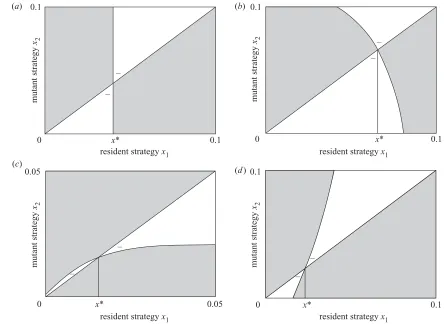
In the case of a linear trade-off (figure 1), the PIP shows that the singular strategyxis convergent stable but not an ESS (figure 2a). Furthermore, the singular strategy is evo-lutionarily attainable, in other words it can invade other strategies when initially rare. Once the singular strategy has been established, all mutations are neutral and although mutual invasibility near the strategy is possible, the branch-ing does not occur (Geritzet al.1998).
In the case of a concave trade-off (figure 1), the PIP shows that the singular strategy x is an ESS, is conver-gence stable and that a pathogen with the phenotypic strat-egyxcan invade nearby strategies when rare itself (figure 2b). Therefore, x is an evolutionary endpoint and is not
invadable by any other mutant strategies. In this case an initially monomorphic pathogen population will stay monomorphic, evolving until the transmission on host 1 reachesx. This outcome is illustrated in figure 3ausing
numerical simulations described in Gudeljet al.(2004).
In the case of a convex trade-off (figure 1), the PIP shows that two different evolutionary outcomes are possible. If, for small values of x, f00(x) is sufficiently large (steep
0 x*
0.1
0
mutant strategy
x2
mutant strategy
x2
mutant strategy
x2
0.05
0.05
x* 0.1
0.1
0 x* 0.1
0.1
0
mutant strategy
x2
x* 0.1
resident strategy x1 resident strategy x1
resident strategy x1 resident strategy x1
(a) (b)
(c)
(d) –
–
–
–
–
–
–
–
Figure 2. A PIP. The resident and mutant strategies are denoted byx1andx2, respectively. The shaded areas indicate the combinations ofx1andx2for which the fitness of the mutant,kx1(x2), is positive. The singular strategy is denoted byx
.
(a) Linear trade-off,f(x)¼0:1x; (b) concave trade-off,f(x)¼0:12(x0:1)=(x0:12); (c) steep convex trade-off,
f(x)¼ 0:000 04(x0:1)=(xþ0:000 04); and (d) shallow convex trade-off,f(x)¼ 0:04(x0:1)=(xþ0:04). Model parameters:r1¼1,r2¼1:5,l¼0:001 andC¼0:5.
evolutionary time
0 0.1 0 0.1 0 0.1
transmission rate on host 1
transmission rate on host 1
transmission rate on host 1
(a) (b) (c)
Figure 3. Simulations of the evolutionary dynamics of the transmission rate on host 1. (a) Concave trade-off,
f(x)¼0:12(x0:1)=(x0:12); (b) steep convex trade-off,
f(x)¼ 0:000 04(x0:1)=(xþ0:000 04); and (c) shallow convex trade-off,f(x)¼ 0:04(x0:1)=(xþ0:04). Model parameters:r1¼1,r2¼1,l¼0:001 andC¼0:1. 2190 I. Gudelj and others Pathogen evolution in heterogeneous plant populations
convex) the singular pointxis not an ESS, is not
conver-gence stable and therefore acts as an evolutionary repeller (figure 2c). Therefore, depending on the value of the initial resident phenotypic trait, the evolutionary outcome will be a monomorphic population of pathogens only infective to host 1 or only infective to host 2 (figure 3b).
However, if, for small small values ofx, f00(x) is suffi-ciently small (shallow convex), the singular pointxis not an ESS but is convergence stable, and in the vicinity ofxa dimorphism can occur: suchxis termed an evolutionary branching point (figure 2d). In this case an initially mono-morphic population will approach the singular point and will undergo disruptive selection, becoming dimorphic and comprising two closely related resident phenotypic traits (see numerical simulations in figure 3c). We can show ana-lytically (see Appendix A) that, through a series of small evolutionary steps, the two resident phenotypic traits will grow apart until they reach the boundary of the phenotypic domain X. On the boundary the two resident pathogen groups are completely host specialized, one infecting only host 1 and the other infecting only host 2. In this case we can also show (Appendix A) that if a dimorphic pathogen population consists of phenotypic traits that are completely host specialized, no mutant with non-zero transmission on both hosts is able to invade. The direction of evolution of each of the two residents is illustrated in figure 4. The sha-ded area represents a set of strategy pairs (x1,x2) that coexist in a protected dimorphism. Horizontal arrows rep-resent the evolutionary direction ofx1, while vertical arrows represent the evolutionary direction ofx2. The final resting point of the dimorphic population is at the boundary of the phenotypic space, with each resident becoming host spe-cialized and therefore present on only one host.
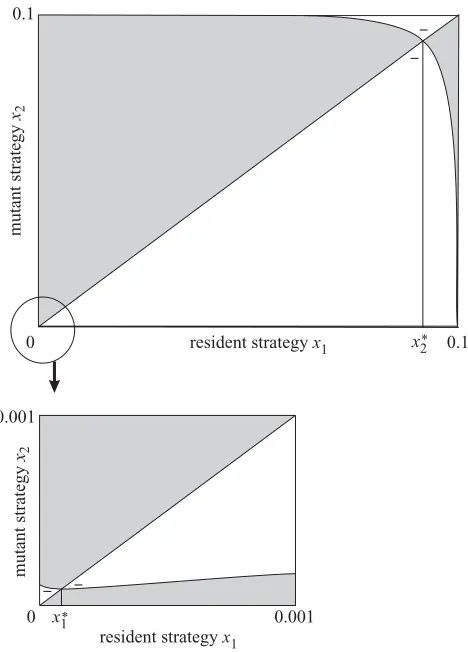
In the case of a sigmoidal (convex–concave) curve (see figure 1), the following two outcomes are possible. Iff00(x) is sufficiently small for smallx(shallow convex–concave), essentially the same results are found as with the concave function (figure 2b). However, iff00(x) is sufficiently large for smallx(steep convex–concave), the PIP shows that two
singular strategies, an evolutionary repeller,x1, and a con-tinuously stable strategy,x
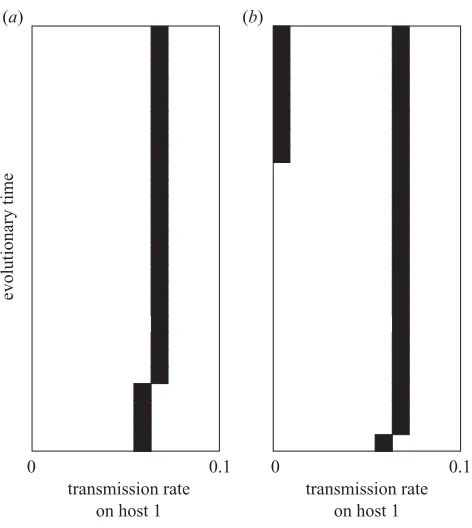
2, are present (figure 5). There-fore, depending on the value of the initial resident phenotypic trait, an initially monomorphic population will, through a series of small evolutionary steps, become either completely specialized on host 2 or infective to both hosts with transmission ratesx2andf(x2) on host 1 and host 2, respectively (see figure 6a for an illustration). Note that qualitatively similar results hold for sigmoidal (concave– convex) curves.
4. DISCUSSION
This paper considers the evolution of a pathogen popu-lation exposed to two different hosts and demonstrates that the outcomes strongly depend on the shape of the trade-off curve for the transmission rates on the different hosts. Evolutionary branching does not occur for linear, concave, steep convex and sigmoidal trade-off curves. In these cases, an initially monomorphic pathogen population remains monomorphic and its host range depends on the shape of the trade-off in the following ways. A generalist population occurs for both linear and concave trade-offs (see figure 2a,b). A steep convex trade-off leads to a specialist popu-lation (see figure 2c), whereas a sigmoidal trade-off leads to 0.1
x2
0 x*
x1 0.1
Figure 4. Evolution in a dimorphic population. The shaded area denotes sets of pairs (x1,x2), denoting pathogen transmission on host 1 and host 2, respectively, coexisting in a protected dimorphism. The singular strategy is denoted byx, while the model parameters are:r1¼1,r2¼1:5,l¼ 0:001 andC¼0:5.
0.1
mutant strategy
x2
mutant strategy
x2
0 resident strategy x1 x2* 0.1
0.001
0.001 0
resident strategy x1
x1*
– –
–
–
Figure 5. A PIP. The resident and mutant strategies are denoted byx1andx2, respectively. The shaded areas indicate the combinations ofx1andx2for which the fitness of the mutant,kx1(x2), is positive. The singular strategy is denoted
byxand the model parameters arer1¼1,r2¼1:5, l¼0:001 andC¼0:5. The trade-off curve is sigmoidal: for 06x60:04, f(x)¼0:0397þ0:1206104=(xþ0:0002)
and for 0:046x60:1,f(x)¼0:04045þ0:2758104 =
either a generalist or a specialist population, depending on the value of the initial phenotypic trait (see figure 5).
We also found that the evolutionary branching of a monomorphic into a dimorphic population occurs only for a shallow convex trade-off curve (see figure 2d). In this case, the evolutionary outcome is a pathogen population consisting of two groups, each of which is specialized on one of the hosts. Examples of such divergent groups can be found in theBlumeriagenus (Hiura 1978) whereB. grami-nis f.sp.hordeiis specialized on barley whereasB. graminis f.sp.triticiis specialized on wheat, and in thePhytophthora
genus whereP. medicaginisandP. trifoliiare specialized on chickpea and clover, respectively.
Owing to its importance in epidemics, the pathogen transmission was chosen as the evolving trait and a trade-off relationship between the transmissions on different hosts was imposed. Regoes et al. (2000) considered the evolution of pathogen virulence using the community dynamics approach, in which the authors found that the presence of a trade-off relationship between the virulence on different hosts was not sufficient for multiple strain coexistence, even though two different host types were present in the system. Coexistence was possible only when virulence was correlated with transmission, and we con-clude that transmission is crucial for the coexistence of multiple strains.
In this study the analysis rests on the use of the adaptive dynamics method. One shortcoming of this approach is that it assumes that mutations from clonal reproduction induce only small phenotypic changes (local mutations). This is somewhat simplistic because experimental studies demonstrate that the offspring of a plant pathogen can sometimes be phenotypically very different from its parent
(global mutations). However, the results of computer simulations (Gudeljet al.2004) show that the evolutionary outcomes do not qualitatively change when both global and local mutations are taken into account. Global mutations are expected to influence the outcome only in the sigmoidal (steep convex–concave) case where the following is antici-pated. Instead of a monomorphic generalist or a monomor-phic specialist population (see figure 5), a dimorphism of the two cases where a generalist and a specialist population coexist can be observed. This is possible because global mutations will eventually give rise to a phenotype that is situated on the opposite side of the repellerx1(figure 5) to the resident phenotype. For an illustration of this outcome see figure 6b. Examples of such pathogen groups can be found within the Botrytis genus (Holliday 1989) where
B. cinereais a generalist whereasB. fabaeis a specialist. It is important to note, however, that without the analytical advantages of the adaptive dynamics which clearly identify the importance of the trade-off shape, the computational study in Gudeljet al.(2004) lacks generality.
Classical evolutionary ecology (see Levins 1968) has also observed that convexity and concavity of trade-offs are important in determining the outcome of evolution. Con-trary to the adaptive dynamics, the classical approach does not include environmental feedback and is based on a rather simplified view of the evolutionary processes, which rests on the assumption that the result of evolution is to realize an optimum strategy, a quantity that is maximized during the course of evolution. For example, the outcome of pathogen evolution is often predicted by maximizing the basic reproductive ratio,R0, of that pathogen (Anderson & May 1982). Comparing the results presented in this paper with the predictions of the R0maximization we find that when the trade-off is concave, both approaches predict the evolution of a monomorphic generalist pathogen popu-lation. However, the differences arise when the trade-off is convex, and in this case theR0maximization predicts the evolution of a monomorphic specialist pathogen population specializing on the host with the highest value ofr. Contrary to this, the adaptive dynamics method indicates that the presence of a dimorphic pathogen population consisting of two specialized groups is also possible. Note that the out-comes of the adaptive dynamics and theR0maximization approaches are in complete agreement only whenr1¼r2.
There is an increasing number of theoretical studies indi-cating that trade-offs are an important component of those mechanisms that govern the evolution of not only pathogen but also host populations. While this paper demonstrates the importance of trade-offs in the evolution of pathogen populations, the results in Boots & Haraguchi (1999) and Bowers & Hodgkinson (2001) demonstrate similar trends in the evolution of host populations. Both Boots & Haraguchi (1999) and Bowers & Hodgkinson (2001) con-sidered the evolution of host resistance to microparasitic infection, assuming a trade-off between host resistance to a pathogen and host intrinsic growth rate.
Formulation and implementation of experiments which could determine the shape of a particular trade-off relation-ship is a complex process, and although there have been some attempts to measure various trade-off relationships in host–pathogen systems for invertebrate and vertebrate host species (Anderson & May 1982; Boots & Haraguchi 1999),
evolutionary time
0 0.1 0 0.1
transmission rate on host 1
transmission rate on host 1
(a) (b)
Figure 6. Simulations of the evolutionary dynamics of the transmission rate on host 1 for the sigmoidal trade-off
f ¼50(0:001(2x0:1)3). (a) Local mutations and (b) global mutations. Model parameters arer1¼1,r2¼1,
l¼0:001 andC¼0:1.
2192 I. Gudelj and others Pathogen evolution in heterogeneous plant populations
there has been very little attempt to estimate trade-off relationships within plant–pathogen systems.
Understanding infection mechanisms of a particular plant–pathogen system may help to infer the shape of a trade-off curve. For example, mechanisms that increase the patho-gen transmission on a particular host with very little initial cost but which become more costly as the pathogen trans-mission increases, would lead to progressive diminution of transmission costs (a concave trade-off ). These mechanisms could be associated with changes in plant–pathogen relation-ships that have additive gene action.
Similarly, mechanisms that increase the pathogen trans-mission on a particular host and are costly to produce, but, once produced, increase the transmission over a large range at little additional cost, would lead to progressive dimin-ution of transmission costs (a convex trade-off ). For example, such a mechanism could relate to the changes in plant–pathogen gene-for-gene relationships (Crute 1994).
Therefore recent advances in molecular techniques (Idnurm & Howlett 2001; Van’t Slot & Knogge 2002) could soon improve our understanding of biochemical pro-cesses that underline plant–pathogen trade-off relation-ships. In turn, this can aid the development of resistant crops that minimize evolutionary pressures on the patho-gen to adapt to the resistant cultivar, or to adapt through evolutionary branching (emergence of new resistant strains). In the long term, such advances will help the development of sustainable agricultural systems.
Rothamsted Research receives grant-aided support from the Biotechnology and Biological Sciences Research Council.
APPENDIX A
(a) Dimorphic populations
Suppose that an evolutionary branching near the singular point has occurred and that the pathogen population is in the new resident system
dH1
dt ¼r1lH1x1P1H1x2P2H1,
dH2
dt ¼r2lH2f(x1)P1H2f(x2)P2H2,
dPi
dt ¼xiPiH1þf(xi)PiH2CPi, (A 1)
with phenotypic characteristicsxi, wherei¼1, 2. Without loss of generality, we assume thatx1 < x2. The above sys-tem (A 1), has a non-trivial coexistence steady state (H1y,H2y,P1y,P2y), of the form
C(f(x2)f(x1))
f(x2)x1x2f(x1)
, C(x1x2)
f(x2)x1x2f(x1) ,P1y,P2y
: (A 2)
A mutant pathogen with the phenotypic characteristicx3is introduced in a small neighbourhood of the resident phenotypic traitsx1orx2, and its fitness is denoted by
kx1,x2(x3)¼x3H
y
1(x1,x2)þf(x3)H2y(x1,x2): (A 3) We distinguish between the following two cases. The first case assumes that the phenotypic characteristicx3, of the mutant pathogen is a small perturbation of the resident characteristicx1, whereas the second case assumes thatx3 is a small perturbation ofx2.
(i) Case I
The mutant’s phenotypic characteristic is of the form
x3¼x1^e, for some small e>0. In this case using the standard Taylor’s expansion, the mutant fitness, equation (A 3) becomes
kx1,x2(x1^e)¼^e(H
y
1þf0(x1)H
y
2),
for smalle.
(ii) Case II
The mutant’s phenotypic characteristic is of the form
x3 ¼x2^e, for some smalle>0. Again, using the stan-dard Taylor’s expansion, the mutant fitness, equation (A 3) becomes
kx1,x2(x2^e)¼^e(H
y
1þf
0(x2)Hy
2),
for smalle.
Therefore, fori¼1, 2,
H1yþf0(xi)H
y
2¼
C(f(x2)f(x1)þf0(xi)(x1x2))
f(x2)x1x2f(x1)
, (A 4)
and using the mean value theorem there exitsh2(x1,x2) such that
f(x2)f(x1)
x2x1
¼f0(h): (A 5)
Recalling our assumptions thatx1<x2 andf is monotone decreasing function ðf060), we can conclude that
f(x2)x1x2f(x1)<0: (A 6)
Becausef00>0, it follows thatf0is a monotone
increas-ing function, in other words becausex1<h<x2it follows that f0(x1)<f0(h)<f0(x2), which when combined with equation (A 5) gives
f0(x1)<f0(h)¼f(x2)f(x1)
x2x1
< f0(x2):
The above inequality together with equations (A 4) and (A 6) give
H1yþf0(x1)H2y<0<H
y
1þf
0(x2)Hy
2,
which is used to conclude that
kx1,x2(x1e)>0 andkx1,x2(x1þe)<0, (A 7) and similarly,
kx1,x2(x2e)<0 andkx1,x2(x2þe)>0: (A 8) (b) The case of host specialization
Consider the host specialized system where xmax>0 denotes the transmission rate of a pathogen completely specialized to host 1, whilef(0) denotes the transmission rate of a pathogen completely specialized to host 2. In this case the resident system equation (A 1), with x1¼xmax,
f(x1) ¼0, x2 ¼0, f(x2) ¼f(0), has a non-trivial locally stable steady state of the form (C=xmax,C=f(0),P1,P2). If a small mutant population that has a non-zero transmission rate on both hosts is introduced into the resident system, its fitness function will be
k(x)¼x C xmax
þf(x) C
f(0)C:
Because f00(x)<0, it follows thatf(x)<f(0)f(0)
REFERENCES
Anderson, R. M. & May, R. M. 1979 Population biology of infectious diseases: part I.Nature280, 361–367.
Anderson, R. M. & May, R. M. 1981 Population dynamics of microparasites and their invertebrate hosts.Phil. Trans. R. Soc. Lond.B291, 451–524.
Anderson, R. M. & May, R. M. 1982 Coevolution of hosts and parasites.Parasitology85, 411–426.
Bonhoeffer, S. & Nowak, M. A. 1994 Mutation and the evol-ution of virulence.Proc. R. Soc. Lond.B258, 133–140. Boots, M. & Haraguchi, Y. 1999 The evolution of costly
resistance in host–parasite systems.Am. Nat.153, 359–370. Bowers, R. G. & Hodgkinson, D. E. 2001 Community dynam-ics, trade-offs, invasion criteria and the evolution of host resistance to microparasites.J. Theor. Biol.212, 315–331. Brasier, C. M. 1987 The dynamics of fungal speciation. In
Evol-utionary biology of the fungi(ed. A. D. M. Rayner, C. M. Brasier & D. Moore), pp. 231–260. Cambridge University Press. Campbell, C. L. & Madden, L. V. 1990Introduction to plant
disease epidemiology. New York: Wiley.
Crute, I. R. 1994 Gene-for-gene recognition in plant–pathogen interactions.Phil. Trans. R. Soc. Lond.B346, 345–349.
Dieckmann, U. 1997 Can adaptive dynamics invade?Trends
Ecol. Evol.12, 128–130.
Dieckmann, U. 2002 Adaptive dynamics of pathogen–host interactions. In Adaptive dynamics of infectious diseases: in pursuit of virulence management(ed. U. Dieckmann, J. A. J. Metz, M. W. Sabelis & K. Sigmund), pp. 39–59. Cam-bridge University Press.
Doebeli, M. & Dieckmann, U. 2000 Evolutionary branching and sympatric speciation caused by different types of eco-logical mechanisms.Am. Nat.156(Suppl.), S77–S101. Frank, S. A. 1993 Evolution of host–parasite diversity.
Evolution47, 1721–1732.
Geritz, S. H. A., Kisdi, E., Meszena, G. & Metz, J. A. J. 1998 Evolutionary singular strategies and the adaptve
growth and branching of the evolutionary tree. Evol.
Ecol. 12, 35–57.
Gilligan, C. A., Gubbins, S. & Simons, S. A. 1997 Analysis and fitting of an SIR model with host response to infection load for a plant disease.Phil. Trans. R. Soc. Lond.B352, 353–364. (doi:10.1098/rstb.1997.0026)
Gubbins, S. & Gilligan, C. A. 1997 Biological control in a dis-turbed environment.Phil. Trans. R. Soc. Lond.B352, 1935– 1949. (doi:10.1098/rstb.1997.0180)
Gudelj, I., Van den Bosch, F. & Fitt, B. D. L. 2004 Evolution of sibling fungal plant pathogens in relation to host specialis-ation.Phytopathology94, 789–795.
Gupta, S. & Hill, A. V. S. 1995 Dynamic interactions in malaria: host heterogeneity meets parasite polymorphism.
Proc. R. Soc. Lond.B261, 271–277.
Hiura, U. 1978 Genetic basis of formae speciales inErysiphe graminisDC. InThe powdery mildews(ed. D. M. Spencer), pp. 101–128. London: Academic.
Holliday, P. 1989A dictionary of plant pathology. Cambridge University Press.
Idnurm, A. & Howlett, B. J. 2001 Pathogenicity genes of phy-topathogenic fungi.Mol. Pl. Pathol.2, 241–255.
Leonard, K. J. 1977 Selection pressures and plant pathogens. Pathogenicity genes of phytopathogenic fungi.Ann. N. Y. Acad. Sci.287, 207–222.
Leonard, K. J. 1997 Modelling gene frequency dynamics. In
The gene-for-gene relationship in plant parasite interactions(ed. I. R. Crute, E. B. Holub & J. J. Burdon), pp. 211–230. Wall-ingford UK: Centre for Agriculture and Biosciences Inter-national.
Levins, R. 1968Evolution in changing environments. Princeton University Press.
Metz, J. A. J., Geritz, S. H. A., Meszena, G., Jacobs, F. J. A. & Van Heerwaarden, J. S. 1996 Adaptive dynamics: a geo-metrical study of the consequences of nearly faithful repro-duction. In Stochastic and spatial structures of dynamical systems (ed. S. J. van Strien & S. M. Verduyn Lunel), pp. 183–231. Amsterdam: North-Holland.
Nowak, M. A. & Sigmund, K. 2004 Evolutionary dynamics of biological games.Science303, 793–799.
Rand, D. A., Wilson, H. B. & McGlade, J. M. 1994 Dynamics and evolutionarily stable attractors, invasion exponents and phenotypic dynamics.Phil. Trans. R. Soc. Lond.B343, 261– 283.
Regoes, R. R., Nowak, M. A. & Bonhoeffer, S. 2000 Evolution of virulence in a heterogeneous host population. Evolution 54, 64–71.
Roughgarden, J. 1983 The theory of coevolution. In Coevolu-tion(ed. D. J. Futuyma & M. Slatkin), pp. 33–64. Sunder-land, MA: Sinauer.
Van den Bosch, F., Frinking, H. D., Metz, J. A. J. & Zadoks, J. C. 1988 Focus expansion in plant disease. III. Two experimental examples.Phytopathology78, 919–925. Van’t Slot, K. A. E. & Knogge, W. 2002 A dual role for
microbial pathogen-driven effector proteins in plant disease and resistance.Crit. Rev. Pl. Sci.21, 229–271.
As this paper exceeds the maximum length normally permitted, the authors have agreed to contribute to production costs.
2194 I. Gudelj and others Pathogen evolution in heterogeneous plant populations