University of New Orleans University of New Orleans
ScholarWorks@UNO
ScholarWorks@UNO
University of New Orleans Theses and
Dissertations Dissertations and Theses
5-20-2005
Array Processing Techniques for Broadband Acoustic
Array Processing Techniques for Broadband Acoustic
Beamforming
Beamforming
Ryan Thiel
University of New Orleans
Follow this and additional works at: https://scholarworks.uno.edu/td
Recommended Citation Recommended Citation
Thiel, Ryan, "Array Processing Techniques for Broadband Acoustic Beamforming" (2005). University of New Orleans Theses and Dissertations. 251.
https://scholarworks.uno.edu/td/251
ARRAY PROCESSING TECHNIQUES FOR BROADBAND ACOUSTIC BEAMFORMING
A Thesis
Submitted to the Graduate Faculty of the University of New Orleans
in partial fulfillment of the requirements for the degree of
Master of Science in
The Department of Electrical Engineering
by
Ryan D. Thiel
ACKNOWLEDGEMENTS
I would like to thank Kenny Lannes, my thesis advisor, who provided the
ideas and motivation which started the thesis. His dedication made this work
possible. I would also like to thank Dr. Dimitrios Charalampidis and Dr. Vesselin
Jilkov for serving on my thesis committee.
Sincere appreciation goes to my parents Stephen and Vicki Thiel for
providing support and motivation throughout my education. I would also like to
thank Christopher Duggan, a fellow electrical engineer and good friend, who
carefully proofread this document many times throughout its development.
Finally, very special thanks goes to my fiancé Katherine Green for her love,
TABLE OF CONTENTS
LIST OF FIGURES ... iv
ABSTRACT... v
CHAPTER 1. Introduction... 1
2. Overview of Beamforming ... 3
2.1 Narrowband Beamforming ... 3
2.2 Broadband Beamforming... 6
3. Techniques ... 9
3.1 Frequency Up-Conversion... 9
3.1.1 Description... 9
3.1.2 Analysis ... 10
3.1.3 Results... 12
3.2 Decimation... 13
3.2.1 Description... 13
3.2.2 Analysis ... 14
3.3 Group Delay Discrimination... 17
3.3.1 Description... 17
3.3.2 Analysis ... 19
3.3.3 Implementation ... 22
3.3.4 Results... 24
4. Conclusions... 34
REFERENCES ... 36
APPENDIX... 37
LIST OF FIGURES
2.1 Typical Narrowband Array Beamformer ... 4
2.2 Two Element Narrowband Array and Beamformer ... 5
2.3 Two Element Narrowband Array Directivity Patterns... 5
2.4 Variation of Directivity Pattern Over a Large Bandwidth ... 6
2.5 Typical Broadband Beamformer ... 8
3.1 Frequency Up-Conversion Technique... 11
3.2 Single Side-Band Frequency Up-Conversion Technique... 12
3.3 Decimation in Time ... 14
3.4 Decimation With and Without a Reference Point ... 16
3.5 Group Delay Discrimination Process ... 19
3.6 Frequency Content of Group Delay Algorithm Test Signals ... 30
3.7 Test 4 Input and Output Comparison... 32
ABSTRACT
Audio acquisition and recording can benefit from directional reception of the
acoustic signals. Current acoustic designs of highly-directional microphones are
bandwidth limited and physically large. A microphone array used in conjunction
with a beamforming algorithm can acquire and spatially filter the signal, but
traditionally this has suffered from limitations similar to those of the purely
acoustic designs. The work presented in this paper attempts to overcome these
limitations by producing and analyzing three atypical techniques for broadband
beamforming. The last and most successful technique employs an algorithm
which calculates the difference in group delay of the acquired signals and uses that
information to determine the direction of the incoming signals as a function of
CHAPTER 1
INTRODUCTION
In film production, theater, news coverage, sports broadcasting, and nature
recording, audio must be recorded from a desired source without interference from
other audio sources. Placing a microphone close to the desired source is the
simplest way to reduce background interference but is often impractical. Common
solutions require directional microphones. Directional microphones have pickup
patterns which favor on-axis and reject off-axis acoustic energy. A wide
assortment of microphone pickup patterns is available ranging from
omni-directional to cardioid to super-cardioid to hyper-cardioid. In order to achieve the
more extreme pickup patterns, many expensive tradeoffs with other areas of
microphone performance, such as bandwidth, are made, so highly-directional
microphone performance leaves much to be desired.
A highly-directional microphone placed far from the source can pick up the
desired signal while reducing background interference, but highly-directional
microphones of the current generation have many shortcomings. The most
commonly used highly-directional microphones rely on either parabolic reflectors
or acoustical tubes (shotgun microphones) developed in the 1920s and 1930s to
focus on-axis or reject off-axis acoustic energy [1]. Attempts to move the sound
techniques. Using a microphone array has many advantages over an acoustic
approach but, with current array processing methods, array techniques suffer from
many of the same tradeoffs as the acoustic methods. Coloration of the sound, poor
low frequency rejection, inconsistent pickup pattern over bandwidth, and large
physical size are the drawbacks of these schemes. These drawbacks provide
motivation for the search for new techniques of acquiring audio data directionally.
Due to the wide availability of low-cost, high performance digital signal
processors and the versatile nature of beamforming, array processing seems the
best avenue to explore. Because the current beamforming methods available
suffer from some of the same drawbacks as the conventional methods for
highly-directional miking, new beamforming signal processing techniques are needed.
The new beamforming techniques should allow for a small array to process a large
bandwidth and provide a consistent narrow beamform over the bandwidth.
This thesis documents a search for these new techniques. An overview of
beamforming is presented in Chapter 2, and analyses of three attempts at new
beamforming techniques are presented in Chapter 3. These include Frequency
Up-Conversion (3.1), Non-Linear Decimation (3.2), and Group Delay
Discrimination (3.3). Chapter 4 concludes with a discussion of the effectiveness
CHAPTER 2
BEAMFORMING BACKGROUND
Beamforming is a method of processing data from an array of transducers
to achieve spatial filtering. The spatial filtering is used to acquire signals from a
particular direction while reducing interference from another. Beamforming can
be applied to either receiving or transmitting arrays and has applications in radar,
sonar, communications, imaging, geophysics, astrophysics, medicine, and more
[2]. The discussion here is limited to beamforming as it applies to receiving
arrays.
2.1 Narrowband Beamforming
Narrowband beamforming is used when the wanted signal occupies a
known narrow bandwidth. Any interference outside of that bandwidth can be
reduced with a temporal (as opposed to spatial) filter. If interference is expected
to occupy the same bandwidth but come from a different direction than the desired
signal, a beamformer can be useful. Signals from a spatial array of sensors can be
combined in such a way to enhance the signal coming from one direction and
reduce signal from another. The combination of the signals, for the narrowband
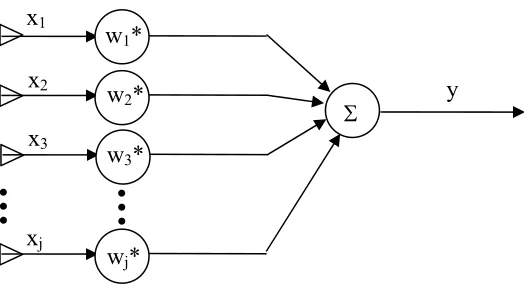
case, is usually a sum of weighted, phase shifted signals [3]. Differences in the
weights are usually complex numbers and represent both changes in phase and
magnitude. A typical narrowband array beamformer is shown in Figure 2.1.
Figure 2.1. Typical Narrowband Array Beamformer
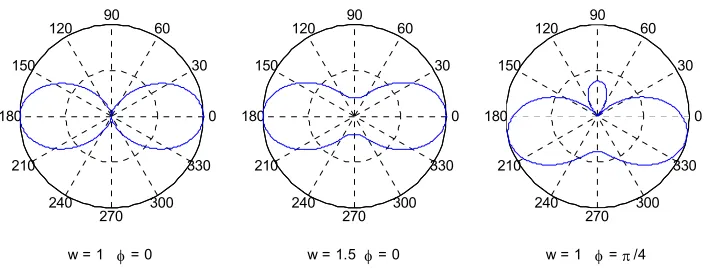
The simple two element array shown in Figure 2.2 has sensor spacing l
and, on one sensor leg, has a real gain w and phase change φ. Figure 2.3 illustrates
how the directivity pattern of the array described in Figure 2.2 is altered by
changes in the gain w and phase φ. The source used in the example has a
wavelength λ which is twice the element spacing (λ =2l).
Σ
x1
w1*
x2 w y
2*
x3
w3*
xj
30
210
60
240 90
270 120
300 150
330
180 0
w = 1 φ = 0
30
210
60
240 90
270 120
300 150
330
180 0
w = 1.5 φ = 0
30
210
60
240 90
270 120
300 150
330
180 0
w = 1 φ = π /4 Figure 2.2. Two Element Narrowband Array and Simple Beamformer
Figure 2.3. Two Element Narrowband Array Directivity Patterns
Narrowband beamformers can have many elements in any geometrical
pattern. The gains of typical narrowband beamformers can be chosen to produce a
wide array of beamforms. The gains can also be updated by adaptive means.
Σ θ
source
l output
2.2 Broadband Beamforming
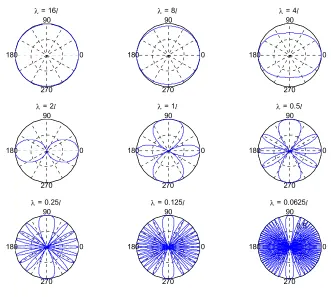
If the narrowband beamformer in Figure 2.2, with w = 1 and φ = 0, is
subject to signals over a large bandwidth the beamform will change considerably.
Figure 2.4 shows the directivity pattern changing drastically over a large
frequency range, with wavelengths from 16 to 1/16 times the distance between the
elements, in one octave steps. This range encompasses 9 octaves which is close to
the bandwidth of audio. The resulting beamforms range from nearly
omnidirectional to having 64 distinct lobes.
90
270
180 0
λ = 16l
90
270
180 0
λ = 8l
90
270
180 0
λ = 4l
90
270
180 0
λ = 2l
90
270
180 0
λ = 1l
90
270
180 0
λ = 0.5l
90
270
180 0
λ = 0.25l
90
270
180 0
λ = 0.125l
0.5 90
270
180 0
λ = 0.0625l
For broadband applications the desired directivity patterns remain the same
over the bandwidth, so systems of the general form shown in Figure 2.1 are no
longer useful. Past techniques used to help extend the bandwidth and improve the
beamforming performance of an array include weighting patterns fashioned after
binomial and chebeychev arithmetic schemes[4] and a method of synthesizing
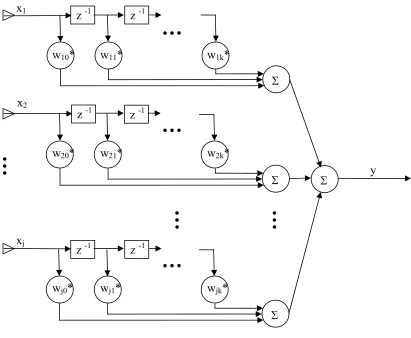
impulse functions[5]. A typical broadband beamformer of these types, shown in
Figure 2.5, uses a finite impulse response (FIR) filter on each sensor leg before the
summation. This provides the ability to change the gain and phase of the signals
differently for different frequencies. Like the narrowband case, the gains can be
fixed or adaptive. To accommodate the large audio bandwidth (approximately 10
octaves) the element spacing in the array must range from very small (at 20 kHz
where wavelength λ = 17 mm) to very large (at 20 Hz where λ = 17 m), so an
array would have to be very large and contain many elements to use this
technique. This large array size is impractical in may applications, so a search for
a new technique that will allow smaller array sizes (measured in physical
Figure 2.5. Typical Broadband Beamformer
Σ
x1
w20*
w10*
x2
xj
w11* w1k*
w21* w2k*
wj0*
z -1 z -1
wj1* wjk*
z -1
z -1 z -1
z -1
Σ
Σ
Σ
CHAPTER 3
TECHNIQUES
The initial purpose of this thesis was to develop a broadband array
processing technique for audio based on frequency up-conversion by mixing. This
technique is the first discussed in this chapter. The frequency up-conversion
technique did not produce the desired results so other techniques were developed
and studied. The final technique, based on group-delay discrimination, produced
exciting, useful results. This chapter describes each technique and its results.
3.1 Frequency Up-Conversion
3.1.1 Description
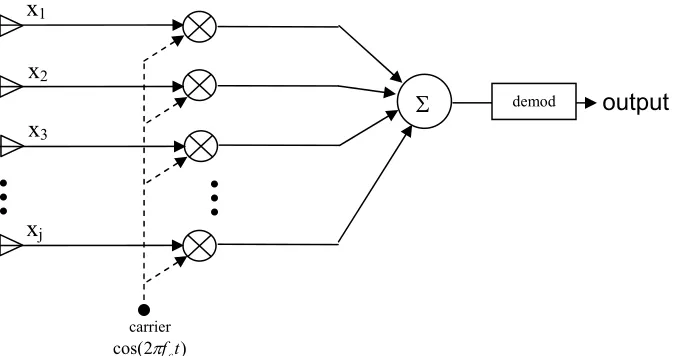
By mixing a base-band audio signal with a carrier signal much higher in
frequency, the bandwidth, in octaves, of the resulting spectrum is greatly reduced.
For example, a signal with frequency content from 20 Hz to 20 kHz,
approximately 10 octaves, is mixed with a carrier of 100 kHz. The resulting
spectrum is only 0.263 octaves wide (single sided), which appears to reduce the
effective variation in wavelength and thus decrease the effective spatial variation
of the signal being acquired. Can this be used to simplify the beamforming
problem by effectively reducing the bandwidth and possibly reducing the required
in the array by the same carrier before summation and demodulates after the
summation. Filtering the lower side-band created by the modulation and using a
chirp instead of a sinusoidal carrier are also considered.
3.1.2 Analysis
For an array of N elements letx
( )
t be the source signal, so x(
t−τn)
is thesignal received by array element n. For the simple case where the received signals
are only summed, the resulting output . If, before the summation,
the signal received at each element is mixed with a carrier
( )
∑
(
)
= − = N n n t x t y 1 τ ) 2cos( πfct , the output is
. Because of the distributive property of multiplication, the
output of the summation simplifies to . Substituting
yields
(
[
∑
= − N n n ct x t f1
) 2
cos( π τ
)
]
)
(
∑
= − N n n ct x t f1 ) 2
cos( π τ
( )
∑
(
)
= − = N n n t x t y 1τ cos(2πfct)y(t). Assuming an ideal demodulator the
output of the system is , the same output obtained for the simple case where
the received signals are only summed. This system is illustrated in figure 3.1.
( )
tFigure 3.1. Frequency Up-Conversion Technique
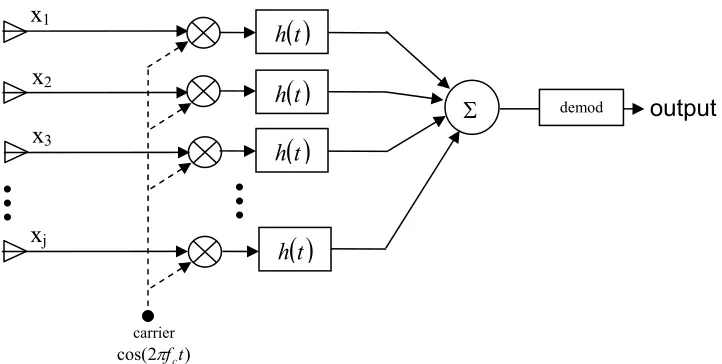
An attempt to make this scheme functional by further narrowing the
signal’s bandwidth was made using single side-band rather than the original dual
side-band modulation. Removing the lower side-band of each array element
signal after modulation with a filter described by impulse function yields
output e convolution, like multiplication, is
distributive the output similarly simplifies to .
Substituting , yields
( )
t h(
)
(
)
[
∑
= ∗ − N n n ct x t ht f1
) 2
cos( π τ
( )
]
and becaus( )
(
)
⎥ ⎦ ⎤ ⎢ ⎣ ⎡ − ∗∑
= N n n ct x t f t h 1 ) 2cos( π τ
( )
∑
(
)
= − = N n n t x t y 1τ h
( )
t ∗[
cos(2πfct)y( )
t]
. Again, assuming anideal demodulator, the output of the system is y
( )
t , the same output obtained forthe simple case where the received signals are only summed. This single
side-band system is illustrated in figure 3.2.
Figure 3.2. Single Side-Band Frequency Up-Conversion Technique
A third attempt was made by modulating the signals with a chirp instead of
the sinusoidal carrier. The chirp technique suffers from the same problems as the
other frequency up-conversion techniques, and is therefore not discussed in further
detail.
3.1.3 Results
The resulting outputs of the modulated systems, when demodulated, are
nothing but the output obtained by simply summing the signals from the array
elements. This is due to the linear phase error characteristics of the mixing
process. For example, a 2 degree phase difference between elements at 100Hz,
still results in only a 2 degree phase shift at 100.1KHz after up-conversion. The
hope was that low frequencies in the band which did not create enough phase shift
Σ
x1
x2
x3
xj
output
demod
( )
t h( )
t h( )
t h( )
t hcarrier
between receiving elements due to the long wavelengths, would experience a
larger phase shift after up-conversion. This was not the case.
3.2 Non-Linear Decimation
3.2.1 Description
The non-linear decimation approach is centered on the concept of reducing
the effective wavelength of a signal by removing samples in the time domain
sequence. This is predicated first by the assumption that the signal is oversampled
such that after decimation, the bandwidth is still usable. This approach is
described in continuous time by the time scaling property of the Fourier transform
⎟ ⎠ ⎞ ⎜ ⎝ ⎛ ⇒
a f X a at
x( ) 1
where a is a real nonzero constant. If oversampling is not achieved, the problem
becomes more than just a scaling operation and there can be a loss of information
through aliasing.
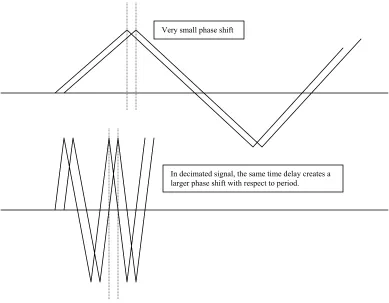
Given there is a constant time delay for a given angle between receiving
elements, that time delay will manifest itself as a phase difference. However, due
to the geometry of the elements, that phase difference can be negligible at very
long wavelengths. By keeping the delay the same but decimating the time
In decimated signal, the same time delay creates a larger phase shift with respect to period. Very small phase shift
Figure 3.3 Decimation in Time
However, in order to accomplish this, there are three critical issues that are
“showstoppers” for using this technique.
3.2.2 Analysis
First, there is no reduced scaling of the bandwidth with respect to octaves
traversed. Section 3.1 shows how an up-conversion process could effectively
reduce the relative octaves in the signal from 10 octaves to 0.263 octaves and still
maintain a 20 Khz bandwidth. When linearly decimating the signal, the frequency
reduction in octaves and there will be no improvement of the spatial variation of
the array vs. frequency. This is best seen with a simple example using a square
wave. A 100 Hz square wave with 50% duty cycle will have the following
harmonics present: 100Hz, 300 Hz, 500Hz, 700Hz, 900Hz, etc. If the signal is
sufficiently oversampled, and the samples are reduced by a factor of 10, the period
is now 1/10 of what it was. The result is a square wave with a fundamental
frequency of 1 KHz which contains harmonics equal to 3 KHz, 5 KHz, 7 KHz, 9
KHz, etc. The bandwidth has shifted up in frequency by a factor of 10, and more
importantly, the bandwidth occupies over 3 octaves in both signals. There is no
change.
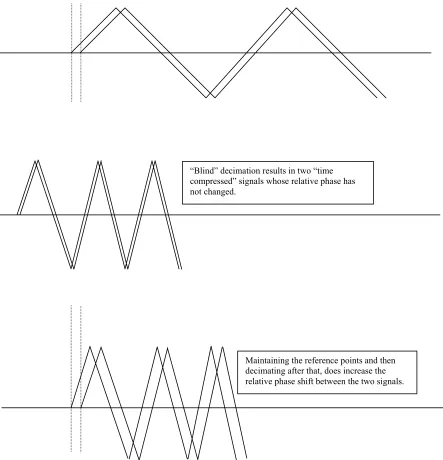
Secondly, in order to use decimation to effectively increase the phase
difference at long wavelengths, a non-linear process must be implemented.
Blindly decimating both receiver signals does not increase the phase shift between
the two receivers. Instead, a threshold must be set to mark the original position in
time of the two signals and this position must be maintained. Without “moving”
the signals from their original positions, the signals are then decimated from the
“Blind” decimation results in two “time compressed” signals whose relative phase has not changed.
Maintaining the reference points and then decimating after that, does increase the relative phase shift between the two signals.
Lastly, this technique only considers one incoming signal. If more than one
spatially separated, simultaneous signal is present, the algorithm breaks down.
Because the reference marking algorithm would have to be based on received
signal amplitude and the superposition of more than one signal causes amplitude
distortion, reference marking would be unreliable. Hence, the implementation of
this in a working environment such as the theater becomes unrealistic. It will be
found to be much easier to differentiate simultaneous signals by their magnitude
and phase responses in the frequency domain.
3.3 Group Delay Discrimination
3.3.1 Description
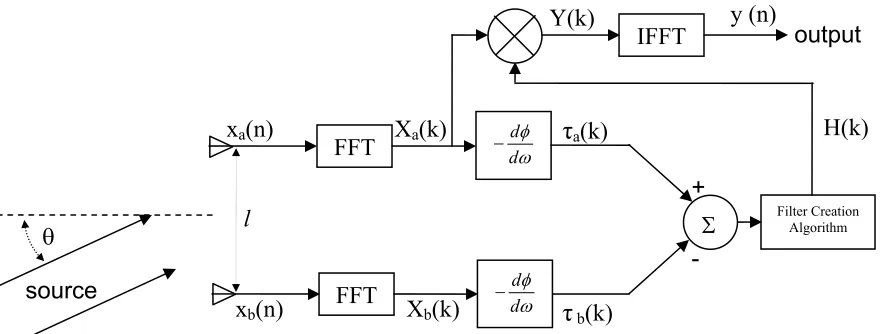
This technique uses the difference in group delay of the signals from two
array elements to produce a temporal filter which masks frequencies contained in
any off-axis interference. The filter is then applied to the signal from one element
to produce the output. The filter is determined by first finding the Fourier
transforms of the signals from the two array elements and expressing the
transforms as a magnitude and a phase. Because the processing will be performed
digitally, the discrete Fourier transform (DFT) is considered here. The forward
DFT is given by
( )
∑
−( )
=
− = 1
0
2
N
n
N kn j e n x k
X
π
and the inverse by
( )
∑
−( )
= = 1
0
2 1 N
k
N kn j e k X N n x
π .
from the phase of the transforms through differentiation with respect to angular
frequency. Group delay is usually defined as the negative derivative of phase with
respect to angular frequency ω φ
d d
− where φ =∠X
( )
ω [6]. The technique describedin this chapter does not require that the group delay be the negative derivative, so
group delay can be redefined here as
ω φ ω τ
d d
=
)
( . Because the system is discrete,
an approximation of the derivative must be used. Once the group delays for the
signals at each element are calculated, their difference is determined and used to
define the filter’s transfer function (determining the filter’s transfer function is
discussed in the next section). Applying the filter to the signal from either array
element masks the frequency content not arriving on axis. The process is outlined
in figure 3.5 and the algorithm is discussed in detail in section 3.3.2.
A technique is used in radar applications where a number of return signals
are processed by two or more antenna elements, and “tagged” or characterized by
their phase (incident angle) and frequency. Then an algorithm can decide which
signals to prioritize and which signals to throw out if any. The similarities have to
do with having the ability to determine from what direction signals of different
Figure 3.5. Group Delay Discrimination Process
3.3.2 Analysis
For a signal arriving at a two element array, the time delay between
elements is a function of the incident angle θ and is described by the equation
c l θ
τ = sin , where c is the propagation speed. The phase difference between the
two elements is a function of the angle of propagation and frequency of the signal
and is described by the equation
c l
f θ
π
φ = 2 sin . Taking the derivative of φ with
respect to angular frequencyω =2π f gives θ τ ω φ = = c l d d sin
, the time delay shown
above. This is the group delay of the signal, and can be used to determine the
incident angle of a received signal. If more than one signal from different
directions are present, the group delay, because it is a function of frequency, can
show the direction from which the signals are coming if the frequency content of
Σ θ source output l FFT FFT xa(n)
xb(n)
Xa(k)
Xb(k)
ω φ d d − + - τa(k)
τb(k)
Filter Creation Algorithm
H(k) IFFT
Y(k) y (n)
ω φ
d d
There are three instances where cyclic phenomenon must be considered.
The first is where there can be more than half of one complete wavelength of a
waveform within the spacing of the array elements. The difference in phase of the
waveforms at the elements is cyclic. Consider two sinusoids of the same
frequency with different phase. If the phase difference between the two signals is
smaller than π, no problem is encountered. Because the interest here is in the
absolute phase difference between the signals and a leading or lagging relationship
cannot be discerned, differences of π or more may cause problems. For example,
a phase difference of 1.5π can be said to be separated by 1.5π or 0.5π. This can
cause interference to masquerade as a desired signal. This problem is remedied by
spacing the array elements a distance smaller than half of the smallest wavelength
in the band. Placing the array elements (remember there are only two) extremely
close together may limit the ability of the beamformer to notice a phase difference
in signals with large wavelengths. This can be overcome by using more than two
elements and letting the closely spaced elements handle the small wavelengths and
the distantly spaced elements handle the large wavelengths.
The second cyclic problem also has to do with the phase of the incoming
signals before the difference. This is when the phase values of a signal (not the
difference in phase) wrap around as frequency increases. For instance, if the
phase values of a signal at adjacent frequency samples are 0.2π apart with values
in Matlab. The unwrap function removes the phase discontinuities by adding or
subtracting appropriate multiples of 2π. For example the sequence
[
0.8π 0.9π −π −0.9π]
unwraps to[
0.8π 0.9π π 1.1π]
.The third instance of possible problem causing cyclic phenomenon has to
do with the recursive nature of the DFT and the length of the signal being
processed. As far as the DFT is concerned, signals in both domains repeat
indefinitely in both directions. For instance, the time-domain sequence of four
samples
[
( )
1 0 0 0]
is actually[
L 1 0 0 0( )
1 0 0 0 1 0 0 0 L]
,so when comparing two signals it may not be clear what the time delay between
them is. For example, the two sequences
( )
( )
⎥ ⎦ ⎤ ⎢ ⎣ ⎡ L L L L 1 0 0 0 1 0 0 0 0 0 0 1 0 0 0 1 1 0 0 0 0 0 0 1are cyclic. The impulses could be said to be separated by one or three samples,
depending on which sequence is used as the reference. This type of ambiguity can
be remedied by padding sequences of N samples with N zeros or assuring that
delays of more than half of the sequence length are not possible. Zero padding the
two sequences above gives the following:
⎥ ⎦ ⎤ ⎢ ⎣ ⎡ L L L L 0 0 0 0 0 0 0 0 0 0 0 0 0 0 0 0 1 0 0 0 ) ( 1 0 0 0 0 0 0 1 ) ( 0 0 0 1 0 0 0 0 0 0 0 0 1 0 0 0 0 0 0 1
The zero padding ensures that the minimum distance between impulses is the
3.3.3 Implementation
In the first step of the algorithm, the received time domain signals are zero
padded if necessary (i.e. if delays of more than half of the sequence length are
possible). Then the Fourier transforms,Xa
( )
k and Xb( )
k , of the (possibly zeropadded) signals at the elements, xa
( )
n and xb( )
n , are calculated by using the fastFourier transform (FFT). From the results Xa
( )
k and Xb( )
k , the phases, ∠Xa( )
kand , are determined. Next the group delay is to be calculated. The
approximate derivative can then be calculated. (In the actual implementation, the
difference in phase is calculated, and the group delay calculation is performed on
this difference; mathematically the processes are the same, but performing only
one approximate derivative makes the process more efficient.) The approximate
derivative used in the calculation is simply the difference between adjacent points
which leaves a vector with one less sample than the input. This is because the
values of the approximate derivative actually fall between the discrete frequency
samples of the signal. This presents a problem when doing further calculations,
but the difference between the first and last points of the phase can be substituted
for the “missing” sample. Placing this “extra” sample before or after the N-1
difference will dictate whether the approximate derivative is a forward or
backward difference. Either can be used. The group delay difference is then fed
into the filter creation algorithm.
( )
kXb
The filter creation algorithm uses the group delay difference to determine
what frequencies are wanted and which are not. A filter, H(k), is created to
remove those frequencies which are not wanted. Where the group delay
difference is zero, the signal is arriving at the two elements at the same time,
which indicates that the signal is arriving on axis (perpendicular to the line defined
by the two array elements). The on axis signals are wanted; all others are not. For
the calculated group delay difference, a function of frequency is created to be
unity when the group delay difference is close to zero (wanted signal) and zero
otherwise (unwanted signal), and the function is used as the filter.
max max
) ( 0
) ( 1
) (
τ τ
τ τ
> ≤ =
f for
f for f
H
The parameter τmaxis calculated with the formula
c l max
max
sinθ
τ = based on the
desired maximum angle of the beamformθmax. The directivity pattern will ideally
be one between −θmax and θmax and zero otherwise. The filter creation algorithm
described is certainly not the only method that can be used. Any function of the
group delay difference may be used to produce other beamforms.
The filter is then applied to the signal from one of the elements. Because
the filter is described by its transfer function and the Fourier transform of the
incoming signal has been determined, the filter is implemented my multiplication
performed and the result is truncated (because of the zero padding in the first step)
yielding the output of the system y(n).
This technique can be implemented in near real time if small adjacent time
frames are processed serially. The number of samples should be large enough to
have adequate resolution in the frequency domain.
3.3.4 Results
The algorithm was implemented in MATLAB and first tested with the
following parameters:
Sampling Frequency fs= 8 Hz
Number of Samples N = 4 Element Spacing l = 1
Maximum Incident Angle 10.8o
max = θ Propagation Speed c = 1
One incoming signal is considered; it is a discrete impulse .
Four incident angles
( )
[
1 0 0 0]
θ are considered which are , , , and
. The angles are chosen to create delays of 0, 1, 2, and 3 samples
respectively. The maximum incident angle corresponds to a time
delay which falls between 2 and 3 samples. Therefore, the incident angles
and should return the signal and the incident angles
and should reject the signal. For each of the four incident angles
o
0
=
θ θ =7.18o θ =14.477o
o
024 . 22
=
θ
o
8 . 10 max = θ
o
0
=
θ θ =7.18o θ =14.477o
o
024 . 22
=
θ θ, a
step by step walkthrough of the algorithm is shown.
Incoming signal x =
[
( )
1 0 0 0]
Incident Angles θ =0o,θ =7.18o,θ =14.477o, and θ =22.024o
For incident angleθ =0o.
The signals at the elements are
( )
[
1 0 0 0]
= a x
( )
[
1 0 0 0]
= b x Padding with N zeros
( )
[
1 0 0 0 0 0 0 0]
= ap x
( )
[
1 0 0 0 0 0 0 0]
= bp x
Performing the FFT
( )
[
1 1 1 1 1 1 1 1]
= ap X
( )
[
1 1 1 1 1 1 1 1]
= bp X
Calculating phase and the phase difference
( )
[
0 0 0 0 0 0 0 0]
= ∠Xap
( )
[
0 0 0 0 0 0 0 0]
= ∠Xbp
( )
[
0 0 0 0 0 0 0 0]
= ∠ − ∠Xap Xbp
Calculating the group delay difference
τ =
[
0 0 0 0 0 0 0 0]
Creating the filter
[
1 1 1 1 1 1 1 1]
= H
Implementing the filter
( )
[
1 1 1 1 1 1 1 1]
= = × p ap H Y X
Performing the IFFT
( )
[
1 0 0 0 0 0 0 0]
= p y
Removing the extra N samples yields the desired result.
( )
[
1 0 0 0]
For incident angle θ =7.18o.
The signals at the elements are
( )
[
1 0 0 0]
= a x
( )
[
0 1 0 0]
= b x
Padding with N zeros
( )
[
1 0 0 0 0 0 0 0]
= ap x
( )
[
0 1 0 0 0 0 0 0]
= bp x
Performing the FFT
( )
[
1 1 1 1 1 1 1 1]
= ap X
( ) (
)
(
)
(
)
(
)
⎥ ⎦ ⎤ ⎢ ⎣ ⎡ − − − − − − + + = 2 1 1 1 2 1 1 1 2 1 1 1 2 1 11 j j j j j j
Xbp
Calculating phase and the phase difference
( )
[
0 0 0 0 0 0 0 0]
= ∠Xap
( )
⎥⎦⎤ ⎢⎣ ⎡ − − − − − − − = ∠ 4 7 2 3 4 5 4 3 2 40 π π π π π π π
bp X
( )
⎥⎦⎤ ⎢⎣ ⎡ = ∠ − ∠ 4 7 2 3 4 5 4 3 2 40 π π π π π π π
bp
ap X
X
Calculating the group delay difference ⎥⎦ ⎤ ⎢⎣ ⎡ = 8 1 8 1 8 1 8 1 8 1 8 1 8 1 8 1 1 τ
Creating the filter
[
1 1 1 1 1 1 1 1]
= H
Implementing the filter
( )
[
1 1 1 1 1 1 1 1]
= = × p ap H Y X
Performing the IFFT
( )
[
1 0 0 0 0 0 0 0]
= p y
Removing the extra N samples yields the desired result.
( )
For incident angle θ =14.477o. The signals at the elements are
( )
[
1 0 0 0]
= a x
( )
[
0 0 1 0]
= b x
Padding with N zeros
( )
[
1 0 0 0 0 0 0 0]
= ap x
( )
[
0 0 1 0 0 0 0 0]
= bp x
Performing the FFT
( )
[
1 1 1 1 1 1 1 1]
= ap X
( )
[
1 j1 1 j1 1 j1 1 j1]
Xbp = − − − −
Calculating phase and the phase difference
( )
[
0 0 0 0 0 0 0 0]
= ∠Xap
( )
⎥⎦⎤ ⎢⎣ ⎡ − − − − − − − = ∠ 2 7 3 2 5 2 2 3 20 π π π π π π π
bp X
( )
⎥⎦⎤ ⎢⎣ ⎡ = ∠ − ∠ 2 7 3 2 5 2 2 3 20 π π π π π π π
bp
ap X
X
Calculating the group delay difference
⎥⎦ ⎤ ⎢⎣ ⎡ = 4 1 4 1 4 1 4 1 4 1 4 1 4 1 4 1 1 τ
Creating the filter
[
0 0 0 0 0 0 0 0]
= H
Implementing the filter
[
0 0 0 0 0 0 0 0]
= = × p ap H Y X
Performing the IFFT
( )
[
0 0 0 0 0 0 0 0]
= p y
Removing the extra N samples yields the desired result.
( )
[
0 0 0 0]
For incident angleθ =22.024o
The signals at the elements are
( )
[
1 0 0 0]
= a x
( )
[
0 0 0 1]
= b x
Padding with N zeros
( )
[
1 0 0 0 0 0 0 0]
= ap x
( )
[
0 0 0 1 0 0 0 0]
= bp x
Performing the FFT
( )
[
1 1 1 1 1 1 1 1]
= ap X
( ) (
)
(
)
(
)
(
)
⎥ ⎦ ⎤ ⎢ ⎣ ⎡ − − − − + − − + = 2 1 1 1 2 1 1 1 2 1 1 1 2 1 11 j j j j j j
Xbp
Calculating phase and the phase difference
( )
[
0 0 0 0 0 0 0 0]
= ∠Xap
( )
⎥⎦⎤ ⎢⎣ ⎡ − − − − − − − = ∠ 4 21 2 9 4 15 3 4 9 2 3 4 30 π π π π π π π
bp X
( )
⎥⎦⎤ ⎢⎣ ⎡ = ∠ − ∠ 4 21 2 9 4 15 3 4 9 2 3 4 30 π π π π π π π
bp
ap X
X
Calculating the group delay difference ⎥⎦ ⎤ ⎢⎣ ⎡ = 8 3 8 3 8 3 8 3 8 3 8 3 8 3 8 3 1 τ
Creating the filter
[
0 0 0 0 0 0 0 0]
= H
Implementing the filter
[
0 0 0 0 0 0 0 0]
= = × p ap H Y X
Performing the IFFT
( )
[
0 0 0 0 0 0 0 0]
= p y
Removing the extra N samples yields the desired result.
( )
[
0 0 0 0]
The previous example shows that for one simple broadband signal the
algorithm successfully returns the signal if it is within the specified pattern and
removes it if not.
The algorithm was then tested with recorded audio vocal data and a square
wave. The system parameters are:
Sampling Frequency fs= 44.1 kHz
Frame Size N = 2205 samples (50 ms)
Element Spacing l = .05 m
Maximum Incident Angle 10o
max = θ
Propagation Speed c = 340.29 m/s
The signals are 2 seconds long and are processed in N length sequential
frames. Zero padding is not used because the maximum time delay between the
elements ( =0.147
c l
milliseconds) is less than half of the frame size (50
milliseconds). The test signals are a 300 Hz, 50% duty cycle square wave with an
amplitude of 1 (square300.wav) and a vocal sample “Now we are about to reach
the end of the road”(end_of_the_road.wav). The signals used are 2 seconds in
Figure 3.6. Frequency Content of Group Delay Algorithm Test Signals
The first test has the square wave arriving at zero angle of incidence. The
algorithm should produce the square wave unaltered. The difference between the
output and the input is on the order of . The error is caused by rounding
errors in the FFT/IFFT calculations. If the FFT and IFFT of the square wave are
performed sequentially for the 50 ms frames, the error is identical to the error
produced by the algorithm.
The second test has the square wave arriving at an angle of incidence of 30
degrees. The desired output here is zero. The actual output is a tone at 14.7 KHz
which is the 49th harmonic of the 300 Hz square wave. The amplitude is 0.0204
which is the same as the amplitude of this harmonic of the square wave. This
harmonic passes through the algorithm untouched because the element spacing is
too large to guarantee that more than one half of a cycle of the incoming signal at
14.7 KHz can span the elements. This was expected.
The third test has the vocal sample “Now we are about to reach the end of
the road.” arriving at zero angle of incidence. The algorithm should produce the
unaltered sample. The difference between the output and the input is on the order
of . The error is caused by rounding errors in the FFT/IFFT calculations, as
in test one. If the FFT and IFFT of the test signal are performed sequentially for
the 50 ms frames, the error is identical to the error produced by the algorithm.
16 10−
The fourth test has the vocal sample “Now we are about to reach the end of
the road.” arriving at an angle of incidence of 30 degrees. The desired output here,
as in the square wave case (Test 2), is zero. The algorithm does not completely
eliminate the signal and creates many artifacts from the process. This can be
explained by the unwrap function not being able to cope with rapidly changing
phase values over frequency for each incoming signal. Large changes in phase
may actually be different by factors of 2π or greater, but the unwrap function
algorithm will let the corresponding frequency content through. The output can be
heard in ‘Test4_output.wav’
Figure 3.7. Test 4 Input and Output Comparison
Up until this point only single sources have been used in the tests. The fifth
test will simulate a wanted source and interference arriving simultaneously. The
vocal sample “Now we are about to reach the end of the road.” is arriving at zero
angle of incidence and the square wave is arriving at an angle of incidence of 30
‘Test5_input.wav’. The vocal sample is unintelligible because it is “buried” under
the square wave. The algorithm should return the vocal sample and remove the
square wave except where the frequency content overlaps. The actual output of
the system can be heard in ‘Test5_output.wav’ and shows the power of the
algorithm to remove interference. The vocal sample can be heard clearly with
only the harmonic of the square wave at 14.7 kHz (as in Test 2) and a few artifacts
from processing of the signal in frames.
CHAPTER 4
CONCLUSIONS
The first two techniques discussed (Frequency Up-Conversion and
Non-Linear Decimation) do not prove to be useful in solving any of the problems
associated with broadband beamforming, but the work done on them did provide a
better understanding of the goings on in beamforming arrays. This understanding
led to the design of the group delay discrimination technique.
The group delay discrimination technique meets the proposed goals by
using an array much smaller (in physical size and number of elements) than
traditional broadband beamforming techniques and the directivity pattern stays
constant over bandwidth (if the frequency content of the signals do not overlap).
In order to meet these goals, tradeoffs were made in the types of signals that can
be acquired. The tradeoffs are that the frequency content of the signals cannot
overlap and the phase of the signals does not change too rapidly for the algorithm
to handle. If the phase discontinuity problem can be resolved, the algorithm may
still work well for many of the intended applications if the frequency content of
the interference does not mostly mask the frequency content of the wanted signal.
If two speakers (one wanted and one unwanted) have different voice profiles the
The group delay discrimination technique can be improved and expanded upon
by further research into:
• Using an improved algorithm to “unwrap” the phase information.
• Processing more than two sensors for larger bandwidth performance.
• Processing more than two sensors for three dimensional pickup patterns.
• Improving the filter creation algorithm to create more complex beamforms.
Further research into the uses of the group delay discrimination technique
can include but is certainly not limited to direction finding and source localization
for both acoustic and electromagnetic sources. The group delay discrimination
algorithm was developed for use in audio-band acoustics, but like beamforming in
general, it can be applied to a number of different fields and is certainly not
REFERENCES
[1] Klapholz J., “The History and Development of Microphones,” Sound &
Communications magazine, September 1986
[2] Van Veen, B. D. & Buckley, K. M., “Beamforming: A Versitile Approach to Spatial Filtering,” IEEE Accoustics, Speech, and Signal Processing Magizine, vol. 5(2), pp. 4-24, April 1998.
[3] Widrow, B. & Stearns, S. D., “Adaptive Signal Processing,” Prentice Hall, 1985.
[4] Balanis, C. A., “Antenna Theory” John Wiley & Sons, Inc, 1982.
[5] Lannes, K. J., “Improvements of Phased Array Performnce by the Use of Synthesizing Impulse Functions,” Masters Thesis,University of Texas at Arlington Libraries, 1994
APPENDIX
Audio Files from Group Delay Discrimination Testing:
‘square300.wav’
‘end_of_the_road.wav’
‘TEST4_output.wav’
‘TEST5_input.wav’
‘TEST5_output.wav’
Matlab Function which Performs Grpup Delay Discrimination Algorithm:
VITA
Ryan Thiel was born in 1978 in New Orleans, LA. He studied Electrical
Engineering at the University of New Orleans and earned a Bachelor of Science
Degree in December 2002. As an undergraduate, he was an IEEE student branch
officer and competed in IEEE Region 5 robitics. In the spring of 2003 he began
graduate studies in electrical engineering at the University of New Orleans while
working as an instrumentation engineer at the university’s School of Naval