Issues
ISSN: 2146-4138
available at http: www.econjournals.com
International Journal of Economics and Financial Issues, 2017, 7(4), 746-751.
Determinants of Growth in SADC Countries: A Fixed Effect
Vector Decomposition Approach
Mduduzi Biyase
1*, September Rooderick
21University of Johannesburg, South Africa, 2University of Johannesburg, South Africa. *Email: [email protected]
ABSTRACT
This paper studies the determinants of economic growth for the Southern African Development Community countries over the period of 1995-2011. A fixed effect vector decomposition estimator (FEVD), which allows the estimation of the coefficient of the time-invariant and account for unobserved heterogeneity is employed to estimate the determinants of economic growth. The analysis also applies a fixed effects two-stage least squares estimator to account for a possible endogeneity bias due to reverse causation between economic growth and government spending or other forms of endogeneity problem. Using the FEVD estimator we find that democracy, education - measured by enrolment rate, government expenditure, foreign direct investment, trade openness have the expected positive impact on economic growth. The results seem to hold fairly well when endogeneity of government spending is taken into account — the signs or directions of the above-mentioned estimated coefficients remain in line with our benchmark results.
Keywords: Endogeneity, Bias, Economic Growth, Unobserved Heterogeneity, Fixed Effect-two Stage Least Squares Fixed Effect Vector Decomposition
JEL Classifications: N17, O11, C26, H56
1. INTRODUCTION
Although Southern African Development Community (SADC) grew relatively faster (grew by an average of 4.7% annually)
over the past years compared to the European Union’s growth
(grew by an average of about 2% per year), it has generally lagged behind other similar regions such as ASEAN (which grew at 7.4% per annum) over the same period (Regional Economic Integration Report, 2016). There is also variation in growth
performance across SADC countries, with some countries growing faster than others. What makes SADC countries grow at the rate at which they are growing? What can be done to
significantly improve their growth rate? While many studies Barro (1999; 2003), Burnside and Dollar (2000), Chen and Feng (2000), Radelet et al. (2001), Dollar (1992), Easterly and Levine (1997), Bhaskara-Rao and Hassan (2011), Chang and Mendy (2012), Anyanwu (2014) have attempted to answer similar questions in other countries (i.e., developed and developing countries), there is a limited number of studies (Mbulawa, 2015; Seleteng et al., 2016) investigating the determinants of growth
in the SADC countries.
Moreover, the existing empirical literature exploring the determinants of growth has often applied a fixed effect model to
panel data. However, this approach is problematic in that it does not permit estimating the effect of time-invariant covariates and does not account for the joint endogeneity of the growth and government
spending (i.e., economic growth might determine government spending), possibly leading to biased results. In this paper, we
apply appropriate panel data approaches designed to address such econometric issues: Heterogeneity, estimation of time-invariant
variables and endogeneity biases. We implemented a fixed effect vector decomposition estimator (FEVD) to capture the
effects of time-invariant variables and to account for unobserved heterogeneity. While the endogeneity bias was accounted for
using a fixed effects two-stage least squares (FE-2SLS) estimator.
The paper proceeds as follows. In section two we review the
existing empirical literature on the determinants of economic
2. LITERATURE REVIEW
The process underlying economic growth has for decades
received extensive attention both theoretically and empirically.
The theoretical basis for the determinants of economic growth
can be traced as far back from the periods of Solow (1956) to Romer (1986) to Krugman (1991) and Fujita et al. (1999) to mention a few for a detailed discussion on this, please see Renelt (1991) who offers a comprehensive review of the theoretical
and empirical literature on growth. The theoretical literature has been accompanied by a growing number of empirical studies investigating the determinants of economic growth. Several
factors have been identified as important determinants of economic
growth.
An important determinant of growth highlighted in the literature
is democracy (Barro, 1996; 1999; Tavares and Wacziarg, 2001; Acemoglu et al., 2014; Rodrik and Wacziarg, 2005). Using the fixed effect and various generalized method of moments (GMM) estimators, Acemoglu et al. (2014) found a significant positive effect of democracy on future gross domestic product (GDP) per capita. However, Barro (1996) and Tavares and Wacziarg (2001)
work suggest a somewhat negative effect of democracy on growth.
Another important determinant of economic growth which has
been long recognized in the literature is investment (Albulescu, 2015; Iamsiraroj, 2016; Hong, 2016). For example, Albulescu (2015) investigated the effect of foreign direct investment on
economic growth in Central and East European for the period
2005-2012 using a panel data technique. He found that foreign direct investment has a significant positive impact on economic growth. In another similar study, Iamsiraroj (2016) investigated
the relationship between foreign direct investment and economic
growth using simultaneously system of equations. Using the cross-country data drawn from 124 countries from 1971 to 2010
he found that there was a bi-directional relationship between investment and economic growth.
A commonly used explanatory variable endorsed by both
neoclassical and endogenous growth model is human capital
(Su and Liu, 2016; Pritchett, 2001; Barrow, 1991; Hanuskek and Kimko, 2000). The empirical results on the importance of human capital in explaining growth are inconclusive. Some studies have found that human capital is important in explaining economic growth (Su and Liu, 2016; Barrow, 1991; Hanuskek and Kimko, 2000), while others found that human capital is not an important determinant of economic growth (Pritchett, 2001).
The importance of trade openness in explaining economic growth is also well-researched in the growth literature (Edwards, 1998; Rodrik, 1999; Dollar and Kraay, 2000; Lee et al., 2004; Fetahi-Vehapi et al., 2015). Besides receiving wide empirical analysis,
the empirical results on the impact of trade openness on growth remain inconclusive. While there are studies that have found
that trade openness have a significant positive impact on growth (Edwards, 1998; Dollar and Kraay, 2000; Fetahi-Vehapi et al., 2015) others have found that trade openness is not significant in explaining economic growth (Rodrik, 1999).
Other variables such as innovation, research and development have
received intensive empirical analysis (Lichtenberg, 1992; Ulku, 2004; Akcali and Sismanoglu, 2015; Pece et al., 2015). Pece et al. (2015) used a multiple regression models to analyses whether economic growth is influenced by innovation. Using different proxies of innovation they found that there was a strong positive
relationship between innovation and economic growth. Similarly,
Akcali and Sismanoglu (2015) used research expenditure as a proxy for R and D and found that the expenditure on R and D has a significant positive impact on growth both in developed and
developing countries.
Using the combination of the above mentioned candidate growth variables, many studies have empirically strived to identify the determinants of growth in sub-Saharan Africa. Using a
IV-2SLS and IV-GMM. Anyanwu (2014) investigated the factors
underlying growth in sub-Saharan Africa and China. He found that domestic investment, education and metal prices were important determinants of growth in sub-Saharan Africa while trade openness, initial level of income and share of population
are important in explaining growth in China. Masanjala and Papageorgiou (2008) used a Bayesian moving average technique and found that mining, primary exports and initial primary
education are important determinants of growth in sub-Saharan
Africa. Contrary to the findings of Anyanwu (2014) and Masanjala and Papageorgiou (2008) found that sub-Saharan Africa growth can be explained by variables that are common to other regions
in the world.
This paper uses a number of growth candidate variables to investigate the determinants of growth in SADC block. We are
not the first to investigate the determinants of growth in SADC
block. The few papers closely related to ours is by and Seleteng
and Motelle (2016) and Mbulawa (2015) which investigated the
determinants of growth in SADC.
3. DATA AND METHODOLOGY
Many panel data growth studies typically use fixed-effect and/or
random-effects models. The latter model is used if the country
specific effects are assumed to be uncorrelated with the error term, while the former model relaxes this assumption, by allowing the country specific effects and the error term, to be correlated. Hausman specification test was performed to ascertain whether the fixed-effects or random-effects models is more suitable. The results reported at the bottom of Table 1 rejects the random effects
model in favour of the fixed effects. Therefore, employ the fixed
effects model in assessing the determinants of economic growth.
However while, fixed effect estimation method yield consistent
estimates of the time varying covariates it does not permit
estimating the effect of time-invariant covariates (such as democracy which is used in this paper), since the fixed effect transformation removes all time-invariant covariates (Baltagi, 2008; Hsiao, 2003; Pesaran and Zhou, 2014). It also fails to
estimate variables that have very little within variance such as
Given that this paper uses both time-variant and time-invariant
variables (for example democracy), we employ a FEVD estimator proposed by Plumper and Troeger (2007), which not only allows the estimation of the coefficient of the time-invariant coefficient but also more efficient than the standard fixed effect method. The FEVD comprise three stages: Stage 1: Estimates a fixed effects
regression without time-invariant variables, Stage 2: Uses the
ordinary least squares (OLS) to regress the fixed effect vector on
the time-invariant variables and Stage 3: Estimates the pooled
OLS regression by incorporating the invariant variables,
time-invariant variables and the time-time-invariant residual. The FEVD
can be expressed as follows:
k m
kk 1 kit m mi1 i it
it m
Y = α +
∑
=β X +∑
=γ Z + ϕ + µ(1)
Where i and t indicate country and year respectively, Xkit represent
a set of time-variant variables (such as government expenditure,
education - measured by enrolment rate, foreign direct investment,
inflation rate, trade openness and fertility rate), Zmi are
time-invariant (such as democracy) or rarely-changing variables, φi represent the fixed effects, µit is an unobservable error term and
α and β are the coefficients to be estimated.
The FEVD is unfortunately not without some deficiencies. Perhaps
a major weakness of this approach for our study is that it does not account for the joint endogeneity of the growth and government
spending (i.e., economic growth might determine government spending). As a matter of fact, there is a well-known theory (called Wagner’s law) which suggests that economic growth stimulates growth in public expenditure we address this issue by using the FE-2SLS estimator. Specifically, we use the lagged value of
government spending as an instrument, consistent with the work
of Yakovlev (2007).
We employ annual data for the period 1995-2011 for seven SADC
countries. The sample encompass a representative panel of SADC
countries covering South Africa, Botswana, Malawi, Namibia,
Swaziland, Mozambique and Tanzania. The time period and
the number of countries used in this paper is carefully chosen based on the availability of data. Thus countries for which many
data series were not available are omitted from the paper. Most
of the variables used in this paper is sourced from the World Development Indicators of the World Bank. In addition to the
dependent variables (economic growth), we use several control
variables in our econometric analysis. We use as independent
variables several factors identified in the literature as important determinants: Government expenditure, education - measured
by enrolment rate, foreign direct investment, inflation rate,
trade openness and fertility rate and democracy (measured by
Institutionalized Democracy1).
4. EMPIRICAL ANALYSIS
Figures 1 and 2 plot the economic growth variable against the log of government spending and log of foreign direct investment. The graphs appear to suggest a fairly strong positive relationship
between these variables (government spending foreign direct investment) and economic growth. Figure 3 plots the relation
between the inflation rates against the economic growth. Perhaps
unsurprisingly, the figure demonstrates a fairly strong negative relationship between these variables. While the scatter plots
provides a quantitative measure of overall relationship between the two variables, it is only suggestive. The subsequent section
will empirically investigate the robustness of these scatter plots.
We commence the discussion by presenting empirical estimates
(reported in Table 1) carried out using the FEVD discussed in
the previous sections. All variables have been converted into
logarithmic form for the empirical estimation with the exception
of the democracy variable. Although we report results of all the
models, our preferred approach is FE-2SLS which is reported
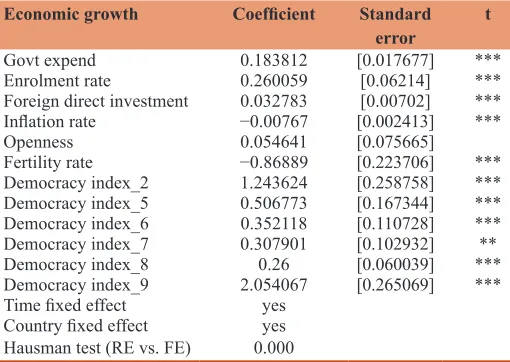
in Table 2. As is evident from the results Table 1, almost all
coefficients of the independent variables are statistically significant at 1%, with expected signs. For example, the coefficient of the government expenditure variable has the theoretically expected positive sign and it is highly statistically significant, implying that the higher the government expenditure, the higher the growth rate. As expected the education coefficient (measured by enrolment rate) appear to be an important factor for economic growth (the coefficient positive and highly statistically significant). This finding is collaborated by Anyanwu (2014) who found that education was
important determinants of growth in sub-Saharan Africa.
Foreign direct investment has significant positive impact on
growth rate in conformity with the findings of Albulescu,
1 “Institutionalized Democracy: Democracy is conceived as three essential, interdependent elements. One is the presence of institutions and procedures
through which citizens can express effective preferences about alternative policies and leaders. Second is the existence of institutionalized constraints on the exercise of power by the executive. Third is the guarantee of
civil liberties to all citizens in their daily lives and in acts of political participation. Other aspects of plural democracy, such as the rule of law, systems of checks and balances, freedom of the press, and so on are means
to, or specific manifestations of, these general principles. We do not include
coded data on civil liberties. The Democracy indicator is an additive
eleven-point scale (0-10).” (world development indicators, 2016). Table 1: FEVD estimates of the determinants of growth in
SADC countries, 1995-2011
Economic growth Coefficient Standard
error t
Govt expend 0.183812 [0.017677] ***
Enrolment rate 0.260059 [0.06214] ***
Foreign direct investment 0.032783 [0.00702] ***
Inflation rate −0.00767 [0.002413] ***
Openness 0.054641 [0.075665]
Fertility rate −0.86889 [0.223706] ***
Democracy index_2 1.243624 [0.258758] ***
Democracy index_5 0.506773 [0.167344] ***
Democracy index_6 0.352118 [0.110728] ***
Democracy index_7 0.307901 [0.102932] **
Democracy index_8 0.26 [0.060039] ***
Democracy index_9 2.054067 [0.265069] ***
Time fixed effect yes
Country fixed effect yes
Hausman test (RE vs. FE) 0.000
Standard errors are reported in parentheses with ***,**, and * denoting significance
2015; Iamsiraroj, 2016; Hong, 2016. Consistent with previous research (Bittencourt et al., 2012; Biyase and Zwane, 2016) we also found that the estimated coefficient on inflation presents an expected negative and statistically significant estimates on growth. Interestingly, the estimated coefficient on democracy have the expected signs and statistically significant, implying that democratic countries (countries with a positive democracy
indicator point scale) are likely to be better off than their counterpart (countries with a zero democracy indicator point scale). This finding is supported by an influential work in this field such as Acemoglu et al. (2014) that found evidence to suggest
that countries that change from non-democracy to democracy
achieves about 20% higher GDP per capita in the long run (over roughly the next 30 years).
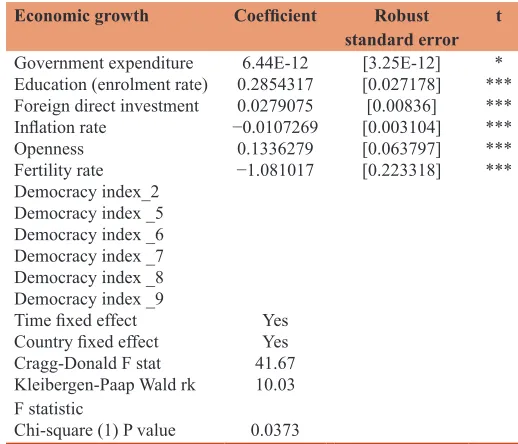
Table 2 presents the FE-2SLS results which account for
endogeneity among the variables. As noted in section 3, we use the lagged value of government spending as an instrument. We
first check if our instrument is valid (i.e., the lagged value of government spending is correlated with the dependent variable).
The rule of thumb is that the Cragg-Donald Wald F statistic and
Kleibergen–Paap Wald F statistic test in FE-2SLS results should exceed a value of 10 for the instrument to be valid. Our results of these specification tests (the Cragg–Donald Wald F statistic and Kleibergen–Paap Wald F statistic test) reject the hypothesis that the endogenous variable is weakly identified and are both above the value of 10 (see bottom of Table 2). As regards the effects of explanatory variables on growth, the FE-2SLS results (which accounts for endogeneity among the variables) appear to resemble the results of the FEVD estimates. Specifically, coefficients for government expenditure, education (measured by enrolment rate), foreign direct investment, remain an
important determinant of economic growth — enters positively
and significantly in both specifications. In line with the FEVD, coefficients for inflation and fertility rate once again matter in explaining economic growth and enter with predicted negative signs. Contrary to the FEVD estimates, trade openness coefficient in the FE-2SLS table is now positively and statistically significant determinant of growth. This suggests as confirmed by many studies in this field Fetahi-Vehapi et al. (2015) that trade openness
is good for growth.
Figure 1: Foreign direct investment and economic growth in Southern African Development Community countries, 1995-2011
Figure 2: Government spending and economic growth in Southern African Development Community countries, 1995-2011
Figure 3: Inflation and economic growth in Southern African Development Community countries, 1995-2011
Table 2: FE-2SLS estimates of the determinants of growth in SADC countries, 1995-2011
Economic growth Coefficient Robust standard error t
Government expenditure 6.44E-12 [3.25E-12] *
Education (enrolment rate) 0.2854317 [0.027178] ***
Foreign direct investment 0.0279075 [0.00836] ***
Inflation rate −0.0107269 [0.003104] ***
Openness 0.1336279 [0.063797] ***
Fertility rate −1.081017 [0.223318] ***
Democracy index_2 Democracy index _5 Democracy index _6 Democracy index _7 Democracy index _8 Democracy index _9
Time fixed effect Yes
Country fixed effect Yes
Cragg-Donald F stat 41.67
Kleibergen-Paap Wald rk
F statistic 10.03
Chi-square (1) P value 0.0373
Standard errors are reported in parentheses with ***,**, and * denoting significance
5. CONCLUSION
This article examined the determinants of economic growth for the SADC countries for the period 1995-2011. We used panel data
approaches designed to address common econometric concerns such as heterogeneity, estimation of time-invariant variables and endogeneity biases. We implemented a FEVD estimator to capture the effects of time-invariant variables and to account for unobserved heterogeneity. While the endogeneity bias was
accounted for using a FE-2SLS estimator. The results of our
investigations provide valuable insights into the determinants of economic growth in SADC countries. We found a number
of variables are significant determinants of economic growth in SADC countries. Specifically, democracy, education - measured by enrolment rate, government expenditure, foreign direct investment, trade openness have the expected positive impact on economic growth, while, inflation rate and fertility rate were found to have
negatively on economic growth in the SADC countries. Similar result have being observed in a previous growth studies in the
SADC block (Mbulawa, 2015; Seleteng and Motelle, 2016) and other related studies such as Bittencourt (2013) and Biyase and Zwane (2016).
The econometric analysis undertaken in this study offers some interesting policy implications which have been echoed by many
previous influential studies. These results suggest that investing in
education and the commitment to becoming matured democratic states should continue to be a major focus of growth promoting
efforts in SADC countries. Glewwe and Kremer (2009) offers
a practical advice on how education can be improved by Sub-Saharan African countries in general. They write: “Better school management methods, such as providing incentives that reward
teachers for student performance, may have more potential.”
REFERENCES
Acemoglu, D., Naidu, S., Restrepo, P., Robinson, J.A. (2014), Democracy does Cause Growth. National Bureau of Economic Research, Inc. Available from: http://www.ideas.repec.org/p/nbr/nberwo/20004. html.
Akcali, B.Y., Sismanoglu, E. (2015), Innovation and the effect of research and development expenditure in some developing and developed countries. Procedia-Social and Behavioural Sciences, 195, 768-775. Albulescu, C.T. (2015), Do foreign direct and portfolio investments affect
long-term economic growth in central and eastern Europe? Procedia Economics and Finance, 23, 507-512.
Anyanwu, J.C. (2014), Factors affecting economic growth in Africa: Are any lessons from China? African Development Review, 26(3), 468-493.
Baltagi, B. (2008), Econometric Analysis of Panel Data. 4th ed. Chichester,
UK: John Riley.
Barro, R.J. (1996), Democracy and growth. Journal of Economic Growth, 1, 1-27.
Barro, R.J. (1999), Determinants of economic growth: Implications of the global evidence for Chile. Cuadernos de Economía, 36(107), 443-478.
Barro, R.J. (2003), Determinants of economic growth in a panel of countries. Annals of Economics and Finance, 4, 231-274.
Barrow, R. (1991), Government spending in simple model of endogenous growth. Journal of Political Economy, 98, 103-125.
Bhaskara-Rao, R., Hassan, G. (2011), Determinants of the long-run growth rate of Bangladesh. Applied Economics Letters, 18, 655-658. Bittencourt, M. (2012), Inflation and economic growth in Latin America:
Some panel time-series evidence. Economic Modelling, 29, 333-340. Bittencourt, M., Eyden, R., Seleteng, M., (2013), Inflation and economic
growth: Evidence from the Southern African development Commuinty,’ ERSA Working Paper 405, ERSA.
Biyase, M., Zwane, T. (2016), Military spending and economic growth: Evidence from the Southern African development community. Frontiers in Finance and Economics, 13(2), 71-89.
Burnside, C., Dollar, D. (2000), Aid, policies, and growth. The American Economic Review, 90(4), 847-868.
Chang, C., Mendy, M. (2012), Economic growth and openness in Africa: What is the empirical relationship? Applied Economics Letters, 19(18), 1903-1907.
Chang, B., Feng, Y. (2000), Determinants of economic growth in China: private enterprise, education and openness. China economic review, 11(1), 1-15.
Glewwe, Paul, Michael Kremer (2006) Schools, Teachers, and education outcomes in developing countries. In Handbook of the Economics of Education, Volume 2, ed. Eric A. Hanushek and Finish Welch, 945-1017. Amsterdam and Oxford: Elsevier, North-Holland. Dollar, D. (1992), Outward-oriented developing economies really do
grow more rapidly: Evidence form 95 LDCs, 1976-1985. Economic Development and Cultural Change, 40(3), 523-544.
Dollar, D., Kraay, A. (2000), Trade, Growth and Poverty. Washington, Mimeo: The World Bank Development Research Group.
Easterly, W.R., Levine, R. (1997), Africa’s growth tragedy: Policies and ethnic divisions. The Quarterly Journal of Economics, 112(4), 1203-1250.
Edwards, S. (1998), Openness, productivity and growth: What do we really know? Economic Journal, 108(447), 383-398.
Fetahi-Vehapi, M., Sadiku, L., Petkovski, M. (2015), Empirical analysis of the effects of trade openness on economic growth: An evidence of South East European countries. Procedia Economics and Finance, 19, 17-26.
Fujita, M., Krugman, P., Venables, A. (1999), The Spatial Economy: Cities, Regions, and International Trade. Cambridge: MIT Press. Hanuskek, E., Kimko, D. (2000), Schooling, labour force quality and
the growth of Nations. American Economic Review, 90, 1184-1200. Hong, J. (2016), Causal relationship between ICT and R and D investment
and economic growth in Korea. Technological Forecasting and Social Change, 116, 70-75.
Hsiao, C. (2003), Analysis of Panel Data. Cambridge: Cambridge University Press.
Iamsiraroj, S. (2016), The foreign direct investment-economic growth nexus. International Review of Economics and Finance, 42, 116-133. Krugman, P. (1991), Increasing return and economic geography. Journal
of Political Economy, 99, 183-199.
Lee, H.Y., Ricci, L.A., Rigobon, R. (2004), Once again, is openness good for growth? Journal of Development Economics, 75, 451-472. Lichtenberg, F. (1992), R and D Investment and International Productivity
Differences. NBER Working Paper No. 4161.
Masanjala, W.H., Papageorgiou, C. (2008), Rough and lonely road to prosperity: A re-examination of the sources of growth in Africa using Bayesian model averaging. Journal of Applied Econometrics, 23, 671-682.
Mbulawa, S. (2015), Determinants of growth in Southern Africa development community: The role of institutions. Applied Economics and Finance, 2(2), 91-102.
Pesaran, M.H., Zhou, Q. (2014), Estimation of time-invariant effects in static panel data models, available on Pesaran’s web pages. Plumper, T., Troeger, V.E. (2007), Efficient estimation of time-invariant
and rarely changing variables in finite sample panel analyses with unit fixed effects. Political Analysis, 15, 124-139.
Pritchett, L. (2001), Where has all the education gone? World Bank Economic Review, 15, 367-391.
Radelet, S., Sachs, J., Whang-Lee, J. (2001), The determinants and prospects of economic growth in Asia. International Economic Journal, 15(3), 1-29.
Renelt, D. (1991), Economic Growth: A Review of the Theoretical and Empirical Iterature. Word Bank PRE Working Paper No. 678. Rodrik, D. (1999), Where did all the growth go? External shocks, social
conflict and growth collapses. Journal of Economic Growth, 4(4), 385-412.
Rodrik, D., Wacziarg, R. (2005), Do democratic transitions produce bad economic outcomes? American Economic Review, 95, 50-55. Romer, P. (1986), Increasing returns and long-run growth. Journal of
Political Economy, 94(2), 1002-1037.
Seleteng, M., Motelle, S. (2016), Sources of economic growth in the Southern African development community: Its likely impact on poverty and employment. Review of Economic and Business Studies, 9(2), 211-249.
Solow, R. (1956), A contribution to the theory of economic growth. Quarterly Journal of Economics, 70, 65-94.
Southern Africa Development Community (2016). Regional economic integration report.
Su, Y., Liu, Z. (2016), The impact of foreign direct investment and human capital on economic growth: Evidence from Chinese cities. China Economics Review, 37, 97-109.
Tavares, J., Wacziarg, R. (2001), How democracy affects growth. European Economic Review, 43, 1341-1378.
Ulku, H. (2004), R and D Innovation and Economic Growth: An Empirical Analysis. IMF Working Paper No. 185.