Efficient Neural Network Learning
Dae-Won Lee, Hyung-Jun Choi, and Jaewook Lee
Department of Industrial Engineering, Pohang University of Science and Technology,
Pohang, Kyungbuk 790-784, Korea.
{woosuhan,chj,jaewookl}@postech.ac.kr
Abstract. A novel two phases training algorithm for a multilayer per-ceptron with regularization is proposed to solve a local minima problem for training networks and to enhance the generalization property of net-works trained. The first phase is a trust region-based local search for fast training of networks. The second phase is an regularized line search tunneling for escaping local minima and moving toward a weight vec-tor of next descent. These two phases are repeated alternatively in the weight space to achieve a goal training error. Benchmark results demon-strate a significant performance improvement of the proposed algorithm compared to other existing training algorithms.
1
Introduction
Many supervised learning algorithms of multilayer perceptrons (MLPs, for short) find their roots in nonlinear minimization algorithms. For example, error back-propagation, conjugate gradient, and Levenberg-Marquardt methods have been widely used and applied successfully to solve diverse problems such as pattern recognition, classification, robotics and automation, financial engineering, and so on [4]. These methods, however, have difficulties in finding a good solution when the error surface are very rugged since they often get trapped in poor sub-optimal solutions.
To overcome the problem of local minima and to enhance generalization capability, in this letter, we present a new efficient regularized method for MLPs and demonstrate its superior performance on some difficult benchmark neural network learning problems.
2
Proposed Method
The proposed method is based on viewing the supervised learning of a MLP as an unconstrained minimization problem with a regularization term as follows:
min
w Eλ(w) =Etrain(w) +λEreg(w), (1)
F. Yin, J. Wang, and C. Guo (Eds.): ISNN 2004, LNCS 3173, pp. 239–243, 2004. c
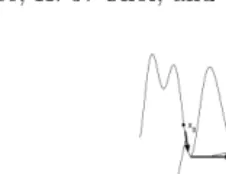
Fig. 1.Basic Idea of Tunneling Scheme
where Etrain(·) is a training error cost function averaged over the training samples which is a highly nonlinear function of the synaptic weight vector w and Ereg(·) is a regularization term to smooth the networks (for example, Ereg(w) =w2is a weight decay term. See ([4]) for other regularization terms). The proposed training algorithm consists of two phases. The first phase employs a trust region-based local search to retain the rapid convergence rate of second-order methods in addition to the globally convergent property of gradient descent methods. The second phase employs a regularized line search tunneling to gener-ate a sequence of weight vectors converging to a new weight vector with a lower minimum squared error (MSE),Eλ. The repeated iteration of these two phases alternatively forms a new training procedure which results in fast convergence to a goal error in the weight space. (See Figure 1.)
2.1 Phase I (Trust Region-Based Local Search)
The basic procedure of a trust region-based local search ([3]) adapted to Eq. (1) is as follows. For a given weight vectorw(n), the quadratic approximation ˆE is defined by the first two terms of the Taylor approximation toEλ atw(n);
ˆ
E(s) =Eλ(w(n)) +g(n)Ts+1 2s
TH(
n)s (2)
whereg(n) is the local gradient vector andH(n) is the local Hessian matrix. A trial steps(n) is then computed by minimizing (or approximately minimizing) the trust region subproblem stated by
min
s Eˆ(s) subject to s2≤∆n (3)
where∆n >0 is a trust-region parameter. According to the agreement between predicted and actual reduction in the functionEas measured by the ratio
ρn= Eλ(w(n))−Eλ(w(n) +s(n)) ˆ
∆n is adjusted between iterations as follows:
∆n+1=
s(n)2/4 ifρn <0.25
2∆n ifρn >0.75 and∆n=s(n)2
∆n otherwise
(5)
The decision to accept the step is then given by
w(n+ 1) =
w(n) +s(n) ifρn≥0
w(n) otherwise (6)
which means that the current weight vector is updated to be w(n) +s(n) if Eλ(w(n) +s(n))< Eλ(w(n)); Otherwise, it remains unchanged and the trust region parameter∆n is shrunk and the trial step computation is repeated.
2.2 Phase II (Regularized Line Search Tunneling)
Despite of its rapid and global convergence properties ([3]), the trust region-based local search would get trapped at a local minimum, say w∗. To escape from this local minimum, our proposed method, which we call a regularized line search tunneling, attempts to compute a weight vector, say ˆw of next descent, by minimizing a subproblem given by
min
t>0Eλ(w(t)) (7)
where{w(t) :t >0}is the solution trajectory of a tunneling dynamics described by
dw(t)
dt =−∇Ereg(w(t)), w(0) =w
∗ (8)
One distingushed feature of the proposed tunneling technique is that the ob-tained weight vector ˆwis located normally outside the convergent region ofw∗ with respect to the trust-region method of Phase I so that applying a trust-region local search to ˆwleads us to get another locally optimal weight vector. Another feature of the proposed method is that the value ofEregbecomes relatively small during the regularized line search tunneling in Eq. (8). Consequently, these fea-tures make it easier to find a new weight vector of next descent with a lower MSE, thereby enhancing generalization ability.
3
Simulation Results
Table 1.Experimental Results results for the benchmark data
Benchmark EBPR DTR BR LMR GA SA Proposed T 235 263 1.7 1.4 347 499 18.2 Iris E1 1% 1% 1.2% 1.7% 4.9% 5.8% 1.1% E2 4% 4% 6% 4.6% 8.2% 11.2% 4%
T 273 265 - 16.5 182.9 224.6 43.4 Sonar E1 1.0% 0.0% - 0.0% 7.95% 13.1% 0.0% E2 27.8% 27.8% - 29.8% 36.2% 41.5% 25.0%
T 2652 2843 11.8 10.0 1824 3966 12.9 2D-sinc E1 0.0055 0.0052 0.0092 0.0054 0.0112 0.0287 0.0052
E2 0.0078 0.0074 0.0120 0.0087 0.0142 0.0308 0.0073 T 671 6365.3 156.2 3.6 4765.6 9454 15.0 Mackey-Glass E1 0.5640 0.0664 0.483 0.6109 0.7313 0.7919 0.0418
E2 0.5643 0.0668 0.597 0.6147 0.7235 0.7730 0.0428
based regularization (EBPR) [4], Dynamic tunneling based regularization (DTR) [5], Baysian Regularization (BR) [2], Levenberg-Marquardt based regularization (LMR) [4], genetic algorithm based network training (GA) and simulated anneal-ing based network trainanneal-ing (SA). Experiments were repeated a hundred times for every algorithm in order to decrease effects of randomly chosen initial weight vector. The criteria for comparison are the average time of training (T), the mean squared (or misclassification) training error(E1) and test error(E2). The results demonstrate that the new algorithm not only successfully achieves the goal training error and smaller test error for all these benchmark problems but also is substantially faster than these state-of-art methods.
4
Conclusion
In this paper, a new deterministic method for training a MLP has been de-veloped. This method consists of two phases: Phase I for approaching a new local minimum in terms of a trust region-based local search and Phase II for escaping from this local minimum in terms of line search tunneling. Benchmark results demonstrate that the proposed method not only successfully achieves the goal training error but also is substantially faster than other existing training algorithms.
The proposed method has several features: First it does not require a good initial guess. Second, even in the complex network architecture it can bring appropriate tunneling directions against a trapped local minimum. Finally, weights converge relatively small value and reduce regularization error term. The robust and stable nature of the proposed method enable to apply it to various supervised learning problems. An application of the method to more large-scale benchmark problems remains to be investigated.
Acknowledgement. This work was supported by the Korea Research Founda-tion under grant number KRF-2003-041-D00608.
References
1. Barhen, J., Protopopescu, V., Reister, D.: TRUST: A Deterministic Algorithm for Global Optimization. Science, Vol. 276 (1997) 1094-1097
2. Foresee, F.D., Hagan, M.T.: Gauss-Newton Approximation to Bayesian Regular-ization. In Procedeengs, International Joint Conference on Neural Networks (1997) 1930-1935
3. Nocedal, J., Wright, S.J.: Numerical Optimization. Springer, New York (1999) 4. Haykin, S.: Neural Networks: A Comprehensive Foundation. Prentice-Hall, New
York (1999)