Application of Simulated Neural Networks as Non-Linear Modular Modeling Method
for Predicting Shelf Life of Processed Cheese
Sumit Goyal and Gyanendra Kumar Goyal National Dairy Research Institute, Karnal 132001, India E-mail: [email protected]; [email protected]
Abstract
This paper presents the capability of simulated neural network (SNN) models for predicting the shelf life of processed cheese stored at ambient temperature 30o C. Processed cheese is a dairy product generally made from medium ripened Cheddar cheese. Elman and Linear Layer(Train) SNN models were developed. Body & texture, aroma & flavour, moisture, free fatty acids were used as input variables and sensory score as the output.Neurons in each hidden layers varied from 1 to 40. The network was trained with single as well as double hidden layers up to 100 epochs, and transfer function for hidden layer was tangent sigmoid while for the output layer, it was pure linear function. Mean square error, root mean square error, coefficient of determination and nash - sutcliffo coefficient performance measures were used for testing prediction potential of the developed models. Results showed a 4201 topology was able to predict the shelf life of processed cheese exceedingly well with R2 as 0.99992157. The corresponding RMSE for this topology was 0.003615359. From this study it is concluded that SNN models are excellent tool for predicting the shelf life of processed cheese.
Keywords: SNN, Elman, Linear layer (train), Processed cheese, Shelf life prediction, Artificial intelligence, Artificial neural network
1. INTRODUCTION
This paper highlights the importance of Simulated Neural Networks (SNN) for predicting the shelf life of processed cheese stored at ambient temperature 30o C. Processed cheese is one of the most popular varieties among the types of cheeses and is generally prepared by using medium ripened (up to 6 months old) grated Cheddar cheese by adding water, emulsifiers, salt, and preservatives by heating to 70ºC for 10-15 minutes with steam in a cleaned double jacketed stainless steel kettle (which is open, shallow and round-bottomed) with continuous gentle stirring (about 50-60 circular motions per min.) with a flattened ladle in order to get unique body & texture in the product.
1.1 Simulated Neural Network
SNNs are relatively new computational tools that have found extensive application in solving many complex real-world problems. The attractiveness of SNNs comes from their remarkable information
processing characteristics pertinent mainly to nonlinearity, high parallelism, fault and noise tolerance, learning and generalization capabilities (Basheer and Hajmeer, 2000).
49 a classification problem can be solved by a threshold unit if the two classes can be separated by a hyperplane (Krogh, 2008).
1.2 Elman Simulated Neural Network (ESNN) Model
ESNN models are two layered backpropagation networks, with the addition of a feedback connection from the output of the hidden layer to its input. This feedback path allows ESNN model to learn to recognize and generate temporal patterns, as well as spatial patterns. The ESNN model has tansig neurons in its hidden (recurrent) layer, and purelin neurons in its output layer. This combination is special in that two layered networks with these transfer functions can approximate any function (with a finite number of discontinuities) with arbitrary accuracy. The only requirement is that the hidden layer must have enough neurons. More hidden neurons are needed as the function being fitted increases in complexity. ESNN model differs from conventional two layer networks in that the first layer has a recurrent connection. The delay in this connection stores values from the previous time step, which can be used in the current time step. Therefore, even if two ESNN models, with the same weights and biases, are given identical inputs at a given time step, their outputs can be different because of different feedback states. Because the network can store information for future reference, it is able to learn temporal patterns as well as spatial patterns. The ESNN models can be trained to respond to, and to generate, both kinds of patterns (Demuth et al., 2009).
1.3 Linear Layer (Train)
Linear layers are single layers of linear neurons. They may be static with input delays of 0, or dynamic with input delays greater than 0. They can be trained on simple linear time series problems, but often used adaptively to continue learning while deployed, so they can adjust to changes in the relationship between inputs and outputs while being used (Mathworks Website, 2011).
1.4 Importance of Shelf Life
Martins et al. (2008) defined shelf life as the time that a product is acceptable and meets the consumer’s expectations regarding food quality. It is the result of the conjunction of all services in production, distribution, and consumption. Shelf life dating is one of the most difficult tasks in food engineering. Market requirement has led to the implementation of shelf-life by sensory evaluation method, which is an expensive and long time consuming procedure, and also may not reflect the full quality spectra. Moreover, traditional methods for shelf-life dating and small-scale distribution chain tests cannot reproduce in a laboratory the real conditions of storage, distribution, and consumption on food quality. The food industry is facing the challenges to monitor, diagnose, and control the quality and safety of food products, but of late innovation of new technologies, viz., nanotechnology, multivariate sensors, and computerized systems have made the task of shelf life estimation quite handy.
Artificial Neural Network (ANN) modeling and several mathematical models were applied to predict the moisture ratio in an apple drying process (Khoshhal et al., 2010). Four drying mathematical models were fitted to the data obtained from eight drying runs and the most accurate model was selected. Two sets of ANN modeling were also performed. In the first set, the data obtained from each pilot were modeled individually to compare the ANN predictions with the best mathematical model. In the second set of ANN modeling, the simultaneous effect of all the four input parameters including air velocity, air temperature, the thickness of apple slices and drying time was investigated. The results showed that the ANN predictions were more accurate in comparison with the best fitted mathematical model. In addition, none of the mathematical models were able to predict the effect of the four input parameters simultaneously, while the developed ANN model predicted this effect with a good precision.
consumer choice on the sales volumes at retail store (Agrawal and Schorling, 1996), and were found to perform better than linear models. Du and Sun (2006) reviewed the learning techniques used in computer vision for food quality evaluation.
A series of partial least squares (PLS) models were employed to correlate spectral data from FTIR(Fourier transform infrared spectroscopy) analysis with beef fillet spoilage during aerobic storage at different temperatures (0,5,10,15, 20ºC).The performance of the PLS models was compared with a three - layer feedforward ANN developed using the same dataset. FTIR spectra were collected from the surface of meat samples in parallel with microbiological analyses to enumerate total viable counts. Sensory evaluation was based on a three-point Hedonic scale classifying meat samples as fresh, semi-fresh, and spoiled. The purpose of the modelling approach employed in this work was to classify beef samples in the respective quality class as well as to predict their total viable counts directly from TIR spectra. The obtained results demonstrated that both the approaches were effective in discriminating the meat samples in one of the three predefined sensory classes. The PLS classification models showed performances ranging from72.0 to 98.2% using the training dataset, and from 63.1 to 94.7% using independent testing dataset. The ANN classification model performed equally well in discriminating meat samples, with correct classification rates from 98.2 to 100%, and 63.1 to73.7% in the train and test sessions, respectively. PLS and ANN approaches were also applied to create models for the prediction of microbial counts (Efstathios et al., 2011).The performance of these was based on graphical plots and statistical indices (bias factor, accuracy factor and root mean square error).
ANNs have been successfully applied for predicting the shelf life of brown milk cakes decorated with kalakand (Goyal and Goyal, 2011a), milky white dessert jeweled with pistachio (Goyal and Goyal, 2011b), instant coffee flavoured sterilized drink (Goyal and Goyal, 2011c, d).Time-delay and linear layer ANN models were suggested for estimating the shelf life of soft mouth melting milk cakes
(Goyal and Goyal, 2011e). Elman and self-organizing models were used to predict shelf life of soft cakes (Goyal and Goyal, 2011f). Radial Basis models were applied for determining the shelf life of brown milk cakes decorated with almonds (Goyal and Goyal, 2011g). ANN models also predicted shelf life of milk based products (Goyal and Goyal, 2012 a, b, c) and processed cheese (Goyal and Goyal, 2012 d, e, f).
The review search revealed that till now the suitability of SNN models for predicting the shelf life of processed cheese stored at ambient temperature 30o C has not been investigated, hence the present study was planned. The outcome of this research would be very beneficial and relevant for dairy factories manufacturing the product, wholesalers, retailers, consumers, regulatory authorities, food researchers and academicians.
2. METHOD MATERIAL
2.1 Data Set
The experimental data concerning quality parameters, viz., body & texture, aroma & flavour, moisture, and free fatty acids of processed cheese stored at ambient temperature 30o C were taken as input variables and sensory score assigned by the trained expert panel was taken as the output for developing the SNN models (Fig.1). The dataset used in the study consisted of 36 observations, which were randomly divided into two disjoint subsets, viz., training set having 30 observations and validation set 6.
Figure1: Input and output parameters of SNN
Body &Texture
Aroma & Flavour
Moisture
Free fatty acids
51 Several approaches of internal parameters, i.e., data preprocessing, data partitioning, number of hidden layers, number of neurons in each hidden layer, transfer function, error goal, etc., were tried in order to optimize the prediction ability of the model. Different algorithms like Gradient Descent algorithm with adaptive learning rate, Polak Ribiére Update conjugate gradient algorithm, Fletcher Reeves update conjugate gradient algorithm, Levenberg Marquardt algorithm, Bayesian regularization were tried (Goyal and Goyal, 2011c). Bayesian regularization mechanism was selected for training the SNN models, as it gave the most promising results. Neurons in each hidden layer varied from 1 to 40. The network was trained up to 100 epochs. SNN was trained with single and double hidden layers. Transfer function for hidden layer was tangent sigmoid, and for the output layer it was pure linear function. MALTAB 7.0 software was used for performing the experiments.
2.2 Measures of Prediction Performance
2 1 exp N cal n Q Q MSE (1)
2 1 exp exp 1 N cal Q Q Q n RMSE (2)
2 1 2 exp exp 2 1 N cal Q Q Q R (3)
21 exp exp
exp 2 1 N cal Q Q Q Q E (4)
Where,Qexp = Observed value;Qcal = Predicted value; Qexp=Mean predicted value; n= Number of observations in dataset.MSE (1), RMSE (2), R2 (3)
and E2 (4) were used in order to compare the prediction potential of the developed SNN models.
3.RESULTS AND DISCUSSION
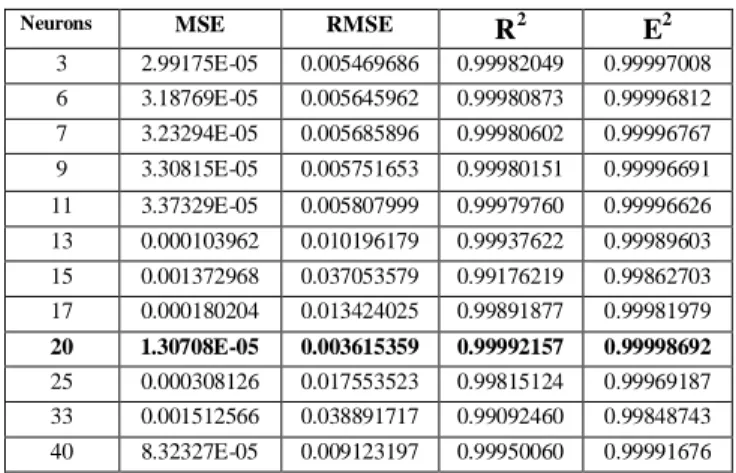
SNN model’s performance matrices for predicting the sensory scores are presented in Table 1, Table 2, and Table 3, respectively.
Table 1: Performance of ESNN models with single hidden layer for predicting sensory score
Neurons MSE RMSE R2
E2
3 2.99175E-05 0.005469686 0.99982049 0.99997008 6 3.18769E-05 0.005645962 0.99980873 0.99996812 7 3.23294E-05 0.005685896 0.99980602 0.99996767 9 3.30815E-05 0.005751653 0.99980151 0.99996691 11 3.37329E-05 0.005807999 0.99979760 0.99996626 13 0.000103962 0.010196179 0.99937622 0.99989603 15 0.001372968 0.037053579 0.99176219 0.99862703 17 0.000180204 0.013424025 0.99891877 0.99981979
20 1.30708E-05 0.003615359 0.99992157 0.99998692
25 0.000308126 0.017553523 0.99815124 0.99969187 33 0.001512566 0.038891717 0.99092460 0.99848743 40 8.32327E-05 0.009123197 0.99950060 0.99991676
Table 2: Performance of ESNN models with double hidden layer for predicting sensory score
Neurons MSE RMSE R2 E2
3:3 3.57853E-07 0.00059820 0.99999785 0.99999964 4:4 3.75352E-07 0.00061265 0.99999774 0.99999962 5:5 0.00035657 0.01888306 0.99786058 0.99964343
7:7 1.56709E-05 0.00395865 0.99990597 0.99998432
9:9 0.000390009 0.01974863 0.99765994 0.99960999 10:10 3.26855E-07 0.00057171 0.99999803 0.99999967 11:11 0.000370803 0.01925625 0.99777518 0.99962919 14:14 2.04387E-05 0.00452092 0.99987736 0.99997956 16:16 0.00020208 0.01421549 0.99878751 0.99979792 20:20 1.8226E-05 0.00426919 0.99989064 0.99998177
Table 3: Performance of linear layer (train) model for predicting sensory score
MSE RMSE R2 E2
0.000241726 0.015547539 0.99854964
4
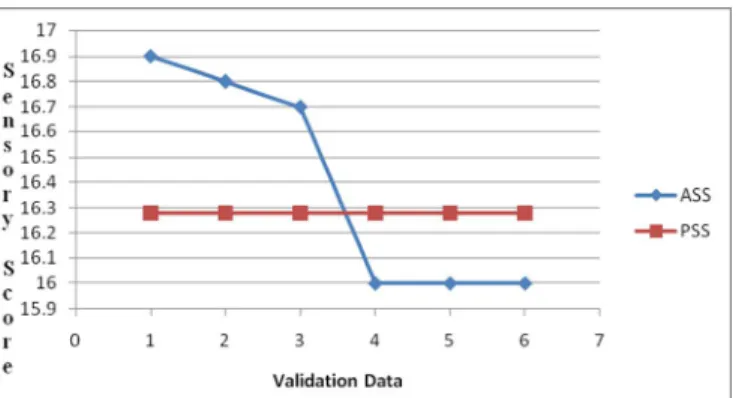
The comparison of Actual Sensory Score (ASS) and Predicted Sensory Score (PSS) for ESNN single hidden layer, double hidden layer and Linear Layer (Train) models are illustrated in Fig.2, Fig.3 and Fig.4, respectively.
Figure 2: Comparison of ASS and PSS for single hidden layer ESNN model
Figure 3: Comparison of ASS and PSS for double hidden layer ESNN model
Figure 4: Comparison of ASS and PSS for Linear Layer (Train) model
ESNN models with single hidden layer and double hidden layer were developed for predicting shelf life of processed cheese. The best results of ESNN model with single hidden layer having 20 neurons were MSE: 1.30708E-05, RMSE: 0.003615359,R2: 0.99992157, E2: 0.99998692 (Table 1); and with two hidden layers having 7 in the first and second layer MSE: 1.56709E-05, RMSE: 0.00395865, R2: 0.99990597, E2: 0.999984329 (Table 2); and for Linear layer(Train) model MSE: 0.000241726, RMSE: 0.015547539, R2: 0.998549644, E2:0.999758274 (Table 3).The best results of all the three models were compared with each other and it was observed that ESNN model with single hidden layer having 20 neurons gave the best fit.
4. 4.CONCLUSION
In this investigation Elman and linear layer(Train) simulated neural network (SNN) models were developed for predicting the shelf life of processed cheese stored at ambient temperature 30o C. The results showed that 4201 topology was able to predict the shelf life of processed cheese exceedingly well with R2 as 0.99992157. The corresponding RMSE for this topology was 0.003615359. From the study it is concluded that SNN models can be an effective alternative method for predicting the shelf life of processed cheese.
REFERENCES
Agrawal, D. and Schorling, C. (1996). Market share forecasting: An empirical comparison of artificial neural networks and multinomial logit model. Journal of Retailing, vol.72, no.4, pp.383–407.
Basheer, I.A. and Hajmeer, M. (2000). Artificial neural networks: fundamentals, computing, design, and application. Journal of Microbiological Methods, vol.43, no.3, pp.3-31.
53 Du, C.J. and Sun, D.W. (2006). Learning techniques used in computer vision for food quality evaluation: A review. Journal of Food Engineering, vol.72,pp.39–55.
Efstathios, Z.P., Fady, R. M., Argyria, A.A., Conrad, M. B. and George-John, E. N. (2011). A comparison of artificial neural networks and partial least squares modelling for the rapid detection of the microbial spoilage of beef fillets based on Fourier transform infrared spectral fingerprints. Food Microbiology, vol.28, no.4, pp.782–790.
Goyal, Sumit and Goyal, G.K. (2011a). Advanced computing research on cascade single and double hidden layers for detecting shelf life of kalakand: An artificial neural network approach. International Journal of Computer Science & Emerging Technologies, vol.2, no.5, pp.292- 295.
Goyal, Sumit and Goyal, G.K. (2011b). A new scientific approach of intelligent artificial neural network engineering for predicting shelf life of milky white dessert jeweled with pistachio. International Journal of Scientific and Engineering Research, vol.2, no.9, pp.1-4.
Goyal, Sumit and Goyal, G.K. (2011c). Cascade and feedforward backpropagation artificial neural networks models for prediction of sensory quality of instant coffee flavoured sterilized drink. Canadian Journal on Artificial Intelligence, Machine Learning and Pattern Recognition. vol.2, no.6, pp.78-82.
Goyal, Sumit and Goyal, G.K. (2011d). Application of artificial neural engineering and regression models for forecasting shelf life of instant coffee drink. International Journal of Computer Science Issues, vol. 8, no.4, pp. 320- 324.
Goyal, Sumit and Goyal, G.K. (2011e). Development of intelligent computing expert system models for shelf life prediction of soft mouth melting milk cakes. International Journal of Computer Applications, vol.25, no.9, pp.41-44.
Goyal, Sumit and Goyal, G.K. (2011f) .Simulated neural network intelligent computing models for predicting shelf life of soft cakes. Global Journal of Computer Science and Technology. vol.11, no.14, version1.0,pp.29-33.
Goyal, Sumit and Goyal, G.K. (2011g). Radial basis artificial neural network computer engineering approach for predicting shelf life of brown milk cakes decorated with almonds. International Journal of Latest Trends in Computing, vol.2, no.3, pp.434-438.
Goyal, Sumit and Goyal, G.K. (2012a). Radial basis (exact fit) artificial neural network technique for estimating shelf life of burfi. Advances in Computer Science and its Applications, vol.1, no.2, pp.93-96.
Goyal, Sumit and Goyal, G.K. (2012b). Soft computing single hidden layer models for shelf life prediction of burfi. Russian Journal of Agricultural and Socio-Economic Sciences, vol.5, no.5, pp.28-32.
Goyal, Sumit and Goyal, G.K. (2012c). Predicting shelf life of dairy product by using artificial neural networks (ANN) and statistical computerized methods. International Journal of Computer Engineering Research, vol.3, no.2, pp.20-24.
Goyal, Sumit and Goyal, G.K. (2012d). A novel method for shelf life detection of processed cheese using cascade single and multi layer artificial neural network computing models. ARPN Journal of Systems and Software, vol.2, no.2, pp.79-83.
Goyal, Sumit and Goyal, G.K. (2012e). Radial basis (exact fit) and linear layer (design) computerized ANN models for predicting shelf life of processed cheese. Computer Science Journal, vol.2, no.1, pp.11-18.
International Journal of Intelligent Systems and Applications, vol.4, no.5, pp.30-37.
Khoshhal, A., Dakhel, A.A., Etemadi, A. and Zereshki,S. (2010). Artificial neural network modeling of apple drying process. Journal of Food Process Engineering, vol.33, pp.298–313.
Krogh, A. (2008). What are artificial neural networks?. Nature Biotechnology, vol.26, no.2, pp. 195-197.
Martins, R.C., Lopes, V.V., Vicente, A.A.and Teixeira, J. A. (2008). Computational shelf-life dating: complex systems approaches to food quality and safety. Food and Bioprocess Technology,vol. 1, no.3, pp.207-222.