Released Test Questions
Chemistry
Introduction - Chemistry
The following released test questions are taken from the Chemistry Standards Test. This test is one of the
California Standards Tests administered as part of the Standardized Testing and Reporting (STAR) Program
under policies set by the State Board of Education.
All questions on the California Standards Tests are evaluated by committees of content experts, including teachers
and administrators, to ensure their appropriateness for measuring the California academic content standards in
Chemistry. In addition to content, all items are reviewed and approved to ensure their adherence to the principles of
fairness and to ensure no bias exists with respect to characteristics such as gender, ethnicity, and language.
This document contains released test questions from the California Standards Test forms in 2003, 2004, 2005,
2006, 2007, and 2008. First on the pages that follow are lists of the standards assessed on the Chemistry Test.
Next are released test questions. Following the questions is a table that gives the correct answer for each
question, the content standard that each question is measuring, and the year each question last appeared on the
test. Reference sheets, provided for students taking the test, are also included as they are necessary in answering
some of the questions. It should be noted that asterisked (*) standards found in the Science Content Standards
for California Public Schools, Kindergarten through Grade 12, are not assessed on the California Standards
Tests in Science and, therefore, are not represented in these released test questions.
NUMBER OF
NUMBER OF
REPORTING CLUSTER
QUESTIONS
RELEASED
ON EXAM
TEST QUESTIONS
Investigation and Experimentation
(Standards: CHIE1. a-n)
6
9
Atomic and Molecular Structure
Atomic and Molecular Structure (Standards: CH1. a-e)
Nuclear Processes (Standards: CH11. a-e)
8
14
Chemical Bonds, Biochemistry
Chemical Bonds (Standards: CH2. a-e)
Organic Chemistry and Biochemistry (Standards: CH10. a-c)
9
13
Kinetics, Thermodynamics
Gases and Their Properties (Standards: CH4. a-f)
Solutions (Standards: CH6. a-d)
Chemical Thermodynamics (Standards: CH7. a-d)
14
23
Chemical Reactions
Acids and Bases (Standards: CH5. a-d)
Reaction Rates (Standards: CH8. a-c)
Chemical Equilibrium (Standards: CH9. a-b)
13
18
Conservation of Matter and Stoichiometry
(Standards: CH3. a-e)
10
13
TOTAL 60
90
Released Test Questions
Chemistry
THE INVESTIGATION AND EXPERIMENTATION REPORTING CLUSTER
The following 14 California content standards are included in the Investigation and Experimentation reporting
cluster and are represented in this booklet by nine test questions. These questions represent only some ways in
which these standards may be assessed on the California Chemistry Standards Test.
CALIFORNIA CONTENT STANDARDS IN THIS REPORTING CLUSTER
Investigation and Experimentation
CHIE1. Scientific progress is made by asking meaningful questions and conducting
careful investigations. As a basis for understanding this concept and addressing the content in the other five reporting clusters, students should develop their own questions and perform investigations. Students will:
CHIE1. a. Select and use appropriate tools and technology (such as computer-linked probes,
spreadsheets, and graphing calculators) to perform tests, collect data, analyze relationships, and display data.
CHIE1. b. Identify and communicate sources of unavoidable experimental error.
CHIE1. c. Identify possible reasons for inconsistent results, such as sources of error or
uncontrolled conditions.
CHIE1. d. Formulate explanations by using logic and evidence.
CHIE1. e. Solve scientific problems by using quadratic equations and simple trigonometric,
exponential, and logarithmic functions.
CHIE1. f. Distinguish between hypothesis and theory as scientific terms.
CHIE1. g. Recognize the usefulness and limitations of models and theories as scientific
representations of reality.
CHIE1. h. Read and interpret topographic and geologic maps.
CHIE1. i. Analyze the locations, sequences, or time intervals that are characteristic of natural
phenomena (e.g., relative ages of rocks, locations of planets over time, and succession of species in an ecosystem).
CHIE1. j. Recognize the issues of statistical variability and the need for controlled tests.
CHIE1. k. Recognize the cumulative nature of scientific evidence.
CHIE1. l. Analyze situations and solve problems that require combining and applying concepts
from more than one area of science.
CHIE1. m. Investigate a science-based societal issue by researching the literature, analyzing data,
and communicating the findings. Examples of issues include irradiation of food, cloning of animals by somatic cell nuclear transfer, choice of energy sources, and land and water use decisions in California.
CHIE1. n. Know that when an observation does not agree with an accepted scientific theory, the
THE ATOMIC AND MOLECULAR STRUCTURE REPORTING CLUSTER
The following 10 California content standards are included in the Atomic and Molecular Structure reporting
cluster and are represented in this booklet by 14 test questions. These questions represent only some ways in
which these standards may be assessed on the California Chemistry Standards Test.
CALIFORNIA CONTENT STANDARDS IN THIS REPORTING CLUSTER
Atomic and Molecular Structure
CH1. The periodic table displays the elements in increasing atomic number and shows
how periodicity of the physical and chemical properties of the elements relates to atomic structure. As a basis for understanding this concept:
CH1. a. Students know how to relate the position of an element in the periodic table to its atomic
number and atomic mass.
CH1. b. Students know how to use the periodic table to identify metals, semimetals, non-metals,
and halogens.
CH1. c. Students know how to use the periodic table to identify alkali metals, alkaline earth
metals and transition metals, trends in ionization energy, electronegativity, and the relative sizes of ions and atoms.
CH1. d. Students know how to use the periodic table to determine the number of electrons
available for bonding.
CH1. e. Students know the nucleus of the atom is much smaller than the atom yet contains most
of its mass.
Nuclear Processes
CH11. Nuclear processes are those in which an atomic nucleus changes, including
radioactive decay of naturally occurring and human-made isotopes, nuclear fission, and nuclear fusion. As a basis for understanding this concept:
CH11. a. Students know protons and neutrons in the nucleus are held together by nuclear forces
that overcome the electromagnetic repulsion between the protons.
CH11. b. Students know the energy release per gram of material is much larger in nuclear fusion
or fission reactions than in chemical reactions. The change in mass (calculated by
E = mc2) is small but significant in nuclear reactions.
CH11. c. Students know some naturally occurring isotopes of elements are radioactive, as are
isotopes formed in nuclear reactions.
CH11. d. Students know the three most common forms of radioactive decay (alpha, beta, and
gamma) and know how the nucleus changes in each type of decay.
CH11. e. Students know alpha, beta, and gamma radiation produce different amounts and kinds of
Released Test Questions
Chemistry
THE CHEMICAL BONDS, BIOCHEMISTRY REPORTING CLUSTER
The following eight California content standards are included in the Chemical Bonds, Biochemistry reporting
cluster and are represented in this booklet by 13 test questions. These questions represent only some ways in
which these standards may be assessed on the California Chemistry Standards Test.
CALIFORNIA CONTENT STANDARDS IN THIS REPORTING CLUSTER
Chemical Bonds
CH2. Biological, chemical, and physical properties of matter result from the ability of
atoms to form bonds from electrostatic forces between electrons and protons and between atoms and molecules. As a basis for understanding this concept:
CH2. a. Students know atoms combine to form molecules by sharing electrons to form covalent
or metallic bonds or by exchanging electrons to form ionic bonds.
CH2. b. Students know chemical bonds between atoms in molecules such as H2, CH4, NH3,
H2CCH2, N2, Cl2 and many large biological molecules are covalent.
CH2. c. Students know salt crystals, such as NaCl, are repeating patterns of positive and
negative ions held together by electrostatic attraction.
CH2. d. Students know the atoms and molecules in liquids move in a random pattern relative to
one another because the intermolecular forces are too weak to hold the atoms or molecules in a solid form.
CH2. e. Students know how to draw Lewis dot structures.
Organic Chemistry and Biochemistry
CH10. The bonding characteristics of carbon allow the formation of many different
organic molecules of varied sizes, shapes, and chemical properties and provide the biochemical basis of life. As a basis for understanding this concept:
CH10. a. Students know large molecules (polymers), such as proteins, nucleic acids, and starch,
are formed by repetitive combinations of simple subunits.
CH10. b. Students know the bonding characteristics of carbon that result in the formation of a
large variety of structures ranging from simple hydrocarbons to complex polymers and biological molecules.
THE KINETICS, THERMODYNAMICS REPORTING CLUSTER
The following 14 California content standards are included in the Kinetics, Thermodynamics reporting cluster
and are represented in this booklet by 23 test questions. These questions represent only some ways in which
these standards may be assessed on the California Chemistry Standards Test.
CALIFORNIA CONTENT STANDARDS IN THIS REPORTING CLUSTER
Gases and Their Properties
CH4. The kinetic molecular theory describes the motion of atoms and molecules and
explains the properties of gases. As a basis for understanding this concept:
CH4. a. Students know the random motion of molecules and their collisions with a surface create
the observable pressure on that surface.
CH4. b. Students know the random motion of molecules explains the diffusion of gases.
CH4. c. Students know how to apply the gas laws to relations between the pressure,
temperature, and volume of any amount of an ideal gas or any mixture of ideal gases.
CH4. d. Students know the values and meanings of standard temperature and pressure (STP).
CH4. e. Students know how to convert between the Celsius and Kelvin temperature scales.
CH4. f. Students know there is no temperature lower than 0 Kelvin.
Solutions
CH6. Solutions are homogenous mixtures of two or more substances. As a basis for
understanding this concept:
CH6. a. Students know the definitions of solute and solvent.
CH6. b. Students know how to describe the dissolving process at the molecular level by using
the concept of random molecular motion.
CH6. c. Students know temperature, pressure, and surface area affect the dissolving process.
CH6. d. Students know how to calculate the concentration of a solute in terms of grams per liter,
molarity, parts per million, and percent composition.
Chemical Thermodynamics
CH7. Energy is exchanged or transformed in all chemical reactions and physical
changes of matter. As a basis for understanding this concept:
CH7. a. Students know how to describe temperature and heat flow in terms of the motion of
molecules (or atoms).
CH7. b. Students know chemical processes can either release (exothermic) or absorb
(endothermic) thermal energy.
Released Test Questions
Chemistry
THE CHEMICAL REACTIONS REPORTING CLUSTER
The following nine California content standards are included in the Chemical Reactions reporting cluster and
are represented in this booklet by 18 test questions. These questions represent only some ways in which these
standards may be assessed on the California Chemistry Standards Test.
CALIFORNIA CONTENT STANDARDS IN THIS REPORTING CLUSTER
Acids and Bases
CH5. Acids, bases, and salts are three classes of compounds that form ions in water
solutions. As a basis for understanding this concept:
CH5. a. Students know the observable properties of acids, bases, and salt solutions.
CH5. b. Students know acids are hydrogen-ion-donating and bases are hydrogen-ion-accepting
substances.
CH5. c. Students know strong acids and bases fully dissociate and weak acids and bases
partially dissociate.
CH5. d. Students know how to use the pH scale to characterize acid and base solutions.
Reaction Rates
CH8. Chemical reaction rates depend on factors that influence the frequency of collision
of reactant molecules. As a basis for understanding this concept:
CH8. a. Students know the rate of reaction is the decrease in concentration of reactants or the
increase in concentration of products with time.
CH8. b. Students know how reaction rates depend on such factors as concentration,
temperature, and pressure.
CH8. c. Students know the role a catalyst plays in increasing the reaction rate.
Chemical Equilibrium
CH9. Chemical equilibrium is a dynamic process at the molecular level. As a basis for
understanding this concept:
CH9. a. Students know how to use LeChatelier’s principle to predict the effect of changes in
concentration, temperature, and pressure.
CH9. b. Students know equilibrium is established when forward and reverse reaction rates are
THE CONSERVATION OF MATTER AND STOICHIOMETRY REPORTING CLUSTER
The following five California content standards are included in the Conservation of Matter and Stoichiometry
reporting cluster and are represented in this booklet by 13 test questions. These questions represent only some
ways in which these standards may be assessed on the California Chemistry Standards Test.
CALIFORNIA CONTENT STANDARDS IN THIS REPORTING CLUSTER
Conservation of Matter and Stoichiometry
CH3. The conservation of atoms in chemical reactions leads to the principle of
conservation of matter and the ability to calculate the mass of products and reactants. As a basis for understanding this concept:
CH3. a. Students know how to describe chemical reactions by writing balanced equations.
CH3. b. Students know the quantity one mole is set by defining one mole of carbon 12 atoms to
have a mass of exactly 12 grams.
CH3. c. Students know one mole equals 6.02 x 10²³ particles (atoms or molecules).
CH3. d. Students know how to determine the molar mass of a molecule from its chemical formula
and a table of atomic masses and how to convert the mass of a molecular substance to moles, number of particles, or volume of gas at standard temperature and pressure.
CH3. e. Students know how to calculate the masses of reactants and products in a chemical
Released Test Questions
Chemistry
�
1
A weather balloon with a 2-meter diameter atambient temperature holds 525 grams of helium. What type of electronic probe could be used to determine the pressure inside the balloon?
A barometric
B thermometric
C calorimetric
D spectrophotometric
CSC10177
�
2
Which would be most appropriate for collectingdata during a neutralization reaction?
A a pH probe
B a statistics program
C a thermometer
D a graphing program
CSC20124
�
3
A scientist observed changes in the gas pressureof one mole of a gas in a sealed chamber with a fixed volume. To identify the source of the changes, the scientist should check for variations in the
A air pressure outside the chamber.
B molecular formula of the gas.
C temperature of the chamber.
D isotopes of the gas.
CSC10120
�
4
Electrical fires cannot be safely put out bydousing them with water. However, fire extinguishers that spray solid carbon dioxide on the fire work very effectively. This method works because carbon dioxide
A displaces the oxygen.
B renders the fire’s fuel non-flammable.
C forms water vapor.
D blows the fire out with strong wind currents.
CSC00005
�
5
d 2
4
2.0 Å
8 5
3
1
6
7
In the cubic crystal shown, if each edge is 2.0 angstroms in length, what is the diagonal distance, d, between atoms 1 and 3? (Assume that the Pythagorean theorem can be used to solve this problem.)
A 2.5 Å
B 2 2 0
�
. Å
C 2 3.0Å
D 3 2. 0Å
CSC00127
6
In order to advance to the level of a theory, ahypothesis should be
A obviously accepted by most people.
B a fully functional experiment.
C in alignment with past theories.
D repeatedly confirmed by experimentation.
�
�
�
�
7
Matter is made of atoms that have positivecenters of neutrons and protons surrounded by a cloud of negatively charged electrons. This statement is
A a theory.
B a hypothesis.
C an inference.
D an observation.
CSC20129
8
Molecules have insignificant volume (point particles).
Molecules are very far apart from each other.
Molecules bounce off walls and each other perfectly elastically.
Molecules are in continuous, completely random motion in all directions with varying speeds. Molecules are not attracted to each other.
No. Corollary
Model of an Ideal Gas
1
2 3
4
5
The model of ideal gases shown above is useful because it
A accurately approximates the properties of most gas molecules.
B predicts the behavior of other phases of matter.
C gives precise explanations for nonideal gas behavior.
D shows a linear relation between gas pressure and volume.
CSC20474
9
When a metal is heated in a flame, the flamehas a distinctive color. This information was eventually extended to the study of stars because
A the color spectra of stars indicate which elements are present.
B a red shift in star color indicates stars are moving away.
C star color indicates absolute distance.
D it allows the observer to determine the size of stars.
CSC00006
10
Periodic Ta
b
le of the Elements
Ge
Cr
Mo
Co Ni
Pd Ag Sn
Which of the following ordered pairs of elements shows an increase in atomic number but a decrease in average atomic mass?
A Ag to Pd
B Co to Ni
C Ge to Sn
D Cr to Mo
�
�
Released Test Questions
Chemistry
11
Why is cobalt (Co) placed before nickel (Ni) onthe periodic table of the elements even though it has a higher average atomic mass than nickel?
A Nickel has one more proton.
B Cobalt was discovered first.
C Nickel has fewer electrons.
D Cobalt has a lower density.
CSC20049
�
12
Generally, how do atomic masses varythroughout the periodic table of the elements?
A They increase from left to right and top to bottom.
B They increase from left to right and bottom to top.
C They increase from right to left and top to bottom.
D They increase from right to left and bottom to top.
CSC20136
13
Periodic Ta
b
le of the Elements
Mn
Cl
Xe
Te I
Iodine would have chemical properties most like
A manganese (Mn).
B tellurium (Te).
C chlorine (Cl).
D xenon (Xe).
�
�
�
�
�
14
Which of the following elements is classified as ametal?
A bromine
B helium
C sulfur
D lithium
CSC20170
15
The chart above shows the relationship between the first ionization energy and the increase in atomic number. The letter on the chart for the alkali family of elements is
A W.
B X.
C Y.
D Z.
CSC00206
16
Which of the following atoms has the largestatomic radius?
A barium (Ba)
B chlorine (Cl)
C iodine (I)
D magnesium (Mg)
CSC10393
17
Which of the following atoms has six valenceelectrons?
A magnesium (Mg)
B silicon (Si)
C sulfur (S)
D argon (Ar)
CSC00185
18
Which statement best describes the density ofan atom’s nucleus?
A The nucleus occupies most of the atom’s volume but contains little of its mass.
B The nucleus occupies very little of the atom’s volume and contains little of its mass.
C The nucleus occupies most of the atom’s volume and contains most of its mass.
D The nucleus occupies very little of the atom’s volume but contains most of its mass.
Released Test Questions
Chemistry
�
�
�
�
19
Results of Firing Alpha Particles at Gold Foil
Observation: Proportion:
Alpha particles went straight
through gold foil. > 98% Alpha particles went through gold
foil but were deflected at large angles. ≈ 2%
Alpha particles bounced off gold foil. ≈ 0.01%
What information do the experimental results above reveal about the nucleus of the gold atom?
A The nucleus contains less than half the mass of the atom.
B The nucleus is small and is the densest part of the atom.
C The nucleus contains small positive and negative particles.
D The nucleus is large and occupies most of the atom’s space.
CSC20056
20
Why are enormous amounts of energy requiredto separate a nucleus into its component protons and neutrons even though the protons in the nucleus repel each other?
A The force of the protons repelling each other is small compared to the attraction of the neutrons to each other.
B The electrostatic forces acting between other atoms lowers the force of repulsion of the protons.
C The interactions between neutrons and electrons neutralize the repulsive forces between the protons.
D The forces holding the nucleus together are much stronger than the repulsion between the protons.
CSC00136
21
The most abundant isotope of lead contains82 protons and 124 neutrons packed closely together in the nucleus. Why do the protons stay together in the nucleus rather than fly apart?
A Electrons in neighboring atoms neutralize repulsive forces between protons.
B Neutrons effectively block the protons and keep them far apart to prevent repulsion.
C Electrostatic forces between neutrons and protons hold the nucleus together.
D Nuclear forces overcome repulsive forces between protons in the nucleus.
CSC20451
22
Which equation correctly represents the alphadecay of polonium-214?
A
214
214
0
84Po
85 Po
+
-1 e
B
214
2
216
84Po
+
4 He
90Th
C
214
210
+ 4
84Po
82 Pb
2 He
D
214
214
0
Pb + He
84Po
82
2
�
23
A 2-cm-thick piece of cardboard placed over a radiation source would be most effective in protecting against which type of radiation?A alpha
B beta
C gamma
D x-ray
CSC00299
�
24
Which of the following is a monatomic gasat STP?
A chlorine
B fluorine
C helium
D nitrogen
CSC10387
�
25
When cations and anions join, they form whatkind of chemical bond?
A ionic
B hydrogen
C metallic
D covalent
CSC20314
�
�
�
26
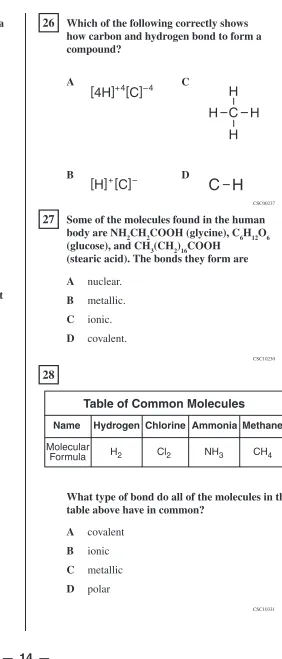
Which of the following correctly showshow carbon and hydrogen bond to form a compound?
A C
+ 4 – 4
[4H] [C]
H
H C H
H
B + – D
[H] [C]
C H
CSC00237
27
Some of the molecules found in the humanbody are NH CH COOH (glycine), C H O2 2 6 12 6
(glucose), and CH3(CH2)16COOH
(stearic acid). The bonds they form are
A nuclear.
B metallic.
C ionic.
D covalent.
CSC10230
28
Table of Common Molecules
Name Hydrogen Chlorine Ammonia Methane
Molecular
Formula H2 Cl2 NH3 CH4
What type of bond do all of the molecules in the table above have in common?
A covalent
Released Test Questions
Chemistry
�
29
The reason salt crystals, such as KCl, holdtogether so well is because the cations are strongly attracted to
A neighboring cations.
B the protons in the neighboring nucleus.
C free electrons in the crystals.
D neighboring anions.
CSC00150
�
30
What type of force holds ions together in saltssuch as CaF2 ?
A electrostatic
B magnetic
C gravitational
D nuclear
CSC20144
�
31
Under the same conditions of pressure andtemperature, a liquid differs from a gas because the molecules of the liquid
A have no regular arrangement.
B are in constant motion.
C have stronger forces of attraction between them.
D take the shape of the container they are in.
CSC10388
�
32
Periodic Ta
b
le of the Elements
Al
As
Ga Ge
Which of the following elements has the same Lewis dot structure as silicon?
A germanium (Ge)
B aluminum (Al)
C arsenic (As)
D gallium (Ga)
CSC00142
�
33
Which substance is made up of manymonomers joined together in long chains?
A salt
B protein
C ethanol
D propane
CSC00323
�
34
For the polymer, polyvinyl chloridethe repeating subunit is
A CH (Cl .)
B CH (Cl CHCH) 2.
C CH 2 CH.
D CH 2 CH(Cl .)
�
35
Which element is capable of forming stable, extended chains of atoms through single, double, or triple bonds with itself?A carbon
B oxygen
C nitrogen
D hydrogen
CSC20155
�
36
Proteins are large macromolecules composed ofthousands of subunits. The structure of the protein depends on the sequence of
A lipids.
B monosaccharides.
C amino acids.
D nucleosides.
CSC00062
�
37
When a cold tire is inflated to a certainpressure and then is warmed up due to friction with the road, the pressure increases. This happens because the
A air molecules hit the walls of the tire less frequently.
B rubber in the tire reacts with oxygen in the atmosphere.
C air molecules speed up and collide with the tire walls more often.
D air molecules diffuse rapidly through the walls of the tire.
CSC00183
�
�
�
38
When someone standing at one end of a largeroom opens a bottle of vinegar, it may take several minutes for a person at the other end to smell it. Gas molecules at room temperature move at very high velocities, so what is responsible for the delay in detection of the vinegar?
A the increase in the airspace occupied by vinegar molecules
B the chemical reaction with nerves, which is slower than other sensory processes
C attractive forces between the air and vinegar molecules
D random collisions between the air and vinegar molecules
CSC00125
39
Methane (CH4) gas diffuses through airbecause the molecules are
A moving randomly.
B dissolving quickly.
C traveling slowly.
D expanding steadily.
CSC20840
40
The volume of 400 mL of chlorine gas at400 mm Hg is decreased to 200 mL at constant temperature. What is the new gas pressure?
A 400 mm Hg
B 300 mm Hg
C 800 mm Hg
D 650 mm Hg
Released Test Questions
Chemistry
�
41
Under what circumstance might a gas decreasein volume when heated?
A The gas is held constant at STP.
B The gas remains under uniform temperature.
C The gas is placed under increasing pressure.
D The gas undergoes a decrease in pressure.
CSC20333
�
42
A sample of carbon dioxide gas occupies avolume of 20 L at standard temperature and pressure (STP). What will be the volume of a sample of argon gas that has the same number of moles and pressure but twice the absolute temperature?
A 10 L
B 20 L
C 40 L
D 80 L
CSC10250
�
43
Standard temperature and pressure (STP) aredefined as
A 0 ºC and 1.0 atm pressure.
B 0 ºC and 273 mm Hg pressure.
C 0 K and 1.0 atm pressure.
D 0 K and 760 mm Hg pressure.
CSC00285
�
44
Under which of the following sets of conditionswill a 0.50 mole sample of helium occupy a volume of 11.2 liters?
A 298 K and 0.90 atm
B 273 K and 1.10 atm
C 373 K and 0.50 atm
D 273 K and 1.00 atm
CSC10234
�
�
�
45
What is the equivalent of 423 kelvin in degreesCelsius?
A –223 ºC
B –23 ºC
C 150 ºC
D 696 ºC
CSC00089
46
Theoretically, when an ideal gas in a closedcontainer cools, the pressure will drop steadily until the pressure inside is essentially that of a vacuum. At what temperature should this occur?
A 0 ºC
B −460 ºC
C −273 K
D 0 K
CSC10216
47
The temperature at which all molecular motionstops is
A −460 ºC.
B −273 K.
C 0 K.
D 0 C. º
�
�
�
48
SOLUBILITY OF SUBSTANCES IN WATER @ 20 oC
Substance Formula/State Solubility (g/100g H2O)
Magnesium chloride MgCl2 / solid 54.6
Ammonia NH3 / gas 34.0
Ethanol CH3CH2OH / liquid infinite
Benzoic Acid C6H5COOH / solid 0.29
Which of the substances in the table can act as either the solute or the solvent when mixed with
100 grams of water at 20 °C?
A NH3
B C6H5COOH
C MgCl2
D CH3 CH2OH
CSC10055
�
49
A teaspoon of dry coffee crystals dissolveswhen mixed in a cup of hot water. This process produces a coffee solution. The original crystals are classified as a
A solute.
B solvent.
C reactant.
D product.
CSC20256
50
If the attractive forces among solid particles areless than the attractive forces between the solid and a liquid, the solid will
A probably form a new precipitate as its crystal lattice is broken and re-formed.
B be unaffected because attractive forces within the crystal lattice are too strong for the dissolution to occur.
C begin the process of melting to form a liquid.
D dissolve as particles are pulled away from the crystal lattice by the liquid molecules.
CSC00088
51
Water is a polar solvent, while hexane is anonpolar solvent.
Solute Water Hexane
NH4Cl, ammonium chloride Soluble Insoluble
C10H8, naphthalene Insoluble Soluble
C2H5OH, ethanol Soluble Soluble
CO(NH2)2, urea Soluble Insoluble
Which of the examples above illustrates a nonpolar solute in a polar solvent?
A NH Cl4 in water
B C H10 8 in water
C C H OH2 5 in hexane
D CO NH( 2 2 ) in hexane
Released Test Questions
Chemistry
�
52
A technician prepared a solution by heating100 milliliters of distilled water while adding KCl crystals until no more KCl would dissolve. She then capped the clear solution and set it aside on the lab bench. After several hours she noticed the solution had become cloudy and some solid had settled to the bottom of the flask. Which statement best describes what happened?
A As the solution cooled, evaporation of water increased the KCl concentration beyond its solubility.
B Water molecules, trapped with the KCl crystals, were released after heating.
C At lower temperatures the solubility of the KCl decreased and recrystallization occurred.
D At increased temperatures the solubility of KCl increased and remained too high after cooling.
CSC00012
�
53
If the solubility of NaCl at 25 ºC is36.2 g/100 g H2O, what mass of NaCl can be
dissolved in 50.0 g of H2O?
A 18.1 g
B 36.2 g
C 72.4 g
D 86.2 g
CSC00275
�
54
How many moles of HNO3 are needed toprepare 5.0 liters of a 2.0 M solution of HNO3?
A 2.5
B 5
C 10
D 20
CSC10375
�
�
�
55
The Dead Sea is the saltiest sea in the world. Itcontains 332 grams of salt per 1000 grams of water. What is the concentration in parts per million (ppm)?
A 0.332 ppm
B 332 ppm
C 33,200 ppm
D 332,000 ppm
CSC20046
56
The random molecular motion of a substance isgreatest when the substance is
A condensed.
B a liquid.
C frozen.
D a gas.
CSC00258
57
Which of these is an example of an exothermicchemical process?
A evaporation of water
B melting ice
C photosynthesis of glucose
D combustion of gasoline
�
�
�
58
The boiling point of liquid nitrogen is 77 kelvin.It is observed that ice forms at the opening of a container of liquid nitrogen. The best
explanation for this observation is
A water at zero degrees Celsius is colder than liquid nitrogen and freezes.
B the nitrogen boils and then cools to form a solid at the opening of the container.
C water trapped in the liquid nitrogen escapes and freezes.
D the water vapor in the air over the opening of the liquid nitrogen freezes out.
CSC00171
�
59
The specific heat of copper is about 0.4 joules/gram ºC. How much heat is needed to change the temperature of a 30-gram sample of copper from 20.0 ºC to 60.0 ºC?
A 1000 J
B 720 J
C 480 J
D 240 J
CSC00045
�
60
Equal volumes of 1 molar hydrochloric acid(HCl) and 1 molar sodium hydroxide base (NaOH) are mixed. After mixing, the solution will be
A strongly acidic.
B weakly acidic.
C nearly neutral.
D weakly basic.
CSC00188
61
The above picture shows a light bulb connected to a battery with the circuit interrupted by a solution. When dissolved in the water to form a 1.0 molar solution, all of the following
substances will complete a circuit allowing the bulb to light except
A hydrochloric acid.
B sodium nitrate.
C sucrose.
D ammonium sulfate.
CSC00146
62
Which of the following is an observableproperty of many acids?
A They become slippery when reacting with water.
B They react with metals to release hydrogen gas.
C They produce salts when mixed with other acids.
�
�
�
�
�
Released Test Questions
Chemistry
63
Copper (II) nitrate and sodium hydroxidesolutions react in a test tube as shown below.
Cu(NO3)2(aq) + 2NaOH(aq) Cu(OH)2(s) + 2NaNO3(aq)
If nitric acid is added to the test tube, the amount of solid precipitate decreases. The best explanation for this is that the acid
A dilutes the solution making the precipitate dissolve.
B reacts with the copper (II) nitrate, pulling the equilibrium to the left.
C will dissolve most solids, including sodium nitrate.
D will react with the copper (II) hydroxide to form water and soluble copper (II) nitrate.
CSC00160
64
Potassium hydroxide (KOH) is a strong basebecause it
A easily releases hydroxide ions.
B does not dissolve in water.
C reacts to form salt crystals in water.
D does not conduct an electric current.
CSC20341
65
Of four different laboratory solutions, thesolution with the highest acidity has a pH of
A 11.
B 7.
C 5.
D 3.
CSC00173
66
H
2+ Cl
22HCl
Which of these describes the rate of this chemical reaction?
A an increase in the concentration of HCl and H2 with time
B an increase in the concentration of HCl with time
C an increase in H2 and Cl2 with time
D a decrease in HCl and Cl2 with time
CSC10369
67
catalyst
C
6H
6�
Br
2C
6H
5Br
�
HBr
Which of the following changes will cause an increase in the rate of the above reaction?
A increasing the concentration of Br2
B decreasing the concentration of C H6 6
C increasing the concentration of HBr
D decreasing the temperature
68
2CO + O
22CO
2If the above reaction takes place inside a sealed reaction chamber, then which of these procedures will cause a decrease in the rate of reaction?
A raising the temperature of the reaction chamber
B increasing the volume inside the reaction chamber
C removing the CO2 as it is formed
D adding more CO to the reaction chamber
CSC00106
�
69
A catalyst can speed up the rate of a givenchemical reaction by
A increasing the equilibrium constant in favor of products.
B lowering the activation energy required for the reaction to occur.
C raising the temperature at which the reaction occurs.
D increasing the pressure of reactants, thus favoring products.
CSC00184
�
�
70
Which reaction diagram shows the effect ofusing the appropriate catalyst in a chemical reaction?
A
Reactants
Products
After Catalyst Before Catalyst
Progress of Reaction
B
Reactants
Products
After Catalyst
Before Catalyst
Ener
g
y
Ener
g
y
Ener
g
y
Ener
g
y
Progress of Reaction
C
After Catalyst
Reactants
Products
Before Catalyst
Progress of Reaction
D
Before Catalyst
Reactants
After Catalyst
Products
Progress of Reaction
�
�
�
�
Released Test Questions
Chemistry
71
H O2 2, hydrogen peroxide, naturally breaksdown into H O2 and O2 over time. MnO2,
manganese dioxide, can be used to lower the energy of activation needed for this reaction to take place and, thus, increase the rate of
reaction. What type of substance is MnO 2 ?
A a catalyst
B an enhancer
C an inhibitor
D a reactant
CSC10368
�
72
When a reaction is at equilibrium and morereactant is added, which of the following changes is the immediate result?
A The reverse reaction rate remains the same.
B The forward reaction rate increases.
C The reverse reaction rate decreases.
D The forward reaction rate remains the same.
CSC00248
�
73
In which of the following reactions involvinggases would the forward reaction be favored by an increase in pressure?
A A + B
AB
B A + B C + D
C 2A + B C + 2D
D AC A + C
CSC00129
74
4HCl
(g)+ O
2(g)2H
2O
(l)+ 2Cl
2(g)+ 113 kJ
Which action will drive the reaction to the right?
A heating the equilibrium mixture
B adding water to the system
C decreasing the oxygen concentration
D increasing the system’s pressure
CSC10082
75
NO
2(
g
) + CO(
g
)
�
NO(
g
) + CO
2(
g
)
The reaction shown above occurs inside a closed flask. What action will shift the reaction to the left?
A pumping CO gas into the closed flask
B raising the total pressure inside the flask
C increasing the NO concentration in the flask
D venting some CO2 gas from the flask
CSC20419
76
NH
4CI(s) + heat
NH
3(
g
) + HCI(
g
)
What kind of change will shift the reaction above to the right to form more products?
A a decrease in total pressure
B an increase in the concentration of HCl
C an increase in the pressure of NH3
D a decrease in temperature
77
In a sealed bottle that is half full of water, equilibrium will be attained when water moleculesA cease to evaporate.
B begin to condense.
C are equal in number for both the liquid and the gas phase.
D evaporate and condense at equal rates.
CSC00152
78
C3H8+ O2 CO2 +H2O
This chemical equation represents the combustion of propane. When correctly balanced, the coefficient for water is
A 2.
B 4.
C 8.
D 16.
CSC00311
79
Which of the following is a balanced equationfor the combustion of ethanol (CH3CH2OH)?
CO
2+ 2H
2O
A
CH
3CH
2OH + 3O
22CO2 + 3H2O
B CH3CH2OH + 3O2
2CO
2+ 3HO
C
CH
3CH
2OH + O
23CO
2+ 2H
2O
D
CH
3CH
2OH + 2O
2CSC10401
80
Hydrazine, N H , 2 4 and dinitrogen tetroxide,N O2 4, react to form gaseous nitrogen and
water. Which of these represents a properly balanced equation for this reaction?
A N H 2 4+N O 2 4 →N 2+H O 2
B 2N H2 4 +N O 2 4 →2N 2+4H O 2
C 2N H 2 4 + N O 2 4 →3N 2+4H O 2
D 2N H2 4 +3N O 2 4 →5N 2+6H O 2
CSC00092
81
__ NH
3(
g
) + __ O
2(
g
)
__ N
2(
g
) + __ H
2O(
g
)
When the reaction above is completely
balanced, the coefficient for NH3 will be
A 2.
B 3.
C 4.
D 6.
CSC20068
82
How many moles of carbon-12 are contained inexactly 6 grams of carbon-12?
A 0 5 mole .
B 2 0 . moles
C 3 01 . ×1023moles
D 6 02 . ×1023 moles
Released Test Questions
Chemistry
�
83
How many atoms are contained in 97.6 g ofplatinum (Pt)?
A 5 1. 6 ×1030
B 3 0. 1 ×10²³
C 1 2. 0 ×1024
D 1 1. 0 ×1028
CSC00255
�
84
When methane (CH4) gas is burned in thepresence of oxygen, the following chemical reaction occurs.
�
�
�
�
CH
4+ 2O
2CO
2+ 2H
2O
If 1 mole of methane reacts with 2 moles of oxygen, then
A 6 02 . ×1023 molecules of CO2 an 6 02 . × 1023
molecules of H O2 are produced.
B 1 2. ×1024 molecules of CO2 and 1 2. × 1024 molecules of H O2 are produced.
C 6 02 . ×1023 molecules of CO2 and 1 2. × 1024
molecules of H O2 are produced.
D 1 2. ×1024 molecules of CO2 and 6 02 . ×1023 molecules of H O2 are produced.
CSC20428
85
How many moles of CH4 are contained in96.0 grams of CH ?4
A 3.00 moles
B 6.00 moles
C 12.0 moles
D 16.0 moles
CSC00162
86
How many atoms are in a chromium samplewith a mass of 13 grams?
A 1 5. ×1023
B 3 3. ×1023
C 1 9. ×1026
D 2 4. ×1024
CSC10251
87
How many moles of chlorine gas are containedin 9 02 . ×1023 molecules?
A 1.5 moles
B 2.0 moles
C 6.02 moles
D 9.03 moles
CSC10373
88
Fe
2O
3�
3CO
2Fe
�
3CO
2In this reaction, how many grams of Fe O are 2 3
required to completely react with 84 grams of CO?
A 64 g
B 80 g
C 160 g
D 1400 g
�
89
�
M
g
3N
2(s)+ 6H
2O
(l)2NH
3(aq)+ 3M
g
(OH)
2(s)If 54.0 grams of water are mixed with excess magnesium nitride, then how many grams of ammonia are produced?
A 1.00
B 17.0
C 51.0
D 153
CSC20076
90
A mass of 5.4 grams of aluminum (Al) reactswith an excess of copper (II) chloride (CuCl2 )
in solution, as shown below.
3CuCl
2+ 2Al
2AlCl
3+ 3Cu
What mass of solid copper (Cu) is produced?
A 0.65 g
B 8.5 g
C 13 g
D 19 g
1 2 3 4 5 6 7 8 9 10 11 12 13 14 15 16 17 18 19 20 21 22 23 24 25 26 27 28 29 30 31 32 33 34 35
Released Test Questions
Chemistry
Question Number Correct Answer Standard Year of Release
A CHIE1.A 2005
A CHIE1.A 2007
C CHIE1.C 2006
A CHIE1.D 2004
B CHIE1.E 2008
D CHIE1.F 2004
A CHIE1.F 2006
A CHIE1.G 2008
A CHIE1.K 2003
B CH1.A 2004
A CH1.A 2007
A CH1.A 2007
C CH1.B 2004
D CH1.B 2008
A CH1.C 2003
A CH1.C 2008
C CH1.D 2003
D CH1.E 2004
B CH1.E 2006
D CH11.A 2005
D CH11.A 2008
C CH11.D 2007
A CH11.E 2003
C CH2.A 2005
A CH2.A 2006
C CH2.A 2008
D CH2.B 2005
A CH2.B 2007
D CH2.C 2004
A CH2.C 2008
C CH2.D 2005
A CH2.E 2003
B CH10.A 2003
D CH10.A 2006
Question Number Correct Answer Standard Year of Release
Released Test Questions
Chemistry
Question Number Correct Answer Standard Year of Release
Chemistr
y Ref
erence Sheet
Calif
or
nia Standards
Sodium 22.99Na
11 Atomic n umberElement symbol Av
er
age atomic mass
, Constants
, and Unit Con
v
ersions
Chemistr
y Ref
erence Sheet
Calif
or
nia Standards
Form
ulas
Ideal Gas La
w
:
PV
=
nRT
Calorimetric Form
ulas –
P
1V
1P
2V
2Combined Gas La
w
:
=
No Phase Chang
e
:
Q = m
(
Δ
T
)
C
pT
1T
2Pressure Form
ula
:
P
=
F
Latent Heat of Fusion
:
Q = m
Δ
H
fusA
Mass-Ener
gy Form
ula
:
E
=
mc
2
Latent Heat of
V
aporization
:
Q = m
Δ
H
va pConstants
L
V
olume of Ideal Gas at STP
:
22.4
mol
Speed of Light in a
V
acuum
:
c
=
3.00
×
10
8
m s
Specific Heat of
W
ater
:
C
p
(H
2O
) =
1.00
cal
J
(g C
)
=
4.18
(g C
)
cal
J
Latent Heat of Fusion of
W
ater
:
Δ
H
fus(H
2O
)=
80
g
=
334
g
cal
J
Latent Heat of
V
aporization of
W
ater
:
Δ
H
va p(H
2O
)=
540
g
=
2260
g
Unit Con
ver
sions
Calorie-Joule Con
ver
sion
:
1 cal = 4.184 J
Absolute T
emperature
Con
ver
sion
:
K
=
C
+
273
lbs.
Pressure Con
ver
sions
:
1 atm
=
760 mm Hg
=
760 T
orr
=
101.325
kP
a
= 14.7
in.
2
=
29.92 in. Hg
2009
Calif
ornia Depar