the opponents’ performance level (Castellano, Blanco-Villasenor, & Alvarez, 2011).
The analysis of work load during basketball match-play is important from the point of view of performance capacity development and also for injury prevention. Basketball is a typical pivoting sport where the most frequent are lower limb injuries including injuries of the knee joint and hamstrings (Prodromos et al., 2008). There are a number of mechanisms that relate to increased risk of knee and hamstring injury and it has been documented that muscular and neuromuscu-lar control are important in reducing load on ACL and thus reducing the risk of ACL injury (Hawkins, Hulse, Wilkinson, Hodson, & Gibson, 2001; Oliver & Smith, 2010). It has been also documented that muscle fatigue is one of the aetiological factors of ACL and hamstring injury (Dai, Mao, Garrett, & Yu, 2014; Sangnier & Tourny-Chollet, 2007). Fatigue reduces dynamic knee stability and thus increases risk of ACL injury (Rozzi, Lephart, & Fu, 1999; Smith et al., 2012; Yu & Garrett, 2007) and hamstring injury (Sangnier & Tourny-Chol-let, 2007; Small, McNaughton, Greig, & Lovell, 2010).
Introduction
Basketball is a sport which imposes a highly variable load on participants (Hůlka, Cuberek, & Bělka, 2013). Basketball performance combines maximum intensity activities and medium or low intensity multidirectional movements such as running, dribbling and shuffling at variable velocities and jumping (Apostolidis, Nas-sis, Bolatoglou, & Geladas, 2004; Narazaki, Berg, Stergiou, & Chen, 2009). The low intensity activities provide opportunities for recovery (Krustrup, Mohr, & Bangsbo, 2002). The frequency of sprint activities, intensity at which they are performed, and length of recovery is influenced by numerous factors such as the level at which the game is being played (Ben Abdelkrim, Chaouachi, Chamari, Chtara, & Castagna, 2010), play-ers’ fitness (Krustrup, Mohr, Ellingsgaard, & Bangsbo, 2005), playing position (Di Salvo et al., 2007), and
* Address for correspondence: Karel Hůlka, Department of Sport, Faculty of Physical Culture, Palacký University Olo-mouc, třída Míru 117, 771 11 OloOlo-mouc, Czech Republic. E-mail: [email protected]
Reliability and validity of a basketball-specific fatigue protocol simulating match load
Karel Hůlka*, Michal Lehnert, and Jan Bělka
Faculty of Physical Culture, Palacký University Olomouc, Olomouc, Czech Republic
Copyright: © 2017 K. Hůlka et al. This is an open access article licensed under the Creative Commons Attribution License (http://creativecommons.org/licenses/by/4.0/).
Background: Research on the amount and type of fatigue caused by match load depends on protocols based on time-motion analysis of match performance in a given sport. The role of these protocols is to accurately simulate specific player match load, which is, contrary to a match, identical for all participants. Objective: The purpose of the study was to determine the reliability and validity using a basketball-specific fatigue protocol simulating player’s performance during a basketball match. Methods: The study involved a total of 25 male basketball players (age 17.4 ± 1.5 years; body height 185.1 ± 7.4 cm and body mass index 22.1 ± 0.3 kg ⋅ m–2) of U17 and U19 categories. The participants
performed a specific basketball fatigue protocol twice during 14 days consisting of four periods separated by breaks as in a basketball match. Each period contained a stage with maximum intensity activities followed by a stage of medium intensity and low intensity. During the protocol, heart rate was recorded and time intervals of maximum, medium and low intensity were measured. Results: The relative reliability measurement pointed to high intra-individual stability of the results, when intraclass correlation coefficient varied from .71 to .92. The typical error of measurement showed that the players should be able to repeat the measurement with less than 1.31 s (0.82%) in total time, 0.17 s (2.73%) in sprint time, and 1.32% (1.19%) for percentage of heart rate. The values 1.68 (38.35%) of Sprint decrement showed very low repeatability. Conclusion: Measurements using a fatigue protocol showed high validity, reliability, and agree-ment of repeated measures.
From reasons mentioned above it is clear that play-ers’ ability to cope with basketball-specific fatigue expe-rienced during match is crucial both from the point of view of injury prevention. Data on players’ external load combined with data on internal response such as heart rate response, sources of muscular energy, mus-cle recruitment patterns and their alterations, musmus-cle capacity to produce and absorb force etc. are used to provide insight into the demands of team sports (Mat-thew & Delextrat, 2009; Woods et al., 2004). This knowledge of modifiable (and also non-modifiable) injury risk factors is required to create appropriate training programmes to improve the player’s condition-ing preparedness and hence reduce the rate at which he or she fatigues and the stress on the musculoskeletal system (McKeag, 2003).
It has been shown that during a basketball match internal load expressed in terms of mean heart rate is about 87–91% of peak heart rate (Ben Abdelkrim, El Faaza, & El Ati, 2007; McInnes, Carlson, Jones, & McKenna, 1995; Montgomery, Pyne, & Minanhan, 2010; Ziv & Lindor, 2009). The external load on play-ers in basketball games has mainly been investigated through time-motion analysis quantifying various low- to high-intensity movement patterns and distance covered (Klusemann, Pyne, Hopkins, & Drinkwater, 2013). External load expressed as distance covered varies between 4500 m and 6300 m (Erčulj et al, 2008; Hůlka et al., 2013; Narazaki et al., 2009). The number of changes of direction and number of accelerations and decelerations vary from 800 to 1050 (Ben Abdelkrim et al., 2007; Klusemann et al., 2013; McInnes et al., 1995), and the number of jumps (one or two leg take-offs into the air) between 40 to 50 (Ben Abdelkrim et al., 2007). Taylor (2003) showed that during the course of a match a player performs 105 ± 51 sprints (efforts at maximal intensity, speed > 5.10 m ⋅ s–1). McInnes et
al. (1995) showed that players spent 35% of the game by walking (activity at no greater intensity than walking pace i.e. 0.10 to 1.00 m ⋅ s–1) or standing and only 15%
in high intensity running or shuffling.
Research on the amount and type of fatigue caused by match load depends on protocols based on time-motion analysis of match performance in a given sport. The role of these protocols is to accurately simulate specific player match load, which is, contrary to a match, identical for all participants. There are match load protocols for soccer (e.g., Small et al., 2010; Wil-liams, Abt, & Kilding, 2010) but there is a paucity of basketball-specific protocols. For basketball we found only the Basketball Exercise Simulation Test (BEST; Scanlan, Dascombe, & Reaburn, 2012). This test simu-lates one quarter only and we consider that its main
purpose is to assess the basketball-specific physical preparedness of players.
Our intention was to construct and verify a basket-ball-specific fatigue protocol which would mimic the demands of game play as accurately as possible and thus permit inferences about the neuromuscular fatigue induced by match play.
The objective of the study was to assess the reli-ability, usefulness, and validity of a basketball-specific fatigue protocol simulating player load during a basket-ball match.
Methods
Participants
The research study involved a total of 25 basketball players in the U17 and U19 categories from the Czech Republic (men; age 17.44 ± 1.52 years, height 185.10 ± 7.44 cm, body mass index 22.13 ± 0.31 kg ⋅ m–2). All the players
were involved in the second nationwide league (called the 1st league) in the 2014/2015 season and had at least
seven-year experience of the game. Players took part in four team sessions (six hours per week), one condition-ing session (one hour per week), and one individual training session per week (one hour per week). The study was approved by local ethic committee. Prior to data collection the players were informed about the purpose of the measurements and provided written, informed consent in accordance with the Helsinki Dec-laration. The involvement of the players was voluntary and the results were used only for the purposes of this research.
Specific basketball fatigue protocol (BSFP28)
Data were collected over four separate periods as in a match. There is a two-minute break following the first and third periods and a fifteen-minute break following the second period. Each period consists of seventeen activity sections involving maximal activity (sprints), submaximal activity (running at 3–5 m ⋅ s–1), low
inten-sity activity (jogging and walking at 1.5–3 m ⋅ s–1) and
All measurement sessions began with a 20-minute warm-up consisting of five minutes of dribbling and passing drill (jogging tempo), ten minutes of dynamic whole body stretches, and brief high-intensity runs with dribbling.
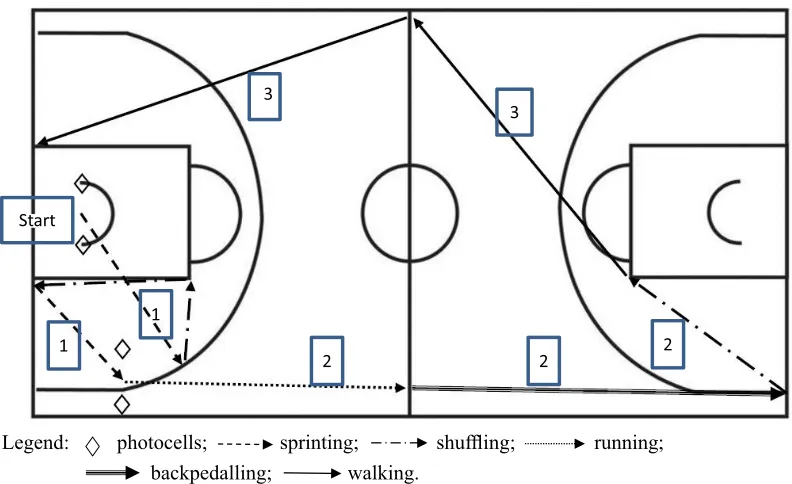
Players participated in a training session during which they learned the movement patterns also the first maximal intensity segment measured by photocells (identified by number 1 on the Figure 1), and practised the pace required in the second and third segments (6.5 to 10.5 s and to 28 s respectively; identified by number 2 and 3 on the Figure 1), which corresponds to the speeds specified for medium and low intensity activi-ties by Barbero-Alvarez, Soto, Barbero-Alvarez, and Granda-Vera (2008) and Bishop and Wright (2006). This was followed by two measurement sessions which were used to determine the reliability and validity of the BSFP28. There was a break of 14 days between mea-surement sessions. Meamea-surement sessions took place on Mondays following a weekend without a match and all sessions took place at the same time under compa-rable conditions. Prior to each measurement session the players performed their usual warm-up. To provide data on internal player load during the BSFP28 we monitored heart rate during the test using the TEAM Polar2Pro system (Polar Electro, Kempele, Finland).
Statistical data analysis
Our assessment of reliability was based on the recom-mendations of Atkinson and Nevill (1998), Gonzalo-Skok, Tous-Fajardo, Arjol-Serrano, and Mendez-Villan-ueva (2013), and Hopkins (2000), and used indicators with one hundredth of a second accuracy. Times of
the remaining two sections are measured manually using stopwatches to verify measurement validity. The starting gate is situated on the semicircle under the basket (1.2 m from the baseline), the width is 1.2 m. The finish gate is situated 2.99 m from the baseline, one part of the finish gate is on the sideline and the width is 1.2 m (Figure 1). The player is required to jump to touch the backboard before every other start. A high intensity segment consists of sprinting to a cone placed at the intersection of the three point line and extended free throw line, 5.8 m from baseline (distance moved = 6.75 m; participants stop when their right foot enters the perimeter lane), followed by high inten-sity shuffling to the corner of a designated area (2.8 m; participants stop when their left foot enters the corner of the designated area), then swing high intensity shuf-fling to the baseline (5.8 m; participants stop when their right foot crosses the baseline) and finally sprint-ing to the finish gate (5.5 m). After the finish gates, the middle intensity segment begins. This consists of run-ning to the half line (11 m), backpedalling to the oppo-site baseline (14 m), and a medium intensity shuffle to the corner of the designed area (7.3 m). The third – low intensity – segment consists of walking (27.8 m).
Measurement procedure
Two weeks before the measurement, the participants took a maximum load field test, the Yo-Yo intermittent level 1 recovery test (Bangsbo, Iaia, & Krustrup, 2008) to determine peak heart rate (HRpeak) using the proce-dure described by Attene et al. (2014).
Legend: photocells; sprinting; shuffling; running;
1 = maximal intensity activity; 2 = medium intensity activity; 3 = low intensity activity.
backpedalling; walking.
3
2 3
2 2
1 1
Start
of absolute reliability (typical error of measurement and limits of agreement), relative reliability (intraclass coefficient of correlation), and usefulness. For statisti-cal data processing we used the SPSS statististatisti-cal soft-ware (Version 17.0; SPSS Inc., Chicago, IL, USA). To describe player performance in the measured BSFP28 we used descriptive statistics in the form of mean val-ues and standard deviations. Relative reliability was assessed through the intraclass correlation coefficient according to Hopkins (2000). Absolute reliability was expressed by 90% limits of agreement and standard error of measurement (SEM). It was calculated accord-ing to Bland and Altman (1986) as 1.95 ⋅ 20.5 ⋅ SEM. The
usefulness of the test was assessed while comparing the smallest worthwhile change calculated with typical error of measurement (TEM) according to Gonzalo-Skok et al. (2013). TEM was calculated as MSE0.5,
where MSE was a mean square error. Results were cal-culated at a level of statistical significance of p < .05. Logical (or face) validity was determined according to Impellizzeri and Marcora (2010), which is based on the inherent characteristics of the test to which a measure obviously involves the performance being measured. The workload of BSFP28 was compared with workload parameters from a match.
Results
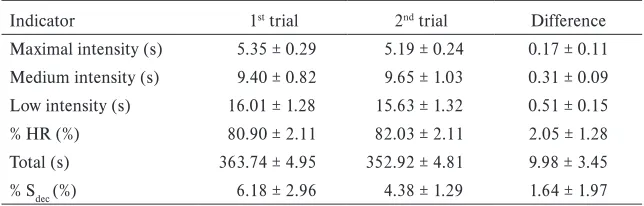
During the test the participants covered 5 504,6 m; calculations imply that during 40 minutes of a game play they would cover 6,880.80 m, and involves a total of 34 jumps (during simulation of 32 minutes of live time of a match), which corresponds to 42.5 jumps during 40 minutes of a match live time. Table 1 shows average time spent in maximal, medium and low intensities during both trials. The participants spent 363.74 ± 4.95 s (352.92 ± 4.81 s) in maximal intensity activities which represent 17.42% (17.03%) of total time, 639.21 ± 22.17 s (656.20 ± 40.13 s) which represent
30.55% (31.66%) of total time in medium intensity activ-ities and 1,088.68 ± 57.32 s (1,062.84 ± 53.05 s) in low intensity activities which represent 52.03% (51.31%) of total time. Table 1 shows the percentage of heart rate, total time, and sprint decrement in both trials.
The reliability, expressed by the intraclass correla-tion coefficient showed a high level of consistency for percentage of heart rate (.922), sprint times (.866), and total time (.851) according to Hopkins (2000). Only moderate level of consistency showed Sdec (.711).
The evidence of high consistency was supported by high agreement of two trials expressed by limits of agreement for sprint times ±0.11 s, total time ±1.55 s, and percentage of heart rate ±0.99%. On the contrary, Sdec showed low agreement of ±2.93%. Typical error measurement expressed absolute values of reliability. According to typical error of measurement, players should be able to repeat the measurement with less than 1.31 s (0.82%) in total time, 0.17 s (2.73%) in sprint time, and 1.32 % (1.19%) for percentage of heart rate. The values 1.68 (38.35%) of Sdec showed very low repeatability.
Discussion
The objective of the study was to assess the reliabil-ity, usefulness, and face validity of a basketball fatigue protocol simulating players’ load during a basketball match. The reliability of a new performance test should be determined before it is used in practice (Spencer, Bishop, Dawson, & Goodman, 2005).
Players’ load in a match is influenced by numerous factors, for example the level at which the match is played (Ben Abdelkrim et al., 2010), players’ fitness (Krustrup et al., 2005), playing position (Di Salvo et al., 2007), the quality of the opponents (Castellano et al., 2011) and previous training (Battaglia, Paoli, Bellafiore, Bianco, & Palma, 2014). Research on the amount and type of fatigue caused by match load Table 1
Descriptive statistics of the test (M ± SD)
Indicator 1st trial 2nd trial Difference
Maximal intensity (s) 5.35 ± 0.29 5.19 ± 0.24 0.17 ± 0.11 Medium intensity (s) 9.40 ± 0.82 9.65 ± 1.03 0.31 ± 0.09 Low intensity (s) 16.01 ± 1.28 15.63 ± 1.32 0.51 ± 0.15
% HR (%) 80.90 ± 2.11 82.03 ± 2.11 2.05 ± 1.28
Total (s) 363.74 ± 4.95 352.92 ± 4.81 9.98 ± 3.45
% Sdec (%) 6.18 ± 2.96 4.38 ± 1.29 1.64 ± 1.97
requires protocols based on time-movement analysis of match performance in a specific sport. The role of these protocols is to accurately copy specific player match load, which is, contrary to a match, similar for all participants.
By analysing match reports from the top men’s league we determined that the mean time for the eight most used players in each team was 28.40 ± 3.98 min. The BSFP28 was designed to simulate player’s load during 28 minutes of a match. Fatigue protocols are frequently used in football, but there are far more sub-stitutions during a basketball match than during a foot-ball match. All observed values were used to estimate the values that the players would achieve in 40 minutes of a game play to make the results comparable with studies of time-motion analysis of game performance in basketball.
BSFP28 measurement validity
The total distance covered during BSFP28 is close to the upper limit for total distance covered in a match (6,605.71 m), which was estimated at 6,235 ± 354 m (Erčulj et al., 2008) and 5,880.91 ± 831.01 m (Hůlka et al., 2013). The number of jumps per player per match has been estimated variously as 44 ± 11 (Ben Abdelkrim et al., 2007) and 17.3 ± 8.4 (Narazaki et al., 2009), BSFP28 with 42.5 is similar to Ben Abdelkrim et al. (2007).
A very important aspect of time-movement analysis of game performance is the total number of changes of direction, speed or type of locomotion in a match. Fol-lowing the intermittent nature of game performance, this is the second factor which distinguishes basketball from sports of a cyclic nature. McInnes et al. (1995) stated 997 ± 183 changes of direction, speed or type of locomotion per player in men’s basketball during a match, Ben Abdelkrim et al. (2007) reported approxi-mately 1,050 ± 51 of these changes per player per match, and Klusemann et al. (2013) reported 809 ± 80. The BSFP28 involves 971.4 changes of direction, speed or type of locomotion.
A limiting factor for game performance is the player’s ability to perform maximum intensity activi-ties repeatedly, throughout the whole match (Glaister, 2008). For training purposes and simulation of player’s load during a match, it is of vital importance to know the number of bursts of maximum intensity activity, their quality and the length of the recovery oppor-tunity (time between burst of maximum intensity). According to McInnes et al. (1995) there are 105 ± 51 maximal intensity activities in a match; however Ben Abdelkrim et al. (2007) claimed that there are only 55 ± 11. This difference can be attributed to differ-ences in the fitness of the players involved in the two
studies. The BSFP28, which simulate 32 min of a match involves 68 bursts of maximal intensity activity which corresponds to 97.14 bursts during a 40-minute match. In terms of the changing load patterns, Bishop and Wright (2006) observed a ratio of 1 : 3 : 4 (maximum : medium : low movement activity); Ben Abdelkrim et al. (2007), Taylor (2003) and Hůlka et al. (2013) observed 1 : 2 : 4, 1 : 3 : 6 and 1 : 2 : 5 respectively. During BSFP28 the participants performed maximum intensity activities for 363.74 ± 4.95 s, medium inten-sity activities for 639.21 ± 27.17 s and low inteninten-sity activities for 1,088.68 ± 57.32 s. These values give a ratio of 1 : 1.79 : 3.00. It could be concluded that this test provides a more exacting alternative than the match measurement results quoted above.
The above mentioned implies that BSFP28 meets the requirements for the simulation of external match load. Heart rate monitoring was used during BSFP28 measurement to verify whether the internal organism reaction is similar to match reaction. Ben Abdelkrim et al. (2007) claim mean heart rate of 171± 4 beats per minute (91 ± 2% of maximum heart rate), Narazaki et al. (2009) mention 169.3 ± 4.5 beats per minute, and Hůlka et al. (2013) observed 167.47 ± 13.01 beats per minute. Mean heart rate was 161.89 ± 3.06 beats per minute (80.90 ± 2.11% of maximum heart rate) during the first measurement and 163.24 ± 4.02 beats per min-ute (82.03 ± 2.11% of maximum heart rate). The values are somewhat lower compared with other studies. We believe that the main reason is the absence of physical contact with an opponent, absence of ball handling and absence of stress (Narazaki et al., 2009). All these three factors increase player load during a match.
BSFP28 measurement reliability
The relative reliability, expressed by intraclass corre-lation coefficient showed high level of consistency in percentage of heart rate. Such evidence showed that repeated internal response of players’ metabolism should be stable and, taking into consideration the validity of the results, similar with internal response during match. Equally, the sprint times and total times of the test showed very high level of consistency. We suppose that the measurement was not weighted by error caused by learning effect. Only medium reliability of moderate and low intensity times showed the diffi-culty of maintaining the tempo of non-maximal speed. With regard to lower necessity of these times, we con-sider between-individual variability to be satisfactory.
(±0.17 s) is crucial for coaches to interpret the results of repeated measures before and after training interven-tions, because measured differences could be caused by error of measurement not by players’ improvement. For future application of BSFP28 in training, a crucial aspect is sensitivity expressed by usefulness of maxi-mum intensity activities, which serves as an indicator of the speed and quality of player’s recovery during medium and low intensity activities. Wragg, Maxwell, and Doust (2000) quote 2% inter-individual variation as the acceptable limit for practical applications. Using this criterion the only variable with significantly unsat-isfactory absolute reliability was Sdec (38.85%). Gabbett (2010), Spencer et al. (2005), Glaister et al. (2009) and Hůlka, Bělka, Cuberek, and Schneider (2014) reported a similar problem and concluded that Sdec can-not be recommended as a fatigue indicator in fatigue protocols due to its high variability. We think that the Sdec index is too sensitive to extreme values of attempts. With regard to high level of reliability, the usefulness should be established before its application in the train-ing or next research. When we compared the smallest valuable change according to Hopkins (2004) with standard error of measurement, the TEM was always lower than usefulness.
As a limit of this study we consider the decreas-ing of the intensity durdecreas-ing each lap, thus interval load but not intermittent load. This fact may influence the metabolic response of players. On the other hand we wanted to make a practically usable test in terms of organisation and utilization in practice and we think more measured high intensity sections could impair the usability of the protocol by coaches.
Conclusions
In the simulation of the nature and size of external load of players during a match in the BSFP28 fatigue proto-col we found that the internal response of the organism to this load is reasonably similar to match load, what indicate BSFP28 to be valid in context of metabolic and biomechanic specificity. Measurements using basket-ball-specific fatigue protocol showed high reliability and agreement of the results.
Acknowledgments
This study was supported by a research grant of Palacký University Olomouc (no. FTK_2014_003).
Conflict of interest
There were no conflicts of interest.
References
Apostolidis, N., Nassis, G. P., Bolatoglou, T., & Geladas, N. D. (2004). Physiological and technical characteristics of elite young basketball players. Journal of Sports Medicine and Physical Fitness, 44, 157–163.
Atkinson, G., & Nevill, A. M. (1998). Statistical methods for assessing measurement error (reliability) in variables relevant to sports medicine. Sports Medicine, 26, 217–238. Attene, G., Pizzolato, F., Calcagno, G., Ibba, G., Pinna, M., Salernitano, G., & Padulo, J. (2014). Sprint vs. intermit-tent training in young female basketball players. Journal of Sports Medicine and Physical Fitness, 54, 154–161. Bangsbo, J., Iaia, F. M., & Krustrup, P. (2008). The Yo-Yo
intermittent recovery test: A useful tool for evaluation of physical performance in intermittent sports. Sports Medi-cine, 38, 37–51.
Barbero-Alvarez, J. C., Soto, V. M., Barbero-Alvarez, V., & Granda-Vera, J. (2008). Match analysis and heart rate of futsal players during competition. Journal of Sport Sci-ences, 26, 63–73.
Battaglia, G., Paoli, A., Bellafiore, M., Bianco, A., & Palma, A. J. (2014). Influence of a sport-specific training back-ground on vertical jumping and throwing performance in young female basketball and volleyball players. Sports Medicine and Physical Fitness, 54, 581–587.
Ben Abdelkrim, N., Chaouachi, A., Chamari, K., Chtara, M., & Castagna, C. (2010). Positional role and competitive-level differences in elite-competitive-level men’s basketball players. Jour-nal of Strength and Conditioning Research, 24, 1346–1355. Ben Abdelkrim, N., El Fazaa, S., & El Ati, J. (2007). Time-motion analysis and physiological data of elite under-19-year-old basketball players during competition. British Journal of Sports and Medicine, 41, 69–75.
Bishop, D. C., & Wright, C. (2006). A time-motion analysis of professional basketball to determine the relationship between three activity profiles: High, medium and low intensity and the length of the time spent on court. Interna-tional Journal of Performance Analysis in Sport, 6, 130–139. Bland, J. M., & Altman, D. G. (1986). Statistical method
of assessing agreement between two methods of clinical measurement. Lancet, 327, 307–310.
Castellano, J., Blanco-Villasenor, A., & Alvarez, D. (2011). Contextual variables and time-motion analysis in soccer.
International Journal of Sports Medicine, 32, 415–421. Dai, B., Mao, D., Garrett, W. E., & Yu, B. (2014). Anterior
cruciate ligament injuries in soccer: Loading mechanisms, risk factors, and prevention programs. Journal of Sport and Health Science, 3, 299–306.
Di Salvo, V., Baron, R., Tschan, H., Montero, F. J., Bachl, N., & Pigozzi, F. (2007). Performance characteristics accord-ing to playaccord-ing position in elite soccer. International Journal of Sports Medicine, 28, 222–227.
using the SAGIT tracking system. Facta Universitatis. Series: Physical Education and Sport, 6, 75–84.
Gabbett, T. J. (2010). The development of a test of repeated-sprint ability for elite women’s soccer players. Journal of Strength and Conditioning Research, 24, 1191–1194. Glaister, M. (2008). Multiple-sprint work: Methodological,
physiological, and experimental issues. International Jour-nal of Sports Physiology and Performance, 3, 107–112. Glaister, M., Hauck, H., Abraham, C. S., Merry, K. L.,
Bea-ver, D., Woods, B., & McInnes, G. (2009). Familiarization, reliability, and comparability of a 40-m maximal shuttle run test. Journal of Sports Science and Medicine, 8, 77–82. Gonzalo-Skok, O., Tous-Fajardo, J., Arjol-Serrano, J. L., &
Mendez-Villanueva, A. (2013). Determinants, reliability, and usefulness of bench press repeated power ability test in young basketball players. Journal of Strength and Condi-tioning Research, 28, 126–133.
Hawkins, R. D., Hulse, M. A., Wilkinson, C., Hodson, A., & Gibson, M. (2001). The association football medical research programme: An audit of injuries in professional football. British Journal of Sports Medicine,35, 43–47. Hopkins, W. G. (2000). Measures of reliability in sports
medicine and science. Sports Medicine, 30, 1–15. Hopkins, W. G. (2004). How to interpret changes in an
ath-letic performance test. Sportscience, 8, 1–7.
Hůlka, K., Bělka, J., Cuberek, R., & Schneider, O. (2014). Reliability of specific on-ice repeated-sprint ability test for ice-hockey players. Acta Gymnica, 44, 69–75.
Hůlka, K., Cuberek, R., & Bělka, J. (2013). Heart rate and time-motion analyses in top junior players during basket-ball matches. Acta Universitatis Palackianae Olomucensis. Gymnica, 43(3), 27–35.
Impellizzeri, F. M., & Marcora, S. M. (2010). Test validation in sport physiology: Lessons learned from clinimetrics.
International Journal of Sports Physiology and Performance, 4, 269–277.
Klusemann, M. J., Pyne, D. B., Hopkins, W. G., & Drinkwa-ter, E. J. (2013). Activity profiles and demands of seasonal and tournament basketball competition. International Jour-nal of Sports Physiology and Performance, 8, 623–629. Krustrup, P., Mohr, M., & Bangsbo, J. (2002). Activity
pro-file and physiological demands of top-class soccer assistant refereeing in relation to training status. Journal of Sports Sciences, 20, 861–871.
Krustrup, P., Mohr, M., Ellingsgaard, H., & Bangsbo, J. (2005). Physical demands during an elite female soccer game: Importance of training status. Medicine & Science in Sports & Exercise, 37, 1242–1248.
Matthew, D., & Delextrat, A. (2009). Heart rate, blood lac-tate concentration, and time-motion analysis of female basketball players during competition. Journal of Sports Sciences, 27, 813–821.
McInnes, S. E., Carlson, J. S., Jones, C. J., & McKenna, M. J. (1995). The physiological load imposed on basketball players during competition. Journal of Sports Sciences, 13,
387–397.
McKeag, D. B. (2003). Basketball. Indianapolis, IN: Black-well Science.
Montgomery, P. G., Pyne, D. B., & Minahan, C. L. (2010). The physical and physiological demands of basketball
training and competition. International Journal of Sports Physiology and Performance, 5, 75–86.
Narazaki, K., Berg, K., Stergiou, N., & Chen, B. (2009). Physiological demands of competitive basketball. Scan-dinavian Journal of Medicine and Science in Sports, 19,
425–432.
Oliver, J., & Smith, P. (2010). Neural control of leg stiffness during hopping in boys and men. Journal of Electromyogra-phy and Kinesiology, 20, 973–979.
Prodromos, C. C., Brown, C., Fu, F. H., Georgoulis, A. D., Gobbi, A., Howell, S. M., … Shelbourne, K. D. (2008). The anterior cruciate ligament: Reconstruction and basic science. Philadelphia, PA: Saunders Elsevier.
Rozzi, S. L., Lephart, S. M., & Fu, F. H. (1999). Effects of muscular fatigue on knee joint laxity and neuromuscular characteristics of male and female athletes.Journal of Ath-letic Training, 34, 106–114.
Sangnier, S., & Tourny-Chollet, C. (2007). Comparison of the decrease in strength between hamstrings and quadri-ceps during isokinetic fatigue testing in semiprofessional soccer players. International Journal of Sports Medicine, 28,
952–957.
Scanlan, A. T., Dascombe, B. J., & Reaburn, R. J. (2012). The construct and longitudinal validity of the basketball exercise simulation test. Journal of Strength and Condition-ing Research, 26, 523–530.
Small, K., McNaughton, L., Greig, M., & Lovell, R. (2010). The effects of multidirectional soccer-specific fatigue on markers of hamstring injury risk. Journal of Science & Medicine in Sport, 13, 120–126.
Smith, H. C., Vacek, P., Johnson, R. J., Slauterbeck, J. R., Hashemi, J., Shultz, S., & Beynnon, B. D. (2012). Risk factors for anterior cruciate ligament injury: A review of the literature – Part 1: Neuromuscular and anatomic risk.
Sports Health, 1, 69–78.
Spencer, M., Bishop, D., Dawson, B., & Goodman, C. (2005). Physiological and metabolic response of repeated-sprint activities: Specific to field-based team sports. Sports Medicine,35, 1026–1044.
Taylor, J. (2003). Basketball: Applying time motion data to conditioning. Strength and Conditioning Journal, 25, 57–64. Williams, J. D., Abt, G., & Kilding, A. E. (2010). Ball-sport
endurance and sprint test (BEAST90): Validity and reli-ability of a 90-minute soccer performance test. Journal of Strength and Conditioning Research, 24, 3209–3218. Woods, C., Hawkins, R. D., Maltby, S., Hulse, M., Thomas,
A., & Hodson, A. (2004). The Football Association Medi-cal Research Programme: An audit of injuries in professio-nal football – aprofessio-nalysis of hamstring injuries. British Journal of Sports Medicine, 38, 36–41.
Wragg, C. B., Maxwell, N. S., & Doust, J. H. (2000). Evalua-tion of the reliability and validity of a soccer-specific field test of repeated sprint ability. European Journal of Applied Physiology, 83, 77–83.
Yu, B., & Garrett, W. E (2007). Mechanisms of non-con-tact ACL injuries. British Journal of Sports Medicine,41,
147–151.