Upper Triassic and Lower Jurassic stratigraphy from exploration well L134/5-1,
o
ff
shore Inner Hebrides, west Scotland
NIGEL R. AINSWORTH1
& IAN BOOMER2
139 De Tany Court, St Albans, Hertfordshire AL1 1TU, UK. ([email protected])
2Department of Geography, University of Newcastle-upon-Tyne, Newcastle NE1 7RU, UK. ([email protected])
ABSTRACT– A thick (c.1368 m) Upper Triassic to Lower Jurassic sedimentary sequence from
explor-ation well L134/5-1, offshore Inner Hebrides, has yielded a rich and diverse foraminiferal and ostracod
microfauna. Many of the taxa have been previously described throughout northwest Europe. Poor preservation (often due to crushing and/or overgrowth) and low numbers preclude a complete taxonomic review of this material, although changes in the faunal composition, rates of faunal turnover and palaeoenvironmental analyses are discussed. This is the first published account of ostracod and foramin-iferal assemblages from the Sea of Hebrides and they indicate that the sediments (argillaceous, arenaceous and carbonates) were deposited in a shelf-marine setting with environmental fluctuations that are possibly
the result of local relative sea-level changes.J. Micropalaeontol.20(2): 155–168, December 2001.
INTRODUCTION
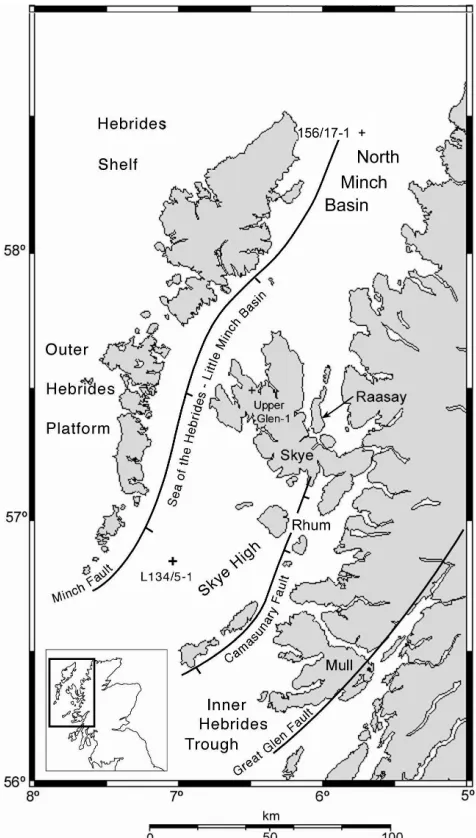
Exploration activity in the Hebrides Basin has remained very low compared to other regions within the United Kingdom continental shelf. To date (April, 2001) only three exploration wells have been drilled, one in the North Minch Basin and two within the Sea of Hebrides. A large number (75) of shallow boreholes have, however, been drilled by the British Geological Survey throughout the Hebrides Basin. British Petroleum drilled the first of the three exploration wells (156/17-1) in the North Minch Basin in 1989 (Fig. 1). This was followed by the first of the two Sea of Hebrides wells, the onshore Upper Glen-1 well drilled by Pentex Oil in 1989 on the island of Skye. Chevron UK drilled well L134/5-1 in the Sea of Hebrides, south of Skye and west of Rhum, within the Inner Hebrides, offthe west coast of mainland Scotland. Chevron L134/5-1 was spudded in February 1991 and plugged and abandoned in May 1991. It reached a total depth of 2472 m, terminating in Stornoway Formation sandstones of Triassic age.
This paper describes the Upper Triassic and Lower Jurassic sediments and microfaunas (foraminifera and ostracods) from well L134/5-1. Particular emphasis has been placed on the microfossil taxa, because it is the first detailed published study of such faunas from this region. The paper describes the micro-faunas and their associated biostratigraphical and palaeoen-vironmental implications. Poor preservation due to compaction and heating of the surrounding sediments by igneous intrusions and/or low abundance preclude a complete taxonomic review of this material. Although the palynological dataset for well L134/ 5-1 has not been used in this study, the authors have had access to the company biostratigraphic report, and have noted that much of the palynomorph biostratigraphic data complements the microfaunal age assignments for the well.
GEOLOGY
The Hebrides Basin can be subdivided into two distinct northeast–southwesterly half-grabens (Fig. 1); to the northwest, the Sea of Hebrides–Little Minch Basin and to the southeast, the Inner Hebrides Trough (Morton, 1983, 1989). Separating these two half-grabens is the Skye High (Morton, 1965; Binnset al., 1975; Harris, 1989, 1992; Fyfeet al., 1993; Hesselboet al., 1998).
The Hebrides Basin is traversed by a number of northeast to southwest/north-northwest to south-southeast trending Caledonian normal faults, which were reactivated during the Triassic. Along the northwest margins of each major basin are two significant faults: the Minch Fault and the Camasunary Fault. The southeast margins of both half-grabens appear, however, to be unfaulted. Numerous rock types occur within the Hebrides Basin, including Proterozoic Torridonian sandstones and Moine Schists, Cambrian Durness Limestone, Devonian Old Red Sandstone, Carboniferous sediments, Triassic New Red Sandstone, Jurassic sediments, Upper Cretaceous chalks, through Palaeogene igneous rocks and finally into Neogene sediments (Fyfeet al., 1993). Within the deepest part of the Sea of Hebrides–Little Minch Basin over 2500 m of Permo-Triassic through to Cretaceous sediments are recovered, of which over 1494 m are Jurassic strata.
LITHOSTRATIGRAPHY
Within the Hebrides Basin, thick extensive Lower Jurassic (Lias Group) sequences have been described from the onshore regions, for example Skye hasc.500 m of exposed Hettangian to middle Pliensbachian sediments. The lithostratigraphical studies of the Lias sequences of the Inner Hebrides commenced in 1897 by Woodward, who subdivided these sediments into a lower Broadford Beds and the overlying Pabba Shales. Since this pioneering work, a large number of publications have discussed these sediments (including Buckman, 1920 (in Lee, 1920); Hallam, 1959; Howarth, 1956; Oates, 1978; Searl, 1992), culmi-nating in the revision of the hebridean Lower Lias Group by Hesselbo et al. (1998). The lithostratigraphy for the L134/5-1 well follows Hesselboet al. (1998).
LITHOLOGY
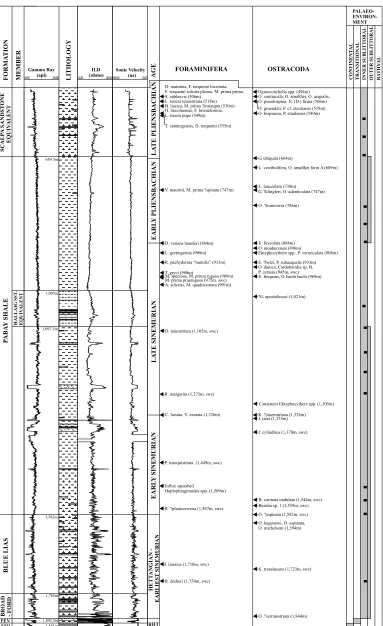
In well L134/5-1, 1368 m of strata were penetrated between the Upper Pliensbachian, Scalpa Sandstone Formation equivalent and the Upper Triassic, Penarth Group (c.494–1890 m depth). One Upper Triassic and six Lower Jurassic lithostrati-graphic units are described using wireline log data (gamma ray, resistivity and sonic velocity) and gross lithology (Fig. 2). A
number of thin igneous intrusions are noted at and below 1250 m (the Pabay Shale Formation). All depths discussed below relate to wireline log data.
The Scalpa Sandstone Formation equivalent: (c.494 m, top not seen, to 659.5 m, log)
The sediments occurring within this interval in well L134/5-1 are envisaged to be lateral equivalents of the Scalpa Sandstone Formation of mainland west Scotland, differing in their more argillaceous content (silty claystone/argillaceous siltstone) and, where recorded, the sandstones comprise finer-grained lith-ologies. These lateral equivalent sediments are presumed to have been deposited in a more distal to source setting.
Age. Late Pliensbachian in well L134/5-1. The Pabay Shale/ Scalpa Sandstone formational boundary is highly diachronous in mainland west Scotland, ranging in age from mid-early to
mid-Late Pliensbachian (mid-ibexto uppermargaritatusZones) (Howarth, 1956; Oates, 1978; Hesselboet al., 1998). The Scalpa Sandstone/Portree Shale formational boundary is placed at, or close to, thetenuicostatum/falciferumzonal boundary (Howarth, 1992).
Lithology.This formation is dominated by medium grey to dark
grey, olive grey, locally silty, non-calcareous to calcareous claystones. Stringers of greyish orange and light olive grey, microcrystalline to sucrosic, dolomite and dolomitic limestone occur throughout. Traces of light olive grey to medium grey, argillaceous siltstone and silty sandstone occur towards the base. Disseminated pyrite occurs throughout this section.
Wireline log characteristics.The lower boundary is moderately
sharp; defined by an increase in gamma ray response and an associated increase in sonic velocity values, reflecting a lithologi-cal change to claystones. The interval is characterized by slightly serrated wireline log motifs with moderately low gamma ray responses and moderately high sonic velocities. The occurrence of sonic spikes indicates dolomite or dolomitic limestone stringers.
The Pabay Shale Formation: (659.5–1582 m, log)
Age.Early Pliensbachian to Early Sinemurian in well L134/5-1. Onshore west Scotland, the Broadford Beds/Pabay Shale for-mational boundary is often poorly dated due to the absence of zonal/subzonal marker faunas. It is tentatively placed at the Early Sinemurian, bucklandi–semicostatum zone boundary (Hesselbo et al., 1998). Similarly the Blue Lias/Pabay Shale formational contact is diachronous. In Morvern (Loch Aline) the junction occurs at thebucklandi–semicostatumzonal bound-ary, while on South Mull the contact is questionably placed within the Early Sinemurian,semicostatumZone.
Lithology. This formation is dominated by argillaceous
sedi-ments, comprising medium dark grey to dark grey, olive grey, in part silty, calcareous claystones. Infrequent beds of dark grey, non-calcareous siltstone and off-white, light olive grey, mica-ceous, calcareous, silty sandstone occur towards the base. Rare stringers of light brownish grey and light olive grey, micro-crystalline to sucrosic, limestone and dolomitic limestone are also noted. Disseminated pyrite occurs throughout this section.
Wireline log characteristics.The upper boundary is moderately
sharp; defined by an increase in gamma ray response and an associated increase in sonic velocity values, reflecting a lithologi-cal change to claystones. The lower boundary of the Pabay Shale Formation is sharp; defined by a decrease in gamma ray response and an associated increase in sonic velocity values, reflecting a lithological change to interbedded limestone and calcareous claystone. The Pabay Shale Formation is character-ized by slightly serrated wireline log motifs with moderately low gamma ray responses and moderately high sonic velocities.
The Hallaig Sandstone Member equivalent: (1005–1097.5 m, log)
The sediments occurring within this interval are considered to be a lateral equivalent to the Hallaig Sandstone Member of
Fig. 1.Location and structure of the Malin–Hebrides area, based on
0.00 50.00 LITHOLOGY 0.20 20.00 60.00 0.00
FORMA
TION
SCALP
A
SANDST
ONE
EQUIV
ALENT
PABA
Y
SHALE
HALLAIG
SST
.
EQUIV
ALENT
HETT
ANGIAN
-EARLIEST
SINEMURIAN
BROAD -FORD
PEN STO
MEMBER
EARL
Y
SINEMURIAN
LA
TE
PLIENSBACHIAN
EARL
Y
PLIENSBACHIAN
LA
TE
SINEMURIAN
D. matutina, F. terquemi bicostata, F. terquemi sulcata plexus, M. prima prima, S. sublaevis (506m)
PALAEO- ENVIRON-MENT
Influx squashed Haplophragmoides spp. (1,509m)
R. dreheri (1,754m, swc) I. liassica (1,710m, swc) M. prima praerugosa (975m, swc)
O. ?serratostriata (1,844m) P. inaequistriata (1,449m, swc)
I. cylindrica (1,370m, swc) D. tenuistriata (1,105m, swc)
A. siliceus, M. quadricostata (991m) M. speciosa, M. prima rugosa (969m) H. lincolnensis, F. brizaeformis, L. tenera pupa (549m)
T. gryci (960m) R. pachyderma “humilis” (933m) L. gottingensis (908m) D. varians hausleri (884m) V. mauritii, M. prima ?spinata (747m) B. liasica, M. prima ?interupta (530m)
G. ?klingleri, O. adenticulata (747m) O. contracula, O. amalthei, O. aequalis, O. pseudospina, N. (D.) firma (506m) L. tenera tenuistriata (518m)
O. bispinosa, P. etaulensis (549m) Ogmoconchella spp. (494m)
O. gruendeli, P. cf. etaulensis (518m)
1,861m
G. ubiquita (664m)
L. vestibulifera, O. amalthei form A (689m)
O. danica, Cardobairdia sp. B, P. cerasia (945m, swc) L. lanceolata (738m)
O. ?transversa (786m)
O. mouherensis (896m)
Ektyphocythere spp., P. vermiculata (908m)
?G. apostolescui (1,021m) E. ?betzi, P. subaequalis (933m)
E. frequens, G. bachi bachi (969m)
C. liasina, V. exarata (1,326m)
Consistent Ektyphocythere spp. (1,305m)
I. tatei (1,335m)
R. ?planiconvexa (1,567m, swc)
B. carinata undulata (1,544m, swc) Bairdia sp. 1 (1,559m, swc)
O. ?aspinata (1,582m, swc)
O. hagenowi, O. aspinata, O. michelseni (1,594m)
K. translucens (1,723m, swc) E. foveolata (884m)
BLUE
LIAS
RHT
TRANSITIONAL
FORAMINIFERA
T. canningensis, D. terquemi (555m)
659.5m
1,097.5m
1,582m
1,785m
1,845.5m 1,005m
ILD
(ohms) Sonic Velocity(us) Gamma Ray
(api)
R. margarita (1,273m, swc)
AGE OUTER
SUBLITT
ORAL
BA
THY
AL
CONTINENT
AL
INNER
SUBLITT
ORAL
OSTRACODA
K. ?sinemuriana (1,326m)
Hesselboet al. (1998). The sediments in well L134/5-1 are finer grained than their onshore counterparts, comprising mainly siltstones/silty claystones, with rare fine-grained sandstones. They are considered to represent a more distal equivalent to the onshore Hallaig Sandstone Membersensu stricto.
Age.Late Sinemurian in well L134/5-1. In Raasay and Skye, the Hallaig Sandstone Member has a maximum stratigraphic extent of mid-Early to mid-Late Sinemurian (mid-semicostatum–lower
oxynotumZones; Hesselboet al., 1998).
Lithology. This member is dominated by dark grey-brownish
black, non- to slightly calcareous silty claystone and siltstone, while subsidiary off-white to light olive grey, very fine- to fine-grained, micaceous, argillaceous sandstone occurs mid-way through the member. Disseminated pyrite occurs throughout.
Wireline log characteristics. The upper boundary is sharp;
defined by a slight decrease in gamma ray response and a marked increase in sonic velocity values, reflecting a lithological change to siltstone. The lower boundary is sharp; defined by a slight increase in gamma ray response and a marked decrease in sonic velocity, reflecting a lithological change to claystones. This member is characterized by a slightly bowed log profile, with the lowest gamma ray response and highest sonic velocity below the midpoint reflecting the most arenaceous part of the section.
The Blue Lias Formation: (1582–1785 m, log)
The Blue Lias Formation interdigitates with the Broadford Formation in many of its more northerly outcrops of west Scotland (e.g. Ardnamurchan), while along its more southerly outcrops (e.g. Mull) it occurs as a lateral equivalent of the Broadford Formation (Hesselbo et al., 1998). The Blue Lias Formation is considered to be a deeper-water equivalent of the Broadford Formation.
Age.Earliest Sinemurian to intra-Hettangian in well L134/5-1. Where fully developed onshore west Scotland, the Blue Lias has a maximum stratigraphic range of Hettangian to earliest Sinemurian (planorbis–bucklandiZones).
Lithology. This formation is dominated by an interbedded
sequence of claystones and limestones. The former comprise medium dark grey to dark grey, olive grey, locally silty, slightly to very calcareous claystones, while the latter comprise yellowish grey, light olive grey, medium dark grey, microcrystalline and sucrosic limestones. The claystones are increasingly lighter in colour and also more calcareous towards the base of the section. Rare beds of off-white to light olive grey, very to fine-grained, micaceous, argillaceous sandstone are also noted.
Wireline log characteristics. The upper boundary is sharp;
defined by a decrease in gamma ray response and an associated increase in sonic velocity, reflecting a lithological change to interbedded limestone and calcareous claystone. The lower boundary is moderately sharp; defined by a decrease in gamma ray response and an associated increase in sonic velocity, reflecting a lithological change to limestone. The Blue Lias Formation is characterized by a regular, serrated ‘spiky’ log
motif, reflecting the limestone–claystone interbeds. The gamma ray response for the Blue Lias Formation is slightly subdued compared to the overlying Pabay Shale Formation.
The Broadford Formation: (1785–1845.5 m, log)
Onshore, this formation has been described as a shallow water equivalent of the Blue Lias Formation. It comprises a succession of littoral carbonate and arenaceous sediments, locally repre-sented by reefs and beach environments (Hesselboet al., 1998). The lower parts of the sequence may yield reduced diversity marine faunas (Hallam, 1959).
Age.Early Hettangian in well L134/5-1. In the Hebrides Basin, the Broadford Formation ranges from the Hettangian through to the earliest Sinemurian (planorbis–bucklandi Zones; Hesselbo
et al., 1998).
Lithology. This formation is dominated by an interbedded
sequence of claystones, limestones and sandstones. The clay-stones are medium dark grey to dark grey, olive grey, locally light brownish grey, in part silty, slightly to very calcareous, while the limestones comprise yellowish grey, light olive grey, medium brown grey, locally sandy, microcrystalline to sucrosic, mudstones. Sandstone beds occur towards the base of the section, comprising off-white to greenish grey, very fine- to fine-grained, slightly argillaceous, calcareous sandstones.
Wireline log characteristics.The upper boundary is moderately
sharp; defined by a decrease in gamma ray response and an associated increase in sonic velocity, reflecting a lithological change to limestone. The lower boundary is sharp; defined by a decrease in gamma ray response and an associated decrease in sonic velocity, reflecting a lithological change to non-calcareous claystones. The Broadford Formation is characterized by an irregular, highly serrated log motif, reflecting the limestone, claystone, sandstone interbedding.
The Penarth Group: (1845.5–1861 m, log)
Age.Rhaetian.
Lithology. This interval solely comprises medium light grey,
dark grey/olive black, waxy, non-calcareous, claystones. These sediments conformably overlie reddened limestones and calcar-eous claystones of the Stornoway Formation at 1861 m (log).
Wireline log characteristics. The upper boundary is sharp;
defined by a decrease in gamma ray response and an associated decrease in sonic velocity, reflecting a lithological change to non-calcareous claystones. This interval is characterized by serrated wireline log motifs with moderately high gamma ray responses and moderately low sonic velocities.
Intrusives
ray responses and high sonic velocities, forming blocky log motifs.
BIOSTRATIGRAPHY
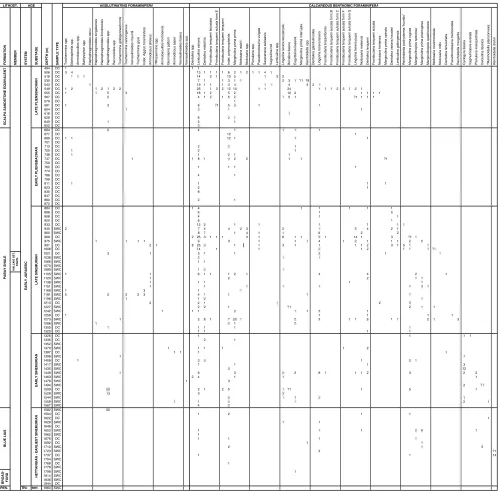
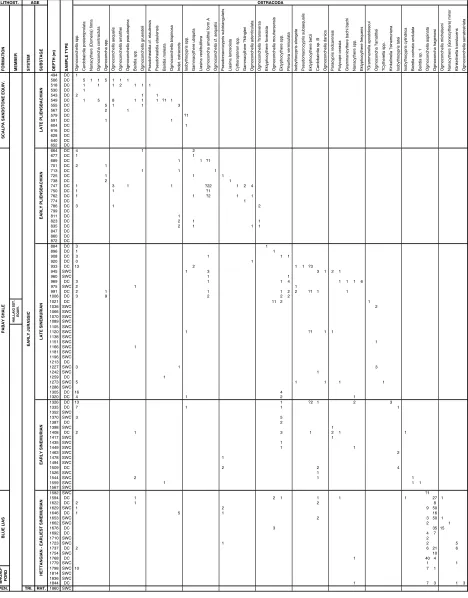
A total of 100 taxa, comprising 11 agglutinating and 44 calcar-eous benthonic foraminifera, in association with 45 species of ostracod were recovered from 104 samples (42 sidewall cores and 62 ditch-cuttings samples). Eight samples were barren of both ostracods and foraminifera. Samples were analysed at approximately 13 m intervals. A number of taxa are considered
to be new; however, very poor preservation precludes a complete taxonomic review of this material (Tables 1–2). Since these data are mainly based on ditch-cuttings, emphasis is placed on the highest downhole occurrences (extinctions) of selected micro-fossil taxa and major micro-fossil assemblage changes. Numerous publications describe the Lower Jurassic microfaunas from the UK and Ireland, and their adjacent offshore areas. These include Ainsworth (1987, 1989a, b, 1990), Ainsworth & Horton (1986), Ainsworthet al. (1987, 1989, 1998), Barnard (1950, 1956, 1957, 1960), Boomer (1990, 1991), Boomer & Ainsworth (in
F
O
RMAT
IO
N
MEMBER SYSTEM SUBST
A G E DEPTH (m) T rochammina spp. G lomospirella spp. Ammobaculit es spp. Bat h ysiphon spp. Haplophragmoides canui Haplophragmoides kingakensis Haplophragmoides lincolnensis Haplophragmoides spp. Recurvoides spp. T rochammina globigerinaef ormis T rochammina canningensis Verneuilinoides maurit ii T rochammina gryci Indet . A gglut . foraminif era Ammodiscus s iliceus ?Rhizammina s pp. Ammobaculit es font inensis G lomospira pat toni Ammodiscus a sper Verneuilinoides liasina Verneuilinoides spp. Dent alina s pp. Lent iculina v arians Dent alina m at ut ina F rondicularia terquemi b icost a ta F rondicularia terquemi s ulcat a fo rm E F rondicularia terquemi terquemi Indet . polymorphinids Marginulina p rima prima Nodosaria issleri Nodosaria spp. Planularia spp. Pseudonodosaria vulgat a Saracenaria sublaevis Vaginulina list i Lent iculina s pp. Lingulina tenera tenuist riat a Brizalina liasica Eogut tu lina liassica Marginulina p rima interrupta Reinholdella spp. Dent alina g landulinoides Lingulina tenera tenera F rondicularia b rizaeif o rmis F rondicularia terquemi s ulcat a fo rm B F rondicularia terquemi s ulcat a fo rm C F rondicularia terquemi s ulcat a fo rm F F rondicularia terquemi s ulcat a fo rm G Lingulina tenera pupa Nodosaria met ensis Dent alina terquemi F rondicularia terquemi s ulcat a Nodosaria hort ensis Marginulina p rima spinata Dent alina v arians hausleri Lent iculina got ti ngensis Reinholdella pachyderma "humilis" Marginulina p rima rugosa Marginulinopsis speciosa Marginulina p rima praerugosa Marginulinopsis quadricost a ta Nodosaria novemcost at a Nodosaria mit is Dent alina tenuist riat a Pseudonodosaria mult icost a ta Reinholdella margarit a Cyclogyra liasina Vaginulinopsis exarat a Planularia inaequist riat a Involutina liassica ?Reinholdella planiconvexa Reinholdella drehri
494 DC 1 1 1
506 DC 3 4 13 1 1 1 1 6 2 1 2 1 1 4 1
518 DC 1 1 1 14 2 1 13 5 1 3 2
530 DC 7 1 1 3 1 1 2 3 1?1 ?9
543 DC 1 19 1 1 1 3 4 1 1 4 3 2 1
549 DC 1 2 1 2 1 2 2 25 1 3 212 10 1 1 24 1 1 1 2 3 1 2 1
555 DC 1 1 5 3 18 1 2 5 2 122 1 1 1 1
567 DC 2 4 1 2 1 5 2 1 5 1 ?11 1 1
579 DC 1
591 DC 1 3 8 ?1 5 3 1 1
604 DC 1 3 1 1
616 DC 1
628 DC 6 2 1
640 DC 1 5 1
652 DC 3
664 DC 2 4 1 1 1 1
677 DC 12 1
689 DC 1 1 12 1 1 1
701 DC
713 DC 2 2 1
725 DC 1 2 1
738 DC 1 1 2 1 1
747 DC 1 1 8 1 4 2 2 1 1 ?1
750 DC
762 DC 1 1 1 1
774 DC
786 DC 4 1
799 DC
811 DC 1 1 1 1
823 DC 2 1
835 DC 8
847 DC
860 DC 2 1
872 DC
884 DC 1 4 1 1 1 1 1
896 DC 6 1 2
908 DC 4 1 1
920 DC 6 1
933 DC 12 2 1 1 1 1 1 1
945 SWC2 7 4 4 2 3 2 1 5 4 2 1
960 SWC 8 7 1 4 1 1 6 2 2
969 DC 225 3 1 1 1 3 1 6 1 1 5 1 141 3 ?11
975 SWC 1 1 1 1 9 3 1 1 1 4 1 2 1 1 1 2 5
991 DC 2 1 825 3 1 1 3 1 1 1 1 2 3 1 5 1 1
1006 DC 14 1 1 2 1 2 1 1 1?1
1021 DC 3 1 5 1 1 3 1 1
1036 SWC 2 1 1
1066 SWC 1 1
1070 SWC
1089 SWC 1 2 1
1105 SWC1 1 6 1 1 1 2 1 4 4 2 1
1120 SWC 1 2 2 1 1
1138 SWC 1 1 1 1 1
1151 SWC 1 1 1 1 1 1 3 1
1166 SWC1 3 1 1
1181 SWC5 2 2 2 3 4 1 1 1 1
1196 SWC 1 1 2 1
1213 DC 2 2 1 1 2 3
1227 SWC 2 2 1 ?1 2 1 1
1242 SWC 1 1 1 2 1 1 3 1
1259 DC 1 1 1 1 1
1273 SWC 1 5 8 1 720 1 2 3 1 1 6 1 1 2 1 3
1286 SWC 1 2 1 2
1305 DC 1 1 1 1 1
1320 DC 1 1 1 1
1326 DC 1 1 1 1
1335 DC 2 1
1352 SWC
1370 SWC 1 1 1 1 1 2
1387 DC 1 1 1 1
1398 SWC 1 1
1408 DC 1 3 3 1 2 1
1417 SWC 1 1 1 3
1435 SWC 3 ?2
1449 SWC 1 6 3 5 2 8 1 1 1 2 3 2 2
1463 SWC 2 4 1 1 1
1478 SWC 1 3
1494 SWC 2 ?1
1509 DC 50 2 1 2 5 1?1 1 5 1
1526 SWC 13 3 3
1544 SWC 5 1 1 2 1
1559 SWC 1 1 5 1 2 1
1567 SWC 4 2
1582 SWC 50
1594 DC 1 2 1 1
1622 DC 1
1629 SWC 1 1
1646 DC
1653 SWC 1 1 1 2 6 1
1662 SWC 1
1676 DC 1 1 1 1
1692 DC 1 1
1710 SWC 2 1 5
1723 SWC 3 ?1
1737 DC 1 1 14
1754 SWC
1768 DC 1
1779 SWC
1798 SWC 1
1814 SWC 1836 SWC
1844 DC
PEN. TRI. RHT. 1860 SWC
LITHOST. BRO AD-FOR D BL UE L IAS SCAL PA SANDST O NE EQ UI VAL E NT PABAY SHAL E H A LLA IG SST. EQUIV.
AGE CALCAREOUS BENTHONIC FORAMINIFERA
SAMPLE TYPE AGGLUTINATING FORAMINIFERA EARL Y J URASSI C HET T ANG IA N -EARL IEST SI NEMURI AN L A T E PL IE NSBACHI AN EARL Y P L IENSBACHI AN L A T E SI NEMURI AN EARL Y S IN EMURI AN
Table 1.Stratigraphical occurrence of foraminifera in well L134/5-1. Samples types are either DC (ditch cuttings) or SWC (sidewall cores). The
FORMATION MEMBER SYSTEM SUBSTAGE DEPTH (m) Ogmoconchella spp. Cardobairdia posteroprolata Nanacythere (Domeria) firma Ogmoconcha contractula Ogmoconcha spp. Ogmoconchella aequalis Ogmoconchella amalthei Ogmoconchella pseudospina Bairdia s pp. Ogmoconchella gruendeli Pseudohealdia c f. etaulensis Pseudohealdia e taulensis Bairdia m olesta Ogmoconchella bispinosa Indet. o stracods Isobythocypris s pp. Gammacythere ubiquita Liasina v estibulifera Ogmoconcha amalthei form A Ogmoconchella cf. aequalis Pseudomacrocypris s ubtriangularis Liasina lanceolata Cytheropteron spp. Gammacythere ? klingleri Ogmoconchella adenticulata Ogmoconchella ?transversa Ektyphocythere foveolata Ogmoconchella mouhersensis Ektyphocythere spp. Pleurifera v ermiculata Isobythocypris e longata Pseudomacrocypris s ubaequalis Ektyphocythere betzi Cardobairdia sp. B Ogmoconchella danica Paracypris redcarensis Polycope cerasia Grammanicythere bachi bachi Nanacythere s pp. Ektyphocythere frequens ?Grammanella apostolescui Ogmoconcha ?amalthei ?Cytherella spp. Kinkelinella ?sinemuriana Isobythocypris tatei Isobythocypris cylindrica Bairdia c arinata u ndulata Bairdia s p. 1 Ogmoconchella aspinata Ogmoconcha hagenowi Ogmoconchella michelseni Nanacythere (Goniocythere) minor Klinkelinella translucens Ogmoconchella serratostriata
494 DC 1
506 DC 5 1 1 5 1 1 1 518 DC 1 1 1 2 1 1 1 530 DC 1
543 DC 2 1 1
549 DC 1 5 8 1 1 1 ?11
555 DC 5 1 1 3
567 DC 2 1
579 DC ?1
591 DC 1 1
604 DC 1
616 DC 628 DC 640 DC 652 DC
664 DC 4 1 2
677 DC 1 1
689 DC 1 1 ?1
701 DC 2 1
713 DC 1 1 1
725 DC 1 1 1
738 DC 2 1
747 DC 1 3 1 1 ?22 1 2 4
750 DC 1 1 ?1
762 DC 1 1 ?2 1 1
774 DC 1
786 DC 3 1 2
799 DC
811 DC 1
823 DC 2 1 1
835 DC 2 1 1 1
847 DC 860 DC 872 DC
884 DC 3 1
896 DC 1 1
908 DC 3 1 1 1
920 DC 0 1
933 DC 13 2 1 1 ?3
945 SWC 1 3 3 1 2 1
960 SWC 1 1
969 DC 3 1 1 4 1 1 1 6
975 SWC 2 1 1
991 DC 2 1 1 1 2 2 ?1 1 1
1006 DC 3 9 2 2 2
1021 DC 11 2 1
1036 SWC 2
1066 SWC 1070 SWC 1089 SWC 1105 SWC
1120 SWC 1 ?1 1 1
1138 SWC
1151 SWC 1
1166 SWC 1
1181 SWC 1196 SWC 1213 DC
1227 SWC 3 1 3
1242 SWC 1
1259 DC 1
1273 SWC 5 1 1 1 1
1286 SWC
1305 DC 16 4
1320 DC 4 1 2 1
1326 DC 13 1 ?2 1 2 3
1335 DC 7 1 1 1
1352 SWC
1370 SWC 3 5
1387 DC 2
1398 SWC 1
1408 DC 2 1 3 1 2 1 1
1417 SWC 1
1435 SWC 1
1449 SWC 1 1
1463 SWC 2
1478 SWC 1
1494 SWC
1509 DC 2 2 4
1526 SWC 1
1544 SWC 2 1 1
1559 SWC 1 1 1
1567 SWC
1582 SWC ?1
1594 DC 1 2 1 1 1 1 27 1
1622 DC 2 1 2 8
1629 SWC 1 2 9 50
1646 DC 1 5 1 16
1653 SWC 2 3 50 1
1662 SWC 2 1
1676 DC 3 35 15
1692 DC 4 7
1710 SWC 2
1723 SWC 1 2 5
1737 DC 2 6 21 6
1754 SWC 10
1768 DC 1 40 4
1779 SWC 1 1
1798 SWC 10 7 1
1814 SWC 1836 SWC
1844 DC 1 7 3 1 3
PEN. TRI. RHT. 1860 SWC
SCALPA SANDSTONE EQUIV. EARLY J URASSIC LATE PLIENSBACHIAN PABAY SHALE SAMPLE TYPE OSTRACODA LITHOST. AGE BLUE LIAS EARLY P LIENSBACHIAN LATE SINEMURIAN H A LLA IG SST. EQUIV. EARLY S INEMURIAN HETTANGIAN -EARLIEST SINEMURIAN BROAD- FORD
press), Brouwer (1969), Clark (1969), Colin et al. (1992), Copestake & Johnson (1984, 1989), Field (1968), Lord (1978), Lord & Bown (1987), Malz & Lord (1976), Park (1987) and Partingtonet al. (1993). Further afield, references are made to France (Apostolescu, 1959; Colloque sur le Lias Français, 1961; Bizon, 1960; Donze, 1967; 1985; Ruget, 1985; Ruget & Sigal, 1967), Germany (Bartenstein & Brand, 1937; Drexler, 1958; Gründel, 1964; Harloff, 1993; Herrig, 1985; Klingler, 1962; Klingler & Neuweiler, 1959; Malz, 1971, 1975), Holland (Brouwer, 1969), Denmark (Norvang, 1957; Bang, 1968, 1971, 1972; Michelsen, 1975), Sweden (Norling, 1972; Sivhed, 1977, 1980), offshore Norway (Malz & Nagy, 1989) and Portugal (Boomeret al., 1998; Exton, 1979; Exton & Gradstein, 1984; Ruget & Sigal, 1970).
To date (April, 2001), only Copestake & Johnson (1989) have published records of the Lower Jurassic foraminifera from the Hebrides Basin, from the Loch Aline area of Morvern, Mull (Gribun) and Raasay. The Lower Jurassic ostracod faunas from the west coast of Scotland have been studied by Clark (1969), although, these data remain unpublished. Currently, this material is being re-examined by one of the present authors (NRA).
Late Pliensbachian (494–664 m)
An age no younger than Late Pliensbachian (margaritatus
Zone) is indicated on the highest downhole occurrence of the calcareous benthonic foraminifera Dentalina matutina at (506 m). Confirmation of this age is indicated by the ostracod
Ogmoconcha contractula Triebel at 506 m and
Haplo-phragmoides lincolnensisCopestake at 549 m. The former taxon
is restricted to the Late Pliensbachian in the Mochras Borehole (Ainsworth et al., 1989; Boomer, 1990), while the latter taxon ranges no higher than the margaritatus Zone (Copestake & Johnson, 1989).
Foraminifera.Thirty species of foraminifera – five agglutinating taxa and 25 calcareous benthonic species – occur in the Late Pliensbachian. Highest downhole occurrences include
Haplophragmoides canui Cushman, H. lincolnensis Copestake,
H. kingakensisTappan,Trochammina canningensis Tappan,T.
globigeriniformis Parker & Jones, Brizalina liasica (Terquem),
Dentalina glandulinoides Franke, D. matutina (d’Orbigny),
D. terquemi d’Orbigny, Eoguttulina liassica (Strickland),
Frondicularia brizaeiformis Bornemann, F. terquemi bicostata
d’Orbigny, F. terquemi sulcata form B Barnard, F. terquemi
sulcata form C Barnard,F. terquemi sulcataform E Barnard,
F. terquemi sulcata form G Barnard, F. terquemi terquemi
d’Orbigny, Lenticulina varians (Bornemann), Lingulina tenera pupa(terquem),L. tenera teneraBornemann,L. tenera
tenuist-riata (Norvang), Marginulina prima ?interupta (Terquem), M.
prima prima d’Orbignyi, Nodosaria hortonensis Terquem, N.
issleri Franke, N. metensis Terquem, Pseudonodosaria vulgata
(Bornemann), Saracenaria sublaevis (Franke) and Vaginulina
listi(Bornemann).
Many of the above foraminifera possess long stratigraphical ranges, with their documented extinctions in the Toarcian. Only two species have their recorded extinctions within the Late Pliensbachian – Haplophragmoides lincolnensis Copestake and
Dentalina matutina(d’Orbigny) – both of which range no higher
than the margaritatus Zone (Copestake & Johnson, 1989). In well L134/5-1, seven species are stratigraphically restricted to the Late Pliensbachian. Throughout this interval the foraminiferal assemblages are dominated by calcareous benthonic species, notably the Nodosariidae (Frondicularia terquemi sulcataplexus Bornemann, Lenticulina varians(Bornemann),Lingulina tenera
plexus Borneman, Marginulina prima prima d’Orbigny), the Polymorphinidae and the Bolivinitidae (Brizalina liasica
(Terquem)). Agglutinating foraminifera only occur in small numbers and are generally poorly preserved. Approximately mid-way through this interval, there is a marked downhole decrease in both diversity and abundance of the foraminifera. Many of the taxa occurring within this interval have been described throughout northwest Europe (see references listed above).
Ostracoda. Eleven species of ostracod occur in the Late
Pliensbachian. Highest downhole occurrences include Bairdia
?molesta Apostolescu, Cardobairdia posteroprolata Ainsworth,
Isobythocypris spp., Nanacythere (Domeria) firma Herrig,
Ogmoconcha amalthei (Quenstedt), O. contractula Triebel,
Ogmoconchella aequalis (Herrig), O. bispinosa (Gründel),
O. pseudospina (Herrig), Pseudohealdia etaulensis Apostolescu
andP.cf.etaulensisApostolescusensuAinsworth.
Although many of these ostracod species are known to range from the Early through to the Late Pliensbachian, none are thought to range into the Toarcian. Ostracod data from the Fastnet Basin, North Celtic Sea and the Mochras Borehole suggested that only two of these species (Ogomoconcha
contractulaTriebel andPseudohealdiacf.etaulensisApostolescu
sensu Ainsworth) are stratigraphically restricted to the Late
Pliensbachian (Ainsworth, 1987; Ainsworth et al., 1989; Boomer, 1990). In well L134/5-1, however, six taxa are restricted to this interval. The Late Pliensbachian ostracod assemblages are not as abundant as the foraminiferal assemblages. Similar to the foraminifera, a marked decrease in abundance occurs below mid-interval, with the earliest part of the Late Pliensbachian barren of ostracods. The assemblages within this interval are dominated by the Healdiidae, notably the generaOgmoconcha
andOgmoconchella, with subsidiary Saipanettidae (Cardobairdia
posteroprolata Ainsworth). No samples contained the latest
Pliensbachian to earliest Toarcian ‘vallate forms’ of
Ogmo-concha (of Malz, 1975) in this section. From the summary
completion log, first returns only began at 494 m, below the setting of the 20 inch casing. The Late Pliensbachian assem-blages bear close similarities to those recorded elsewhere in northwest Europe, especially with the dominance of the Healdiidae.
Early Pliensbachian (664–884 m)
An Early Pliensbachian age is indicated by the highest downhole occurrence of the ostracodGammacythere ubiquitaMalz & Lord at 664 m and the subsequent downhole occurrence of
Ogmo-concha amalthei?form A Michelsen at 889 m.
Foraminifera. Nine species of foraminifera – 1 agglutinating
Verneuilinoides mauritii (Terquem) and Marginulina prima
spinataTerquem.
One taxon is stratigraphically restricted to the Early Pliensbachian (Verneuilinoides mauritii (Terquem), while two taxa do not occur below the Early Pliensbachian (Glomospirella
spp., Brizalina liasica (Terquem)). Throughout this interval, foraminifera are generally rare, of low diversity and are com-prized almost exclusively of calcareous benthonic taxa, notably the Nodosariidae (Lenticulina varians (Bornemann)) and the Polymorphinidae. This marked decrease in foraminiferal diver-sity within the Early Pliensbachian has also been described from a number of localities throughout England, including Lincolnshire (Brouwer, 1969), Dorset (Barnard, 1950) and the Mochras Borehole (Copestake & Johnson, 1989).
Ostracoda. Fourteen species of ostracod occur in the Early
Pliensbachian. Highest downhole occurrences include
Ektyphocythere foveolata(Michelsen), Gammacythere ?klingleri
Boomer,G. ubiquitaMalz & Lord,Liasina lanceolata (Aposto-lescu),L. vestibuliferaGramann,Ogmoconcha amalthei?form A Michelsen, Ogmoconchella adenticulata (Pietrzenuk),
Ogmo-conchella cf.aequalis (Herrig) sensu Ainsworth, O. transversa
(Gründel) andPseudomacrocypris subtriangularisMichelsen. The occurrence of Gammacythere ubiquita Malz & Lord indicates an Early Pliensbachian (davoei Zone) age at 664 m. The presence of a tentatively identified specimen of
Gamma-cythere klingleriBoomer suggests an Early Pliensbachian (ibex
Zone) age at 747 m, while the occurrence of a caved specimen (884 m) of Ektyphocythere foveolata (Michelsen) indicates the presence of lowermost Pliensbachian (?lower ibex–jamesoni
Zones) sediments within the well section.Ogmoconcha amalthei
?form A Michelsen is also a marker taxon, restricted to the Early Pliensbachian (Michelsen, 1975). From the 14 taxa recorded in this interval, 8 are stratigraphically restricted, while another 4 species do not occur below the Early Pliensbachian. The assem-blages are again dominated by the Healdiidae, notably the genera Ogmoconcha and Ogmoconchella, in association with subsidiary Cytheracea such asGammacythere. The faunas within this section are, however, generally sparser than those occurring in the overlying Late Pliensbachian.
Late Sinemurian (884–1326m)
A Late Sinemurian age is denoted by the highest downhole occurrence of the calcareous benthonic foraminiferaDentalina
varians hausleri (Schick) at 884 m. Although this taxon has a
long stratigraphic range (Lower Sinemurian–Lower Toarcian), it is most commonly recorded from the Late Sinemurian,
raricostatum Zone (Brouwer, 1969; Copestake & Johnson,
1989). Subsequent confirmation of this age is indicated by the occurrence of the ostracod Ogmoconchella mouhersensis
(Apostolescu) at 896 m. This taxon has a restricted stratigraphi-cal range (upper obtusum–lower raricostatum Zones) in the Mochras Borehole (Boomer, 1990).
Foraminifera.Forty-one species of foraminifera – 6
agglutinat-ing taxa and 35 calcareous benthonic species – occur in this interval. Highest downhole occurrences include Ammodiscus
siliceus(Terquem),Trochammina gryciTappan, Dentalina
ten-uistriata Terquem, D. varians hausleri (Schick), Lenticulina
gottingensis (Bornemann), Marginulina prima praerugosa
Norvang, M. prima rugosa Bornemann, Nodosaria metensis
(Terquem), Marginulinopsis quadricostata (Terquem), M.
speciosa (Terquem), Nodosaria mitis (Terquem & Berthelin),
N. novemcostata Bornemann, Pseudonodosaria multicostata
(Bornemann), Reinholdella margarita (Terquem) and
R. pachyderma‘humilis’ Copestake.
Two of the above taxa indicate an age no younger than Late Sinemurian (raricostatum Zone) – Dentalina varians hausleri
(Schick) at 884 m and Trochammina gryciTappan at 960 m – while Reinholdella pachyderma ‘humilis’ Copestake ranges no younger than mid-raricostatum Zone at 933 m (Copestake & Johnson, 1984, 1989). Reinholdella margarita (Terquem) is an important marker species in the UK Early Jurassic, ranging no younger than the earliest Late Sinemurian (mid-obtusumZone) to intra-Early Sinemurian (mid-semicostatumZone) (Copestake & Johnson, 1989). In well L134/5-1, its highest occurrence at 1273 m (swc) is taken to indicate an earliest Late Sinemurian (mid-obtusum Zone) age. Of the 41 taxa recorded, 12 are stratigraphically restricted, while another 10 species do not occur below the Late Sinemurian. The Late Sinemurian interval is dominated by diverse and rich foraminiferal assemblages, especially with respect to the calcareous benthonic taxa, notably the Nodosariidae (Dentalina matutina(d’Orbigny),D. terquemi
d’Orbigny, Lenticulina varians (Bornemann), Lingulina tenera
plexus Bornemann, Marginulina prima plexus d’Orbigny)
and the Polymorphinidae. Although present, agglutinating foraminifera (Ammodiscus, Haplophragmoides and Trocham-minaspp.) are generally very rare throughout the interval, but they do become numerically significant within the middle part of this interval.
Ostracoda. Fifteen species of ostracod occur in the Late
Sine-murian. Highest downhole occurrences includeCardobairdiasp. B Ainsworth,Isobythocypris elongata(Blake),E. ?betzi(Klingler & Neuweiler), E. frequens (Ainsworth), Ektyphocythere spp.,
Gramannicythere bachi bachi(Gramann),Ogmoconchella danica
Michelsen,O. mouhersensis(Apostolescu),Paracypris redcaren-sis (Blake), Pleurifera vermiculata (Apostolescu), Polycope
cerasia(Blake) andPseudomacrocypris subaequalisMichelsen.
The interval is marked by a number of taxa which do not range above the Sinemurian/Pliensbachian boundary. These compriseCardobairdia sp. B Ainsworth, E. ?betzi(Klingler & Neuweiler), E. frequens (Ainsworth), Ogmoconchella danica
Michelsen andO. mouhersensis(Apostolescu). In the Mochras Borehole,Ogmoconchella danica Michelsen is restricted to the latestoxynotum–mid-raricostatumZones, whileO. mouhersensis
(Apostolescu) is restricted to the mid-obtusum–early
rarico-statum Zones (Boomer, 1990). The occurrence of moderate
numbers of Ektyphocythere spp. is a diagnostic feature of Sinemurian ostracod assemblages. Of the 15 taxa recorded, 10 are stratigraphically restricted, while 1 species does not occur below the Late Sinemurian. A marked change in the ostracod composition occurs at the Sinemurian/Pliensbachian boundary with the highest downhole occurrence of moderate numbers of the Cytheracea (Ektyphocythere spp.), in association with the Healdiidae. The Late Sinemurian interval, is dominated by moderately diverse assemblages, particularly the Cytheracea
Similar Upper Sinemurian assemblages, dominated by ornate Cytheracea, are recorded throughout northwest Europe (see references listed above).
Early Sinemurian (1326–?1582 m, swc)
A latest Early Sinemurian age is indicated by the highest downhole occurrence of the calcareous benthonic foraminifera
Vaginulinopsis exarata(Terquem) and the ostracodKinkelinella
?sinemuriana(Ainsworth) at 1326 m. The former taxon is
strati-graphically restricted to the late semicostatum–early turneri
Zones in west Scotland (Copestake & Johnson, 1989).
Foraminifera.Twenty-five species of foraminifera – 4 agglutinat-ing taxa and 21 calcareous benthonic species – occur in the Early Sinemurian. Highest downhole occurrences includeAmmodiscus
asper(Terquem),Verneuilinoides liasina(Terquem & Berthelin),
Cyclogyra liasina (Terquem), ?Involutina liassica (Jones),
Lingulina tenera substriata (Franke) and Planularia
inaequist-riata (Terquem), ?Reinholdella planiconvexa (Fuchs) and
Vaginulinopsis exarata(Terquem).
The latest Early Sinemurian (lowertuneriZone) is denoted by the occurrence ofVaginulinopsis exarata(Terquem) at 1326 m. The presence ofPlanularia inaequistriata(Terquem) confirms an Early Sinemurian age at 1449 m (swc). This taxon has a short stratigraphical range (bucklandi Zone) in Morvern, west Scotland (Copestake & Johnson, 1989), however, in well L134/ 5-1 it is envisaged to have a less restricted range, extending into the mid-Early Sinemurian. Of the 25 taxa recovered, 5 species are stratigraphically restricted, while another 11 taxa do not occur below the Early Sinemurian. The Early Sinemurian can be divided into an upper interval (1326–1494 m, swc) characterized by sparse foraminiferal assemblages (some specimens of which are presumed cavings) and a lower interval (1509–1582m, swc) characterized by large numbers of poorly preserved
Haplo-phragmoides spp., with subsidiary Nodosariidae (Lenticulina
varians (Bornemann)) and the Polymorphinidae. No direct
faunal comparisons can be made with these Lituolidae-dominated assemblages; however, the calcareous benthonic foraminifera are similar to those described from other sites in northern Europe.
Ostracoda. Thirteen species of ostracod occur in the Early
Sinemurian. Highest downhole occurrences includeBairdia
cari-nata undulata Herrig, Bairdiasp. 1 Ainsworth, Isobythocypris
cylindrica(Herrig),I. tatei(Coryell) andKinkelinella
?sinemuri-ana(Ainsworth).
All of the above ostracod taxa are envisaged to range later than the Early Sinemurian, with bothBairdiasp. 1 Ainsworth
and Isobythocypris tatei (Coryell) occurring often in profuse
numbers throughout the UK offshore (Ainsworth, 1989a, b; Ainsworthet al., 1987, 1989, 1998). Of the 13 species recorded, 4 taxa are stratigraphically restricted, while 1 species does not occur below the Early Sinemurian. Two distinct ostracod assemblages are recognized during the Early Sinemurian. The upper interval (1326–1408 m) is composed of moderately diverse ostracod assemblages, comprising smooth-valved taxa such as
Ogmoconchella, Isobythocypris, CardobairdiaandParacypris, in
association with moderate numbers of ornate Cytheracea (e.g.
Ektyphocythere and Kinkelinella). The lower interval (1417–
1567 m, swc) is characterized by sparse, low diversity faunas composed entirely of smooth taxa, notably Bairdia carinata
undulataHerrig, Bairdia. sp. 1 Ainsworth, Cardobairdiasp. B
Ainsworth, Isobythocypris spp. and Pseudomacrocypris
subtriangularisMichelsen.
Similar assemblages have been described by Ainsworth (1989a) and Ainsworth et al. (1987, 1989) from a number of wells situated in both the North Celtic Sea Basin and Fastnet Basin. Comparable faunas are also known to occur in the more offshore regions of the English Channel Basin and the Southern North Sea (Ainsworth, pers. obs.).
Earliest Sinemurian–Hettangian (?1582–1844 m)
An age no younger than earliest Sinemurian (bucklandiZone) is indicated on the highest downhole occurrence of the ostracod
Ogmoconchella aspinata (Drexler) at 1582 m. The subsequent
downhole occurrence of Ogmoconcha hagenowi Drexler and
Ogmoconchella michelseniAinsworth confirm this age at 1594 m.
Foraminifera. Twelve species of foraminifera – 1 agglutinating
taxon and 11 calcareous benthonic species – occur in the earliest Sinemurian to Hettangian interval. Notable occurrences include common Involutina liassica (Jones) and Reinholdella dreheri
(Bartenstein).
Involutina liassica (Jones) is a common constituent of the
foraminiferal fauna at 1710 m (swc). In the UK Early Jurassic, it is often recorded in abundance within the latest Hettangian– earliest Sinemurian (lateangulata–bucklandiZones) (Copestake & Johnson, 1989). In well L1343/5-1 its abundance is thought to represent its earliest stratigraphic occurrence (late
angulata-Zone). Of these 12 species only one taxon is stratigraphically restricted (Reinholdella dreheri (Bartenstein)). The interval is characterized by low diversity assemblages, with localized peak abundance levels of Haplophragmoidesspp., Reinholdella spp.
and Involutina liassica (Jones). Many of the taxa occurring
within this section may be the product of cavings.
Ostracoda. Ten species of ostracod occur in the earliest
Sinemurian to Hettangian. Highest downhole occurrences in-clude Kinkelinella translucens (Blake), Ogmoconcha hagenowi
Drexler, Ogmoconchella aspinata (Drexler), O. michelseni
Ainsworth andO. ?serratostriataAinsworth.
The association of Ogmoconcha hagenowi Drexler,
Ogmo-conchella aspinata(Drexler), O. michelseniAinsworth indicates
an age no younger than earliest Sinemurian (bucklandiZone) at 1594 m. All three taxa can often occur in profuse numbers. The presence of specimens tentatively assigned to Ogmoconchella
serratostriata Ainsworth at 1844 m suggests an earliest
Hettangian age. Six species are restricted to this interval. With the exception ofOgmoconchella serratostriataAinsworth, all of the other nine species decrease in abundance below c.1770 m. This is envisaged to be a function of lithology resulting in poor recovery from the indurated limestones of the Broadford Formation. The ostracod assemblages are dominated by large numbers of the Healdiidae (notably Ogmoconcha hagenowi
other regions in northwest Europe, most of which are dominated by the Healdiidae. This faunal assemblage is also charac-teristic of contemporary horizons in the North Minch Basin (Ainsworth, pers. obs.).
PALAEOENVIRONMENTAL ANALYSIS
The foraminiferal and ostracod assemblages occurring in well L134/5-1 are very similar to contemporaneous records described from other areas in northwest Europe. The palaeoenvironmental reconstruction of the Hebridean area during the Early Jurassic (Hesselbo et al., 1998) places this exploration well at the southern end of a NNE–SSW-trending depositional basin open-ing seaward to the south, with major detrital sources to the west (Hebrides Platform) and east (Scottish mainland). Given the relatively fine-grained nature of many of the sediments occurring in well L134/5-1, the depositional environment is thought to have been more distal than the correlative sedimentary sequences on Skye to the northwest, typified by a higher incidence of coarser-grained sediments (siltstones and sand-stones). The microfossil assemblages support this palaeogeo-graphical interpretation since they are all indicative of fully marine conditions. There is little evidence of proximity to land or marginal marine conditions which would be indicated by the ostracod taxaDarwinulaorLutkevichinella.
Changes in the faunal composition of both foraminifera and ostracods in well L134/5-1 are illustrated in Figures 3 and 4. From these data, a number of distinct events with characteristic assemblages have been noted. None of the data, however, have taken into account the weight of the unprocessed sample.
The foraminifera display a number of distinct changes. Figure 3 (graphs C and D) illustrates species abundance and
simple species diversity, and includes a 5-point moving mean line which highlights the major patterns of change. For-aminiferal abundance is generally higher than the ostracods throughout much of the studied interval, attaining a maximum of 71 specimens at 969 m. However, ostracods are more abun-dant within the Hettangian–earliest Sinemurian. Likewise foraminiferal diversity is generally higher than the ostracods (with a maximum 24 taxa at 549 m), with a number of distinct cycles clearly visible. Figure 4 (graphs D and E) shows the percentage of agglutinating and calcareous benthonic foramini-fera present in each sample. Throughout much of the Early Jurassic, calcareous benthonic taxa are the prevalent group both in diversity and abundance, dominated by the Nodosaridae
(Dentalina, Lenticulina, Lingulina, Marginulina), the
Polymor-phidae and, to a smaller extent, the Bolivinitidae (Brizalina
liasica). Agglutinating foraminifera are less diverse and
gener-ally of moderate to rare abundance, dominated by Lituolidae
(Haplophragmoides spp.). A number of localized peaks of
Haplophragmoides spp. occur, however, between 1509 m and
1582 m (swc).
The ostracods also exhibit a number of distinct faunal changes throughout the Early Jurassic. Figure 3 (graphs A and B) illustrates species abundance and species diversity, including the 5-point moving mean. Ostracod abundance is highest within the Hettangian–earliest Sinemurian, with numbers reaching 62 specimens, whereas during the Early Sinemurian to Late Pliensbachian interval, totals do not exceed 35 specimens. Ostracod diversity remains relatively low throughout the Early Jurassic (never exceeding 8 taxa), however, again there are clearly a number of cycles. The percentage faunal composition of the ostracod assemblages is illustrated in Figure 4, Graph A
Late Pliensbachian
Early Pliensbachian
Late Sinemurian
Early Sinemurian
Earliest Sinemurian
-Hettangian
Rhaetian B. Ostracod Diversity
400
600
800
1000
1200
1400
1600
1800
2000
0 5 10
D. Foram Diversity
400
600
800
1000
1200
1400
1600
1800
2000
0 10 20 30
A. Ostracod Abundance
400
600
800
1000
1200
1400
1600
1800
2000
0 20 40 60
Depth
(m)
C. Foram Abundance
400
600
800
1000
1200
1400
1600
1800
2000
0 50 100
Fig. 3.Changing diversity and abundance of foraminifera and ostracods with depth based on their highest downhole occurrences. (Graph A) Simple
(Metacopina), Graph B (Bairdiidae and Cyprididae combined) and Graph C (Cytheracea and others) which includes both the Cladocopina and the Platycopina, both groups being extremely rare. The Metacopina graph (Pseudohealdia, Ogmoconchaand
Ogmoconchella) clearly illustrates the dominance of this group in
the earliest Jurassic interval (Hettangian to earliest Sinemurian), it should also be noted that the highest abundance of meta-copids coincides with the ostracod diversity peaks, illustrating their importance within Early Jurassic ostracod assemblages. Of the 80 samples that yielded ostracods, 56 contained metacopids and in all but 10 of those samples, the metacopids make up more than half of all specimens, while 24 samples comprise more than 80%.
The earliest sediments examined in this study (Rhaetian, Penarth Group) are devoid of microfaunas. From both litho-facies evidence and palynological data (rare acritarchs and abundant miospores) a marginal marine environment is sug-gested for these uppermost Rhaetian sediments. The succeeding lowermost Jurassic sediments, the Broadford Formation of Hettangian age, yielded only small numbers of metacopid ostracods, in association with rare echinoderm debris. A shallow marine (inner shelf) environment is suggested, with deposition occurring during the continuing marine transgression initiated during the uppermost Rhaetian. The overlying Blue Lias Formation (Hettangian–earliest Sinemurian) yields low diversity foraminiferal and ostracod faunas. The former is dominated by calcareous benthonic taxa, notably the Nodosaridae
(Lenticulina, Lingulina, Marginulina), with localized peaks of
the Involutinidae (Involutina liassica) and Epistominidae
(Reinholdella dreheri). Ostracods are dominated byOgmoconcha
andOgmoconchellaspp. (albeit in low diversity), with subsidiary
Cytheracea (e.g. Kinkelinella translucens). Echinoderm debris,
microgastropods and bivalves occur in large numbers through-out this interval. A shallow, slightly deeper, low energy, well-oxygenated open marine (inner to middle shelf) environment is envisaged. The occurrence of common specimens ofReinholdella
dreheriat 1754 m (swc) suggests either a slight shallowing or a
period of marine restriction. The high abundance of metacopid ostracods within this interval and the low diversity and abun-dance of foraminifera (which occurs throughout northwest Europe) has been interpreted as the colonization of a transgres-sive sea by an opportunistic and successful group of organisms. The Lower Sinemurian can be subdivided into two units. The lowermost part of the Pabay Shale Formation of intra-Early Sinemurian age is marked by large numbers of agglutinating foraminiferids (squashedHaplophragmoides spp.) occurring as three distinct peaks. Calcareous benthonic foraminifera, notably the Nodosaridae and the Polymorphinidae, occur in smaller numbers. This is associated with a marked decline in the ostracod faunas, especially with respect to the Metacopina. Although rare, the ostracod assemblages comprise mainly smooth-walled ostracods of the Bairdiidae and Cyprididae
(Bairdia, Isobythocypris, PseudomacrocyprisandCardobairdia).
This association of faunal elements may suggest localized events of slightly reduced (dysaerobic) oxygen conditions upon the sea floor, within a dominantly shallow marine (inner to middle shelf) environment. Bottom water conditions are envisaged to have ameliorated during the latest part of the Early Sinemurian, denoted by a marked increase in the ostracod faunas, notably the ornate Cytheracea (Ektyphocythere). The foraminiferal faunas, however, remain sparse both in diversity and abun-dance, with no particular group dominating the assemblages. An increase in calcareous benthonic foraminiferal diversity and abundance occurs in the earliest part of the Late Sinemurian,
Late Pliensbachian
Early Pliensbachian
Late Sinemurian
Early Sinemurian
Earliest Sinemurian
-Hettangian
Rhaetian B. % Bairdiidae &
Cyprididae
400
600
800
1000
1200
1400
1600
1800
2000
0 50 100
C. % Cytheracea & others
400
600
800
1000
1200
1400
1600
1800
2000
0 50 100
A. % Metacopina
400
600
800
1000
1200
1400
1600
1800
2000
0 50 100
Depth
(m)
D. % Agglutinated
400
600
800
1000
1200
1400
1600
1800
2000
0 50 100
E. % Calcareous Benthonic
400
600
800
1000
1200
1400
1600
1800
2000
0 50 100
Fig. 4.Changing percentage patterns of foraminifera and ostracods with depth, based on their highest downhole occurrences. (Graph A) Percentage
suggesting moderate to good bottom water conditions, within an inner to mid-shelf environment. The foraminiferal faunas are dominated by the Nodosaridae, notablyDentalina, Lenticulina,
LingulinaandMarginulina,reaching an abundance of 64
speci-mens at 1273 m. The ostracods mirror this increase in numbers within this early part of the Late Sinemurian, with the assemblages again dominated byEktyphocythere,in association with subsidiary smooth forms, notably Paracyprisand
Ogmo-conchella. Within the early part of the Late Sinemurian, both
diversity and abundance of the calcareous benthonic fora-miniferids and ostracods decreases; however, agglutinating foraminifera (Ammodiscus, Haplophragmoides and
Tro-chammina) achieve numerical significance, indicating some basin
restriction within the inner to middle shelf environment. Simi-larly the macrofaunas (bivalves, microgastropods and echino-derm debris) are only recovered in small numbers, again suggesting dysaerobic bottom waters at this time. Microfaunal recovery within the Hallaig Sandstone Member equivalent is also poor. Deposition is envisaged to have been within a shallow, inner shelf marine environment. The uppermost Sinemurian sediments yield diverse and abundant macro-and microfaunas, with deposition in a well oxygenated inner shelf, shallow marine environment. The foraminiferal assem-blages are dominated by calcareous benthonic taxa, notably the Nodosaridae (Lenticulina, Dentalina, Lingulina and
Marginulina), reaching a peak abundance of 71 specimens at
969 m and a peak diversity of 20 species at 991 m. Agglutinating taxa only comprise a tiny fraction of the total fauna. Ostracod faunas also increase in both diversity and abundance towards the Sinemurian–Pliensbachian boundary, with up to 20 speci-mens. The assemblages are dominated by the ornate Cytheracea
(Ektyphocythere, Pleurifera, Grammanicythere), in association
with smooth forms, notably the Metacopina (Ogmoconchella). Microfaunal diversity and abundance dramatically decline within the earliest Pliensbachian, suggesting restricted water circulation within an inner to mid-shelf environment. This is supported by the occurrence of large numbers of micro-gastropods within this interval. Midway through the Early Pliensbachian (top Pabay Shale Formation), conditions amelio-rated, denoted by an increase in microfaunal recovery. Similar to the Late Sinemurian interval, the foraminiferal faunas almost exclusively comprise calcareous benthonic taxa, dominated by the Nodosaridae (Lenticulina, Marginulina) and the Polymor-phinidae. Although generally rarer than the foraminifera, a marked peak in ostracod abundance (35 specimens) occurs at 747 m. The ostracods are dominated by the Metacopina, notably Ogmoconcha, Ogmoconchella, in association with the ornate genusGammacythere. A marked decline in microfauna, associated with large numbers of both echinoderm debris and microgastropods, occurs within the basal part of the Scalpa Sandstone equivalent of earliest Late Pliensbachian age. A shallow marine, partly restricted and/or shallow water environ-ment is suggested. A marked increase in diversity and abun-dance occurs within the latest Pliensbachian, with the foraminiferal assemblages dominated by rich calcareous benthonic faunas, including the Nodosaridae (Dentalina,
Frondicularia,Lenticulina, Lingulina,Marginulina,Saracenaria)
and the Bolivinitidae (Brizalina liasica). Although rare, aggluti-nating taxa are dominated by Haplophragmoides and
Tro-chammina. Late Pliensbachian ostracods are moderately
common, again dominated by smooth-walled taxa, including the Cyprididae (Cardobairdia), and the Metacopina (Ogmoconcha,
Ogmoconchella and Pseudohealdia). Deposition of the
Scalpa Sandstone equivalent is envisaged to have occurred within shallow (inner shelf) open marine, well oxygenated environments, distal to an arenaceous source.
CONCLUSIONS
Exploration well L134/5-1 has yielded an extensive Triassic to Lower Jurassic sequence, which contains a valuable biostrati-graphical record permitting correlation with contemporaneous sites throughout much of NW Europe. Although the Rhaetian sediments were barren of microfaunas, the Hettangian to Upper Pliensbachian yields a rich and diverse foraminiferal and ostra-cod fauna. A total of 100 taxa, comprising 11 agglutinating and 44 calcareous benthonic foraminifera, in association with 45 species of ostracod, are recorded. A number of taxa are envis-aged to be new, however, poor preservation precludes a com-plete taxonomic review of this material. Not surprisingly, many of the microfaunal assemblages possess very strong similarities to those described from the west coast of Scotland, the Mochras Borehole, Fastnet and North Celtic Sea basins, as well as southern England and the various North Sea basins. Faunal comparisons can also be made further afield to those of France, Germany, Portugal and Sweden.
The environment of deposition was entirely marine from the earliest Hettangian through to the Late Pliensbachian, but a combination of local tectonic controls and eustatic changes in sea-level caused a number of abrupt changes in faunal diversity, turnover and assemblage composition. It has not been possible to ascertain the relative impact of each of these dynamic processes upon the microbenthos. Figure 5 indicates that ostra-cod diversity remains low despite increasing sample size, whereas the foraminiferal diversity increases with abundance.
The Early Jurassic Hebrides microfossil record can be summarized as follows.
0 5 10 15 20 25
0 20 40 60 80 100
Specimen abundance
Species
diversity
OSTRACODS
FORAMS
Fig. 5.The number of specimens recorded is plotted against the number
The Hettangian to earliest Sinemurian interval is
character-ized by relatively high ostracod abundance dominated by the Metacopina; this is a similar pattern to elsewhere in Europe. The single Triassic sample examined is barren of ostracods and foraminifera.
The Early Sinemurian marks a switch to low abundance Cyprididae/Bairdiidae-dominated assemblages, with relatively high proportions of agglutinating foraminifera. This is fol-lowed by a period dominated by cytheracean ostracods.
The Late Sinemurian witnesses two peaks in diversity and
abundance of both foraminifera and ostracods between the depths 1000 m and 1300 m. These peaks are dominated by metacopine ostracods and calcareous benthonic foraminifera.
The Early Pliensbachian yields poor foraminiferal
assem-blages, but with a peak in ostracod diversity and abundance at about 750 m; subsequently diversity and abundance of both groups falls sharply.
The Late Pliensbachian interval is characterized by
increas-ing biodiversity, dominated by metacopine ostracods and calcareous benthonic foraminifera.
ACKNOWLEDGEMENTS
The authors wish to acknowledge the co-operation of Chevron Europe-London for permission to publish this paper, in particu-lar to David Lewis, Adrian J. Robinson and Lucy Williams. The interpretations expressed in this manuscript are entirely the responsibility of the authors. We wish to thank Dr Sylvie Crasquin-Soleau and the reviewers (Dr P. Copestake and Prof. A. R. Lord) for their useful comments and constructive criticisms.
Manuscript received 12 September 2000 Manuscript accepted 10 May 2001
REFERENCES
Ainsworth, N. R. 1987. Pliensbachian Ostracoda from the Fastnet
Basin, offshore southwest Ireland.Bulletin of the Geological Survey of
Ireland,4: 41–62.
Ainsworth, N. R. 1989a. Systematic description of new ostracod species, in Rutherford, M. M. & Ainsworth, N. R. Micropalaeontological and stratigraphical recognition of the Triassic/Jurassic boundary in the
North Celtic Sea and Fastnet Basins.InBatten, D. J. & Keen, M. C.
(Eds), Northwest European Micropalaeontology and Palynology,
56–65. Ellis Horwood, Chichester.
Ainsworth, N. R. 1989b. Rhaetian, Hettangian and Sinemurian
Ostra-coda from the Fastnet Basin offshore Southwest Ireland.Bulletin of
the Geological Survey of Ireland,4: 107–150.
Ainsworth, N. R. 1990. Uppermost Rhaetian to lower Bajocian
Ostra-coda from the Porcupine, Slyne, Erris and Donegal Basins, offshore
West Ireland.Bulletin of the Geological Survey of Ireland,4: 169–200.
Ainsworth, N. R. & Horton, N. F. 1986. Mesozoic micropalaeontology
of exploration well Elf 55/30-1 from the Fastnet Basin, offshore
southwest Ireland.Journal of Micropalaeontology,5: 19–29.
Ainsworth, N. R., O’Neill, M., Rutherford, M., Clayton, G., Horton, N. F. & Penney, R. A. 1987. Biostratigraphy of the Lower Creta-ceous, Jurassic and uppermost Triassic of the North Celtic Sea and
Fastnet Basins.InBrooks, J. & Glennie, K. (Eds),Petroleum Geology
of North West Europe, 611–622. Graham & Trotman, London. Ainsworth, N. R., O’Neill, M. & Rutherford, M. M. 1989. Jurassic and
Upper Triassic Biostratigraphy of the North Celtic Sea and Fastnet
Basins.InBatten, D. J. & Keen, M. C. (Eds),Northwest European
Micropalaeontology and Palynology, 1–44. Ellis Horwood, Chichester. Ainsworth, N. R., Braham, W., Gregory, F. J., Johnson, B. & King, C. 1998. A proposed latest Triassic to earliest Cretaceous microfossil
biozonation for the English Channel and its adjacent areas. In
Underhill, J. R. (Ed.),Development, evolution and Petroleum Geology
of the Wessex Basin. Geological Society, London, Special
Publi-cations,133: 87–102.
Apostolescu, V. 1959. Ostracodes du Lias du Bassin de Paris.Revue de
L’Institut Francais du Pètrole,14: 795–826.
Bang, I. 1968. Biostratigraphical investigations of the pre-Quaternary
in the Oresund boreholes mainly on the basis of foraminifera. In
Larsen, G., Buch, A., Christensen, O. B. & Bang, I. (Eds),Oresund,
Helsingor–Halsingborgslinien, Geologisk Rapport, 86–88. Rapport Danmarks Geologiske Undersøgelse.
Bang, I. 1971. Jura aflejringerne I Ronde Nr1 (2103-2164M).
Bio-stratigrafi pa grundlag af foraminiferen. Danmarks Geologiske
Undersøgelse,39: 74–80.
Bang, I. 1972. Jura biostratigrafi I Novling Nr1 pa grundlag af
foraminiferen.Danmarks Geologiske Undersøgelse,40: 119–123.
Barnard, T. 1950. Foraminifera from the Lower Lias of the Dorset
Coast.Quarterly Journal of the Geological Society of London, 105:
347–391.
Barnard, T. 1956. Some Lingulinae from the Lias of England.
Micropaleontology,2: 271–282.
Barnard, T. 1957. Frondicularia from the Lower Lias of England.
Micropaleontology,3: 171–181.
Barnard, T. 1960. Some species of Lenticulina and associated genera
from the Lias of England.Micropaleontology,6: 41–55.
Bartenstein, H. & Brand, E. 1937. Mikropaläontologische
Unter-schungen zur Stratigraphie des nordwestdeutschen Lias und
Doggers. Abhandlungen Herausgegeben von der Senckenbergischen
Naturforschenden Gesellschaft,439: 1–224.
Binns, P. E., McQuillin, R., Fannin, N. T. G., Kenolty, N. & Ardus, D. A. 1975. Structure and stratigraphy of the sedimentary basins in
the Sea of the Hebrides and the Minches. In Woodland, A. W.
(Ed.), Petroleum and the Continental Shelf of North-West Europe,
93–102. Applied Science Publishers, Barking.
Bizon, G. 1960. Révision de quelques espèces-types de foraminiféres
du Lias du Bassin Parisien de la collection Terquem. Revue de
Micropaléontologie,3: 3–18.
Boomer, I. D. 1990. On Gammacythere klingleri Boomer sp. nov.
Stereo-Atlas of Ostracod Shells,17: 77–80.
Boomer, I. D. 1991. Lower Jurassic Ostracod biozonation of the
Mochras Borehole.Journal of Micropalaeontology,9: 205–218.
Boomer, I. & Ainsworth, N. R. in press. Early Jurassic.InAthersuch, J.,
Keen, M. C. & Wilkinson, I. P. (Eds), A Stratigraphical Atlas of
British Ostracoda2. British Micropalaeontological Society . Boomer, I., Ainsworth, N. R. & Exton, J. 1998. A re-examination of the
Pliensbachian and Toarcian Ostracoda of Zambujal, west-central
Portugal.Journal of Micropalaeontology.,17: 1–14.
Brouwer, J. 1969. Foraminiferal assemblages from the Lias of N. W. Europe. Verlandelingen der Koninklinjke Netherlandsche
(Nederlandse) Akademie van Wetenschappen, Amsterdam.Afdeeling
Natuurkunde,25: 1–48.
Clark, A. R. 1969. The Ostracoda of the Scottish Lias. PhD thesis,
University of London.
Colin, J.-P., Ionnoides, N. S. & Vining, B. 1992. Mesozoic stratigraphy
of the Goban Spur, offshore south-west Ireland. Marine and
Petroleum Geology,9: 527–541.
Colloque sur le Lias Francais 1961.Memoire du Bureau de Recherche
géologiques Miniéres4.
Copestake, P. & Johnson, B. 1984. Lower Jurassic (Hettangian– Toarcian) Foraminifera from the Mochras borehole, North Wales
(U. K.) and their application to a worldwide biozonation.Benthos ’83.
Second International Symposium on Benthic Foraminifera Pau, April
1983, 183–184.
Copestake, P. & Johnson, B. 1989. The Hettangian to Toarcian. In
Jenkins, D. G. & Murray, J. W. (Eds),Stratigraphical Atlas of Fossil
Foraminifera 2, 129–189. British Micropalaeontology Society/Ellis Horwood Limited, Chichester.
Donze, P. 1967. Les Ostracodes du Sondage de
Laneuveville-devant-Nancy (Lotharingen de la region type).Sciences de la Terre,12: 71–90.
Donze, P. 1985. Lias Infe´rieur et Moyen.InOertli, H. J. (Ed.), Atlas
des Ostracodes de France. Bulletin des Centres de Recherches