
Cause-Related Marketing as A Commercially and Socially Oriented Activity: What
Factors Influence and Moderate the Purchasing Intentions?
Karina Adomaviciute
1, Goga Bzikadze
1, Joseph Cherian
2,
Sigitas Urbonavicius
11Vilnius University
Sauletekio al. 9, LT-10222, Vilnius Lithuania
E-mail. [email protected], [email protected], [email protected]
2Graham School of Management
Saint Xavier University
3700 W. 103rd Street, IL 60655, Chicago, US E-mail. [email protected]
http://dx.doi.org/10.5755/j01.ee.27.5.15166
Cause-related marketing uniquely integrates business objectives with social causes, thus simultaneously satisfying usual consumer needs and moral considerations to support social campaigns. As cause-related marketing (CRM) becomes more prevalent, companies will need to be more effective and efficient in launching cause-related marketing campaigns. Simply having a cause-related marketing campaign was once sufficient to distinguish a company; increasing competitiveness in this arena means that campaigns have to be more distinctive and pertinent to successfully gain a position against competitors. While numerous studies have identified factors that influence consumer intention to purchase cause-related products, just a few of them have examined moderating influences. Therefore, this study sought to identify factors that moderated the influence of personal characteristics on the intention to purchase cause-related products. Data were obtained via online surveys from 393 English speaking Lithuanian students. Linear regression and moderating impact analysis were used in order to test seven hypotheses. Results confirmed that altruism, materialism and individualism have positive direct relationships with the intention to purchase cause-related products; product type and guilt did not have a moderating effect on those relationships, but cause involvement is an important moderator. These findings contribute to the theory of cause-related marketing by identifying moderators as being a specific type of personal characteristic (e.g., cause-involvement) and ruling out others (e.g., guilt), or product type. Furthermore, these findings provide insights to marketing managers for planning and positioning cause-related marketing campaigns by showing what factors amplify the effects of altruism, materialism and individualism in this context.
Keywords:Cause-Related Product, Materialism, Individualism, Altruism, Cause Involvement, Guilt, Product Type.
Introduction
Partnering businesses with charitable activities is increasingly common, and numerous companies are trying to implement cause-related marketing (CRM) strategies to improve sales and maintain favourable brand image (Barone et al., 2007), enhance brand awareness, and differentiate their products (Cheron et al., 2012). Furthermore, it is an effective way for a company to add to its social responsibility activities, as CRM is a philanthropic activity when the companies donate money to a social cause with every purchase (Chang, 2008; Lii & Lee, 2012).
As the use of CRM increases, companies need to have knowledge of potential determinants influencing consumer’s intention to purchase cause-related products, in addition to product related factors influencing purchase intentions (Chang, 2008). Despite the large number of studies about variables influencing consumer’s intention to purchase cause-related products, there are few about how the personal characteristics of a consumer influence the intention to purchase cause-related products. This research gap is reiterated by a number of authors (Hyllegard et al., 2010, Goldsmith & Clark, 2012; Bennett, 2003; Gupta &
Pirsch, 2006). Therefore, this paper concentrates on the research problem – how certain personal characteristics affect intention to purchase cause-related products, and what factors exert a moderating influence on this relationship. The study aims to disclose influence of the personal characteristics (altruism, materialism, individualism) on the intention to purchase cause-related products, and especially – to analyze the variables that might have moderating impact on the above mentioned factors.
Consumer Characteristics That Influence
Intention to Purchase Cause-Related Product
2003), individualism (Cornwell & Coote, 2003; Bennett, 2003), trust (Till & Nowak, 2000) have been found to have an influence on the consumer’s intention to purchase cause-related products; however, the studies show rather diverse results (Proenca & Pereira, 2008; Strahilevitz & Myers, 1998).
Consumer demographics (mainly – age and gender) are found to have large influence on general consumer attitudes, and on their willingness to be involved in the cause-related marketing campaign (Ross et al., 1992; Cheron et al., 2012; Hyllegard et al., 2010, Barnes, 1992, Moosmayer & Fulijahn 2010; Proença & Pereira, 2008).
Along with the other factors, value related characteristics (such as hedonism, utilitarianism and altruism) can influence consumer attitudes and purchasing behaviour in general (Strahilevitz & Myers, 1998; Proença & Pereira, 2008; Okada, 2005; Chang & Chen, 2009). Those characteristics might define the specific motivation of consumers to support social causes and will affect participation in cause-related marketing campaign, as the main purchase incentive (Strahilevitz & Myers, 1998). More specifically, consumption of hedonic products activates feeling of guilt, which pushes consumers to take part in cause-related marketing campaigns (Subrahmanyan, 2004). Therefore, even though hedonic consumption is generally linked with the personal desire for pleasure, hedonic consumers more likely have positive intention to purchase cause-related products (Arnold & Reynolds, 2003). Likewise, Proença & Pereira (2008) emphasize that hedonic shopping motivations influence consumer attitudes to support CRM campaigns, and their desire for social responsibility is enhanced.
Conversely, utilitarian shopping does not directly affect purchase intent in CRM situations. Utilitarian motivation is oriented towards more practical satisfying of needs, and it does not necessarily influence consumer’s intention to purchase cause-related products (Strahilevitz & Myers, 1998). Therefore, in comparison to utilitarian consumption, hedonic consumption enhances altruistic feelings and the intention to purchase cause-related products is expressed more strongly (Strahilevitz & Myers, 1998; Okada, 2005).
Altruism is considered to be a core variable which moves consumers to support social causes, increasing their intention to be more socially responsible members of society. Webb & Mohr (1998) emphasize that consumers get double benefit while purchasing cause-related products, as the product fulfils the functional needs for which they bought the product, and the CRM campaign fulfils their altruistic needs by helping a social cause. Strahilevitz & Myers (1998) describe altruism as the consumption of a “warm glow” and the process of buying internal satisfaction. Whenever consumers are sure that a company has altruistic desires while sponsoring a social cause, their desire to support the social cause is much stronger and positive attitudes arise in their mind regarding the sponsoring organization (Gupta & Pirsch, 2006). Proença and Pereira (2008) state that altruism is a pure source of motivation for the consumers to be part of cause-related marketing campaigns, as it makes them to feel psychologically satisfied. According to Gupta & Pirsch (2006), when the altruistic feelings are enhanced in consumer’s mind, they
make an individual more socially responsible, and they trust the cause supporter (a company) more.
Trust has been considered as one of the most influential factors in CRM and can have significant impact on the individual’s intention to support the campaign (Webb & Mohr, 1998). However, if the image of the sponsoring company is negative, consumers might not trust company’s pro-social behaviour to support the cause (Till & Nowak, 2000). According to Grau & Folse (2007), when consumers are involved in the cause, they have better understanding of the issues and it positively affects their trust level towards the CRM campaign.
Numerous studies show that materialism is an important personal characteristic that influences the consumer’s consumption behaviour (Goldsmith & Clark, 2012). Goldsmith & Clark (2012) describe materialism as a value orientation to achieve material possessions and consequent social acknowledgment. Likewise, Wymer & Samu (2009) state that materialists consider their possessions and acquisitions as being the most important assets in their life, which makes them feel happy and satisfied. In addition, Bennett (2003) states that materialists strive all the time to accumulate products that have external symbolic value, so they can enhance their social status. Therefore, the emphasis on hedonic or utilitarian aspects in a CRM campaign (for example, using products that are more of hedonic or of utilitarian nature) might have the influence on a materialistic consumer’s intention to participate in the cause-related marketing campaign (Strahilevitz & Meyers, 1998). Individuals with a high level of materialism have been found to have positive attitudes towards the companies supporting worthy social causes (Bennett, 2003). In addition, materialists are considered to be more influenced and attracted by the cause-related marketing campaign when the brand is well-known, i.e. when they can relate their self-concept with the brand image (Wymer & Samu, 2009). Therefore materialists are expected to have higher level of the positive response towards the cause-related marketing campaign as they are looking for yet another way to impress other society members (Bennett, 2003). Furthermore, Wymer & Samu (2009) found that the individuals with higher levels of the materialism respond to the cause-related marketing campaign more positively than do individuals with the lower levels of materialism. According to Strahilevitz & Myers (1998), some materialistic people have stronger feelings of guilt, which can affect their response to the CRM campaign.
related marketing campaign (Bennett, 2003). In addition, Kim & Johnson (2013) state that people with high level of individualism try to define themselves as unique members of society with different mental attributes: values, traits, motives, abilities and the motivation to be independent. If these mental attributes match the aims of the CRM campaign and/or values of the participating company, individualists are likely to support the cause-related marketing campaigns launched by this organization (Cornwell & Coote, 2003). Hence, Kim & Johnson (2013) clearly emphasize that the individualists have stronger desire to support the CRM campaign when they are involved in the social cause as it accentuates their feelings of individuation.
However, while extant literature on consumer related characteristics shows the importance of those characteristics on consumer attitudes towards the cause-related marketing campaigns, the influence of the altruism, materialism and individualism on consumer’s intention to purchase cause-related products remains not fully explored (Goldsmith & Clark, 2012; Bennett, 2003; Gupta & Pirsch, 2006).
Guilt, Cause Involvement and Product Type
Moral emotions influence consumer behaviour (Coulter & Pinto, 1995; Cotte et al., 2005). In some cases, feeling of the guilt (one of these moral emotions) is understood as a cognitive variable that affects altruistic desire and enhances willingness support cause-related marketing campaigns (Proença & Pereira, 2008). There are various ways how the feeling of guilt motivates people to be part of CRM campaign. For example, Proença & Pereira (2008) consider moral guilt as the result of not donating to charity and that creates negative associations in consumer’s mind. Because non-participation makes them feel that they are avoiding social responsibility, this feeling of anticipated guilt makes them respond to the CRM campaigns positively. Consumption of hedonic products is also often followed by the feeling of guilt, which motivates consumers to buy cause-related products, in order to assuage the moral guilt (Strahilevitz & Myers, 1998). Webb and Mohr (1998) emphasize that consumers actively try to avoid negative feelings/emotions (like guilt) after purchasing luxury products. According to Proença & Pereira (2008) consumers buy cause-related products more readily when they want to overcome the feeling of guilt. Consequently, marketers may develop their marketing message in a way that enhances consumer feelings of guilt, and that increases sales (Burnett & Lunsford, 1994). Kim & Johnson (2013) state that individuals with the high level of guilt, have higher intention to buy cause-related products, as they want to get rid of guilt; in fact, guilt can be the key moral emotion influencing consumer desire to be part of a cause-related marketing campaign. In this sense, the influence of guilt is similar to the influence of materialism, and this suggests that guilt and materialism are highly correlated (Wymer & Samu, 2009). Cause involvement also has been considered as the important factor in CRM by influencing consumer attitudes and purchasing decisions (Bigne-Alcaniz et al., 2010; Grau & Folse, 2007; Hajjat, 2003; Trimble & Rifon, 2006). Historically, personal involvement in the cause was described as the degree to which personal interest was
awakened by the stimulus of a specific issue (Antil, 1984), which is often based on personal interests and values (Zaichkowsky, 1985). Whenever consumers are deeply involved in a social cause, they have better understanding of the issues and they process CRM messages more carefully, which can enhance brand identity and image (Bigne-Alcaniz et al., 2010). According to Grau & Folse (2007), consumers, who are more involved with a social cause, are more likely to participate in the cause-related marketing campaign. In addition, highly cause involved individuals identify sponsor brand much easier and their brand commitment is much higher (Grau & Folse, 2007). Highly involved individuals expect to make large donations to the social cause as it is important to them (Hajjat, 2003). According to Grau & Folse (2007) consumers more often donate to the social causes connected to their personal lives and they consider that connection as an important reason to donate. However, consumers, who have low involvement in the social cause, might support the CRM campaign if the partnering brand is familiar to them, as they may want to enhance their identification with the cause supporter brand (Bigne-Alcaniz et al., 2010). Companies understand the importance of consumer involvement with the cause and they link their CRM messaging with relevant partners in order to better engage their target audience with the cause, and, through that, with their brand.
this case both the buyer of the charity-linked product and the recipient of the gift feel accomplished by supporting the social cause. According to Wymer & Samu (2009) cause-related product type and the price are two important variables which can have a significant influence in CRM. Chang & Liu (2012) determined that consumers are more likely to choose a hedonic product offering a donation with a complementary cause (fit). This differs from the preference in case of a utilitarian product.
Summarising, the literature review suggest that guilt, cause involvement and product type may have impact on consumer behaviour in CRM. However, the way they interact with other factors are not entirely clear, and that is discussed next.
Research Methodology
Though studies on various aspects of altruism are abundant, it has not been studied extensively in the context of CRM campaigns, especially in the context of different product types. However, product types were seen earlier to generate different levels of participation in CRM campaigns (Strahilevitz & Myers, 1998). The product type (e.g., luxury and practical products) can moderate the link between the altruism and purchase intention of a CRM product, because the link is stronger for altruistic products. Therefore, these hypotheses follow:
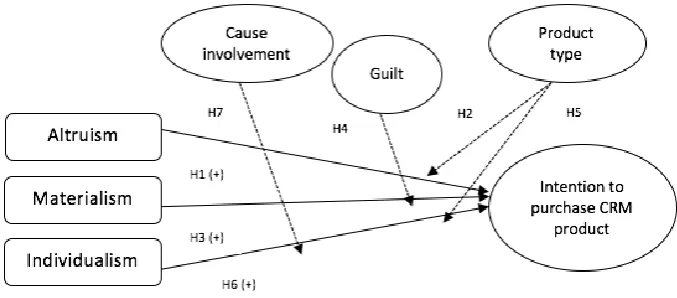
Hypothesis 1: The higher the consumer altruism the higher the purchase intention towards cause-related products.
Hypothesis 2: Altruism has stronger influence on purchase intention toward cause-related products for luxury products than for practical products.
Similarly, the literature review showed the under-researched link between materialism and intention to
purchase CRM products. As before, literature suggests a moderating effect of materialism based on product types as it outlined earlier (Strahilevitz & Myers, 1998; Goldsmith & Clark, 2012). Materialism “works” in the context of the CRM in conjunction with the guilt. Therefore, these hypotheses follow:
Hypothesis 3: The higher the consumer materialism the higher the purchase intention towards cause-related products.
Hypothesis 4: The positive influence of consumer materialism on the purchase intention towards cause-related products gets stronger with the increase of guilt.
Hypothesis 5: Materialism has stronger influence on purchase intention towards cause-related products for luxury products than for practical products.
Materialistic consumers are often considered to have higher sense of individualism, as they strive to accumulate things, which brings them personal satisfaction and they are less influenced by circumstances (Goldsmith & Clark, 2012; therefore, they are willing to base their behaviours on personal principles and beliefs. Individualistic consumers are likely to participate in cause-related marketing if it can differentiate them from others; this should work independent of product type. Therefore, these hypotheses follow:
Hypothesis 6: The higher the consumer individualism the higher the purchase intention towards cause-related products.
Hypothesis 7: Individualism has a stronger positive influence on purchase intention towards cause-related products when consumers have higher cause involvement.
All these hypotheses are summarised in the research model below (Figure 1).
Figure 1. Research model
Data was collected using an online survey and a non-probability (i.e., convenience) sampling. The questionnaire was sent to 742 Lithuanian students, 393 completed questionnaires were collected and used for further analysis. Non-response analysis showed no significant differences between respondents and non-respondents.
The research questionnaire consisted of 6 main constructs: altruism, materialism, individualism, guilt,
involvement, 4-items scale by Maheswaran & Meyers-Levy (1990) was chosen. Grau & Folse (2007) adapted purchase intention scale to make it more relevant for the buying situation that involves cause-related marketing campaign. Therefore, 3–item adapted scale by Grau & Folse (2007) was used in research to measure consumer’s purchase intention. In all instances, 7-point Likert scale was employed.
In order to measure the product type, the statement “I am more likely to support a cause-related marketing campaign when I buy x” (Subrahmanyan, 2004), was modified in a way that “x” indicated a choice between luxury and necessity products.
All Cronbach alphas were higher than 0.6 (Downing, 2004), therefore all the constructs have been used for further exploratory analysis (table 1).
Analysis
Linear regression was used to check the relationship and variance between the main variables; the impact of moderating variables was tested with PROCESS addition to SPSS (Hayes & Preacher, 2014).
The linear regression was used to test H1, H3 and H6 hypothesis, in order to see the relationship between altruism, materialism, individualism and intention to purchase cause-related products.
According the results of linear regression, F=70.609 and p=0.00 for ANOVA and R2 = 0.353, therefore model was statistically significant. Furthermore, all variables (altruism (b=0.395) materialism (b=0.213) and individualism (b=0.115)) had positive significant impact on the intention to purchase cause-related products. Results showed that the impact of altruism was the strongest. Therefore, H1, H3 and H6 hypothesis were supported.
In order to test H2, H4, H5 and H7 and to check the moderator impact of the product type, cause involvement and guilt on intention to purchase cause related products, the PROCESS regression plug in was used (Hayes & Preacher, 2014).
First of all we tested the moderating impact of product type on the relationship between altruism and intention to purchase cause-related products. Moderation is shown up by a significant interaction effect, and, according to the PROCESS procedure, in this case the interaction was insignificant, (b=-0.0489, 95 % CI [-0.3001, 0.2024], t=-0.3826, p=0.7023). This means that the relationship between altruism and intention to purchase cause-related products is not moderated by the product type. Therefore, H2 is rejected.
Next, H4 was tested to check for moderating impact of guilt on the relationship between materialism and intention to purchase cause-related products. Results show that the interaction between guilt and materialism (b=0.0257, 95 % CI [-0.0743, 0.1256], t=0.5054, p=0.6136) is not statistically significant, indicating that the relationship between the materialism and intention to purchase cause-related products is not moderated by the guilt. H4 hypothesis was rejected.
In addition to the above discussed results, the moderator influence of the product type on the relationship between materialism and intention to purchase cause-related
products was tested. Results show that the interaction between product type and materialism (b=0.1496, 95 % CI [-0.0834, 0.3827], t=1.2626, p=0.2075) is not statistically significant, which means that the relationship between the materialism and intention to purchase cause-related products is not moderated by the product type. Therefore H5 hypothesis was rejected.
Finally, H7, checking the moderating influence of the cause involvement on the relationship between individualism and intention to purchase cause-related products was tested. Results show that the interaction between cause involvement and individualism (b=-0.1476, 95 % CI [-0.2767 -0.0184], t=-2.2465, p=0.0252) is significant, which confirmed that individualism had positive direct impact on the intention to purchase cause-related products, when the moderating influence of the cause involvement was considered. Therefore, H7 hypothesis was confirmed. To interpret the moderation effect, conditional effect analysis was performed. Results show that: 1) when cause involvement is low, there is a significant positive relationship between individualism and intention to purchase cause-related products, b=0.3553, 95 % CI [0.1433, 0.5672], t=3.2953, p=0.0011; 2) at the mean value of cause involvement, there is a significant positive relationship between individualism and intention to purchase cause-related products, b=0.1927, 95 % CI [0.0111, 0.3743], t=2.0867, p=0.0376; 3) when cause involvement is high, there is a non-significant positive relationship between individualism and intention to purchase cause-related products, b=0.0302, 95 % CI [-0.2178, 0.2782], t=0.2394, p=0.8109.
To sum up the testing of hypotheses, the statistical tests allow confirming the hypotheses H1, H3, H6 and H7.
Table 1 Results of the Reliability Analysis
Note: N=393. Dependent variable: intention to purchase cause related products.
Furthermore, altruism, individualism and materialism had direct positive connection with consumer’s intention to purchase cause-related products. Likewise, when altruism, materialism and individualism were higher consumer’s intention to purchase cause-related products was higher. The moderating influence of cause involvement on the relationship of the individualism and intention to purchase cause-related products was confirmed. On the other hand, H2, H4 and H5 hypotheses were rejected, as guilt and product type did not impact the relationship of the altruism/materialism and intention to purchase cause-related product
Discussion and Conclusions
The objective of this study was two-fold. First, the study tested the influence of three personal characteristics
Variable Cronbach’s alpha
Altruism 0.868
Materialism 0.809
Individualism 0.644
Product type -
Cause involvement 0.645
(altruism, materialism, individualism) on intentions to purchase cause-related products; of the three, only altruism has received wider attention in research. The moderating influence of these three personal variables on purchase intentions has not been studied (Strahilevitz & Myers, 1998; Goldsmith & Clark, 2012; Bennett, 2003; Proença & Pereira; 2008). Second, literature suggested strong reasons to expect product type, guilt and cause involvement to have a moderating influence between the three characteristics and purchase intention.
The first objective and related hypotheses were confirmed; altruism, materialism and individualism have positive influence on intention to purchase cause-related products. The influence of the latter two is less strong than in case of the altruism, but statistically significant. Together the three factors explain more than one third of the total variance, and this is the first important conclusion of this study.
The analysis of moderation produced more conflicting result. Rather surprisingly, the product type did not generate its moderating influence on the two analysed relationships (altruism → intention; and materialism → intention). This requires further study as the literature review and hypotheses development showed strong reasons to expect these effects.
The moderating influence of guilt on the relation between the materialism and intention was also not significant. This is rather important observation regarding the type of the relationship between the three factors, since relation of guilt and materialism on intention to purchase CRM products are confirmed by former studies (guilt) and by both former and the current study (materialism). The
results of this study suggest looking for other type of interaction between the variables.
The moderating influence of the cause involvement on the relationship of individualism → intention was confirmed, and this is a rather new insight on the studying consumer behaviour in the CRM context, and can be used in further studies as well as in developing managerial insights. This can be considered as the second summarised finding/conclusion of this study.
The contribution of this study towards CRM theory is the exploration and partial confirmation of a variety of moderation effects; in a field that primarily studied main-effects, this study shows a pathway that other disciplines used to evolve towards interaction-effects based studies. The contribution towards CRM management is that there are specific person-based and product-type variables to consider when designing campaigns. The pattern of influence within the CRM context is as complex as, if not more complex than, other consumption behaviours. Therefore, campaign designs must move beyond an expectation so simple.
This study has certain limitations. One of them is the type (students) and scope (one country based) of the sample, which does not allow broad generalizations. Another limitation occurs from the design of the survey. Though it is appropriate to get opinions of respondents without the precisely describing the social cause, this may to some extent impact results of the survey. It is likely that respondents prefer concrete descriptions, and in future studies spelling the specific characteristics of campaigns will be suggested.
References
Antil, J. H. (1984). Conceptualization and operationalization of involvement. Advances in Consumer Research, 11(1), 203– 209.
Arnold, M. J., & Reynolds, K. E. (2003). Hedonic shopping motivations. Journal of retailing, 79(2), 77–95. https://doi.org/10.1016/S0022-4359(03)00007-1
Bakar, A., Lee, R., & Hashim, N. H. (2013). Parsing religiosity, guilt and materialism on consumer ethics. Journal of Islamic Marketing, 4(3), 232–244. https://doi.org/10.1108/JIMA-04-2012-0018
Barnes, N. G. (1992). Determinants of consumer participation in cause-related marketing campaigns. American Business Review, 10(2), 21–24.
Barone, M. J., Norman, A. T., & Miyazaki, A. D. (2007). Consumer response to retailer use of cause-related marketing: is more fit better? Journal of Retailing, 83(4), 437–445. https://doi.org/10.1016/j.jretai.2007.03.006
Bennett, R. (2003). Factors underlying the inclination to donate to particular types of charity. International Journal of Nonprofit andVoluntary Sector Marketing, 8(1), 12–29. https://doi.org/10.1002/nvsm.198
Bigne-Alcaniz, E., Curras-Perez, R., Ruiz-Mafe, C., & Sanz-Blas S. (2010). Consumer behavioural intentions in cause-related marketing. The role of identification and social cause involvement. International Review on Public and Nonprofit Marketing, 7(2), 127–143. https://doi.org/10.1007/s12208-010-0053-6
Burnett M. S., & Lunsford D. A. (1994). Conceptualizing Guilt in the Consumer Decision‐making Process. Journal of ConsumerMarketing, 11(3), 33–43. https://doi.org/10.1108/07363769410065454
Chang, C. T. (2011). Guilt Appeals in Cause-Related Marketing. The Subversive Roles of Product Type and Donation Magnitude. International Journal of Advertising, 30(4), 587–616. https://doi.org/10.2501/IJA-30-4-587-616
Chang, C. T., & Liu, H. W. (2012), Goodwill hunting? Influences of product-cause fit, product type, and donation level in cause-related marketing. Marketing Intelligence & Planning, 30 (6), 634–652. https://doi.org/10.1108 /02634501211262609
Cheron E., Kohlbacher F., & Kusuma K. (2012).The effects of brand-cause fit and campaign duration on consumer perception of cause-related marketing in Japan. Journal of Consumer Marketing, 29(5), 357–368. https://doi.org/10. 1108/07363761211247479
Cornwell, T. B., & Coote, L. V. (2003). Corporate sponsorship of a cause: the role of identification in purchase intent. Journal of BusinessResearch, 58(3), 268–276. https://doi.org/10.1016/S0148-2963(03)00135-8
Cotte, J., Coulter, R., & Moore, M. (2005). Enhancing or disrupting guilt: the role of credibility and perceived manipulative intent. Journal of Business Research, 58(3), 361–368. https://doi.org/10.1016/S0148-2963(03)00102-4
Coulter, R. H., & Pinto, M. B. (1995). Guilt appeals in advertising: what are their effects? Journal of Applied Psychology, 80(6), 697–705. https://doi.org/10.1037/0021-9010.80.6.697
Downing, S. M. (2004). Reliability: on the reproducibility of assessment data. Medical Education, 38(9), 1006–1012. https://doi.org/10.1111/j.1365-2929.2004.01932.x
Goldsmith, R. E., & Clark, R. A. (2012). Materialism, Status Consumption, and Consumer Independence. Journal of Social Psychology, 152(1), 43–60. https://doi.org/10.1080/00224545.2011.555434
Grau, S. L., & Folse, J. A. G. (2007). Cause-related marketing (CRM): The influence of donation proximity and message-framing cues on the less-involved consumer. Journal of Advertising, 36(4), 19–33. https://doi.org/10.2753/JOA0091-3367360402
Gupta Sh., & Pirsch J. (2006).The company-cause-customer fit decision in cause-related marketing. Journal of Consumer Marketing, 23(6), 314–326. https://doi.org/10.1108/07363760610701850
Hayes, A. F., & Preacher, K. J. (2014). Statistical mediation analysis with a multicategorical independent variable. British Journal ofMathematical and Statistical Psychology, 67(3), 451–470. https://doi.org/10.1111/bmsp.12028
Hajjat, M. M. (2003). Effect of Cause-Related Marketing on Attitudes and Purchase Intentions: The Moderating Role of Cause Involvement and Donation Size. Journal of Nonprofit & Public Sector Marketing, 11(1), 93–109. https://doi.org/10.1300/J054v11n01_07
Hyllegard, K. H., Yan, R. N., Ogle J. P., & Attmann J. (2010). The influence of gender, social cause, charitable support, and message appeal on Gen Y's responses to cause-related marketing. Journal of Marketing Management, 27(1/2), 100–123. https://doi.org/10.1080/02672571003683755
Kim, J. E., & Johnson, K. K. (2013). The impact of moral emotions on cause-related marketing campaigns: A cross-cultural examination. Journal of business ethics, 112(1), 79–90. https://doi.org/10.1007/s10551-012-1233-6
Lii, Y. Sh., & Lee, M. (2012). Doing Right Leads to Doing Well: When the Type of CSR and Reputation Interact to Affect Consumer Evaluations of the Firm. Journal of Business Ethics, 105(1), 69–81. https://doi.org/10.1007/s10551-011-0948-0
Maheswaran, D., & Meyers-Levy, J. (1990). The influence of message framing and issue involvement. Journal of Marketing research, 27(3), 361-367. https://doi.org/10.2307/3172593
Moosmayer D. C., & Fuljahn A. (2010).Consumer perceptions of cause related marketing campaigns. Journal of Consumer Marketing, 27(6), 543–549. https://doi.org/10.1108/07363761011078280
Okada, E. M. (2005). Justification effects on consumer choice of hedonic and utilitarian goods. Journal of Marketing Research, 42(1), 43–53. https://doi.org/10.1509/jmkr.42.1.43.56889
Polonsky, M. J., & Macdonald, E. K. (1999). Exploring the link between cause-related marketing and brand building. InternationalJournal of Nonprofit and Voluntary Sector Marketing, 5(1), 46–57. https://doi.org/10.1002/nvsm.96 Proenca, J. F., & Pereira, I. V. (2008). Exploring the consumption of charity-linked products. International Review on
Public and Nonprofit Marketing, 5(1), 53–69. https://doi.org/10.1007/s12208-008-0007-4
Richins, M. L., & Dawson, S. (1992). A consumer values orientation for materialism and its measurement: Scale development and validation. Journal of Consumer Research, 19(3), 303–316. https://doi.org/10.1086/209304 Ross, J. K., Patterson, L. T., & Stutts, M. A. (1992). Consumer Perceptions of Organizations that Use Cause-Related
Marketing. Journalof the Academy of Marketing Science, 20(1), 93–97. https://doi.org/10.1007/BF02723480 Rushton, J. P., Chrisjohn, R. D., & Fekken, G. C. (1981). The altruistic personality and the self-report altruism scale.
Singelis, T. M., Triandis, H. C., Bhawuk, D. P., & Gelfand, M. J. (1995). Horizontal and vertical dimensions of individualism and collectivism: A theoretical and measurement refinement. Cross-cultural research, 29(3), 240–275. https://doi.org/10.1177/106939719502900302
Steenhaut, S., & Van Kenhove, P. (2006). The mediating role of anticipated guilt in consumers' ethical decision-making. Journal of Business Ethics, 69(3), 269–288. https://doi.org/10.1007/s10551-006-9090-9
Steenkamp, J. B. E., Batra, R., & Alden, D. L. (2003). How perceived brand globalness creates brand value. Journal of International Business Studies, 34(1), 53–65. https://doi.org/10.1057/palgrave.jibs.8400002
Strahilevitz, M. & Myers, J. G. (1998). Donations to Charity as Purchase Incentives: How Well They Work: May Depend on What You Are Trying to Sell. Journal of Consumer Research, 24(4), 434–446. https://doi.org/10.1086/209519 Strahilevitz, M. A. (1999). The Effects of Product Type and Donation Magnitude on Willingness to Pay More for a
Charity-Linked Brand. Journal of Consumer Psychology, 8(3), 215–241. https://doi.org/10.1207/s15327663jcp0803_02 Subrahmanyan, S. (2004). Effects of price premium and product type on the cause-related brands: A Singapore perspective.
Journal ofProduct & Brand Management, 13(2), 116–124. https://doi.org/10.1108/10610420410529744
Till, B. D., & Nowak, L. I. (2000). Toward effective use of cause-related marketing alliances. Journal of Product & Brand Management, 9(7), 472–484. https://doi.org/10.1108/10610420010351394
Trimble, C. S., & Rifon, N. J. (2006). Consumer perceptions of compatibility in cause‐related marketing messages. International Journalof Nonprofit and Voluntary Sector Marketing, 11(1), 29–47. https://doi.org/10.1002/nvsm.42 Webb, D. J., & Mohr, L. A. (1998). A typology of consumer responses to cause-related marketing: From skeptics to socially
concerned. Journal of Public Policy & Marketing, 17(2), 226–238.
Wymer, W., & Samu, S. (2009). The influence of cause marketing associations on product and cause. International Journal of Nonprofitand Voluntary Sector Marketing, 14(1), 1–20. https://doi.org/10.1002/nvsm.348
Zaichkowsky, J. (1985). Measuring the Involvement Construct. Journal of Consumer Research, 12(3), 341–352. https://doi.org/10.1086/208520
![CHAPTER 29 THE LAW OF MARRIAGE ACT [PRINCIPAL LEGISLATION] ARRANGEMENT OF SECTIONS](data:image/gif;base64,R0lGODlhAQABAIAAAP///wAAACH5BAEAAAAALAAAAAABAAEAAAICRAEAOw==)