1. Introduction
Since the 1990s, the increasing amount of harvested wood has been one of the factors influencing the ex -pansion of mechanized harvesting in Poland. In 2017, the harvesting of merchantable timber in the State Forests National Forest Holding (SF NFH) aimed to achieve 40.5 million m3, a considerable increase compared to the 15.9 million m3 harvested in 1990 (Forestry 2006). The increase in forest growth leads to higher timber production and forest utilisation, chang-ing unfavourable proportions of stands in all age classes (Borecki et al. 2016). Such conditions have been recognised as attractive by forest contractors, who popularised cut-to-length (CTL) technology, and in
2016, approximately 530 harvesters were in operation in Poland (Mederski et al. 2016b). The harvesters were able to cut and process about 30% of the available tim-ber with highly effective thinning operations in pine stands (Mederski et al. 2016a). Among all forest spe-cies, Scots pine (Pinus sylvestris L.) is the most common in Poland, covering 60% of the land area, while among broadleaves, oak (Quercus robur L. and Quercus petraea (Matt.) Liebl.) claims the biggest share in growing stock, amounting to 8.1% and 6.8% of area and volume, respectively (The National Forest Inventory 2015).
When discussing mechanised harvesting, tree spe-cies cannot be ignored. The original harvesters were built to cut and process coniferous trees, mainly spruce
Investigation of Log Length Accuracy
and Harvester Efficiency in Processing of
Oak Trees
Piotr S. Mederski, Mariusz Bembenek, Zbigniew Karaszewski, Zenon Pilarek,
Agnieszka Łacka
Abstract
Harvester use in broadleaves has recently become more effective economically. However, dif-ficulties with delimbing have shown that not all harvesting heads are suitable and efficient for broadleaved species. The typical obstacles are mainly large tree sizes, bends and forks in the trunks and large branches. For these reasons, it is difficult to obtain specific log lengths ac-cording to the settings in the harvester on-board computer. The objective of the research was to determine: 1) the accuracy of the log lengths from the bottom, middle and top parts of oak trees, and 2) harvester efficiency in the utilisation of the trunk for logs. The research was car-ried out on 61-year-old oaks from which logs with an expected length of 250 cm were processed. To achieve this length, a margin of error was set in the harvester computer with minimum and maximum lengths of 252 and 257 cm. For thinning operations, a Ponsse Ergo harvester with a H7 harvesting head was used. After harvesting, manual log measurements were carried out on 280 logs: 69, 142 and 69, from bottom, middle and top parts of the trees, respectively. The largest share of assortments satisfying the minimum requirement of 250–257 cm was obtained from the middle part of the trees (93%), followed by bottom logs (91%) and top logs (88%). The highest frequency of logs, which were too short, were found to be the top logs (9%), while bottom logs were most often too long (6%); therefore, different length settings should be applied to limit such inaccuracies. Analysis of the last log from the highest part of the tree indicated a strong goodness of fit between the top diameter and the DBH; the mean value of the top diameter was 13.3 cm over bark.
in lowland areas. With time, the scope of operations of these machines was broadened to include steep ter-rains (Stampfer 1999, Frutig et al. 2007) as well as broadleaved stands (Martin et al. 1996 as cited by Sinneau and Cuchet 2001, Spinelli et al. 2002, Spinelli et al. 2009, Mederski 2013). The use of harvesters for broadleaved species makes the machine more univer-sal in Central Europe or Baltic countries, where mixed forests are common, or where a larger share of broad-leaves has been introduced (Mederski et al. 2009). In Central Europe, harvester relocation from one plot to another, exclusively among coniferous forest, very of -ten lengthens trips, leading to increased costs. Mixed and broadleaved stands available to the harvester fill these gaps in machine relocation and contribute to bet-ter machine utilisation and, due to betbet-ter logistics, lower fuel consumption and CO2 emissions. However, the mechanised harvesting of broadleaved trees has resulted in problems associated with delimbing (Labelle et al. 2016), taller stumps in coppice stands (Spinelli et al. 2017), but also larger shavings of the bark and the lateral surface of the processed assortments (Karaszewski et al. 2016). Furthermore, it seems that particular broadleaved species are more favourable for harvesters. In Estonia and Latvia, birch and alder cover approx. 40% of the stands; in Estonia, 95% of the timber is cut by harvesters in final fellings (80% in thin -nings), while in Latvia, 70% of the wood is harvested with CTL technology (Moskalik et al. 2017). Not only has the wider use of harvesters been observed in re-cent years (Mederski et al. 2016b), but there has also been a higher annual use of CTL in European coun-tries (Spinelli et al. 2011, Malinen et al. 2016). It is pre-sumed that the current wider use and higher effective -ness of harvesters are, among other things, due to education, training, automation and organisational knowledge exchange (Häggström and Lindroos 2016).
When discussing the high effectiveness of harvest -ers, obtaining logs of accurate length has its economic importance. First of all, accurate processing leads to optimal trunk use for logs. However, economic losses can be observed when there are significant inaccura -cies, not only due to inefficient use of the trunk: logs which are too long but are destined for the paper in-dustry have to be shortened before debarking, which creates extra costs. In contrast, logs which are too short can be useless for the pallet industry, where an accu-rate, minimum length is necessary to produce a pallet, and meet safety and certification requirements. Basi -cally, logs which are too short generate extra costs by being transported to the factory and then not being used for their intended purpose.
Bearing in mind the above considerations, the re-search presented in this paper was carried out to de-termine to what extent oak branching influences the effectiveness of using a harvester for thinning opera -tions. In particular, the research was designed to main-ly find out the influence of oak branching on the ac -curacy of the cross-cutting of top logs, but also to determine length accuracy in general, in different sec -tions of the tree trunk. In other research, it was re-vealed that when harvesting aspen, the lengths of top logs (from tree crown where branches were removed) did not differ statistically from those of bottom logs (Mederski et al. 2008). This has been explained by the low density of aspen tree wood, which does not pro-vide much resistance during delimbing, and conse-quently does not have a negative influence on the workings of the measuring device inside the harvest-ing head (allowharvest-ing the trunk to remain in constant contact with the measuring wheel).
In light of these results, a hypothesis was formu-lated that the branching in oak (hardwood species) may lead to a decrease in the length accuracy of CTL timber assortments and could limit the processing of logs from the top parts of oak trees. Large branch di-ameter with a high wood density may present resis-tance to the delimbing knives, which could result in multiple attempts to cut the branches, thus decreasing the accuracy of the length measurement by the mea-suring wheel. At the same time, large diameter branch-es may limit log procbranch-essing in the top parts of the trebranch-es. Therefore, the objectives of this research were to find out: 1) the accuracy of log lengths from the bottom, middle and top parts of oak trees, and 2) harvester efficiency in the utilisation of the trunk for logs. Ad -ditionally, the study aimed to propose new variants of computer settings to obtain the largest possible share of logs with the expected length.
2. Materials and methods
up). The DBH of every tree was measured in a different direction, e.g. if one tree was measured along the N–S axis, the next was measured NE–SW, W–E, etc. Tree height and the thickest branch height were measured using a Vertex Laser (Haglof) with an accuracy of 0.1 m.
Subsequently, the study trees were selected to ac -curately represent all the DBH classes (to account for the smallest and largest diameters), but a higher fre-quency of trees was achieved in the more populated DBH classes. For this reason, the trees were selected in such a way that the selected study population (69 trees) presented a normal distribution of DBH. A Shapiro-Francia normality test set at a=0.01 was carried out, the result of which confirmed a normal distribution of DBH for the selected tree population. This was done not only to show the best representation of trees, but also to meet the best criteria for statistical evaluation.
The expected and acceptable assortment lengths for the customer were from 250 to 257 cm. This was applicable for all assortments, from bottom, middle and top tree sections. Therefore, the original harvester computer length settings were 252–257 cm, to meet customer expectations.
The aim was to process logs of a minimum top di-ameter of 7 cm over bark (minimum didi-ameter of mer-chantable timber). From the originally selected 69 study trees, 280 processed assortments were measured after cutting: 69 bottom, 142 middle and 69 top logs. More middle logs were cut as two or more assortments were obtained from the middle part of the trees de-pending on the length of the merchantable trunk.
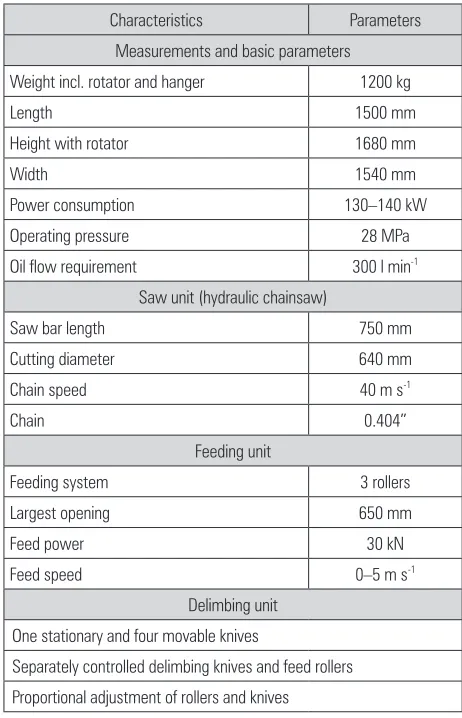
The length measurements were made using a mea-suring tape and were accurate to 1 cm. Additionally, the smallest top diameter (one measurement) over the bark of the last assortment (from the highest part of the trunk) from each of the analysed trees was mea-sured with a Digitech Professional electronic calliper with an accuracy of 1 mm. The timber was harvested in the middle of summer, in July, using a Ponsse Ergo single-grip harvester equipped with a H7 harvesting head (Table 2), which according to the manufacturer’s information, is suitable for coniferous and broad-leaved species. Before thinning, calibration was car-ried out by an operator according to the current stan-dards and with respect to species. The operator was 29 years old with 5 years’ experience working on har -vesters, cutting pine and spruce to a large extent, oc -casionally the broadleaved species - birch and oak.
According to the manufacturer, the H7 harvesting head with three feed rollers (Fig. 1) is designed for harvesting both coniferous and broadleaved trees. Key elements of the machine include: additional feed Table 1 Characteristics of remaining stand, all harvested trees and
those selected for study
Trees Remaining Harvested Harvested & analysed
Feature DBH cm
h
m DBH
cm
h
m DBH
cm
h
m
hb m
Mean 24 18.9 20 17.9 20 18.2 11.9
Minimum 13 11.2 6 8.9 12 11.2 2.2
Maximum 38 27.0 50 24.3 37 22.5 18.3
Standard deviation 5 2.4 6 2.5 6 2.7 2.8
N 137 137 441 441 69 69 69
THI=0.84
DBH – diameter at breast height h – tree height
hb – height of thickest branch on tree
THI – thinning intensity, understood as mean diameter of harvested trees divided by mean diameter of remaining trees
Table 2 Technical specifications of H7 harvesting head
Characteristics Parameters Measurements and basic parameters
Weight incl. rotator and hanger 1200 kg Length 1500 mm Height with rotator 1680 mm Width 1540 mm Power consumption 130–140 kW Operating pressure 28 MPa Oil flow requirement 300 l min-1
Saw unit (hydraulic chainsaw)
Saw bar length 750 mm Cutting diameter 640 mm Chain speed 40 m s-1 Chain 0.404”
Feeding unit
Feeding system 3 rollers Largest opening 650 mm Feed power 30 kN Feed speed 0–5 m s-1
Delimbing unit One stationary and four movable knives
rollers on the frame of the harvester head, upper and lower independently controlled hydraulic delimbing knives, as well as the controlled acceleration of the feed rollers. The length accuracy of the harvester measuring system was 1 cm.
The results obtained from the measured harvested assortments were analysed statistically. The data in the three analysed groups (bottom, middle and top parts) were of a different quantity and had no normal distribution. As a result of this, the non-parametric Kruskal-Wallis test was carried out, followed by a Dunn test for the multiple comparison of the means from each group. The analysis was carried out at a significance level of a=0.05 with STATISTICA 10.0. To graph the results, the program package R (3.0.2) was used (R Development Core Team, 2013).
3. Results
3.1 Log lengthThe average assortment length was 252.5 cm, while the minimum and maximum lengths equalled 243 and 266 cm, respectively (Table 3). On average, the longest
assortments produced were the bottom logs at 254.1 cm; however, these were characterised by the smallest standard deviation (SD). The top logs had the biggest differentiation with the highest standard deviation (Table 3). The average assortment length of the middle logs (251.9 cm) did not fit the length intervals set in the harvester computer (252–257 cm), although it was within the range of expected length (250–257 cm).
Statistical analysis pointed towards a difference in the length of the top logs and middle logs in com-parison to the bottom logs. At the same time, the dif -ference in the top log and middle log lengths was not statistically significant (Table 3).
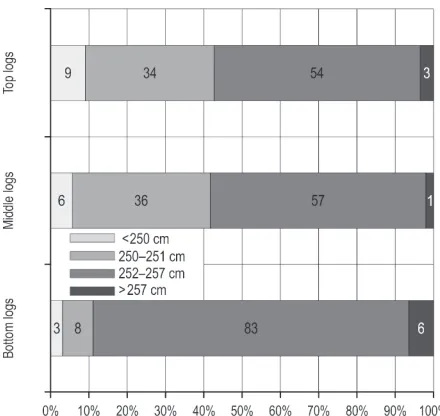
The largest share of assortments satisfying the minimum requirement of 250–257 cm was obtained from the middle part of the trees (93%), followed by the bottom logs (91%) and top logs (88%) (Fig. 2). At the same time, the bottom logs exhibited parameters
Fig. 1 Ponsse H7 harvester head (photo by Piotr S. Mederski) and measuring wheel (indicated with an arrow) in central part of head measure length of tree trunk by contact with its surface
Fig. 2 Proportions of logs from different parts of trees in respective assortment lengths
Table 3 Measures of length variability in harvested logs
Parameter Logs
All Bottom Middle Top Mean, cm 252.5 254.1b 251.9a 252.3a Minimum, cm 243 249 243 245 Maximum, cm 266 259 266 266 Standard deviation 3.89 1.97 2.41 3.03 N 280 69 142 69
most closely complying with those set on the harvest-er computharvest-er: 83%, with only 57% and 54% for the middle and top logs, respectively (Fig. 2). The top logs also featured the largest number of logs that were too short (9%), while the overly long logs were generally found among the bottom logs (6%).
The most common log length was approximately 254 cm long. In other words, the harvester had a ten-dency to cut lengths within the middle of the 252–257 cm setting. For assortments from the middle part of the tree, a tendency for logs to be below the assigned value (namely 251 cm) was observed. The top logs tended to exhibit lengths from the middle of the assigned interval as well as constituting the most populous type of overly short assortment (Fig. 3).
3.2 Effectiveness of trunk processing
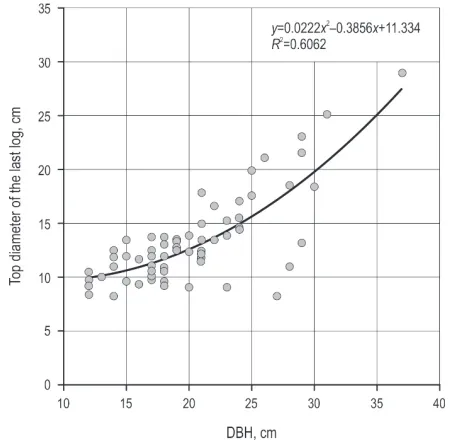
The oak trees were of a good quality with relatively short crowns representing an average of 35% of the to-tal tree height (Table 1). An analysis of the last log from the highest part of the tree indicated a strong goodness of fit between the top diameter and the DBH (Fig. 4). The mean value of the top diameter was 13.3 cm over bark; however, the largest reached as much as 29.0 cm over bark (Fig. 4). The relation between the DBH and the top diameter expressed by multiple R-squared was relatively high: 0.6062. A particularly dynamic increase in the top diameter of the last log was observed in the trees with a DBH above 25 cm; however, these were not very frequent in the present study (Fig. 4).
4. Discussion
4.1 Log lengthThe assortments obtained agreed to a large extent with the expected minimum (250 cm) and maximum (257 cm) length. Altogether, 91% of the assortments complied with these lengths. Although the bottom logs were most often (6%) excessively long (Fig. 2), the maximum excess in length was only 2 cm over the as -signed values inserted into the harvester on-board computer (Table 3). At the same time, 93% of the as-sortments, whose length was between 250 and 257 cm, came from the middle part of the trunk.
The observed results point towards the fact that maintaining the maximum length of the thickest (and therefore the heaviest) assortments is the most prob-lematic with respect to the influence of inertia. In the research analysing cut-to-length accuracy by Bem-benek et al. (2015), birch and aspen bottom logs were also, on average, the longest. A similar tendency was observed when pine was harvested, where the influ -ence of the assortment length on the accuracy of the cut log was analysed (Różański 1993). In the aforemen -tioned research, the greatest number of assortments (96%) with deviations of ±2 cm was observed with the shortest assortments with an assigned length of 240 cm. Among the longer assortments – 305, 405 and 505 cm – this condition was satisfied by 48%, 35% and 13% of the logs, respectively (Różański 1993). At the same time, the shortest assortments with the smallest diameter Fig. 3 Vioplot of log length data showing the frequency of data in
groups; it presents a symmetrical reflection of kernel density esti-mation; the centre of each violin contains a boxplot
and length (240 cm) were obtained from the top parts of pine trees, which can be delimbed very readily (Mederski 2013).
Similar results were obtained by Nieuwenhuis and Dooley (2006), who described the influence of calibra -tion on the precision of cut-to-length Sitka spruce (Picea sitchensis (Bong.)). These researchers compared the length measurements obtained using a measuring tape with the harvester measurements for two types of assortment: bottom logs and pulp wood (middle and top logs). In both instances, a smaller value was obtained from the tape measurements. Moreover, this pattern appeared more often in pulp wood, which means it is likely that the measuring wheel lost contact with the pulp log surface more often. At the same time, a reverse tendency was observed for assortment vol-ume, where a smaller value was obtained when mea-sured by the harvester.
It should also be noted that the research of Nieuwenhuis and Dooley (2006) showed that calibration did not always eliminate inaccuracies in measuring assort-ments, although it did have an influence on the correct determination of volume. Ultimately, however, the fluctuations in volume for pulp wood were unaccept -able. Similar conclusions were drawn by Andersson and Dyson (2001), namely that the longer the assort-ment, the greater the inaccuracy in measuring its length. Moreover, the longest assortments were most frequently found to be too long.
It is important to point out that errors in assortment length measurements may not only be due to machine error. When manual harvesting is conducted using a chainsaw, factors such as branching and curviness have very limited impact (if any) on length accuracy. However, logs that are too short can be more common when bucking with a chainsaw in comparison with a harvester (Zinkevičius et al. 2012).
Bearing in mind the fact that the bucking point is indicated by the measuring device located on the har-vesting head, it is interesting to note that in the anal-ysed research the bottom logs were the part of the as -sortment that most frequently complied with the assigned length. The bottom logs were also the most stable in maintaining lengths as the SD was the lowest, while the top logs were of a greater length variability with the highest SD (Table 3). During the experiment, it was also observed that the bottom ends of the trunks were without visible signs of bark damage. When large wounds are caused by thinning operations (Tavankar et al. 2017), they can also influence the accu-racy of harvester measurement.
From the top parts of the trunk, 43% of the assort-ments were shorter than the assigned length in the
computer, however only 9% of the logs were shorter than the expected 250 cm. Overly long logs are ob -tained when the measuring wheel loses contact with the sides of the trunk measured. An explanation for the overly short logs seems a little more complicated, although two factors stand out from the rest and are worthy of note: surface unevenness (bends, stubs, and loss of bark), around which the measuring wheel ro-tates, and the lack of contact of the measuring wheel during the reverse movement of the feeding rollers with partially opened movable knives. The results ob-tained in this research can serve to explain the specific influence of these two factors. The largest percentage of logs with an inadequate length were the top logs. This could be explained by stubs giving the measuring wheel a further distance to travel, hence decreasing the quality of delimbing. At the same time, this assort -ment most commonly required a retraction of the trunk by the feed rollers. This consequently reduced the impetus of the wood passing through the harvest-ing head needed to delimb the toughest branches. The repeated processing of the trunk and the multiple de-limbing attempts (with the movable knives opening) can lead to the loss of contact of the measuring wheel with the sides of the trunk.
Another significant factor to consider in this re -search is the importance of the influence of the oak wood density and hardness in relation to increased resistance during delimbing. Mederski et al. (2008) did not observe statistical differences between the lengths of aspen bottom logs and top logs obtained in Lithu -ania. This was explained by the low density and hard -ness of that particular tree species and consequently its low resistance during delimbing. At the same time, low frequency rates of trunk retraction through the feed rollers (hence an increase in trunk impetus pass-ing through the harvester) enabled the delimbpass-ing of the thickest branches. However, Bembenek et al. (2015) proved that there was a difference (statistically sig -nificant) between the length accuracy of thicker bot -tom logs and thinner top logs of aspen harvested in Poland. The differing results from research carried out on aspen in Lithuania (Mederski et al. 2008) and Poland (Bembenek et al. 2015) suggest that there could also be geographical and/or stand condition factors influencing the morphological features (branch thick -ness) of the same species, as indicated by Spinelli et al. (2010). The branch size, angle between the branch and trunk, and trunk shape were indicated by Mederski (2013) as factors influencing the quality of delimbing and length accuracy.
accuracy of bucking to a certain degree. At the same time, Andersson (1999) indicates that neither tree fea-tures, nor measurement method or climatic conditions influence bucking accuracy. According to Andersson (1999), the processing of broadleaved trees with a har-vester, deep within the vegetation season, contributes to a substantial loss of bark, particularly in birch and alder. This leads to the trunk sliding through the har-vester head, consequently resulting in length inaccura -cies. Taking into consideration Andersson’s (1999) observations, it would be sensible to bear in mind these factors when trying to maintain steady assort-ment lengths in different environassort-ments.
4.2 Effectiveness of trunk processing
A particularly important fact to emerge out of re-searching the harvesting of oak was the observation of a significant relationship between the top diameter of the assortments from the top part of the trunk and the DBH (Fig. 4). This relationship was present due to natural tree morphology – the thicker the tree, the big-ger and lonbig-ger the crown. Consequently, bigbig-ger and longer crowns had thicker branches growing lower on the stem (where there were bigger diameters), and these obstructed delimbing in the top section of the trees. In the case of all the remaining timber with a diameter of over 20 cm, of particular importance is the fact that there are significant levels of timber waste (tree tops). This also points towards certain limitations to harvester use in the processing of oak with larger diameter branches. As can be seen in research by Mederski (2013), the harvesting of pine in Central Europe allowed for the production of pine assort-ments with average minimum diameters of 9.4 and 10.6 cm over the bark (for 45 and 60-year-old pines, respectively), when the expected diameter was 7 cm over the bark. However, tree tops are in growing demand and can have a high value in the energy sector, especially when the quality of logging residues is satisfactory (Nilsson et al. 2016). As harvesters can have limitations in the processing of logs of smaller diameters from the tree tops, CTL technology in broadleaved stands can naturally contribute to a larger share of a renewable energy source. The relationship between the size of the top diameter of the last log and the DBH can be explained by the fact that trees with the biggest diameter have a stronger build, a longer crown and thicker branches. Thick branches, in particular, interfered and limited delimbing by the harvester head. It should also be assumed that the assortment length from the top logs of the thickest tree is even less accurate due to the lower quality of delimbing of the thickest branches (Mederski 2013).
4.3 Proposed corrections for error window
Bearing in mind the tendencies in the bucking of the trunk into logs (with respect to the three aforemen-tioned trunk sections), it is suggested that for top and middle logs different settings should be applied. In order to attain the optimal distribution, spread within the 250–257 cm limits with the minimum interval val-ues for oak trees (of considered sizes and age), the following settings could be applied to the Ponsse Ergo (with the H7 head) harvester on-board computer: 254–257 cm for top and middle logs (the lower value moved up by 2 cm), and 252–255 cm for bottom logs (the higher value lowered by 2 cm). The proposed set-tings should result in fewer logs that are too short when obtained from the top and middle parts of the trunk, as well as a lower number of bottom logs that are too long.
5. Conclusions
To summarise, the results obtained for the anal-ysed harvester and species (oak), three dependencies can be clearly observed:
Þ the larger (and heavier) the assortment, the greater the tendency to produce overly long tim-ber, particularly in the case of bottom logs
Þ the tested harvester had a tendency to produce top logs that were too short
Þ the use of the trunk was limited, and the larger the DBH, the more of the top of the tree re-mained unprocessed
Generally, the bottom logs were, on average, ap -proximately 2 cm longer than the middle and top logs. At the same time, the highest standard deviation of length appeared in the top logs, with the lowest in the bottom logs. The length of the bottom log assortments differed statistically from those of the other trunk assortments.
processing top logs from thicker trees. The mean top diameter of 13.3 cm over bark of the last log suggests that there is still potential for log processing from these parts of trees. The thicker the tree, the larger the tree top that remains. Wider use of a harvester, for conifer-ous and broadleaved stands in Central Europe, allows for the better utilisation of CTL technology within a given area by reducing machine relocation costs.
Acknowledgements
This paper was written with the experience and knowledge gained during completion of the project: The potential of harvester application for hardwood species, EO-2717-22/13, financed by the General Direc -torate of the State Forests, 2013-2016. Additionally, the authors would like to thank Caiyin Wang for her help in data collection. Special thanks to Dariusz Szczawiński, PhD. current manager of Lidzbark Forest District for his help in arranging the field tests and to Kazimierz Durzyński for providing a harvester for this research. Finally, the authors would like to thank the two reviewers for their valuable comments that helped to improve this paper.
6. References
Andersson, B., 1999: Log measuring accuracy of cut-to-length harvesters and processors. Forest Engineering Re-search Institute of Canada, Vancouver, Canada, Final Report of project CC97139-ORE, 18 p.
Bembenek, M., Mederski, P.S., Karaszewski, Z., Łacka, A., Grzywiński, W., Węgiel, A., Giefing, D.F., Erler, J., 2015: Length accuracy of logs from birch and aspen harvested in thinning operations. Turkish Journal of Agriculture and For-estry 39(6): 845–850.
Borecki, T., Stępień, E., Wójcik, R., Orzechowski, M., 2016: Verification of the principles of accounting for the size of the allowable fellings in forest management planning. Drewno 59(197): 61–75.
Cacot, E., Bigot, M., Cuchet, E., 2006: Developing full-mech-anized harvesting systems for broadleaved trees: a challenge to face the reduction of the manual workface and to sustain the supply of hardwood industries. In Proc., 29th Council on
Forest Engineering (COFE) Conference: Working Globally – Sharing Forest Engineering Challenges and Technologies Around the World July 22 to August 2, eds. W. Chung and H.S. Han, Coeur d’Alene, USA, 9 p.
Forestry, 2006: Central Statistical Office of Poland, Warsaw, 285 p.
Frutig, F., Fahrni, F., Stettler, A., Egger, A., 2007: Mechanisi-erte Holzernte in Hanglagen (Mechanised timber harvesting on slopes). Wald und Holz 4: 47–52.
Glöde, D., 1999: Single- and double-grip harvesters – pro-ductive measurements in final cutting of shelterwood. Jour-nal of Forest Engineering 10(2): 63–74.
Häggström, C., Lindroos, O., 2016: Human, technology, or-ganization and environment – a human factors perspective on performance in forest harvesting. International Journal of Forest Engineering 27(2): 67–78.
Karaszewski, Z., Łacka, A., Mederski, P.S., Noskowiak, A., Bembenek, M., 2016: Damage caused by harvester head feed rollers to alder, pine and spruce. Drewno 59(197): 77–88. Labelle, E.R., Soucy, M., Cyr, A., Pelletier, G., 2016: Effect of Tree Form on the Productivity of a Cut-to-Length Harvester in a Hardwood Dominated Stand. Croatian Journal of Forest Engineering 37(1): 175–183.
Malinen, J., Laitila, J., Väätäinen, K., Viitamäki, K., 2016: Variation in age, annual usage and resale price of cut-to-length machinery in different regions of Europe. Interna-tional Journal of Forest Engineering 27(2): 95–102.
Martin, P., Lapeyre, D., Douchet, O., Restoy, G., Guegand, G., 1996: Récolte mécanisée des taillis en bois ronds (Mecha-nised timber harvesting in coppice stands). AFOCEL Fiche Information-Forêt 4(540): 1–6.
Mederski, P.S., 2013: The potential of harvester use for thin-ning operations in mixed birch-pine stands. Poznań Univer-sity of Life Sciences Press, Poznań, 109 p.
Mederski, P.S., Bembenek, M., Jakubowski, M., Zinkevičius, R., 2008: Length accuracy of aspen logs harvested with CTL 40HW harvester head designed for broadleaved species. Hu-man and Nature Safety 14: 241–243.
Mederski, P.S., Bembenek, M., Karaszewski, Z., Łacka, A., Szczepańska-Álvarez, A., Rosińska, M., 2016a: Estimating and Modelling Harvester Productivity in Pine Stands of Dif-ferent Ages, Densities and Thinning Intensities. Croatian Journal of Forest Engineering 37(1): 27–36.
Mederski, P.S., Jakubowski, M., Karaszewski, Z., 2009: The Polish landscape changing due to forest policy and forest management. iForest 2(4): 140–142.
Mederski, P.S., Karaszewski, Z., Rosińska, M., Bembenek, M., 2016b: Dynamics of harvester fleet change in Poland and factors determining machine occurrence. Sylwan 160(10): 795–804.
Moskalik, T., Borz, S.A., Dvořák, J., Ferencik, M., Glushkov, S., Muiste, P., Lazdiņš, A., Styranivsky, O., 2017: Timber Har-vesting Methods in Eastern European Countries: a Review. Croatian Journal of Forest Engineering 38(2): 231–241. Nillson, D., Pettersson, R., Thörnqvist, T., Nylinder, M., 2016: The importance of accurate measurement of comminuted logging residues’ moisture contents for small-scale forest owners. Drewno 59(198): 99–110.
R Development Core Team, 2013: R: A Language and Envi-ronment for Statistical Computing. R Foundation for Statis-tical Computing, Vienna, Austria.
Różański, H., 1993: Wydajność i dokładność wyróbki drew-na harwesterem wysięgnikowym Lokomo FMG 990/756 (Productivity and bucking accuracy of the Lokomo FMG 990/756 harvester). Przegląd Techniki Rolniczej i Leśnej 10: 18–19.
Conference: Thinnings: A valuable forest management tool, IUFRO Unit 3.09.00 and FERIC, Natural Resources Canada and Canadian Forest Service, Québec, Canada 2001, 8 p. Spinelli, R., Hartsough, B.R., Magagnotti, N., 2010: Produc-tivity standards for harvesters and processors in Italy. Forest Products Journal 60(3): 226–235.
Spinelli, R., Magagnotti, N., Nati, C., 2009: Options for the mechanised processing of hardwood trees in Mediterranean forests. International Journal of Forest Engineering 20(1): 39–44.
Spinelli, R., Magagnotti, N., Picchi, G., 2011: Annual use, economic life and residual value of cut-to-length harvesting machines. Journal of Forest Economics 17(4): 378–387. Spinelli, R., Magagnotti, N., Schweier, J., 2017: Trends and Perspectives in Coppice Harvesting. Croatian Journal of For-est Engineering 38(2): 219–230.
Spinelli, R., Owende, P.M.O., Ward, S.M., 2002: Productivity and cost of CTL harvesting of Eucaliptus globulus stands
using excavator-based harvesters. Forest Products Journal 52(1): 67–77.
Stampfer, K. 1999: Influence of terrain conditions and thin-ning regimes on productivity of a track-based steep slope harvester. In Proc., International Mountain Logging and 10th
Pacific Northwest Skyline Symposium March 28 – April 1, eds. J. Sessions and W. Chung, Corvallis, Oregon, USA, 10 p.
Tavankar, F., Picchio, R., Nikooy, M., Lo Monaco, A., Ve-nanzi, R., Iranparast Bodaghi, A., 2017: Healing rate of log-ging wounds on broadleaf trees in Hyrcanian forest with some technological implications. Drewno 60(199): 65–80. The National Forest Inventory, 2015: Bureau for Forest Man-agement and Geodesy, Sękocin Stary, Poland, 176 p. Zinkevičius, R., Steponavičius, D., Vitunskas, D., Činga, G., 2012: Comparison of harvester and motor-manual logging in intermediate cuttings of deciduous stands. Turkish Jour-nal of Agriculture and Forestry 36(5): 591–600.
Received: December 12, 2017 Accepted: March 3, 2018
Authors’ addresses:
Assoc. prof. Piotr S. Mederski, PhD.* e-mail: [email protected] Mariusz Bembenek, PhD.
e-mail: [email protected] Department of Forest Utilisation
Poznań University of Life Sciences Wojska Polskiego 71A
60-625 Poznań POLAND
Zbigniew Karaszewski, PhD.
e-mail: [email protected] Wood Science and Application Department Wood Technology Institute
Winiarska 1 60-654 Poznań POLAND
Zenon Pilarek, PhD.
e-mail: [email protected] Department of Forest Technology Poznań University of Life Sciences Wojska Polskiego 71C
60-625 Poznań POLAND
Agnieszka Łacka, PhD.
e-mail: [email protected]
Department of Mathematical and Statistical Methods Poznań University of Life Sciences
Wojska Polskiego 28 60-637 Poznań POLAND