Journal of Computing and Security
An HMM-based Method for Adapting Service-based Applications
to Users’ Quality Preferences
Yousef Rastegari
aAfshin Salajegheh
baFaculty of Computer Science and Engineering, Shahid Beheshti University, Iran.
bComputer Science and Software Engineering Department, Islamic Azad University, South Tehran Branch.
A R T I C L E I N F O.
Article history:
Received:15 September 2016
Revised:10 May 2018
Accepted:31 July 2018
Published Online:30 November 2018
Keywords:
Web Service Selection, Quality of Service, Hidden Markov Model, Service-Based Applications, Software Adaptation.
A B S T R A C T
Service-based application (SBA) is composed of software services, and these services may be owned by the developing organization or third parties. To provide functionalities based on the user’s preferences, SBA’s constitute services should be selected dynamically at runtime. For each distinct user’s request, we aim at finding a sequence of services which mostly satisfies user’s preferences. Furthermore, we aim at reporting in a systematic manner the list of relevant contributions similar to our work focusing on the adaptation mechanisms. We applied Hidden Markov Model (HMM) to propose a QoS-based service selection method. The method is presented in three steps: Modelling, Learning, and QoS-based Selection. We used real-world QoS dataset to investigate the fitness and the execution time of the method. We compared this work with GSA-based and PSO-based service selection methods. We built and trained an HMM for selecting services for a given sequence of tasks in which the selected services are mostly aligned with user’s preferences. Experimental results showed that our method achieves the maximum fitness in a reasonable time. Since service-oriented environments are ever changing, unsupervised learning approaches like Maximum Likelihood Estimation or Viterbi Training should be used to modify the elements and the probabilities of HMM.
c
2018 JComSec. All rights reserved.
1
Introduction
Service-oriented computing is increasingly adopted as a paradigm for building loosely coupled, distributed and adaptive software applications, called service-based applications (SBA). SBA is composed of soft-ware services (i.e.constitute services), and those ser-vices may be owned by the developing organization or third parties [1]. SBA adaptation is required to
∗ Corresponding author.
Email addresses:y [email protected](Y. Rastegari),
a [email protected](A. Salajegheh) https://dx.doi.org/10.22108/jcs.2018.106853.0
ISSN: 2322-4460 c2018 JComSec. All rights reserved.
overcome the runtime changes in functionalities and quality objectives. Therefore, it is desirable to modify SBA’s constitute services through (semi) automatic adaptation mechanisms.
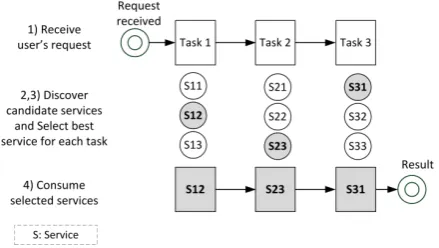
Figure 1. Dynamic Service Selection Model.
Most of the existing approaches focus on Adaptive mechanisms [4–7] which modify the SBA in response to changes affecting its environment like contextual changes or the needs of a particular user. Correc-tive mechanisms [8–15] replace a faulty service with a new version that provides the same functionality and quality. Preventive mechanisms [16–18] use pre-diction techniques to detect the probable failures or SLA violations and also assess the accuracy of predic-tion. There are few approaches targeting Extending mechanisms [19–22] which aim to extend the SBA by adding new required functionalities.
In this paper we focus on SBA customization based on user’s preferences, which is a subset of Adaptive mechanisms. Suppose itinerary purchase scenario in which the travel agency is the owner of SBA. Travel agency orchestrates the available services to fulfil the customers’ requests. Each customer has specific preferences that are expected to be satisfied by travel agency. A customer may prefer cost-effective flight and normal hotel, while the other customer may prefer high-quality flight and luxury hotel. These quality concerns could be achieved bydynamically selecting web services based on user’s preferences. As shown in Figure 1, dynamic service selection includes the following steps [23]:
• Converting a user’s request to a machine under-standable model
• Discovering candidate services for each task of a given process
• Selecting the best set of services among candi-date services based on QoS constraints and user’s preferences
• Executing the solution (made in step 3) with Business Process Execution Language (BPEL) engine and producing the results
Finding the best services through the ordinary meth-ods leads to an NP-hard problem. Therefore several heuristic and dynamic programming approaches were proposed to model service selection as an optimiza-tion problem. In this paper we present a dynamic ser-vice selection method which has a strong
mathemati-cal basis. The proposed method is based on Hidden Markov Model (HMM),i.e., a mathematical model inspired from Markov Chain. The method considers user’s preferences while selecting appropriate services for a given set of tasks. The process of applying HMM in the service selection problem includes following steps: Modelling, Learning, and QoS-based Selection. In modelling step, HMM is applied in the service se-lection problem. The output HMM from the previous step is initialized in learning step by supervised or un-supervised learning methods. The Viterbi algorithm is used in QoS-based selection step to select the most appropriate services in a reasonable time.
Execution time and fitness are the critical factors in comparing and proposing service selection meth-ods. Execution time shows the length of time taken for selecting services and producing a composition model in common business process languages like WS-BPEL. Fitness shows how much the output model satisfies user’s preferences. Fitness has direct relation-ship with user satisfaction. In comparison with GSA-based, PSO-GSA-based, and GA-based service selection methods, our method achieves the maximum fitness in a reasonable time.
The rest of this paper is organized as follows. The characteristics of this work are compared with related studies in Section 2. Section 3 describes HMM briefly. The proposed service selection method based on HMM is described in Section 4. Section 5 presents the ex-perimental results. Finally the paper is concluded in Section 6.
2
State of the Art
Pre-ventive and Extending.
2.1 Adaptive Adaptation
MOSES [4] is a QoS-based adaptation framework based on MAPE components. It is classified as an adaptive adaptation method. MOSES uses abstract composition to create new processes and also service selection to dynamically bind the processes to differ-ent concrete web services. MOSES is applicable where a service-oriented system is architected as a compos-ite service. RuCAS [5] is a rule-based service plat-form, which helps clients to manage their own context-aware web services via Web-API or GUI-based inter-face. RuCAS together with an autonomic manager could shape a self-managing ecosystem. Beggas, et al. [6] proposed a middleware that calculates ideal QoS model using a fuzzy control system to fit context in-formation and user preferences. Then, the middleware selects the best service among all variants having the nearest QoS value to the ideal. Chouiref et al. [25] pro-posed a fuzzy framework for service selection. These types of approaches are classified as context-aware or perfective adaptation in which the quality char-acteristics of SBA are optimized, or the application is customized or personalized according to the needs and requirements of particular users. CHAMELEON [7] is an adaptive adaptation framework which per-sonalize/customize the application according to the device and network contexts in B3G mobile networks. They enriched the standard Java syntax to specify adaptable classes, adaptable methods and adaptation alternatives that specify how one or more adaptable methods can actually be adapted. In [26], two hid-den markov models (HMM1 and HMM2) are used for context-aware service selection. HMM1 is used for modelling context information and HMM2 is used for modelling invoked services. Building HMM is different from this work, since they did not consider quality of services in selection phase. Also the efficiency and the scalability of the model are not evaluated. Since ser-vice providers do not expose the details of functional and quality of web services, it is hard for consumers to make an efficient service contract. Wang et al. [27] proposed incentive contract to offer qualities based on consumer preferences. Canton-Puerto et al. [28] used Baum-Welch algorithm to train HMM. They consid-ered QoS parameters like cost, performance etc. Un-like we make relation between web services (hidden states) and tasks (observed states), they mapped web services to different qualities.
2.2 Corrective Adaptation
VieCure [8] is a corrective adaptation method which extracts monitored misbehaviours to diagnoses them
2.3 Preventive Adaptation
Some works try to prevent service based applications from future faults or SLA violations. Wang et al. [16] make adaptation decisions through two-phase evalu-ations. In estimation phase, they estimate the QoS attribute (e.g.execution time) in the future and com-pare the estimated value with the target value defined in the SLA. If a violation is tent to happen, a suspi-cion of SLA violation is reported to decision phase. In decision phase, they use static and adaptive deci-sion strategies to evaluate the trustworthy level of the suspicion in order to decide whether to accept or to neglect the suspicion.
Unnecessary adaptations can be costly and also faulty even in the proactive case. Metzger et al. [17] propose a preventive approach for augmenting service monitoring with online testing to produce failure pre-dictions with confidence. In a similar work [18], Met-zger selected prediction techniques and defined met-rics to assess the accuracy of predictions. Jingjing et al. [30] proposed a proactive service selection method to prevent service provider overloads. The proactive method is based on analysing a time series of services received to forecast the overloads through a negotia-tion process.
2.4 Extending Adaptation
Auxo [19] is an extending adaptation approach which realize adaptation concerns through modifying the runtime software architecture (RSA) model. Auxo proposes an architecture style (interfaces, connectors and components) and runtime infrastructure which maintains an explicit and modifiable RSA model. To fulfil the modification requests, they modify the RSA model, evaluate the architecture constraints, and en-act changes to the real system. SALMon [20] is a mon-itoring framework that supports different adaptation strategies in the SBA lifecycle by providing the knowl-edge base (accurate and complete QoS) to the follow-ing expert systems: WeSSQoS (for service selection based on user requirements), FCM (for service deploy-ment on a cloud federation system), SALMonADA (for identifying and reporting SLA violations), MAE-SoS, PROSA, PROTEUS, and CASE (for adapta-tion purposes whenever malfuncadapta-tions in the system occur). Daubert et al. [21] proposed Kevoree, a re-flective framework which provides models@runtime approach to design adaptable SBA. Models@runtime considers the reflection layer as a real model that can be uncoupled from the running architecture for reasoning, validation and simulations purposes and later automatically resynchronized with its running instance. CLAM [22] is a cross-layer adaptation man-ager for SBA. CLAM provides Application, Service
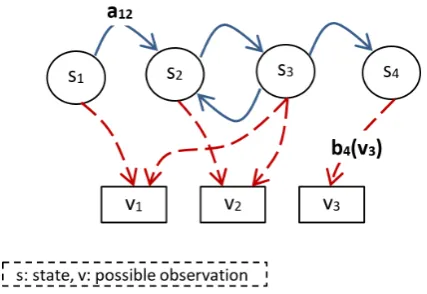
Figure 2. The Basic Hidden Markov Model.
and Infrastructure models. Each model element is associated with Analysers, Solvers and Enactors. A cross-layer rule engine governs the coordination of Analysers, Solvers and Enactors. For each adaptation need, CLAM produces a tree of the possible alterna-tive adaptations, identifies the most convenient one, and applies it.
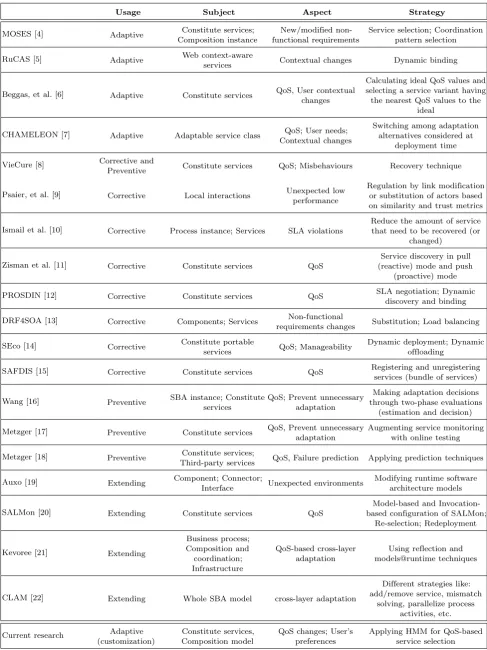
To classify our work, we defined its characteristics using S-CUBE adaptation taxonomy. The adaptation taxonomy distinguishes approaches by three following questions: 1) Why is adaptation needed (adaptation usage)?, 2) What are the adaptation subject and aspect?, and 3) How does adaptation strategy take place?. As shown in Table 1, this research presented an adaptive method which customizes SBA based on user’s preferences and quality constraints. The adaptation subjects are SBA’s constitute services and their composition models. We applied HMM to realize service selection adaptation strategy.
3
Hidden Markov Model
An HMM has an underlying stochastic process that is not observable (it is hidden), but can only be ob-served through another set of stochastic processes that produce the sequence of observed symbols [31]. In Figure 2, hidden states are presented by circles and observed symbols are presented by rectangles. HMMs is applicable in speech processing, natural language processing, extracting target information from docu-ments etc.
HMM is formally defined in formula 1, where S is the set of states, and V is the set of possible observations [32].
λ= (A, B, π) (1)
S= (s1, s2, ..., sN) (2)
Table 1. Classification of SBA Adaptation Approaches, According to S-CUBE Adaptation Taxonomy.
Usage Subject Aspect Strategy
MOSES [4] Adaptive Constitute services; Composition instance
New/modified non-functional requirements
Service selection; Coordination pattern selection
RuCAS [5] Adaptive Web context-aware
services Contextual changes Dynamic binding
Beggas, et al. [6] Adaptive Constitute services QoS, User contextual changes
Calculating ideal QoS values and selecting a service variant having the nearest QoS values to the
ideal
CHAMELEON [7] Adaptive Adaptable service class QoS; User needs; Contextual changes
Switching among adaptation alternatives considered at
deployment time
VieCure [8] Corrective and
Preventive Constitute services QoS; Misbehaviours Recovery technique
Psaier, et al. [9] Corrective Local interactions Unexpected low performance
Regulation by link modification or substitution of actors based on similarity and trust metrics
Ismail et al. [10] Corrective Process instance; Services SLA violations
Reduce the amount of service that need to be recovered (or
changed)
Zisman et al. [11] Corrective Constitute services QoS
Service discovery in pull (reactive) mode and push
(proactive) mode
PROSDIN [12] Corrective Constitute services QoS SLA negotiation; Dynamic discovery and binding
DRF4SOA [13] Corrective Components; Services Non-functional
requirements changes Substitution; Load balancing
SEco [14] Corrective Constitute portable
services QoS; Manageability
Dynamic deployment; Dynamic offloading
SAFDIS [15] Corrective Constitute services QoS Registering and unregistering services (bundle of services)
Wang [16] Preventive SBA instance; Constitute services
QoS; Prevent unnecessary adaptation
Making adaptation decisions through two-phase evaluations
(estimation and decision)
Metzger [17] Preventive Constitute services QoS, Prevent unnecessary adaptation
Augmenting service monitoring with online testing
Metzger [18] Preventive Constitute services;
Third-party services QoS, Failure prediction Applying prediction techniques
Auxo [19] Extending Component; Connector;
Interface Unexpected environments
Modifying runtime software architecture models
SALMon [20] Extending Constitute services QoS
Model-based and Invocation-based configuration of SALMon;
Re-selection; Redeployment
Kevoree [21] Extending
Business process; Composition and coordination; Infrastructure
QoS-based cross-layer adaptation
Using reflection and models@runtime techniques
CLAM [22] Extending Whole SBA model cross-layer adaptation
Different strategies like: add/remove service, mismatch
solving, parallelize process activities, etc.
Current research Adaptive (customization)
Constitute services, Composition model
QoS changes; User’s preferences
Qis a sequence of hidden states with lengthT andO
is a sequence of observations. Each observation inO is emitted by a hidden state inQ. As presented in formula 6 and formula 7, A is the transition array, storing the time-independent probability of statej following state i, and, B is the observation array, storing the probability of observationm being produced from the statei, independent oft.
Q= (q1, q2, ..., qT) (4)
O= (o1, o2, ..., oT) (5)
A= [aij], aij=P(qt=sj|qt−1=si) (6)
B= [bi(m)], bi(m) =P(xt=vk|qt=si) (7)
In formula 8,πis defined as the initial probability array:
π= [πi], πi=P(q1=si) (8)
The model makes two assumptions including the Markov assumption and the independence assumption, presented in formula 9 and formula 10. The Markov assumption, states that the current state is dependent only on the previous state. The independence assump-tion, states that the output observation at timet is dependent only on the current state; it is independent of the previous observations and states:
P(qt|qt1−1) =P(qt|qt−1) (9)
P(ot|ot1−1) =P(ot|qt) (10)
Given a HMMλand a sequence of observationsO, we would like to computeP(O,λ),i.e., the probability of observing sequenceO.
The probability of the observationsO for a specific state sequence Q and the probability of the state sequence are shown in formula 11 and formula 12 respectively:
P(O|Q, λ) =
T
Y
t=1
P(ot|qt, λ) (11)
P(Q|λ) =πq1×aq1q2×aq2q3×...×aq(T−1)qT (12)
So we can calculate the probability of the observa-tions given the model as:
P(O|λ) =X
Q
P(O|Q, λ)×P(Q|λ) (13)
The result shows the probability of observing se-quenceO by considering state sequenceQ.
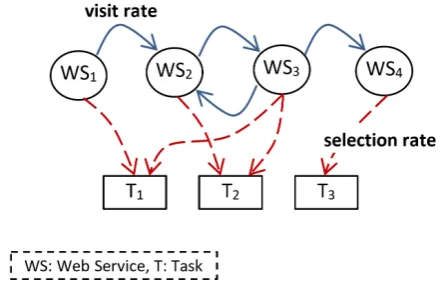
Figure 3. HMM Is Applied for the Service Selection Problem.
4
Service Selection Based on HMM
In this section, we applied HMM for the service se-lection problem in three following steps: Modelling, Learning, and QoS-based Selection.
4.1 Modelling
The formal definition of service selection problem is as follows:
λ= (V isitRate, SelRate, π) (14)
AWS is the set of available web services, andAT is the set of tasks of all processes.
AW S= (ws1, ws2, ..., wsN) (15)
AT = (t1, t2, ..., tM) (16)
We defineWS as a sequence of web services with length T. We also defineT as a sequence of tasks. Each task inT consumes a corresponding web service inWS.
W S = (ws1, ws2, ..., wsT) (17)
T = (t1, t2, ..., tT) (18)
As defined in Eq. 2 and Eq. 3, HMM includes se-quence of hidden states and sese-quence of possible ob-servations. As defined in Eq. 7, hidden state si has the probabilitybi(m) to produce the observationvm.
Consideringsias theith candidate web service, and
vmas themth task of a process, we could saybi(m)
in-dicates the probability of selectingith web service for
mth task. Figure 3 represent this assumption in graph-ical mode. As you can see, web services are modeled with hidden states and process’s tasks are modeled with observations.
We definedV isitRateij to indicate the probability
states. Visit rates are initialized in learning step and their values could be updates by the log records of the services repository server (i.e.UDDI server).
V isitRateij =
no.of times W Sjis visited af ter W Si
no.of times W Siis visited
(19) We need to present rational definitions for the state transition probabilities (Eq. 6), and the output prob-abilities (Eq. 7). We definedSelRatei(m)to indicate
the probability of selectingith web service formth task. Selection rate is similar to Eq. 7 which defines the output probabilities. Selection rates are initialized in learning step and their values could be updates by the logs of BPEL engine.
SelRatei(m) =
no.of times W Siis selected f or Tm
no.of times W Siis selected
(20)
4.2 Learning
After modelling the service selection problem by HMM, the output model should be trained by supervised learning methods or unsupervised learning methods. The unknown parameters of an HMM are the transi-tions probabilities and the output (observation) prob-abilities.
In supervised learning, we use a database of sample HMM behaviours and estimate the transition proba-bilities and the output probaproba-bilities. The Visit rate array (Eq. 19) could be estimated either based on the log records of services repository or based on the log records of BPEL engine. The Selection rate array (Eq. 20) could be estimated based on the history of service invocations. The selected web services are described in WS-BPEL format. BPEL engine executes given WS-BPEL process and invokes the selected web ser-vices. Therefore, the log of service invocations is kept by BPEL engine.
In unsupervised learning, HMM parameters have to be estimated from the observed sequences and the parameters are updated based on new samples. If database of samples are not available, the standard unsupervised approaches like Maximum Likelihood Estimation or Viterbi Training could be applied [33].
4.3 QoS-Based Selection
It is necessary to consider user’s quality preferences while selecting the best services for each task. So we define the fitness function based on user’s preferences and the QoS parameters of services. Some quality parameters like execution-time and cost have inverse
relationship with their measurements (i.e., a higher value shows a lower degree of quality), whereas some quality parameters like reliability and availability are in direct relationship with their measurements (i.e., a higher value shows a higher degree of quality). Since we need a fitness function composed of the above measures, with a value in range of [0, 1], we use Eq. (21) for the quality parameters with inverse relationship and Eq. (22) for the quality parameters with direct relationship.
V(QKij) =
QK
ij−minv(QKiv)
maxv(QKiv)−minv(QKiv)
, maxv(QKiv)6=minv(QKiv)
1, maxv(QKiv) =minv(QKiv)
(21)
V(QKij) =
maxv(QKiv)−QKij
maxv(QKiv)−minv(QKiv)
, maxv(QKiv)6=minv(QKiv)
1, maxv(QKiv) =minv(QKiv)
(22) Fitness function is defined in Eq. (23):
Fij = k
X
VijkWk,06Wk61,
X
Wk= 1 (23)
Where,Wkis the weight ofkth quality parameter
identified in user’s preferences,Vk
ij is the standardized
value of thekth QoS parameter of thejth candidate web service for theith task, andFk
ijis the standardized
fitness value of thejth candidate web service for the
ith task.
In order to consider the effects of user’s preferences in selecting the best services, Eq. 11 is modified to Eq. 24. The fitness function (Eq. 23) adjusts the output probabilities based on user’s preferences.
P(T|W S) =
T
Y
t=1
P(Tt|W St)×Ftt (24)
Finally, the Viterbi algorithm is used to find the best services for a given sequence of tasks. The Viterbi algorithm is a dynamic programming algorithm for finding the most likely sequence of hidden states that produces a sequence of observations. The time com-plexity of the Viterbi algorithm isO(T×|S|2), where
|S|indicates the number of hidden states (i.e.web services) and T indicates the length of output (i.e.
tasks).
4.4 Pseudo Code
Algorithm 1QoS-Based Service Selection
input:
all available web services (SERVICES REPOSITORY), all processes’ tasks (PROCESSES),
user’s preferences (QoS WEIGHT),
requested process (REQUESTED PROCESS), log of service invocations (LOG)
output:
a sequence including the best web services for realizing REQUESTED PROCESS (SOLUTION) 1: begin
2: if (HMM does not exist) then//build and train HMM 3: for each service i in SERVICES REPOSITORYdo
4: AW Si←−service i // Eq. 15
5: for each task i in PROCESSESdo
6: ATi←−task i // Eq. 16
7: //Use LOG records and Eq. 19 to produce state transition (probabilities) 8: //Use LOG records and Eq. 20 to produce output probabilities
9: end for
10: end for
11: end if
12: for each task i in REQUESTED PROCESSdo
13: Titask i //Eq. 18
14: for each task i in REQUESTED PROCESSdo
15: foreach service j in SERVICES REPOSITORYdo
16: setFijusingQoS W EIGHT //Eq. 23
17:
18: end for
19: end for
20: end for
21: //Use Viterbi algorithm to produce sequence WS (Eq. 17) as a SOLUTION which includes the most appro-priate web services for the given sequence of tasks T (Eq. 18)
22: returnSOLUTION 23: end
transition probabilities (refer to Eq. 19) and SelRate to produce output probabilities (refer to Eq. 20). Next, vector T is defined as a sequence of tasks in requested process. Each task in T consumes a corresponding web service. Then, two nested loops make Fitness matrix (refer to Eq. 23) which is used to adjust the output probabilities based on user’s preferences. Finally, the Viterbi algorithm is used to produce sequence WS, which includes the most appropriate web services for the given sequence of tasks T.
5
Experimental Results
5.1 Hypothesis
Prior to defining the experimental hypotheses, we uti-lized the “Goal/Question/Metric” (GQM) template [34] to explicitly define the experimentation goal G1 as follows and its regarding evaluation questions and metrics.
Goal G1: “To analyse the efficiency of the
proposed method for the purpose of selecting the most appropriate services among all candi-date services based on user’s preferences”.
QuestionQ1: Does the method show any improve-ment in selecting the services that are mostly aligned with user’s preferences and improves user satisfaction?
• MetricM1.1: Fitness. Fitness shows how much the output model satisfies user’s preferences. Fit-ness has direct relationship with user satisfaction. QuestionQ2: Does the method show any improve-ment in scalability?
Figure 4. Changes in the Number of Tasks and the Number of Candidate Services.
As shown in Table 2, we evaluated the efficiency and scalability of the proposed method for QoS-based service selection. Particularly, we aimed at evaluating
the fitness andthe execution time of the method. This work was compared with GSA-based [23] (i.e.
our previous work) and PSO-based service selection methods. We did not consider genetic algorithm (GA) in our comparison, since the PSO algorithm is better in finding the optimized selection with higher fitness than the genetic algorithm [35]. The measurements have been conducted on an Intel Celeron CPU 2.2 GHz PC with 1GB of RAM running Ubuntu 12.4LTS and JDK 1.7.0-17. As shown in Figure 4, the number of tasks changes from 10 to 100, and the number of candidate services changes from 5 to 50 depending on the experiment.
We used web service QoS dataset released by Al-Masri et al. [36] to evaluate service selection methods in performing users’ requests with different preferences. This dataset includes 5,000 web services with the measurements of their quality of services. The selected QoS parameters that are used in our experiments are listed below:
• Response time (ms): Time taken to send a request and receive a response
• Availability (%): The ratio of the number of suc-cessful invocations to the number of total invoca-tions
• Reliability (%): The ratio of the number of error messages to the number of total messages The quality parameters are classified in three levels including Bronze (qos weight: 0.2), Silver (qos weight: 0.3) and Gold (qos weight: 0.5). In our experiments, we generated weights of quality parameters randomly.
5.2 User Satisfaction
Since heuristic algorithms (e.g.GSA, PSO, GA) de-pend on the initial population and the number of iter-ations, we measured fitness value in below scenarios:
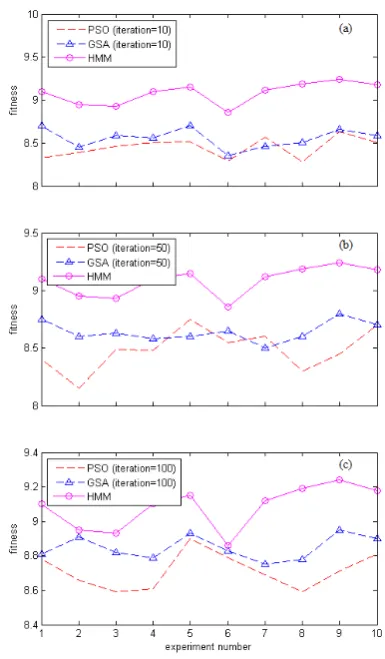
Figure 5. Fitness Changes, With Increasing the Number of Iterations. (No. of Tasks=10; No. of Candidate Services=5; No. of Iterations: From 10 to 100).
A) Fitness changes, with increasing the num-ber of iterations from 10 to 100
First scenario was performed 10 times with differ-ent user’s preferences. We considered 10 tasks and 5 candidate services for each task. As shown in Figure 5, HMM produced the most optimized sequence of web services that resulted in highest fitness value in each experiment. Since the Viterbi algorithm is a dynamic programming technique, the fitness value does not de-pend on the number of iterations. GSA moves much more quickly towards the convergence point (i.e. find-ing the fitter composite web service) in comparison with the PSO algorithm.
B) Fitness changes, with increasing the num-ber of candidate services from 5 to 50
Table 2. The GQM Metrics for Evaluation.
Goal Question Metric Description
G1
Q1: User satisfaction M1.1: Fitness
Fitness changes, with increasing the number ofiterations from 10 to 100. (No. of tasks=10; No. of candidate services=5)
Fitness changes, with increasing the number ofcandidate services from 5 to 50. (No. of tasks=10; Iterations=100)
Q2: Scalability M2.1: Execution time
Execution time changes, with increasing the number oftasks from 10 to 100. (Iterations=100; No. of candidate services=5)
Execution time changes, with increasing the number ofcandidate services from 5 to 50. (No. of tasks=10; Iterations=100)
Figure 6. Fitness Changes, With Increasing the Number of Candidate Services (C.S.). (No. of Tasks=10; Iterations=100; No. of Candidate Services: From 5 to 50).
algorithm and the PSO algorithm were performed in 100 iterations. Although increasing the number of can-didate services improves the fitness in both GSA and PSO algorithms, HMM is still more effective in se-lecting web services and producing composite models which are more aligned with user’s preferences.
5.3 Scalability
Figure 7 shows changes of execution time with increas-ing the number of tasks. In this experiment we consid-ered 5 candidate services for each task. As shown in Figure 7, when a given process has 100 tasks, there is
Figure 7. Execution Time Changes, With Increasing the Num-ber of Tasks. (Iterations=100; No. of Candidate Services=5; No. of Tasks: From 10 to 100).
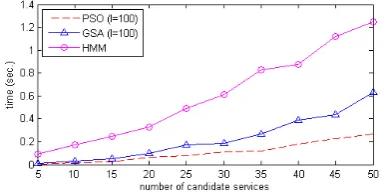
Figure 8. Execution Time Changes, With Increasing the Num-ber of Candidate Services. (No. of Tasks=10; Iterations=100; No. of Candidate Service: From 5 to 50).
a negligible value of 0.15 second gap between perform-ing HMM and performperform-ing the least time consumperform-ing heuristic algorithm,i.e., PSO. Furthermore, most of the business processes have less than 100 tasks. There-fore we could claim that our proposed method is still applicable.
Figure 8 shows changes of execution time with in-creasing the number of candidate web services. In each experiment, the GSA algorithm and the PSO algorithm were performed in 100 iterations.
mostly efficient in cases that there is less than∼20 candidate services for each task (see Figure 8).
In GSA and PSO algorithms, the number of can-didate services increases the population of cancan-didate solutions and affects the execution time. As shown in Figure 8, these types of algorithms are able to consider hundreds of candidate services in performing user’s requests.
This section could be concluded as follows. Our method achieves the maximum fitness in each exper-iment. Although our method is a little more time-consuming than the heuristic methods (e.g.GA, PSO, and GSA), it selects most appropriate services in a reasonable time even when the number of web services increases. The comparison of HMM with heuristic al-gorithms in service selection filed shows that HMM is a useful method, which improves the lacks of heuristic algorithms like fitness in a reasonable time.
6
Conclusion
In this paper, we applied Hidden Markov Model for the QoS-based service selection problem. We presented the method in following steps: Modelling, Learning, QoS-based selection. In modelling step, the HMM definition of service selection problem was described. The output HMM from the modelling step is initialized in learning step by supervised or unsupervised learning methods. The Viterbi algorithm is used in QoS-based selection step to find the most appropriate services in reasonable time.
We compared this work with GSA-based service selection method and PSO-based service selection method. Our method achieves the maximum fitness in each experiment. Although our method is a little more time-consuming than the heuristic methods (e.g.GA, PSO, and GSA), it selects most appropriate services in a reasonable time even when the number of web services increases.
In future, we would use unsupervised approaches like Maximum Likelihood Estimation or Viterbi Traing to overcome continues modifications in HMM in-cluding: available web services, existing tasks, transi-tion probabilities, and output probabilities.
References
[1] S. Lane, Q. Gu, P. Lago, and I. Richardson. To-wards a framework for the development of adapt-able service-based applications. Service Oriented Computing and Applications, 8(3):239–257, 2014.
ISSN 1863-2394. doi:10.1007/s11761-013-0136-4. [2] R. Kazhamiakin, S. Benbernou, L. Baresi, P.
Ple-bani, M. Uhlig, and O. Barais. Adaptation of service-based systems. InService Research Chal-lenges and Solutions for the Future Internet, pages 117–156. Springer, Heidelberg, 2010. ISBN 978-3-642-17599-2. doi:10.1007/978-3-642-17599-2 5. [3] A. Metzger, K. Pohl, M. Papazoglou, E. Di Nitto, A. Marconi, and D. Karastoyanova. Research challenges on adaptive software and services in the future internet: towards an S Cube research roadmap. In 2012 First International Work-shop on European Software Services and Sys-tems Research - Results and Challenges (S-Cube), pages 1–7. IEEE, 2012. ISBN 978-1-4673-1806-8. doi:10.1109/S-Cube.2012.6225501.
[4] V. Cardellini, E. Casalicchio, V. Grassi, S. Ian-nucci, F. Lo Presti, and R. Mirandola. MOSES: A framework for qos driven runtime adaptation of service-oriented systems. IEEE Transactions on Software Engineering, 38(5):1138 – 1159, 2012. ISSN 0098-5589. doi:10.1109/TSE.2011.68. [5] H. Takatsuka, S. Saiki, S. Matsumoto, and
M. Nakamura. Developing service platform for web context-aware services towards self-managing ecosystem. In Service-Oriented Computing-ICSOC 2014 Workshops, pages 270– 280. Springer, 2015. ISBN 978-3-319-22884-6. doi:10.1007/978-3-319-22885-3 24.
[6] M. Beggas, L. M´edini, F. Laforest, and M. Tayeb Laskri. Towards an ideal service QoS in fuzzy logic-based adaptation planning middleware.
Journal of Systems and Software, 92:71–81, 2014. doi:10.1016/j.jss.2013.07.023.
[7] M. Autili, V. Cortellessa, P. Di Benedetto, and P. Inverardi. On the adaptation of context-aware services. CoRR, abs/1504.07558, 2015.
[8] H. Psaier, F. Skopik, D. Schall, and S. Dust-dar. Behavior monitoring in self-healing service-oriented systems. InSocially Enhanced Services Computing, pages 95–116. Springer, 2011. ISBN 978-3-7091-0812-3. doi:10.1007/978-3-7091-0813-0 5.
[9] H. Psaier, F. Skopik, D. Schall, and S. Dust-dar. Runtime behavior monitoring and self-adaptation in service-oriented systems. In2010 Fourth IEEE International Conference on Self-Adaptive and Self-Organizing Systems, pages 164–173. IEEE, 2010. ISBN 978-1-4244-8537-6. doi:10.1109/SASO.2010.44.
[10] A. Ismail, J. Yan, and J. Shen. Incremen-tal service level agreements violation han-dling with time impact analysis. Journal of Systems and Software, 86(6):1530–1544, 2013. doi:10.1016/j.jss.2013.01.052.
IEEE Transactions on Software Engineering, 39 (7):954 – 974, 2012. doi:10.1109/TSE.2012.84. [12] K. Mahbub and G. Spanoudakis. Proactive sla
negotiation for service based systems: Initial im-plementation and evaluation experience. In2011 IEEE International Conference on Services Com-puting. IEEE, 2011. ISBN 978-1-4577-0863-3. doi:10.1109/SCC.2011.34.
[13] E. Mezghani and R. Ben Halima. DRF4SOA: A Dynamic Reconfigurable Framework for design-ing autonomic application based on SOA. In2012 IEEE 21st International Workshop on Enabling Technologies: Infrastructure for Collaborative En-terprises, pages 95–97. IEEE, 2012. ISBN 978-1-4673-1888-4. doi:10.1109/WETICE.2012.81. [14] H. J. La and S. D. Kim. Dynamic
Architec-ture for Autonomously Managing Service-Based Applications. In 2012 IEEE Ninth Interna-tional Conference on Services Computing, pages 515–522. IEEE, 2012. ISBN 978-1-4673-3049-7. doi:10.1109/SCC.2012.78.
[15] G. Gauvrit, E. Daubert, and F. Andre. Safdis: A framework to bring self-adaptability to service-based distributed applications. In 2010 36th EUROMICRO Conference on Software Engi-neering and Advanced Applications, pages 211– 218. IEEE, 2010. ISBN 978-1-4244-7901-6. doi:10.1109/SEAA.2010.25.
[16] C. Wang and J.-L. Pazat. A Two-Phase Online Prediction Approach for Accurate and Timely Adaptation Decision. In2012 IEEE Ninth In-ternational Conference on Services Computing, pages 218–225. IEEE, 2012. ISBN 978-1-4673-3049-7. doi:10.1109/SCC.2012.26.
[17] A. Metzger, O. Sammodi, K. Pohl, and M. Rzepka. Towards pro-active adaptation with confidence: augmenting service monitoring with online testing. In Proceedings of the 2010 ICSE Workshop on Software Engineering for Adap-tive and Self-Managing Systems, pages 20– 28. ACM, 2010. ISBN 978-1-60558-971-8. doi:10.1145/1808984.1808987.
[18] A. Metzger. Towards accurate failure predic-tion for the proactive adaptapredic-tion of service-oriented systems. In Proceedings of the 2010 ICSE Workshop on Software Engineering for Adaptive and Self-Managing Systems, pages 18–23. ACM, 2011. ISBN 978-1-4503-0853-3. doi:10.1145/2024436.2024442.
[19] H. Wang, B. Ding, D. Shi, J. Cao, and A. T. S. Chan. Auxo: an architecture-centric framework supporting the online tuning of software adaptiv-ity. Science China Information Sciences, 58(9): 1–15, 2015. doi:10.1007/s11432-015-5307-9. [20] M. Oriol, X. Franch, and J. Marco. Monitoring
the service-based system lifecycle with SALMon.
Expert Systems with Applications, 42(19):6507– 6521, 2015. doi:10.1016/j.eswa.2015.03.027. [21] E. Daubert, F. Fouquet, O. Barais, G. Nain,
G. Sunye, J-M. J´ez´equel, J-L. Pazat, and B. Morin. A models@ runtime framework for designing and managing service-based applica-tions. 2012 First International Workshop on Eu-ropean Software Services and Systems Research-Results and Challenges (S-Cube), pages 10–11, 2012. doi:10.1109/S-Cube.2012.6225498. [22] A. Zengin, A. Marconi, and M. Pistore. CLAM:
cross-layer adaptation manager for service-based applications. InProceedings of the International Workshop on Quality Assurance for Service-Based Applications, pages 21–27. ACM, 2011. ISBN 978-1-4503-0826-7. doi:10.1145/2031746.2031754. [23] B. Zibanezhad, K. Zamanifar, R. S.
Sad-jady, and Y. Rastegari. Applying gravita-tional search algorithm in the QoS-based Web service selection problem. Journal of Zhe-jiang University SCIENCE C, 12(9):730, 2011. doi:10.1631/jzus.C1000305.
[24] B. Kitchenham. Guidelines for performing sys-tematic literature reviews in software engineering.
Ver. 2.3 EBSE Technical Report, Tech. Rep, 2007. [25] Z. Chouiref, A. Belkhir, K. Benouaret, and
A. Hadjali. A fuzzy framework for effi-cient user-centric Web service selection.
Applied Soft Computing, 41:51–65, 2016. doi:10.1016/j.asoc.2015.12.011.
[26] X. Zheng, Y. Shi, X. Wang, and C. Xu. A context-aware service selection mechanism based on hidden markov model. In2013 International Conference on Service Sciences (ICSS), pages 196–201. IEEE, 2013. ISBN 978-1-4673-6258-0. doi:10.1109/ICSS.2013.17.
[27] P. Wang and X. Du. QoS-aware Service Se-lection Using An Incentive Mechanism. IEEE Transactions on Services Computing, 2016.
doi:10.1109/TSC.2016.2602203.
[28] D. G. Canton-Puerto, F. Moo-Mena, and V. Uc-Cetina. QoS-Based Web Services Selection Using a Hidden Markov Model.JCP, 12(1):48–56, 2017. doi:10.17706/jcp.12.1.48-56.
[29] L. Juszczyk, H.-L. Truong, and S. Dustdar. Genesis-a framework for automatic generation and steering of testbeds of complexweb services. In13th IEEE International Conference on En-gineering of Complex Computer Systems (iceccs 2008), pages 131–140. IEEE, 2008. ISBN 978-0-7695-3139-7. doi:10.1109/ICECCS.2008.27. [30] H. Jingjing, C. Xiaolei, and Z. Changyou.
to hidden Markov models.IEEE ASSP Magazine, 3:4–16, 1986. doi:10.1109/MASSP.1986.1165342. [32] P. Blunsom. Hidden markov models. Lect. notes,
15:18–19, 2004.
[33] A. Allahverdyan and A. Galstyan. Comparative analysis of viterbi training and maximum likeli-hood estimation for hmms. InNIPS, pages 131– 140, 2011.
[34] R. Van Solingena, V. Basili, G. Caldiera, and H. D. Rombach. Goal question metric (gqm) approach. Encyclopedia of Software Engineering, 2002. doi:10.1002/0471028959.sof142.
[35] M. Chen and Z. wu Wang. An Approach for Web Services Composition Based on QoS and Discrete Particle Swarm Optimization. In
Eighth ACIS International Conference on Soft-ware Engineering, Artificial Intelligence, Net-working, and Parallel/Distributed Computing (SNPD 2007). IEEE, 2007. ISBN
978-0-7695-2909-7. doi:10.1109/SNPD.2007.11.
[36] E. Al-Masri and Q. H. Mahmoud. Qos-based dis-covery and ranking of web services. In2007 16th International Conference on Computer Commu-nications and Networks. IEEE, 2007. ISBN 978-1-4244-1250-1. doi:10.1109/ICCCN.2007.4317873.
Yousef Rastegari received his PhD from Department of Computer Engineering and Science, Shahid Beheshti University. He is member of two research groups namely ASER (Automated Software Engineering Research) (aser.sbu.ac.ir) and ISA (Information Systems Architecture) (isa.sbu.ac.ir).