
167
Available online at http://ijdea.srbiau.ac.ir
Int. J. Data Envelopment Analysis (ISSN 2345-458X)
Vol. 1, No. 3, Year 2013 Article ID IJDEA-00135, 7 pages
Research Article
Common weights for the evaluation of
decision-making units with nonlinear virtual inputs and
outputs
S. Borzoeia, M.Zohrehbandiana
(a) Department of Mathematics, Karaj Branch, Islamic Azad University, Karaj, Iran.
Received 21 August 2013, Accepted 26 September 2013
Abstract
In this paper, by investigating the common weights concept and DEA models with nonlinear virtual inputs/outputs, we introduce a model for evaluating the decision making units with nonlinear virtual
inputs and outputs based on the common weights.
Keywords: Data envelopment analysis, Common weights, Nonlinear virtual inputs/outputs.
1. Introduction
Data envelopment analysis (DEA) obtains the efficiency measurement of decision making units (DMUs) with multiple inputs/outputs based on the ratio of weighted outputs to weighted inputs, where each DMU can take the desirable weights for inputs/outputs to provide the maximum performance. But the evaluation of DMUs based on the selection of different set of weights is unacceptable.
Therefore, some researchers by linking DEA with some other techniques such as multi-objective programming, have developed models to generate a set of common weights for evaluating and ranking the DMUs (see Roll and Golany [9], Doyle [6] , Bylton and Vickres [1], Lee and Reeves [8], Kao and hung [7], Chen et al [2] and Zohrehbandian et al [10]).
In addition, Cook et al [3] and Cooper et al [4] have assumed linear input/output models in DEA as unreal properties and by considering Piecewise linear form for them, they tried to provide a model for evaluating DMUs in more realistic situations. Moreover, Despotis et al [5] have proposed a general formula by considering nonlinear virtual inputs/outputs in DEA models.
Tel:+989122124384
[email protected] borz
Sajad
:
mail addresses
-E
Corresponding author
168 S.Borzoei, et al /IJDEA Vol.1, No. 3 (2013).167- 173
In this paper, a common weight model with nonlinear virtual inputs/outputs will be presented, which is the idea of the combination of common weights models and nonlinear virtual inputs/outputs concept. The rest of the paper is as follows. In section 2, nonlinear virtual inputs/outputs and common weight concepts will be reviewed. Section 3 presents a common weight model with nonlinear virtual inputs/outputs. Section 4 includes numerical example while section 5 is devoted to concluding remarks
2. Preliminaries and notations
2.1 - Model with nonlinear virtual inputs/outputs
Suppose we have n DMUs with m inputs and s outputs. CCR model to assess the performance unit o is as the following form:
Max ∑𝑠𝑟=1𝑢𝑟𝑦𝑟𝑜 s.t. ∑𝑚𝑖=1𝑣𝑖𝑥𝑖𝑜 = 1,
∑𝑠𝑟=1𝑢𝑟𝑦𝑟𝑗− ∑𝑚𝑖=1𝑣𝑖𝑥𝑖𝑗 ≤ 0 (𝑗 = 1, … , 𝑛) 𝑣 ≥ 𝑜, 𝑢 ≥ 𝑜
When Yj= (y1j, y2j, … , ysj) and Xj= (x1j, x2j, … , xmj) are vectors of inputs/outputs for unit j. In this notation, the weighted sum of inputs and outputs can be seen in the following form:
∑s uryrj
r=1 = U(Yj) , ∑si=1vixij= V(Xj)
But by removing the assumption of linearity of these functions, approximating the output vector Yj= (y1j, y2j, … , ysj) can be done based on the following aggregate function, where U1, U2, … , Us are non-linear functions:
𝑈(𝑌𝑗) = 𝑈1(𝑌1𝑗) + 𝑈2(𝑌2𝑗) + ⋯ + 𝑈𝑠(𝑌𝑠𝑗)
Moreover, piecewise linear approximation of function Ur (r = 1, ..., s) can also be achieved as follows. Suppose that [lr, hr] is range of output r for all decision units ( lr= minj{yrj} , hr= maxj{yrj}).
For each r, the output interval [lr, hr] with breakpoints b1r, br2, … , brk, brk+1, … br
ar can be segmentation
where for any yrj> lr there is exactly one kj such that yrj ∈ [brkj, brkj+1]. In other words, yrj can be decomposed as follows:
yrj = b1r+ (b r
2− b
r 1) + (b
r
3− b
r
2) + ⋯ + (b r kj
− brkj−1) + (yrj− br kj
)
Now, instead of considering a variable weight for output r for wide range of [lr, hr], it will be allocated
by different weighting factors for each sub-interval [brk, brk+1] k = 2, … , ar− 1 and the replacement:
γr11 = b r 1, γ
r2
1 = (b
r
2− b
r 1), γ
r3
1 (b
r
3− b
r 2), … , γ
rkj
1 = (b
r kj
− brkj−1) , γrk1 j+1= (yrj− brkj) , γrk1 j+2
Then, amounts of function Ur(Yrj) for each yrj ∈ [br, br ] is obtained as follows:
𝑈𝑟(𝑌𝑟𝑗) = (𝛾𝑟11 + 𝛾𝑟21)𝑢𝑟1+ 𝛾𝑟31𝑢𝑟2+ ⋯ + 𝛾𝑟𝑘1𝑗𝑢𝑟𝑘𝑗−1+ 𝛾𝑟𝑘1 𝑗+1𝑢𝑟𝑘𝑗+ 𝛾𝑟𝑘1 𝑗+2𝑢𝑟𝑘𝑗+1+ ⋯
+ 𝛾𝑟𝑎1𝑟𝑢 𝑟𝑎𝑟−1
By writing the above equation for each r = 1, ..., s, and gathering on the r, virtual output for U(Yj)of unit j is a linear function of u = (u11, … , u1,ar−1, … , ur1, … , urar−1, … us1, … usar−1) as follows:
𝑈(𝑌𝑗) = ∑ [(𝛾𝑟1𝑗 + 𝛾𝑟2𝑗)𝑢𝑟1+ ∑𝑎𝑟 𝛾𝑟𝑘𝑗 𝑢𝑟𝑘−1
𝑘=3 ]
𝑠 𝑟=1
But, probably the assumption of non-linearity is acceptable only for a particular category of the outputs. In this case, call these outputs as non-linear and call others as linear outputs. Without loss of generality, we assume that the sorted output and (d <s) are linear and the rest of them are non-linear. Therefore, the above formula will be changed as follows:
𝑈(𝑌𝑗) = ∑ 𝑦𝑟𝑗𝑢𝑟
𝑑
𝑟=1
+ ∑ [(𝛾𝑟1𝑗 + 𝛾𝑟2𝑗)𝑢𝑟1+ ∑ 𝛾𝑟𝑘𝑗 𝑢𝑟𝑘−1
𝑎𝑟
𝑘=3
]
𝑠
𝑟=𝑑+1
Similarly, the virtual inputs can be assumed to have non-linear assumption and similarly by segmentation the final amount U(Xj) for unit j has the following form:
𝑈(𝑋𝑗) = ∑ 𝑥𝑖𝑗𝑣𝑖
𝑡
𝑖=1
+ ∑ [(𝜇𝑖1𝑗 + 𝜇𝑖2𝑗)𝑣𝑖1+ ∑ 𝜇𝑖𝑘𝑗 𝑣𝑖𝑘−1
𝑎𝑖
𝑘=3
]
𝑚
𝑖=𝑡+1
2.2 Common weight models
Choosing different weights in a DEA model for evaluation of DMUs is unacceptable. Therefore common weights concept was introduced in DEA literature. Most of the proposed methods are based on the solution of a multi-objective model which simultaneously maximizes the efficiency of all DMUs. In this section, we introduce the methods proposed by Kao and Hung [7].
If we show the optimal value produced by the CCR model as Ej∗, which is the best performance value for DMUj, to produce a common weights, we can assume E∗= (E1∗, E2∗, … , En∗) as an ideal efficiency vector and provide an efficiency vector for DMUs which is the nearest to this ideal. In other words, we want to obtain the efficiency vector E(u, v) = (E1(u, v), E1(u, v), … , En(u, v)) by the common set of
weights which has the minimum distance from the ideal solution E∗. Hence,
Min Dp = [∑(Ej∗− Ej(u, v))p
n
j=1
]
1⁄p
s.t
Ej(u, v) =∑ uryrj
s r=1
∑m vixij
i=1
170 S.Borzoei, et al /IJDEA Vol.1, No. 3 (2013).167- 173
ur , vi≥ ε > 0 𝑟 = 1, … , 𝑠 , 𝑖 = 1, … , 𝑚
3. Common weight model with nonlinear virtual inputs/outputs
As it was explained in the previous section, nonlinear virtual inputs/outputs can be considered as follows:
U(Xj) = ∑ xijvi
t
i=1
+ ∑ [(μi1j + μi2j ) vi1+ ∑ μik j
vik−1
ai
k=3
]
m
i=t+1
U(Yj) = ∑ yrjur
d
r=1
+ ∑ [(γr1j + γr2j ) ur1+ ∑ γrk j
urk−1
ar
k=3
]
s
r=d+1
Then, common weight model of Kao and Hung [7] for the case p = ∞ using these nonlinear virtual inputs/outputs is as follows:
Min w
s.t
𝐸𝑗∗− ∑ ( ∑ û yr̂rj
s r=1
∑m v̂ xîij
i=1 n
j=1
) ≤ 𝑤 𝑗 = 1, … , 𝑛
∑ û yr̂rj
s
r=1
− ∑ v̂ xîij
m
i=1
≤ 0 j = 1, … , n
û , vr ̂ ≥ ε > 0 𝑟 = 1, … , s , i = 1, … , m i
Where v̂ and û are inputs and outputs weight vectors, respectively. Hence:
v̂ = (v1, … , vt, vt+1,1… , vt+1,at+1−1, … , vm1, … , vm,am−1)
X ̂ = | | | |
𝑥11 12 1𝑛
… … … …
𝑥𝑡1 (𝜇𝑡+1,11 + 𝜇𝑡+1,21 )
𝜇𝑡+1,31 … 𝜇𝑡+1,𝑎1 𝑡+1−1
… (𝜇𝑚11 + 𝜇
𝑚2
1 )
𝜇𝑚31
… 𝜇𝑚,𝑎1 𝑚−1
𝑥𝑡2 … 𝑥𝑡𝑛 (𝜇𝑡+1,12 + 𝜇
𝑡+1,2
2 ) … (𝜇
𝑡+1,1𝑛 + 𝜇𝑡+1,2𝑛 )
𝜇𝑡+1,32 … 𝜇𝑡+1,3𝑛
… … …
𝜇𝑡+1,𝑎
𝑡+1−1
2 … 𝜇
𝑡+1,𝑎𝑡+1−1 𝑛
… … …
(𝜇𝑚12 + 𝜇 𝑚2
2 ) … (𝜇 𝑚1
𝑛 + 𝜇
𝑚2𝑛 )
𝜇𝑚32 … 𝜇𝑚3𝑛 …
𝜇𝑚,𝑎2 𝑚−1 ……
… 𝜇𝑚,𝑎 𝑚−1 𝑛 | | | |
𝐘̂ =
| | | |
𝒚𝟏𝟏 𝒚𝟏𝟐 … 𝒚𝟏𝒏
… … … …
𝒚𝒅𝟏 (𝜸𝒅+𝟏,𝟏𝟏 + 𝜸𝒅+𝟏,𝟐𝟏 )
𝜸𝒅+𝟏,𝟑𝟏 … 𝜸𝒅+𝟏,𝒂
𝒅+𝟏−𝟏
𝟏
… (𝜸𝒔𝟏𝟏 + 𝜸𝒔𝟐𝟏 )
𝜸𝒔𝟑𝟏 … 𝜸𝒔,𝒂
𝒔−𝟏
𝟏
𝒚𝒅𝟐 … 𝒚𝒅𝒏
(𝜸𝒅+𝟏,𝟏𝟐 + 𝜸𝒅+𝟏,𝟐𝟐 ) … (𝜸𝒅+𝟏,𝟏𝒏 + 𝜸𝒅+𝟏,𝟐𝒏 ) 𝜸𝒅+𝟏,𝟑𝟐 … 𝜸𝒅+𝟏,𝟑𝒏
… … …
𝜸𝒅+𝟏,𝒂
𝒅+𝟏−𝟏
𝟐 … 𝜸
𝒅+𝟏,𝒂𝒅+𝟏−𝟏 𝒏
… … …
(𝜸𝒔𝟏𝟐 + 𝜸𝒔𝟐𝟐 ) … (𝜸𝒔𝟏𝒏 + 𝜸 𝒔𝟐
𝒏 )
𝜸𝒔𝟑𝟐 … 𝜸𝒔𝟑𝒏 … 𝜸𝒔,𝒂 𝒔−𝟏 𝟐 … … … 𝜸𝒔,𝒂 𝒔−𝟏 𝒏 | | | |
4. Numerical examples
Table 1 presents 5 DMUs, each of which contains2 inputs and 2 outputs:
Table 1:
Data inputs and outputs
X1 X2 Y1 Y2
DMU A 5 15 60 8
DMU B 10 10 90 4
DMU C 15 5 80 9
DMU D 20 10 90 10
172 S.Borzoei, et al /IJDEA Vol.1, No. 3 (2013).167- 173
Here, we consider the first input and first outputas linear and second input and second output as nonlinear. If the input rangebe [4,15], and we consider breakpoints as: 4,7,10,13,15, then input augment matrix is as follows:
𝑋̂ = ||
5 10 15 20 7
7 7 5 7 4
3 3 0 3 0
3 0 0 0 0
2 0 0 0 0
||
And the weight vector is:
v̂ = (v1, v1,1, v2,1, v3,1, v4,1)
Moreover, for the output range [4.10], by considering the breakpoints4,6,8,10, the output augment matrix would be as follows:
ŷ = |
60 90 80 90 75
6 4 6 6 6
2 0 2 2 0
0 0 1 2 0
|
And the weight vector is:
û = (u1, u1,1, u2,1, u3,1)
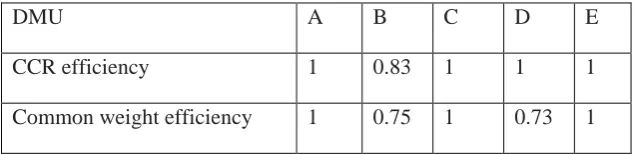
Finally, following table gives CCR efficiency and common weight efficiency values with nonlinear virtual inputs/outputs assumption for each DMU.
Table 2:
Efficiency score
E D
C B
A DMU
1 1
1 0.83 1
CCR efficiency
1 0.73 1
0.75 1
Common weight efficiency
5 Conclusion
This paper presents a common weight model with nonlinear virtual inputs/outputs assumption. Firstly, the DEA models with nonlinear virtual inputs/outputs were introduced. Then common weight models have been introduced. Finally, we proposed the common weight model with nonlinear virtual inputs/outputs based on the combination of these two concepts.
[1] Belton V and Vickers SP . Demystifying DEA-A visual interactive Approach based on multiple criteria analysis. J Opl Res Soc 44 (1993): 883-896
[2] Chen, Y-W. Larbani, M. Chang, Y-P.Multiobjective data envelopment analysis. . J Opl Res Soc (2009) 60: 1556-1566[13] Cook, W.D., Zhu, J., 2009. Piecewise linear output measures in DEA. European Journal of Operational Research 197, 312–319
[3] Cook, W.D., Yang, F., Zhu, J., 2009. Nonlinear inputs and diminishing marginal value in DEA.Journal of the Operational Research Society.doi:10.1057/jors.2008.121.
[4] Cooper, W., Seiford, L., Kaoru, T., 2006. Data Envelopment Analysis: A Comprehensive Text with Models, Applications, References and DEA-Solver Software. Springer, NY.
[5] Despotis, D.K., Stamati, L.V.,Smirlis,Y.G., 1990. Data envelopment analysis with nonlinear virtual input and outputs. European Journal of Operational Research 202, 604–613
[6] - Doyle J .Multiattrbute choice for the lazy decision maker: Let the alternatives decide. Organ Behav Hum Decis Process 62: (1995): 87-100
[7] Kao C and Hung CT . Data envelopment analysis with common weight: The compromise solution approach. J Opl Res Soc (2005) 56: 1196-1203
[8] Li X-B and Reevese GR . A multiple criteria approach to data envelopment analysis .Eur J Opl Res 115 (1999): 507-517
[9] Roll Y and Golany B . Alternative methods of treating factor weights in DEA. Omega 21 (1993): 99-103.

![A Molecular Electron Density Theory Study of the Reactivity of Azomethine Imine in [3+2] Cycloaddition Reactions](data:image/gif;base64,R0lGODlhAQABAIAAAP///wAAACH5BAEAAAAALAAAAAABAAEAAAICRAEAOw==)