i tif c n
e C
i o
c n
S f
l e
a r
n e
o n
i c
t e
a
2
nr 0
et 1
1 n I
ISC 2011
Proceeding of the International Conference on Advanced Science,
Engineering and Information Technology 2011
Hotel Equatorial Bangi-Putrajaya, Malaysia, 14 - 15 January 2011
ISBN 978-983-42366-4-9
ISC 2011
International Conference on Advanced Science, Engineering and Information Technology
ICASEIT 2011
Cutting Edge Sciences for Future Sustainability
Hotel Equatorial Bangi-Putrajaya, Malaysia, 14 - 15 January 2011
SR
IE AUNVIIT
NESIE DO KB
IN N
R AG
JA A
L S
A A
E N
P M
N A
A L
U A
T Y
A S
SREP A I
N I
NO OD
I TAI COSSA STNEDUTS NA IESN
Organized by Indonesian Students Association Universiti Kebangsaan Malaysia
Proceeding of the
Improved Gait Classification with Different
Smoothing Techniques
Hu Ng
#, Hau-Lee Tong
#, Wooi-Haw Tan
*, Junaidi Abdullah
## Faculty of Information Technology, Multimedia University
Jalan Multimedia, 63100 Cyberjaya, Selangor, Malaysia. Tel.:+60383125411, E-mail: [email protected]
* Faculty of Engineering, Multimedia University Jalan Multimedia, 63100 Cyberjaya, Selangor, Malaysia
Tel.:+60383125447, E-mail: [email protected]
Abstract —Gait as a biometric has received great attention nowadays as it can offer human identification at a distance without any contact with the feature capturing device. This is motivated by the increasing number of synchronised closed-circuit television (CCTV) cameras which have been installed in many major towns, in order to monitor and prevent crime by identifying the criminal or suspect. This paper present a method to improve gait classification results by applying smoothing techniques on the extracted gait features. The proposed approach is consisted of three parts: extraction of human gait features from enhanced human silhouette, smoothing process on extracted gait features and classification by fuzzy k-nearest neighbours (KNN). The extracted gait features are height, width, crotch height, step-size of the human silhouette and joint trajectories. To improve the recognition rate, two of these extracted gait features are smoothened before the classification process in order to alleviate the effect of outliers. The proposed approach has been applied on a dataset of nine subjects walking bidirectionally on an indoor pathway with twelve different covariate factors. From the experimental results, it can be concluded that the proposed approach is effective in gait classification.
Keywords— Biometric, Gait analysis, Fuzzy k-nearest neighbour, Outlier filter
I. INTRODUCTION
Biometrics are getting significant and widely accepted as an authentication tool in security system nowadays. This is due to their uniqueness and one will not lose or forget them over time. Biometrics refers to the automatic recognition of the individuals based on their physical or behavioural characteristics such as face, fingerprint, gait, typing rhythm, Deoxyribonucleic acid (DNA) and spoken voice.
Gait is a complex locomotion pattern which involves synchronized movements of body parts, joints and the interaction among them [1]. It can be concluded that every individual has his/her own walking pattern, so gait can be considered a unique feature. Gait is a motion based biometric technology, which offers the ability to identify people at a distance when other biometrics are obscured. Furthermore, there is no point of contact with any feature capturing device and is henceforth unobtrusive.
Basically, gait analysis can be divided into two major categories, namely model-based method and model-free
method [2]. Model-based method generally models the human body structure or motion and extracts the features to match them to the model components. It incorporates knowledge of the human shape and dynamics of human gait into an extraction process. This implies that the gait dynamics are extracted directly by determining joint positions from model components, rather than inferring dynamics from other measures, thus, reducing the effect of background noise (such as movement of other objects). For instance, Johnson et al. used activity-specific static body parameters for gait recognition without directly analyzing gait dynamics [3]. Cunado et al. used thigh joint trajectories as the gait features [4]. The advantages of this method are the ability to derive gait signatures directly from model parameters and free from the effect of different clothing or viewpoint. However, it is time consuming and the computational cost is high due to the complex matching and searching process.
The advantages of this method are low computational cost and less time consuming. For instance, BenAbdelkader et al. proposed an eigengait method using image self-similarity plots [5]. Collins et al. established a method based on template matching of body silhouettes in key frames during a human’s walking cycle [6]. Philips et al. characterized the spatial-temporal distribution generated by gait motion in its continuum [7].
This paper presents a model-free silhouette based technique to extract the human gait features by dividing human silhouette into six body segments and applying Hough transform to obtain the joint trajectories. This concept of joint trajectory calculation is found faster in process and less complicated than the model-based method like linear regression approach by Yoo et al. [8], temporal accumulation approach by Wagg et al. [9] and spatial motion
templates approach by Bouchrika et.al. [10]. As there are
only a few studies on gait classification using the covariate
database [11], [12], this study aims to evaluate the
recognition rate of the walking subjects with different covariate factors using three smoothing techniques.
II. OVERVIEW OF THE SYSTEM
As gait includes both the physical appearance of body and dynamics of human walking stance [13], the proposed approach extracts the static gait features (height and width, step size) and dynamic gait features (joint trajectories).
For the gait feature extraction, morphological opening is first applied to reduce background noise on the raw human silhouette images. Each of the human silhouette is then measured for its width and height. Next, each of the enhanced human silhouette is divided into six body segments based on the anatomical knowledge [14]. Morphological skeleton is later applied to obtain the skeleton of each body segment. The joint trajectories are obtained after applying Hough transform on the skeletons. Step-size, which is the distance between the bottom of both legs, is measured from the skeletons of the lower legs. Crotch height, which is the distance between the subject’s crotch and the floor, is also determined. The dimension of the human silhouette, step-size, crotch height and two joint trajectories from the body segments are then used as the gait features for classification.
To mitigate the effect of outliers, both thigh trajectory and crotch height are smoothened before their average values are applied in the classification process. Even though the
smoothing process reduces the peak value of the data, it is
not affecting the uniqueness of gait features of the subject. In addition, it also reduces the outlier of the data. This is proven as better gait classification results have been obtained comparing with the technique without smoothing. Fig. 1 summarises the process flow of the proposed approach.
Start Original image enhancement
Measurement of width and height
Human silhouette segmentation
Skeletonization of body segments Joint trajectory
extraction Measurement of
step-size and crotch height Smoothing of
thigh trajectory and crotch
height
Computation of similarities
Determination of fuzzy-k nearest
neighbor
Classification of unlabelled
subjects
End Part 1: Extraction of human gait features
Part 2: Classification of extracted human gait features
Fig.1 Flow chart of the proposed system
III. EXTRACTING THE HUMAN GAIT FEATURES The original human silhouette images are obtained from the SOTON covariate database [15]. This database was used to evaluate the recognition rate of the walking subjects with different covariate factors.
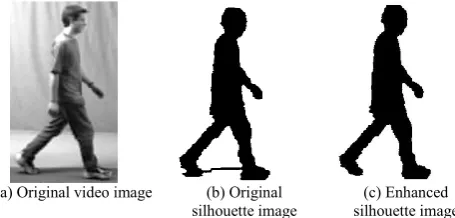
In most of the human silhouette images, shadow is found especially near to the feet. It appears as part of the subject body in the human silhouette image as shown in Figure 2. The presence of the artifact affects the gait feature extraction and the measurement of joint trajectories. The problem can be reduced by applying a morphological opening operation
with a 77 diamond shape structuring element, as denoted
by
A
B = (AB) B) (1)where A is the image, B is the structuring element,
represents morphological erosion and represents
morphological dilation. The opening first performs erosion, followed by dilation. Fig. 2 shows the original and enhanced images.
(a) Original video image (b) Original
silhouette image silhouette image (c) Enhanced Fig.2 Original and enhanced images after morphological opening After that, the width and height of the enhanced human silhouette are measured. Next, the enhanced human silhouette is divided into six body segments based on anatomical knowledge [14]. Fig. 3 shows the six segments of
the body, where a represents head and neck, b represents
torso, c represents right hip and thigh, d represents right
lower leg and foot, e represents left hip and thigh and f
a
b
c
d e
f
Fig. 3 Six body segments
To enhance the segments structure, morphological skeleton is used to construct the skeleton from all the body segments. Skeletonization involves consecutive erosions and opening operations on the image until the set differences between the two operations are zero. The operations are given as:
Erosion Opening Set differences
AkB (AkB)
B (AkB) – ((AkB))
B (2)where A is an image, B is the structuring element and k is
from zero to infinity.
To extract the joint trajectory for each body segment, Hough transform is applied on the skeleton. For the details of the steps and figures, please refer to [16].
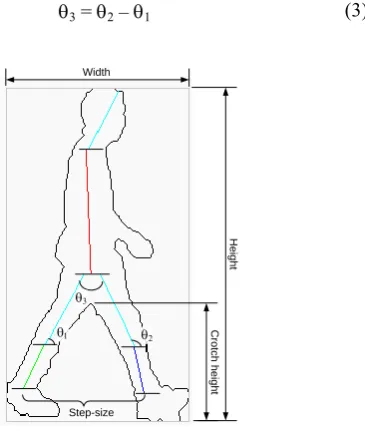
To obtain the step-size of each walking sequence, the Euclidian distance between the bottom ends of lower right leg and lower left leg are measured. To obtain the crotch height, the distance between the subject’s crotch and the floor is measured. Fig. 4 shows all the gait features extracted
from a human silhouette, where 3 is the thigh trajectory,
calculated as
3 = 2 – 1 (3)
3
1 2
Heig
ht
Crotch heig
ht
Width
Step-size
Fig. 4 The entire extracted gait features
IV.SMOOTHING TECHNIQUES
It can be observed from the collected gait features, the changes in crotch height and thigh trajectory are sinusoidal over time. The curves for crotch height and thigh trajectory
are uneven due to the presence of outliers. Fig. 5 shows an example of the original thigh trajectory over time. Therefore,
smoothing is required to reduce the effect of these outliers. Three smoothing techniques have been applied for this
purpose. Initially, the moving average filter is used due to its
simplicity. The data, [y1, y2,…, yN] can be converted to a
new set of smoothed data. The set of smoothed data is
actually the average of an odd number of consecutive n
points of the raw data, where n is the number of points. The
denominator, 2n+1 is the filter width. For example the new
smoothed data for yjis
'
2 1
i nj i j
i n
y
y
n
(4)Fig 5 Changes in original thigh trajectory over time
Fig 6 below shows the smoothed thigh trajectory by using moving average filter with filter width of seven.
Fig.6 smoothed thigh trajectory over time by using moving average filter with filter width of seven
The second technique is the one-dimensional Gaussian filter. It is designed to give no overshoot to a step function input while minimizing the rise and fall time. It generates a bell-shaped curve after the smoothing process. The operation is shown as:
22
, 2
2
1
2
j y
j
y
e
(5)where parameters μ and σ2 are the mean and the variance,
and y is the raw data. Fig. 7 shows the smoothed thigh
Fig.7 smoothed thigh trajectory over time by using Gaussian filer with σ of 1.4
Median filter is applied as the third technique. The median filter is an effective filter as it suppresses isolated noise without blurring sharp edges. In particularly, it substitutes a pixel by the median of all pixels in the neighbourhood by the operation as shown in Equation 6.
ym = median{yj, jw} (6)
where w represents a neighbourhood centred around location
m in the dataset. Fig. 8 shows the smoothed thigh trajectory
by using Median filter with filter width of five.
Fig.8 smoothed thigh trajectory over time by using Median filter with filter width of five
V. CLASSIFICATION TECHNIQUE
For the classification, the supervised fuzzy K-Nearest Neighbour (KNN) algorithm is applied, as sufficient data is
available for training and testing. Basically, KNN is a
classifier that is used to distinguish different subjects based on the nearest training data in the feature space. In other words, subjects are classified according to the majority of nearest neighbours. In an extension to KNN, Keller et al. [17] integrated fuzzy relation with the KNN. According to Keller’s concept, the unlabelled subject’s membership
function of class i is given as:
2 1
2 1
1
( )
||
||
( )
1
||
||
i
x KNN m
i
x KNN m
u x
x
x
u x
x
x
(7)
where
x
, x and ui(x) represent the unlabelled subjects,labelled subjects and x’s membership of class i respectively.
Equation 7 will compute the membership value of unlabelled
subject by the membership value of labelled subject and distance between the unlabelled subject and fuzzy KNN labelled subjects.
VI. EXPERIMENTAL RESULTS AND DISCUSSION
The experiment was carried out for nine subjects in walking parallel to a static camera, with twelve different covariate factors that consist of nine different apparel and
three different walking speed. Each subject was captured
wearing a variety of footwear (flip flops, socks, boots, own shoes and trainers), clothes (normal or with rain coat) and carrying various bags (barrel bag slung over shoulder or carried by hand, and rucksack). They were also recorded walking at different speed (slow, fast and normal speed).
For each subject, there are approximately twenty sets of walking sequences, which are from left to right and vice-versa on normal track. Fig. 9 shows the examples of a subject with different apparel.
(a) Boots (b) Trainer
(c) Rucksack (d) Barrel bag slung over shoulder
(e) Rain coat (f) Barrel bag carried by hand
Fig.9 Examples of a subject with different apparel. Left: original image. Right: silhouette image.
In order to obtain the optimized results, four gait features were adopted for the classification. First, maximum thigh
trajectory,
7max was determined from all the thightrajectories collected during a walking sequence. When
max 7
was located, the corresponding values for the step-size,Sand width, w and height, h were determined as well. To
improve the recognition rate, additional features were used. These features were the average of the local maxima
detected for width (AW), smoothed crotch height (AHS) and
smoothed thigh trajectory (ATS).
i,
j
D x x
=(
7maxi
7max 2j)
+2
(
w
i
w
j)
+
(
h
i
h
j)
2+2
(
S
i
S
j)
+
(
W W)
2i j
A
A
+(
A
iHS
A
HSj)
2+
(
TS TS)
2i j
A
A
(8)
where xi is the unlabelled subject, xj is the labelled subject.
Since supervised classification algorithm is adopted, the classification process is divided into training and testing
parts.For the training part, eight walking sequences for each
subject with each covariate factor were utilised. The rest of the sequences will be used in the testing part. Thus, there are
864training and 1354 testing sequences respectively.
Three experiments were conducted using different values
of k for the fuzzy KNN algorithm for classification. In each
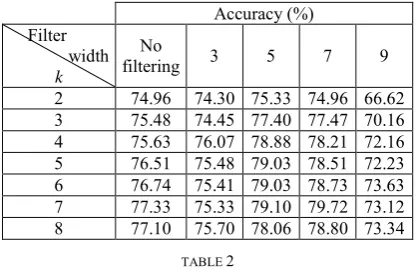
of these experiments, one of the smoothing techniques (moving average filter, Gaussian filter and Median filter) was applied to reduce the effect of outliers in the gait features data. Different filter widths or sigma values have been used to get the optimisation results. The overall results are summarised in Table 1, Table 2 and Table 3.
TABLE 1
RECOGNITION RATES WITH DIFFERENT K AND MOVING AVERAGE FILTER
WIDTH
Accuracy (%) Filter
width k
No
filtering 3 5 7 9
2 74.96 74.30 75.33 74.96 66.62 3 75.48 74.45 77.40 77.47 70.16 4 75.63 76.07 78.88 78.21 72.16 5 76.51 75.48 79.03 78.51 72.23 6 76.74 75.41 79.03 78.73 73.63 7 77.33 75.33 79.10 79.72 73.12 8 77.10 75.70 78.06 78.80 73.34
TABLE 2
RECOGNITION RATES WITH DIFFERENT K AND GAUSSIAN FILTER SIGMA
Accuracy (%) Sigma
k
No
filtering 1.0 1.2 1.4 1.5 2 74.96 74.82 75.11 76.96 76.51 3 75.48 76.29 77.18 78.73 78.14 4 75.63 76.59 76.96 78.80 78.95 5 76.51 76.96 78.29 79.54 80.13 6 76.74 77.25 77.99 79.91 80.21 7 77.33 77.70 78.73 80.21 80.50 8 77.10 77.47 78.51 80.58 80.43
TABLE 3
RECOGNITION RATES WITH DIFFERENT K AND MEDIAN FILTER WIDTH
Accuracy (%) Filter
width k
No
filtering 3 5 6 7
2 74.96 77.84 76.81 76.00 73.19 3 75.48 78.95 77.77 77.62 75.33 4 75.63 78.14 78.58 78.43 75.70 5 76.51 77.99 79.17 78.58 75.11 6 76.74 77.99 78.51 78.29 75.26 7 77.33 77.99 78.73 78.88 75.70 8 77.10 78.51 79.10 78.80 76.51
From the tables above, it can be observed that the recognition rates have improved to a certain extend when smoothing filters are applied. For the moving average filter (Table 1), the highest recognition rate (79.72%) is obtained
with the filter width of 7 when k = 7. For the Gaussian filter
(Table 2), the highest recognition rate (80.58%) is obtained
with the sigma of 1.4 when k = 8. For the median filter
(Table 3), the highest recognition rate (79.10%) is obtained
with the filter width of 5 when k = 8. For comparison, this is
better than the recognition rate of 73.4% as reported by Bouchrika et al. [12]. By selecting the optimum filter width, it is found that the recognition rate is better than those using the average values of crotch height and thigh trajectory. In this case, there is an improvement of 3.35% with respect to the best recognition rate obtained with no filtering.
VI. CONCLUSION
A novel approach for extracting the gait features from enhanced human silhouette image has been developed. The gait features are extracted from human silhouette by determining the skeleton from body segments. The joint trajectories are obtained after applying Hough transform on the skeleton. Both crotch height and thigh trajectory had been smoothened before their average values were applied for classification. This step is shown to be effective as it has improved the recognition rate from 77.33% to 80.58%. The results show that the proposed method is robust and can perform well regardless of walking speed and apparel. Future development includes experiments on other gait databases and the application of various classification algorithms.
ACKNOWLEDGMENT
The authors would like to thank Professor Mark Nixon, School of Electronics and Computer Science, University of Southampton, United Kingdoms for his kindness in providing the SOTON covariate database for use in this work.
REFERENCES
[1] C. BenAbdelkader, R. Culter, H. Nanda and L. Davis, “EigenGait: motion-based recognition of people using image self-similarity,” in Proc. of International Conference Audio and Video-Based Person Authentication, 2001, pp. 284-294,
[3] Bobick and A. Johnson, “Gait recognition using static, activity-specific parameters,” in Proc. of IEEE Computer Vision and Pattern Recognition, I, 2001, pp.423-430.
[4] D. Cunado, M. S. Nixon and J. Carter, “Automatic extraction and description of human gait models for recognition purposes,” Computer and Vision Image Understanding, vol. 90, no 1, pp. 1 – 41, 2003.
[5] BenAbdelkader, R. Cutler and L. Davis, “Motion-based recognition of people in EigenGait space,” in Proc. of Fifth IEEE International Conference, May 2002, pp. 267 – 272.
[6] R. Collin, R. Gross and J. Shi, “Silhouette-based human identification from body shape and gait,” in Proc. of Fifth IEEE International Conference, May 2002, pp 366-371.
[7] P.J. Phillips, S. Sarkar, I. Robledo, P. Grother and K. Bowyer. “The gait identification challenge problem: Dataset and baseline algorithm,” in Proc. of 16th International Conference Pattern
Recognition, vol I, 2002, pp. 385-389.
[8] Jang-Hee Yoo, M. S. Nixon and C. J. Harris, “Extracting human gait signatures by body segment properties,” in Fifth IEEE Southwest Symposium on Image Analysis and Interpretation, 2002, pp. 35-39. [9] K. Wagg and M. S. Nixon, “On automated model-Based extraction
and analysis of gait,” in Proc. of 6th IEEE International Conference
on Automatic face and Gesture Recognition, 2004, pp.11-16. [10] I. Bouchrika and M. S. Nixon, “Model-based features extraction for
gait analysis and recognition,” in Proc. Of Mirage: Computer and Vision / Computer Graphics Collaboration Techniques and Applications, 2007, pp. 150-160.
[11] S. Sarkar, P.J. Phillips, Z. Liu, I.R. Vega, P. Grother and K.W. Bowyer, “The humanID Gait Challenge Problem: Data Sets, Performance, and Analysis,” in IEEE Transactions on Pattern Analysis and Machine Intelligence, vol. 27(2), pp.162–177, 2005. [12] I. Bouchrika and M. S. Nixon, “Exploratory factor analysis of gait
recognition,” in 8th IEEE International Conference on Automatic Face and Gesture Recognition, 2008.
[13] L.Lee and W. Grimson, “Gait analysis for recognition and classification,” in Proc. International Conference Automatic Face and Gesture recognition, 2002, pp 155-162.
[14] W. T. Dempster and G. R. L. Gaughran, “Properties of body segments based on size and weight, “American Journal of Anatomy, vol. 120, pp. 33-54, 1967.
[15] J. D. Shutler, M. G. Grant, M. S. Nixon, and J. N. Carter, “On a large sequence-based human gait database,” in Proc. of 4th International
Conference on Recent Advances in Soft Computing, Nottingham (UK), 2002, pp. 66-71.
[16] H. Ng, W. H. Tan, H. L. Tong, J. Abdullah and R. Komiya, “Extraction of human gait features from enhanced silhouettes,” in Proc. of of 1st International Conference on Signal and Image
Processing Application, Nov. 2009, pp. 425-430.