the Seepage Analysis in Porous Media with
Irregular Geometry
Amir Zayeri Baghlani Nejad1, Mohammad Shokrollahi1
1Engineering Department, Jundi-Shapur University of Technology, Dezful, Iran
Abstract
novel discrete singular convolution (DSC) formulation is presented for the seepage analysis in irregular geometric porous media. The DSC is a new promising numerical approach which has been recently applied to solve several engineering problems. For a medium with regular geometry, realizing of the DSC for the seepage analysis is straight forward. But DSC implementation for a medium with
irregular geometry encounters some
challenging issues. To overcome the difficulty, a novel DSC scheme for seepage analysis in irregular geometric porous media is proposed. There is no general analytical solution for the seepage analysis in irregular geometries; thus, the validation of the proposed algorithm is carried out by comparing the results with those from
available numerical methods. Good
agreement between the results shows that the proposed algorithm can be utilized in solving seepage analysis as a new approach.
Keywords: Discrete Singular Convolution, Seepage, Numerical Analysis, Irregular Geometric Medium
1. Introduction
One of the important problems in water resource management discipline is the seepage analysis in porous media. Water leakage in the body of the soil dams, seepage from the body of the channel and foundation of the concrete dams and water movement in aquifers are some of the practical examples in this branch. Apart from a few cases with special boundary
Regarding this matter, numerical approaches can be utilized as proper instruments for solving the equations. Recently, one of the novel approaches which is used to solve the problems is discrete singular convolution (DSC). This method was invented to solve the differential equations by Wei (1999). After then, this method was implemented to solve a wide variety of engineering problems. Firstly, Wei enlisted the DSC to solve vibration problems in the field of solid mechanics (2001c). Then Civalek developed the method in 3D problems (2007). Navier-Stokes equations were analyzed using the DSC by Wan and Wei (2000). Xin et-al. analyzed nonlinear circuits in the field of
electromagnetic (2004). Solving the
quantum equations (Wei 2000) and edge detecting (Hou and Wei 2002), are other applications of the DSC. More recently, the authors of this paper developed the DSC algorithm for non-Darcian seepage analysis in the coarse porous media (Zayeri Baghlani Nejad and Shokrollahi 2011). A wide number of reviews about the DSC works can be found in Reference Shokrollahiand Zayeri Baghlani Nejad (2014).
DSC formulation which is presented in reference (Zayeri Baghlani Nejad and Shokrollahi 2011) is limited to media with rectangular geometries. However, in a great number of real problems, such as ground water movement, water seepage from the body of the soil dams and similar problems,
the solution domain doesn’t have
quadrature method in analyzing vibration of the non-rectangular plates is applied (1996).
In continue details of the DSC method will be discussed firstly. Then, formulation of the mentioned approach will be presented in the irregular domains. After that, discretization and solution of the governing equations of the water movement in porous media will be implemented. A computer program will be written for modeling some problems. Finally, the DSC results will be compared with those of the finite element method to validate the algorithm.
2. DSC method
Discrete singular convolution (DSC)
method is a relatively new numerical technique in applied mechanics which was originally introduced by Wei (1999). Since then, the DSC method applied to various science and engineering problems. Accurate
results and exact convergence have
demonstrated that the DSC is a reliable and
convenient numerical approach. The
mathematical foundation of the DSC algorithm is the theory of distributions and wavelet analysis. Like some other numerical methods, the DSC method discretizes the spatial derivatives and, therefore, reduces the given partial differential equations into a system of linear algebraic equations. So, in the DSC algorithm, any function f(x) and its
derivatives with respect to a coordinate at a grid point x are approximated by a linear sum of the functional values in the narrow domain [x-x-M, x+xM] in that coordinate
direction. This expression can be written as follows (Wei 1999):
) ( ) ( )
( (,)
) (
i M
M i
i n n
x f x x x
f
(1)
where superscript n (n = 0, 1, 2...) denotes the nth-order derivative with respect to x. The 2M +1 is the computational bandwidth which is usually smaller than the whole
computational domain. Therefore, the
resulting approximation matrix has a banded structure, which makes the DSC method more efficient than normal global methods and is particularly valuable with respect to large scale computations. {xi} is an
appropriate set of discrete points on which the DSC of Eq. (1) is well-defined and δ is a singular kernel. The DSC algorithm can be realized by using many approximation kernels (Wei et al. 2002b). However, it was shown (Wei 2001b; Wei et al. 2002a; Wei 2000; Wei 2001a) that for many problems, the use of the Regularized Shannon Kernel (RSK) is very efficient. The RSK is given by (Wei 1999):
2
2
,
2 exp sin
) (
k
k k k
x x
x x
x x x
x (2)
In these equations, L/(N1) is the grid spacing and N is the number of grid points. The parameter σ determines the width of the Gaussian envelope and often varies in association with the grid spacing,
i.e., σ = r.Δ, here r is a parameter chosen in computations.
First and second derivative of RSK with respect to x is defined as below:
2
2
2 2
2 )
1 (
,
2 exp sin
2 exp cos
) (
k
k k k
k k k
m
x x
x x
x x x
x x
x x x x
2 2 4 2 2 2 2 2 3 2 2 2 2 2 2 2 2 ) 2 ( , 2 exp sin 2 exp sin 2 exp sin 2 2 exp ) cos( 2 2 exp cos 2 2 exp sin ) ( ) ( k k k k k k k k k k k k k k k k k k m x x x x x x x x x x x x x x x x x x x x x x x x x x x x x x x x x x x x (4)0
)
0
(
) 1 ( ,
(5)2 2 2 ) 2 ( , 3 1 ) 0 (
(6)
As the DSC kernel is symmetric, the DSC computation requires a total of M fictitious grid points (FPs) outside each edge. Furthermore, the solution carries out for the grids inside the domain, so FPs must be eliminated. More precisely, it requires function values on these FPs which could be determined from those inside the domain by applying the boundary condition equations. Some attempts have been carried out for
applying boundary conditions by
researchers. Wei et al. (2001), Wei et al. (2002b), Zhao and Wei (2002), proposed a
practical method to incorporate the
boundary conditions. After that, Zhao et al. (2005) applied the iteratively matched boundary method to impose the free boundary conditions for Euler beams. More recently, Wang and Xu (2010) present a
method for applying boundary conditions using the Taylor’s series expansion. For gaining more details about the DSC method, interested readers may refer to the works of Wei et al. (2002a), Wei et al. (2002b); Wei (2001c), Xiang et al. (2002), Wei (2000), Wei (2001a) and Civalek (2008).
3. Formulation of the DSC in
irregular geometric media
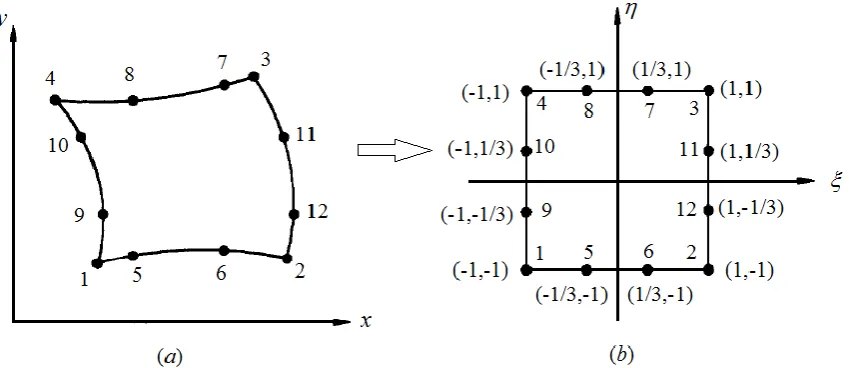
If the calculation in a domain with irregular geometry is to be considered in a global cartesian coordinate (Fig. 1-a), with a mapping this in a natural coordinate system
and (Fig. 1-b), the calculation will be simplified. Relations between the points in two domains define as follows (Charles and Moinuddin 1996):
iN k i i N k
i x y S y
S x s s
1 1 , , (7)where xi and yi (i1,2,...,Ns) are the coordinates of boundary nodes and Si
,are interpolation functions. The mapping of
Fig. 1 12 node transformation mapping of a medium with irregular geometry
The Si function must be defined in a way that its value will be considered as unit at the ith node and zero in the other
Ns1
nodes. For example, if we use eight nodes
for mapping of the geometry of the medium, it is convenient to use of the following functions (Han and Liew 1997):
(1 )(1 ) 4,82 1 ,
; 6 , 2 )
1 )( 1 ( 2 1 ,
; 7 , 5 , 3 , 1 )
1 )(
1 )( 1
( 4 1 ,
2 2
i S
i S
i S
i i
i i
i i i i
i
(8)
where i and i are the coordinates of the
ith node in the coordinate system. Based on the chain rule of the derivative, the relation between first and
second derivatives in the two coordinate systems can be written as follows (Han and Liew 1997):
/ /
/ / /
/ 2
/ /
/ /
/ /
1 0 1 1 2 2
2 2
2 2 1 2 2
2 2
2 2
1 0
f f J J J f
f f
J y x f
y f
x f
f f J y f
x f
(9)
)) / )( / ( ) / )( / (( 2 1 ) / )( / ( ) / )( / ( ) / )( / ( ) / ( ) / ( ) / )( / ( ) / ( ) / ( / / / / / / / / / / 2 2 2 2 2 2 2 2 2 2 2 2 2 2 2 1 0 y x y x y y x x y x y x y x y x J y x y x y x J y x y x J (10)
The following matrixes can be defined for simplification:
1
320 1 1 2 3 3 1 2 2 2 1 0
J
a
ijB
J
b
ijT
J
J
J
t
ijA
(11)
Approximation of the nth-order
derivative of the f function (equation 4) can be mapped from
x
y
coordinate systemto the coordinate system, using
equations (7) to (10). For instance, the first order derivative of the f function using new DSC formulation in the coordinate system is as follows:
m m k k m m k k x x f k a f k a x f i ) ( ) ( ) ( )( (1)
, 12 ) 1 ( ,
11 (12)
4. Governing equations
The governing equation of water movement in porous media is the Richards equation (Richards 1931): 0 ) ( ) ( ) ( ) ( t nS z V y V x
Vx w y w z w w
w
(13)
In the above equation V is the current velocity, w is the mass density of water, n
is the void ratio of soil, is the saturation of soil and t is the time parameter.
Despite the fact that all the physical systems are 3D, as the water movement in parallelogram vertical planes are similar, the Z coordinate is eliminated from the calculation for simplicity (Harr 1962). So, assuming the saturated medium and steady stream, the continuity equation will be as follows: 0 y V x
Vx y (14)
The combination of Darcy’s law and continuity equation will due to the following equation for modeling of seepage in homogenous porous media.
0 2 2 2 2 y h k x h
kx y (15)
where h is piezometric head and kxand
k
yare hydraulic conductivities in x and y
directions, respectively.
For solving the seepage analysis in a porous medium, the solution domain must be mapped to a regular medium and then it must be meshed. After that, N and Nare the number of equidistant nodes in both directions of new coordinate system. The distance between the nodes are and.
The governing equation (15) will be descretized at these nodes.
The discrete form of the governing equation (15) in the natural coordinate
system for every arbitrary node
(
i,
j)
w
m
m k
k j i ij
y x m
m k
j k i
ij y x m
m k
k j i m
m k ij y x
m
m k
k j i ij
y x m
m k
j k i ij
y x
h k t
k t k h k
t k t k h k k
b k b k
h k b
k b k h k b
k b k
0 )
( )
( ) (
) (
) ( )
( )
(
) ( )
( ) ( )
(
, )
2 (
, 22
12 , )
1 (
,
21 11 ,
) 1 (
, )
1 (
, 23
13
, )
2 (
, 22
12 , )
2 (
, 21
11
(16)
The equations of the boundary
conditions depend on the problem.
Boundary conditions could be carried out after writing these equations in the new coordinate system and descretizing them. For example, the boundary condition at a boundary parallel with y direction is:
0
x h
(17)
The discrete form of the equation (17) in the transformed coordinate system is:
0 )
( )
( (1) ,
, 12 , )
1 (
,
11
m
m k
k j i m
m k
j k
i a k h
h k
a
(18)
The boundary condition could be easily participated in the calculation by use of the equation (18).
Implementing the equation (16) for every node over the solution domain and applying the boundary conditions due to construction an equation system that its matrix form is as follows:
C{h}{d} (19)where {h}{h1,1,h1,2,...,hNN}. Solving
equations (19) produces water head at each node.
5. Results
To confirm the analysis and validate the proposed algorithm, an example is solved using the modified DSC. The obtained results are compared with those of the conventionally finite element method. Details of the problem and procedure of solution are illustrated below:
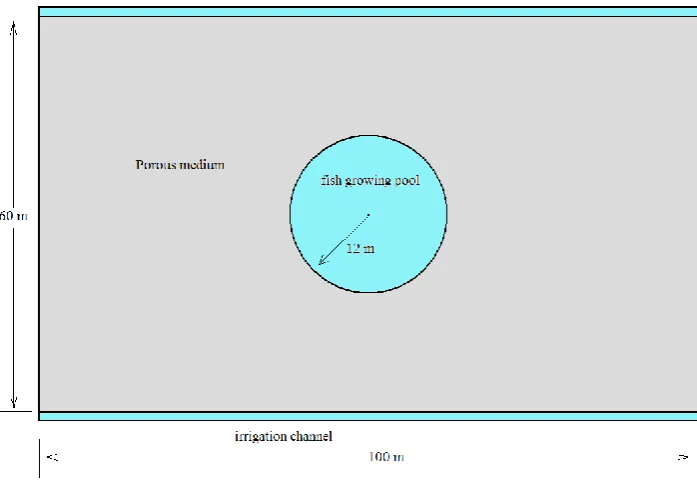
Example: plan of a farm which has a pool for fish growing on its center is shown in Fig. 2. The water head of the pool with respect to the base level is considered as 7 m. There are two irrigation channels in north and south sides which their water head is 10 m with respect to the base level. The objective is to calculate the water head at points of the field. In this example we consider thatkxky, so paying attention to
the equation (16), these coefficients will be eliminated from the solution.
As the shape and the boundary conditions of the problem are symmetric, we can carry out the calculations for a quarter of the solution domain (Fig. 3). For solving the problem using the modified
DSC, 8-node transform is employed. Fig. 3
shows the boundary conditions and
boundary nodes for mapping the solution domain.
Fig. 3 Boundary conditions and locations of the transformation nodes for mapping of a quarter of the solution domain
Using the written computer program, h
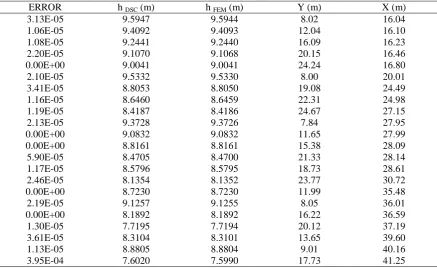
values are calculated at various nodes of the domain. Fig. 4 shows the equipotential lines obtained from the new numerical model. Comparison between the results with those of finit element method is utilized for validation. For achieving to this end, the water head obtained from two methods is
exhibited for some chosen point in table (1). The coordinates of points in this table are those that devoted to the Fig. 4. As it is seen, there is a good agreement between the results of proposed algorithm and finite element method. This matter shows the accuracy of the new DSC algorithm.
Table1 Comparison of the water heads obtained from the DSC and finite element methods at some nodes in (x, y) coordinate system.
X (m) Y (m)
h FEM (m)
h DSC (m)
ERROR
16.04 8.02
9.5944 9.5947
3.13E-05
16.10 12.04
9.4093 9.4092
1.06E-05
16.23 16.09
9.2440 9.2441
1.08E-05
16.46 20.15
9.1068 9.1070
2.20E-05
16.80 24.24
9.0041 9.0041
0.00E+00
20.01 8.00
9.5330 9.5332
2.10E-05
24.49 19.08
8.8050 8.8053
3.41E-05
24.98 22.31
8.6459 8.6460
1.16E-05
27.15 24.67
8.4186 8.4187
1.19E-05
27.95 7.84
9.3726 9.3728
2.13E-05
27.99 11.65
9.0832 9.0832
0.00E+00
28.09 15.38
8.8161 8.8161
0.00E+00
28.14 21.33
8.4700 8.4705
5.90E-05
28.61 18.73
8.5795 8.5796
1.17E-05
30.72 23.77
8.1352 8.1354
2.46E-05
35.48 11.99
8.7230 8.7230
0.00E+00
36.01 8.05
9.1255 9.1257
2.19E-05
36.59 16.22
8.1892 8.1892
0.00E+00
37.19 20.12
7.7194 7.7195
1.30E-05
39.60 13.65
8.3101 8.3104
3.61E-05
40.16 9.01
8.8804 8.8805
Fig. 4 Equipotential lines obtained from the DSC method in the entire of the solution domain
6. Conclusion
In this paper a novel formulation of the DSC is presented for seepage analysis in media with irregular geometry. The governing equations and boundary conditions are discretized using the proposed approach and a computer program is produced for solving some examples. A problem with irregular geometry solved by use of a new algorithm and the results are compared with those of finite element method. Good agreement between the results demonstrated that the proposed algorithm could be utilized as a promising approach to solve the seepage through porous media.
References
1 Charles, W. Bert and Moinuddin, Malik
(1996). The differential quadrature method for irregular domains and
application to plate vibration,
International Journal of Mechanical Sciences, 38, 589-606.
2 Civalek, O. (2007). Three-dimensional
vibration, buckling and bending
analyses of thick rectangular plates based on discrete singular convolution
method, International Journal of
Mechanical Sciences, Vol. 49, pp. 752-765.
3 Civalek, O. (2008). Vibration analysis of conical panels using the method of
discrete singular convolution.
Communications in Numerical
Methods in Engineering, 24(3),169– 181.
4 Han J. B. and Liew, K.M. (1997). An
eight-node curvilinear differential
quadrature formulation for
Reissner/Mindlin plates, Computer
Methods in Applied Mechanics and Engineering, 141, 265–280.
5 Harr, M. E., (1962). Groundwater and Seepage, McGraw-Hill, New York.
6 Hou, Z.J. and Wei, G.W. (2002). A new
approach to edge detection, J. Pattern Recognition Society, 35, 1559–1570.
7 Shokrollahi,M., Zayeri baghlani
nejad,A. (2014). Numerical analysis of free longitudinal vibration of
non-uniform rods; Discrete singular
convolution (DSC) approach,
Engineering mechanics, Accepted.
8 Richards, L. A. (1931). Capillary
conduction of liquids through porous mediums, Physics, 1, 318-333.
9 Wan, D. C., and Wei, G.W. (2000).
Numerical study of Euler and Navier-Stokes Equations by Efficient Discrete Singular Convolution Method, ACTA MECHANICA SINICA, 16(3), 223-239.
10 Wang, X., Xu, S. (2010). Free vibration analysis of beams and rectangular plates with free edges by the discrete singular convolution. Journal of Sound and Vibration, 329(10), 1780–1792. 11 Wei, G.W. (2001a). A new algorithm
for solving some mechanical problems.
Computer Methods in Applied
12 Wei, G.W. (1999). Discrete singular convolution for the Fokker-Planck equation, J. Chem. Phys. 110(18), 8930-8942.
13 Wei, G.W. (2001b).Discrete singular
convolution for beam analysis.
Engineering Structures, 23(9) 1045– 1053.
14 Wei, G.W. (2000). Solving quantum
eigenvalue problems by discrete
singular convolution. Journal of
Physics B: Atomic, Molecular and Optical Physics, 33 (3), 343–352. 15 Wei, G.W. (2001c).Vibration analysis
by discrete singular convolution.
Journal of Sound and Vibration, 244(3), 535–553.
16 Wei, G.W., Zhao, Y.B., Xiang, Y. (2002a). A novel approach for the analysis of high-frequency vibrations. Journal of Sound and Vibration, 257 (2), 207– 246.
17 Wei, G.W., Zhao, Y.B., Xiang, Y. (2002b). Discrete singular convolution and its application to the analysis of plates with internal supports: part 1. Theory and algorithm. International Journal for Numerical Methods in Engineering, 55(8), 913–946.
18 Wei, G.W., Zhao, Y.B, Xiang, Y. (2001). The determination of natural frequencies of rectangular plates with mixed boundary conditions by discrete
singular convolution, International
Journal of Mechanical Sciences, 43(8), 1731–1746.
19 Xiang, Y., Zhao, Y.B., Wei, G.W. (2002). Discrete singular convolution and its application to the analysis of plates with internal supports: part 2. Applications. International Journal for Numerical Methods in Engineering, 55(8), 947–971.
20 Xin Zhou, Dian Zhou, Jin Liu, Ruiming Li, Xuan Zeng and Charles Chiang. (2004). Steady-State Analysis of Nonlinear Circuits Using Discrete
Singular Convolution Method,
Proceedings of the Design, Automation and Test in Europe Conference and Exhibition, IEEE Computer Society. 21 Zayeri Baghlani Nejad, A. and,
Shkrollahi, M. (2011). Numerical Solution of Turbulent leakage problem
by using new algorithms DSC,
Irrigation and water engineering, 2, 36-42, (In Persian).
22 Zhao Y.B., Wei G.W. (2002). DSC analysis of rectangular plates with non-uniform boundary conditions, Journal of Sound and Vibration, 255 (2), 203– 228.
23 Zhao, S., Wei, G.W., Xiang, Y. (2005). DSC analysis of free-edged beams by
an iteratively matched boundary
method, Journal of Sound and