Supa’at & Khilman Rofi’ Azmi
102 Ijtimā’iyya, Volume 4, Number 1, March 2019
Ijtim
ā
'iyya: Journal of Muslim Society Research
e-ISSN 2541-0040; p-ISSN 2541-2736; pages 102-115
DOI: https://doi.org/10.24090/ijtimaiyya.v4i1.3022
Ijtimā'iyya: Journal of Muslim Society Research is licensed under a Creative Commons Attribution-ShareAlike 4.0 International License
Learning Quality Improvement Through the Metacognitive Keywords
Model (MKM) Teaching Model in Islamic Learning
Supa’at1, Khilman Rofi’ Azmi2
1,2State Institute on Islamic Studies Kudus, Indonesia
Abstract
The dynamics of developmental technology and information in the Postglobalization era has a significant impact in building the scientific method of education, especially for Islamic Education. The teacher or Tutor as the main actor in delivering the learning material in the classroom is required to be able to map and guide students in understanding and implementing Islamic value. This article aims to developing PAI learning models through the Metacognitive Keyword Model (MKM). A teaching method intended for teachers / tutors so that they can guide their own thoughts in delivering the material appropriately, effectively and efficiently. The term "Keyword" refers to the “stressing point” of every material taught. MKM consists of several stages including (1) refresh; (2) re-arrange the keywords; (3) creating positive self-talk or affirmation; (4) review and (5) Reflect. MKM can also be applied specifically to students through the keyword mapping process of each material. Through this model it is hoped that it will improve the quality of the learning process of Islamic Religion in educational settings.
Keywords: teaching model, metacognitive keyword, islamic education
A. Introduction
Learning Quality Improvement Through the Metacognitive Keywords Model ...
Ijtimā’iyya, Volume 4, Number 1, March 2019 103
and fear God Almighty, noble, healthy, knowledgeable, capable, creative , independent, and become a democratic and responsible citizen "(Ministry of National Education, 2003).
So far the field of cultivation sought by the Government of Indonesia is still felt only in cognitive knowledge, even though Benjamin S. Bloom (Bloom, 2009) in The Taxonomy of Educational Objectives that the educational realm is divided into three, namely (cognitive, affective, and psychomotor). If the three domains can be optimally empowered, education in Indonesia will gradually improve. One of the important roles in the development of education in Indonesia on a macro basis is character education that is integrated in several subjects such as Citizenship Education, Guidance and counseling and Religious Education. Therefore, efforts are needed to empower teachers in order to deliver materials related to religious education, especially Islamic Religious Education (PAI).
During the Dutch occupation, religious education was taught without a special system, its activities were outside the scheduled learning activities at school. Religious education is only officially granted only at the Faculty of Law with an Islamic Course through some of its Orientalist instructors and by using literature among them. The students get an Islamic religious education from the da'i who come to school, to give religious lectures voluntarily outside of scheduled meetings in class (Djamas, 2009). The government has issued UUSPN No. 2/1989 article 39 paragraph (2) which further emphasizes that the curriculum content of each type, path and level of education must contain certain subjects, one of which is Religious Education (Explanation of Law 2-1989 concerning the National Education System, 1989) and this is enhanced in Law No. 20 of 2003 concerning the National Education System (Sisdiknas) which leads to the formation of noble and betaqwa morals on the Almighty God.
PAI or Islamic education has a position as part of formal education is a government effort to safeguard the next generation of people from radical thoughts and Godless understanding (Nizar, 2009). Islamic Education has an understanding of the business in the form of teaching, guidance and care for children so that later their education can understand, appreciate and practice the religion of Islam, and make it a way of life, both personal and community life (Intercession, 2008).
Supa’at & Khilman Rofi’ Azmi
104 Ijtimā’iyya, Volume 4, Number 1, March 2019
the urgency of implementing PAI in each educational institution as the basic capital in educating people to be our human beings. However, as in the previous discussion, learning Islamic Education still leaves problems and challenges. In addition to being considered as an additional subject, PAI is also still dealing with norms and religious practices which are considered not integrated with every human behavior in their daily lives, there is also a missing link between the practice of worship and the integration of every behavior that rarely reflects God's obedient human. Another thing is the still poor innovation and creativity of PAI teachers in delivering every material to students. Whereas with the demands of the times and the rapid flow of information, a PAI teacher is required to adapt so well that he can provide innovation in learning.
One of the breakthroughs that can be done by PAI teachers is to carry out costumization and modification of the learning model that has been done so far. Learning models such as cooperative learning, inquiry learning and discovery learning are models that can be modified so that they are relevant to current needs (Weil, 2011). In addition, the learning model that emphasizes the integration of information and technology with learning such as blended learning is also one of the keys to the success of teachers in delivering materials.
In addition to the learning model, the success of students in understanding certain material in the learning process is also determined by cognitive factors. In this context, students are required to understand the entire material through constructive thinking (Weil, 2011). Students are expected to be able to think about thinking or known as metacognitive. Metacognitive skills greatly influence student achievement (Amin, Ihdi, 2015). Even so, the implementation of learning using metacognitive knowledge is still widely implemented in subjects such as physics, mathematics and other exact sciences. Though metacognitive according to (Jones, 2013) who calls it thinking skills, it can be implemented on all subjects, especially for social subjects. Through cognitive skills, students' weaknesses will soon be covered by other skills (Atmojo, 2016). Metacognitive will make students become personal who are able to be a guide for their own mind in order to solve problems for the material presented by PAI teachers.
Research related to the importance of metacognitive learning processes can be found in several previous studies such as (1) a positive correlation between metacognitive and efficient learning (Veenman, Kok, & Blöte, 2005); (2) metacognitive and problem solving skills (Howard, 2003); (3) Metacognitive and Understanding and the performance of completing tasks in mathematics subjects (Veenman et al., 2005); (4) Metacognitive and academic achievements in the field of mathematics (Dori, Mevarech, & Baker, n.d.); (5) Metacognitive and Some qualities of student learning are summarized in rubric scoring (Pucheu, 2008) and the Metacognitive Effects of Social Interaction (Dori et al., N.d)
Learning Quality Improvement Through the Metacognitive Keywords Model ...
Ijtimā’iyya, Volume 4, Number 1, March 2019 105
cognitive aspects of students to understand each PAI learning, through keywords in each material explanation will make it easier for students to understand the material and then apply it in their daily lives. The MKM Learning Model (Metacognitive Keywords Model) is structured to help improve the learning process of PAI that is dynamic, innovative and creative.
B. Research Method
The research method in this paper uses a qualitative approach based on literature studies / literature studies conducted by examining and exploring various theories and praxis through literature ranging from books, scientific journals, dissertations, e-books, internet and various data and facts that exist in society, specifically related to the phenomenon of the learning process of Islamic Religious Education (PAI) which must always be improved for the better.
C. Results and Discussion
1. Model of Teaching
The model of teaching is a variance of learning activities carried out by a teacher or instructor. According to (Weil, 2011), in the 21st century, various innovations emerged in the field of learning so that students would be more enthusiastic in learning. Nevertheless, the dynamic development in the field of learning is chosen from the old model, which is often referred to as conventional learning.
Conventional learning is a model that is still widely used by teachers and instructors. Conventional learning models emphasize the teacher as an information center (teacher centered) and students as recipients of information. (Djamarah., N.d) conventional learning methods are orthodox learning methods or also called the lecture method, because this method has always been used as a tool of oral communication between teachers and students in the process of learning and learning. By historical learning conventional methods are characterized by explanations, as well as division of tasks and exercises. (Freire, Freire, & Oliveira, n.d.) provide the term for such teaching as an education with a "bank concept of education". The implementation of education is only seen as an activity of providing information that must be accepted by students, which must be remembered and memorized. This process will further have implications for the occurrence of relations that are antagonistic between teachers and students.
Supa’at & Khilman Rofi’ Azmi
106 Ijtimā’iyya, Volume 4, Number 1, March 2019
Although it is still often used, not a few teachers or instructors use various breakthroughs and innovations in learning media such as the use of cooperative learning, inquiry learning, discovery learning and other learning models that emphasize students, not teachers (student centered). Although, it must be acknowledged that many PAI teachers still use conventional models, but the learning model (Metacognitive Keyword Model) is pursued as a learning model that emphasizes the form of collaboration between teachers and students, the teacher's role is to become a learning partner so that this model is feasible implemented in the learning settings of Islamic Religious Education (PAI).
2. Metacognitive in Teaching and Learning
Important efforts are made in order to optimize the PAI learning process, needing to be supported by the creation of a metacognitive environment, where teachers monitor and apply student knowledge, metacognitive behavioral modeling to help students realize their own thoughts (Downing, K., Ning, F., & Shin, 2011 ) The term metacognition (metacognition) was first introduced by John Flavell in 1976. Metacognition consists of affixes "meta" and "cognition". Meta is the prefix for cognition which means "after" cognition. The addition of the "meta" prefix to cognition to reflect the idea that metacognition is interpreted as cognition about cognition, knowledge of knowledge or thinking about thinking (Desmita, 2010). Flavell defines metacognition as thinking about thinking about thinking or one's knowledge of the thought process (Blakey, E. & Spence, 1990). He also added that the metacognition as active monitoring and regulation of cognitive processes. (Flavell, 1987) states that metacognition is a process in which a person thinks about thinking in order to develop strategies to solve problems. Metacognitive can also be interpreted as a set of knowledge and understanding related to the process and ability to think to be better and form self regulation. The ability to form visionary thinking skills (McElwee, n.d.)
Learning Quality Improvement Through the Metacognitive Keywords Model ...
Ijtimā’iyya, Volume 4, Number 1, March 2019 107
The importance of metacognitive in the learning process of Islamic Religious Education (PAI), among others, can be assessed from the urgency of using metacognitive skills such as student needs to do problem solving. It is necessary to understand how the car thinks and functions of its thinking 2011) or even every behavior and activity related to problem solving always needs metacognitive abilities. (Blakey, E. & Spence, 1990) say that in order to improve metacognitive abilities and skills of students, students need opportunities through their activities to build their own knowledge with varied methods and strategies in the process of solving their problems. In fact (Dawson & Furedy, 1976) also said that students or students who use metacognition well will become a critical thinker, a solution to problems and good in every decision making. Metacognitive plays a role that plays an important role in learning, motivation, critical thinking, problem solving and other meaningful activities.
3. Metacognitive Teaching Framework (MTF)
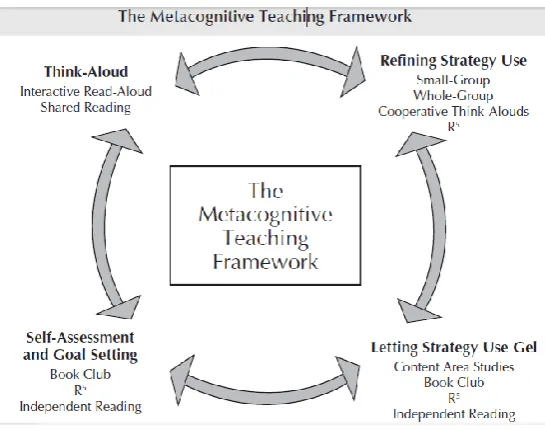
One form of metacognitive application that can be used in the learning process is MTF or Metacognitive Teaching Framework. MTF has been widely developed in several countries such as America, Canada, Britain and other countries. The framework is also not only used in the exact learning process, but also a language which is based on four levels of metacognitive knowledge that can help the reader to comprehend comprehensively (Harvey & Goudvis, 2007) which is through the use of the following strategies.
a. Tacit learners/readers lack awareness of their thinking as they read.
b. Aware learners/readers know when meaning breaks down, but do not have the
strategies to repair meaning.
c. Strategic learners/readers know when meaning breaks down and are able to use
a strategy or strategies to fix meaning.
d. Reflective learners/readers reflect on their reading and intentionally apply a
Supa’at & Khilman Rofi’ Azmi
108 Ijtimā’iyya, Volume 4, Number 1, March 2019
Figure 2. An example of an MTF diagram that is applied in the "reading" learning process (Boyles & Soll, n.d)
Based on the image, (Oczkus, n.d.) tries to provide 4 steps for implementing MTF as follows.
a. Introduce, explain, and define the strategic components for students.
b. Apply the strategy components while you read aloud.
c. Have students figured out which strategy component you’re using.
d. Clarify the purpose of the strategy or a specific strategy component for students.
4. The Aspect and Elements of Metacognitive
Metacognitive in the learning process is closely related to the regulation of the cognitive system which consists of three components, namely planning, monitoring and evaluating (Cohen & Hyde, n.d.). This is in accordance with the North Central Regional Educational Laboratory (NCREL) which presents three basic elements of metacognition specifically in dealing with tasks, namely developing an action plan (developing a plan of action), monitoring action plan (maintaining / monitoring the plan), and evaluating action plan (evaluating the plan) (NCREL, 2018). However, another opinion explains that Metacognitive is usually divided into two different components, namely knowledge of cognition and regulation of cognition, where the researchers direct the two components as metacognitive knowledge and metacognitive skills (Schraw, G., Olafson, L., Weibel, M ., Sewing, 2012)
Learning Quality Improvement Through the Metacognitive Keywords Model ...
Ijtimā’iyya, Volume 4, Number 1, March 2019 109
of specific knowledge possessed; (2) Control or self-monitoring of a person's thinking process where have never used difficult techniques before checking whether there are simple techniques that can be used to solve the problem. When resolving problems, students need to look for new steps and change ways of solving if needed; (3) Expert problem solvers often have a sharp feeling about a problem such as "this does not seem to be a solution" and is able to find other alternatives. Metacognitive control such as a "feeling of knowing" is only obtained from careful practice.
Some of the results of the following research show a strong attachment between metacognitive elements resulting in a positive and significant relationship. Research by (Rimbatmojo, Kusmayadi, & Riyadi, 2017), (Huda, Sutawidjaja, Subanji, & Rahardjo, 2018), (Parrott & Rubinstein, 2015), shows that: (1) students' abilities regarding metacognitive awareness are more dominant in high and medium criteria, while the average ability of metacognitive awareness is in the low category; (2) there is a positive linear relationship between metacognitive awareness and cognitive skills; (3) there is a positive linear relationship between metacognitive awareness and metacognitive skills; and (4) there is a positive correlation between cognitive skills and metacognitive skills in the middle category.
5. The Metacognitive Keyword Model (MKM) for Teaching Model in Islamic Learning
MKM is one of the results of developing a learning model that refers to metacognitive and keyword. The term metacognitive refers to the explanation of the previous sub-chapter, while keyword refers to the results of analytical thinking to find the stressing point on each question and statement that appears at the learning of Islamic Education (PAI). The use of keywords in the learning process proved to be effective in increasing student understanding of certain materials delivered by the teacher or the results of discussions together.
If MKM has been applied by PAI Teachers, the benefits to be obtained include (1) students will complete and complete the task more efficiently; (2) the occurrence of Self-Regulated Learning; (3) identify various obstacles in learning and find solutions to these obstacles; (4) students can recognize their strengths and weaknesses in learning; (5) obtain better test performance (Ben-David & Orion, 2013). In addition, the following are some other predictions related to the use of MKM in learning Islamic Education (PAI), among others: (1) Teaching metacognitive skills can be beneficial to a variety of learning needs; (2) The Equality of Challenge initiative has put together a set of strategies that can be used flexibly in many settings; and (3) The document is a working in progress - lots of opportunities to match your teaching & learning objectives.
Supa’at & Khilman Rofi’ Azmi
110 Ijtimā’iyya, Volume 4, Number 1, March 2019
Help pupils to learn about their thinking as they work on a task; (4) Show that you value metacognition in your classroom / mentoring relationship.
MKM learning stages in Islamic Religious Education (PAI) refer to metacognitive theories that are in accordance with the North Central Reegional Educational Laboratory (NCREL) by presenting three basic elements of metacognition specifically in the face of the task, namely developing a plan of action, monitor the action plan (maintaining / monitoring the plan), and evaluate the action plan (evaluating the plan) (NCREL, 2018) However, the specific stages in the MKM are also described through (1) refresh; (2) re-arrange the keywords; (3) creating positive self talk and affirmation; (4) review and (5) Reflect.
Refers to the initial process of PAI learning activities by conducting relaxation and ice breaking, it is intended to make students comfortable and happy so that they are more enthusiastic in following the learning process of Islamic Religious Education (PAI). Refresh stage. The next step is to rearrange the Keywords. This stage emphasizes the process of preparing questions and keywords for students by making a list of questions with the keywords. This stage really needs the teacher's role in guiding students to find the right type of keywords on each question that will help students' metacognitive process. The next stage is creating the positive self talk and affirmation. This stage is a positive and helpful stage of creating self-talk in order to guide the brain in completing various materials provided in the learning of Islamic Religious Education (PAI). Affirmations also reinforce students in completing tasks through motivation and self esteem or self-confidence to succeed in undergoing this learning process. The role of teachers and instructors is also still highly expected to be able to stimulate the results of student analysis of the emergence of positive self talk and self-affirmation.
Learning Quality Improvement Through the Metacognitive Keywords Model ...
Ijtimā’iyya, Volume 4, Number 1, March 2019 111
Table 1. Metacognitive Keyword Model (MKM) implications for the PAI learning
process
Element of
Metacognitive
Self Questions Keywords
Before Session
(Planning)
a. What initial knowledge helped in solving this task?
Experience, same
b. What instructions are used in thinking? Rules
c. What did I do first? Here, now
d. Why did I read the choice (this section)?
Interesting, masterful
e. How long do I do this task in full? Time, deadline
During Session (Monitoring)
a. How do I do it? Experience
b. Am I on the right track? Rules
c. How do I proceed? Knowledge
d. What information is important to remember?
Priority, information
e. Should I move to another clue? Rules
After Session (Evaluating)
a. How well do I do it? Value, experience
b. Will this particular thinking discourse produce more or less than I expected?
Completeness, confidence
c. Can I do it differently? Experience,
challenge d. How do you apply this process to
another problem?
Supa’at & Khilman Rofi’ Azmi
112 Ijtimā’iyya, Volume 4, Number 1, March 2019
e. Do I have to go back to the initial assignment to fulfill?
Rules, knowledge
In addition to the list of questions, students will also be given a special format relating to the graphic organizer for students to use as they are doing a project (KWL) on each PAI learning material as in the following picture.
Table 2. MKM Graphic organizer for students
K What I Know
W
What I Want to Learn
L
What I Have Learned
The implementation of the Metacognitive Keyword Model (MKM) can be implemented through a variety of strategies in learning, including (1) Teacher modeling of problem solving steps; (2) Think-pair-share; (3) Goal setting; (4) Journal Writing; (5) Activation of Prior Knowledge; (6) Cues and Questions; (7) Debate; (8) Role Play; (9) Story map; (10) Story retelling; (11) Story frame; and (12) Semantic mapping.
D. Conclusion
The importance of using metacognitive is one of the inspirations for the emergence of this learning model. Metacognitive Keyword Model (MKM) in the learning process of Islamic Religious Education (PAI). Through the stages and metacognitive elements, it is hoped that the PAI learning process will be more attractive and innovative. However, some of the shortcomings that are of concern in developing this model include (1) the need for larger scale trials; (2) the need for evaluators in the field of learning assessment; (3) as well as the need for special guidelines and worksheets to make it easier for teachers or instructors to apply this model.
Bibliography
Azmi, K. R. (2015). ENAM KONTINUM DALAM KONSELING TRANSGENDER
SEBAGAI ALTERNATIF SOLUSI UNTUK KONSELI LGBT. Jurnal
Learning Quality Improvement Through the Metacognitive Keywords Model ...
Ijtimā’iyya, Volume 4, Number 1, March 2019 113
Bimbingan Konseling, 1(1), 50. https://doi.org/10.26858/jpkk.v1i1.1136
Abdul Mujib; Jusuf Mudzakkir. (2006). Ilmu Pendidkan Islam. Jakarta: Kencana
Prenada Media.
Amin, Ihdi, S. (2015). “Analysis Metacognitive Skills On Learning Mathematics in
High School.” International Journal of Education and Research, 3(3).
Atmojo. (2016). Analisis keterampilan kognitif siswa dalam Menyelesaikan soal Geometri. Surakarta: Universitas Muhammadiyah Surakarta.
Ben-David, A., & Orion, N. (2013). Teachers’ Voices on Integrating Metacognition into
Science Education. International Journal of Science Education, 35(18), 3161–
3193. https://doi.org/10.1080/09500693.2012.697208
Blakey, E. & Spence, S. (1990). Developing Metacognition. New York: ERIC
Clearinghouse on Information Resources Syracuse NY. New York: : ERIC
Clearinghouse on Information Resources Syracuse NY.
Bloom, B. S. (2009). Taxonomy of Educational Objectives: Handbook 1, Cognitive
Domain (1st ed.). New York: David McKay.
Boyles, N. N., & Soll, K. (n.d.). Comprehensive literacy basics : an anthology by
Capstone Professional.
Cohen, M. B., & Hyde, C. A. (n.d.). Empowering workers and clients for organizational
change.
Daulay, H. P. (2007). Sejarah Pertumbuhan dan Pembaruan Pendidikan Islam di
Indonesia. Jakarta: Kencana Press.
Dawson, M. E., & Furedy, J. J. (1976). The Role of Awareness in Human Differential Autonomic Classical Conditioning: The Necessary-Gate Hypothesis.
Psychophysiology, 13(1), 50–53. https://doi.org/10.1111/j.1469-8986.1976.tb03336.x
DeMeo, S. (2008). Multiple solution methods for teaching science in the classroom :
improving quantitative problem solving using dimensional analysis and proportional reasoning. Universal Publishers. Retrieved from
https://www.google.com/search?safe=strict&biw=1024&bih=503&ei=b7CkXP2
nFM_bz7sP-qmumAE&q=Burrowes+%282003%29+&oq=Burrowes+%282003%29+&gs_l=
psy- ab.12..0i22i30l2.100618.100618..103124...0.0..0.192.192.0j1...0....2j1..gws-wiz.O2s9ORwIVn8
Depdiknas. Undang-Undang Sistem Pendidikan Nasional (2003). Indonesia: Depdiknas.
Desmita. (2010). Psikologi Perkembangan Peserta Didik, (Bandung: PT. Remaja Rosda
Karya, 2010),. Bandung: PT. Remaja Rosda Karya.
Djamarah. (n.d.). Strategi Belajar Mengajar. Jakarta: Rineka Cipta.
Supa’at & Khilman Rofi’ Azmi
114 Ijtimā’iyya, Volume 4, Number 1, March 2019
Jakarta: Rajawali Press.
Dori, Y. (Yehudit), Mevarech, Z. R., & Baker, D. R. (n.d.). Cognition, metacognition,
and culture in STEM education : learning, teaching and assessment. Retrieved from
https://www.google.com/search?safe=strict&biw=1024&bih=503&ei=9aukXK7 rAci89QO6vIfgBQ&q=%28metacognitive+Cooper%2C+2008%29&oq=%28me
tacognitive+Cooper%2C+2008%29&gs_l=psy- ab.3...45609.48501..49226...0.0..0.630.3323.0j3j3j3j1j1...0....1..gws-wiz...0i71j0i7i30j0i8i7i30.c_FXcs6TvqU
Downing, K., Ning, F., & Shin, K. (2011). Impact of Problem-Based Learning on Student Experience and Metacognitive Develompment. Multicultural Education & Technology Journal., (5(1)), 55–69.
flavell. (1987). Metacognition. new york: sage publication.
Freire, P., Freire, A. M. A., & Oliveira, W. F. de. (n.d.). Pedagogy of Solidarity : Paulo
Freire patron of Brazilian education.
Harvey, S., & Goudvis, A. (2007). Strategies that work : teaching comprehension for
understanding and engagement. Stenhouse Publishers. Retrieved from
https://www.google.com/search?safe=strict&biw=1024&bih=503&ei=bbukXNq dCun7z7sP8fyM2AQ&q=%28Harvey+and+Goudvis%2C+2007%29++&oq=%
28Harvey+and+Goudvis%2C+2007%29++&gs_l=psy- ab.3..0i22i30.171554.171554..172975...0.0..0.340.340.3-1...0....2j1..gws-wiz.mSoJ_EF5wyI
Howard, R. (2003). The Implication of Metacognitive and Problem Solving. London. Retrieved from
https://www.google.com/search?safe=strict&biw=1024&bih=503&ei=iqikXI2M BsrWvAT39qfoDA&q=%28Howard+2000%2C+Rozencwajg%2C+2003%29&
oq=%28Howard+2000%2C+Rozencwajg%2C+2003%29&gs_l=psy-ab.3...88776.88776..90760...0.0..0.170.170.0j1...0....1..gws-wiz.mktSyCux Huda, N., Sutawidjaja, A., Subanji, & Rahardjo, S. (2018). The errors of metacognitive
evaluation on metacognitive failure of students in mathematical problem
solving. Journal of Physics: Conference Series, 1008, 012073.
https://doi.org/10.1088/1742-6596/1008/1/012073
Jones, R. N. (2013). Basic counseling skills: A Helper’s Manual. London: SAGE
Publications, Inc.
McElwee, S. (n.d.). Metacognition for the Classroom and beyond. Oxford, UK:
University of Oxford.
NCREL. (2018). Metacognition in Strategic Teaching and Reading Project Guidebook. Retrieved from
Learning Quality Improvement Through the Metacognitive Keywords Model ...
Ijtimā’iyya, Volume 4, Number 1, March 2019 115
Nizar, S. (2009). Sejarah Pendidikan Islam: Menelusuri Jejak Sejarah Pendidikan Era
Rasulullah Sampai Indonesia. Jakarta: Kencana Press.
Oczkus, L. D. (n.d.). Just the Facts! : close reading and comprehension of
informational text.
Parrott, J. S., & Rubinstein, M. L. (2015). Metacognition and evidence analysis
instruction: an educational framework and practical experience. Systematic
Reviews, 4(1), 112. https://doi.org/10.1186/s13643-015-0101-8
Penjelasan UU 2-1989 ttg Sistem Pendidikan Nasional (1989). Retrieved from https://ngada.org/uu2-1989pjl.htm
Pucheu. (2008). Scoring rubic of Metacognitive.
Rimbatmojo, S., Kusmayadi, T. A., & Riyadi, R. (2017). Metacognition Difficulty of Students with Visual-Spatial Intelligence during Solving Open-Ended Problem. Journal of Physics: Conference Series, 895, 012034.
https://doi.org/10.1088/1742-6596/895/1/012034
Schraw, G., Olafson, L., Weibel, M., Sewing, D. (2012). Metacognitive Knowledge and Field-based Science Learning in an Outdoor Environmental Education Program. Journal of Metacognition in Science Education., 4., 58–59.
Schraw, G. and D. M. (1995). “Metacognitive Theories”. Educational Psychology
Review, 7(4), 351–371.
Simard, E. P., Ward, E. M., Siegel, R., & Jemal, A. (2012). Cancers with increasing
incidence trends in the United States: 1999 through 2008. CA: A Cancer Journal
for Clinicians, 62(2), 118–128. https://doi.org/10.3322/caac.20141
Syafaat, A. S. S. M. (2008). Peranan Pendidikan Agama Islam. Jakarta: PT. Raja
Grafindo Persada.
Veenman, M. V. J., Kok, R., & Blöte, A. W. (2005). The relation between intellectual
and metacognitive skills in early adolescence. Instructional Science, 33(3), 193–
211. https://doi.org/10.1007/s11251-004-2274-8