The Thirty-Third AAAI Conference on Artificial Intelligence (AAAI-19)
Towards Personalized Review
Summarization via User-Aware Sequence Network
Junjie Li,
1,2Haoran Li,
1,2Chengqing Zong
1,2,31National Laboratory of Pattern Recognition, Institute of Automation, CAS, Beijing, China 2University of Chinese Academy of Sciences, Beijing, China
3CAS Center for Excellence in Brain Science and Intelligence Technology, Beijing, China {junjie.li, haoran.li, cqzong}@nlpr.ia.ac.cn
Abstract
We address personalized review summarization, which gener-ates a condensed summary for a user’s review, accounting for his preference on different aspects or his writing style. We propose a novel personalized review summarization model named User-aware Sequence Network (USN) to consider the aforementioned users’ characteristics when generating sum-maries, which contains a aware encoder and a user-aware decoder. Specifically, the user-user-aware encoder adopts a user-based selective mechanism to select the important infor-mation of a review, and the user-aware decoder incorporates user characteristic and user-specific word-using habits into word prediction process to generate personalized summaries. To validate our model, we collected a new datasetTrip, com-prising 536,255 reviews from 19,400 users. With quantitative and human evaluation, we show that USN achieves state-of-the-art performance on personalized review summarization.
Introduction
Review summarization aims to generate a condensed sum-mary for a review or multiple reviews (Hu and Liu 2004; Ganesan 2010; Carenini, Cheung, and Pauls 2013; Gerani et al. 2014; Lu and Wang 2016). As this task can alleviate the information overload problem, it has been widely studied.
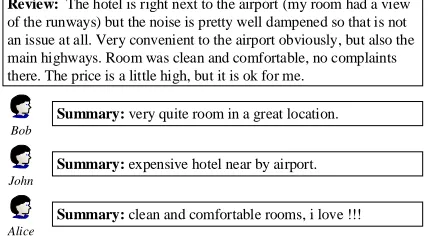
This paper addresses personalization issues of review summarization1, which have not been discussed in previ-ous research. Given a review, different users may care about different contents according to their own experiences or thoughts. Figure 1 illustrates the motivation with a hotel review sample. Bob may travel on business and he cares aboutlocationandroommore thanprice, whileJohnmay travel on a tight budget and care aboutpricemore. What’s more, different users have their own writing styles.Alice of-ten summarizes reviews with the words which can explicitly express her emotions, such as “love” or “hate”, whileBob andJohndon’t do that.
Actually, personalized review summarization is applica-ble to a wide range of online consumer review platforms,
Copyright c2019, Association for the Advancement of Artificial Intelligence (www.aaai.org). All rights reserved.
1
In this paper, we focus on single-review summarization and we leave adapting our model to multi-review summarization scenario to future work.
Review: The hotel is right next to the airport (my room had a view of the runways) but the noise is pretty well dampened so that is not an issue at all. Very convenient to the airport obviously, but also the main highways. Room was clean and comfortable, no complaints there. The price is a little high, but it is ok for me.
Summary: very quite room in a great location.
用户
Bob
Summary: expensive hotel near by airport.
用户
John
Summary: clean and comfortable rooms, i love !!!
用户
Alice
Figure 1: Personalized review summarization is motivated by that different users are likely to generate different sum-maries for the same review, according to their own experi-ences, thoughts, or writing styles.
such as Tripadvisor and Yelp. For example, users often write reviews about their attitudes on hotels or restaurants in these websites. One function is to automatically generate sum-maries for these reviews using their own words and consid-ering their preference on different aspects2.
Another example would be helpful for users who read these reviews to choose products. Classical review summa-rization systems only summarize reviews based on review contents and show the same summaries to all readers. How-ever, personalized review summarization can consider read-ers’ preference and generate different summaries of reviews for different readers. These summaries can directly reflect aspects that readers care about and may be more suitable for them to choose products.
To perform personalized review summarization, we pro-pose a User-aware Sequence Network (USN). USN is based on sequence to sequence models (Seq2Seq), which are pop-ular methods in machine translation (Bahdanau, Cho, and Bengio 2015; Zhao et al. 2018), text summarization (Rush, Chopra, and Weston 2015; See, Liu, and Manning 2017; Li et al. 2018) and review summarization (Lu and Wang 2016;
2
Ma et al. 2018). Our major updates over standardSeq2Seq are three-fold.
First, we design two kinds of user-based representations for personalized review summarization. One is user embed-ding, which embeds each user into a low-dimension vec-tor and another is user-specific vocabulary memory, which stores user’s active vocabulary.
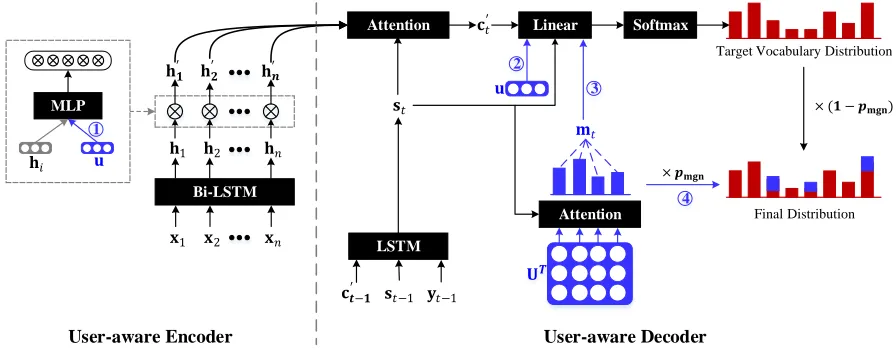
Second, to consider users’ different preferences on review content, we propose aUser-aware Encoder, which utilizes a bidirectional-LSTM to encode review, and then it adopts a user-based selective mechanism to select the important in-formation of the review to obtain a better representation.
Third, different from the classical decoder module in Seq2Seq, we propose aUser-aware Decoderto consider dif-ferent writing styles of users. It incorporates user embedding and user-specific vocabulary memory into word prediction module to generate personalized summaries.
To validate our approach, we collect a new personalized review summarization dataset named Trip from Tripadvi-sor website, which contains 536,255 review-summary pairs with 19,400 users. With quantitative and human evaluation, we show that USN achieves state-of-the-art performance on personalized review summarization. Our contributions are as follows:
• To the best of our knowledge, we first propose a user-awareSeq2Seq-based model named User-aware Sequence Network (USN) for personalized review summarization.
• Our model adopts a user-based selective mechanism con-sidering different user preferences on review content when summarizing a review, and applies user-specific vo-cabulary to consider user’s writing styles when generating a summary.
• For evaluation of personalized review summarization, we introduce a novel dataset namedTrip, which is available at https://github.com/Junjieli0704/USN.
Background
In this section, we formalize our problem and introduce a classical sequence-to-sequence attentional model for review summarization.
Problem Formulation
Suppose we have a corpusDwithmuser-review-summary triples, and each triple contains a reviewx, a summaryyand a useruwho postsxand summarizesxtoy. Reviewx con-sists ofnwords as{x1, x2, ..., xn}, wherexi∈VsandVsis
the source vocabulary. Summaryyconsists ofl ≤nwords as{y1, y2, ..., yl}, whereyi∈VtandVtis the target
vocab-ulary. Personalized review summarization aims to generate summaryyfrom reviewxby attending tou’s characteristics on summarizing reviews.
Sequence-to-sequence attentional model
Sequence-to-sequence attentional model has been widely used in abstractive text and review summarization, and it contains two basic modules: encoder and decoder.
Encoder. Given reviewx, it first embeds each wordxiinto
vectorxiusing embedding matrixEv. Then, these word
vec-tors are fed into the encoder module (a single-layer bidirec-tional LSTM) one by one, producing a sequence of encoder hidden stateshi.
Decoder. At each decoding time step t, the decoder (a single-layer unidirectional LSTM) receives previous word embedding to obtain the new hidden statest. Then it
com-putes context vectorctfor time steptthrough the attention
mechanism:
et,i=vTtanh(Wahi+W0ast+ba) (1)
αt,i=
exp(et,i) P
iexp(et,i)
(2)
ct= X
i
αt,ihi (3)
where Wa,W0a,ba and v are parameters in the attention
layer andαt,imatches the importance score between current
decoder statestand the encoder hidden statehi.
It then combines the context vector ct and the decoder
statestto construct the readout statert, that is fed through a
linear layer to produce the vocabulary distributionPvoc:
rt=Wr[ct;st] +br (4)
Pvoc= softmax(Wort+bo) (5)
where Wo,Wb,bo,bb are learnable parameters, and [; ] is
the concatenating operator.
Finally, negative log likelihood is used for computing loss and the overall loss for the whole sequence is:
L=−1 l
l X
t=0
logPvoc(yt) (6)
User-aware Sequence Network
It is obvious that different users may care about different content of a review and have different word-using habits. Therefore we encode user information into encoder and de-coder modules to model these different characteristics to perform personalized review summarization.
Specifically, we consider user from two views as follows: (1) user embedding (we embed useruas vectoruand add
u into our models) , (2) user-specific vocabulary memory, which is composed ofKmost user-specific words{Uk}Kk=1 from u’s previous reviews and summaries. After embed-ding each word in{Uk}Kk=1into vector{Uk}Kk=1using em-bedding matrixEv, we can get the user-specific vocabulary
memoryUfor useru. To build{Uk}Kk=1, we first merge all reviews and summaries posted byuinto a document. Then we computetf-idfscores for each word appears in the doc-ument, and we finally select top-Kwords foru. Usingtf-idf scores means we do not include too general terms that many users commonly use, because they are not helpful for con-sideringu.
𝐬𝑡
Linear Softmax
𝐦𝑡 Attention
2
3
4
𝐮
× 𝒑𝐦𝐠𝐧
× (𝟏 − 𝒑𝐦𝐠𝐧)
Target Vocabulary Distribution
Attention
LSTM
𝐔𝑻
User-aware Encoder User-aware Decoder
Final Distribution
Bi-LSTM
𝐱1
𝐡1
𝐱2
𝐡2
𝐱𝑛
𝐡𝑛 MLP
𝐡𝑖 𝐮
𝐡𝒏′
𝐡𝟏′ 𝐡𝟐′
1
𝐜𝑡′
𝐜𝒕−𝟏′ 𝐬𝑡−1 𝐲𝑡−1
Figure 2: The architecture of User-aware Sequence Network (USN). USN encodes two kinds of user information, user embed-ding (u) and user-specific vocabulary memory (U), into its two basic modules (User-aware EncoderandUser-aware Decoder).
1
, and 2show strategies based on user embedding, and represent User Selection strategy, and User Prediction strategy, respec-tively. 3and 4indicate strategies based on user-specific vocabulary memory and represent User Memory Prediction strategy and User Memory Generation strategy, respectively.
User-aware Encoder
Different users pay attention to different content of a review. Inspired by (Zhou et al. 2017), we propose a user-based sele-tive mechanism to select important information from review for different users. The selective mechanism can construct a tailored representation of reviewx by consideringu. In detail, our user-based seletive network takes user vectoru
and the encoder hidden statehias input, and outputs a gate
vectorgateito selecthi.
gatei=σ(Wk[hi;u] +bk) (7)
h0i=higatei (8)
whereWk,bk are learnable parameters,[; ]is the
concate-nating operator,σdenotes sigmoid activation function, and is element-wise multiplication.
From equation 7, we can find gatei is a vector whose value is between 0 and 1. Therefore we can utilize||gatei||2 to measure the degree of the filter and call it2-Norm Gate Value. High value means most of the information in hi is
passed from the filter, which results in the wordxiis
impor-tant. This is the first strategy we proposed to take users into consideration calledUser Selection strategy.
User-aware Decoder
After selecting important information using user-aware en-coder, we obtain new hidden stateh0ifori-th word in review
x. Classical attention module is also applied to compute con-text vectorc0
tfor time stept.
When generating a summary, different users may have their own vocabulary. Thus it is natural to take user-specific vocabulary memory into consideration when predicting out-put vocabulary distributionPvocand different words in user-specific vocabulary may have different effects. Thus, we
uti-lize an attention mechanism to extract important words inU
when obtaining vocabulary statemt.
gt,k =vTtanh(WmUk+W0mst+bm) (9)
βt,i =
exp(gt,k) P
iexp(gt,k)
(10)
mt= X
k
βt,kUk (11)
whereWm,W0mandbmare parameters. Therefore, we can
enhance the readout statertby consideringmt. Besides, we
can also enhance the readout statertby combining user
vec-toru.
r0t=Wr0[c0t;st;u;mt] +br0 (12)
Pvoc0 = softmax(Wor0t+bo) (13)
whereWr0 andbr0 are learnable valuables.
The strategies of adding user vector u and vocabulary state mt into readout state r0t are called User Prediction
strategyandUser Memory Prediction strategy, respectively. Last but not least, inspired by (See, Liu, and Manning 2017), we also propose a soft copy mechanism to copy user-specific words in generating summaries, which is the 4-th strategy calledUser Memory Generation strategy.
The generation probabilitypmgn ∈ [0,1]for timestep t is calculated from the context vectorc0t, the decoder statest
and the vocabulary statemt:
pmgn=σ(Wmg[c0t;st;mt] +bmg) (14)
whereWmg,bmg are learnable parameters, [; ]is the
from the target vocabularyVtor coping a word from
user-specific vocabulary.
P(w) = (1−pmgn)Pvoc0 (w) +pmgn
X
k:Uk=w
βt,k (15)
The first part in Equation 15 represents generating words from our vocabulary, and the second part indicates coping words from user-specific vocabulary memory, respectively.
Dataset
Since there is no available personalized review summariza-tion dataset, we create a new one namedTrip.Tripis col-lected from Tripadvisor, which is a travel review website that contains user-generated reviews along with their authors and titles. The title of a review often summarizes the impor-tant information of the review, therefore we take the title as the reference summary of the review. We collect 2,832,874 user-review-summary triplets. However, when we observe these triplets carefully, we find there are many noisy sam-ples. Since there is no any constraints on writing a title, users may write titles arbitrarily and it results in many mean-ingless titles, such as “not my first choice”, “i will be back again”, and “twice in one trip”. To remove these noisy sam-ples from our original dataset, we propose three filters: (1) Aspect-based filter is used to remove samples whose
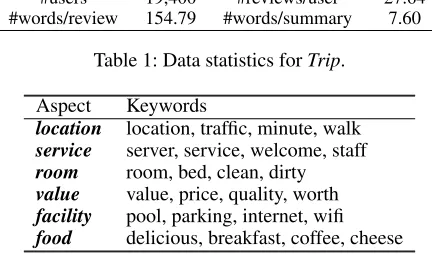
ti-tle does not describe any aspects. We manually define 6 common aspects in the hotel domain (location, ser-vice, room, value, facility and food) as well as their seed words shown in table 2. Then Aspect Segmenta-tion(Wang, Lu, and Zhai 2010) algorithm is used to ex-pand their seed words automatically with boot-strapping strategy. Hyperparameters inAspect Segmentation, such as selection threshold and iteration times, are set as the same with (Wang, Lu, and Zhai 2010). Finally, we re-move samples that all words in review title do not appear in our seed words for all aspects.
(2) Title length filter is used to remove samples whose title are too short (length is less than 5).
(3) Compression ratio filter is used to remove samples whose ratio between the length of a review and a title is larger than 50.
After applying these filters, we construct Trip with 536,255 user-review-summary triplets. We also randomly choose 1,000 samples fromTripand check the aspects over-lap between the reviews and the summaries by humans. We find that the percentage of all samples whose aspects de-scribed in a summary all appear in its corresponding review surpasses 90%, which reveals the reliability of our dataset.
Statistics ofTripare summarized in Table 1. We randomly split the dataset into 5,000 reviews for test, 5,000 reviews for validation and the rest for training. The input and output vocabularies are collected from the training data, which have 360,448 and 48,378 word types respectively.
Experiments
In this section we introduce the evaluation metric, all the comparison methods, the implementation details, and the performance of our model.
#reviews 536,255 #summaries 536,255
#users 19,400 #reviews/user 27.64
#words/review 154.79 #words/summary 7.60
Table 1: Data statistics forTrip.
Aspect Keywords
location location, traffic, minute, walk
service server, service, welcome, staff
room room, bed, clean, dirty
value value, price, quality, worth
facility pool, parking, internet, wifi
food delicious, breakfast, coffee, cheese
Table 2: Aspects and their keywords forTrip.
Evaluation Metric
We exploit ROUGE (Lin 2004) as our evaluation metric. ROUGE scores reported in this paper are computed by Py-rouge package3.
Comparison Methods
As far as we know, all previous review summarization stud-ies focused on the multi-review summarization scenario, which is essentially different from our task. Here, we com-pare with several methods which are popular in text sum-marization and can be divided into two types: extractive and abstractive summarization approaches.
• Lead-1 is an extractive approach which selects the first sentence in review as summary.
• LexRank (Erkan and Radev 2004) is also an an famous extractive approach that computes text centrality based on PageRank algotithm.
• S2S+Attis sequence to sequence model with attention im-plemented by us.
• SEASS(Zhou et al. 2017) adopts a selective network to se-lect important information from review intoS2S+Attand obtains state-of-the-art results in sentence summarization.
• PGN(See, Liu, and Manning 2017) adopts a copy mecha-nism to copy words from review when generating summa-rization intoS2S+Att and obtains state-of-the-art results in document summarization.
Implementation Details
For all experiments, we set the word embedding size and user embedding size to 128, and all LSTM hidden state sizes to 256. We use dropout (Srivastava et al. 2014) with prob-ability p= 0.2. During training, we use loss on the vali-dation set to implement early stopping and also apply gra-dient clipping (Pascanu, Mikolov, and Bengio 2013) with range[−5,5]. At test time, our summaries are produced us-ing beam search with beam size 5.
We use Adam as our optimizing algorithm. We set the batch size to 128. We use a vocabulary of 30,000 words for
3
Models RG-1 RG-2 RG-L
Lead-1 12.77 2.98 11.24 LexRank 10.84 1.88 9.46
S2S+Att 22.09 6.39 20.36 SEASS 21.77 6.14 20.12
PGN 22.51 6.89 20.79
USN 24.78∗ 7.75∗ 22.66∗
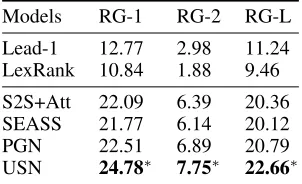
Table 3: ROUGE F1 scores on the test set. RG in the Table denotes ROUGE. Models and baselines in the top half are ex-tractive methods, while those in the bottom half are abstrac-tive ones. The best performance is inbold. The superscript∗ indicates our USN model performs significantly better than all baseline models as given by the 95% confidence interval in the official ROUGEscript.
both source and target. We truncate the review to 200 tokens, which is done to expedite training and testing. However we also find that truncating the review can raise the performance of the model4. We use the develop set to choose the size of
user-specific vocabulary and set it to 200.
Results
The results are displayed in Table 3. For extractive methods, we can see thatLead-1 performs best. However, it only ob-tains 12.77 ROUGE-1, 2.98 ROUGE-2 and 11.27 ROUGE-L F1 scores. The reason is that summaries inTripare very suc-cinct and often cover content across sentences. Therefore, the extractive methods perform poor. That is also the reason why we build our user-aware review summarization model based on abstractive methods.
For abstractive methods, we can find thatS2S+Attis bet-ter than all extractive methods. Afbet-ter adding selective mech-anism into S2S+Att, the performance of SEASS decreases slightly. The reason is that the selective mechanism pro-posed by SEASS is designed for sentence summarization, which may not be suit for summarizing documents (re-views). The average length of input is less than 40 in Zhou et al. 2017, while the average length inTripis about 154. How-ever, using selective mechanism to filter the input is very necessary for summarization. Therefore, we propose a user-based selective mechanism to filter the input and our method is proved to be effective. When considering copy mechanism intoS2S+Att,PGNobtains better performance.
Finally, after incorporating our proposed 4 user-based strategies intoS2S+Att,USNachieves 24.78 ROUGE-1, 7.75 ROUGE-2 and 22.66 ROUGE-L F1 scores and performs sig-nificantly better than all previous methods. Compared to S2S+Att, our model has a 2.69 ROUGE-1, 1.36 ROUGE-2 and 2.3 ROUGE-L gains, which shows explicitly modeling user-related characteristics can indeed improve summariza-tion quality. Our model also surpassesPGNby 2.27 ROUGE -1, 0.86 ROUGE-2 and 1.87 ROUGE-L and achieves the state-of-the-art performance on review summarization.
4
Indeed, we found that using only the first 200 tokens of the review yields higher ROUGEscores than using the first 600 tokens.
Models Precision Recall F1
S2S+Att 0.516 0.502 0.509
PGN 0.518 0.542 0.530
USN 0.587 0.601 0.594
Table 4: Aspect-level Precision, Recall and F1 for different systems
Human Evaluation on Aspect-level Coverage
USN is a personalized model, which can not only capture word-level user preference, but also capture aspect-level user preference. Aspects that user care about often appear in gold summaries. Therefore, we want to identify whether aspects described in summaries generated byUSNare con-sistent with aspects described in gold summaries.
We utilize 6 aspects (location,service,room,value, fa-cility and food) provided by Table 2 as our gold aspects. Beyond that, we also add an aspect to describe the overall attitude and name ithotel. Given a summary, we label it with the aforementioned 7 aspects. Two summaries with human labeled aspect are as follows:
Example. 1 friendly staff with good room (service,room) Example. 2 a great hotel in city center (hotel,location) To perform this human evaluation, we randomly sample 1000 user-review-summary triplets from our test set. We first generate summaries of these reviews from S2S+Att, PGN andUSN. Then we ask two students to label aspects to these gold and generated summaries. After that, we com-pute aspect-level precision, recall and F1 for different sys-tems and show it in Table 4. We can find thatUSN outper-forms other models (S2S+AttandPGN) by a large margin, which shows our model can capture aspect-level user pref-erence.
Discussions
Effects of Different User-based Strategies
In this paper, we propose 4 user-based strategies to construct our user-aware review summarization model. To evaluate the effect of each strategy on personalized review summariza-tion, we perform the ablation study ofUSN and report ex-periment results in Table 6.
First, we find that models which adds only one kind of user-based strategy into S2S+Att (line 2-5) can obtain at least 0.83 in ROUGE-1 compared withS2S+Att. It shows that all these strategies improve the performance of per-sonalized review summarization. User Prediction and User Memory Prediction strategies are the two most effective strategies, the reason is that they directly affect the word pre-diction module inUSN.
Review fromUserA: i was here one night for a business meeting in the hotel . i was immediately impressed with the front-desk staff when checking in . i had several needs ,
and they were very accommodating . the bed was perfect - super comfortable . the restaurant
food is quite decent , as well . i definitely recommend this hotel and would return .
Table 5: User-based selective gate visualization of a input review. The important words are selected from the input review, such as “impressed”, “staff”, “bed” and “perfect”. The output summary of our model is“excellent service , comfy be” and the true summary is “excellent service , very comfortable bed”.
line USel UPre UMP UMG RG-1 RG-2 RG-L
1 – – – – 21.15 6.08 19.56
2 3 – – – 22.29 6.20 20.41
3 – 3 – – 24.04 7.30 21.92
4 – – 3 – 23.36 6.84 21.40
5 – – – 3 21.98 6.49 20.33
6 – 3 3 3 23.23 6.64 21.17
7 3 – 3 3 24.64 7.88 22.56
8 3 3 – 3 24.11 7.43 22.22
9 3 3 3 – 24.52 7.56 22.28
10 3 3 3 3 24.78 7.75 22.66
Table 6: Effects of different user-based strategies on review summarization. USel, UPre, UMP and UMG denote User Selection strategy, User Prediction strategy, User Memory Prediction strategy and User Memory Generation strategy, respectively. “3” means our model considers the specific strategy, while “–” means not. When there is no user-based strategies considered in our model, our model degrades into S2S+Att(line 1).
Third, after merging all strategies intoS2S+Att,USN ob-tains the best result.
Effects of user-specific vocabulary size
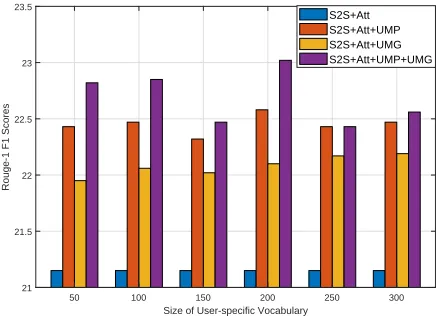
Since User Memory Prediction (UMP) and User Memory Generation (UMG) strategies are based on user-specific vo-cabulary, we show the effect of user-specific vocabulary size of these two strategies on development set ofTripin Figure 3, our observations are follows:
First, we can see that adopting user-specific vocabulary into S2S+Att withUMP or UMG can indeed improve the performance of review summarization, even though when the user-specific vocabulary size is small (such as 50). Sec-ond, by comparing the ROUGE-1 F1 Scores betweenUMG and UMP, we can find that UMP obtains higher perfor-mance, the reason is thatUMPcan directly affect the word prediction module. Finally, we set our user-vocabulary size to 200, sinceS2S+Att+UMP+UMGobtains the best perfor-mance at the point.
User-based Selective Gate Visualization
In order to validate that our model is able to select important words in a review for personalized review summarization, we visualize user-based selective gate value in Table 5.
50 100 150 200 250 300
Size of User-specific Vocabulary 21
21.5 22 22.5 23 23.5
Rouge-1 F1 Scores
S2S+Att S2S+Att+UMP S2S+Att+UMG S2S+Att+UMP+UMG
Figure 3: Effects of user-specific vocabulary size on devel-opment set ofTrip.
Word with dark color means high 2-Norm Gate Value (see the section of User-aware Encoder) and results in a im-portant word. From the gold summary given byUserA, we can find UserA may care about “service” and “bed” more and the important words found by our user-based selective mechanism are “impressed”, “staff”, “bed” and “perfect”, which also reflectsUserA’s experience on these two aspects. It shows our personalized model can mine the important in-formation for users.
Case Study
We show the case study of a sample from Triptest set in Figure 4.
First, although the review describesUserB’s attitudes on
room,food,service, andlocation, the reference only con-tainsroomandlocation. This showsUserBcares these two aspects more. Actually, we observe all reviews posted by UserB. There are 40 reviews with summaries posted by UserB, more than 80% these reviews and summaries con-tain UserB’s attitude on these two aspects. Existing meth-ods without modeling user information (S2S+AttandPGN) cannot capture UserB’s preference on these two aspects, which results in these methods generate words (such as the “staff”) about service. While our personalized model can mine such preference and only generate words about loca-tionandroom.
S2S+Att: nice hotel with good room PGN: friendly staff with good room
USN: great location , comfortable room
Gold: great location with comfortable room
Review from UserB: i stayed here for three nights
and i felt really pleasing. it had a fully equipped kitchen, a lounge and the shower was great too. the bar downstairs gets pretty busy, but i could not hear much from our room. the staff was always friendly and helpful. they offer a decent breakfast. it is opposite the train station, but i was on my bike so i found it easy to get to nearby attractions ...
Figure 4: An example of the generated review summairza-tion of S2S+Att, PGN and USN (Italic and bold denote words that do not appear in review).
it appears inUserB-specific vocabulary. After merging the vocabulary,USNcan generate the word accurately.
Related Work
Review summarization belongs to sentiment analysis (Liu 2016; Xia et al. 2015), which is a large area in natural lan-guage processing and contains sentiment classification (Li and Zong 2008; Xia, Zong, and Li 2011; Li, Yang, and Zong 2016; 2018), emotion dection (Li et al. 2015b), spam detec-tion (Wang, Liu, and Zhao 2017) and so on. Personalized review summarization is related to both opinion summariza-tion and personalized text summarizasummariza-tion.
Opinion summarization
There are two mainstream approaches for opinion summa-rization: extractive and abstractive approaches. A key task in extractive methods (Hu and Liu 2004; Lerman, Blair-Goldensohn, and Mcdonald 2009; Xiong and Litman 2014) is to identify important text units. For example, Hu and Liu (2004) first recognize the frequent product features and then attach extracted opinion sentences to the correspond-ing feature. Xiong and Litman (2014) exploit review help-fulness for review summarization. However, many stud-ies (Carenini, Cheung, and Pauls 2013; Fabbrizio, Stent, and Gaizauskas 2014) have shown that abstractive approaches may be more appropriate for summarizing evaluative text than extractive ones. Therefore, in this paper, we study ab-stract generation techniques to summarize reviews.
Abstractive approaches (Ganesan 2010; Carenini, Che-ung, and Pauls 2013; Fabbrizio, Stent, and Gaizauskas 2014; Gerani et al. 2014; Lu and Wang 2016) are also very popu-lar methods in review summarization. For example, Gane-san (2010) first represent review as token-based graphs based on the token order in the string and then rank sum-mary candidates by scoring paths after removing redundant information from the graph. Gerani et al. (2014) utilize dis-course structure of review to identify important aspects and then design a set of templates to generate summarizations.
Lu and Wang (2016) propose an attention-based neural net-work model for generating abstractive summaries of opin-ionated text.
All these studies focus on review summarization in the multiple review scenario, while our work focuses on person-alization issues in single review summarization scenario. Ma et al. (2018) is also related to our work, which jointly models review summarization and sentiment classification in an uni-fied framework. However, this work also ignores the effect of users on review summarization, while our task is person-alized review summaization and our model can consider the effect of users on review summarization.
Personalized text summarization
Personalized text summarization is an active area (Zhang et al. 2003; Yan, Nie, and Li 2011; D´ıaz and Gerv´as 2007; Yang et al. 2012; M´oro and Bielikov 2012; Li et al. 2015a). These studies either employ interactive user clicks/examinations (Yan, Nie, and Li 2011) or utilize users’ annotations or highlights (Zhang et al. 2003; M´oro and Bielikov 2012) to capture user preference and perform per-sonalized summarization. Although these studies boost the performance of text summarization, their user information is hard to obtain. Different with them, we only utilize users’ previous reviews to mine user preference, which is very easy to obtain. Another difference between our work and these studies is that they all focus on news-based text summariza-tion, while we focus on review summarization.
Poussevin, Guigue, and Gallinari (2015) and Wang and Zhang (2017) also summarize review in a personal situation to boost recommendation system. However, our work and these two studies are not in the same scenario. To generate a personalized summary of productpfor useru, they need a set of reviews posted byuand a set of reviews aboutp. Our work is to summarize a review posted byuby considering u’s characteristics.
Conclusion and Future Work
In this paper, we address personalized issue of review sum-marization and propose a User-aware Sequence Network (USN) to consider user information into personalized review summarization. USN contains two basic modules: user-aware encoder and user-user-aware decoder. To build these two user-aware modules, we propose 4 user-based strategies. To validate our model, we construct a new dataset (Trip). Exten-sive experiments onTripshow that USN outperforms state-of-the-art methods significantly.
This paper focuses on personalized review summarization in the single-review scenario. For future work, we wish to extend our model to the multi-review scenario.
Acknowledgements
References
Bahdanau, D.; Cho, K.; and Bengio, Y. 2015. Neural ma-chine translation by jointly learning to align and translate. In ICLR.
Carenini, G.; Cheung, J. C. K.; and Pauls, A. 2013. Multi-document summarization of evaluative text. Computational Intelligence29(4):545–576.
D´ıaz, A., and Gerv´as, P. 2007. User-model based personal-ized summarization. Information Processing and Manage-ment43(6):1715–1734.
Erkan, G., and Radev, D. R. 2004. Lexrank: Graph-based lexical centrality as salience in text summarization. J. Artif. Intell. Res.22:457–479.
Fabbrizio, G. D.; Stent, A.; and Gaizauskas, R. 2014. A hy-brid approach to multi-document summarization of opinions in reviews. InINLG, 54–63.
Ganesan, K. 2010. Opinosis:a graph-based approach to ab-stractive summarization of highly redundant opinions. In COLING, 340–348.
Gerani, S.; Mehdad, Y.; Carenini, G.; Ng, R. T.; and Nejat, B. 2014. Abstractive summarization of product reviews us-ing discourse structure. InEMNLP, 1602–1613.
Hu, M., and Liu, B. 2004. Mining and summarizing cus-tomer reviews. InSIGKDD, 168–177.
Lerman, K.; Blair-Goldensohn, S.; and Mcdonald, R. 2009. Sentiment summarization: evaluating and learning user pref-erences. InEACL, 514–522.
Li, S., and Zong, C. 2008. Multi-domain sentiment classifi-cation. InACL, 257–260.
Li, P.; Bing, L.; Lam, W.; Li, H.; and Liao, Y. 2015a. Reader-aware multi-document summarization via sparse coding. In IJCAI, 1270–1276.
Li, S.; Huang, L.; Wang, R.; and Zhou, G. 2015b. Sentence-level emotion classification with label and context depen-dence. InACL, 1045–1053.
Li, H.; Zhu, J.; Zhang, J.; and Zong, C. 2018. Ensure the correctness of the summary: Incorporate entailment knowl-edge into abstractive sentence summarization. InCOLING, 1430–1441.
Li, J.; Yang, H.; and Zong, C. 2016. Sentiment classification of social media text considering user attributes. InNLPCC, 583–594.
Li, J.; Yang, H.; and Zong, C. 2018. Document-level multi-aspect sentiment classification by jointly modeling users, as-pects, and overall ratings. InCOLING, 925–936.
Lin, C.-Y. 2004. Rouge: A package for automatic evaluation of summaries. InText Summarization Branches Out. Liu, B. 2016. Sentiment analysis: Mining opinions, senti-ments, and emotions. University of Cambridge: Cambridge University Press.
Lu, W., and Wang, L. 2016. Neural network-based abstract generation for opinions and arguments. InNAACL, 47–57. Ma, S.; Sun, X.; Lin, J.; and Ren, X. 2018. A hierarchical end-to-end model for jointly improving text summarization and sentiment classification. InIJCAI, 4251–4257.
M´oro, R., and Bielikov, M. 2012. Personalized text summa-rization based on important terms identification. In Interna-tional Workshop on Database and Expert Systems Applica-tions, 131–135.
Pascanu, R.; Mikolov, T.; and Bengio, Y. 2013. On the difficulty of training recurrent neural networks. In ICML, 1310–1318.
Poussevin, M.; Guigue, V.; and Gallinari, P. 2015. Extended recommendation framework: Generating the text of a user review as a personalized summary. InRecSys, 34–41. Rush, A. M.; Chopra, S.; and Weston, J. 2015. A neural attention model for abstractive sentence summarization. In EMNLP, 379–389.
See, A.; Liu, P. J.; and Manning, C. D. 2017. Get to the point: Summarization with pointer-generator networks. In ACL, 1073–1083.
Srivastava, N.; Hinton, G.; Krizhevsky, A.; Sutskever, I.; and Salakhutdinov, R. 2014. Dropout: a simple way to prevent neural networks from overfitting.Journal of Machine Learn-ing Research15(1):1929–1958.
Wang, Z., and Zhang, Y. 2017. Opinion recommendation using a neural model. InEMNLP, 1626–1637.
Wang, X.; Liu, K.; and Zhao, J. 2017. Handling cold-start problem in review spam detection by jointly embedding texts and behaviors. InACL, 366–376.
Wang, H.; Lu, Y.; and Zhai, C. 2010. Latent aspect rating analysis on review text data: a rating regression approach. In SIGKDD, 783–792.
Xia, R.; Xu, F.; Zong, C.; Li, Q.; Qi, Y.; and Li, T. 2015. Dual sentiment analysis: Considering two sides of one re-view. IEEE Trans. Knowl. Data Eng.27(8):2120–2133. Xia, R.; Zong, C.; and Li, S. 2011. Ensemble of feature sets and classification algorithms for sentiment classification. In-formation Science181(6):1138–1152.
Xiong, W., and Litman, D. 2014. Empirical analysis of exploiting review helpfulness for extractive summarization of online reviews.Grantee Submission.
Yan, R.; Nie, J. Y.; and Li, X. 2011. Summarize what you are interested in: An optimization framework for interactive personalized summarization. InEMNLP, 1342–1351. Yang, G.; Wen, D.; Chen, N. S.; and Sutinen, E. 2012. Per-sonalized text content summarizer for mobile learning: An automatic text summarization system with relevance based language model. InIEEE Fourth International Conference on Technology for Education, 90–97.
Zhang, H.; Chen, Z.; Ma, W. Y.; and Cai, Q. 2003. A study for documents summarization based on personal annotation. InHLT-NAACL.
Zhao, Y.; Zhang, J.; He, Z.; Zong, C.; and Wu, H. 2018. Ad-dressing troublesome words in neural machine translation. InEMNLP, 391–400.