800
Copyright © 2011-15. Vandana Publications. All Rights Reserved.
Volume-5, Issue-2, April-2015
International Journal of Engineering and Management Research
Page Number: 800-805
The Effectiveness of Vernonia amygdalina and Allium cepa Extract
Mixture as Corrosion Inhibitor on Mild Steel in Hydrochloric Acid
Solution
I. C. Ekeke1, I. K. Madu2, A. C. Nkwocha3, K. Chiemeka4
1,2,3,4
Department of Chemical Engineering, Federal University of Technology, Owerri, NIGERIA
ABSTRACT
A combination of bitter leaf (Vernonia amygdalina) and white onion (Allium cepa) extract is more effective together as an inhibitor on mild steel in hydrochloric acid solution than if they were used separately. In this study, series of weight loss experiments were carried out. Hydrochloric acid and varying concentrations of inhibitors were tested with mild steel coupons. The experimental set-up was left to stand for four (4) days with 24 hours periodic washing, drying and weighing of the metal plates. Increase in the concentration of the leaves extract reduces the rate of corrosion of the mild steel in the corrosion medium. Analyses of the experimental results were done using a quadratic model to determine the optimum inhibition efficiency as well the corresponding concentration and time; a surface plot was used to illustrate these optimum conditions. The surface plot of the mixture of
Allium cepa and Vernonia amygdalina extract shows that
maximum inhibition efficiency can be achieved at 94.94% after 20.4hrs and 49.5ml concentration which is higher than the maximum inhibition efficiency of Allium cepa (93.4%) and Vernonia amygdalina (88.52%) extract used individually.
Keywords— Allium cepa, corrosion inhibitor, inhibition
efficiency, mild steel, Vernonia amygdalina.
I.
INTRODUCTION
Corrosion is the deterioration of materials by chemical interaction with their environment. The term corrosion is sometime applied to plastics, wood and concrete degradation, but generally refers to metals [3]. Corrosion, being the breaking down of a metal as a result of various chemical reactions layer by layer until it loses its mechanical strength and cracks, is common knowledge. The effects of corrosion on metals are more than just loss
of metal; according to [4], corrosion affects the safe, reliable, and efficient operation of equipment or structures. The effects of corrosion include: reduction of metal thickness leading to loss of mechanical strength and structural failure, loss of operational time of industrial equipments, reduction in the value of goods, contamination of fluids in vessels and pipes, cracks in equipments which may lead to escape of contents, loss of technically important surface properties of metallic components.
801
Copyright © 2011-15. Vandana Publications. All Rights Reserved.
bonds with aromatic rings in their molecular structureswhich are adsorbed on the metal surface, form protective films, and obey various adsorption isotherms [8].
Allium cepa (white onion) is a plant that can be found in everyday household kitchen. It is cheap, fairly abundant to be accessed, safe, and environmentally
friendly [14]. Research has been conducted on Allium cepa
and its properties, and the findings have proven that the compounds in the onion skin (quercetin) can inhibit corrosion. Using weight loss technique, the efficiency of onion as a corrosion inhibitor was found to be dependent
on its concentration [1]. Vernonia amygdalina (bitter leaf),
a member of the Asteraceae family is a small shrub that grows in the tropics of Africa. The leaves may be consumed either as a vegetable (macerated leaves in soups) or aqueous extracts as treatment of various illnesses
[2]. Research has also found Vernonia amygdalina extract
to be an effective corrosion inhibitor.
Mild steel is a medium carbon steel with a carbon content of 0.2-0.5%, and is often used as piping material [7]. It is widely employed in most industries due to its low cost and wide availability for the fabrication of various vessels and piping systems [5]. It can corrode in both acidic and non-acidic media [6], but this paper discusses its corrosion in acidic media.
This study is to determine the effectiveness of the
combination of Vernonia amygdalina and Allium cepa
extract as a corrosion inhibitor on mild steel, using 2.0M hydrochloric acid as medium. The inhibition efficiencies of Vernonia amygdalina and Allium cepa extract will be determined at different concentrations and time; the concentration and time at which optimum inhibition efficiency will be achieved is also determined.
II.
MATERIALS AND METHODS
Raw Materials, Reagents and Equipment
Bitter leaves and white onion bulbs were purchased from an open market in Owerri, Imo state, Nigeria. Hydrochloric acid and acetone used were purchased in a reagent store in Owerri. The 4 x 3 x 0.04cm mild steel coupons used were fabricated by the Mechanical Engineering Department of the Federal University of Technology, Owerri; with composition (wt%) Mn (0.42), P (0.02), C (0.25), Si (0.02), Ni (0.01), Cr (0.03), Fe (99.25). Experiments were carried out in the Chemical Engineering laboratory of the Federal University of Technology, Owerri. The equipment used for the experiment include: beakers, blender, desiccators, electric oven, retort stand, weighing balance, stop watch, measuring cylinders and thread.
Preparation of Plant Extracts
700g of onions was rinsed, chopped and blended. Distilled water was added, and it left to stand for some time; the ground mix was then squeezed to obtain the
liquid extract, and then filtered using muslin. 750ml of the extract was stored. 1000g of bitter leaf was washed thoroughly with distilled water, and the first extract obtained was used; 750 ml was collected and stored. To obtain the mixture of both extracts, 250ml of each was added to separate conical flask to obtain 500ml, and later stored in a plastic bottle.
Weight Loss Measurement Experimental Procedures
1600ml of HCl with molar concentration 2M was prepared, after which 100ml was poured into sixteen separate beakers. The beakers were labeled in the order of the varying inhibitor volume they were to contain. The inhibitor was poured into fifteen beakers in the varying volumetric order of 50ml, 40ml, 30ml, 20ml, and 10ml, the remaining beaker was blank (beaker without any extract). The metal coupons were taken from the desiccators and were initially weighed with a digital weighing balance after which they were put into the solution by suspending the metals with threads. The experiment was carried out using the individual extracts, white onion and bitter leaf extract, and also with a mixture of the extracts. They were first left for twenty four hours after which, they were removed dried and weighed to check for weight loss. The metal specimen was then dropped back and the experiment carried out all over again; this experiment went on for 4 days after which readings were compiled and analysis made. It should be noted that this experiment was carried out at room temperature, and the time used for washing, drying and weighing was not put into consideration.
Determination of Weight Loss and Percentage Inhibition Efficiency (I.E.%)
The weight loss was calculated for each metal coupon after each day from the experimentally determined weight with and without an inhibitor. It was calculated by subtracting the weight of the coupon after each day from its initial weight for both the blank solution and the inhibitor solutions.
The percentage inhibition efficiency can be calculated using the equation below:
Where,
= weight loss without inhibitor,
= weight loss with inhibitor
III.
RESULTS AND DISCUSSIONS
Weight Loss of Mild steel Coupons
802
Copyright © 2011-15. Vandana Publications. All Rights Reserved.
inhibitor solutions. Under the experimental conditionsinvestigated in this study, the weight loss results did not follow a particular trend for the different extract concentrations. However, in general, the weight loss
decreased as the concentration of the Vernonia amygdalina
and Allium cepa extract increased from 10ml to 50ml; while for the combination of both extracts, as the concentration increased, the weight loss varied after the third and fourth day.
Table 1: Weight loss of mild steel specimen in different concentrations of the three extracts used at different time interval
EXTRACT AND
CONCENTRATION (ML)
WEIGHT LOSS (G)
AFTER
24 HRS
AFTER
48 HRS
AFTER
72 HRS
AFTER
96 HRS
BLANK 0.171 0.285 0.375 0.389
VERNONIA AMYGDALINA
10 0.066 0.094 0.100 0.113
20 0.060 0.082 0.086 0.099
30 0.038 0.055 0.058 0.066
40 0.031 0.047 0.050 0.052
50 0.029 0.044 0.044 0.045
ALLIUM CEPA
10 0.046 0.058 0.065 0.069
20 0.036 0.046 0.052 0.056
30 0.035 0.043 0.047 0.050
40 0.035 0.041 0.045 0.048
50 0.016 0.020 0.022 0.026
VERNONIA AMYGDALINA
+
ALLIUM CEPA
10 0.018 0.028 0.044 0.048
20 0.015 0.024 0.031 0.034
30 0.010 0.019 0.023 0.025
40 0.009 0.017 0.026 0.029
50 0.008 0.016 0.022 0.024
Percentage Inhibition Efficiency
The percentage inhibition efficiency of the plant
extracts used – Vernonia amygdalina, Allium cepa and a
mixture of both Vernonia amygdalina and Allium cepa -
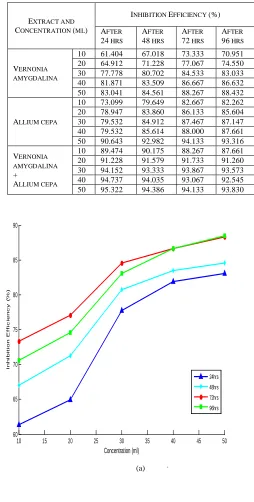
were calculated and tabulated for mild steel. Just as in the analysis of the weight loss, the results of the percentage inhibition efficiency did not follow a particular trend for the various concentrations of the extracts used. This is because for the extracts used, optimal inhibition efficiency can be achieved at a particular concentration of the extract and after a particular period of time, and not necessarily at the highest concentration of the extract (50ml). But it should be noted that inhibition efficiency increases with inhibitor concentration.
Statistical modeling and analysis was done to determine the optimum inhibition efficiency achievable and at what time and concentration the optimum inhibition will be obtained. The knowledge of the optimum inhibition efficiency is vital because at this point, corrosion inhibition is at its peak, and this in turn helps to safeguard the life-span of the metal in real life application.
Table 2: Calculated and tabulated results of %I.E. at various concentrations of the three extracts used on mild steel at different time intervals
EXTRACT AND
CONCENTRATION (ML)
INHIBITION EFFICIENCY (%)
AFTER
24 HRS
AFTER
48 HRS
AFTER
72 HRS
AFTER
96 HRS
VERNONIA AMYGDALINA
10 61.404 67.018 73.333 70.951
20 64.912 71.228 77.067 74.550
30 77.778 80.702 84.533 83.033
40 81.871 83.509 86.667 86.632
50 83.041 84.561 88.267 88.432
ALLIUM CEPA
10 73.099 79.649 82.667 82.262
20 78.947 83.860 86.133 85.604
30 79.532 84.912 87.467 87.147
40 79.532 85.614 88.000 87.661
50 90.643 92.982 94.133 93.316
VERNONIA AMYGDALINA
+
ALLIUM CEPA
10 89.474 90.175 88.267 87.661
20 91.228 91.579 91.733 91.260
30 94.152 93.333 93.867 93.573
40 94.737 94.035 93.067 92.545
50 95.322 94.386 94.133 93.830
10 15 20 25 30 35 40 45 50
60 65 70 75 80 85 90
Concentration (ml)
I
nhi
bi
t
ion E
f
f
ic
ienc
y
(
%
)
24hrs
48hrs 72hrs
96hrs
803
Copyright © 2011-15. Vandana Publications. All Rights Reserved.
10 15 20 25 30 35 40 45 50
70 75 80 85 90 95
Concentration (ml)
Inhi
bi
ti
on E
ff
ic
ienc
y
(
%
)
24hrs 48hrs 72hrs 96hrs
(b)
10 15 20 25 30 35 40 45 50
87 88 89 90 91 92 93 94 95 96
Concentration (ml)
I
nhi
bi
t
ion E
f
f
ic
ienc
y
(
%
)
24hrs
48hrs
72hrs
96hrs
(c)
Figure 1: Variation of Inhibition Efficiency with Inhibitor Concentration for mild steel coupons in 2.0M HCl solution at different time periods,
(a) In Vernonia amygdalina extract (b) In Allium cepa extract
(c) In the mixture of Vernonia amygdalina and Allium cepa
extract
Model Equation and Analyses
Model equations were developed for the different
extracts using MATLAB 8.2 software. The Inhibition
efficiency was set as the output variable; time and extract concentration were set as the input variables. For all three extracts used, a quadratic model was developed, and is given below:
F(x,y) = p00 + p10x + p01y + p20x^2 + p11xy + p02y^2
x = concentration; y = time.
For Vernonia amygdalina:
Coefficients (with 95% confidence bounds); Probability value (pval):
p00 = 42.3903 (33.24, 51.54); 1.010604623440522e-07 p10 = 1.0809 (0.6616, 1.5); 7.434044297704502e-05 p01 = 0.4178 (0.1799, 0.6557); 0.002084509812079 p20 = -0.007949 (-0.01424, -0.001656); 0.1486349371243 p11 = -0.001978 (-0.004753, 0.0007972); 0.016950025573 p02 = -0.002108 (-0.003936, -0.0002796); 0.02684105601
Goodness of fit:
SSE: 67.49, R-square: 0.9458,
Adjusted R-square: 0.9265, RMSE: 2.196
10 15 20
25 30 35
40 45 50
40 60 80 65 70 75 80 85
X: 49.25 Y: 75.84 Z: 88.52
Concentration (ml) %IE vs. conc. and time
Time (hrs)
Inhi
bi
ti
on E
ff
ic
ienc
y
(
%
)
Figure 2a: Surface plot of Inhibition Efficiency vs. concentration (ml) and time (hrs) for mild steel in Vernonia amygdalina extract
For Allium cepa:
Coefficients (with 95% confidence bounds); Probability value (pval):
p00 = 64.624 (56.19, 73.06); 1.514870117076560e-10 p10 = 0.1048 (-0.2818, 0.4913); 0.570281836457125 p01 = 0.4202 (0.2009, 0.6395); 0.0011
804
Copyright © 2011-15. Vandana Publications. All Rights Reserved.
p11 = -0.001548 (-0.004106, 0.001011); 0.1206285316751p02 = -0.002315 (-0.004001, -0.0006301); 0.01061734322
Goodness of fit:
SSE: 57.36, R-square: 0.9071,
Adjusted R-square: 0.8603, RMSE: 2.024
10 15 20
25 30 35
40 45 50
40 60 80 75 80 85 90 95
X: 49.25 Y: 72.67 Z: 93.4
Concentration (ml) %IE vs. conc. and time
Time (hrs)
Inhi
bi
ti
on E
ff
ic
ienc
y
(
%
)
Figure 2b: Surface plot of Inhibition Efficiency vs. concentration (ml) and time (hrs) for mild steel in Allium cepa extract
For Vernonia amygdalina and Allium cepa mixture:
Coefficients (with 95% confidence bounds); Probability value (pval):
p00 = 86.16 (83.29, 89.02); 1.009369620678836e-18 p10 = 0.3905 (0.2591, 0.5219); 1.722785052287884e-05 p01 = -0.005686 (-0.08022, 0.06885); 0.872360921739148 p20 = -0.004203 (-0.006175, -0.002232); 0.796420479274 p11 = -0.0001066 (-0.0009759, 0.0007628); 4.345800e-04 p02 = -6.884e-05 (-0.0006416, 0.0005039); 0.8003299210
Goodness of fit:
SSE: 6.625, R-square: 0.9267,
Adjusted R-square: 0.9006, RMSE: 0.6879.
10 20
30 40
50
40 60 80 88 90 92 94
X: 49.25 Y: 20.4 Z: 94.94
Concentration (ml) %IE vs. conc. and time
Time (hrs)
Inhi
bi
ti
on E
ff
ic
ienc
y
(
%
)
Figure 2c: Surface plot of Inhibition Efficiency vs. concentration (ml) and time (hrs) for mild steel in the mixture of Vernonia amygdalina and Allium cepa extract
The Vernonia amygdalina extract model was a
quadratic model with R2 value 0.9458, which shows that
only 5.42% of the total variation on the inhibition efficiency could not be explained by the model. The surface plot showed its optimum inhibition efficiency at 88.52%; achieved by keeping the concentration at 49.25ml
and time at 75.84hrs. The Allium cepa extract model was
also a quadratic model with R2 value 0.9071. The surface
plot showed its optimum inhibition efficiency at 93.4%; achieved by keeping the concentration at 49.25ml and time
at 72.67hrs. The mixture of Vernonia amygdalina and
Allium cepa extract model was also a second-order
polynomial (quadratic) model with R2
From the surface plots, done using MATLAB 8.2
curve fitting toolbox, it is observed that the mixture of Vernonia amygdalina and Allium cepa extracts give a
value 0.9267, showing an acceptable correlation with the experimental data. The surface plot showed its optimum inhibition efficiency at 94.94%; achieved by keeping the concentration at 49.25ml and time at 20.4hrs.
The probability value (pval) of the coefficients was determined by analysis of the data using MATLAB
8.2. It is asserted that terms of a model having coefficients
with pval > 0.05 are of less significance to the model
equation. For the Vernonia amygdalina model, the x^2
term (pval = 0.1486) had no significant effect on the model
equation. For the Allium cepa model, the x term (pval =
0.5703), x^2 term (pval = 0.2154), and xy term (pval = 0.1206) had no significant effect to the model equation. As
for the mixture of Vernonia amygdalina and Allium cepa
805
Copyright © 2011-15. Vandana Publications. All Rights Reserved.
higher optimum inhibition efficiency for mild steel inhydrochloric acid, than if used separately.
Previous studies showed that temperature affects the efficiency of inhibitors [12][13], thus there is need for further study on the effects of temperature on the inhibition
properties of the leaves (Vernonia amygdalina and Allium
cepa) extract in hydrochloric acid.
IV.
CONCLUSION
The present study shows that extract of Vernonia
amygdalina and Allium cepa exhibit good inhibitive property on mild steel in hydrochloric acid. The study
further shows that a mixture of Vernonia amygdalina and
Allium cepa extract is a better inhibitor for the corrosion of mild steel in 2M HCl than if used separately. From the
surface plots, the mixture of Vernonia amygdalina and
Allium cepa extract gave the highest optimum inhibition efficiency of 94.94% at a concentration of 49.25ml after 20.4hrs.
REFERENCES
[1] A.O. James. and O. Akaranta, The inhibition of corrosion of zinc in 2.0M hydrochloric acid solution with
acetone extract of red onion skin. Afr. J. Pure Appl.
Chemistry,3, 212-219, 2009.
[2] M.M. Opata, and E.B. Izevbigie, Aqueous V.amygdalina extracts after MCF-7 cell membrane
permeability and efflux. Int. J. Environ. Res. Public
Health. 3(2): 174-179, 2006.
[3] P. Neha, A. Shruti and S. Pallow, “Greener Approach
towards Corrosion Inhibition”. Chinese Journal of
Engineering. Volume 2013, Article ID 784186, 2013. [4] F.O. Aramide, “Corrosion Inhibition of AISI / SAE Steel in the Marine Environment.” ISSN 1583-0223, pp 1-2, 2009.
[5] A.K. Dubey and G. Singh, Corrosion Inhibition of Mild Steel in Sulphuric acid solution by using Polyethylene Glycol Methyl Ether (PEGME). Portugaliae Electrochemica Acta 25, pp 221-235, 2007.
[6] B.S. Prathibha, P. Kotteeswaran and R. Bheema, Study on the inhibition of Mild Steel Corrosion by Cationic Surfactant in HCl Medium”. IOSR Journal of Applied Chemistry (IOSRJAC); vol.2, issue1, 2012.
[7] O.P. Aggarwal, “Engineering Chemistry”. Khana
Publishers, New Delhi. 3rd
[10] F.O. Aramide, “Corrosion Inhibition of AISI / SAE Steel in the Marine Environment.” ISSN 1583-0223, pp 1-2, 2009.
ed., pp.718-797, 2010.
[8] A.Y. El-Elre and M. Abdallah, Natural Honey as Corrosion Inhibitor for Metals and Alloys. Corr. Sci. 47, No. 2, pp. 385-390, 2005.
[9] E.M. Sherif, Park Su-Moon. Corrosion Science. Vol. 48(12), pp. 4065-4079, 2006.
[11] M. Mihit, R. Salghi, S. El-Issami, L. Bazzi, B. Hammouti, Addi El-Ait, S. Kerit, “Pigment and Resin Technology”. Vol. 35(3), pp. 151-157, 2006.
[12] C.A. Loto and A.P.I. Popoola, Plant Extracts
Corrosion Inhibition of Aluminum Alloy in H2SO4.
Canadian Journal of Pure and Applied Sciences. Corrosion Sciences. Vol. 6, No. 2, pp. 1973-1980, 2012.
[13] O.M. Ndibe, M.C. Menkiti, M.N.C. Ijomah, and Onukwuli, Corrosion inhibition of Mild Steel by Acid
Extract of Vernonia amygdalina in HCl and HNO3.
EJEAFChe, 10(9), pp. 2847-2860, 2011.
[14] S. Sulaiman, A. Nor-Anur, A.S. Abd-Razak, S. Chelliapan, A study of using Allium cepa (onion) as Natural Corrosion Inhibitor in Industrial Chill Wastewater
system. Research J. of Chemical Sciences. Vol. 2 (5), pp