The Thirty-Third AAAI Conference on Artificial Intelligence (AAAI-19)
Efficient and Effective Incomplete Multi-View Clustering
Xinwang Liu,
1Xinzhong Zhu,
2,3Miaomiao Li,
1Chang Tang,
4En Zhu,
1Jianping Yin,
5Wen Gao
61School of Computer Science, National University of Defense Technology, Changsha, China, 410073
2College of Mathematics, Physics and Information Engineering, Zhejiang Normal University, Jinhua, Zhengjiang, China, 321004 3Research Institute of Ningbo Cixing Co., Ltd, Ningbo, China, 315336
4School of Computer Science, China University of Geosciences, Wuhan, China, 430074 5Dongguan University of Technology, Guangdong, China
6School of Electronics Engineering and Computer Science, Peking University, Beijing, China, 100871
Abstract
Incomplete multi-view clustering (IMVC) optimally fuses multiple pre-specified incomplete views to improve cluster-ing performance. Among various excellent solutions, the re-cently proposed multiple kernel k-means with incomplete kernels (MKKM-IK) forms a benchmark, which redefines IMVC as a joint optimization problem where the cluster-ing and kernel matrix imputation tasks are alternately per-formed until convergence. Though demonstrating promis-ing performance in various applications, we observe that the manner of kernel matrix imputation in MKKM-IK would in-cur intensive computational and storage complexities, over-complicated optimization and limitedly improved clustering performance. In this paper, we propose an Efficient and Ef-fective Incomplete Multi-view Clustering (EE-IMVC) algo-rithm to address these issues. Instead of completing the in-complete kernel matrices, EE-IMVC proposes to impute each incomplete base matrix generated by incomplete views with a learned consensus clustering matrix. We carefully develop a three-step iterative algorithm to solve the resultant optimiza-tion problem with linear computaoptimiza-tional complexity and the-oretically prove its convergence. Further, we conduct com-prehensive experiments to study the proposed EE-IMVC in terms of clustering accuracy, running time, evolution of the learned consensus clustering matrix and the convergence. As indicated, our algorithm significantly and consistently outper-forms some state-of-the-art algorithms with much less run-ning time and memory.
Introduction
Multi-view clustering (MVC) optimally integrates features from different views to improve clustering performance (Bickel and Scheffer 2004). It has been intensively stud-ied and widely applstud-ied into various applications during the last few decade (Yu et al. 2012; Li, Jiang, and Zhou 2014; Du et al. 2015; Liu et al. 2016; Li et al. 2016; Liu et al. 2017b; Li et al. 2015; Cai, Nie, and Huang 2013; Tao, Liu, and Fu 2017; Liu et al. 2013; Zhang et al. 2015; Tao et al. 2017). All these MVC algorithms assume that the views of samples are observable. However, in some practi-cal applications (Kumar et al. 2013; Xiang et al. 2013), this assumption may not hold anymore due to the absence of par-tial views among samples. The violation on this assumption
Copyright c2019, Association for the Advancement of Artificial Intelligence (www.aaai.org). All rights reserved.
makes the aforementioned MVC algorithms not applicable to handle incomplete multi-view clustering (IMVC) tasks.
Many efforts have been devoted to addressing IMVC, which can roughly be grouped into two categories. In the first category, the incomplete views are firstly filled with an imputation algorithm such as zero-filling, mean value filling,k-nearest-neighbor filling, expectation-maximization (EM) filling (Ghahramani and Jordan 1993) and other ad-vanced ones (Trivedi et al. 2010; Xu, Tao, and Xu 2015; Shao, He, and Yu 2015; Bhadra, Kaski, and Rousu 2016; Yin, Wu, and Wang 2015). A standard MVC algorithm is subsequently applied into these imputed views to perform clustering tasks. This kind of algorithms are termed “two-stage” ones, where the imputation and clustering processes are separately carried out. By observing that the above-mentioned “two-stage” algorithms disconnect the processes of imputation and clustering, the other category, termed as “one-stage”, puts forward to unify imputation and cluster-ing into a scluster-ingle optimization procedure and instantiate a clustering-oriented algorithm termed as multiple kernel k -means with incomplete kernels (MKKM-IK) algorithm (Liu et al. 2017a). Specifically, the clustering result at the last it-eration guides the imputation of absent kernel elements, and the latter is used in turn to conduct the subsequent clustering. By this way, these two procedures are seamlessly connected, with the aim to achieve better clustering performance.
Of the above-mentioned IMVC algorithms, the “one-stage” methods form a benchmark, where the incomplete views are optimized to best serve clustering. The main con-tribution of these methods is the unification of imputation and clustering, so that the imputation would be meaning-ful and beneficial for clustering. It has been demonstrated that the “one-stage” methods can achieve promissing clus-tering performance in various applications (Liu et al. 2017a; Zhu et al. 2018), but they also suffer from the following non-ignorable drawbacks. i) High computational and storage
complexities. Its computational and storage complexities are
O(n3)andO(mn2)per iteration, respectively, wherenand
m are the number of samples and views. It prevents them from being applied to large-scale clustering tasks. ii)
Over-complicated imputation. Existing “one-stage” methods
whole optimization over-complicated and also considerably increase the risk of falling into a low-quality local minimum.
iii)Limitedly improved clustering performance. Note that a
clustering result is determined by a whole similarity matrix in (Liu et al. 2017a). As a result, the imputation to an in-complete similarity matrix has impact to the clustering of all samples, no matter whether a sample is complete or not. When an imputation is not of high quality, it could adversely affect the clustering performance of all samples, especially for those with complete views.
All of the above issues signal that directly imputing the incomplete similarity matrices seems to be problematic and that a more efficient and effective approach shall be taken. In this paper, we propose Efficient and Effective Incomplete Multi-view Clustering (EE-IMVC) to address these issues. EE-IMVC imputes each incomplete base clustering matrix generated by performing clustering on each separated in-complete similarity matrix, instead of itself. These imputed base clustering matrices are then used to learn a consensus clustering matrix, which is then employed to impute each incomplete base clustering matrix. These two steps are al-ternately performed until convergence. This idea is fulfilled by maximizing the alignment between the consensus clus-tering matrix and an adaptively weighted base clusclus-tering matrices with an optimal permutation. We design a simple and computationally efficient algorithm to solve the resul-tant optimization problem by three singular value decom-position (SVD) per iteration, and analyze its computational and storage complexities and theoretically prove its conver-gence. After that, we conduct comprehensive experiments on four benchmark datasets to study the properties of the proposed algorithm, including the clustering accuracy with the various missing ratios, the running time with the various number of samples, the evolution of the learned consensus matrix with iterations and the objective value with iterations. As demonstrated, EE-IMVC significantly and consistently outperforms the state-of-the-art methods in terms of cluster-ing accuracy with much less runncluster-ing time.
Related Work
Let{xi}ni=1 ⊆ X be a collection ofnsamples, andφp(·) :
x ∈ X 7→ Hp be the p-th feature mapping that maps x
onto a reproducing kernel Hilbert spaceHp(1 ≤p≤m).
In the multiple kernel setting, each sample is represented as φβ(x) = [β1φ1(x)>,· · · , βmφm(x)>]>, where β =
[β1,· · ·, βm]>consists of the coefficients of thembase
ker-nels{κp(·,·)}mp=1. These coefficients will be optimized
dur-ing learndur-ing. Based on the definition ofφβ(x), a kernel func-tion can be expressed asκβ(xi,xj) = φβ(xi)>φβ(xj) =
Pm
p=1β 2
pκp(xi,xj). A kernel matrixKβis then calculated by applying the kernel functionκβ(·,·)into{xi}ni=1. Based
on the kernel matrixKβ = Pmp=1βp2Kp, the objective of
MKKM can be written as
minH,β Tr(Kβ(In−HH>))
s.t. H∈Rn×k, H>H=I k,
β>1m= 1, βp≥0,∀p,
(1)
whereIkis an identity matrix with sizekandkis the
num-ber of clusters.
The optimization problem in Eq. (1) can be solved by al-ternately updatingHandβ. Specifically,H is updated by given β, and β is then optimized with updatedH. These two steps are alternately performed until convergence.
The recently proposed MKKM-IK (Liu et al. 2017a) has extended the existing MKKM in Eq. (1) to enable it to han-dle multiple kernel clustering with incomplete kernels. It unifies the imputation and clustering procedure into a sin-gle optimization objective and alternately optimizes each of them. That is, i) imputing the absent kernels under the guid-ance of clustering; and ii) updating the clustering with the imputed kernels. The above idea is mathematically fulfilled as,
minH,β,{Kp}pm=1 Tr(Kβ(In−HH
>))
s.t. H∈Rn×k,H>H=I k,
β>1m= 1, βp≥0,
Kp(sp,sp) =Kp(cc), Kp0, ∀p,
(2)
wheresp(1≤p≤m)denote the sample indices for which
thep-thview is present andK(pcc)be used to denote the
ker-nel sub-matrix computed with these samples. The constraint
Kp(sp,sp) =K (cc)
p is imposed to ensure thatKpmaintains
the known entries during the course. Different from the opti-mization in MKKM, (Liu et al. 2017a) incorporates an extra step to impute the missing entries of base kernels, leading to a three-step alternate optimization algorithm. Interested readers are referred to (Liu et al. 2017a).
Although MKKM-IK demonstrates excellent clustering performance in handling incomplete multi-view clustering tasks (Liu et al. 2017a), it also suffers from the follow-ing non-ignorable drawbacks. Firstly, from the above opti-mization procedure, we observe that its computational com-plexity is O(n3 + Pm
p=1n 3
p +m3) per iteration, where
n, np(np ≤ n)andmare the number of all samples,
ob-served samples of p-thview and views. During the learn-ing procedure, it requires to store mbase kernel matrices with size n. Therefore, its storage complexity is O(mn2). The relatively high computational and storage complexi-ties preclude it from being applied to large-scale cluster-ing tasks. Furthermore, as seen from Eq. (2), there are
1
2(n−np)(n+np+ 1)elements to be imputed for thep-th
incomplete base kernel matrixKp(1≤p≤m). It
unneces-sarily increases the complexity of the optimization and the risk of be trapped into a local minimum, adversely affecting the clustering performance. In addition, note that a cluster-ing result is determined by a whole similarity matrix in (Liu et al. 2017a). As a result, the imputation to an incomplete similarity matrix has impact to the clustering of all samples, no matter whether a sample is complete or not. This improp-erly increases the influence of imputation on all samples, especially for those with complete views. As a result, in-stead of imputing incomplete similarity matrices{Kp}mp=1,
all of them reside in a common clustering partition space, which would produce better imputation and finally improve the clustering.
Efficient and Effective Incomplete Multi-view
Clustering (EE-IMVC)
In this section, we propose Efficient and Effective Incom-plete Multi-view Clustering (EE-IMVC) which performs clustering and imputes the incomplete base clustering matri-ces simultaneously. We firstly define thep-th (1≤p≤m) base clustering matrix as
Hp= [H(po) >
,H(pu)>]>∈Rn×k, (3)
whereH(po)∈ Rnp×k can be obtained by solving kernelk
-means in Eq. (2) with mincomplete base kernel matrices {Kp(sp,sp)}mp=1, whileH
(u)
p ∈ R(n−np)×k denote the
in-complete part ofHp that is required to be filled. Note that
other similarity based clustering algorithms such as spectral clustering can also be used to generate{H(po)}mp=1.
According to the above discussion, EE-IMVC proposes to simultaneously perform clustering and the imputation of {H(pu)}mp=1while keeping{H
(o)
p }mp=1unchanged during the
learning course. Specifically, it firstly optimizes a consensus clustering matrix H from imputed {Hp}mp=1, and then fill
the {H(pu)}mp=1 with H. These two learning processes are
seamlessly integrated. By doing so, they are allowed to co-ordinate with each other to achieve optimal clustering. The above idea can be fulfilled as follows,
max H,{Wp,Hp(u),βp}mp=1
Tr "
H>Xm
p=1βp
H(po)
H(pu)
!
Wp
#
s.t. H∈Rn×k, H>H=Ik,
Wp∈Rk×k, Wp>Wp=Ik,
H(pu)∈R(n−np)×k, H(u)
p >
H(pu)=Ik,
β∈Rm, Xm
p=1β 2
p= 1, βp≥0,
(4) whereHandH(pu)are the consensus clustering matrix and
the missing part of the p-th base clustering matrix, re-spectively,Wpis thep-thpermutation matrix to optimally
matchHp andH, andβ = [β1,· · ·, βm]> is the adaptive
weights ofmbase clustering matrices. Note that the orthog-onal constraints are respectively imposed on H andH(pu)
since they are clustering matrices. We also put an orthogo-nal constraint onWpbecause it is a permutation matrix.
Compared with MKKM-IK (Liu et al. 2017a), the objec-tive function of EE-IMVC in Eq. (4) has the following nice properties. (1)Less imputation variables: The number of el-ements needs to be filled for thep-thview is(n−np)×k,
which is much less than 12(n−np)×(n +np + 1)
re-quired by MKKM-IK. This could dramatically simplify the model and enhance its robustness to optimization. (2)Less
vulnerable to low-quality imputation: In EE-IMVC,
cluster-ing on samples with complete views will not be affected by
the imputation they are kept unchanged during the learning course. However, it is not the case for MKKM-IK because it needs to fill all incomplete elements and conduct eign-decomposition on the whole imputed similarity for cluster-ing. This is helpful to make the proposed model be more robust in the whole course of optimization. (3) More
rea-sonable imputation: EE-IMVC utilizesHto completeH(pu)
rather than the incomplete base kernels matrices as in (Liu et al. 2017a), which is more reasonable since bothHandH(pu)
reside in clustering partition space. Besides, our algorithm is parameter-free once the number of clusters to form is spec-ified. These advantages significantly boosts the clustering performance, as demonstrated in the experimental part.
Alternate Optimization
Jointly optimizingH, {H(pu),Wp}mp=1 andβin Eq. (4) is
difficult. In the following, we design a simple and computa-tionally efficient three-step algorithm to solve it alternately.
Solving H with fixed {Wp,H
(u)
p }mp=1 and β Given
{Wp, H (u)
p }mp=1andβ, the optimization w.r.tHin Eq. (4)
is equivalent to
maxH Tr H>T s.t.H∈Rn×k, H>H=Ik, (5)
whereT =Pm
p=1βpHpWp. It is a singular value
decom-position (SVD) problem and can be efficiently solved with computational complexityO(nk2).
Solving {Wp}mp=1 with fixed H,{H (u)
p }mp=1 and β
GivenH, {H(pu)}mp=1 andβ, the optimization w.r.t
permu-tation matrixWpin Eq. (4) equivalently reduces to,
maxWpTr W > pQp
s.t.Wp∈Rk×k, W>pWp=Ik,
(6) whereQp =H>pH. Again, it is a SVD optimization
prob-lem with computational complexityO(k3).
Solving {H(pu)}mp=1 with fixed {Wp}mp=1,H and β
GivenH,{Wp}mp=1andβ, the optimization w.r.t H (u) p in
Eq. (4) is equivalent to
maxH(u)
p Tr
H(pu)>Up
s.t. H(pu)∈R(n−np)×k, H(pu) >
H(pu)=Ik,
(7)
whereUp = H(ˆsp,:)Wp> andˆsp denotes the sample
in-dices for which thep-thview is missing. Once again, it is a SVD problem and can be efficiently solved with computa-tional complexityO((n−np)k2).
Solving β with fixed Hand {Wp,H
(u)
p }mp=1 Given H
and{Wp,H (u)
p }mp=1, the optimization w.r.tβin Eq. (4) is
equivalent to
maxβ ν>β s.t. β∈Rm, Xm
p=1β 2
p= 1, βp≥0,
As seen, the optimization in Eq. (8) has an analytical so-lution ifνp ≥ 0 (1 ≤ p ≤ m). The following Theorem 1
tells that the optimal weights of each base clustering matrix can be obtained analytically.
Theorem 1 The optimal solution for Eq. (8) is β? =
ν/kνk.
Proof 1 Let (H(t),{Hp(t),W(t)p }mp=1) be the solution at the t-th iteration. We have νp(t) = Tr((H(t))>H
(t)
p W
(t)
p ) =
max
H(pu)Tr (H
(t)
)>[H(o)p
>
,H(u)p
> ]>Wp(t)
≥maxWpTr
(H(t))>[H(o)p
>
, H(u)p (t−1)>
]>Wp > 0,∀p. The proof is
completed by taking the derivative of the Lagrangian function of Eq. (8) onβpand letting it vanish.
Algorithm 1The Proposed EE-IMVC
1: Input:{H(po),sp}mp=1, kand0. 2: Output:H.
3: InitializeW(0)p =Ik, H (u) p
(0)
=0,β(0) =1/√mand t= 1.
4: repeat
5: Update H(t) by solving Eq. (5) with
{W(pt−1),H(pu) (t−1)
}m p=1andβ
(t−1).
6: Update {W(pt)}pm=1 withH(t),{H (u) p
(t−1)
}m p=1 and
β(t−1)by Eq. (6).
7: Update {H(pu) (t)
}m
p=1 with H(t),{W (t)
p }mp=1 and
β(t−1)by Eq. (7).
8: Update β(t) with H(t),{W(pt)}mp=1 and
{H(pu) (t)
}m
p=1by Eq. (8). 9: t=t+ 1.
10: untilobj(t)−obj(t−1)/obj(t−1)≤0
In sum, our algorithm for solving Eq. (4) is outlined in Algorithm 1, where obj(t)denotes the objective value at the t-th iteration. The following Theorem 2 shows that Algo-rithm 1 is guaranteed to converge to a local maximum.
Theorem 2 Algorithm 1 is guaranteed to converge to a lo-cal optimum.
Proof 2 Note that for ∀p,Tr(H>[H(po) >
,H(pu) >
]>Wp)≤
1 2[Tr(H
>H) + Tr(W> p[H
(o) p
>
,H(pu) >
][H(po) >
,H(pu) >
]>
Wp)] = 12[2k + Tr(W > pH
(o) p
>
H(po)Wp)]. Note
that the maximum of Tr(W>pH
(o) p
>
H(po)Wp) with
constraint W>pWp = Ik is P
k j=1λ
j
p, where
{λj
p}kj=1 are the k eigenvalue of H
(o) p
>
H(po). We have
Tr H>[H(o) p
>
,H(pu) >
]>W p
≤ 1
2[2k+
Pk
j=1λ j p] , ap.
Correspondingly, Pm
p=1βpTr(H>[H (o) p
>
,H(pu) >
]>Wp)≤
Pm
p=1βpap, which is upper-bounded byP
m
p=1kapkdue to
the `2-norm constraint on β. Meanwhile, the objective of
Algorithm 1 is guaranteed to be monotonically increased when optimizing one variable with others fixed at each iteration. As a result, our algorithm is guaranteed to converge to a local minimum.
Discussion and Extension
We end up this section by analyzing the computational and storage complexities, the initialization of {H(pu),Wp}mp=1
and potential extensions.
Computational complexity: As seen from Algorithm 1, the
computational complexity of EE-IMVC isO(nk2+m(k3+
(n−np)k2))per iteration, wheren, mandkare the number
of samples, views and clusters, respectively. Therefore, EE-IMVC has a linear computational complexity with number of samples, which enables it more efficiently to handle large scale clustering tasks when compared with MKKM-IK (Liu et al. 2017a).
Storage complexity: During the learning procedure,
EE-IMVC needs to store H and {Hp,Wp}mp=1. Its storage
complexity isO(nk+mnk+mk2), which is much less than
that of MKKM-IK withO(mn2)sincenkin practice.
Initialization of {H(pu),Wp}mp=1: In our current
imple-mentation, we simply initialize {H(pu)}mp=1 as zeros, and
{Wp}mp=1 as identity matrix. This initialization has well
demonstrated superior clustering performance of EE-IMVC in our experiments. Further exploring other initializations and studying their influence on the clustering performance will be an interesting future work.
Extensions: EE-IMVC can be extended from the
follow-ing aspects. Firstly, EE-IMVC could be further improved by sufficiently considering the correlation among{Hp}mp=1.
For example, we may build this correlation by criteria such as Kullback-Leibler (KL) divergence (Kato and Rivero 2017) and Hilbert-Schmidt independence criteria (HSIC), to name just a few. This prior knowledge could provide a good regularization on mutual base clustering matrix com-pletion, and would be helpful to improve the clustering per-formance. Secondly, the way in generating{H(po)}mp=1could
be readily extendable to other similarity based clustering al-gorithms, such us spectral clustering (von Luxburg 2007). This could further improve the clustering performance. Last but not least, the idea of joint imputation and clustering is so natural that can be generalized to other learning task such as feature missing.
Experiments
Experimental settings
The proposed algorithm is experimentally evaluated on four widely used multiple kernel benchmarkdata sets shown in Table 2. They are Oxford Flower17 and Flower1021, Cal-tech1022and Columbia Consumer Video (CCV)3. For these datasets, all kernel matrices are pre-computed and can be
1http://www.robots.ox.ac.uk/˜vgg/data/flowers/ 2
http://files.is.tue.mpg.de/pgehler/projects/iccv09/
3
0.1 0.2 0.3 0.4 0.5 0.6 0.7 0.8 0.9 missing ratio 0.3 0.35 0.4 0.45 0.5 0.55 ACC Flower17 MKKM+ZF MKKM+MF MKKM+KNN MKKM+AF MKKM-IK LI-MKKM EE-IMVC
0.1 0.2 0.3 0.4 0.5 0.6 0.7 0.8 0.9 missing ratio 0.2 0.25 0.3 0.35 0.4 ACC Flower102 MKKM+ZF MKKM+MF MKKM+KNN MKKM+AF MKKM-IK LI-MKKM EE-IMVC
0.1 0.2 0.3 0.4 0.5 0.6 0.7 0.8 0.9 missing ratio 0.15 0.16 0.17 0.18 0.19 0.2 0.21 0.22 0.23 0.24 0.25 ACC CCV MKKM+ZF MKKM+MF MKKM+KNN MKKM+AF MKKM-IK LI-MKKM EE-IMVC
0.1 0.2 0.3 0.4 0.5 0.6 0.7 0.8 0.9 missing ratio 0.14 0.16 0.18 0.2 0.22 0.24 0.26 0.28 0.3 0.32 ACC Caltech102 MKKM+ZF MKKM+MF MKKM+KNN MKKM+AF MKKM-IK LI-MKKM EE-IMVC
0.1 0.2 0.3 0.4 0.5 0.6 0.7 0.8 0.9 missing ratio 0.35 0.4 0.45 0.5 NMI Flower17 MKKM+ZF MKKM+MF MKKM+KNN MKKM+AF MKKM-IK LI-MKKM EE-IMVC
0.1 0.2 0.3 0.4 0.5 0.6 0.7 0.8 0.9 missing ratio 0.36 0.38 0.4 0.42 0.44 0.46 0.48 0.5 0.52 0.54 0.56 NMI Flower102 MKKM+ZF MKKM+MF MKKM+KNN MKKM+AF MKKM-IK LI-MKKM EE-IMVC
0.1 0.2 0.3 0.4 0.5 0.6 0.7 0.8 0.9 missing ratio 0.11 0.12 0.13 0.14 0.15 0.16 0.17 0.18 0.19 0.2 NMI CCV MKKM+ZF MKKM+MF MKKM+KNN MKKM+AF MKKM-IK LI-MKKM EE-IMVC
0.1 0.2 0.3 0.4 0.5 0.6 0.7 0.8 0.9 missing ratio 0.38 0.4 0.42 0.44 0.46 0.48 0.5 0.52 NMI Caltech102 MKKM+ZF MKKM+MF MKKM+KNN MKKM+AF MKKM-IK LI-MKKM EE-IMVC
0.1 0.2 0.3 0.4 0.5 0.6 0.7 0.8 0.9 missing ratio 0.35 0.4 0.45 0.5 0.55 Purity Flower17 MKKM+ZF MKKM+MF MKKM+KNN MKKM+AF MKKM-IK LI-MKKM EE-IMVC
0.1 0.2 0.3 0.4 0.5 0.6 0.7 0.8 0.9 missing ratio 0.2 0.25 0.3 0.35 0.4 0.45 Purity Flower102 MKKM+ZF MKKM+MF MKKM+KNN MKKM+AF MKKM-IK LI-MKKM EE-IMVC
0.1 0.2 0.3 0.4 0.5 0.6 0.7 0.8 0.9 missing ratio 0.19 0.2 0.21 0.22 0.23 0.24 0.25 0.26 0.27 0.28 Purity CCV MKKM+ZF MKKM+MF MKKM+KNN MKKM+AF MKKM-IK LI-MKKM EE-IMVC
0.1 0.2 0.3 0.4 0.5 0.6 0.7 0.8 0.9 missing ratio 0.14 0.16 0.18 0.2 0.22 0.24 0.26 0.28 0.3 0.32 0.34 Purity Caltech102 MKKM+ZF MKKM+MF MKKM+KNN MKKM+AF MKKM-IK LI-MKKM EE-IMVC
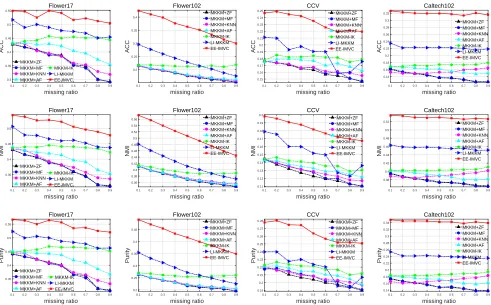
Figure 1: ACC, NMI, Purity and Rand Index comparison with the variation of missing ratios on four benchmark datasets.
Table 1: Aggregated ACC, NMI, purity and rand index comparison (mean±std) of different clustering algorithms on benchmark datasets.
Datasets MKKM+ZF MKKM+MF MKKM+KNN MKKM+AF MKKM-IK LI-MKKM EE-IMVC (Trivedi et al. 2010) (Liu et al. 2017a) (Zhu et al. 2018) Proposed
ACC
Flower17 37.0±0.7 36.8±0.6 37.8±0.3 40.8±0.3 44.7±0.3 47.9±0.3 52.9±0.7
Flower102 18.0±0.2 18.0±0.2 18.3±0.1 18.5±0.1 21.5±0.2 23.1±0.2 36.4±0.2
CCV 16.2±0.1 16.4±0.1 16.6±0.2 17.4±0.1 18.1±0.2 18.7±0.3 23.4±0.4
Caltech102 14.0±0.1 14.0±0.1 15.4±0.2 15.8±0.1 17.3±0.2 22.1±0.2 31.9±0.2
NMI
Flower17 37.3±0.5 37.3±0.4 38.4±0.2 40.3±0.3 43.7±0.3 46.3±0.2 51.4±0.6
Flower102 37.4±0.1 37.4±0.1 37.8±0.1 37.7±0.1 39.6±0.1 41.7±0.1 50.8±0.1
CCV 12.5±0.1 12.7±0.1 12.9±0.1 13.3±0.1 13.8±0.2 15.1±0.2 18.2±0.2
Caltech102 37.7±0.1 37.7±0.1 39.1±0.1 38.9±0.1 40.4±0.2 45.6±0.1 52.9±0.1
Purity
Flower17 38.4±0.6 38.2±0.5 39.3±0.3 42.2±0.3 45.9±0.7 48.8±0.3 54.7±0.7
Flower102 22.5±0.1 22.4±0.1 22.9±0.1 22.9±0.2 26.0±0.2 28.0±0.2 41.8±0.2
CCV 20.4±0.1 20.7±0.1 20.8±0.1 21.2±0.1 21.9±0.2 22.0±0.2 26.5±0.4
Caltech102 15.3±0.1 15.3±0.1 16.9±0.1 17.0±0.1 18.6±0.2 23.9±0.1 34.3±0.2
publicly downloaded from the above websites. Their num-ber of samples varies from one thousand to over eight thou-sands, and views from four to48.
We compare the proposed EE-IMVC with several com-monly used imputation methods, including zero filling (ZF),
Table 2: Datasets used in our experiments.
Dataset #Samples #Kernels #Classes
Flower17 1360 7 17
Flower102 8189 4 102
CCV 6773 6 20
Caltech102 3060 48 102
MKKM+KNN and MKKM+AF, respectively. In addition, we compare with the recently proposed MKKM-IK (Liu et al. 2017a), which jointly optimizes the imputation and clus-tering.
For all data sets, it is assumed that the true number of clusters k is known and it is set as the true number of classes. We follow the approach in (Liu et al. 2017a; Zhu et al. 2018) to generate the missing vectors{sp}mp=1.
The parameterε, termed missing ratio in this experiment, controls the percentage of samples that have absent views, and it affects the performance of the algorithms in compar-ison. To show this point in depth, we compare these algo-rithms with respect toε. Specifically,εon all the datasets is set as[0.1 : 0.1 : 0.9].
The widely used clustering accuracy (ACC), normalized mutual information (NMI) and purity are applied to evalu-ate the clustering performance. For all algorithms, we repeat each experiment for50times with random initialization to reduce the effect of randomness caused byk-means, and re-port the best result. Meanwhile, we randomly generate the “incomplete” patterns for30times in the above-mentioned way and report the statistical results. The aggregated ACC, NMI, purity and rand index are used to evaluate the good-ness of the algorithms in comparison. Taking the aggregated ACC for example, it is obtained by averaging the averaged ACC achieved by an algorithm over differentε.
In the following parts, we conduct comprehensive exper-iments to study the properties of EE-IMVC from the fol-lowing four aspects: clustering performance, running time, the evolution of the learned consensus clustering matrix and convergence.
Clustering Performance
Figure 1 presents the ACC and NMI comparison of the above algorithms with different missing ra-tios on all datasets. We have the following obser-vations: 1) The recently proposed MKKM-IK (Liu et al. 2017a) (in green) outperforms existing two-stage imputation methods. For example, it exceeds the best two-stage imputation method (MKKM+AF) by 0.1%,1.2%,1.7%,2.7%,2.8%,4.4%,4.7%,6.9% and 6.9% in terms of NMI, with the variation of missing ratios in [0.1,· · ·,0.9] on Flower17. These results verify the effectiveness of its joint optimiza-tion on imputaoptimiza-tion and clustering. 2) The proposed EE-IMVC significantly and consistently outperforms MKKM-IK. For example, it improves the latter by 10.7%,9.7%,8.7%, 8.2%,8.0%,6.5%, 5.9%,5.5% and 5.6%with the variation of missing ratios in [0.1,· · · ,0.9]
on Flower17. These results verify the effectiveness of im-puting base clustering matrices rather than kernel matrices. 3) The superiority of EE-IMVC is more significant when the missing ratio is relatively small. For example, EE-IMVC improves the second best algorithm (MKKM-IK) by10.7% on Flower17 in terms of NMI when the missing ratio is 0.1 (see Figure 1(c)). The curves in terms of purity and rand index are provided in the supplemental material due to space limit.
We also report the aggregated ACC, NMI, purity and rand index, and the standard deviation in Table 1, where the one with the highest performance is shown in bold. Again, we observe that the proposed algo-rithm significantly outperforms MKKM+ZF, MKKM+MF, MKKM+KNN, MKKM+AF and MKKM-IK. For example, EE-IMVC exceeds the second best one (MKKM-IK) by 8.3%,14.9%,5.3%and14.7%in terms of clustering accu-racy on Flower17, Flower102, CCV and Caltech102, respec-tively. These results are consistent with our observations in Figure 1.
The above experimental results on these datasets have well demonstrated that EE-IMVC is superior to some state-of-the-art in terms of clustering accuracy, NMI, purity and rand index. We attribute the superiority of EE-IMVC as two aspects: i) Completing the incomplete base clustering ma-trices with the consensus one. Different from MKKM-IK where the consensus clustering matrixHis utilized to fill in-complete base kernels, EE-IMVC imputes each inin-complete base clustering matrix withH. The latter is more natural and reasonable since bothHand incomplete base clustering ma-trices reside in the same clustering space, leading to more suitable imputation. ii) The joint optimization on imputation and clustering. On one hand, the imputation is guided by the clustering results, which makes the imputation more directly targeted at the ultimate goal. On the other hand, this mean-ingful imputation is beneficial to refine the clustering results. These factors bring forth the significant improvements on clustering performance.
Running Time
To compare the computational efficiency of the above-mentioned algorithms, we design another experiment to study the relationship between running time and the number of samples. To see this point in depth, we randomly select samples from the four benchmark datasets, run the afore-mentioned algorithms, record their running time, and plot them in Figure 4. We have the following observations from these figures: 1) The running time of EE-IMVC is nearly lin-ear with the number of samples. 2) The superiority of EE-IMVC is more significant with the increase of samples, in-dicating its computational efficiency in handling large-scale clustering tasks. In sum, the experimental results in Figure 4 have well demonstrated the computational advantage of EE-IMVC.
10 20 30 40 50 60 70 80 90 100 The Number of Iterations 0.35
0.4 0.45 0.5 0.55
NMI
Flower17 (missing ratio = 0.1)
EE-IMVC
10 20 30 40 50 60 70 80 90 100 The Number of Iterations 0.46
0.48 0.5 0.52 0.54 0.56
NMI
Flower102 (missing ratio = 0.1)
EE-IMVC
10 20 30 40 50 60 70 80 90 100 The Number of Iterations 0.12
0.13 0.14 0.15 0.16 0.17 0.18 0.19 0.2
NMI
CCV (missing ratio = 0.1)
EE-IMVC
10 20 30 40 50 60 70 80 90 100 The Number of Iterations 0.44
0.45 0.46 0.47 0.48 0.49 0.5 0.51 0.52 0.53
NMI
Caltech102 (missing ratio = 0.1)
EE-IMVC
Figure 2: The evolution of the learned consensus clustering matrixHwith missing ratio0.1on all datasets. The curves with other missing ratios are similar and we omit them due to space limit.
10 20 30 40 50 60 70 80 90 100 The Number of Iterations 30
35 40 45
Objective Values
Flower17 (missing ratio = 0.1)
EE-IMVC
10 20 30 40 50 60 70 80 90 100 The Number of Iterations 150
160 170 180 190 200 210
Objective Values
Flower102 (missing ratio = 0.1)
EE-IMVC
10 20 30 40 50 60 70 80 90 100 The Number of Iterations 27
28 29 30 31 32 33 34
Objective Values
CCV (missing ratio = 0.1)
EE-IMVC
10 20 30 40 50 60 70 80 90 100 The Number of Iterations 400
450 500 550 600 650
Objective Values
Caltech102 (missing ratio = 0.1)
EE-IMVC
Figure 3: The objective value of EE-IMVC with iterations with missing ratio0.1on all datasets. The curves with other missing ratios are similar and we omit them due to space limit.
200 400 600 800 1000 1200 Number of Samples 1
2 3 4 5 6 7 8 9 10 11
Running Time
Flower17 (missing ratio=0.1) MKKM+ZF
MKKM+MF MKKM+KNN MKKM+AF MKKM-IK EE-IMVC
1000 1500 2000 2500 3000 3500 4000 Number of Samples 10
20 30 40 50 60 70 80
Running Time
Flower102 (missing ratio=0.1) MKKM+ZF
MKKM+MF MKKM+KNN MKKM+AF MKKM-IK EE-IMVC
400 600 800 1000 1200 1400 1600 1800 2000 Number of Samples 2
4 6 8 10 12
Running Time
CCV (missing ratio=0.1) MKKM+ZF
MKKM+MF MKKM+KNN MKKM+AF MKKM-IK EE-IMVC
1000 1500 2000 2500 3000 Number of Samples 100
200 300 400 500 600 700 800
Running Time
Caltech102 (missing ratio=0.1) MKKM+ZF
MKKM+MF MKKM+KNN
1000 1500 2000 2500 3000 Number of Samples 100
200 300 400 500 600 700 800
Running Time
Caltech102 (missing ratio=0.1) MKKM+ZF
MKKM+MF MKKM+KNN MKKM+AF MKKM-IK EE-IMVC
Figure 4: Running time comparison of different algorithms with various number of samples with missing ratio0.1 on all datasets. The curves with other missing ratios are similar and omitted due to space limit.
based on theHlearned at each iteration on Flower102 and CCV and plot the curves in Figure 2. From these figures, we observe that the NMI of EE-IMVC gradually increases to a maximum and generally maintains it up to slight varia-tion. These experiments have clearly demonstrated the effec-tiveness of learned consensus clustering matrix, indicating the advantage of imputing incomplete base clustering matri-ces, instead of imputing incomplete kernel matrices. Other curves in terms of ACC and purity have similar trend and are omitted due to space limit.
Convergence
Our algorithm is theoretically guaranteed to converge ac-cording to Theorem 2. We record the objective values of EE-IMVC with iterations on all datasets and plot them in Fig-ure 3. As observed, the objective value of EE-IMVC does monotonically increase at each iteration and that it usually converges in less than50iterations.
Conclusion
While the recently proposed MKKM-IK (Liu et al. 2017a) is able to handle incomplete multi-view clustering, the rela-tively high computational and space complexities prevent it from large scale clustering tasks. This paper proposes a late fusion approach to simultaneously clustering and imputing the incomplete base clustering matrices. The proposed al-gorithm effectively and efficiently solves the resultant opti-mization problem, and demonstrates well improved cluster-ing performance via extensive experiments on benchmark datasets. In the future, we plan to explore the correlation among base clustering matrices and use it to further improve the imputation.
Acknowledgements
grate-fully acknowledge Prof. Huiying Xu from Zhejiang Normal University for her help in the proofreading of this paper. Xin-wang Liu and Xinzhong Zhu equally contribute to the paper. Xinzhong Zhu is the corresponding author of this paper.
References
Bhadra, S.; Kaski, S.; and Rousu, J. 2016. Multi-view kernel completion. InarXiv:1602.02518.
Bickel, S., and Scheffer, T. 2004. Multi-view clustering.
InProceedings of the 4th IEEE International Conference on
Data Mining (ICDM 2004), 19–26.
Cai, X.; Nie, F.; and Huang, H. 2013. Multi-view k-means clustering on big data. InIJCAI, 2598–2604.
Du, L.; Zhou, P.; Shi, L.; Wang, H.; Fan, M.; Wang, W.; and Shen, Y.-D. 2015. Robust multiple kernelk-means cluster-ing uscluster-ing`21-norm. InIJCAI, 3476–3482.
Ghahramani, Z., and Jordan, M. I. 1993. Supervised learn-ing from incomplete data via an EM approach. InNIPS, 120–127.
G¨onen, M., and Margolin, A. A. 2014. Localized data fu-sion for kernel k-means clustering with application to cancer biology. InNIPS, 1305–1313.
Kato, T., and Rivero, R. 2017. Mutual kernel matrix com-pletion. InarXiv:1702.04077v2.
Kumar, R.; Chen, T.; Hardt, M.; Beymer, D.; Brannon, K.; and Syeda-Mahmood, T. F. 2013. Multiple kernel comple-tion and its applicacomple-tion to cardiac disease discriminacomple-tion. In
ISBI, 764–767.
Li, Y.; Nie, F.; Huang, H.; and Huang, J. 2015. Large-scale multi-view spectral clustering via bipartite graph. InAAAI, 2750–2756.
Li, M.; Liu, X.; Wang, L.; Dou, Y.; Yin, J.; and Zhu, E. 2016. Multiple kernel clustering with local kernel alignment max-imization. InIJCAI, 1704–1710.
Li, S.; Jiang, Y.; and Zhou, Z. 2014. Partial multi-view clustering. InAAAI, 1968–1974.
Liu, J.; Wang, C.; Danilevsky, M.; and Han, J. 2013. Large-scale spectral clustering on graphs. InIJCAI, 1486–1492. Liu, X.; Dou, Y.; Yin, J.; Wang, L.; and Zhu, E. 2016. Mul-tiple kernelk-means clustering with matrix-induced regular-ization. InAAAI, 1888–1894.
Liu, X.; Li, M.; Wang, L.; Dou, Y.; Yin, J.; and Zhu, E. 2017a. Multiple kernelk-means with incomplete kernels. InAAAI, 2259–2265.
Liu, X.; Zhou, S.; Wang, Y.; Li, M.; Dou, Y.; Zhu, E.; and Yin, J. 2017b. Optimal neighborhood kernel clustering with multiple kernels. InAAAI, 2266–2272.
Shao, W.; He, L.; and Yu, P. S. 2015. Multiple incomplete views clustering via weighted nonnegative matrix factoriza-tion with`2,1regularization. InECML PKDD, 318–334.
Tao, Z.; Liu, H.; Li, S.; Ding, Z.; and Fu, Y. 2017. From en-semble clustering to multi-view clustering. InIJCAI, 2843– 2849.
Tao, Z.; Liu, H.; and Fu, Y. 2017. Simultaneous clustering and ensemble. InAAAI, 1546–1552.
Trivedi, A.; Rai, P.; Daum´e III, H.; and DuVall, S. L. 2010. Multiview clustering with incomplete views. InNIPS 2010: Machine Learning for Social Computing Workshop,
Whistler, Canada.
von Luxburg, U. 2007. A tutorial on spectral clustering.
Statistics and Computing17(4):395–416.
Xiang, S.; Yuan, L.; Fan, W.; Wang, Y.; Thompson, P. M.; and Ye, J. 2013. Multi-source learning with block-wise missing data for alzheimer’s disease prediction. In ACM
SIGKDD, 185–193.
Xu, C.; Tao, D.; and Xu, C. 2015. Multi-view learn-ing with incomplete views. IEEE Trans. Image Processing
24(12):5812–5825.
Yin, Q.; Wu, S.; and Wang, L. 2015. Incomplete multi-view clustering via subspace learning. InACM CIKM, 383–392. Yu, S.; Tranchevent, L.-C.; Liu, X.; Gl¨anzel, W.; Suykens, J. A. K.; Moor, B. D.; and Moreau, Y. 2012. Optimized data fusion for kernel k-means clustering. IEEE TPAMI
34(5):1031–1039.
Zhang, R.; Li, S.; Fang, T.; Zhu, S.; and Quan, L. 2015. Joint camera clustering and surface segmentation for large-scale multi-view stereo. InICCV, 2084–2092.