An Experiential Learning Activity to Teach the Main Quality Function Deployment
Matrix
Danilo Sirias, Ph.D.
Department of Management and Marketing
Saginaw Valley State University
7400 Bay Road
University Center, MI 48710
United States of America
Abstract
The main quality function deployment (QFD) matrix is a tool used to translate customer requirements into design specifications and is taught in most production and operations management courses. One of the challenges in teaching this tool experientially is that the examples provided by textbooks are not appropriate for the previous knowledge students have at the point when they are taking a production course. The purpose of this paper is to show a process that can be used in class to teach QFD by designing business courses to ensure students gain the skills needed to become successful professionals.
Keywords:
Quality Function Deployment, experiential learning, course design, teaching activity.1. INTRODUCTION
The main quality function deployment (QFD) matrix is a tool used to translate customer requirements into design specifications. QFD is covered in most production and operations management courses as part of product design and quality management chapters (e.g., Stevenson, 2009; Boyer & Verma, 2010; Collier & Evans, 2012). One potential challenge to teach QFD is finding examples that students, especially at the undergraduate level, are familiar with. Some of the examples used in textbooks may not satisfy that requirement. For instance, Stevenson (2009) has an example of a designing a printer, and Boyer & Verma (2010) provide an example related to the design of an electrical transformer. While students are familiar with these products, they are probably not aware of the technical specifications required to make the product work, which inhibits faculty from using an experiential learning activity to teach QFD.
Students taking a production and operations management class are most likely business majors who will graduate within two years. As a result, they have knowledge of both the teaching-learning interaction in a business course and the requirements needed to be successful in the marketplace. The purpose of this paper is to show a process that can be used in class to teach QFD by designing business courses to ensure students gain the skills needed to become successful professionals.
2. LITERATURE REVIEW
Several papers have described how QFD can be used to design academic programs. Ermer (1995) reports the use of QFD to modify University of Wisconsin—Madison’s Mechanical Engineering undergraduate curriculum. A similar paper by Aytac and Deniz (2001) demonstrates how the curriculum of the Tyre Technology Department at the Kocaeli University Kosekoy Vocational School of Higher Education in Turkey was modified using QFD. Sillero Perez and Gonzalez Aleu (2009) describe the applications of several industrial engineering tools, including QFD, to create an undergraduate Industrial Engineering academic program at the University of Monterrey, Mexico.
77
3. PROCEDURE
The procedure for this class activity follows the typical steps to construct the main matrix of QFD: 1) determine customer’s needs, 2) rank needs, 3) provide a list of teacher design tools (this takes the place of determining technical specifications), 4) build the relationship matrix and 5) find the importance weightings.
3.1 Determine customer’s needs
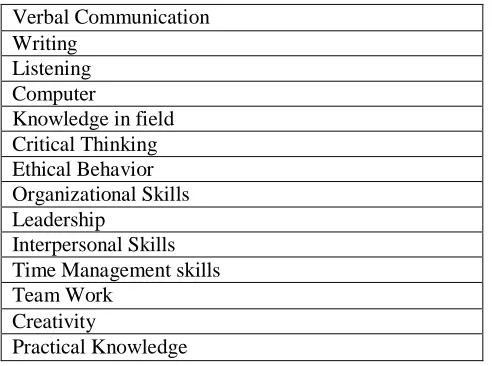
The first step is to ask students to propose skills that they consider to be important to become successful business professionals. I open this discussion to the whole class to generate a list as comprehensive as possible. Students suggest skills such as written communication, oral communication, problem solving, the ability to work in teams, etc. Students are very knowledgeable about which skills are important in the workplace because of their experiences when looking for employment or reading job postings. In general, students will recommend between 10 to 15 skills in this step. An example of a list created in one of the classes is provided in Table 1; the same list is used by all students in the rest of the activity.
The rest of the teaching activity is done in groups of four to six students. The objective is to have several independent team results at the end of the activity so that comparisons can be made. If several teams working independently come up with the same results, then the accuracy and robustness of QFD can be demonstrated. Also, small groups provide students with opportunities to participate and discuss their findings, which promote team and communication skills. The effectiveness of using teams in class setting has been discussed in the literature (see, e.g., Umble, et al. 2008)
3.2 Rank needs
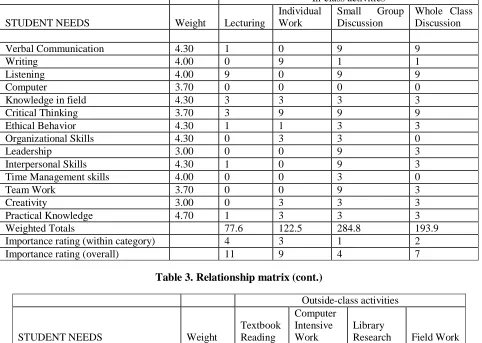
The next step in the activity is to rank skills in order of importance. Students are asked to individually assign to each skill found in the previous step a value between 1 and 5, where 1 is unimportant and 5 is very important. Each group uses the individual scores of each of their team members to calculate the mean for each skill. These calculated means are used as a representation of the relative importance of each skill, which are the “weights” that the QFD process assigns to the customer’s need column (see table 3).
Table 1. An example of important skills suggested by students
Verbal Communication Writing
Listening Computer
Knowledge in field Critical Thinking Ethical Behavior Organizational Skills Leadership
Interpersonal Skills Time Management skills Team Work
Creativity
Practical Knowledge
3.3 Provide a list of teacher design tools
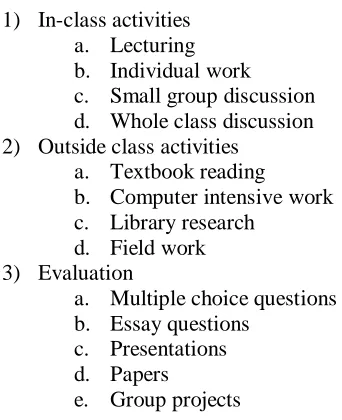
Table 2. Teacher class design 1) In-class activities
a. Lecturing b. Individual work c. Small group discussion d. Whole class discussion 2) Outside class activities
a. Textbook reading b. Computer intensive work c. Library research
d. Field work 3) Evaluation
a. Multiple choice questions b. Essay questions
c. Presentations d. Papers
e. Group projects
3.4 Build relationship matrix
The skills with their respective weights and the class design form the skeleton for the relationship matrix (see table 3). Students are asked to work in teams to complete the matrix by finding the relationship between each skill and the teacher design tools. To do this, teams are instructed to discuss and assign a value of 9 if a strong relationship exists between the skill and the teacher design tool, 3 for medium, 1 for low and 0 for none. At the end of this step, each skill and teacher design tool should have a number representing the degree of relationship between the two. This step is easier to do in teams if students work with flip chart paper and markers to complete the work.
3.5 Find importance weightings
79 Table 3. Relationship matrix
In-class activities
STUDENT NEEDS Weight Lecturing
Individual Work
Small Group
Discussion
Whole Class Discussion
Verbal Communication 4.30 1 0 9 9
Writing 4.00 0 9 1 1
Listening 4.00 9 0 9 9
Computer 3.70 0 0 0 0
Knowledge in field 4.30 3 3 3 3
Critical Thinking 3.70 3 9 9 9
Ethical Behavior 4.30 1 1 3 3
Organizational Skills 4.30 0 3 3 0
Leadership 3.00 0 0 9 3
Interpersonal Skills 4.30 1 0 9 3
Time Management skills 4.00 0 0 3 0
Team Work 3.70 0 0 9 3
Creativity 3.00 0 3 3 3
Practical Knowledge 4.70 1 3 3 3
Weighted Totals 77.6 122.5 284.8 193.9
Importance rating (within category) 4 3 1 2
Importance rating (overall) 11 9 4 7
Table 3. Relationship matrix (cont.)
Outside-class activities
STUDENT NEEDS Weight
Textbook Reading
Computer Intensive Work
Library
Research Field Work
Verbal Communication 4.30 0 0 0 3
Writing 4.00 1 9 0 1
Listening 4.00 0 0 0 9
Computer 3.70 0 9 3 3
Knowledge in field 4.30 9 9 3 9
Critical Thinking 3.70 3 9 3 3
Ethical Behavior 4.30 1 3 1 9
Organizational Skills 4.30 0 9 3 9
Leadership 3.00 0 0 0 3
Interpersonal Skills 4.30 0 0 0 9
Time Management skills 4.00 3 3 3 0
Team Work 3.70 0 0 0 9
Creativity 3.00 0 3 1 1
Practical Knowledge 4.70 0 3 0 3
Weighted Totals 70.1 228 67.3 289.3
Importance rating (within category) 3 2 4 1
Table 3. Relationship matrix (cont.)
Evaluation
STUDENT NEEDS Weight
Multiple Choice Questions
Essay
Questions Presentations Papers
Group Project
Verbal Communication 4.30 0 0 9 0 9
Writing 4.00 0 9 3 9 9
Listening 4.00 0 0 0 0 9
Computer 3.70 0 0 3 3 3
Knowledge in field 4.30 9 9 9 9 9
Critical Thinking 3.70 9 9 1 9 9
Ethical Behavior 4.30 3 3 3 3 3
Organizational Skills 4.30 0 9 9 9 9
Leadership 3.00 0 0 9 0 9
Interpersonal Skills 4.30 0 0 9 0 9
Time Management skills 4.00 1 3 9 3 9
Team Work 3.70 0 0 3 0 9
Creativity 3.00 0 3 9 3 3
Practical Knowledge 4.70 1 0 3 1 1
Weighted Totals 93.6 180.6 309.7 196.4 394.1
Importance rating (within
category) 5 4 2 3 1
Importance rating (overall) 10 8 2 6 1
4. CLASS DISCUSSION
After all calculations have been made, the first discussion is to compare which teacher design element has the highest weighted average in each group. Over the last 5 years in which the author of this brief has been doing this activity in class, the design element occupying either the first and second place has been in the majority of cases, regardless of the initial set of skills identified at the beginning of the process, group projects and field work. This consistent result is a testimony to the effectiveness not only of the teaching activity but also of the robustness of the tool. From the student’s perspective, experientially learning a tool that delivers consistent results is an instructive experience.
Next, the instructor can compare what design tools have a high weighted average within each teaching design category (in-class activity, outside class activity and evaluation). Again, the results have been very consistent. For in-class activity, small group discussion has the highest average in the majority of cases; for outside class activities, the highest is usually field work; and for evaluation, it is group project. The instructor can once more re-emphasize the usefulness of the process in determining design specifications.
81
REFERENCES
Aytac, A., & Deniz, V. (2005). Quality Function Deployment in education: A curriculum review. Quality and Quantity, 39(4), 507-514.
Boyer, K., & Verma, R. (2010). Operations & supply chain management. Mason, OH: South Western, Cengage Learning.
Collier, D. A., & Evans, J.R. (2012). OM. Mason, OH: South Western, Cengage Learning.
Denton, J. W., Kleist, V. F., & Surendra, N. (2005). Curriculum and course design: A new approach using Quality Function Deployment. Journal of Education for Business, 81(2), 111-117.
Duffuaa, S. O., Al-Turki, U. M., & Hawsawi, F. M. (2003). Quality Function Deployment for designing a basic statistics course. The International Journal of Quality & Reliability Management, 20(6/7), 740-750. Ermer, D. S. (1995). Using QFD becomes an educational experience for students and faculty. Quality Progress,
28(5), 131-136.
Peters, M. H., Kethley, R. B., & Bullington, K. (2005). Course design using the House of Quality. Journal of Education for Business, 80(6), 309-315.
Sillero Pérez, J., & González Aleu, F. (2009). Industrial engineering approach to develop an industrial engineering curriculum. Proceedings of the Industrial Engineering Research Conference, 271-277 Stevenson, W. J. (2009). Operations management. New York, NY: McGraw-Hill.