The Variable-Increment Counting Bloom Filter
Ori Rottenstreich, Yossi Kanizo and Isaac Keslassy
Abstract—Counting Bloom Filters (CBFs) are widely used in networking device algorithms. They implement fast set represen-tations to support membership queries with limited error, and support element deletions unlike Bloom Filters. However, they consume significant amounts of memory.
In this paper we introduce a new general method based on variable increments to improve the efficiency of CBFs and their variants. Unlike CBFs, at each element insertion, the hashed counters are incremented by a hashed variable increment instead of a unit increment. Then, to query an element, the exact value of a counter is considered and not just its positiveness. We present two simple schemes based on this method. We demonstrate that this method can always achieve a lower false positive rate and a lower overflow probability bound than CBF in practical systems. We also show how it can be easily implemented in hardware, with limited added complexity and memory overhead. We further explain how this method can extend many variants of CBF that have been published in the literature. We then suggest possible improvements of the presented schemes, and provide lower bounds on their memory consumption. Last, using simulations with real-life traces and hash functions, we show how it can significantly improve the false positive rate of CBFs given the same amount of memory.
Index Terms—Counting Bloom Filter, Variable Increments, False Positive Rate.
I. INTRODUCTION
A. Motivation
CBF (Counting Bloom Filter) variants are increasingly used in networking device algorithms, in fields as diverse as ac-counting, monitoring, load-balancing, caching, policy enforce-ment, routing, filtering, security, and differentiated services. For instance, for a given flow, they can determine whether it has at least one packet currently queued (set membership), how many of its packets are queued (counter representation), whether it is in a given state (state representation), or where to forward its packets (IP lookups) [1]–[7].
CBFs (and the simpler Bloom Filters) are reportedly used in such well-known products as Mellanox’s IB Switch Sys-tem [8], Facebook’s distributed storage sysSys-tem Cassandra [9], Google’s web browser Chrome [10], Google’s database system BigTable [11], the network storage system Venti [12] or the Web Proxy Cache Squid [13].
CBFs are often used in networking devices because they can be easily implemented in hardware. In particular, element insertions, deletions and queries can be implemented in CBFs using a constant complexity that is essentially independent of the number of elements for a given bits-per-element ratio.
O. Rottenstreich and I. Keslassy are with the Department of Electrical Engineering, Technion, Haifa 32000, Israel (e-mails: [email protected], [email protected]).
Y. Kanizo is with the Department of Computer Science, Technion, Haifa 32000, Israel (e-mail: [email protected]).
However, CBFs also consumesignificant amounts of memory. For instance, using four bits per entry and ten entries per element yields a needed memory space in bits that is 40 times larger than the number of inserted elements.
This paper is about a general method to improve the memory efficiency of CBFs in networking devices, with limited added hardware complexity. We introduce a novel method based on variable increments to reduce the amount of memory used by CBFs for a given false positive rate. This method can also implement element insertions, deletions and queries using a constant complexity per element. It has a low hardware implementation overhead when compared to CBFs, and can replace CBFs as a sub-module in any networking device implementation without required outside changes.
B. Intuition for Variable Increments
We now provide some intuition for variable increments by comparing Bloom Filters (BFs), Counting Bloom Filters (CBFs) and Variable-Increment Counting Bloom Filters (VI-CBFs).
A Bloom Filter (BF) is a well-known simple data structure used to represent a set of n elements S = {x1, . . . , xn} elements from a universe U using an array of m bits [14]. However, it is not designed to support deletions of elements, which are often needed in networking device algorithms.
As illustrated in Figure 1(a), BF uses k uniformly-distributed hash functions over the range{1, . . . , m}of itsm -bit filter. For each elementx∈S,khash entries are calculated using the hash functions and the corresponding bits are set to one. For instance, in the figure, the bits of x and y are set to one. In order to check whether an element z is in S, we check whether all of its k corresponding bit locations hi(z) are set to one. If this is not the case, we know thatz is not in S. If all of them are set, as in Figure 1(a), we state that
z∈S, although this might be afalse positiveerror. For each
z /∈ S, the false positive rate, i.e. the probability of a false positive error, is(1−p0)k, where p0 = (1−1/m)nk is the
probability that a specific bit is still zero after the insertion of
nelements. Since BF does not support deletions of elements, it cannot for instance be used to represent the current set of packets of a flow in a router where flows might dynamically change.
The Counting Bloom Filter (CBF) suggested by Fan et al. [1] is a generalization of BF, in which each hash entry contains a counter with a fixed size of b bits, instead of a single bit in BF. Unfortunately, while supporting deletions, CBF also needs large amounts of memory space (i.e. btimes the memory space consumed by BF), which is often valuable in networking devices.
(a) BF (Bloom Filter) (b) CBF (Counting Bloom Filter) (c)V I−CBF (Variable-Increment CBF)
Fig. 1. Comparison of the concepts behind BF, CBF and our proposedV I−CBF, usingS={x, y}and a query of elementz /∈S. In this example, BF and CBF yield false positives whileV I−CBF does not.
to delete it, all of its hashed counters are decremented. To determine if an element z∈S, we check if all of its hashed entries are positive. For instance, in Figure 1(b), we state that
z ∈S, which might be a false positive as in BF. Given only insertions, the false positive rate of CBF is the same as for BF with the mentioned increase in memory space. CBF might also suffer from counter overflows with a probability that depends on its counter sizeb, althoughb= 4is sufficient to practically obtain a negligible overflow probability [1].
We now want to introduce the use of variable increments. We notice that CBF does not store much information in its counter values. When querying an element, it does not distinguish between any counter values greater than zero, and only considers their positiveness. In this paper, we use the specific value of a counter in order to give a more complete answer to the query.
The Variable-Increment Counting Bloom Filter, denoted as
V I−CBF, is a generalization of CBF that uses variable increments to update each entry. We first define a set of possible variable incrementsD. Then, for each counter update by an element, we hash the element into a value ofDand use it to increment the counter. Likewise, to delete an element, we decrement by its hashed value in D. Last, to determine if an element z∈S, we check in each of its counters if its hashed value in D could be part of the sum. If this is not the case in at least one counter, then necessarily z̸∈S. Otherwise, as for BF and CBF, we state that z∈S, which might be a false positive.
Figure 1(c) illustrates V I−CBF with D = {4,5,6,7}. First,xandyincrement their corresponding counters by their corresponding hashed values inD. For instance,xincrements its first counter value by 7 ∈ D. Consider now a query of whether z is inS. The second hashed entry ofz has counter value 9, while for this entry z hashes to increment 7 ∈ D. Since 9−7 = 2 cannot be presented as a sum of elements of D, the increment 7 cannot be part of the sum 9, and we deduce that necessarilyz /∈S, avoiding the false positive that occurred in CBF (Figure 1(b)). Note that we could have known that as well from the third hashed entry of z (since 6 >5), but not from its first entry (becausexandzhash to the same increment, so the sum of5can be composed of the increment
5).
C. Related Work: Applications of the Variable-Increment Method
The variable-increment method is a generic approach that can actually be implemented to improve or extend most
variants of CBFin networking devices. In this paper, we detail and evaluate its application to both CBF andML-HCBF.
• CBF [1]: As presented above.
• ML-HCBF(MultiLayer Hashed CBF) [4]: This algorithm uses a hierarchical compression of CBF filters to achieve better performance. We explain in Section V how the same hierarchical compression idea could be combined with V I−CBF, and show in Section VIII how this combination can achieve even better results.
• VL-CBF(Variable Length CBF) [15]: This algorithm uses a variable-length coding, such as the Huffman coding, to represent counters with a variable number of bits. A similar coding can be used for efficient representation of counters inV I−CBF. Unfortunately, even using index tables, a lookup in VL-CBF might be 100 times slower than in the standard BF. Thus, it cannot be implemented at line rate.
• SBF(Stateful BF)ACSM(Approximate Concurrent State Machine) [2]: This scheme enables the representation of dynamically-changing states of flows. Using variable increments, it is possible to represent the set of two states hashing into the same entry as the sum of their hashed values, instead of simply storing a DK (Don’t Know) value as currently done.
• Counter Braids [6]: This efficient counter architecture incrementally compresses flow counters as it uses a hierarchy of counters braided via a random graph. It later uses an iterative reconstruction scheme for the recovery of flow counters. The decoding of all flow counters is required to obtain any single flow counter. By using variable increments in each of its stages, it would provide more information to its reconstruction scheme, which may help ensure better guarantees on the termination of the decoding scheme.
number of bits required to store these values. In addition, it may behave more gracefully when there are more than h states, by temporarily losing some information, but being able to recover it with high probability upon deletion (i.e. decrement) of some of the states.
• And many additional schemes like Selective CBF [16], compressed CBF [17] and Access-Efficient Balanced BF [18].
However, there are also a few variants to CBF that the generic variable-increment idea does not necessarily improve. For instance, [19] uses counters to estimate item multiplicities and the suggested counter updating schemes might make it impossible to obtain the exact sum of increments in a counter. Finally, there are many works on Bh sequences [20]–[22], yet none have been used in network applications. For instance, [22] suggests dense constructions of such sequences.
D. Contributions
This paper presents an improved Counting Bloom Filter technique based on variable increments. This technique can also implement element insertions, deletions and queries in networking devices using a constant complexity per element. We suggest two schemes based on CBFs with variable incre-ments.
We first present the Bh−CBF scheme. This scheme is based on Bh sequences. To the best of our knowledge, this
is the first time that Bh sequences are used in network
applications. Intuitively, a Bh sequence is a set of integers with the property that for any h′ ≤ h, all the sums of h′
elements from the set are distinct. Therefore, given a sum of
h′ elements, we can determine whether an element of theBh
sequenceis a part of the sum. In the Bh−CBF scheme we have in each hash entry a pair of counters: one with fixed increments, and another one with variable increments that are selected from theBh sequence. We illustrate theBh−CBF scheme and compute its false positive rate.
Then, we present the V I−CBF scheme. In this scheme, each hash entry only contains a single counter, as illustrated above. We analytically show that the V I−CBF scheme can always achieve a lower false positive rate and a lower overflow probability bound than CBF in practical systems.
We also provide detailed implementation considerations for these schemes in networking devices. We discuss the complexity and throughput of the schemes, and show that their complexity overhead is lower than would be expected, especially for theV I−CBF scheme, which can avoid using any lookup table.
Further, although in each operation both schemes require calculating 2k hash functions instead of k in CBF, we show that the relative increase in the number of required random bits is very small. For instance, the V I−CBF scheme typically needs k·(⌈log2(m)⌉+ 1) bits instead of k·(⌈log2(m)⌉) in
CBF.
Next, we show thatV I−CBF can be combined with the MultiLayer Hashed CBF scheme [4] in networking device im-plementations to further decrease its memory requirements for a requested false positive rate. Later, we suggest an improved
query scheme for theBh−CBF that further reduces its false positive rate.
Then, we provide lower bounds on the memory require-ments of theBh−CBF and theV I−CBF schemes.
Last, we evaluate the efficiency of all schemes in networking devices, using simulations with real-life traces and hash func-tions. We show that this method can reduce the false positive rate of the original CBF by up to an order of magnitude, or alternatively reduce the memory requirements for a requested false positive rate by 33%.
II. THEBh−CBF SCHEME
A. Bh Sequences
In this section we introduce the Bh−CBF scheme, a
variable-increment CBF (Counting Bloom Filter) based on
Bh sequences [20]. We start with the formal definition ofBh sequences.B2sequences are also called Sidon sequences [21].
Definition 1 (Bh Sequence): Let D = {v1, v2, ..., vℓ} ⊆
N∗ be a sequence of positive integers. Then D is a B
h
sequenceiff all the sumsvi1+vi2+· · ·+vih with1≤i1≤
· · · ≤ih≤ℓ are distinct.
Example 1: Let D={v1, v2, v3, v4}={1,4,8,13} ⊆N∗.
We can see that all the 20 sums of 3 elements ofDare distinct:
1 + 1 + 1 = 3,1 + 1 + 4 = 6,1 + 1 + 8 = 10,1 + 1 + 13 = 15,1 + 4 + 4 = 9,1 + 4 + 8 = 13,1 + 4 + 13 = 18,1 + 8 + 8 = 17,1 + 8 + 13 = 22,1 + 13 + 13 = 27,4 + 4 + 4 = 12,4 + 4 + 8 = 16,4 + 4 + 13 = 21,4 + 8 + 8 = 20,4 + 8 + 13 = 25,4 + 13 + 13 = 30,8 + 8 + 8 = 24,8 + 8 + 13 = 29,8 + 13 + 13 = 34,13 + 13 + 13 = 39. Therefore,D is aB3 sequence.
However,4 + 4 + 4 + 4 = 16 = 1 + 1 + 1 + 13, therefore D
is not aB4 sequence.
We can observe that for anyh′∈[1, h]the sums of exactly
h′ elements of the Bh sequence are also distinct.
Observation 1: If D = {v1, v2, ..., vℓ} is a Bh sequence andh′ ∈[1, h]thenD is also aBh′ sequence.
Proof: The case of h′ = h is trivial. If for some
h′ ∈ [1, h−1] we have the same sum of h′ elements with two different sets of elements of D, we can simply add to each of the sums the same arbitraryh−h′ new elements. We obtain two non-distinct sums of exactly helements from the
Bh sequence. Contradiction to Definition 1.
B. Scheme Principles
We now introduce the Bh−CBF scheme to represent
|S| = n elements using m entries. While in CBF, each entry contains a single counter with fixed increments of one, in Bh−CBF, each entry contains a pair of counters: The first counter, with fixed increments of one, counts the number of elements hashed into this entry (as in CBF). The second counter, with variable increments, provides a weighted sum of these elements. Its variable increments are selected from a pre-determinedBh sequenceD={v1, v2, ..., vℓ}.
(a) Insertion (see Example 2) (b) Query (see Example 3)
Fig. 2. Examples of insertion and query inBh−CBF with theB3 sequenceD={1,4,8,13}.
Bh−CBF uses two sets of k hash functions. The first set H = {h1, . . . , hk} uses k hash functions with range
{1, . . . , m}, i.e. it points to the set of entries. The second setG={g1, . . . , gk} useskfunctions with range{1, . . . , ℓ}, i.e. it points to the setD.
Insertion —Upon insertion, an elementxis hashed into the
k hash entries pointed by{h1, . . . , hk}. At each entryhi(x),
Bh−CBF updates the pair of counters as follows. The first counter, with fixed increments, is incremented by one. The second counter, with variable increments, is incremented by the element vgi(x) of the Bh sequence D, where gi is the
corresponding hash function of G.
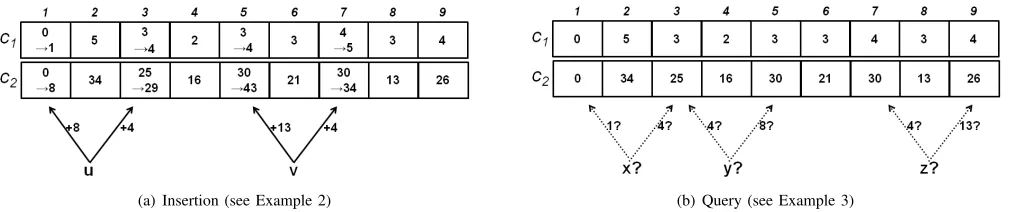
Upon deletion, the counters are decremented similarly. Example 2: Figure 2(a) illustrates the insertion of two ele-ments uandv. It uses the B3 sequenceD={v1, v2, v3, v4}
={1,4,8,13} from Example 1, and each element is hashed into k = 2 entries. In this example, {h1(u), h2(u)} =
{1,3} and {g1(u), g2(u)} = {3,2}. The packet belonging
to flow u is hashed into entries 1,3 using hash functions
h1, h2. It increments the first counter of each entry by one.
It also increments the second counters of these entries by
(vg1(u), vg2(u)) = (v3, v2) = (8,4), respectively. Similarly, a packet of flowvis hashed into entries5and7and increments their variable-increment counters by 13and4, respectively.
Query — To query whether an element y is in S,
Bh−CBF uses the unique properties of the Bh sequence. For i∈[1, k], let c1(i)and c2(i)be the values of the
fixed-increment and variable-fixed-increment counters in entry hi(y), respectively. Bh−CBF asks whether y might have been
inserted in this entry in the past. Namely, if y is hashed into value vgi(y), it asks whetherc2(i)can be a sum ofc1(i)
elements includingvgi(y). Specifically, in each entryhi(y), it
considers several cases depending on the value of c1(i):
• Ifc1(i) = 0,then as in CBF,Bh−CBF determines that
y /∈S.
• If c1(i) ∈[1, h], Bh−CBF considers the exact values of both the counters. In this case, no more than h elements were hashed into the hash entry hi(y). Therefore, c2(i)is a
sum ofc1(i)≤helements of D. Since D is aBh sequence,
Bh−CBF can deduce the elements of D used in the sum
c2(i) (i.e. in the insertions of these elements into this hash
entry). In particular,Bh−CBF can determine whethervgi(y)
is part of the sumc2(i). Otherwise, necessarilyy /∈S.
• If c1(i)> h,Bh−CBF considers the entry as useless. The value of c2(i)is not used and we cannot determine that
y /∈S based on the current hash entry.
If Bh−CBF cannot determine that y /∈S based on any of thek hash functions, it determines that y∈S. With some probability, Bh−CBF might be wrong and yield a false positive. More precisely, in case y /∈ S, the false positive occurs if for each of thekhash functions, either there are more thanhelements hashed into the corresponding hash entry, or the corresponding element of the Bh sequence was used by another element hashed into the same entry.
Example 3: As illustrated in Figure 2(b), we look at three queries for Bh−CBF introduced in Example 2. In this figure, we assume that for x, y, z the hash entries selected by the hash functions h1 and h2 are provided by their left
and right outgoing arrows, respectively. For each element
a ∈ {x, y, z}, we denote the values of the two counters in the hash entryhi(a)by ca1(i), c
a
2(i).
First, in order to determine whether x ∈ S, we start by looking at the hash entryh1(x). Sincecx1(1) = 0,Bh−CBF can determine immediately that x /∈ S. We now consider y. In its first hashed entry, h1(y), the number of elements is
cy1(1) = 3. Since we use aBh sequenceD withh= 3, then
Bh−CBF can determine the components of the weighted sum by definition of theBhsequence. In this case,Bh−CBF can deduce thatcy2(1) = 25is comprised of4 + 8 + 13 = 25. Since y increments this counter by vg1(y) = 4, Bh−CBF cannot exclude y ∈ S based on this hash entry. However, since cy1(2) = 3≤h as well, the variable-increment counter
cy2(2) = 30 = 4+13+13is not comprised ofvg2(y)= 8. Thus, Bh−CBF can also determine that y /∈S. Finally, applying the above method toz,Bh−CBF cannot deduce thatz /∈S based on the two hash entries since cz1(1), cz1(2) = 4 > h.
Therefore,Bh−CBF determines that z ∈S. This might of course yield a false positive if z /∈S. (In fact, using a more careful examination, it is possible to determine that indeedz /∈ S, as detailed below with theimprovedBh−CBF scheme.)
C. False Positive Rate
We now provide the false positive rate of Bh−CBF. As shown in the literature, in real-world systems, practical hash functions usually work as if they were fully random [23]. We assume in our proofs that the hash functions map items to random numbers uniformly distributed over their given range, and that the inserted elements and the elements in the query are independent. We will show that the false positive rate of
Bh sequence D and is not affected by the exact values of
v1, v2,· · ·, vℓ.
Theorem 1: The false positive rate ofBh−CBF is given by:
F P R=
(
1−
h ∑
j=0
(
nk j
)(ℓ−1
ℓm
)j(
1− 1 m
)nk−j)k
. (1)
Proof:LetX denote the number of elements hashed into an arbitrary entry. The probability of the eventX =jis given by
Pr(X =j) =
(
nk j
)(1
m
)j(
1− 1 m
)nk−j
. (2)
When exactly X =j elements are hashed into an entry, a specific value of the Bh sequence is not used by any of them
with probability (
1−1ℓ
)j
. Therefore, the false positive rate
F P R, i.e. the probability that for an elementy /∈S we cannot deduce from each of the k hash entries thaty /∈S, is
F P R=
(
1−
h ∑
j=0
Pr(X=j)
(
1−1 ℓ
)j)k
, (3)
yielding the result.
Note that by adopting a more complex query scheme, we can further decrease the false positive rate. This improved Bh−CBF schemeanalyzes the hash entry even when there are more than h hashed elements. In such a case, the Bh sequence definition does not directly help anymore, because the elements in the sumc2(i)are not necessarily unique when
there are more than h elements. However, by examining all the possible variable increments that can lead to the sumc2(i),
we can still sometimes conclude that an element cannot have been inserted into this entry. Unlike theBh−CBF scheme, the false positive rate of the improvedBh−CBF schemeis influenced by the exact values of the elements v1, v2,· · ·, vℓ composing the Bh sequence D. More details and analysis can be found in Section VI.
III. THEV I−CBF SCHEME
A. Scheme Description
TheBh−CBF scheme suggested above uses two counters per entry instead of a single counter. This nearly doubles the needed number of bits (neglecting the differences in counter sizes). Consequently, we introduce V I−CBF (Variable-Increment Counting Bloom Filter), which also uses variable increments but only relies on a single variable-increment counter per entry, without the additional counter that indicates the number of hashed elements.
Specifically, as previously illustrated in Figure 1(c), we use again an array of m entries to represent |S| = n elements. In each array entry, the single variable-increment counter is updated exactly like the second counter in the Bh−CBF scheme, using variable increments selected from a set D = {v1, v2, ..., vℓ}. We use again two sets of k hash functions,
H = {h1, . . . , hk} and G = {g1, . . . , gk}. Upon insertion, at each corresponding array position hi(x), the counter is
incremented by the element vgi(x) of the set D. Likewise,
upon deletion, counterhi(x)is decremented byvgi(x)∈D.
We now want to find an appropriate set D for the
V I−CBF scheme. A problem in the V I−CBF scheme is that it cannot directly use Bh sequences anymore. This is because the Bh sequence definition requires to know the number of elements in a sum. However, unlike theBh−CBF scheme, the V I−CBF scheme cannot obtain it because it does not have a small counter that provides the number of elements hashed into a given entry.
B. A First Option for D: B˜h Sequences
According to the last observation, we now suggest to use more complicated sequences, and call them B˜h sequences. Informally, the B˜h sequences are the sequences that can still help distinguish the elements in a sum even when the exact number of elements is unknown. As long as there are at most
h elements in this sum, we can know it from the sum and determine the elements.
Definition 2 (B˜h Sequence): LetD={v1, v2, ..., vℓ} ⊆N∗ be a sequence of positive integers. Then D is aB˜h sequence iff all the sumsvi1+vi2 +· · ·+vih′ with 1 ≤h
′ ≤h and 1 ≤ i1 ≤ · · · ≤ih′ ≤ ℓ are distinct and differ from all the sums of more thanhelements ofD.
Example 4: LetD={v1, v2}={3,4} ⊆N∗. Then all the
sums of up to two elements are distinct, and also different from all the sums of at least three elements: the sums of at most two elements are 3,4,3 + 3 = 6,3 + 4 = 7,4 + 4 = 8, while the sums of at least three elements are at least 9. Therefore,
D is aB˜2 sequence.
Exactly as in Bh−CBF, for an element y /∈ S we can deduce that indeed y /∈S based on one of the counters if no more than h elements are hashed into this counter and any one of them don’t have the same variable increment from D
as y. We can now deduce the following lemma.
Lemma 1: While considering hash entries with at most h
hashed elements, the false positive rate ofV I−CBF with a
˜
Bh sequenceD˜ equals the false positive rate of Bh−CBF with a Bh sequence D (with the same other parameters
m, n, k, ℓ) and is given by Equation (1).
C. A Simple Option forD:DL= [L,2L−1]
In the general case, to query whether an element is hashed into an entry, the implementation of the Bh−CBF and
V I−CBF schemes requires the use of a predetermined two-dimensional binary table based on the setD(see Section IV). However, we will now present a set D =DL that does not
need such a lookup table. Therefore,DLis easier to implement in hardware.
In the next subsections, we first analyze the V I−CBF
Let L ≥2 be a positive integer of the form L = 2i. We define the set DL of size Las DL= [L,2L−1] ={L, L+
1, ...,2L−1}.
We now want to compute the false positive rate of the
V I−CBF scheme. First, if an element y /∈ S hashes into an entry counter hi(y)of value c, we want to determine the probability that we will be able to tell thaty /∈Sgivenc. Note that the entry counter valuecis defined as a sum of elements of DL. To do so, we distinguish different values of c using the following lemma.
Lemma 2: Let y be an element whose i-th hash function
hi(y) hashes into an entry of value c. If (
c −vgi(y)
)
∈ (−∞,−1]∪[1, L−1]theny /∈S.
Proof:Intuitively, we want to determine when the counter value c can be written as a sum of increments in D that includes the increment vgi(y) ∈ D. It is only true when
c −vgi(y) is also a sum of increments from D. Therefore,
We distinguish different values of c:
• Ifc= 0, then the number of elements in the sum is zero, and thereforey /∈S.
• If c∈[L,2L−1], we can deduce thatc is composed of a single element of DL, because the minimal value of a sum of two or more elements isL+L= 2L. Further, this element is of course c. Therefore ifvgi(y)̸=c, theny /∈S.
•Ifc∈[2L, ...,3L−1], we must have thatcis a sum of two elements, because the maximal value of one element is2L−1
and the minimal value of three elements is3L. For instance,
c=L+ (c−L),orc= (L+ 1) + (c−L−1),etc. Therefore,c
can be comprised of any of the elements{L, L+ 1, ..., c−L}, but not of any x∈ {c−L+ 1, ...,2L−1}, since in such a case (c−x) < L. So if vgi(y) ∈ {/ L, L+ 1, ..., c−L} (i.e.
(c−vgi(y))< L), theny /∈S.
• Ifc≥3L,ccan be comprised of any of the elements in
DL, since(c−vgi(y))> Lfor anyvgi(y)∈[L,2L−1].
Summarizing the cases above, we cannot exclude thaty∈S
if c=vgi(y) or(c−vgi(y))≥L, hence the result.
In the next theorem we present the false positive rate of this case.
Theorem 2: The false positive rate of the V I−CBF
scheme using D=DL is given by:
F P R=
(
1−
(
1− 1 m
)nk
−L−1 L
(
nk 1
)
1 m
(
1− 1 m
)nk−1
−(L−1)(L+ 1) 6L2
(
nk 2
)(1
m
)2(
1− 1 m
)nk−2)k
.
(4)
Proof: Lety /∈S be an input to a query. As usual, since there arekhashed entries, the false positive rateF P Ris given by
(1−p)k, (5)
where p is the probability that by considering one of the k
hash entries used by hash functionhi, we can determine that
y /∈ S. Let X denote again the number of elements hashed into this entry and letcbe the resulting counter value, i.e. the
weighted sum of X elements of DL. We distinguish several cases based onX.
As explained earlier, ifX= 0 then clearlyy /∈S.
IfX= 1, thenchas one of theLvalues ofDL, each with the same probability of L1. Thereforec has one of theL−1
values that differ fromvgi(y)w.p.
L−1
L ·Pr(X = 1), in which case we can deduce thaty /∈S.
IfX = 2, there areL2possible ordered pairs of increments.
Further, there are L3 combinations of the values of the two
increments and the corresponding increment vgi(y) of the
examined element, each having an equal probability of1/L3.
We now distinguish depending on the value of c. First, as explained in the proof of Lemma 2, if c ∈ [2L, ...,3L−1], there are exactlyc−2L+ 1options to obtain a sum ofcwith two addends ofDL: The possibilities are{(L) + (c−L),(L+
1) + (c−L−1), ...,(c−L) + (L)}. Also, the sum ofccannot be comprised of(3L−c−1)of the values inDL. Therefore, out of theL3 combinations above, in
3∑L−1
c=2L
(c−2L+ 1)(3L−c−1) (6)
=
L∑−1
i=0
(i+ 1)(L−i−1) =
L∑−1
i=1
i(L−i)
of them, we can determine thaty /∈S. In addition, ifc≥3L, then the value of X is not necessarily known and c can be comprised of any of the L values of DL. Thus, the current entry is not used to determine that y /∈S.
If X ≥ 3 then c ≥ 3L and the current entry is not used again to determine thaty /∈S.
Combining all cases forX, we obtain the following formula for the probabilitypthat we can determiney /∈S using c.
p= Pr(X = 0) +L−1
L Pr(X = 1)
+ 1
L3Pr(X = 2)
L∑−1
i=1
i(L−i). (7)
We use the formula∑ni=1i2=1
6n(n+ 1)(2n+ 1)and get
L∑−1
i=1
i(L−i) =L
L∑−1
i=1
i−
L∑−1
i=1
i2=1
6(L−1)L(L+ 1). (8)
Simplifying p, using Equations (2) and (5), we obtain the result.
D. Improving the False Positive Rate of CBF
We now demonstrate thatV I−CBF can always improve the false positive rate of CBF as the system is scaled. For a fair comparison, we assume that the two schemes use the same amount of memory for the same number of inserted elements. In addition, since this false positive rate computation does not take into account the counter overflow probability, we also show thattheV I−CBF scheme always obtains a lower overflow probability bound than CBF.
Assume that CBF uses four bits per counter (a common assumption, initially suggested by Fan et al. [1]). Let α
number of elements n, the memory size is αn bits with
m = ⌈αn4 ⌉ counters. Then the following theorem compares the performances of V I−CBF and CBF as nis scaled and both schemes use the same memory size.
Theorem 3: While keeping the same bit-per-element ratio
α > 0 (and, as a consequence, also the same total memory size), V I−CBF satisfies the following properties when compared to CBF:
(i) V I−CBF obtains a lower false positive rate than CBF withm counters for anym≥m0= 10.
(ii) When α goes to infinity, i.e. the two systems are made increasingly efficient, the ratio of their false positive rates goes to0.
(iii) V I−CBF obtains a lower counter overflow probability bound than the classical bound for CBF from [1].
Proof: We first consider a CBF with m counters,
n elements and k hash functions. Its false positive rate
F P R(CBF)is optimized whenk=mn ln(2)[1] and equals
F P R(CBF) =
(
1−
(
1− 1 m
)kn)k
=
(
1−
(
1− 1 m
)ln(2)m)k
>
(1
2
)k
. (9)
Incidentally, whenkis not integer, it is possible to let each flow use eitherk1=⌊k⌋hash functions with probabilitypk=
⌈k⌉ −k (i.e., as determined by an additional hash function), or k2 = ⌈k⌉ w.p. 1−pk. The probability that an entry bit is equal to zero remains unchanged, but the resulting false positive rate is a weighted sum of those for k1 and k2. The
proof then stays unchanged, simply using the weighted sums instead. In the remainder, we assume thatk is integer.
As mentioned in [1], using four bits per counter in CBF suffices to obtain a negligible counter overflow probability of
Pr
(
max
i c(i)≥16 )
≤m
(enk
16m
)16
≈1.37·10−15·m.
(10)
Let’s now consider a V I−CBF with m′ counters, n
elements and k hash functions. Note that we use the same
kas in CBF scheme for simplicity, but might further improve the false positive rate with a different k. We choose the parameter L of this scheme to be L = 4, and therefore
DL = {L, L+ 1, ...,2L−1} = {4,5,6,7}. The maximal counter increment ismax(DL) = 2L−1 = 7. Instead of using four bits per counter as in CBF, we suggest to use seven bits per counter. For simplicity, we also assume that m satisfies that 47m is an integer. Therefore, given the same total number of memory bits, we use m′ =⌈4m
7 ⌉ =
4m
7 counters, i.e. 4 7
of the number of counters since the counters are larger in a factor of 74. Let r = 4/7 denote the ratio in the number of counters, such thatm′ =mr. Likewise, letpdenote again the probability that by considering one of the khash entries used by hash function hi, we can determine that y /∈S and letX denote again the number of elements hashed into this entry.
We compare the false positive rate of V I−CBF from Theorem 2 to the false positive rate of CBF as presented in Equation (9). In order to demonstrate that the false positive
rate of V I−CBF is lower than the false positive rate of CBF, we just need to prove thatp > 12, where
p=
(
1− 1 m′
)nk
+L−1 L ( nk 1 ) 1 m′ (
1− 1 m′
)nk−1
(11)
+(L−1)(L+ 1) 6L2 ( nk 2 )( 1 m′
)2(
1− 1 m′
)nk−2
=
Pr(X = 0) +L−1
L Pr(X= 1) +
(L−1)(L+ 1)
6L2 Pr(X= 2).
Distinguishing the elements in the formula of p, we get
Pr(X = 0) =
(
1− 1 m′
)nk
=
(
1− 1 mr
)mln(2)
≥
(
1− 1 m0r
)m0ln(2)
, (12)
where the last inequality is satisfied form≥m0. Likewise,
Pr(X = 1) =
( nk 1 ) 1 m′ (
1− 1 m′
)nk−1
(13)
= mln(2) mr−1 ·
(
1− 1 mr
)mln(2)
> ln(2) r ·
(
1− 1 mr
)mln(2)
≥ ln(2) r ·
(
1− 1 m0r
)m0ln(2)
,
where again the last inequality is again satisfied form≥m0.
Furthermore, form≥m0,
Pr(X= 2) =
(
nk 2
)( 1
m′
)2(
1− 1 m′
)nk−2
(14)
=mln(2)(mln(2)−1) 2(mr−1)2 ·
(
1− 1 mr
)mln(2)
≥mln(2)(mln(2)−1)
2(mr)2 ·
(
1− 1 mr
)mln(2)
≥ln(2)(ln(2)−
1
m0)
2r2 ·
(
1− 1 m0r
)m0ln(2)
.
Therefore, combining Equations (11-14), we get
p≥p0,
(
1− 1 m0r
)m0ln(2)
·(1 + L−1 L ·
ln(2) r
+(L−1)(L+ 1)
6L2 ·
ln(2)(ln(2)−m1 0) 2r2
)
. (15)
p0 is a lower bound on p. ForL= 4, r= 4/7, m0 = 10, we
getp0>0.5and the false positive rate is indeed improved. The
analysis so far assumed CBFs with four bits per counter. The comparison of the false positive rate can be easily generalized to CBFs with d bits per counter for a general d. Then, for
L = 4 and a maximal variable increment of 2L−1 = 7,
V I−CBF can use counters ofd+⌈log2(7)⌉=d+ 3bits. Thus the ratio in the number of counters isr(d) =d/(d+ 3). For larger d, the ratio r(d) is larger and the relative reduc-tion in the number of counters is smaller. Accordingly, the improvement in the false positive rate is more significant. We can see that for d ≥ 5, the inequality p0 > 0.5 is satisfied
even for m0 = 5. When d= 3, the improvement is smaller
Next, we can see that (forp0>0.5) whenαgoes to infinity,
the optimal number of hash functions for CBF also goes to infinity. Thus, we have
F P R(V I−CBF) F P R(CBF) =
(1−p)k (
1−(1−m1)ln(2)m
)k (16)
≤
(
1−p0
1/2
)k k→∞
−−−−→0.
To complete the proof, for CBFs of four bits per counter, we look at the counter overflow probability of V I−CBF, using seven bits per counter. For i ∈ [1, m′], let γ(i) be the number of addends in the sum c(i)of the corresponding counter. Clearly, the maximal value of a counter that does not yield to an overflow is 127.
We denote by γ(i, j) (for i ∈ [1, m′], j ∈ [1, ℓ = 4]) the number of addends in the sum c(i) that equal vj, s.t.
γ(i), the number of addends in the sumc(i), satisfies γ(i) =
∑ℓ
j=1γ(i, j). Since the maximal increment isvℓ= 2L−1 =
7, we observe that if the i-th counter has encountered an overflow (i.e. c(i)≥128), then γ(i)≥ ⌈128v
ℓ ⌉=⌈
128
7 ⌉= 19.
Further, if c(i)≥128 andγ(i) = 19, then γ(i,4)≥14, i.e. at least 14 among the 19 addends in the sum c(i)arev4= 7.
Since all the elements of D are uniformly selected and the four events, {(γ(i,1)≥14, γ(i) = 19),(γ(i,2)≥14, γ(i) = 19),(γ(i,3) ≥ 14, γ(i) = 19),(γ(i,4) ≥ 14, γ(i) = 19)}
are disjoint, we must have thatPr (γ(i,4)≥14|γ(i) = 19)≤
1
ℓ = 0.25.
We finally have (forr= 4/7) that
Pr
(
max
i c(i)≥128 )
≤m′Pr (c(i)≥128) (17)
≤m′·
(
Pr (γ(i,4)≥14, γ(i) = 19) + Pr(γ(i)≥20)
)
≤m′·
(
0.25·Pr (γ(i) = 19) + Pr(γ(i)≥20)
)
≤m′·
(
0.25·Pr (γ(i)≥19) + Pr(γ(i)≥20)
)
≤m′·
(
0.25·
( enk
19m′
)19
+
( enk
20m′
)20)
=mr·
(
0.25·
(emln(2)
19mr
)19
+
(emln(2)
20mr
)20)
=mr·
(
0.25·
(eln(2)
19r
)19
+
(eln(2)
20r
)20)
≈mr·1.104·10−15≈6.31·10−16·m.
Comparing to the classical overflow probability bound of CBF (from Equation (10)), this upper bound of the overflow probability ofV I−CBF (withr= 4/7) is strictly lower.
IV. IMPLEMENTATIONCONSIDERATIONS
In this section we discuss the implementation of the
Bh−CBF and V I−CBF schemes in comparison with CBF. We consider several issues such as computational com-plexity, logic comcom-plexity, memory throughput and hashing complexity.
Computational Complexity — We consider the
computa-tional complexity of a query in the two suggested schemes.
(a) CBF - A set ofkhash functions is used to selectkhash entries. For each hash entry, we check whether the counter valuecis positive.
(b) Bh−CBF - Two sets ofk hash functions are used to selectk
hash entries and thekcorresponding variable increments. For each hash entry, we consider the exact values of the two counters(c1, c2)and the
variable incrementv using a lookup table, which is based on the Bh
sequenceD.
[image:8.612.70.300.99.164.2](c)V I−CBF - Two sets ofkhash functions are used to selectkhash entries and thekcorresponding variable increments. For each hash entry, we check the difference(c−v)of the counter valuecand the variable incrementv.
Fig. 3. Logical View of Hardware Implementation. Components that also appear in CBF are presented in gray, while white ones are new.
In the Bh−CBF, let (c1, c2) be the values of the two
counters and let v ∈D be the current variable increment. In order to efficiently determine whether the weighted sumc2can
be comprised ofvusing exactlyc1addends, we suggest using
a predetermined two-dimensional binary tableAthat is based onD. The bitA[i][j]is set if there is a sum ofiaddends from
Dthat equalsj. We notice that the valuec2 can be comprised
of v using c1 addends forc1 ≥1 only if there is a sum of
exactlyc1−1addends that equals the value c2−v, i.e. if the
bit valueA[c1−1][c2−v]is set. The cases out of the table
boundary (c1 = 0 and c1 > h) can easily be defined in the
lookup procedure. In summary, if c1 > h or if the relevant
bit value is set,Bh−CBF continues to the next hash entry. Otherwise, it determines that the element is not in the set.
Note thatBh−CBF enters tableA only for cases where
c1∈[1, h]. Therefore the first dimension index isc1−1≤h−1
and the maximal possible value of the weighted sum is at most
(c1−1)·max(D)≤(h−1)·vℓ. Thus, the memory size of the tableAis at mosth·((h−1)·vℓ+1)≤h2·vℓbits. Note also that the setD is fixed, and therefore the binary table is also fixed and is calculated only once and not for each query. To calculate the table, we can simply go over all the multisets of up toh
[image:8.612.324.556.276.354.2]3, ℓ= 4, we can calculate once the table by simply going over the(3+43 )= 35multisets. For these parameters, the size of the table is limited byh·((h−1)·vℓ+1) = 3·((3−1)·13+1) = 81 bits.
Next, we consider the complexity of the V I−CBF
scheme given the setD=DL. As explained in Section III-C, a lookup table is not required in this case. Instead of the lookup operation, for a counter valuec, we just check whether
c −v = 0 or c−v ≥ L (Lemma 2). If so, V I−CBF
continues to the next hash entry. Otherwise, it determines that the element is not in the set.
To summarize, upon a query in both schemes we simply calculate the difference of a counter value and the variable increment. Then, we either compare it a to fixed bound or use it as an index to a lookup table. Heavy computations that include going over all possible sums or other complicated algorithms for judging whether an element can be a part of a given sum are not required upon query.
Pipeline Complexity — The insertion, deletion and query
of each element can be organized in a pipeline manner, so that each operation is implemented at line rate. We assume for simplicity that there are no conflicts between elements at different steps of the pipeline.
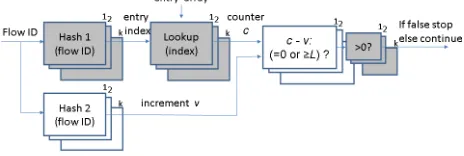
Figure 3 illustrates the logical pipeline implemented to go through a query of packet x. It focuses on one ofk parallel pipelines, shown on k parallel planes, and corresponding to the khash entries.
Figure 3(a) presents the implementation of CBF in which the flow ID of the packet is hashed into one of the CBF array entries. The corresponding counter value c in considered. If it equals zero, CBF determines that x /∈ S. Otherwise, CBF continues to check the next hash entry.
Figure 3(b) illustrates the implementation of Bh−CBF. Components that also appear in CBF are presented in gray, and the additional components in white.Bh−CBF uses two hash functions instead of one. The first points to an entry in the Bh−CBF array with the pair of counters (c1, c2). The
second points to an increment from the set D denoted by v. These three values are then considered as described above.
Next, we consider the implementation of the V I−CBF
scheme given the set D =DL presented in Figure 3(c). As in the previous scheme, two hash functions are calculated. The first points to an entry in the V I−CBF array with a countercand the second points again to an incrementv∈D. These two values are then considered without a lookup table as explained earlier.
Memory Throughput — In order to increase the memory
throughput, we can implement the two schemes using the ideas implemented in the Blocked Bloom Filter [24]. For each element, all hash functions are mapped into a single block in the memory, i.e. a single memory word. Although this technique suffers from a higher false positive rate, it is clearly energy-efficient and improves the memory throughput, because there is a single memory word access instead of up to k.
Hashing Complexity — In each operation of insertion,
deletion or query, the two suggested schemes require the com-putation of 2k hash functions instead ofk in CBF. However, the total required number of random bits is much less than
twice the number in CBF. In order to point to a random element in D, only⌈log2(|D|)⌉=⌈log2(ℓ)⌉random bits are required. Since the selection ofDwith small cardinality (such asℓ= 4) is enough to have an improved false positive rate, as explained in the proof of Theorem 3, we can reduce to two the number of random bits generated by each ofG={g1, . . . , gk} hash functions. In addition, given the same overall memory size, the number of counters in V I−CBF is reduced by a factor of two, because they are twice larger, therefore they need one less bit for each counter selection. Thus,V I−CBF typ-ically needsk·(2 + (⌈log2(m)⌉ −1)) =k·(⌈log2(m)⌉+ 1)
bits instead ofk·(⌈log2(m)⌉)in CBF.
V. COMBINING WITH THEML-HCBF
In this section we show that V I−CBF can be combined with the MultiLayer Hashed CBF scheme (ML-HCBF) [4] to further decrease its memory requirements for a requested false positive rate.
Instead of using one level with a constant number of bits per counter,ML-HCBFuses a hierarchical structure of several layers with narrower counters such that the number of counters is a decreasing function of the level number. The number of counters in the first level is a baseline number of counters, and their number in each additional level is based on the overflow probability of counters in the previous level. During insertion, a counter in the first level is examined. If it is not saturated, it is simply incremented. If it is saturated, the counter position is hashed to obtain an address of a counter in the next levels. If it is also saturated, the procedure continues in the next levels until a non-saturated counter is found.
A similar concept can be implemented using variable in-crements, as in V I−CBF. We denote it ML-VI-HCBF. We increment a counter in the first level by a variable increment till it reaches its maximal value. If it was saturated, we continue and increment another counter in the next level by the rest of the increment, such that the sum of their increments equals the requested one. By using perfect hashing as in [4], the actual value of a counter can be calculated as the sum of the corresponding counters in one or more levels. For instance, instead of using counters of8bits as forV I−CBF, we can have a hierarchical structure of 4 levels with (4,3,3,3) bits per counter, i.e. only four bits per counter in the first level and three bits per counter in all the other levels.
VI. IMPROVEMENTS OF THEBh−CBF SCHEME
In this section we consider a possible improvement of the
Bh−CBF Scheme. We show that we can further decrease its false positive rate by considering also hash entries with more thanhhashed elements.
Consider a hash entry hi(y) with more than h hashed elements. In such a case, the Bh sequence definition does not help anymore, because the elements in the sumc2(i)are
not necessarily unique. However, we can still obtain some information in certain cases. By examining all the possible variable increments from theBhsequenceD={v1, v2, ..., vℓ} that can lead to the sum c2(i), we can conclude that y /∈ S
Fig. 4. The detection probability functionfD(j)for theB3sequenceD=
{1,4,8,13}. For theBh−CBF scheme,fD(j) = 0 forj > h. For the
improvedBh−CBF scheme,fD(j)>0for somej > h.
increments. For a given number of bits per hash entry, this improvement enables to reduce the false positive rate while keeping the same counter overflow probability. To implement this improvement using the suggested two-dimensional binary table, a slightly larger table is required. The additional entries of the table stand for sums of more then haddends.
Let vi be a uniformly-distributed element of D =
{v1, v2, ..., vℓ}. Let c be a sum of j uniformly-distributed elements ofD\{vi}. With some probability, we can determine that c is not comprised of vi. Given a Bh sequence D, we denote byfD(j)the probability that we can indicate this fact based on the values c and j. The function fD(j) is called the detection probability function. Of course, since D is a
Bh sequence, for any j ∈[0, h], there is only one sum of j elements that equalsc. Thus, this sum must have the property that its elements are all inD\ {vi}. Therefore, we must have that fD(j) = 1 for j ∈ [0, h]. In the previously presented
Bh−CBF scheme, fD(j) = 0for j > h, since we cannot leverage the properties of the Bh sequence in such cases. In the improved scheme,fD(j)equals the probability that all the sums of j elements ofD which equalc are not comprised of
vi. In all such cases, we can deduce that c is not comprised of vi.
Using the last definition, we can now present the false positive rate of the improved scheme.
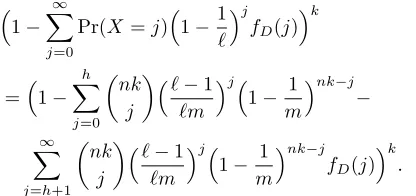
(
1− ∞ ∑
j=0
Pr(X =j)
(
1−1 ℓ
)j
fD(j) )k
(18)
=
(
1−
h ∑
j=0
(
nk j
)(ℓ−1
ℓm
)j(
1− 1 m
)nk−j
−
∞ ∑
j=h+1
(
nk j
)(ℓ−1
ℓm
)j(
1− 1 m
)nk−j
fD(j) )k
.
From the last statement, it is clear that this scheme has an improved false positive rate in comparison with the basic
Bh−CBF scheme. The false positive rate of the basic
Bh−CBF scheme presented in Equation (1), can be achieved from Equation (18) using fD(j) = 1 for j ∈ [0, h] and
fD(j) = 0 for j > h since with this scheme we do not consider any hash entry with more than hhashed elements.
Example 5: We look again at the B3 sequence D =
{1,4,8,13} from Example 1. Figure 4 presents fD(j) for
j ∈ [0,15]. As explained earlier, for the basic Bh−CBF scheme, we have that fD(j) = 1 for j ∈ [0, h] = [0,3] and fD(j) = 0 for j > h. We now try to calculate fD(j) for our improved Bh−CBF scheme. As explained earlier,
fD(j) = 1 for j ∈ [0, h] = [0,3]. To calculate fD(4), for instance, we consider the 44 = 256possible combinations of four ordered elements ofD. Among them there are, for each of the four values of D, 34 (ordered) combinations in which it does not appear. There is a total number of 4·(34) = 324
cases of four addends vi1, vi2, vi3, vi4 ∈ D\ {vt} for some t ∈ [1, ℓ]. We denote by c the sum vi1 +vi2 +vi3 +vi4. Among these cases, there are 282 cases in which any sum of four addends that equals c is not comprised of vt. There-fore, fD(4) = 282324 ≈ 0.87. Likewise, we can obtain that
fD(8) = 262443916 ≈ 0.15. We can now use these results to
examine a query of an element y /∈S. Consider a hash entry
hi(y) with counters values c1(i) and c2(i). If c2(i) is not
comprised ofvgi(y) andc1(i) =h+ 1 = 4, we can determine
thaty /∈S based on the current hash entry with probability of about0.87.
Example 6: Consider the query of the element z from Ex-ample 3, as illustrated in Figure 2(b). Althoughcz1(1) = 4> h,
we can notice thatcz2(1) = 30, as a sum ofcz1(1) = 4elements
from D, cannot be comprised of vg1(z)= 4. This is because cz
2(1)−vg1(z)= 30−4 = 26 cannot be comprised of exactly cz
1(1)−1 = 4−1 = 3addends from the B3 sequenceD, as
illustrated in Example 1. Thus, we can determine thatz /∈S, avoiding a false positive.
VII. LOWERBOUNDS ON THECODINGSCHEMES
We now consider the Bh−CBF scheme that uses a Bh sequence D and the V I−CBF scheme with the option of a B˜h sequence D. A fundamental view of these algorithms is that in each entry, using either one or two counters, they represent a multiset of up to h elements taken from a space of size |D| = ℓ. This can provide us a lower bound on the needed number of bits for the representation of a hash entry. As an example, consider again theBh−CBF scheme with the B3 sequence D = {v1, v2, v3, v4} = {1,4,8,13} with
|D|=ℓ= 4. There are 20 multisets of exactly three elements from D (as illustrated in Example 1), 10 multisets of two elements and of courseℓmultisets of size one. The empty set is also a subset of D. Thus there are 35 multisets of up to three elements fromD. Therefore at least⌈log2(35)⌉= 6bits are required to represent the information in such cases.
More generally, in order to represent differently all these multisets, we must have a number of bits that equals at least the base-2 logarithm of the number of possible multisets. In particular, since the number of multisets of up tohelements from a set of sizeℓequalsϕ(h, l) =(h+hℓ), we obtain a lower bound of
⌈log2ϕ(h, l)⌉=
⌈
log2
(
h+ℓ h
)⌉
(19)
[image:10.612.74.282.555.653.2]20 25 30 35 40 45 50 55 10−4
10−3 10−2 10−1
bits per element
false positive rate
[image:11.612.98.289.53.178.2]CBF (theory) CBF (simulation) Bh − CBF (theory) Bh − CBF (simulation) Improved Bh − Bloom (simulation) VI − CBF, D = DL (theory) VI − CBF, D = DL (simulation) VI − CBF, general D (simulation)
Fig. 5. Comparison of the false positive rates of the CBF, V I−CBF
and Bh−CBF schemes and the theoretical models from Theorem 1 and
Theorem 2.
⌈
log2(73)⌉ = ⌈log235⌉ = 6 bits are required for each hash entry.
However, while these provide attractive lower bounds, they might lack additional properties of the Bh−CBF and the
V I−CBF schemes that are essential for fast hardware implementation: in particular, during insertions and deletions, they first need to decode the value before re-encoding the next value, which is not needed in the schemes presented in this paper. Of course, special codes that can be incremented iteratively may be suggested. Further, by allocating more bits per entry, these two schemes have a relatively low counter overflow probability, even when a hash entry represents more thanhelements.
VIII. EXPERIMENTALRESULTS
A. Trace-Driven Simulations
We conduct experiments using real-life traces recorded on a single direction of an OC192 backbone link [25], and rely on a 64-bit mix hash function [26] of the IP 5-tuple to implement the requested hash functions.
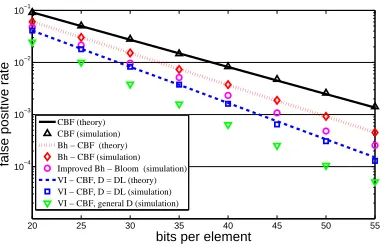
Figure 5 plots the false positive rate of various schemes as a function of the memory size (in bits per element). It also compares the experimental values with the values obtained by theory.
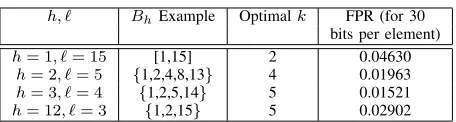
For Bh−CBF, we use a Bh sequence D ={v1, ..., vℓ} withh= 3andℓ= 4. We compare the false positive rate of the basic scheme with Theorem 1. We remind that in the (basic)
Bh−CBF scheme, the false positive rate does not depend on the exact values of v1,· · · , vℓ but only on the parameters
h, ℓ. We also present the results of the improvedBh−CBF scheme that we introduced after Theorem 1. For this scheme we use a specificBhsequence with the above parametersD=
{1,4,13,15}, which was found to yield a low false positive rate on synthetic inputs.
For V I−CBF, we first use D = DL with L = 4, where the false positive rate is given by Theorem 2, and later also use the more general set D ={8,12,14,15} (that was again found to be a good set) to compare the two sets. We classically assume four bits per counter for CBF, and for the two Bh−CBF schemes, twelve bits per hash entry (four and eight bits for the fixed-increment and variable-increment counters, respectively). For the V I−CBF scheme, we use
seven bits per counter whenD=D4and eight bits per counter
for the generalD.
First, the simulation results confirm the theory from Theorem 1 and Theorem 2. Further, all the suggested schemes improve upon CBF. In addition, the two variants of V I−CBF outperform the Bh−CBF scheme and the improved Bh−CBF scheme.V I−CBF with the general set D yields the best performance, and the improvement is especially significant for larger numbers of bits per element. For instance, for 30 bits per element, the false positive rate for CBF, Bh−CBF, improved Bh−CBF, V I−CBF with
D = DL and V I−CBF with a general D are 0.02803, 0.01521, 0.00970, 0.00825 and 0.00383, respectively, thus obtaining an improvement by a factor of 7. Likewise, for 50 bits we have 0.00258, 0.00092, 0.00048, 0.00031 and 0.00011 respectively, thus improving the result by over an order of magnitude. Of course, as mentioned,V I−CBF with
D=DLis easier to implement in hardware thanV I−CBF with a general D, hence there is a clear tradeoff between efficiency and complexity.
Alternatively, for the same false positive rate of CBF with 50 bits per element, V I−CBF with a general D requires approximately 32 bits per element, hence a reduction of about a third in the memory requirement.
B. Comparison with State-of-the-Art Algorithms
We adopt the same settings as in [4] to examine the memory requirements of our suggested schemes in comparison with several well-known schemes such as CBF [1], Spectral BF [19], dlCBF [3] and ML-HCBF [4]. Specifically, we compare the total memory size required to obtain a false positive rate of 10−3 when |S| = n = 2000 elements are represented.
The performance results of the previous schemes are taken from [4]. We present the results of six new schemes:
Bh−CBF, the improved Bh−CBF scheme, V I−CBF withD=DL,V I−CBF with a generalDand each of these two versions ofML-VI-HCBF, i.e.V I−CBF combined with ML-HCBF. ForBh−CBF andV I−CBF, we use the same set D and the same number of bits per counter as in the previous simulation. Table I summarizes the results.
For the new schemes, we consider the additional size of the lookup table, when required. For instance, as explained in Section IV, Bh−CBF requires a table of size h2·vℓ =
33·15 = 135 bits≈0.02KB. For the improved Bh−CBF scheme we base, in this simulation, the query decision on counters with up to2·h= 6. Thus, the table size is(2h)2·vℓ≈
0.07KB. For theV I−CBF scheme with the set D=DL, a lookup table is not required. For the general setD, the size is at most15·15 = 225 bits≈0.03KB.
InBh−CBF, the required memory size is12.09KB, and it drops to 11.38 KB in the improved Bh−CBF scheme.
V I−CBF with D =D4 requires 12842 counters of seven