Original
Article
Validity and Reliability of the Iranian
Version of the Insomnia Severity Index
Zohreh Yazdi1, Khosro Sadeghniiat haghighi2,
Mohammad Ali zohal1, Khadijeh elmizadeh1
1 Qazvin University of Medical Sciences, Qazvin, Iran
2 Department of Occupational Medicine, Tehran University of Medical
Sciences, Tehran, Iran
Submitted: 26 Feb 2012
Accepted:11 Jul 2012
Abstract
Background: The Insomnia Severity Index (ISI) is a short subjective questionnaire which helps physicians in making decisions about patients suffering from insomnia. The present study was an attempt to test the reliability and validity of the Iranian version of the ISI and to measure the correlation between ISI items and polysomnography results in chronic insomnia patients.
Methods: Two groups responded to the Persian translation of four questionnaires; ISI, Pittsburg Sleep Quality Index (PSQI), Epworth Sleepiness Scale (ESS), and General Health Questionnaire (GHQ). The first group consisted of 135 patients diagnosed with chronic insomnia, and the second group was comprised of 55 normal people. After completing the questionnaires, the insomniac patients underwent standard overnight polysomnography.
Results: The internal consistency demonstrated by Cronbach’s alpha coefficient was above 0.8 for both groups. The Intra-class correlation coefficient was above 0.7 after two weeks for both groups. The correlations between ISI, PSQI, ESS, and GHQ were high. In addition, close correlations were found between scores obtained from the ISI questionnaire items in insomniac patients with corresponding polysomnographic variables.
Conclusion: The Iranian version of the ISI is a reliable and valid instrument. It is a valuable short and first-line questionnaire for insomnia research and clinical work.
Keywords: insomnia, Insomnia Severity Index, Iran, reliability, validity
Introduction
Insomnia is a common sleep disorder in the world (2,3), affecting at least 10–35% of the adult population (4). Insomnia is characterized by the perception of inadequate quantity or quality of sleep with associated prominent negative impact on health and daily functioning. Insomniac patients suffer from high levels of absenteeism from the workplace and increased use of health care services. They are also prone to psychiatric morbidities (5). Epidemiologic studies show that insomnia has been associated with affective disorders, substance abuse, lower life expectancy, and other adverse health outcomes (6).
The four most common complaints about insomnia are difficulty initiating sleep, frequent awakenings from sleep, difficulty falling back to sleep after nocturnal awakenings, and spontaneous early morning awakening. Therefore, definition of insomnia relies on the patient's perspective and decision of the physician (7,8). There is no diagnostic test to define insomnia, and taking a history is sufficient to establish the condition. With
this in mind, designing a valid and reliable self-reporting questionnaire would help physicians to rapidly and inexpensively gather information from patients about their sleep complaints (9).
There are relatively few self-reporting questionnaires for assessment and clinical diagnosis of insomnia. The Insomnia Severity Index (ISI) is a short subjective instrument for measuring insomnia symptoms and consequences. The ISI is composed of seven items assessing sleep onset, sleep maintenance, early morning awakening, interference with daily functioning, perceived prominence of impairment attributed to the sleep problem, concerns about sleep problems, and satisfaction with sleep patterns (1). Perceived severity of each item is rated on a 0–4 scale. A total score ranging from 0 to 28 is obtained from summing the seven ratings.
reliability for evaluating and screening in the context of primary insomnia (10,11).
The purpose of the present study was to assess the validity and reliability of the Iranian version of the ISI questionnaire. We assessed the internal consistency and concurrent validity (with polysomnography) at a sleep clinic in a sample of chronic insomniac patients. Furthermore, we assessed the internal consistency and concurrent validity (with three other questionnaires) in a normal group.
Subjects and Methods
We first had a bilingual expert panel of sleep physicians, psychiatrics, and occupational medicine specialists translate the ISI questionnaire into Persian. Each item was discussed until agreement was reached on an appropriate translation. We made every effort to keep the sentences of the questionnaire conceptually understandable and simple. Then, we had two external translators translate it back into English. Lastly, we had a few fluent users of English compare the original ISI with the back-translated edition. This revealed only one mistake in the translation. As it was not possible to show emphasis using capitalization in the Persian edition, we used bold words.
The purpose of the study was explained to all participants, and their informed consent was obtained. The experimental group consisted of 135 patients who had been diagnosed with chronic insomnia by a single sleep physician according to ICD-10 criteria. These patients attended the sleep clinic between November 2008 and March 2009. In addition, they underwent medical examinations to rule out other medical disorders. The control group consisted of 55 cases without insomnia in the same age range as the members of the experimental group. They were recruited from the staff of a university not occupied with shift work. They had normal sleep habits and did not report insomnia, loud snoring, or excessive daytime sleepiness.
Subjects with underlying chronic illnesses or history of taking medication or substances affecting the sleep-wake cycle such as hypnotics or stimulants were excluded from the study. Twenty people from each group were randomly selected for participation in the test-retest process. The interval between the test and the retest was two weeks.
Four sleep questionnaires were used: ISI, Pittsburg Sleep Quality Index (PSQI), Epworth
Questionnaire (GHQ-28) (1,12–14). The Persian versions of these questionnaires had been used in previous studies (15–17). After filling the questionnaires, the patients with chronic insomnia were subjected to overnight polysomnography in a sleep laboratory.
SPSS 11.5 was used for statistical analysis. Summary statistics for descriptive data were obtained for means and standard deviations. We used Cronbach’s alpha to test the internal consistency reliabilities and the intra-class correlation coefficients (ICC) to compute test-retest reliability of the ISI scores. The correlation between ISI items and polysomnography results was computed using two-tailed the Spearman correlation coefficient. For all data, a p < 0.05 was considered statistically significant.
Results
A total of 135 insomniac patients (56 men and 79 women) and 55 normal people (26 men and 29 women) took part in this study. Table 1 shows the demographic variables in both groups.
According to PSG results, 12 patients were diagnosed with mild obstructive sleep apnea with an apnea hypopnea index (AHI) > = 5, and two patients had moderate sleep apnea (AHI > = 10). There were no cases with severe sleep apnea, narcolepsy, and PLMD.
The results from the ISI questionnaire were interpreted according to Morin study (1). Of all the participants in the experimental group, 26.6% (n = 36) exhibited clinically insignificant insomnia (0–7), 32.6% (n = 44) sub-threshold insomnia (8–14), 36.3% (n = 49) clinical insomnia of moderate severity (15–21), and 4.4% (n = 6) severe clinical insomnia (22–28). The mean and standard deviation turned out to be 12.1 and 6.7, respectively.
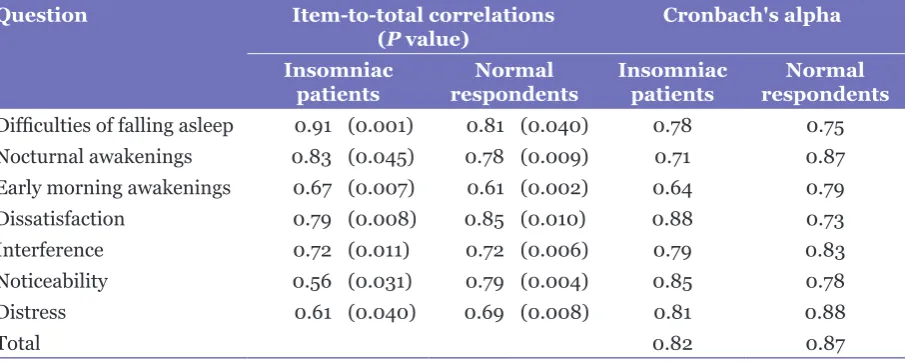
item-to-0.61 to 0.85 in normal respondents (Table 2). Table 3 shows the correlation between ISI items and corresponding polysomnographic variables. There was a significant correlation between subjective complaint about difficulty in sleep initiation and sleep onset latency in PSG (r = 0.56, p < 0.001). Furthermore, there was a significant correlation between subjective complaint about difficulty in sleep maintenance and the number of awakenings in PSG (r = 0.19,
p = 0.025). A low patient satisfaction from sleep was associated with lower total sleep time in PSG (r = –0.3, p = 0.02). No significant correlation was found between patient satisfaction from sleep and sleep efficiency in PSG (r = –0.34,
p = 0.26). Also, there was no significant correlation between polysomnographic variables and the last three questions of the ISI questionnaire
(i.e., interference, noticeability, and worried) (p > 0.05).
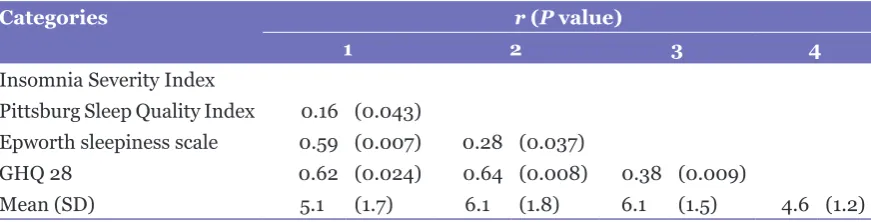
As tables 4 and 5 show, there were significant correlations between the ISI, PSQI, ESS, and GHQ. The correlation between the ISI questionnaire and the PSQI was stronger in insomniac patients than in healthy patients.
Discussion
Despite recent advances in insomnia treatment and introducing new drugs, diagnosis remains a challenge. On the other hand, insomnia may develop with different symptoms which make it more difficult to diagnose. Several studies show that sleep deprivation causes many harmful effects on the quality of life and daily functioning (15,18).
Table 2: Insomnia Severity Index items-to-total correlations in patient and control groups Question Item-to-total correlations
(P value) Cronbach's alpha
Insomniac
patients respondentsNormal Insomniac patients respondentsNormal Difficulties of falling asleep 0.91 (0.001) 0.81 (0.040) 0.78 0.75
Nocturnal awakenings 0.83 (0.045) 0.78 (0.009) 0.71 0.87
Early morning awakenings 0.67 (0.007) 0.61 (0.002) 0.64 0.79
Dissatisfaction 0.79 (0.008) 0.85 (0.010) 0.88 0.73
Interference 0.72 (0.011) 0.72 (0.006) 0.79 0.83
Noticeability 0.56 (0.031) 0.79 (0.004) 0.85 0.78
Distress 0.61 (0.040) 0.69 (0.008) 0.81 0.88
Total 0.82 0.87
Table 1: Clinical and demographic variables in insomniac and normal people Categories Insomniac patients
n = 135 Mean (SD)
Normal respondent n = 55
Mean (SD)
P value
Age (years) 42.3 (5.8) 38.7 (8.3) 0.110
BMI (Kg/m2) 24.3 (5.7) 25.7 (7.1) 0.090
Education 10.4 (2.6) 11.6 (4.1) 0.071
ISI scores 12.1 (6.7) 5.1 (1.7) 0.003
Total sleep time (min) 339.6 (78.5) 363.5 (80.3) 0.005
Sleep latency (min) 22.2 (27.6) 13.2 (18.2) 0.030
Number of awakening 25.8 (13.8) 16.5 (12.8) 0.001
Apnea-hypopnea index 12.3 (4.8) 13.1 (7.5) 0.090
In this study, we translated the ISI questionnaire into Persian and then back-translated it into English to assess the validity and reliability of its Persian version. We took care to make the translation free from any error.
A significant correlation was found between the results obtained from the ISI questionnaire and those from PSQI and GHQ questionnaires.
Also, the correlations between items on the ISI questionnaire and corresponding polysomnographic variables were found to
be appropriate. The correlations were more significant in the first three questions of the questionnaire. This demonstrates that the ISI is more useful in quantifying insomnia severity at a sleep clinic than in detecting dissatisfaction from sleep. We can also conclude that this questionnaire can differentiate between different types of insomnia.
Furthermore, there was a significant correlation between the ISI questionnaire and the ESS. Previous studies disagree on this.
Table 3: Correlations between Insomnia Severity Index and polysomnographic results Insomnia Severity Index Polysomnography measures
SOL a NA b SE c TST d
r (P) r (P) r (P) r (P)
Difficulties of falling asleep 0.56 (< 0.001) –0.31 (< 0.001)
Nocturnal awakenings 0.19 (0.025) –0.37 (< 0.001)
Early morning awakenings –0.21 (0.002)
Dissatisfaction –0.34 (0.260) –0.3 (0.020)
Total score –0.29 (0.001)
a SOL, sleep onset latency. b NA, number of awakenings. c SE, sleep efficiency. d TST, total sleep time.
Table 4: Descriptive statistics and Pearson correlation between the ISI questionnaire with PSQI, ESS, and GHQ28 in insomniac patients
Categories r (P value)
1 2 3 4
Insomnia Severity Index
Pittsburg Sleep Quality Index 0.58 (0.046)
Epworth sleepiness scale 0.42 (0.041) 0.37 (0.001)
GHQ 28 0.67 (0.043) 0.69 (0.023) 0.41 (0.009)
Mean (SD) 12.1 (6.7) 8.6 (2.1) 8.4 (1.8) 5.2 (0.9)
Table 5: Descriptive statistics and Pearson correlation between the ISI questionnaire with PSQI, ESS, and GHQ28 in normal group
Categories r (P value)
1 2 3 4
Insomnia Severity Index
Pittsburg Sleep Quality Index 0.16 (0.043)
Epworth sleepiness scale 0.59 (0.007) 0.28 (0.037)
Some studies have found a stronger correlation between the ISI and fatigue than between the ISI and sleepiness. This means that, in spite of less nocturnal sleep, insomniac patients do not have excessive daytime sleepiness. That is to say, insomnia is a condition of 24 hours hyperarousal (19,20).
Another study has found a strong correlation between the ISI questionnaire and the ESS (5). Daytime sleepiness in insomniac patients might be a consequence of nocturnal sleep disturbance or other disorders such as narcolepsy and obstructive sleep apnea.
Also, our findings suggest that the ISI is a homogenous scale. For all the items, component scores were significantly correlated with the global score. This is more obvious for components related to sleep quantity (sleep latency, and the number of awakenings). These findings are consistent with previous studies about the ISI (5,20,21).
Given the high prevalence of insomnia and its harmful consequences on health, it seems that there should be a reliable and valid questionnaire for rapid screening of insomnia.
The results of our study showed that the Persian edition of the ISI is a reliable and valid tool to screen insomnia in the Iranian population. It is also a useful tool to measure insomnia in both chronic insomniac patients and normal people.
This questionnaire was developed by Morin and colleagues for the screening of insomnia and measuring the effects of treatment on the severity of the condition (1). The ISI is now widely employed in English- and non-English-speaking countries, and its reliability and validity have been measured in various languages (5,10,20–22).
Our results about the reliability and validity of the Persian version of the ISI were close to the studies performed in other languages including English, Chinese, Spanish, Turkish, and Arabic (5,10,20,22,24).
Also, we found a stronger correlation between the ISI questionnaire and the PSQI in insomniac patients than in healthy patients. This indicates that validity of the ISI is appropriate in insomniac patients. This finding agrees with previous studies (10,20).
Conclusion
Insomnia is a serious health problem and can exacerbate other problems like epilepsy (3). Therefore, early diagnosis and treatment is very important. We can claim that the Persian version of the ISI questionnaire is a valuable tool
for clinical and research work. Furthermore, it is a useful short and first-line questionnaire to evaluate insomnia symptoms.
Our study had several limitations. We did not examine results from the post-treatment ISI. This was because the treated patients did not return to the clinic to complete the questionnaire. Second, the PSG was not done on the healthy control group as we considered it acceptable and not different from previously published studies (5,10,19,21). Third, only one PSG recording was conducted for insomniac participants, indicating that the information gathered could be subject to a first-night effect. This means that in the sleep laboratory setting, disturbed sleep is experienced on the first night even in adults with normal sleep (25). Due to the high cost of overnight polysomnography, it was impossible to perform two night PSG exams for each participant. Future researchers can evaluate results from the Persian version of the ISI questionnaire before and after treatment in patients suffering from insomnia. In addition, the reliability of this questionnaire can be studied in other populations with sleep disorders such as shift workers.
Authors’ Contribution
Conception and design, analysis and interpretation of the data, drafting of the article, and critical revision of the article for important intellectual content: ZY
Conception and design and analysis and interpretation of the data: KSH
Conception and design and analysis and interpretation of the data: MAZ
Correspondence
Mohammad Ali Zohal Pulmonologist, Department of internal medicine, assistant professor of Qazvin University of Medical Sciences
Shahid Bahonar Boulevard, Qazvin University of Medical Sciences, Qazvin, Iran
Tel: +0098-2813 3360 02 Fax: +0098-2813 3595 03
Email: [email protected]
References
1. Morin CM. Insomnia Psychological assessment and management. New York (NY): Guilford Press; 1993.
3. Ohayon MM. Epidemiology of insomnia: what we know and what we still to learn. Sleep Med Rev.
2002;6:97–111.
4. Ohayon MM, Partinen M. Insomnia and global sleep dissatisfaction in Finland. J Sleep Res. 2002;11(4): 339–346.
5. Chung K, Kan KK, Yeung W. Assessing insomnia in adolescents: Comparison of Insomnia Severity Index, Athens Insomnia Scale and Sleep Quality index. Sleep Medicine. 2011;12:463–470.
6. Xiang Y, Ma X, Cai Z, Li S, Xiang Y, Guo H. The prevalence of insomnia, its sociodemographic and clinical correlates, and treatment in rural and urban regions of Beijng, China: A general population-based survey. Sleep. 2008;31(12):1655–1662.
7. Ruiz C, Guilera G, Gomez-Benito J. Development of a scale to assess the diurnal impact of insomnia.
Psychiatry Research. 2011;190(2-3):335–341.
8. Roth T, Zammit G, Kushida C, Doghramji K, Mathias SD, Wong JM, et al. A new questionnaire to detect sleep disorders. Sleep Medicine. 2002;3:99–108.
9. Gomez-Benito J, Ruiz C, Guilera G. A Spanish version of the Athens insomnia scale.Quality Life Research.
2011;20(6):931–937.
10. Savard MH, Savard J, Simard S, Ivers H. Empirical validation of the Insomnia Severity Index in cancer patients. Psych-oncology. 2005;14:429–441.
11. Sadeghniiat kh, Aminian O, Poryaghob GH, Yazdi Z. Efficacy and hypnotic effects of melatonin in shift work nurses: Double blind, placebo-controlled, cross over trial. Journal of Circadian Rhythm. 2008;29: 6–10.
12. Shochat T, Tzischinsky O, Oksenberg A, Peled R. Validation of the Pittsburg sleep quality index Hebrew translation (PSQI-H) in a sleep clinic sample. IMAJ. 2007;9:853–856.
13. Izei B, Ardic S, Firat H, Sahin A, Altinors M, Karacan I. Reliability and validity studies of the Turkish version of the Epworth Sleepiness Scale. Sleep Breath.
2008;12(2):161–168.
14. Malakuti SK, Fatolahi P, Mirabzade A, Zandy T. Reliability, validity and factor structure of the GHQ-28 used among elderly Iranians. Int Psychogeriatr.
2007;19(4):623–634.
15. Montazeri A, Harirchi AM, Shariati M, Garmaroudi G, Ebadi M, Fateh A. The 12-item General Health Questionnaire (GHQ-12): translation and validation study of the Iranian version. Health and Quality of Life Outcomes. 2003;1:66.
16. Sadeghniiat Haghighi K, Montazeri A, Khajeh Mehrizi A, Aminian O, Rahimi Golkhandan A, Saraei M, et al. The Epworth Sleepiness Scale: translation and validation study of the Iranian version. Sleep Breath. 2012:11.
17. Nakhaee N., Sheibani V., Garrusi B., Amirkafi A. Psychometric properties of the Persian version of the Pittsburg Sleep Quality Index addendum for PTSD.
Sleep Breath. 2009;13(3):259–262.
18. Tjepkema M. Insomnia. Health Rep. 2005;17(1): 9–19.
19. Vgontzas AN, Zoumakis M, Papanicolaou DA, Bixler EO, Prolo P, Lin HM, et al. Chronic insomnia is associated with a shift of interleukin-6 and tumor necrosis factor secretion from nighttime to daytime.
Metabolism. 2002;51(7):887–892.
20. Fernandez-Mendoza J, Rodriguez-Muñoz A, Vela-Bueno A, Olavarrieta-Bernardino S, Calhoun SL, Bixler EO, et al. The Spanish version of the Insomnia Severity Index: A confirmatory factor analysis. Sleep Medicine. 2012;13(2):207–210.
21. Doghramji K. The epidemiology and diagnosis of insomnia. The American Journal of Manage Care.
2006;12:s214–s220.
22. Soleiman KH, Yates BC. Translating the Insomnia Severity Index into Arabic. Journal of Nursing Scholarship. 2011;43(1):49–53.
23. Sierra JC, Guillen-Serrano V, Santos-Lglesias P. Insomnia severity index: some indicators about its reliability and validity on an older adults sample. Rev Neurol. 2008;47(11):566–570.
24. Boysan M, Gulec M, Besiroglu L, Kalafat T. Psychometric properties of the Insomnia Severity Index in Turkish sample. Anatolian Journal of Psychiatry. 2010;11:248–252.