Experimental Study on Properties of Concrete
by Using Ceramic Materials
Aneesh Thankachan#1, Geethakumari#2
#1 PG-Student, Department of Structural Engineering, CSI College of Engineering, Ketti, The Nilgiris, Tamilnadu, India.
#2 Professor, Department of Structural Engineering, CSI College of Engineering, Ketti, The Nilgiris, Tamilnadu, India.
ABSTRACT
This paper generalizes the results of study on concrete using ceramic materials as partial replacement for fine and coarse aggregate. The attempt has been made to compare, the 7 days and 28 days compressive strength, splitting tensile strength and flexural strength of ceramic concrete with the normal concrete of M25 grade with maintaining the water cement ratio 0.45. The objective of this study is to develop concrete with good strength, less porous, less capillarity, eco-friendly concrete. For this purpose, the experiment has been carried out on M25 grade of concrete, using ceramic materials as partial replacement in different percentage 0%, 10%, 20%, 30% to the weight of fine and coarse aggregate.
Key words: ceramic concrete, fine aggregate, coarse aggregate,partial replacement, water cement ratio.
Corresponding Author: Aneesh Thankachan
INTRODUCTION
Generally in design of concrete mix, cement, fine aggregates and coarse aggregates are using from long back, which plays a crucial role in designing of a particular grade of concrete. But now a days there is a scarcity in aggregates. So, some new materials which are locally available for low cost have to introduce for replacing the fine aggregates, coarse aggregates and as well as cement to get the same strength as that these basic materials can give. So, we have to search for different materials to reduce the quantity of basic natural materials in the concrete mix without changing any mix design procedure and considerations. Use of cheaper material without loss of performance is very crucial to the growth of developing countries. We cannot replace the whole basic material in the concrete, but we can replace with other materials to some extent.
In the present world, huge amount of solid wastes are obtaining from manufacturing units and demolitions of construction from human daily
habitats. Some researchers are working on solid waste as partial replacing substances based on the locally available waste materials like crushed plastic, Stone dust, over burnt bricks, M – sand, glass powder, coconut shells, waste tires, slag, fly ash produced from industries, broken glass pieces, rice husk ash, coconut shell ash, etc., to use them in concrete to partially replace the basic materials. And studies have been going on to preserve the natural basic aggregates and to promote use of the recycled aggregates to the next level in the concrete mix and to reuse the solid waste from construction again as a material in the concrete to decrease the land fill of solid waste and decrease the scarcity of natural aggregates like gravel and sand. Huge usage of ceramic tiles and other ceramic for architectural appearance, the productions of which are drastically increased. As 30 to 40% of the total production from manufacturing units is solid waste. So, we selected these waste tiles as a replacement material to the basic natural aggregate.
NEED FOR CERAMIC MATERIALS IN CONCRETE
OBJECTIVES
The objective of this work is to develop concrete with good strength, less porous, less capillarity so that durability will be reached. For this purpose it requires the use of different pozzolanic materials like rice husk ash, ground granulated blast furnace slag, and silica fume. So the experiment carried out;
To study the properties of M25 grade of ceramic concrete.
To save the natural aggregate by using ceramic waste.
To investigate the increase in the strength of concrete and better bonding between the aggregate and cement paste.
To minimize the environment hazards by utilizing wastages
PROPERTIES OF CERAMIC CONCRETE
Workability
Slump cone test was performed on fresh concrete, for all mixes having different percentages of replacing materials, Slump values are not changing when waste crushed tiles are replaced in place of coarse aggregate. But, increase in percentage of tile powder in place of fine aggregate leads to the increase in slump value. Maximum slump is obtained for 20% mix i.e., when 20% of fine aggregate replaced by the tiles powder. In case of combinations also slump value is increasing. From the experiments clearly observe that the workability is increasing for all mixes at different percentages of replacing materials. There is a huge change in slump value when only tile powder was replaced in place of fine aggregate. So, here tile powder is acting like admixtures, which are used to produce RMC mix.
Strength
The strength of the concrete depends on a number of factors including the properties and proportions of the constituent materials, degree of hydration, rate of loading, and method of testing and specimen geometry. The properties of the constituent materials which affect thestrength are: the quality of fine and coarse aggregates, the cement paste and the paste aggregate bond characteristics, i.e. properties of the interfacial transition zone. These, in turn, depend on the macro- and microscopic structural features including total porosity, pore size and shape, pore distribution and morphology of the hydration products, plus the bond between individual components.
MATERIALS USED
Cement: Ordinary Portland Cement, 53 Grade.
Fine aggregate: Locally available river sand.
Coarse aggregate: Locally available crushed blue stones conforming to graded aggregate of nominal size 20mm and 10mm.
Ceramic materials: crushed tiles and ceramic powder.
Water: Potable water.
MATERIAL PROPERTIES
Cement
Ordinary Portland Cement (53 Grade) was used for casting all the specimens. To produce high performance concrete, the utilization of high strength cements is necessary. Different types of cement have different water requirements to produce pastes of standard consistence. Different types of cement also will produce concrete have a different rates of strength development. The choice of brand and type of cement is the most important to produce a good quality of concrete. The type of cement affects the rate of hydration, so that the strengths at early ages can be considerably influenced by the particular cement used. It is also important to ensure compatibility of the chemical and mineral admixtures with cement.
Table 1. Properties of Cement
S. No. Properties Values
1 Fineness Of Cement 7.5%
2 Grade Of Cement 53
3 Specific Gravity 3.15
4 Initial Setting time 30 min
5 Final Setting Time 600 min
Fine Aggregate
Table 2. Properties of Fine Aggregate
S. No. Properties Values
1 Specific Gravity 2.65
2 Fineness Modulus 2.25
Coarse Aggregate
The coarse aggregate with 20 mm nominal size and 10mm size having specific gravity 2.72 was used. The impact value is 20.44%. And the water absorption of the coarse aggregate is 0.38%.In addition to cement paste – aggregate ratio, aggregate type has a great influence on concrete dimensional stability.
Table 3. Properties of Coarse Aggregate
S. No. Properties Values
1 Specific
Gravity
2.72
2 Size of
Aggregate
Passing Through 12.5 mm Sieve
3 Fineness
Modulus
5.96
Ceramic materials
The amount of ceramic tile waste on earth is enough for use as a coarse and fine aggregate in concrete. Ceramic tile is produced from natural materials sintered at high temperatures. There are no harmful chemicals in tile. Waste tiles cause only the hazard of pollution. Wherever some parts of tiles are used in cotto as flooring and also flooring in different types of structures use differently like tennis courts, walkways, cycling paths and gardens as a ground material. So due to such reasons waste tiles are stored in factory fields because of their economic value. Nevertheless, every year approximately 250,000 tons of tiles are washed out, while 100 million tiles are used for repairs. Ceramic waste can be transformed into useful Fine and Coarse aggregate. It has been calculated that about 30% of the daily production in the ceramic industry left as a waste. This waste is not recycled in any form at present. Ceramic tiles possess a broad range of properties, and certain tiles are better suited for some installations than others. Few
tiles are fitted for all types of installations; consequently, good knowledge of the properties is essential for the consumer to achieve the desired and look forward value of the tile. Because so many tile installations are built around or near water, and because due to porous materials it can soak up the moisture and dock unwanted organisms, absorption is one of the most important properties, that is because, in wet-area applications, it can involve health and safety issues, and in exterior applications, it can initiate important freeze/thaw damage .Ceramic waste can be separated in two categories in compliance with the origin of raw materials. The first one are all fired waste generated by the ceramic factories that use only red paste to manufacture their products, such as brick, blocks and roof tiles. The second one is all ignited waste manufactured in stoneware ceramic such as wall, floor tiles and sanitary ware. The ceramic industry is comprised of thefollowing sub-sectors like wall and floor tiles, sanitary ware, bricks and roof tiles, stubborn materials and ceramic materials for domestic and ornamental.
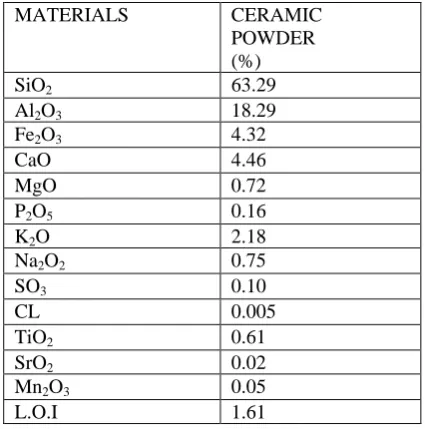
Table 4: chemical properties of ceramic waste
MATERIALS CERAMIC
POWDER (%)
SiO2 63.29
Al2O3 18.29
Fe2O3 4.32
CaO 4.46
MgO 0.72
P2O5 0.16
K2O 2.18
Na2O2 0.75
SO3 0.10
CL 0.005
TiO2 0.61
SrO2 0.02
Mn2O3 0.05
L.O.I 1.61
MIX DESIGN
The concrete mix design was done DOE method. The following mix proportion was arrived as shown
Quantities of the ingredients required for 1 cum cement concrete (M25)
cement Fine aggregate
Coarse aggregate
water
422.543 524.64 1166.53 194.37
Ratio = 1 : 1.24 : 2.76 : 0.46
PERCENTAGES OF F.A AND C.A REPLACED
Table 6.replacement percentage
Mix Fine Aggregate (%) Coarse Aggregate(%) Sand Tiles
Powder
C.A Crushed Tiles
A0 100 0 100 0
A1 100 0 90 10
A2 90 10 70 30
A3 90 10 100 0
A4 80 20 80 20
A5 80 20 90 10
A6 70 30 80 20
A7 70 30 70 30
TEST RESULTS
Compressive strength
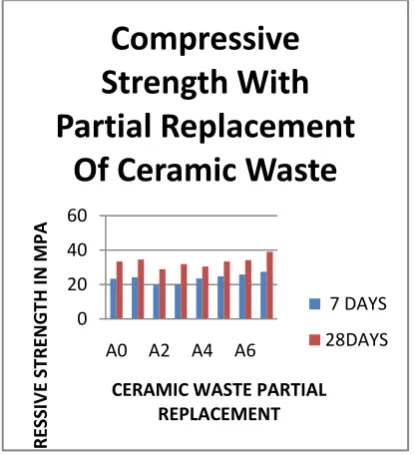
Table 7. Compressive Strength
SL.NO Mix
Average Compressive Strength (Mpa)
7 days 28 days
1 A0 23.42 33.41
2 A1 24.20 34.55
3 A2 19.88 28.90
4 A3 20.10 31.88
5 A4 23.50 30.48
6 A5 24.78 33.41
7 A6 25.80 34.20
8 A7 27.41 39.04
Fig 1. Compressive strength at 7 & 28 Days
Ultrasonic pulse velocity test
It is a Non-Destructive method of testing on harden concrete to measure the quality of the concrete. The test was conducted following the procedure and specifications given in IS1311 part 1: 1992. As per Table 2 of IS1311 part 1: 1992, the quality grade of the concrete with respect to the velocity of the pulse traveled in the concrete as follows.
Table 8 : quality grading of concrete
Sl.no Velocity (km/sec)
Quality grading
1 Above 4.5 Excellent
2 3.5 to 4.5 Good
3 3.0 to 3.5 Medium
4 Below 3.0 Doubtful
0 20 40 60
A0 A2 A4 A6
COMPRE
SSIV
E
STRENG
TH
IN MPA
CERAMIC WASTE PARTIAL REPLACEMENT
Compressive
Strength With
Partial Replacement
Of Ceramic Waste
7 DAYS
28DAYS
S. No .
Shape of the Speci men
Properti es to be Studied
No. of Spe cim ens
Days of Testi ng
Size of Specimen
1 Cube
Compre ssive Strength
21 28 Days
150x150 x150mm
2 Cylin der
Split Tensile Strength
21 28 Days
150mm dia, 300mm high
3 Prism Flexural Strength 21
28 Days
Table 9 : ultrasonic pulse velocity test results
Mix Velocity (km/sec) Concrete quality grading 7 days 28 days
A0 4.77 4.82 Excellent A1 4.74 4.73 Excellent A2 4.75 4.72 Excellent A3 4.78 4.90 Excellent A4 4.71 4.82 Excellent A5 4.67 4.89 Excellent A6 4.68 4.86 Excellent A7 4.65 4.79 Excellent
Flexural strength
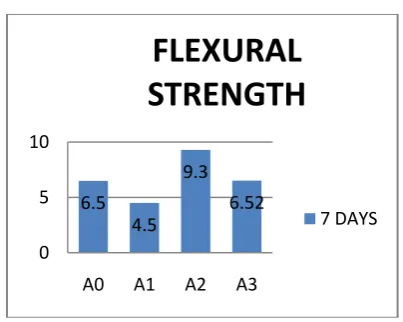
Flexural tensile strength, also determines as modulus of rupture is explained as the material ability to resist deformation under load or in other words load at which the concrete members may crack. It is determined by the standard testing specimens of 500x100x100mm over a span under symmetrical two point load.
Fig2:flexuralstrength
CONCLUSION
With the experimental studies conducted the following conclusions can be drawn:
Ceramic waste initially there is decrease of 23.32% in compressive strength of 7days when partially replacement of 10%, but after that while replacing 20% there is increase of 5.48% and with 30% there is increase of 14.56% increases respectively in initial compressive strength with respect to normal concrete mix. The reason behind this is that the ceramic waste (sand) behaves as micro filler in concrete. When the ceramic waste replaced as 10% the amount of micro filler is not enough to exhibit required strength but further increase in amount of ceramic waste (sand) fill more
voids in concrete mix due to which the compressive strength increased.
Ceramic waste initially there is decrease 16.20% in compressive strength of 28days when partially replacement of 10%, but after that while replacing 20% there is increase of 4.2% and with 30% there is increase of 14.42% increases respectively in final compressive strength with respect to normal concrete.
Initially there is decrease by 39.49% in flexural strength (28days) when partially replacement of 10%, but after that while replacing 20% there is increase of 8.57% and with 30% there is increase of 33.40% increases respectively in flexural strength with respect to normal concrete.
REFERENCE
1. T.Subramani , B.Suresh, Experimental Investigation Of Using Ceramic Waste As A Coarse Aggregate Making A Light Weight Concrete, International Journal of Application or Innovation in Engineering & Management (IJAIEM) Volume 4, Issue 5, May 2015 ISSN 2319 – 4847.
2. Fernando Pacheco-Torgal, Said Jalali, Compressive strength and durability properties of ceramic wastes based concrete, Materials and Structures DOI 10.1617/s11527-010-9616-6.
3. Y.Tabak, M.Kara, E.Gunay, S.T.Yildirim, Ş.Yilmaz, Ceramic Tile Waste as a Waste Management Solution for Concrete.
4. Amitkumar, D. Raval, Dr.Indrajit, N. Patel, Prof. JayeshkumarPitroda, Ceramic Waste : Effective Replacement Of Cement For Establishing Sustainable Concrete, International Journal of Engineering Trendsand Technology (IJETT) - Volume4 Issue6- June 2013. 5. Juned Ahmad, Meraj Ahmad Khan, Abdullah Anwar,
Study of Properties of Concrete with Partial Replacement of Conventional Coarse Aggregate by Ceramic Waste and Fine Aggregate by Stone Dust.
6. Amir Javed, Salman Siddique, Ram Prasad V S, Investigation on ceramic waste and stone dust as aggregate replacement in concrete, International Journal of Engineering Technology, Management and Applied Sciences, March 2015, Volume 3 Special Issue, ISSN 2349-4476.
6.5 4.5
9.3 6.52
0 5 10
A0 A1 A2 A3