Journal of
Applied Research on Industrial Engineering
Journal of Applied Research on Industrial Engineering
Vol. 3, No. 1 (2016) 30-38
Multi Objective Decision Making for Impregnability of Needle Mat Using
Design of Experiment Technique and Respond Surface Methodology
Hamidreza Jafari
1*, alborz hajikhani
2 1Young reserchers and Elite club, Abhar Branch, Islamic Azad University, Abhar Iran ([email protected]) 2
Young reserchers and Elite club, Hidaj Branch, Islamic Azad University, Hidaj Iran ([email protected])
A B S T R A C T A R T I C L E I N F O
One of the main problems in production process of composite curly sheet process is long time duration of impregnability of needle mat to resin operation and high costs of this operation. Increased time of impregnability operation in production process caused the occurrence of ravine and consequently the output amount of production line is dramatically reduced. Removing ravine or reducing its time, has direct effect on production increase therefore the cost price of final product will decrease too. In this article first by using design of experiment technique, the effective factors on reducing operation time in production process are identified, in next stage, appropriate functions for variables of time respond and direct cost of impregnability operation was processed as separated on each agent level. Then, using multiple objective design making techniques, optimum levels of each factor for each formed model was determined and finally, the best achieved answer from processed models is chosen as optimum final answer. Model sensitiveness toward changes in importance degree of each of the aims is also analyzed and studied in comparison with each other.
Article history :
Received: 24 February 2016 Received in revised format: 24 May 2016
Accepted: 18 August 2016 Available online: 5 November 2016 Keywords :
Design of Experiments, Multiple Objective Decision Making (MODM), Response Surface Methodology (RSM), Methodology of Needle Mat, Resin, Impregnability.
1.
Introduction
composite industry is one of growing industries in producing polymer products. Today, because of advantages of composite in comparison with metals, this industry has expanded dramatically for instance utilization of composite parts in vehicle making industry.
31
which are enforced by fiberglass. The range of utilization of composites empowered by fiberglass is very vast so that today these spectrums of parts are used vastly in vehicle making, navy and airplane making industry. Of the advantages of using these parts we can mention their light weight, easy production, corrosion resistance, low investment and high mechanical properties. Diba Fiberglass Company in direction of expansion of products and creating subset industries has put a kind of composite curly sheet with needle mat enforcement with density of 450 g/sq.m in its productions. For this reason after some months of production beginning and passing the experimental production phase and calibration and setting up measuring system analysis and statistical process control, some problems are observed in production process of this part, the most important of which is the long time of needle mat impregnability operation to resin that will cause ravine in production process of this product.
32
Montgomery, Duglas (2008), the previous performed researches in optimizing welding process Valtair, et al.(2009). optimizing multi answer statistical problems Pasandideh (2004). and simulation of solving statistical problems has tried to use simulation methods and using desirability functions method but in this research the method of weighting the objective and creating a single target function from the answers set so that at the time of optimizing by compiling some target functions, each should be minimized or maximized, a single target function will be achieved that by weighting method and creating metric of LP function should be minimized, this method has less been considered previously. In previous literature using statistical methods and using functions’ particulars, the optimizing has taken place which is an advantage for this research. About the subject’s background, no article related to performed work was found in valid internal magazines and available electronic magazines. Of course in other matters such as optimizing processes in composite compounds, Chao and Hoang, (1997) used Tagochi method for optimizing compounds. Lane and Canada, (2004), for quality improvement of injective products, used design of experiment method. Elagomorty and palaniraga,( 2006) used design of experiments method for finding effective factors on milling component materials Alagumurthi, et al.(2006). And finally Yung-Kuang Yang, (2006) offered the optimizing mould injection process using design of experiment method. In recent article optimizing the injection molding process of fiberglass and enforced polycarbonate compound has been performed by Tagochi method. In mentioned articles mostly compound quality is considered and optimal levels of compounding materials are obtained using design of experiments.
2.
Problem Explanation
Basic problem in producing composite curly sheet product with needle mat enforcement is long process of impregnability of needle mat to compound resin with catalyzer, which will create ravine in manufacturing process of the product, that according to process flow diagram (attached fig. 2) product manufacturing process, this operation is numbered with element no. 16. In this research we try to identify factors effective on increasing the operation time for needle mat saturation to resin and by designing experiments for different levels, effect of each of factors on the time of product saturation and costs of material compound (as the variables of the answer) optimum level of each of effective factors for simultaneous optimizing of both answer variables were determined.
2.1.
Determining Factors Levels
33
2.2.
Determining Answer Variable (Dependent Variables)
According to the poll performed among experts and manufacturing professional individuals, optimal condition is that the two following objectives get fulfilled as much as possible:
1)
Minimum time of needle mat impregnability to resin.
2)
Minimum production costs (utilized raw materials, cost for lost time of
machineries).
2.3.
Effective Factors (Independent Variables)
The most important effective and controllable factors on answer variables are: 1- The type of resin used (A)
2- The weight ratio of resin to fiberglass (B)
3- The weight ratio of catalyzer (Folic Acid) to fiberglass) (C)
Table 1. levels of quantitative factors of experiment
Independent variable Low limit High limit
Resin weight ratio (B) (-1)30% (+1)60%
Catalyzer weight ratio (C) (-1)1% (+1)3%
3.
Determining Design for Experiments
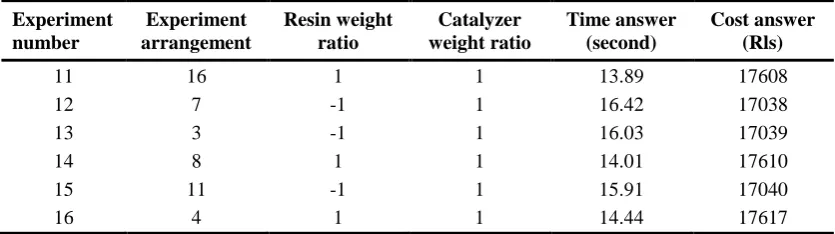
Considering that the first factor is a qualitative variable, therefore for using mathematical models (linear or non-linear functions) by destroying this factor (resin type) we change the problem into three problem of design of experiments each including 2 quantitative factor with two levels (explaining a problem for each type of resin). Therefore for each of mentioned problems, factorial design 22 with 4 repetitions for executing experiments is chosen. It should be mentioned that for minimizing the uncontrollable effects, the experiments are performed completely on random, therefore totally 48 experiments obtained in laboratory environment with sequence obtained from creating random numbers are performed and the results of answer variables of impregnability time and production costs was recorded in book. For instance, chart (2) shows the experiment answer in using first type resin.
Table 2. answer variables quantities for different experiments in case of using resin type A
Experiment number
Experiment arrangement
Resin weight ratio
Catalyzer weight ratio
Time answer (second)
Cost answer (Rls)
34
Table 2. answer variables quantities for different experiments in case of using resin type A
Experiment number
Experiment arrangement
Resin weight ratio
Catalyzer weight ratio
Time answer (second)
Cost answer (Rls)
11 16 1 1 13.89 17608 12 7 -1 1 16.42 17038 13 3 -1 1 16.03 17039 14 8 1 1 14.01 17610 15 11 -1 1 15.91 17040 16 4 1 1 14.44 17617
It should be mentioned that for calculating cost the following equation was used:(a+(b×15))= operation cost for one unit (Rls.)
a: is the materials cost utilized for impregnating one unit of product (Rls.) b: time of performing operation for one unit of product (second)
15: value of each second of the considered machinery in Rls.
Note: In this paper Statistical analysis was performed using Minitab 16 software. All calculations related to estimation of various effects, sum of squares and freedom degree for two answers of time and cost for various levels of qualitative factor (resin types) was performed. In this article, the procedure of completed stages for one of the levels of qualitative factor (resin type A) is performed and is mentioned later and for other levels was performed in the same way.
4.
Processed Regression Models for Answer Variants in Using Resin Type A
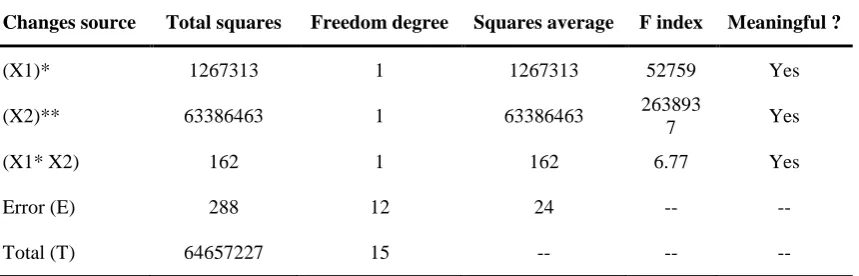
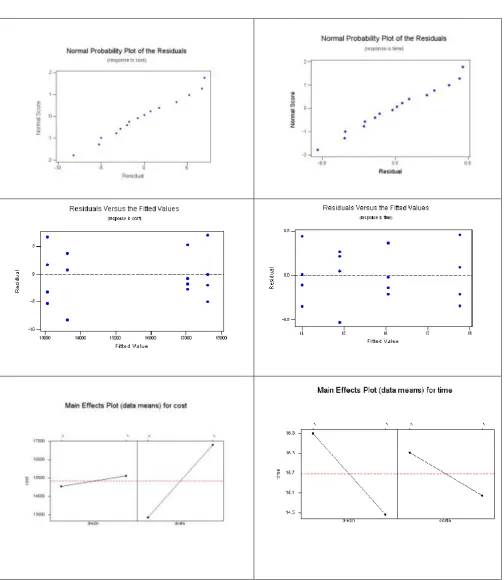
The chart of main effects on answer variable of impregnability time (attached) shows that increasing the amount of resin weight percent and catalyzer percent, impregnability time will be reduced and reduction changes about weight percent of resin is higher than catalyzer percent. Studying this graph about costs answer variation shows the reverse results of time results and in general we can say that the results of two variants of time and costs are against each other. It is the answers are somehow in contrast. Considering the charts of variance analysis (Table 3 & 4) obtained with 5 percent error, both factors and inter-effects of two factors are considered affective therefore the obtained model for impregnability time answer variation is as follows:
T1(X)=-1.231x1-0.625x2+0.205x1 x2+15.676
And regression model obtained for answer variation of material combination costs of one unit of product is as follows:
C1(X)= 281.6x1+ 1990.3x2+3.1x1 x2 +15335.1
The predictor chart (that tests the supposition of being zero for each function separately) shows the ratio of P and the match T for each function. From what observed in chart about functions we find that functions x1, x2, and x1* x2 are different from zero.
35
Therefore there is no need to consider second degree effect of resin and catalyzer percent for model and complicating function essence for analysis.
In other cases of experiment, this analysis took place too and considering appropriateness of obtained models, the second degree of quantitative factor is not added to the model.
Table 3. factors variance analysis for the variant of answer variant impregnability time for resin type A
Changes source Total squares Freedom degree Squares average F index Meaningful ?
(X1)* 3.4 1 3.4 4.27 Yes (X2)** 41.86 1 41.86 52.47 Yes (X1* X2) 125.22 1 125.22 125.22 Yes Error (E) 9.57 12 0.8 -- -- Total (T) 180.5 15 -- -- --
Table 4. factors variance analysis for answer variant of material compound cost in resin A
Changes source Total squares Freedom degree Squares average F index Meaningful ?
(X1)* 1267313 1 1267313 52759 Yes (X2)** 63386463 1 63386463 263893
7 Yes (X1* X2) 162 1 162 6.77 Yes Error (E) 288 12 24 -- -- Total (T) 64657227 15 -- -- --
(X1)*: weight compound ratio of resin to fiberglass (X2)**: catalyzer weight compound ratio to fiberglass
4.1.
Studying Model Sufficiency
Supposing that errors have normal distribution with zero average, we can evaluate the model sufficiency by drawing the graph of remaining normal probability if this diagram inclines to straight line. Therefore considering the diagram of enclosed Figure 1, we can find the sufficiency of processed model. In all performed experiments (three types of resin) the mentioned diagrams show the model sufficiency.
4.2.
Analysis of variance error
36
5.
Solve and optimizing the Problem
Considering the obtained regression models we are about to decrease and minimize two target functions. For this purpose one of multi objective decision making methods is used for optimizing two objectives. The used method is LP-metric. Target functions using LP-metric method are explained as follows and should be minimized:
Min z = W1 [
] + W2[
] (1)
W1 and w2 of weight is relative importance of criteria for each other that is considered equal in first stage. T* and c* are desirable and optimized quantities of time and cost, considering the obtained data from comparisons performed by product consumers and also present standards in this field and the view of professional experts the desirable quantities for parameters T* and c* are: 12 seconds for time and Rls. 12.000 for costs. Therefore:
Min z = .5 [ ] + .5 [ ] (2)
If we can minimize the above target minimize the above target function it means that we have made the distance of desirable quantities from anticipated quantities under li experiment to minimum. Considering the obtained results it is observed that while relative importance of time and cost is equal, resin type A will give the best answer according to time and cost with weight compound percent of 80 percent resin and catalyzer percent 10 percent.
6.
Results and Conclusion
In this article, time and cost of needle mat impregnability with resin was studied in frame work of design of experiments technique. The used design is factorial design 22 with 4 repetitions which was experimented in three qualitative level (three types of resin). Using variance analysis chart in level a= 0.05, the appropriate regression function for two variants of time and cost was processed. Considering simultaneous consideration of two answers, the multiple objective decision making LP-metric method was chosen. The obtained result from solving three target functions show that using resin type one is the best possible state when parameters are in condition of x1=0.6 (weight ratio of resin) and x2= 0.01 (catalyzer weight ratio) and if relative importance of time and cost is considered equal, (WT= Wc) is the best state and both answer variants (time and cost) are minimized in it. It is recommended for future researches for making the obtained results more accurate and reducing error, other multiple objective decision making methods which are based on decision making (DM) information exchange and analyzer be used. Among mentioned methods we can name ideal planning method and destination access method. Considering the introduced criteria in product quality discussion we can add quality answer variants in addition to variants of time and cost answer and optimize the problem simultaneously for three objectives. Design of experiment was performed without adding central points in this research. For future researches it is recommended to expand obtained models by adding central points.
7.
References
37
Alagumurthi N., Palaniradja, K. and oundararajan, V. (2006). “Optimization of grinding process through design of experiment(DOE)_ A comparative study”. Material and Manufacturing Processes, Vol. 21, No. 1, pp. 19-21.
Amiri, M. and Gheslaghi, K. (2007), “Application of Design of Experiments, Response Surface Methodology and Multiple Objective Decision Making in Optimizing Effective Qualitative Particulars: Case Studies on Tension Process of Back Fender Plate for Pride 141 and Moulding Process of Plastic Injection”, Publication of Technical Faculty, Vol. 41, No. 7, pp. 835-848.
Asgharpour, M.J. (2006). “Multiple Objectives Decision Making”, Publication of University of Tehran, Forth Edithion, pp. 11-14.
Chao, P.Y. and Hwang, Y.D. (1997). “An improved Taguchi’s method in design of experiments for milling CFRP composite”. Inter. J. of Production Research, Vol. 35, No. 1, pp. 61– 66.
Lin, T. and Chananda, B. (2004). “Quality improvement of an injection molded product using design of experiments: a case study”, Quality Engineering, Vol. 16, No. 1, pp. 99–104.
Montgomery, D.C. (2006), “Design and Analysis of Experiments”, University Publication Center, 2nd Edition, pp. 3-6.
Montgomery, D.C. (2007). “Design Analysis of Experiments”, 6th, ed., John Wiley and Sons, New York.
Montgomery, D.C. (2008). “Response Surface Methodology”, 2nd ed., John Wiley and Sons, New York.
Pasandideh, S.H. (2004). “Genethic Algorythm Utilization in Optimizing Multiple Answer Statistical Problems”, International Industrial Engineering Conference.
Ferraresi, V.A. (2009). “Comparison between genetic algorithms and Response Surface methodology in GMAW Welding optimization”, Journal of Material Process Technology. Vol. 160, No. 1, pp. 34-42.