12
1. Introduction
Composite flour is a mixture of varying proportion of two or more flour which may contain or may not contain wheat flour and used for production of bread, pastries, cake and other confectionery products that are conventionally produced from wheat flour with the intention of
increasing the essential nutrients in human diet and increase the economic relevance of indigenous crops (Okoye & Obi, 2017). Home-grown crops and seeds rich in protein have been researched and exploited as possible supplement to wheat in baked products (Deshmukk & Yengi, 2016). Notably, the presence of gluten in wheat
The Effect of Different Processing Treatments on the Proximate Composition
and Functional Properties of Maize-Mung bean Composite Flours
Offia Olua, B. I /*Onwuzuruike, U. A / Nwankpa, M. A /
Authors’ Affiliation
Department of Food Science and Technology, College of Applied Food Sciences and Tourism, Michael Okpara University of Agriculture, Umudike, Abia State, Nigeria
Corresponding author
Onwuzuruike, Uzochukwu Anselm
Department of Food Science and Technology, College of Applied Food Sciences and Tourism, Michael Okpara University of Agriculture, Umudike, Abia State, Nigeria
Email:[email protected]
Tel:+234 (0) 8033981164
Funding source
None
Abstract
Three processing methods (fermentation, malting and toasting) were used in processing maize and mung bean seeds into flours. Composites of maize: mung bean (MA: MU) flours were produced using different ratios. Proximate composition and functional properties of the composite flours were determined. Proximate composition showed that moisture contents of the treated flours were generally low for all fermented flours (6.57 - 7.61 %), malted flours (5.78 - 8.98 %) and toasted flours (4.93 - 8.18 %). The processing methods gave appreciable protein content (10.10 - 21.50 % for fermented, 11.12 - 19.51 % for malted and 12.81 - 17.23 % for toasted respectively) and ash content (1.01 - 5.60 % for fermented, 2.10 - 4.75 % for malted and 3.20 - 6.60 % for toasted respectively) while the fibre content (0.17 - 0.07 % for fermented, 0.66 - 0.00 % for malted and 0.33 - 0.00 % for toasted respectively) and fat content (3.34 - 1.14 % for fermented, 2.84 - 1.91 % for malted and 3.96 - 1.83 % for toasted respectively) were low for all processing methods. Carbohydrate (CHO) and energy values were generally high for all processing steps. The results of functional properties showed that fermentation, malting and toasting processes resulted to flours with similar water absorption capacity, emulsion capacity and foam capacity values. Malting process resulted to flours with higher oil absorption capacity (1.81 - 3.19 g/mL), gelatinization temperature (64.50 - 95.00°C) and gelation capacity (81.50 - 102.50 %) compared to fermentation and toasting. Fermentation process resulted to flours with higher bulk density (0.68 - 0.76 g/cm) compared to malting (0.65 - 0.69 g/cm) and toasting (0.64 - 0.69 g/cm) processes. Conclusively, the studied processing methods could be employed towards producing flours with appreciable functional properties and improved protein, mineral and carbohydrate contents.
Practical applications
Processing this hard-to-boil and hard-to-dehull legume (mung bean) into flour and its use in supplementing cereals such as maize which has limited protein content would boost the nutritional profile of their composite flours when utilized in the food industry for breakfast cereal formulation and production, and possibly infant food formulation as well as in the production of baked foods and extruded snack products.
Keywords: maize, mung bean, proximate composition, functional composition.
DOI: 10.36400/J.Food.Stab.3.1.2020-0023
13 has made it an indispensable major ingredient in
leavened bakery products, however, flours and meals from indigenous crops are often added, even up to about 50% (See et al., 2007) in the case of cassava flour, for the purpose of enhancing the organoleptic and nutritional properties, reducing ingredient cost, creating varieties, increasing and promoting the utilization of locally grown crop and meeting requirements for certain ethnic markets (Gernah
et al., 2010).
Maize (Zea mays L.) is an annual monocotyledonous diploid belonging to the poaceae family (Tanner & Raemakers, 2001). It is an important cereal grain which serves as an important food ingredient in the world in the production of varieties of products such as canned corn, breakfast cereals and in the formulation of infant foods. This makes maize the third most important cereal in the world after rice and wheat (Gwirtz & Garcia-Casal, 2014). Additionally, maize is higher in fat, iron and fiber content compared to wheat and rice but is nutritionally inferior in protein content to other cereals (Mejia, 2003). In Nigeria, it is widely grown in the Northern and Southern states, particularly in states like Kwara, Kano, Jos, Benue and Plateau states (Hera et al., 2013). Maize is widely used for human nutrition as a source of flour, starch and oil. Maize is used in several food products, such as bread, tortillas, snacks, beverages, pancakes, porridges (Gwirtz & Garcia-Casal, 2014). Unlike wheat, maize is a gluten-free cereal, which makes it suitable in the production of gluten-free products like bread, tortillas, snacks, beverages, pancakes, porridges
(Zilic et al., 2015).
Mung bean (Vigna radiata L.) is a leguminous crop with high protein content which makes it a cheap and one of the richest sources of plant
protein (Akaerue & Onwuka, 2010). They also contain significant amount of essential fatty acids, antioxidants, minerals (potassium, phosphorus and calcium), and vitamins (A, B1, B2, niacin vitamin C) (Masood et al., 2010), thus could be used as a substitute or to supplement other ingredients in many food formulation and production (Kollarova et al., 2010). It is green in color, and oval in shape. It can be consumed raw, boiled, cooked and sprouted. They are small, ovoid in shape and green in colour. They are also known as green gram or golden gram (Masood et al., 2010).
The use of poorly commercialized flour such as mung bean flour as a supplement to maize flour would create an avenue for enhancing their utilization and promote the utilization of other nutrient-packed home-grown crops and improve the nutritional as well as health benefits of composite flours produced from indigenous crops. This study was therefore carried out to assess the proximate composition and functional performance of maize flour supplemented with mung bean flour.
2. Materials and methods
2.1. Source of raw materials
The mung bean was procured from the Department of Crop Science of Michael Okpara University of Agriculture Umudike while the maize was purchased from a rural market (Ndoro) in Oboro Ikwuano LGA of Abia State.
2.2. Preparation of malted maize - mung bean composite flour
14 grains were spread in-between moist muslin
clothes and was allowed to germinate for 48 hours. Water was sprinkled every 12 hours to keep the germinating grains moist. After germination, the mung bean sprouts were first dehulled manually before drying both the mung bean and maize in the oven at 650°C until the grains were fully dried. The dried grains were subjected to dry milling and sieved through 80 µm mesh sieve to obtain their respective malted flours (Aniche, 2003).
2.3. Preparation of fermented maize - mung bean flour
The method described by Abasiekong (2008) and
Ariahu et al. (1999) was used in preparing fermented maize and mung bean flours respectively. The grains were sorted manually. Maize grains were steeped in tap water in a plastic container and was allowed to ferment for 48 hours at room temperature, while the mung beans were first soaked in tap water for 4 hours, followed by decanting the water and the grains were allowed to ferment at room temperatures for 48 hours. The fermented maize and mung bean grains were dried in an oven at 600°C for 12 hours. The dried grains were ground using a hammer mill and sieved with 60 µm mesh sieve.
2.4. Preparation of toasted maize - mung bean composite flour
The method described by Akaerue & Onwuka (2010) was used. Mung beans and maize were sorted manually. The cleaned maize seeds were washed and sun dried for about 4 hours, while the mung beans were oven dried for 2 hours at 60°C after cleaning. The dried maize and mung beans were further toasted at 120°C for 60 minutes. The grains were allowed to cool, before being subjected to milling and sieving to obtain their respective flours.
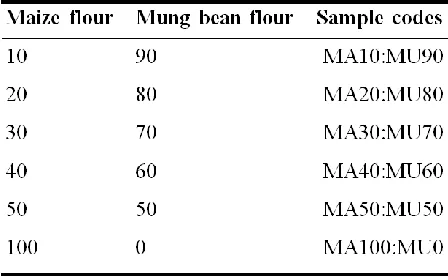
2.5. Formulation ratios and sample codes for maize - mung bean composite flours
Table 1: sample codes and formulation ratio of composite flours
2.6. Sample analyses
2.6.1. Proximate analysis
2.6.1.1. Moisture content determination
The gravimetric method described by AOAC (1990) was used. One gram of the sample was measured into two previously washed, dried and weighed moisture crucibles. The crucibles and samples were dried in a hot air electric oven at 105°C for two hours, and then cooled in a desiccator. The crucibles and the sample were reweighed and put back into the oven for further drying. Drying, cooling and weighing were obtained respectively until a constant weight was obtained using the expression.
Where:
W1 = weight of empty crucibles
W2 = weight of crucibles + sample before drying
15
2.6.1.2. Crude protein determination
The crude protein content was determined using described by Onwuka (2010). This was done by the Kjeldahl method. The total N2 was determined and multiplied with factor 6.25 to obtain the protein content. The sample (1.0 g) was mixed with 10 mL of concentrated H2SO4 in a digestion flask. A tablet of selenium catalyst was added to it before it was heated in a fume cupboard until a clear solution was obtained (i.e. the digest) which was diluted to 100 mL in a volumetric flask using distilled water. The digest (10 mL) was mixed with equal volume of 45% NaOH solution in a Kjeldahl distillation apparatus. The mixture was distillated into 10 mL of 4% buric acid containing 3 drops of mixed indicator (bromoseresol green/methyl red). A total of 50 mL of distillates was collected and titrated against 0.02 N EDTA from green to deep red end point. The N2 content and hence the protein content was calculated using the formula below:
Where,
w = weight of sample
N = Normality of titrant (0.02 H2SO4)
Vt = Total digest volume (1000)
Va = Volume of digest analyzed (10 mL)
T = Titre value of sample
B = Titre value of Blank.
2.6.1.3. Fat content determination
The solvent extraction method described by
Pearson (1976) was used. The processed sample (3 g) was wrapped in a porous paper (Whiteman filter paper) and put in a thimble. The thimble
was placed in a Soxhlet reflux flask and mounted in a weighed extraction flask containing 200 mL of petroleum ether. The upper end of the reflux flask was connected to a water condenser. The solvent (petroleum ether) was heated, vaporized and condensed into the reflux flask. The sample in the thimble was covered with the solvent which extracted the fat. The sample remained in contact with the solvent until the reflux flask filled up and siphoned over, carrying its oil extract down to the boiling flask. This process was allowed to go on repeatedly for 4 hours before the defatted sample was removed, the sample received and the oil extracted was left in the flask. The flask containing the oil extract was dried in the oven at 60°C for 30 minutes (to remove the residual solvent), cooled in a desiccator and weighed. By difference, the weight of fat extracted (W2-W1) was determined and expressed as a percentage of the weight of the analysed sample and is given by the expression below:
Where,
W1 = weight of empty extraction flask.
W2 = weigh of extraction flask + fat extract.
2.6.1.4. Ash content determination
This was done by furnace incineration of the
16 Where,
W1 = weight of empty crucible
W2 = Weight of crucible + ash
W3 = Weight of sample
2.6.1.5. Crude fibre determination
Crude fibre was determined according to the
AOAC (1990) method. The processed sample (3 g) was boiled in 150 mL of 1.25% H2SO4 solution for 30 minutes under reflux. The boiled samples were washed in several portions of hot water using a two-fold Muslin cloth to trap the particles which were returned back to the flask and boiled again in 150 mL of 1.25% NaOH for another 30 minutes under the same condition. After washing in several portions of hot water, the sample were allowed to drain dry before being transferred to a weighed crucible where it was dried in an oven at 105°C to a constant weight. It was burnt to ashes in a muffle furnace. The weight of fibre was calculated as a percentage of weight of sample analysed. It was given by the expression below:
Where,
W2 = weight of crucible + sample after boiling, washing
and drying
W3 = weight of crucible + samples as ash
2.6.1.6. Carbohydrates constant determination
It was calculated using the formula below:
% Carbohydrate = 100 - % (protein + fat + ash + moisture contents).
2.6.1.7. Energy value determination
The gross food energy was determined using the equation of AOAC (1990) for food energy value as shown below:
Where:
FE = Food Energy
CHO = Carbohydrate
CP = Crude protein
2.6.2. Functional analysis
The gelation temperature, gelation capacity, bulk density, emulsification capacity, water absorption and oil absorption capacities, and foam capacity was determined using the method of Onwuka (2010).
2.6.2.1. Bulk density determination
Ten grams of the flour sample was weighed into a graduated cylinder and its volume was recorded. After then, the cylinder was tapped constantly against a table (10 - 15 minutes) until there was no further change in volume. The calculation was as follows:
2.6.2.2. Foam capacity
Two gram of flour sample was blended with 100 mL distilled water in a warring blender and centrifuged at 1600 rpm for 5 minutes at room temperature. The mixture was poured into a 250 mL measuring cylinder and the volume was recorded after 30 seconds. The calculation was as follows:
2.6.2.3. Emulsification capacity
17 seconds in a warring blender at 1600 rpm. After
complete dispersion 25 mL vegetable oil was added and blended for another 30 seconds. The mixture was later transferred into a centrifuge tube and centrifuged at 1,600 rpm for 5 minutes. Calculation was as follows:
Where,
X = height of emulsified layer
Y = height of whole solution in the centrifuged tube
2.6.2.4. Gelatinization temperature and capacity
One (1) gram of each flour sample was mixed with 5 mL of distilled water in test tubes to obtain suspension. The test tubes were heated for one hour in a boiling water bath, cooled rapidly under running tap water and further cooled for two hours in a refrigerator at 40°C. The temperature at which they form gel was recorded as their gelatinization temperature while the gelation capacity is the least gelation concentration determined as the concentration when they sample from the inverted test tube will not fall or slip.
2.6.2.5. Water absorption capacity
One gram of sample was weighed and transferred into a clean centrifuge tube of known weight. Distilled water was mixed with the flour to make up to 10 mL dispersion. This was centrifuged at 3500 rpm for 15 minutes. The supernatant was decanted and the tube and its content were re-weighed. The gain in mass to the water absorption of flour was calculated using the formula below:
Where;
W = Weight of sample
W₁ = Weight of empty tube
W₂ = weight of tube + Water absorbed
2.6.2.6. Oil absorption capacity
Each flour sample (1.0 g) was weighed and placed in a clean centrifuge tube of known weight. Peanut oil was mixed with the flour to make up to 10 mL dispersion. The tubes were discarded and the tube reweighed. The gain in mass is recorded as the oil absorption capacity as calculated using the formula below:
Where,
W = weight of sample
W₁ = Weight of empty tube
W₂ = Weight of tube + Oil absorbed
2.7. Statistical analysis
All experimental data were expressed as mean ± SD (standard deviation). After checking the pre-requisites, one-way analysis of variance (ANOVA) was used to analyse the data using the SPSS software (version 16, IBM, USA), while Duncan Multiple Range Test (DMRT) method was used to compare the means of experimental data at 95 % confidence interval when a significant difference was observed from the One-way ANOVA.
3. Results and discussion
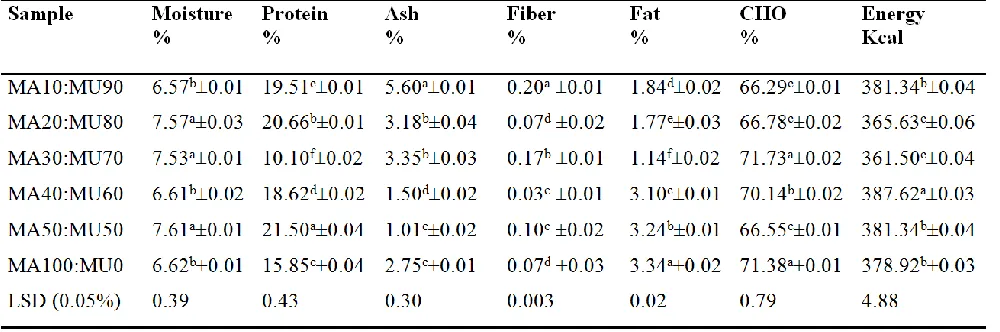
3.1. Proximate composition
18 to 7.61 %) which signified an improved shelf life
and quality. The values obtained in this were within the values of moisture content of fermented cowpea flours previously reported by
Ezeocha & Onwuka (2010). Adams (1990)
reported that fermentation results in increase in the concentration of proteins. The protein content of the fermented composite flours notably increased such that MA50:MU50 had the highest protein content.
The ash content of the samples was within the values reported by Ezeocha & Onwuka (2010). MA10:MU90 had the highest ash content (5.60 %) while MA50:MU50 had the lowest ash content (1.01 %) which signifies variation in the mineral content of flour samples. The variation in the ash content in the flour samples could be attributed to the effect of mung bean supplementation such that, reduction in mung bean supplementation resulted to concurrent reduction in the ash content of the flour samples. These results thereby indicated that the ash content of the flour samples was largely influence by the quantity of mung bean flour present in the flour composition. The fiber
content of the samples was generally low (0.03 to 0.20 %) which could be attributed to the processing steps, especially sieving operation the flours were subjected to. Etudaiye et al. (2009)
and Onimawo & Egbekun (1998) reported low fiber values (0.01 to 0.23 %) in cassava fat flours when muslin cloth was used as source of sieving material. The fat content of the flour samples was significantly different from each other. The results showed that MA100:MU0 had the highest
fat content value (3.34 %) while MA30:MU70 had the lowest fat content value (1.14 %). Similar to fiber content, the fat contents of the processed flours were generally low (1.14 to 3.34 %) and this is advantageous as fat content of food samples can affect their shelf life or stability through oxidative rancidity. There was significant increase in the carbohydrate content (66.29 to 71.73 %) of the samples which indicated that the flour samples would have an energy giving potential as indicated by the energy value of the flour samples (361.50 to 387.62 Kcal).
The results of proximate composition of malted maize-mung bean composite flour are presented
Table 2: Proximate composition of fermented maize-mung bean composite flour
19 in Table 3. Similar to fermented composite flours
(Table 1),
the moisture content of the malted samples was considerably low (8.98 to 5.78 %) which signified a good keeping quality (Safa-Dedeh & Saalia, 1997). The malting process seems to increase the protein content (11.12 to 19.51 %) of the flour samples with MA10:MU90 having the highest value (19.51 %). Protein contents of malted flour samples gave values within the range of values reported by Akaerue & Onwuka (2010). Ash gives an idea of the amount of total mineral contents of the food material. The ash content values were generally higher (2.10 to 4.75 %) than those obtained from fermentation process which suggested that malting process might contribute to an increase in the mineral content of food materials. The values obtained in this study were within the range of values reported by Akaerue & Onwuka (2010). The fiber content of the samples was notably low (0.00 to 0.334 %) and below other values reported by Akaerue & Onwuka, (2010). This could be attributed to the processing steps such as dehulling of the seeds before milling into flours and sieving of the flours. The fat content
of malted flours was low (1.61 to 2.84 %) just as in the case of fermented samples, and thus,
would lower the incidence of rancidity
(Amankwa et al., 2009). Compared to fermented flour samples, the carbohydrate content of the malted flour samples is notably higher (68.19 to 74.88 %). Carbohydrate content was higher in MA50:MU50 (74.88%) and was lower in MA10:MU90 (68.19 %) composite flour. Similarly, energy value was higher in MA50:MU50 (369.78 Kcal) but lower in MA100:MU0 (363.36Kcal). Energy values of the malted flour was high and above values previously reported by Akaerue & Onwuka (2010) which signify their energy giving capacity.
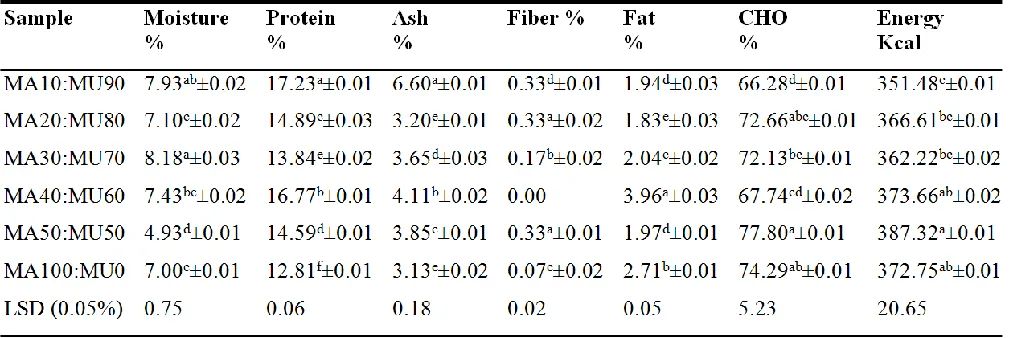
The results of proximate composition of toasted maize-mung bean composite flour are presented in Table 4. The moisture content of the toasted flour samples was considerably low (4.93 to 8.18 %) with MA50:MU50 having the lowest value (4.93 %). Moisture content of the samples obtained in this study also confirms the value reported by Akaerue & Onwuka (2010) when evaluating the effect of processing on the proximate composition of the dehulled and
Table 3: Proximate composition of malted maize-mung bean composite flour
20 undehulled mung bean flours. There was
significant increase in the protein content of the samples.
MA10:MU90 had the highest protein content (17.27 %) while MA100:MU0 had the lowest value (12.80 %) which was similar to what was obtained in the malted samples. Heat treatment improves the protein quality by inactivating the antinutritional factors, particularly trypsin inhibitors, hemagglutinins and by unfolding the protein structure, thus making them more susceptible to attack by digestive enzymes (Sathe
et al., 1984). Also, MA10:MU90 had the highest ash content (6.60 %) while MA100:MU0 had the lowest value (3.13 %). The ash content values appeared higher than those obtained in fermented and malted flour samples which signified improved mineral content. However, ash values obtained by toasting gave values within the range of values obtained by Akaerue & Onwuka (2010). The fiber content (0.00 to 0.33 %) of the samples was generally low as a result of processing operations. Fat contents of the toasted flour samples was low but within the values of fat contents of processed mung bean flour reported by Akaerue & Onwuka (2010). These
values signified reduced chances of oxidative rancidity. The carbohydrate content was high (66.28 to 77.80 %) and could possibly contribute
significantly to the energy giving capacity of the food based on the energy values (351.48 Kcal to 387.32 Kcal) that was calculated from carbohydrate, lipid and protein.
3.2. Functional properties
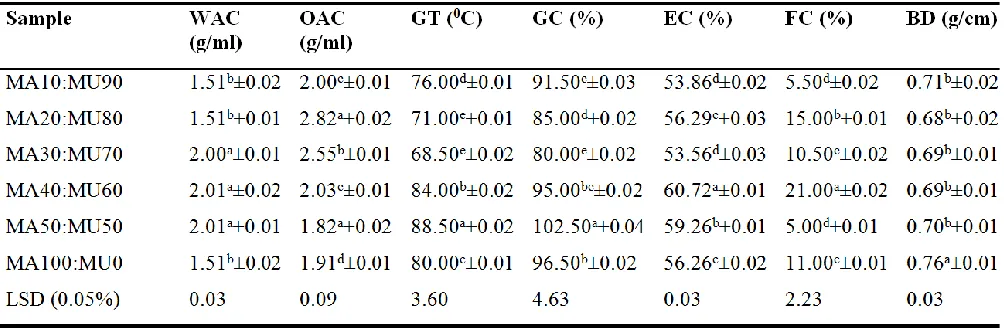
The results of functional properties of fermented maize-mung bean composite flours are presented in Table 5. The water absorption capacity (WAC) of the flour samples ranged from 1.51 to 2.01 g/mL which suggested that the samples would have a good water absorbing potential. The values obtained were similar to the values of
Akaerue & Onwuka (2010). Oil absorption capacity (OAC) was high in MA20:MU80 (2.82 g/mL) and low in MA50:MU50 (1.82 g/mL).
Etudaiye et al. (2009) stated that oil absorption capacity (OAC) is affected by several factors such as the protein content, the liquidity of the oil and the method used. These factors could have led to the variations in the OAC of the samples. The gelatinization temperature (GT) of
Table 4: Proximate composition of toasted maize-mung bean composite flour
21 the samples are quite high (71.00 to 88.50 °C)
which signified that the lowest temperature required to bring about gelation in the flour samples was 71°C. The primary function of gel in foods is to
bind or solidify the free water in foods
(Onimawo & Egbekun, 1998). Similarly, the flour samples have a high gelation capacity (80.00 to 102.50 %) and would therefore have a high gelling power and as well as suitable for food formulation desiring high gelling function. Emulsion capacity (EC) values (53.56 to 60.72 %) were higher than values reported by Akaerue & Onwuka (2010). MA40:MU60 had the highest value (60.72 %). These values indicated that the samples would have a desirable emulsifying ability. The foam capacity (FC) is an index of foamability of protein dispersion. Foams improve texture and it is affected by processing methods (Onimawo & Akubor, 2005). Therefore, MA20:MU80 (15.00 %), MA30:MU70 (10.50 %) and MA40:MU60 (21.00 %) would have better foamability. There was no significant difference (P>0.05) in the
bulk density (BD) of the samples. However, MA100:MU0 was significantly different (P<0.05). Bulk density gave similar values which implied that similar packaging designs and materials could be used. It could be used in
determining the packaging requirement of flour as it relates to the load the sample could carry if allowed to rest directly on one another (Ezeocha & Onwuka, 2010).
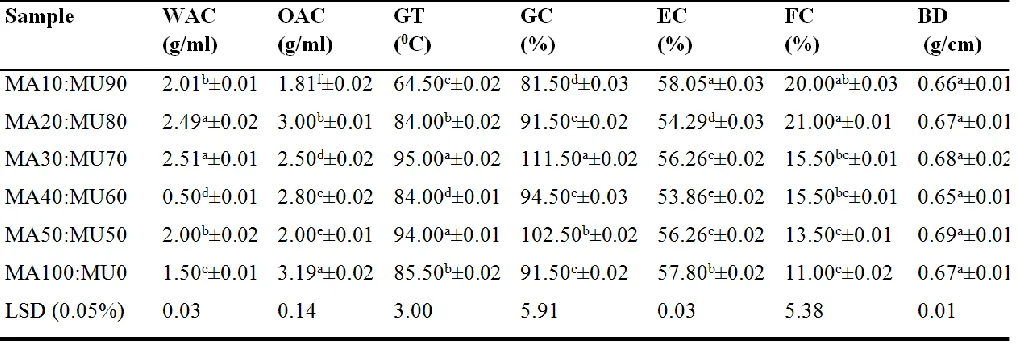
The results of functional properties of malted maize-mung bean composite flours are presented in Table 6. The samples gave appreciable amount of WAC (0.50 to 2.51 g/mL). This may be attributed to the hydration of the maize and mung bean seeds during soaking and sprouted which in turn unfolds the protein, thereby increasing their hydrophilic binding sites and exposing them to the aqueous phase (Akaerue & Onwuka, 2010). OAC was highest in MA100:MU0 (3.19 g/mL) and lowest in MA10:MU90 (1.81 g/mL). The OAC of the malted samples was quite higher than those of fermented samples which could be attributed to
Table 5: Functional properties of fermented maize-mung bean composite flour
22 the difference in surface areas, the charge and
topography as affected by processing types
(Etudaiye et al., 2009). The GT of the malted samples are similar to those of fermented samples and suggested that the flour samples would require a temperature below 100°C for gelatinization to take place.
Gelation capacity is an important structural and rheological property of flour proteins. It is a measure of consistency of a protein solution when it is heated at a certain temperature for a given period of time (Etudaiye et al., 2008). The values obtained in this study are notably high (81.50 to 102.50 %) which suggested that the flour samples would give a good consistency in product formulation. The emulsion capacity values (53.86 to 58.05 %) were similar to those of fermented flour samples (Table 4) and reflect the emulsifying potential of the flour samples. FC was highest in MA20:MU80 (21.00 %) and lowest in MA100:MU0 (11.00 %). Foams improves appearance of foods and it is affected by pH, processing methods, viscosity and surface tension (Onimawo & Akubor, 2005). The FC
were quite high and would possibly contribute to improve food appearance and texture. The flour samples had similar BD values (0.65 to 0.69 g/cm) which indicate similar level of porosity and packaging designs.
The functional properties of toasted maize-mung bean composite flours are presented in Table 7.
The WAC values (1.50 to 2.01 g/mL) was comparable to what was obtained in fermented (1.1 to 2.01 g/mL) and malted flour samples (0.50 to 2.51 g/mL). High WAC in the toasted flours may be explained on the basis of the fact that when a protein is heated, the bonds that maintain the secondary and tertiary structures are weakened and at some temperatures, are broken. This breaking of non-covalent bonds with the resulting alteration of protein structure is termed denaturation. The early stage causes most protein molecules to begin to unfold which often lead to slight increase in the amount of water to interact with the charged groups. At some temperature, the interaction forces will have been weakened enough to allow extensive water-ion interactions. This causes an unfolding of the molecule and an
Table 6: Functional properties of malted maize-mung bean composite flour
23 increase in water binding (Akaerue & Onwuka,
2010). Oil Absorption Capacity (OAC) was highest in MA40:MU60 (2.62 g/mL) and lowest in MA100:MU0 (1.91 g/mL). The OAC values of the samples signified the oil absorbing potential of the flour samples. The gelation temperature (GT) values (67.50 to 81.00 %) were lower than the values obtained in fermented and malted
flour samples. These values suggested that toasting may possible reduce the temperature at which gelatinization takes place in flours. However; the gelation capacity (GC) of the samples are quite high (75.00 to 100.00 %) which signified their potential to gelatinize when used in food formulations, since the primary function of gel in food is to bind the free water in food. Gel enhances the body and texture of foods
(Onimawo & Egbekun, 1998). The efficiency of emulsification by seed proteins varies with the type of protein, its concentration and solubility, ionic strength, temperature and method of preparation of the emulsion (Onimawo & Akubor, 2005). There was no significant
difference in the EC of the samples and was close to the values obtained in fermented and malted samples, which suggested similar emulsifying potential. Foam Capacity was highest in MA10:MU90 (24.50 %) and lowest in MA50:MU50 (6.00 %). The variation in the foam capacity of the samples could be attributed to the type of protein, processing methods, viscosity and surface tension (Onimawo & Akubor, 2005). However, the foam capacity of
the samples except MA50:MU50 (6.00 %) were considerably high which could contribute towards improving the texture, consistency, and appearance of foods. The BD values (0.64 to 0.69 %) was similar to the values obtained in fermented and malted flour samples.
4. Conclusion
The present study evaluated the impact of three different processing methods (fermentation, malting and toasting) on the proximate and functional properties of the maize -mung bean composite flour samples. The proximate analysis revealed that the processing methods resulted to composite flours with low moisture and fat
Table 7: Functional properties of toasted maize-mung bean composite flour
24 contents which is advantageous during storage.
However, the protein, mineral, carbohydrate contents and energy values were found to increase for all processing methods. Results from functional analysis showed that the fermentation, malting and toasting processes had an improved effect on the functional composition of the flour samples. This study has therefore demonstrated the potential of employing the studied processing methods towards improving the nutritional and functionality of maize and mung bean composite flours.
Conflict of interest
The authors declare that there are not conflicts of interest.
Ethics
This Study does not involve Human or Animal Testing.
References
A.O.A.C. (1990). Association of Official Analytical
Chemists. Official Methods of Analysis.
13th Edition. Washington D.C.
Abasiekong, K.S. (2008). Nutritional and
physicochemical properties of maize-
bambara based complementary foods. Department
of food sciences and Technology. MOUAU. (A Thesis). 35 - 54.
Adams, M.R. (1990). Tropical aspects of fermented
foods. Trends in Food Science Technology, 1,
141-144.
Akaerue, B.I. & Onwuka G.I. (2010). Effect of processing on the proximate composition of the dehulled and undehuled Mungbean (vigna radiata
(L) Wikzek) flours. In: Pakistan Journal of
Nutrition, 9 (10), 1006-1016.
Akaerue, I.B. & Onwuka G. I.G. (2010). Evaluation of the Yeild, Protein Content and Functional Properties of Mungbean [Vigna radiata (L.)
Wilczek] Protein Isolates as Affected by
Processing. Pakistan Journal of Nutrition, 9 (8),
728-735.
Amankwah, E.A.J., Barimah, A.K.M., Nuamah, J.
H., O. & Nnaji, C.O. (2009). Formulation of weaning food from fermented of maize, Rice,
soybean and fish meal. Pakistan Journal of
Nutrition, (11), 1747-1752.
Aniche, G.N. (2003). Physiological aspects of
malting cereals, In: Fundamentals of Brewing science and Technology. Colour Communication
publishers, Enugu: 52-61
Ariahu, C., Ukpabi, C.U. & Mbajunwa, K.O. (1999).
Production of African breading out
(Treculia africana) and soybean (Glycine max)
seed-based food formulation: effects of
germination and fermentation on nutritional and
organoleptic quality. Plant foods and Human
Nutrition, 3 (4), 193-206.
Deshmukk, P. & Yenagi, N. (2016). Nutritional and
functional properties of processed little
millet flours in the development of composite flour
bread. International Journal of Food and
Nutritional Sciences; 5(3), 42-52.
Etudaiye, H.A., Nwabueze, T.U. & Sanni, L.O.
(2009). Quality of fufu processed from cassava
mosaic disease (CMI) resistant varieties In: Africa
Journal of Food Science, 3 (3), 061-067.
Etudaiye, H.A., Oti, E. & Aniedu, C. (2008).
Functional properties of wheat: sweet potato
composite flour and sensory qualities of
confectionaries produced from the
composites. In: Nigerian Journal of Nutritional
25
Ezeocha, V.C. & Onwuka, I.G. (2010). Effect of
processing methods on the physico-chemical and nutritional quality of maize and soyabean
based complimentary blends. In:
Nigerian Food journal, 28 (2), 210-216.
Gernah, D.I., Senger, I.A. & Audu, J.O. (2010).
Physicochemical and sensory evaluation of cookies produced from wheat and brewers’ spent
grain composite flour. Nigerian Food
Journal, 28 (2), 440-447.
Gwirtz, J.A. & Garcia-Casal, M.N. (2014). Processing maize flour and corn meal food
products. Annals of the New York Academy of
Sciences, 13 (12), 66-75.
Hera, E.D.L., Talegón, M., Caballero, P. & Gómez,
M. (2013). “Influence of maize flour
particle size on gluten-free breadmaking, Journal
of Science of Food and Agriculture, 93, 924-932.
Kollarova, K., Vatehov, Z., Slovakova, L. & Liskova,
D.(2010).Interaction of galactoglucomannan
oligosaccharides with auxin in mungbean primary
root. Plant Physiology and Biochemistry, 48,
401-406.
Masood, A., Saeed, S., Erbilgin, N. & Jung Kwon, Y. (2010). Role of stressed mango host conditions in attraction of an colonization by the mango bark
beetle Hypocryphalus mangiferae Stebbing
(Coleoptera: Curculionidae: Scolytinae) and in the symptom development of quick decline of mango
trees in Pakistan. Entomological Research, 40,
316-327.
Mejía, D. (2003). MAIZE: Post-Harvest Operation,
Food and Agriculture Organization of the United Nations (FAO).
Okoye, J.I. & Obi, C.D. (2017). Nutrient composition
and sensory properties of wheat–
African breadfruit composite flour cookies. Sky
Journal of Food Science, 6 (3), 021-026.
Onimawo, A.I & Egbekun, K.M. (1998).
Comprehensive food science and nutrition. Reviewed edition-published by ADMIK Press Ltd Benin city Edo state, 193-201.
Onimawo, A.I. & Akubor, P.I. (2005). Food
chemistry (Integrated Approach with Biochemical background). First edition published by ADMIK
Press Ltd. Benin city, Edo state, 193-224.
Onwuka, G.I. (2010). Food analysis and
instrumentation. Theory and practices. Naphthali prints Lagos pp. 63-161.
Pearson, D. (1976). The chemical analysis of foods
churches in-bill living stone Edibberburgh, London.
Sathe, S.K., Desphaude, S.S. & Salunkhe, D.K.
(1984). Dry beans of phaseolus: A review part 1
chemical composition proteins CRC, Critical
Review in Food Science and Nutrition 20, 1-46.
See, E.F., Wan Nadiah, W.A. & Noor-Aziah, A.A
(2007). Physico-chemical and sensory
evaluation of breads supplemented with pumpkin
flour. Asian Food Journal, 14 (2), 123-130.
Sefa-Dedeh, S. & Saali, A.F.K. (1997). Extrusion of
maize-cowpea blends in a modified oil
expeller. Journal of Science, Food and Agriculture.
73, 160-168.
Tanner, D. & Raemaekers, R. (2001). Wheat. In: R. Raemaekers (ed.), Crop Production in Tropical Africa. Directorate General for International Cooperation, Ministry of Foreign Affairs, Brussels, Belgium, pp. 101-118.
Zilic, S., Delic, N., Basic, Z., Ignjatovic-Micic, D.,
Jankovic, M. & Vancetovic, J. (2015).
Effect of alkaline cooking and sprouting on
bioactive compounds, their bioavailability
26 Cite this paper as: Offia, O.B.I., Onwuzuruike,
U.A., Nwankpa, M. A. (2020). The Effect of Different Processing Treatments on the Proximate Composition and Functional Properties of
Maize-Mung bean Composite Flours. Journal of Food
Stability, 3 (1): 12-25