Themed Section: Science and Technology
IoT Based Smart Irrigation Using Water Flow Sensors
P. Nagacharan Yadav1, S. Chakrisreedhar2
1PG Scholar, Department of ECE(ES), Sree Rama Engineering College, Tirupati, Andhra Pradesh , India 2Assistant Professor, Department of ECE, Sree Rama Engineering College, Tirupati, Andhra Pradesh , India
ABSTRACT
India is a horticulture based country. It is important to enhance the efficiency and nature of agro based items. The proposed configuration is a programmed framework that guides the client in water system handle. It continues informing the rancher through an on-board LCD show and messages that is sent to the User PC. This proposed design is moreover valuable for the Users who are standing up to control frustration issues to keep up a uniform water supply as a result of vitality disillusionment or inadequate and non-uniform water supply. The customized water framework structure in like manner keeps the Users to revived with all the establishment practices through a GPRS Module that sends messages on the PC. This contraption can be a vital turning point for our overall population. The contraption is easily direct by the Users of the country. This proposed arrangement is valuable for decreasing the human work. This is a low spending framework with a fundamental social application.
Keywords: Arduino, IR sensors, MAX-232.
I.
INTRODUCTION
Agribusiness makes utilization of eighty five% of to be had freshwater assets worldwide, and this percent will keep on being overwhelming in water allow because of populace increment and duplicated nourishment request. There is a squeezing need to make systems construct absolutely with respect to innovation and innovation for maintainable utilization of water, comprehensive of specialized, agronomic, administrative, and institutional updates. There are numerous frameworks to procure water investment funds in differing plants, from central ones to additional mechanically propelled ones. For instance, in a solitary gadget plant water notoriety changed into checked and water system planned in light of shade temperature dispersion of the plant, which end up noticeably gotten with warm imaging .moreover, unique structures have been advanced to time table water system of yields and streamline water use by utilizing a harvest water strain file (CWSI). This contraption utilizes sensors like stickiness, soil
dampness. These sensors send qualities to small scale controller. Microcontroller sends qualities to PC utilizing serial discussion. As indicated by constant sensors esteems relentless diagram is show on PC and Android Based portable utilizing Internet and Android application. Here edge expense is keep, if sensor esteems pass the edge charge at that point Drip Irrigation segments can be control mechanically through microcontroller.
II.
EXISTING SYSTEM
III.
PROPOSED SYSTEM
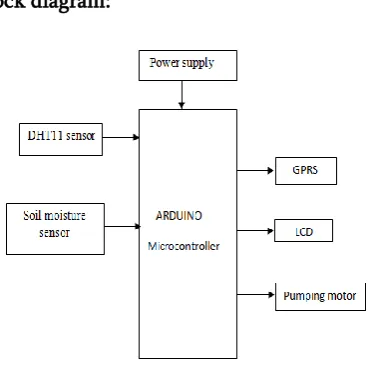
The proposed gadget has exceptional sensors, a small scale controller, GPRS and quality assets. A few WSUs might be conveyed in-zone to design a dispensed sensor group for the programmed water system gadget. Every unit relies upon on the miniaturized scale controller that controls the radio modem GPRS and tactics statistics from the dirt dampness sensor, temperature sensor and water degree sensor. In this remote sensor unit or transmission unit the sensor information from various sensors (Soil dampness, temperature, moistness and water degree) are amassed within the primary controller. This facts is shown on transmission section LCD. Arduino controller is changed to some restrict estimations of temperature and soil dampness.
Block diagram:
Figure 1
Hardware requirement: Arduino:
The Arduino Micro Controller is a open source platform which has 6 analog pins ,14 digital pins, one serial port,one power jack and one usb jack for code dumping
ATMEGA328P FEATURES:
Progressed Reduced Instruction Set Computer (RISC) Architecture which has the accompanying components as takes after
It has 131 Strong Instructions.
Most executable instruction is single clock cycle.
32 sticks each with eight universally useful working registers
It accompanies completely static operation
At 20 MHz it has the throughput up to 20 Million Instructions Per Second (MIPS)
It has two cycles of multiplier on chip
It has senior non-fickle Memory Segments
It has 32 Kilo Bytes of In-scheme self-designed Flash program memory
It has 1K Bytes EEPROM
It has 2K Bytes Intramural static RAM (SRAM)
It has compose/eradicate cycles of 10,000 glimmer/100,000 EEPROM
The aggregate information maintenance capacity of around 20 years at 85°C/100 years at 25°C
facultative boot code area with self-determining bolt bits which has both In-System designed by on-chip boot loader program and genuine read while compose operation
The program can be bolted with the assistance of the product security
A portion of the fringe elements are as per the following
There are two 8-bit clocks/counters with independent re-scale and think about mode
There are two 8-bit clocks/counters with independent re-scale and think about mode
It has constant counter with isolated oscillator work
An arrangement of 10-bit ADC in PDIP
A USART for serial communication
There are two-master slave SPI linkup’s
Designed guard dog clock with isolated on-chip oscillator
Special features of the µc are detailed:
It will get reset when power on.
It also has the internal Oscillator
Two separate sources are available.
An extra 6 sleep modes are available, stand-by mode is also available
The I/O and Babbage are
It has 28- I/O lines
28-pin in PDIP, 32-lead in TQFP, 28-pad in QFN/MLF and 32-pad in QFN/MLF
Executing voltage are as follows
• 1.8 - 5.5V for Atmega328P
Temperature range is
-40°C to 85°C
Speed grade is
0 - 20 MHz at 1.8 - 5.5V
Low Power utilization at 1 MHz, 1.8V, 25°C for ATmega328P:
Active Mode: 0.2 mA
Power-down Mode: 0.1 µA
Power-save Mode: 0.75 µA (Including 32 kHz RTC)
IV.
PIN ARRANGEMENT
Figure 2
Figure 3
Figure 4
PIN VERSION
VCC: Digital supply voltage.
GND: Earth ground.
Port B (PB.7-PB.0):
It contains the data transmission from 8-bit two-way I/O port, these having internal pull-up resistors. It has the PIN range from PB.7-PB.0. These pins also have some external features such as XCTL1, XCTL2 and OSC1, OSC2 for oscillator Frequency and Asynchronous timer/Counter.
Port C (PC.5-PC.0):
It is a7-bit two-way port I/o port which has in-built pull-up resistors the pin arrangement is from PC.5-PC.0. it has a tri-state condition which is used when reset condition becomes active the clock don’t run.
It is a programmable reset pin which is used to RESTART the program from the starting position. The Execution starts from the first line of the program.
Port D (PD.7PD.0):
It is a7-bit two-way port I/O port which has in-built pull-up resistors the pin arrangement is from PC.5-PC.0. it has a tri-state condition which is used when reset condition becomes active the clock don’t run.
AVCC:
It is the Power Supply pin for A/D conversions, PC3:0 and ADC7:6. It should be linked with the VCC supply
AREF: AREF is the analog reference pin for the A/D Converter
ADC7:6 (TQFP and QFN/MLF Package Only): In the TQFP and QFN/MLF package, ADC7:6 serve as analog inputs to the A/D converter. These pins are powered from the analog supply and serve as 10-bit ADC channels.
Soil Moisture sensor:
Soil dampness sensors degree the volumetric water content in soil. Since the direct gravimetric estimation of free soil dampness calls for wiping out, drying, and weighting of an example, soil dampness sensors degree the volumetric water content material roundabout by utilizing some different resources of the dirt, comprising of electric resistance, dielectric relentless, or transaction with neutrons, as an intermediary for the dampness content material. The connection among the planned belongings and soil dampness have to be aligned and can range contingent upon ecological additives, for example, soil type, temperature, or electric conductivity. Reflected microwave radiation is stimulated by using the dirt dampness and is utilized for detecting in hydrology and farming. Versatile take a look at devices can be utilized by agriculturists or cultivators.
Figure 5 LCD (Liquid Crystal Display)
LCD (Liquid Crystal Display) screen is a computerized show module and find a huge mishmash of occupations. A 16x2 LCD indicates is phenomenally essential module and is regularly utilized as a bit of various devices and circuits. These modules are bolstered more than seven components and diverse multi section LEDs.
The expense enroll shops the summon bearings given to the LCD. A summon is a course given to LCD to do a predefined undertaking like presenting it, clearing its show, setting the cursor work, controlling exhibit et cetera. The measurements enroll shops the insights to be appeared on the LCD. The realities are the ASCII estimation of the character to be demonstrated at the LCD. Snap to douse up additional about internal structure of a LCD. There are various styles of LCD resembles 16x2 and 20x4. Here on this test we utilize 16x2 LCD. Here we utilize dab grid LCD.
POWER SUPPLY:
It is a circuit which converts AC to DC. It is very essential circuit required for any electronic gadget like mobile, laptop,etc..,
Some Basic components used in Power Supply: Transformers
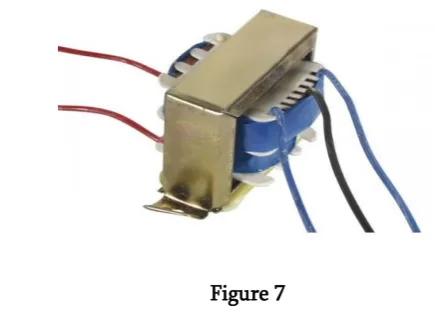
Transformer is an electrical component which transfers electrical energy from one circuit to another circuit by changing its voltage strength.
Here we are using step down transformer for reducing 230 V to 12 v.
Figure 7
Basically, there are two sides in a transformer one is primary coil and other one is secondary coil.
Rectifier:
Rectifier is an electronic component which converts AC to pulsating DC.
Here we are using four diodes as a bridge rectifier which has high efficiency.
Figure 8
Figure 9
It doesn’t change voltage strength. Capacitors:
Capacitors are used to convert pulsating DC to smooth pure DC. It filters small AC components.
Figure 10 Voltage regulators:
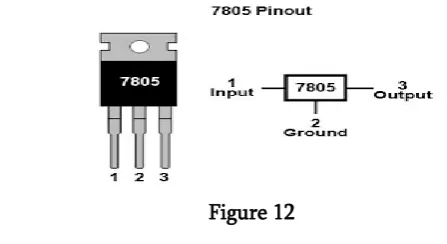
Voltage regulator is used to regulate constant voltage. Here we are using 7805IC
Which can output 5 V DC.
Figure 12
DHT11SENSOR (TEMPERATURE/HUMIDITY SENSOR):
This DHT11 Temperature and Humidity Sensor include an adjusted advanced flag yield with the temperature and mugginess sensor complex. Its innovation guarantees the high dependability and magnificent long haul solidness. An elite 8-bit microcontroller is associated. This sensor incorporates a resistive component and a feeling of wet NTC temperature measuring gadgets. It has superb quality, quick reaction, hostile to impedance capacity and high cost execution points of interest.
Each DHT11 sensors highlights to a great degree exact adjustment of dampness alignment chamber. The adjustment coefficients put away in the OTP program memory, inner sensors identify motions all the while, we should call these alignment coefficients. The single-wire serial interface framework is coordinated to end up noticeably snappy and simple. Little size, low power, flag transmission remove up to 20 meters, making it an assortment of utilizations and even the most requesting applications. The item is 4-stick single column stick bundle. Advantageous association, uncommon bundles can be given by clients require. Specification
Supply Voltage: +5 V
Temperature range :0-50 °C error of ± 2 °C Humidity :20-90% RH ± 5% RH error Interface: Digital
GSM/GPRS:
It is a standard set created by the European
portray conventions for second era (2G) computerized cell systems utilized by cell phones. A Modem is a gadget which tweaks and demodulates motions as required to meet the correspondence necessities. It regulates a simple transporter flag to encode computerized info, and furthermore demodulates such a bearer flag to interpret the transmitted data.
A GSM/GPRS module has a MAX-232 interface for serial response with an outside World. For this circumstance, the transmitter (Tx) of the PC's Serial port is connected with the Receiver (Rx) of the GSM module's MAX-232 interface. The transmitter (Tx) of the MAX-232 of GSM/GPRS module is related with Receiver (Rx) of microcontroller's serial transmission stick. Besides, the serial transmit stick of the microcontroller is related with the get stick of the PC's Serial port. In this way the summons and their results are transmitted and gotten in a triangular way as depicted underneath.
Figure 13
In resulting ventures (see MC075 and MC076), the HyperTerminal will be supplanted by the microcontroller itself; along these lines staying away from the need of utilizing a Computer to set up an interface. This would prompt a free GSM based framework.
GSM module is interfaced with Arduino Processor by adjusting the TX, RX and ground pins in it. The instruction to the GSM is altered in the code itself when there is need of the GSM, ARM processor initiates the instruction through the AT (Attention Commands) such as AT, ATEO, AT+CMGF, AT+CMGS etc;
Software Description: Arduino IDE:
The Arduino IDE software is a open source software, where we can have the example codes for the beginners. In the Present world there are lot of version in the Arduino IDE in which present usage is Version1.0.5. It is very easy to connect the PC with Arduino Board.
Working of the project:
By using DHT11 we can find the temperature and humidity and soil moisture sensor is used to detect the condition of the soil. If soil moisture sensor is in dry condition the pumping motor will on. Here LCD is used to display the temperature and humidity values. By using GPRS we can transmit the data.
Advantages:
Provides a healthy, beautiful landscape
Reduces water waste
Saves money
Provides convenience Applications:
At home
Nurseries
In Gardens
Results:
1.
The hardware Setup of our proposed system is shown belowFigure 14
2.
When the Moisture level is high then motor is in OFF ConditionFigure 15
3.
The data is uploaded to the server continuouslyFigure 16
4.
After Completion of uploading the data to the server5.
When the soil moisture is in low condition the motor is in ON ConditionFigure 17
6.
Continuously this data is uploaded to the sever in cyclic processV.
CONCLUSION
The small scale water system device done wind up plainly resolved to be reasonable and fetched capable for enhancing water valuable asset for rural creation. This water system framework lets in development in areas with water shortage subsequently improving maintainability. The miniaturized scale water system framework created demonstrates that the utilization of water might be dwindled for a given measure of crisp biomass generation. The utilization of sun control on this water system gadget is correlated and obviously imperative for natural plants and other farming stock which can be geologically insolated, in which the interest in electric vitality supply could be exorbitant. The water system machine might be changed in accordance with a spread of particular product craves and requires least upkeep. The particular setup of the smaller scale water system machine lets in it to be scaled up for bigger nurseries or open fields. Likewise, unique projects which incorporate temperature observing in compost assembling might be effortlessly done.
VI.
REFERENCES
[1]."W. A. Jury and H. J. Vaux, -The developing
and struggle between water users, Adv. Agronomy, vol. 95,pp. 1-76, Sep. 2007."
[2]."X. Wang, W. Yang, A. Wheaton, N. Cooley, and B. Moran, -Efficient enlistment of optical and IR pictures for programmed plant water push appraisal, Comput. Electron. Agricult., vol. 74, no. 2, pp. 230-237,Nov. 2010."
[3]."G. Yuan, Y. Luo, X. Sun, and D. Tang, -Evaluation of a harvest water push record for recognizing water worry in winter wheat in the North China Plain, Agricult. Water Manag., vol. 64, no. 1, pp. 29-40, Jan. 2004."
[4]."S. B. Idso, R. D. Jackson, P. J. Pinter, Jr., R. J. Reginato, and J. L. Hatfield, -Normalizing the anxiety degree day parameter for natural variability,Agricult. Meteorol., vol. 24, pp. 45-55, Jan. 1981."