UCL
Un i v e r s i t y Co l l e g e Lo n d o n De p a r t m e n t o f Co m p u t e r Sc ie n c e
Developing and Measuring
Parallel Rule-Based Systems
in a Functional Programming
Environment
Stuart dayman
A thesis submitted for the degree of Doctor of Philosophy
in the University of London
ProQuest Number: 10017738
All rights reserved
INFORMATION TO ALL USERS
The quality of this reproduction is dependent upon the quality of the copy submitted.
In the unlikely event that the author did not send a complete manuscript and there are missing pages, these will be noted. Also, if material had to be removed,
a note will indicate the deletion.
uest.
ProQuest 10017738
Published by ProQuest LLC(2016). Copyright of the Dissertation is held by the Author.
All rights reserved.
This work is protected against unauthorized copying under Title 17, United States Code. Microform Edition © ProQuest LLC.
ProQuest LLC
789 East Eisenhower Parkway P.O. Box 1346
Abstract
This thesis investigates the suitability of using functional programming for building parallel rule-based systems.
A functional version of the weU known rule-based system OPS5 was implemented, and there is a discussion on the suitability of functional languages for both building compilers and manipulating state. Functional languages can be used to build compilers that reflect the structure of the original grammar of a language and are, therefore, very suitable. Particular attention is paid to the state requirements and the state manipulation structures of applications such as a rule-based system because, traditionally, functional languages have been considered unable to manipulate state.
From the implementation work, issues have arisen that are important for functional programming as a whole. They are in the areas of algorithms and data structures and development environments. There is a more general discussion of state and state manipulation in functional programs and how theoretical work, such as monads, can be used. Techniques for how descriptions of graph algorithms may be interpreted more abstractly to build functional graph algorithms are presented. Beyond the scope of programming, there are issues relating both to the functional language interaction with the operating system and to tools, such as debugging and measurement tools, which help programmers write efficient programs. In both of these areas functional systems are lacking.
To address the complete lack of measurement tools for functional languages, a profiling technique was designed which can accurately measure the number of calls to a function , the time spent in a function, and the amount of heap space used by a function. From this design, a profiler was developed for higher-order, lazy, functional languages which allows the programmer to measure and verify the behaviour of a program. This profiling technique is designed primarily for application programmers rather than functional language implementors, and the results presented by the profiler directly reflect the lexical scope of the original program rather than some run-time representation.
Acknowledgments
As much of the early research work for this thesis was undertaken at Kingston Polytechnic, I would first like to thank Prof. George Rzevski, formerly Head of the Department of Information Systems at Kingston, who had faith in me and let me start a PhD on a part-time basis and then employed me as a Research Lecturer. Thanks are also due to Prof. Pat Pearce, who as a supervisor and a friend helped and advised me through the years, and with whom I had many interesting discussions and exchange of views. Further thanks go to Ed Whitehead for his assistance in documentation, and to all the members of the Department for making it an enjoyable place to work.
This thesis work was completed at the Department of Computer Science of University College London with help from SERC in the form of a short grant. Thanks go to Chris Clack, my supervisor at UCL, and to all the members of the functional programming-group. Special thanks go to Dave Parrott for his persistent efforts in building a distributed graph reduction system and adding a profiling mechanism, and for his patience in his discussions with me about the finer points of reduction systems, and for our chats in general. Also, Simon Courtenage read drafts of my thesis in detail, and both Derek Long and Russel Winder gave support and advice when times got difficult. I would like to thank all the members of the department who made my stay at UCL pleasant.
Introduction ... 1
1. General Background... 9
1.1. Functional Programming ... 9
1.1.1. Program proving... 12
1.1.2. Program transformation... 12
1.1.3. Functional Applications... 15
1.2. Parallelism ... 17
1.2.1. Parallel hardw are... 19
1.3. The Rule-Based System Approach ... 22
1.3.1. How A Rule-Based System W o rk s... 23
2. State-Saving in Rule-Based S y stem s... 29
2.1. A Language for Rule-Based Systems ... 29
2.2. Alternatives to OPS5 ... 32
2.3. Different matching algorithm s... 34
2.3.1. Non state-saving matching algorithm s... 34
2.3.2. State-saving ... 34
2.4. Analysis of Matching A lgorithm s... 35
2.4.1. Cost Analysis of a Non State-Saving Matcher ... 36
2.4.2. Cost Analysis of the Rete State-Saving M atch er... 38
2.5. Parallel Rule-Based S ystem s... 41
3. The Design and Implementation of a
Functional Rule-Based S y stem ... 47
3.1. Design of a Functional Rule-Based System ... 47
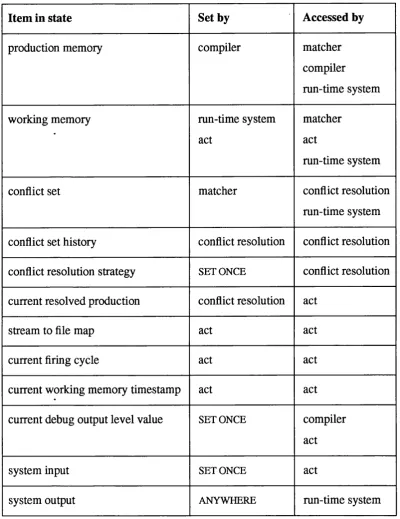
3.2. State Requirements of a Rule-Based System ... 51
3.2.1. State Items in the Functional Rule-Based S ystem ... 51
3.3. Implementation of the Functional Rule-Based S ystem ... 53
3.3.1. The OPS5 C om piler... 54
3.3.2. The Recognize-Act Cycle ... 64
3.3.3. The Run-Time System ... 69
3.4. Executing 0PS5 ... 75
3.5. Analysis of the Functional Rule-Based S ystem ... 77
3.6. Summary ... 80
4. Issues Arising in Functional Programming ... 83
4.1. S ta te ... 84
4.1.1. Manipulating S tate... 86
4.2. M o n ad s... 94
4.2.1. Sequencing with m onads... 103
4.2.2. Review of m onads... 106
4.3. V ectors... 107
4.3.1. A Vector Data T y p e ... I l l 4.3.2. Primitives for V ectors... 112
4.4. Graphs ... 116
4.5. Interaction With The Operating System ... 123
4.5.1. Input and O utput... 123
4.5.2. Environment Interaction... 125
4.6. M easurem ent... 127
4.7. D ebugging... 130
5. Profiling ... 133
5.1. Different Kinds Of Profiling... 135
5.2. Styles of Profiling... 138
5.3. Existing Profilers... 140
5.3.1. gprof - an existing imperative p rofiler... 140
5.3.2. The New Jersey SML Profiler... 141
5.3.3. UCL inline cost prim itive... 142
5.3.4. Glasgow Cost C en tres... 143
5.3.5. Runciman and Wakeling Heap Profiler... 143
5.4. Lexical Profiling... 144
5.4.1. Design Objectives... 144
5.4.2. Program Size ... 147
5.4.3. Requirements for Lexical Profiling... 149
5.4.4. Lexical P rofiling... 151
5.5. Implementation Techniques for Lexical Profiling... 153
5.5.3. Lexical profiling and compiled graph reduction
... 159
5.5.4. Extending the technique to parallel graph reduction ... 159
5.6. Analysis of the Lexical P ro file r... 160
5.6.1. Observing Program B ehaviour... 160
5.6.2. Verifying Program B ehaviour... 169
5.6.3. Achievements of Lexical Profiling... 176
5.7. Summary ... 177
6. Parallelism and Functional Program s... 181
6.1. Parallelism in Functional Programming... 183
6.1.1. Compiler Detected Parallelism ... 183
6.1.2. Skeletons... 184
6.1.3. Annotations... 184
6.1.4. Managing Parallelism ... 185
6.2. Use of parallel system s... 186
6.2.1. Use of GRIP ... 186
6.3. Other Reported Experience ... 194
6.3.1. Use of Compiler Detetected Parallelism ... 195
6.3.2. Use of skeletons ... 196
6.3.3. Use of Annotations... 198
6.4. Review of Parallelism in Functional Programmming ... 202
6.4.1. Review of GRIP ... 203
6.4.3. Advantages and Disadvantages of
Compiler Detected Parallelism ... 208
6.4.4. Advantages and Disadvantages of Skeletons... 209
6.4.5. Advantages and Disadvantages of Annotations 210 6.5. Parallel Applications... 212
6.6. Summary ... 214
7. Conclusions ... 217
7.1. Review of the Goals of the R esearch... 219
7.2. Summary of the Research Issues ... 224
7.3. Further W o rk ... 228
Introduction
Current research indicates that there is a need for parallelism in rule-based systems in order to increase their speed [Gupta86], [Hillyer86], and [Miranker87]. Functional programming is considered a technique well-suited for harnessing parallelism because functional programs decompose into independent tasks each of which can be evaluated concurrently [Hudak85], [Cripps87], and [Watson88]. Given that there is a need for parallelism and there is a tool that is well-suited for harnessing parallelism, it seems pertinent to ask the question:
Can functional programming be used for harnessing parallelism in rule-based systems?
The need for extra resources in computer systems is being hampered by conventional software and hardware techniques [Tumer80]. The software limitations are known as the software crisis, where the size and complexity of software systems is becoming unmanageable. This is combined with a proportional increase in both the number of bugs, and the cost of development and maintenance. One solution to the software crisis is the use of functional programming techniques which provide benefits through good design, powerful abstraction mechanisms, the lack of side-effects, and a strong mathematical basis [Tumer84].
processors all executing programs at the same time [Hülis85]. Each processor does a small amount of the work, but the whole homogeneous machine does enormous amounts. The architecture of these parallel machines is a deviation from conventional machines, and the harnessing of the parallelism to the fullest capacity calls for novel techniques in software. Functional programming provides a method for approaching software design in a novel way [Hughes89] and, as functional languages are independent of any machine architecture [Henderson80] [Glaser84], they are amenable to execution on a wide range of machines.
A particular class of applications which imposes a heavy load on conventional architectures and would benefit from parallelism are rule-based systems [Stefik81]. Rule-based systems [Hayes-Roth85] are the use of artificial intelligence techniques applied to human understanding and reasoning [Winston81], [Rich83], [Chamiak85]. They are particularly appropriate for many tasks, including requirements analysis, expert systems for analysis and synthesis, and for complex problems where the flow of control is unknown or the definition of the model is incomplete.
In the past, rule-based systems, which provide a powerful paradigm for problem solving, have been limited by their run-time performance. In an attempt to overcome this, several parties have written parallel versions of rule-based systems [Gupta84], [Hillyer86], [Gupta86], and [Oflazer87]. They all use specialized hardware for their implementations and their work provides comprehensive data concerning these specialized machines. Yet, although the behaviour of their algorithms are well understood, little work in this area has been done for general purpose hardware.
compiler [Hudak85], [Kelly87] ). In parallel functional programming environments, the dynamic mapping of tasks onto machines occurs at run-time in contrast to some specialized environments, in which a static mapping of tasks onto machines is done in advance [May84]. This feature enables functional environments to have dynamic load balancing, which distributes work more evenly [Hudak84]; in other words, no machine need be idle if there is work to be done [Eager86]. The most important aspect from a programming viewpoint is that parallelism is implicit and no programmer intervention is needed to run the rule-based system on a selection of different parallel machines.
Goals of the research
The need for parallelism in rule-based systems has been ascertained. In [StoIfo86] and [Rosenthal85], both conclude that implicit parallelism, which is where the system finds the parallelism rather than the programmer stating where it is, is a promising area to investigate in order to obtain more parallelism in a rule-based system. This is because programmer specification of parallelism has reached its limits due to the complexity of the task. As a consequence of the findings of Stolfo and Rosenthal and because one of the many proposed benefits of functional languages is that parallelism is implicit, functional programming techniques seem well-suited for obtaining parallelism in a rule-based system. Therefore, functional programming was chosen as the vehicle for the implementation of a parallel rule-based system in this research.
The original goals of the research were:
i) to use functional programming techniques to implement a rule-based system.
ii) to analyse the functional rule-based system for inefficiencies and then to implement efficient new algorithms or to transform old algorithms into more efficient ones.
iv) to analyse the functional parallel environment and gather data on the performance of the parallel functional rule-based system in order to remove any inefficiencies.
v) to compare the performance of the parallel functional rule-based system with an existing parallel rule-based system.
Only when these 5 aims have been addressed will it be possible to determine if functional programming techniques are suitable for harnessing parallelism in rule-based systems.
There are three main research areas in this thesis, namely: functional programming, rule-based systems, and parallelism. There has been previous research work in combinations of two of the three areas, but this thesis is new in combining all three. These main research areas are inter-related such that their combination can be viewed as a three way relationship:
rule-based systems
functional parallelism
programmmg
rule-based systems in particular.
The functional programming environments available are not as mature as imperative programming environments because practical functional programming environments are relatively new. There are few sources of functional interpreters and compilers, there are no known full development environments for functional languages, and there are no books on the design and development of large, functional applications. Furthermore, there are no design methodologies in general use for developing functional programs as there are for imperative programs. The lack of development environments and written material could limit the development of a functional application; this thesis will investigate if this is the case.
Furthermore, the formalisms which constitute the basis of functional languages are considered to be an advantage for functional programmers. These formalisms provide a rigid framework within which programs are built. However, this advantage could also be a disadvantage because operations that are simple to do in imperative languages could be difficult in a functional language due to this rigid framework. (For example, it is impossible to add a line of code to print the value of an object. In order to get this value, the code must be explicitly designed).
Contributions
The contributions of this thesis are:
• a critical assessment of the suitability of functional programming techniques for implementing large applications and rule-based systems in particular.
• a critical assessment of practical state manipulation techniques in functional programming.
• a large, working, application written in a lazy, higher-order functional programming language which does large amounts of state manipulation • a critical assessment of the functional programming environment, with
• the design, implementation and analysis of a tool for profiling lazy, higher-order functional programs. The tool measures function call count, time spent in a function, and the heap space used by a function.
• a critical assessment of techniques for parallelizing large functional programs.
Overview of the thesis
It is the aim of this research to investigate if functional programming techniques can be used to develop and build rule-based systems that are of an acceptable quality, if they are indeed beneficial for tasks that require parallelism, and if they can be used to harness parallelism in a rule-based system such that the resulting rule-based system executes at an acceptable speed. In addition, the available functional programming development environments will be considered in relation to these aims, and in particular to determine their suitability for writing a large application.
Chapter 1 provides a general background to the three main research areas, and the advantages of functional programming are discussed in more detail.
Chapter 2 provides a more detailed discussion of rule-based systems, why certain pattern matchers are more efficient than others, and discusses previous work in parallel rule-based systems.
Chapter 3 considers the design and implementation of a rule-based system written in a higher-order, lazy functional language, and discusses how different aspects of functional programmmg affected the design and the implementation of separate components of the rule-based system.
functional programs is described. This profiler measures the number of calls to a function, the amount of time spent in a function, and the amount of heap space used by a function.
Chapter 6 considers how parallelism can be harnessed in a functional program and shows the results of using a real parallel machine. It can be seen that the techniques advocated are not ready to be used for large functional programs.
Chapter 1
1. General Background
This chapter presents a general background to the three main research areas in this thesis, namely functional programming, parallelism, and rule-based systems.
1.1. Functional Programming
A functional program is a program that consists entirely of functions. A program has a main function, which calls other functions to do work for it, and they in turn call yet more functions. The main function collects input from the user and prints the result which is calculated by its body. Functional programs have a mathematical basis which enforces a rigorous approach to the design and implementation of the program.
Functional programming is being investigated by many researchers because of its theoretical basis, and because functional programs are amenable to automatic machine- based reasoning. The areas being investigated include automatic program transformation [DarlingtonSO] [Darlington90], automatic program proving [Tumer82], and formal semantics [StoySO] [Schmidt86], while others are investigating the efficient implementation of functional programs on conventional architectures ( [Tumer79], [Fairbum87], [Peyton-Jones87], ) [Peyton-Jones89]. The area this thesis investigates is the use of functional programming for large applications.
The benefits gained from writing an application in a functional language are:
incrementing a control variable of a loop, and leaves the programmer free to solve larger problems.
• there is no assignment to variables, just definitions; thus there can be no side-effects and the ability to state formally what is happening in a program is maintained. Obscure behaviour from variables being unexpectedly updated is eliminated.
• there is no explicit flow of control or sequencing due to there being no variables to change in a loop statement and no concept of a program counter to state where the next instruction is. Therefore, there are no confusing goto’s. The programmer does not have to define a total ordering on operations; flow of control and sequencing is through function application, recursion, and data dependencies.
• there is no explicit memory management. The memory or heap space is managed transparently, with heap space being allocated and deallocated on demand. This avoids the problems of programs failing because of illegal pointers.
• there is no connection between the source language and the underlying machine architecture. Therefore, the code for the application need never be changed when a different sequential or parallel machine is available.
• potential parallelism in the code can be found by special compiler techniques because there are no inter-procedural dependencies between functions. As the parallelism is implicit, the programmer is saved from stating where parallelism occurs.
degree of expressiveness.
• lazy evaluation is available in some run-time systems which allows infinite data structures to be defined. This means general solutions to problems can be defined rather than having a solution for an arbitrary number as is often the case in imperative programs, whereby a programmer will chose to evaluate a large number of solutions. This results in greater modularity [Hughes89].
• there are very few syntactic rules, thus enabling programmers to concentrate on the problem at hand and not on the syntax. Conventional languages often over-burden the programmer with syntactic rules [May83]. • the notation used in functional languages is very close to that used in
formal methods, hence any system designed using these methods can be implemented very rapidly. Functional languages are often considered as executable specification languages [Tumer84].
These benefits allow the development of more expressive and modular programs which are closer to the conceptual abstraction of a model. This contrasts with the conventional approach which requires a sequence of commands to be specified to fit with the traditional von-Neumann model of computation [Backus78]. This is a major benefit for functional programming because no time needs to be spent changing the conceptual model into the von-Neumann model so that an algorithm can be expressed in a conventional programming language.
1.1.1. Program proving
To determine if a function behaves correctly it is desirable to prove its correctness rather than running numerous and contrived tests of the function which may not find failure cases. Functional programs are amenable to program proving, which is much the same concept as a mathematical proof. The approach used to prove functional programs is based on equations and the properties of equality. Most of the facts one may wish to prove about a program may be expressed as equations. For example we may need to prove that:
fnap ( f' g) = m a p f ' map g or that:
reverse (reverse I) = I
In [Bird88] there is a detailed presentation of proofs of both of these equations.
The attraction of this approach is that functional programs already consist of equations, so that the nature of proving a program involves deriving a new set of equations which have the same properties as the given set of equations. Reasoning with equations is a well established mathematical activity and thus presents no new undefined problems.
1.1.2. Program transformation
Program transformation is a technique for mapping an expression from one form to another using techniques similar to algebraic manipulation. For example, n{x + 1) can be transformed into nx + n, and vice-versa. Different transformers take the expression and rewrite the expression such that it is semantically equivalent but structurally changed. Transformation can be used to improve efficiency in programs by manipulating the text of a program while maintaining correctness. The set of transformations developed are [Burstall77]:
Instantiation — introduces a substitution instance of another equation.
Unfolding — replaces a call of a function by its body, substituting the formal parameters.
Folding — replaces the body of a function by a call to the function with the parameters
Abstraction — introduces sub-definitions.
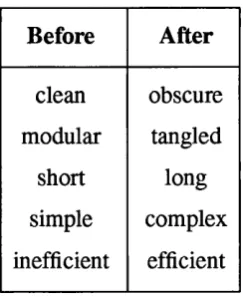
Program transformation can be used to convert well designed code into a more efficient form for execution. Table 1.1 shows the attributes of the before and after code. The before code is the style written by the programmer and has all of the desirable properties of a program from a human perspective. The after code is the code actually executed on a machine and has the desirable property of executable code, namely efficiency. Thus, program transformation does all the hard work of optimization and allows the programmer to concentrate on the important issues of good quality design and structured programming.
Before After
clean modular
short simple inefficient
obscure tangled long complex efficient
Table 1.1: Transforming functional programs for efficient execution
An Example of Program Transformation
This example relies on some proofs that are not shown here but are taken to be true. As an example of program transformation, consider a function that takes two lists and appends every element of the first list onto every element of the second list. This is similar to the cross product function, which is traditionally defined as:
{(%, y) I x e X , y e Y } This function will be called cp [1].
The cp function can be used to create the cross product of multiple lists. The following expression creates the cross product of 4 lists:
cp listl {cp list! (cp Ust3 (cp Ust4 [[]]))) (A) where the resulting list will have elements of the same length as the number of lists passed to the calls of c p, in this case 4. By using program transformation, it is possible to convert multiple calls of cp into a function that will take any number of fists, and produce their cross product. Step 1 uses the proof:
f (g x) = ( f ' g) X
such that equation A can be transformed into:
{cp listl • cp listl • cp Ust3 • cp listA) [[]] (B) Step 2 uses the proof:
( /• g) x = compose [ / , g] x such that equation B can be transformed into:
compose [cp listl , cp l i s t l, cp Ust3 , cp listA^ [[]] (C) Step 2 uses the proof:
map f ^2, • • • ] = [ / -^1, / -^2, • • • ]
[1] A version of cross product which can be composed with other cross product functions can be defined in Haskell as:
such that equation C can be transformed into:
compose (map cp [listl , l i s t l, Ust3 , Ust4]) [[]] (D) where brackets have been added around the map expression for grouping. The final step involves the introduction of a new definition:
multicp I = compose (map cp Ï) [[]] (E)
Using the new function multicp, equation A can be written as the expression: multicp [listl , l i s t l, Ust3 , list4]
However, multicp can be passed any number of lists to generate the lists’ cross product. The importance of transformation in large functional programs is discussed in [Kelly87]. Kelly’s PhD thesis has an extensive description of program transformations used for a graphics processing system which takes a naive implementation and produces a program which is more amenable to a distributed, parallel architecture. In the cross product example, it took 5 transformation steps to go from a specific instance of function calls to a general purpose function.
1.1.3. Functional Applications
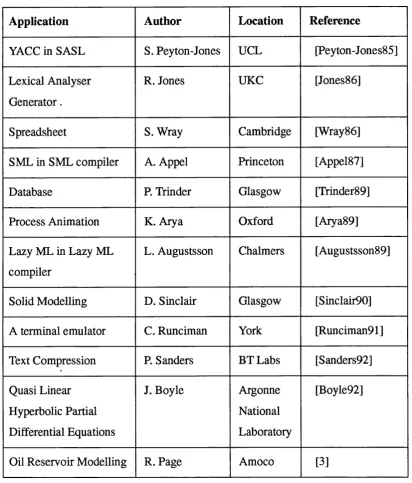
There are few large functional applications, and the creation of one normally is of enough interest to generate some research papers. Some examples of large functional applications are shown in table 1.2. At the start of this research there was little reference material for the functional applications builder. The current situation is that many more have been written and reported in recent times, showing how functional
applications are now coming to the fore [2].
Application Author Location Reference
YACC in SASL S. Peyton-Jones UCL [Peyton-Jones85] Lexical Analyser
Generator.
R. Jones UKC [Jones86]
Spreadsheet S. Wray Cambridge [Wray86]
SML in SML compiler A. Appel Princeton [Appel87]
Database P. Trinder Glasgow [Trinder89]
Process Animation K. Arya Oxford [Arya89]
Lazy ML in Lazy ML compiler
L. Augustsson Chalmers [Augustsson89]
Solid Modelling D. Sinclair Glasgow [Sinclair90] A terminal emulator C. Runciman York [Runciman91] Text Compression P. Sanders BT Labs [Sanders92] Quasi Linear
Hyperbolic Partial Differential Equations
J. Boyle Argonne
National Laboratory
[Boyle92]
Oil Reservoir Modelling R. Page Amoco [3]
Table 1.2: Examples of functional applications
research because it was the most effective lazy, higher-order functional language available. It had the latest features, it was commercially supported, and it was widely used in the functional programming community. Since that time Miranda has been superseded in the functional programming community by Haskell, a public domain language for which there are now many sources of compilers and interpreters [HudakSS]. As Haskell is the more modem and generally used functional language, and because any Miranda functions can be easily converted to Haskell, all code examples will be in Haskell even though they were originally implemented in Miranda. A brief introduction to Haskell is given in appendix B in order to clarify the features used in this thesis.
1.2. Parallelism
The main aim of parallelism is to execute a program on more than one processor in order to speed-up the execution time of that program. This technique is achieved by splitting the program into separate tasks and evaluating the tasks concurrently, or by applying the same operation to many data items concurrently [Uhr87]. The former approach is known as process parallelism and the latter is known as data parallelism.
Process parallelism consists of a number of independent threads of control engaged in concurrent computation. Each task does a small amount of the whole computation. Data dependencies between the tasks cause task synchronization. Data parallelism consists of multiple data structures which are processed at the same time by one operation.
explicitly stating where the parallelism is can be difficult.
An alternative method is to use functional programming, in which the parallelism is implicit and can be found by a clever compiler [Clack85]. There are no side-effects in functional programming, so there are no obscure interactions and there is no global data store and, thus, no need to synchronize on global data. In addition, the semantics of the language are well defined and do not change when a parallel evaluation mechanism is used [Peyton-Jones89a]. Furthermore, there is no burden for humans in learning parallel features; they can involve themselves with expressing algorithms only.
Although parallelism is a way to improve the performance of complex applications, the parallelism harnessed has to be effective, i.e. a parallel version of a program must be more efficient than the best sequential version. Furthermore, some algorithms need to be rewritten and / or redesigned in order to work in parallel. (Experiments with old Fortran programs have demonstrated this [4]). Effective parallelism is not about keeping processors busy but about speed-up relative to the speed of the fastest sequential version. Schultz warns [Schultz88]:
i) a parallel algorithm can be made to achieve optimal cpu usage by increasing the complexity — that is, just because a parallel algorithm is keeping many cpu’s busy does not mean that the algorithm is effective. ii) a parallel algorithm can be made cpu bound either by making its
complexity sufficiently bad or by using slower cpu’s.
iii) a poor algorithm doing operations at a high rate does not necessarily finish before a good algorithm doing operations at a slow rate.
The important factor is speed-up over the best sequential version of a program. One can define speed-up to be:
time o f the best sequential algorithm speed - u p =
time o f the best parallel algorithm
In [Padua87], which is predominantly about parallelism and Fortran, Padua discusses how parallelism is harnessed in imperative languages such as Fortran and how this may differ for functional languages. He observes that explicit parallelism, which forces the programmer to use parallel language constructs in order to harness parallelism, must be used. The constructs may be one of:
• fork/join • microtasks • parallel loops
and are needed due to the features of imperative languages, such as global store and side-effects.
Conversely, implicit parallelism occurs when a compiler or interpreter automatically extracts the parallelism. Due to the absence of side-effects in functional languages, Padua observes that there is no need for compile-time:
• inter-procedural analysis to compute dependencies • array expansion
• variable renaming
which are all required for parallel versions of Fortran and other imperative languages. Padua concludes that, although there are differences in parallel languages at present, future parallel systems will comprise program manipulation components, meta languages, and specification languages. The functional programming world is able to address of all these now.
1.2.1. Parallel hardware
• general versus fixed communication • fine versus coarse granularity
• multiple versus single instruction streams • shared versus distributed memory
Although each issue can be characterized by extreme schools of thought, each offers a spectrum of choices rather than a yes/no decision. Each choice is independent of the other, thus allowing for many styles of architecture [Hillis85].
General Versus Fixed Communication
Some portion of the computation in all parallel machines involves communication among the individual processors. General communication permits any processor to talk to any other, whereas fixed communication allows only a few specific patterns of communication which are defined by the hardware.
The main advantage of fixed communication is simplicity, and for certain applications this mechanism can be much faster. The general communications machines have the potential of being easier to program for a wider range of tasks, and the connection pattern can change dynamically for particular data. However, depending on how a general communications network is implemented, some pairs of processors may be able to communicate more quickly than others due to attributes of the underlying real architecture.
Fine Versus Coarse Granularity
such as a large communication overhead. The processors in a fine grained system are generally less powerful, so many small processors may be slower than one fast, large processor.
Multiple Versus Single Instruction Stream
A multiple instruction stream machine is a collection of autonomous computers, each capable of executing different code. A single instruction stream machine is a collection of identical computers, each executing the same code. As both types of machine operate on different data, this leads to the commonly used synonyms for parallel machines - MIMD (multiple instruction multiple data) and SIMD (single instruction multiple data)
The most common type of SIMD machines are vector or array processors. These fall into two categories, either general purpose machines such as the Cray supercomputer, or special purpose machines such as CLIP [Duff83], which is used specifically for image processing.
MIMD machines come in many different forms due to the different methods of design and construction used by the different research groups. Some of the better known forms include dataflow machines [Watson79], Transputers [Inmos85], hypercubes [Intel85], the Connection machine [Hillis85], and the graph reduction machine [Cripps87] [Clack86]. Graph reduction machines are commonly used for executing parallel functional programs.
Shared Versus Distributed Memory
When processors have to access memory there are generally two configurations for this memory, (a) shared memory, where there is one memory and every processor has access to that memory, and (b) distributed memory, where there are many memories. In the distributed memory case, either the memories are independent units whereby any processor can access the memory, or the memories are associated with one processor and only that processor can access the memory. Each layout has advantages and disadvantages for different applications and, again, there are many arguments to consider when choosing an architecture.
1.3. The Rule-Based System Approach
Rule-based techniques are appropriate for many tasks, including requirements analysis, expert systems for analysis and synthesis, and complex problems where either the flow of control is unknown or where there is an incomplete definition of the model [Hayes-Roth85] [Waterman86]. Because of their modularity, rules appear to be the most natural representation for systems that are in constant flux [Hayes-Roth83].
One of the major reasons for choosing rule-based systems is that humans usually find it intuitively appealing to express their knowledge in terms of condition / action pairs (i.e. if condition then action). Also, because rule-based systems tend to be built incrementally due to knowledge becoming available in a piecemeal fashion, it is not necessary to know the entire model in advance, but rather to gradually build towards it
[Waterman86] [5]. The power of rule-based systems is most evident when they are applied to large ill structured problems for which it is difficult to provide a detailed specification, such as analysing complex laws and statutes.
A rule-based system is a tool which enables the builders of artificial intelligence applications to represent their knowledge of a domain through rules (see [McDermott78], [Hayes-Roth85], and [Waterman86] ). Consider an example rule from a computer hardware configuration program given in [McDermott82]. This rule helps to assign power supplies to a bus of the computer:
IF the most current active context is assigning a power supply and a bus module of any type has been put into the cabinet and the position it occupies in the cabinet is already known
and • space is available in the cabinet for a power supply at that position and there is an available power supply
THEN put the power supply in the cabinet in the available space
This rule is part of a system that started with 300 rules, and grew over a period of 6 years to have approximately 3500 rules. As the rules were added, the program could configure new computers as they were manufactured and could perform many new tasks. It is this kind of evolutionary growth to which rule-based systems are most suited. The rules are specified in English by the rule-based system designer to be expressive. They are then encoded by the rule-based system designer into a particular rule-based system language when enough rules have been acquired to process the facts of the domain. In an implementation of a rule-based system, rules are encoded in the form of productions [6].
1.3.1. How A Rule-Based System Works
A rule-based system has three main components:
• production memory, which contains productions each in the form of condition / action
• working memory, which contains working memory elements, each one being a fact about the domain
• an inference engine, whose task is to initiate the recognize-act cycle
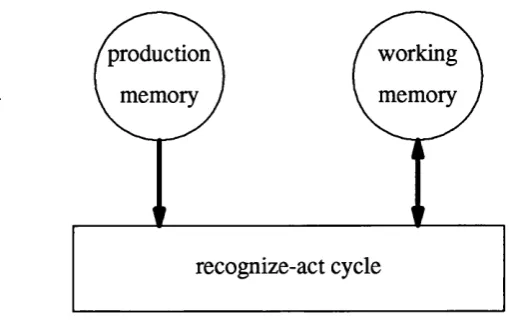
In a rule-based system, production memory and working memory are independent of one another. Both production memory and working memory are unstructured and elements within each are independent of the other elements. Only the recognize-act cycle can combine the contents of production memory and working memory, and on each iteration of the cycle may update working memory. This process is shown in figure 1.1.
working memory production
memory
recognize-act cycle
Figure 1.1: The components of a rule-based system
Production memory contains productions which are similar to a single conditional ( i f - t h e n ) statement in a conventional programming language. All productions are independent of one another, and there is no predefined order of production execution. A production contains n conditions Ci to C„ and m actions A ^ io A production may be executed when working memory is in a state such that all conditions Ci to C„ are simultaneously true. When the production is executed, then all actions Aj to are evaluated in the order in which they are written [7]. An action may add or delete an
object from the contents of working memory or do some input or output. Usually the condition parts of a production are called the left hand side (LHS) and the action parts are called the right hand side (RHS). This is because productions take the written form:
Cl C2 • • • C„ ^
Ai A2" ' Ajn
where the conditions are to the left of the arrow and the actions are to the right.
Working memory contains objects called working memory elements. These objects represent either physical objects, relationships between objects, or statements about a particular domain. Working memory contains the "state of the world" for each rule- based system application, and its contents change continuously as the rule-based system executes productions. Production memory, by contrast, is stable [8]. Working memory and production memory are independent, and both have to be initialized at the beginning of exection for an application to work. Working memory is initialized with facts about the domain, that is, it contains the current "state of the world", and production memory is initialized with the rules of the domain.
The inference engine is the executor in a rule-based system. It determines which productions are appropriate to select by matching each production against contents of working memory. It then chooses one production to execute through conflict resolution. The execution of the production causes the actions to be evaluated, which then causes working memory to be updated, and hence the "state of the world" changes. This process of selection and execution is called the recognize-act cycle. Because of the continuous operation of the recognize-act cycle and because of changes in the "state of the world", new productions are selected on each iteration of this cycle. If it becomes impossible to select a production for execution, then the inference engine stops.
The recognize-act cycle takes the form:
1. match — evaluate the LHS’s of the all the productions in production memory to determine which productions are satisfied given the current
contents of working memory. The match process compares each condition of a production with every element of working memory.
2. conflict resolution — choose one production with a satisfied LHS. Often, more than one production is satisfied in the match phase; this is called a conflict. The conflict is resolved by selecting the best single production. If there are no satisfied productions, then the inference engine halts.
3. act — perform the actions specified in the RHS of the selected production. Th& actions may update working memory or do input or output.
The cycle iterates again by going back to matching, i.e. step 1.
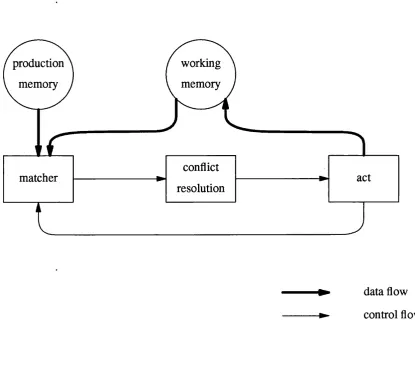
The control flow and data flow of a rule-based system are presented in figure 1.2. Control flows from the matcher, to conflict resolution, to act, and back to the matcher again - this is the recognize-act cycle. Data flows from production memory and working memory into the matcher for matching, and into working memory when a production is acted upon.
Rule-based systems differ from conventional programs in two major respects. The first is that rule-based systems use a different method of encoding the state of a computation than conventional methods. A conventional program encodes state by updating values in variables. A rule-based system encodes state by placing objects into the system’s working memory. The second difference is the way the flow of control is managed. A . conventional program uses ordered statements together with control constructs such as loops and conditional branching. A rule-based system uses left hand side satisfaction. That is, each production’s left hand side is a description of the states in which the production is applicable, such that the production is satisfied when objects in working memory cause each condition on the left hand side of the production to be true. When the rule-based system performs a match it is in effect searching for the best production to process the data in working memory. Once a production is chosen, the actions on the right hand side cause working memory to be updated.
working memory production
memory
resolution conflict
matcher act
data flow control flow
Figure 1.2: The control and data flow in a rule-based system
Chapter 2
2. State-Saving in Rule-Based Systems
In this chapter there is a brief description of OPS5, which is a widely used rule- based system. There is a discussion and analysis of state-saving and non state-saving matching algorithms used in rule-based systems. This will show the benefit of saving state in a rule-based system matcher. Particular attention is paid to the Rete matching algorithm used in 0PS5. This is an efficient algorithm for doing matching and is effective in sequential and parallel implementations. Then follows a discussion on research into parallelizing 0PS5; this includes work done on the design of special hardware for executing rule-based systems in parallel, in particular OPS 5, and on why the Rete matching algorithm is amenable to implementation on a parallel system. Finally, the issues arising from this research which lead onto considering why functional programming could be suitable for harnessing parallelism in 0PS5 are reviewed.
2.1. A Language for Rule-Based Systems
The rule-based system chosen for further investigation in this thesis is 0PS5 [ForgySl]. 0PS5 is a system which allows the encoding of rules as a set of independent productions. Moreover, it is widely used and is the basis for some of the largest and best known expert systems (for example, a computer backplane configuration system
considered the best system to analyse and to make comparisons with the rule-based system devised in this thesis [9].
The representation of knowledge in 0PS5 is contained in working memory. The representation is oriented towards objects and relations between objects. Each object and its attributes are represented through the use of working memory elements. For example, a working memory element may represent a block, which is named b lo c k l, is red, weighs 500 grammes, and measures 100 mm on each side. This block object can be represented in 0PS5 as:
( b l o c k
^name b l o c k l
^ c o lo u r r e d
Tmass 500
^ l e n g t h 100
^ h e ig h t 100
■^width 1 0 0 )
In this example, the name b l o c k is the object class and is followed by a set of attribute p a irs. The name of the attribute is preceded with a caret and followed by the attribute value.
The specification of rules in OPS5 is simple yet sophisticated, allowing relatively easy encoding of knowledge into rules. The left hand side (LHS) of a production consists of one or more conditions. Each condition is a pattern that describes a working memory element. During the match phase of the recognize-act cycle, each condition of a production is compared with elements in working memory in order to determine if the condition matches any working memory elements. The condition is considered satisfied if it matches at least one working memory element, and the whole production is satisfied if every condition is satisfied.
The patterns of each condition are abstract representations of working memory elements. These patterns may fully match every attribute pair of a working memory element, or may partially match a working memory element by matching a few attribute pairs. A pattern will match any working memory elements that contain the information in the pattern. For example, the condition pattern:
( b l o c k ^ c o lo u r r e d )
would match any working memory element that described a red block, such as b lo c k l. However, the pattern
( b l o c k ^ c o lo u r b l u e )
would not match blockl because the colour attribute of blockl is red. Patterns may contain variables which can match anything, but if the variable occurs again in the production, the value of the variable must be the same as before. In this way, OPS5 is able to the represent relationships between objects.
The right hand side (RHS) of a production consists of the actions. The actions can add, delete, or modify working memory elements and perform input or output. To create a working memory element, OPS5 defines the m ake action. This takes a description that looks like a pattern and creates a working memory element.
A production consists of a name, a set of conditions, and a set of actions. The p symbol is used to denote a production and the - - > symbol is used to separate the LHS and RHS. The following example production prints a message if it finds a coloured block:
(p f i n d - c o l o u r e d - b l o c k
( g o a l ^ s t a t u s a c t i v e ^ t y p e f i n d ^ o b j e c t b lo c k '^ c o lo u r < c > )
( b l o c k ^ c o lo u r < c > ^name < n > )
- - >
( w r i t e s t d o u t Found a < c > b lo c k c a l l e d < n > ) )
In this rule, if the first condition matches a relevant working memory element and the second condition matches the working memory element for b lo c k l, then the message:
would be produced.
2.2. Alternatives to OPS5
The 0PS5 rule-based system is freely available software which is reliable. It works on various platforms, as the source code has been written in many dialects of LISP, and there is detailed documentation and descriptions of how the inner parts of OPS 5 work. This allows a functional 0PS5 to be written and compared with an existing version. Furthermore, parallel versions of 0PS5 have been built and documented. As 0PS5 is used widely for research into rule-based systems, it was chosen for this research rather than any of the other options. In this section there is a brief overview of the alternative rule-based systems to OPS5 which were considered at the beginning of this research. The tools considered were large hybrid tools and small PC-based tools.
Large Hybrid Tools
The large hybrid tools that were considered were all commercial products; ART sold by Inference Corporation, KEE sold by Intellicorp, and Knowledge Craft sold by Carnegie Group. They are knowledge engineering environments rather than merely rule-based system shells. This is due to the fact that they each offer a variety of different ways to approach any given problem. They are complex systems with many options and considerable flexibility. The range of facilities these tools provide for knowledge-based system developers are:
• different methods of representing knowledge within each system • inheritance of values by entities in the system
• alternative worlds or viewpoints, which allow hypothetical reasoning • the support of truth maintenance mechanisms
• the selection of powerful inference and control mechanisms
mechanisms and explanation facilities, and allow full access to the underlying system and to other programming languages such as LISP or C. This enables developers to write critical code in a more efficient manner. These tools also allow access to commercial database systems for storing large amounts of data. With all these facilities available to the systems developer, any one of the three tools considered would be highly suitable to develop and implement a deliverable expert system. However, this is not the aim of this research.
The drawbacks of these development environments are the lack of a detailed description of their inner workings which is needed in order to make comparisons with the implementation in this thesis. There were no known parallel implementations of these tools and they were too big and complicated to emulate given the scope of the research. Furthermore, they consume enormous amounts of computing power, require machines with huge amounts of resources in order to execute, and need graphics hardware for their advanced user interfaces. In the light of these drawbacks, the large hybrid tools were not considered suitable for this research.
Small Tools
The small tools considered were taken from a collection of rule-based system tools which have proliferated recently on desktop PC’s. They were considered because of the availability of the machinery for development and for end-users, and because the software was generally available. These were also commercial products but much smaller and cheaper than the hybrid systems. Those available were Expert Ease, Micro Expert, Micro Synics, and ES/P Advisor.
2.3. Different matching algorithms
A matching algorithm in a rule-based system computes the state of the match between the whole of working memory and all the productions. Its task is to select the productions in which every condition of the production matches an element from working memory. From the selected productions, just one is chosen by conflict resolution for further execution. There are two main techniques for doing this matching; they are non state-saving and state-saving.
2.3.1. Non state-saving matching algorithms
The non state-saving algorithm is the simpler. Every condition of every rule is matched with every working memory element to generate the state of the match. Conflict resolution chooses the one production for execution, and the state of the match is then forgotten. However, every iteration of the recognize-act cycle recomputes the state of the match, but because very little changes on each iteration, it is nearly the same state that gets recomputed and forgotten. Due to the matching behaviour of this approach, the algorithm is sometimes called the dumb matcher. As this algorithm keeps recomputing the same state, it can clearly be improved.
2.3.2. State-saving
Matching algorithms for rule-based systems can save some of the match state on each iteration of the recognize-act cycle. This is because each match state is similar to previous match states. By saving some state, the cost of the match is reduced. There are different matching algorithms for OPS5 that store different amounts of state. They are:
ii) the Rete algorithm [Forgy82], developed at Camegie-Mellon University. Rete saves working memory elements that match each condition and also saves data for some fixed combinations of conditions. It stores data for the combination of successive conditions in a rule. It stores the state of the match for condition 1, and then the state of the match of condition 1 combined with condition 2, and then the state of the match for a combination of condition 1 and condition 2 and condition 3, until all the conditions have been matched.
iii) Oflazer’s algorithm [OflazerS?]. This algorithm saves working memory elements that match each condition and it also saves the combinations of matches for all conditions. It stores the state of the match for condition 1 and condition 2, for condition 1 and condition 2 and condition 3, etc. But it also stores the state of the match for condition 1 and condition 3.
The amount of state saved is different in each of these three algorithms. TREAT is at the low end of the state-saving spectrum; however, it has to recompute some fixed combinations on each cycle which increases its execution time. Oflazer’s algorithm, which is at the high end of the state-saving spectrum, spends a lot of time computing state which may never be used and also stores huge amounts of state. Its execution time and memory usage are higher than both TREAT and Rete. Rete is in the middle of the state-saving spectrum and is the algorithm used in the sequential version of 0PS5.
2.4. Analysis of Matching Algorithms
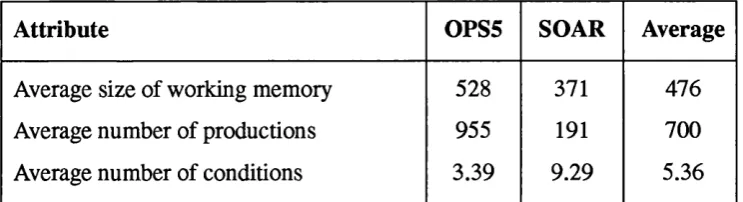
This section provides an analysis of the cost of using either non state-saving or state-saving algorithms. Data collected by Gupta in [Gupta86] shows the typical values in a range of real rule-based system applications for the average size of working memory, the average number of productions, and the average number of conditions for all productions. The data was collected from four OPS5 applications and two SOAR applications [10] [Rosenbloom85], and is shown in table 2.1.
A ttribute OPS5 SOAR Average
Average size of working memory 528 371 476
Average number of productions 955 191 700
Average number of conditions 3.39 9.29 5.36
Table 2.1: Data fro m Gupta^s PhD thesis
2.4.1. Cost Analysis of a Non State-Saving Matcher
The cost of using a non state-saving matcher for real systems can be evaluated by using the data collected by Gupta in a set of equations which identifies the cost of the non state-saving matcher.
Let:
w = average size of working memory p = average number of productions I = average number of conditions
The average cost of a match for one production during one iteration of the recognize-act cycle involves choosing all the combinations of the size of the production’s left hand side from working memory and then matching them with the production. This equates to:
C ,= w\
The average cost of matching during one recognize-act cycle is the cost of one production multiplied by the total number of productions:
(A)
w = 528
1 = 339 (rounded to 3) p = 955
The average number of matches per recognize-act cycle equates to: = 955x^^C 3
528! = 955x
= 955 X
3! 525!
5 2 8 x 5 2 7 x 5 2 6 1 x 2 x 3 = 2.33x10^°
Therefore, when using a non state-saving matcher for a large OPS5 application, there are 2.33 x 10^® matches performed on every cycle.
To calculate the algorithmic complexity of the non state-saving matcher some approximations are made. One can use the approximation [11]:
5 2 8 x 5 2 7 x 5 2 6
1 x 2 x 3 = 528^
SO that the average number of matches is approximately:
955x528^
Therefore, equation A can be approximated by:
pxw^
The complexity of the match is approximately polynomial on the size of working memory, and is cubic (/ = 3) for an average 0PS5 program.
[11] It can be observed that:
2.4.2. Cost Analysis of the Rete State-Saving Matcher
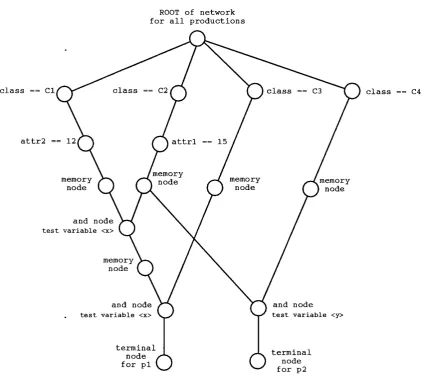
The Rete algorithm uses a clever compiler which converts the left hand side of a production into a graph representation of that production, caUed a Rete network. Nodes in the graph are used either to test attribute pairs of working memory elements or to save the state of previously computed matches. The test nodes match an individual attribute value or test that variables are bound correctly across combinations of working memory elements. The state-saving (or memory) nodes are used to save working memory elements that have successfully matched tests in the network. When all the conditions have been satisfied, the terminal node becomes active and the production is put into the conflict set. Consider two example rules, such as:
(p p i
( C l ^ a t t r l <x > ^ a t t r 2 1 2 )
(C2 ^ a t t r l 15 ^ a t t r 2 < x > )
(C3 ^ a t t r l < x > )
- - >
( rem o ve 3 ) )
and
(P p2
(C2 ^ a t t r l 15 ^ a t t r 2 < y > )
(C4 ^ a t t r l <Y >)
- >
( m o d if y 1 ^ a t t r l 1 2 ) )
These two productions have the Rete networks as presented in figure 2.1.
ROOT of network for production pi
R OOT of network
for production p2
class C2
class Cl class 03
1 2
attr2 attrl 15
m e m o r y
1 node memory
node memory
node
and node
test variable <x>
memory node
a nd n o d e
test variable <x>
terminal node for pi I
class 02
class 04
15 a t tr l
memory
I node memory I node
and node
test variable <y>
terminal node for p2
Figure 2.1: Rete networks for productions p i and p2
(C2 " a t t r l 15 . . . )
which can be shared. The network with sharing is shown in figure 2.2.
ROOT of network for all productions
c l a s s
c l a s s Cl C2 c l a s s 03 c l a s s
attr2 12 attrl 15
m e m o r y I n o d e m e m o r y
n o d e
m e m o r y n o d e
m e m o r y I n o d e
a n d n o d e
te s t v a r i a b l e <x>
m e m o r y n o d e
a n d n o d e
te s t v a r i a b l e <x>
a n d n o d e
t e s t v a r i a b l e <y>
terminal node for pi I
terminal node for p2
c l a s s = = 04
Figure 2,2: A Rete network with sharing
matches per cycle of the production system. In the non state-saving matcher there are 2.33 X 10^^ matches per cycle, and with Rete there are 430. Therefore, the Rete state- saving matcher is algorithmically superior to a non state-saving matcher.
2.5. Parallel Rule-Based Systems
The desire for parallelism in rule-based systems is motivated by the observation that, although rule-based systems have been used extensively to build large expert systems, they are computationally expensive because of the matching required and, hence, run slowly. This slow execution time limits the use of rule-based systems to domains that are not time critical. For example, one study considered implementing an algorithm for real-time speech recognition using a rule-based system [Newell78]; it was found that present rule-based systems were between 5,000 and 20,000 times too slow for such a task. Rete was considered a suitable candidate for a parallel implementation of OPS5 because it is such a good algorithm for matching in sequential rule-based systems.
2.5.1. Parallelism and Rete
In his PhD thesis [Gupta86], Gupta states that the expected speed-up available from parallelism in Rete is between 100 and 1,000 times. However, the actual amount of speed-up is between 10 and 25 times. The main reasons for this are:
i) only a small number of productions are affected on each change to working memory (28 on average).
ii) a large variation exists in the processing required for each production. Furthermore, this variation can change on each cycle of the production system.
iii) the number of changes made to working memory per cycle is minimal (3.1 on average)
i) only a few processors would be busy even if there were a processor per production. This is due to the small number of productions that are affected on each recognize-act cycle.
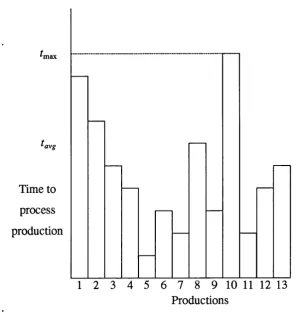
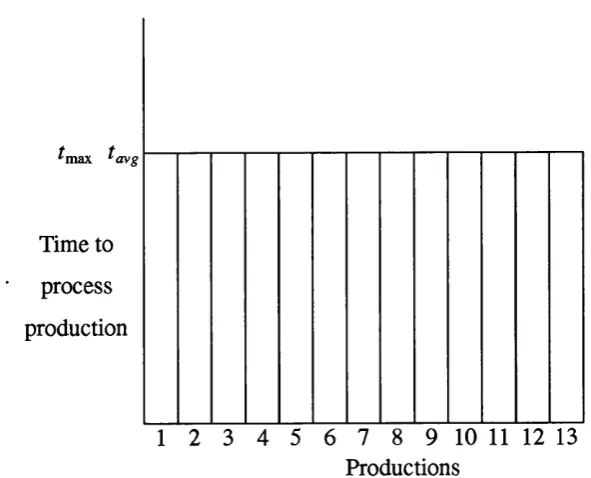
ii) one is less certain of any speed-up due to parallelism because the stage after matching cannot begin until all productions have been matched. If the time to process one production is large, then the variation of processing time is large and the speed-up will be reduced. Figure 2.3 shows the time taken to process some productions in parallel. Matching all productions takes the same time as matching the most expensive production. Gupta states that it is desirable to eliminate the variation (for example, by using load balancing). The situation may change from cycle to cycle, but the important aspect is the time because this is the time taken for the whole match phase. The aim is to reduce so that it is closer to t^^g. This situation is shown in Figure 2.4.
iii) the speed-up from processing multiple changes to working memory in parallel is minimal because only a small percentage of working memory is changed on each cycle and the amount of processing required to deal with these changes is also minimal.