4830
A Zero-Sum Game-Based Security Algorithm
Against Dos Attack In Vanets
A.Ilavendhan, K.Saruladha
Abstract: The number of accidents occurred in recent years due to the increase of vehicle users in road transportation and the inability of providing the safety alert messages to the vehicle users during natural disasters. To prevent such accidents, VANETs create an environment where the vehicles can interact with each other. Due to the vulnerabilities in the VANET, the timely circulation of emergency messages to vehicle users is retarded. Ensuring VANET's security mechanism is critical for reliable data transmission in the network. Game theory has been used in strategic areas over the years, such as retail, auctioning, gaming, etc. The game theory concept has been used in defense fields and is often referred to as security games. This paper provides a zero-sum security algorithm to solve a problem involving an attacker or a defender's interaction game during a denial of service attack (DoS), and it shows the better result for mitigating the DoS attack when compared to other existing methods.
Index Terms: Game Theory, Cooperative Game, Non-Cooperative game, NE, Best Response, DSRC
—————————— ——————————
1 INTRODUCTION
Vehicular networks commonly referred to as VANETs are susceptible to several attack types of attacks. As the lives of users are at risk, it is crucial and essential to guarantee their vehicle network security from all possible attacks [1],[2]. Due to the tremendous rise in traffic, the safety of these vehicles has a vital role. Nowadays, road accidents are more frequent and claim many lives. Traffic management tackles the difficult task of providing the vehicle user with protection. VANET [11] offers a moving vehicle interactive environment where signals are exchanged by utilizing the DSRC. One vehicle sends the message to the other by setting up an infrastructure for Vehicles to Vehicle (V2V) and Vehicle to Infrastructure (V2I). These communications help the car to distribute information about safety and non-safety messages. The primary purpose of safety data is to prevent accidents, investigations after disasters, or traffic controls. The non-safety information contains the location of the fuel station, the restaurant, and the electronic toll data needed for passengers. The main aim of information exchange is to monitor accidents by alerting vehicle users of traffic jams and thus saving people's lives earlier. Unlike MANETs, VANETs are more restrictive, like frequent connections, rapid topology changes, high node mobility, and frequent disconnection. DoS attacks Family is one of the most vulnerable VANET attacks family.In this article, we focus on VANET response to DoS attacks and suggest newly developed game theory protection strategies since it appears to be a reasonable way to address our problem. In reality, in a game in which a player takes action, the other Response. In a game, each player tries to maximize his gain and or decrease his loss, according to the general principle of Game Theory. The gain or loss can be obtained by cost calculation methods commonly known as the payoff function in formal modeling terminology. Based on the strategies chosen by the player, they will maximize the profit. A strategy can be one action or a sequence of movements over the course of the game. Sometimes a player may win or lose at the end of the
game. Therefore, for each stage of the game, the total cost of a given player can be measured as the number of gains or losses. Game theory categorizes games under several categories, including Cooperative vs. Non-cooperative, Static vs. Dynamic, Strategic-form vs. Extensive-form, Perfect vs. Imperfect, and Complete Game theory categorizes games under several categories, including Cooperative vs. No-cooperative, Static vs. Dynamic, Strategic-form vs. Extensive-form, Perfect vs. Imperfect, and Complete vs. Incomplete information. The selection of one of these criteria depends in particular on the procedure and conditions of the game itself.Basically, two main game families exist cooperative games and non-cooperative games. The cooperative games require mutual agreements between users; external signals are also required. In a highly mobile, heterogeneous system like VANET, it may be harder to achieve this conclusion. In a non-cooperative game, decision-makers are the players themselves, but without the necessity of any cooperation, everyone decides for themselves. Therefore, the most important contribution of the paper is to provide a modern formalism based on non-cooperative game theory to refuse the DoS attack in VANETs.The following paper is structured as follows. In section 2 we start with the related work. Chapter 3 explains the proposed security-game algorithms. In Section 4 we describes the simulation environment, parameters of simulation, matrices, and performance evaluation results. The article finishes with the conclusion in Section 5.
2RELATEDWORK
This paper addresses the problem interrelated to several research axes, for example, DoS[10] attacks. Game theory is specifically applied for designing a security algorithm against attacks. However, some important researches focused on game theory on wireless network simulation attacks was suggested. The specific possibilities of the use of game theory as a simulation method for wireless network attacks were shown by felegyhazi and hubaux in [3]. The behavior of an intruder node will potentially change the behavior of a legitimate node in wireless networks. Such actions can, therefore, be based on attack or defense games. Four simple explanations were used to illustrate the most basic concepts of non-cooperative game theory. The authors tried to combine the four proposed games: Joint Packet Forwarding game, __________________________________________
A.Ilavendhan, Research Scholar, Department of Computer Science and Engineering, Pondicherry Engineering College, Pondicherry, India, PH-+9790176965. E-mail: [email protected]
4831 Multiple Access games, Forwarder's Dilemma game, and
jamming game to mitigate different prospective attacks. The above four games are designed as a two-player game.In [4], Apcan and Buchegger explored the most important aspects of defense for VANETs from the point of view of game theory. They offered a system for taking preventive and automated actions against malicious user's attacks. The basic models and implementations for further structures are given. The security games for VANETs suggested use as inputs such metrics called centrality indicators measured on road maps and on the distribution of cars. The Nash equilibrium was also evaluated.A new game theory-based intrusion prevention system for VANET was recently developed by Sedjelmaci et al.[5]. It can predict a potential attacker's possible malicious behavior. They used the principle of game theory to predict future action and categorize the controlled node into one of four different groups. Despite their preventive approach and our system for the identification, we compared their overhead to ours. The author has suggested an Algorithm, based on Bayesian game theory, Yaser Taheri et al. method [6], which models interactions between nodes in mobile ad-hoc networks. The contact between the nodes is considered as two-player games for sending and receiving messages. Both players in the game will save details on nearby nodes in the network. This information is gathered and used in the networks to identify the malicious node.Basant subba et al.[7] devises an IDS scheme for the detection of intruders in the VANETs, which is not based on a cooperative game. The developer developed a clustering algorithm to maintain the consistency of the IDS structure and selects the cluster head and agent nodes in each cluster for the distributed operation of the IDS.Mohsin Mehdi et al. approach [8] implemented a trusted model using the attacker and defender game. This model allows the nodes of the opposing ones to overlook the nodes of the attacker so that the main opinion of central and node density can be calculated to identify the malicious node.Therefore we can see very different ways to use game theory to solve certain security issues in ad-hoc networks and, in particular, VANETs. The latter topic is miserably not discussed enough in the literature. Our current work, which we detail in the next section, hopefully, helps to reduce this gap.
3 PROPOSED
SECURITY
GAME
This section includes our model developed for mathematical applications for vehicle communication. A VANET with variable speed nodes is designed. Some of them acted as attackers. We take for granted that players are rational (to seek to minimize loss or maximize profit) to ensure compatibility with the requirements of game theory. The preference of profit maximization or loss minimizing depends heavily on the existence of the payoff functions. A player will sometimes win or lose throughout the game. By using the utility functions we describe below, the loss and gain values are calculated.The idea of our security game is to avoid driving in places that have been targeted. In a VANET, we presume that fleeing the targeted areas and malicious nodes (whereas the final destination can be maintained) increases the performance with respect to the data rate for a VANET user.We also consider that the targeted area is split into the region. We limit the attack impact on the location of the attacker. We also consider that every Player, Pi, travels from Source to Destination, does not change the source and destination, but can be reached by choosing different paths. Our proposed security zero-sum
game is one of the Non-cooperative games. The basic concept behind this game is that one player’s gain is losses of the competent player. Let consider the two players P1 and P2, which is defined as a Genuine Vehicle and Malicious Vehicle. The Genuine Vehicle is noted as GV, and Malicious Vehicle is represented by MV. The set of a player in the VANETs is denoted by Sp={ GV1, GV2, GV3,…..GVn, MV1, MV2, MV3,….. MVm}. The total number of the vehicle in the VANETs is n+m. For our simulation work, we assume that Genuine vehicle is much higher than the Malicious vehicle, i.e. (GVn >MVm). The action or strategy of these two players GV and MV are {Sustain, Move Away, Stop} and {Attack, Stop}. Attackers basically have two choices: They can either maintain or stop their attack. On the other hand, the GV continues to drive on the current region is represented by Sustain, or it can move away from the attacker region, and finally, the player also stops to wait for the attacker to shift to some other region.
In Fig.1, it is represented the payoff value that we proposed in the game. It must be remembered that our game is a zero-sum game with these pay off values. Consider if the attacker chooses the action to attack, he got a payoff equal to MV11= +4 when the GV sustains in its direction to the attacked region. In this position, the GV receives a payoff value to GV11 = -4. In addition, if the MV decided to choose the action to stop the attack, he gets a payoff value to MV12 = -4, when the GV sustain in the attacked region. The Nash Equilibrium (NE) of this game is achieved when the MV performs an action to attack, and the GV chooses the action move away from the attacked region if players play for a certain number of steps, one after the other. Let a game with two players P1 and P2, take a look to explain the game.
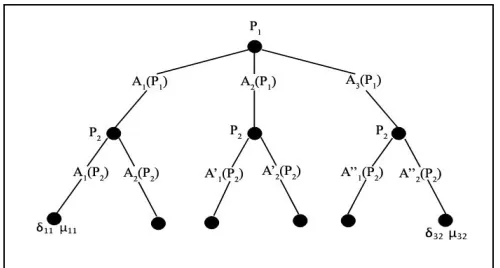
Consider the player P1 in Fig.2 has three feasible actions Fig. 1. Payoff matrix
4832 A1(P1), A2(P1) and A3(P1), Similarly for player P2 has two
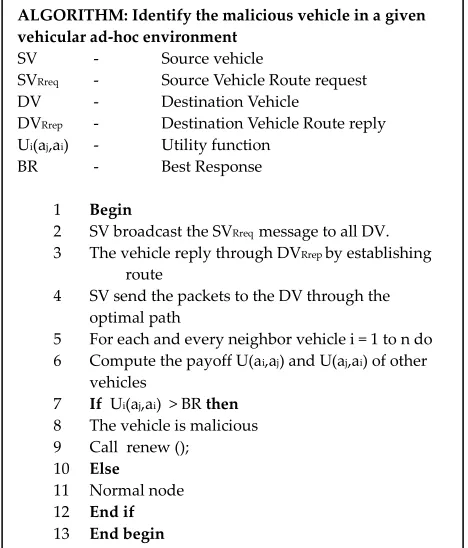
possible action A1(P2), A2(P2); A’1(P2), A’2(P2) and A’’1(P2), A’’2(P2). Player P1 begins the game, and the player P2 continues and so on. δ11 and µ11 denoted the payoff pair of P1 and P2 when they chose the actions one then 2. Every player can play by a particular set of possible responses. It is possible to continually play this zero-sum game between all networked vehicles until the MV is found. The security algorithm is shown in Fig.3. for detecting the malicious vehicle.
The payoff calculation for the malicious and genuine vehicle is calculated by following Fig.4 and Fig.5.
The NE of the game is achieved when both the player chooses the Best Response (BR). For example, when the MV tries to attack the GV and the GV decides the move away from that attack region, which appears to be a logical outcome for the DoS attack mitigation we discussed below.
4
SIMULATION
AND
RESULTS
We simulated our work in the Ns2 as a network simulator and SUMO as a mobility model, which provides the real vehicular traffic environment, and lastly, MOVE is used to create a traffic model. In our simulation, we created the vehicular environment consists of 200 vehicles in which the attackers may vary. The simulation parameters are listed in table 1. We also consider that the chance of an attacker's vehicle turning to a genuine one is negligible and of a GV becoming an attacker's.
We used the following metrics to determine the performance of our security game.
Packet Drop Ratio: Ratio of the Number of packets that never Parameters used for
simulation Values
Number of Vehicles 10-200
Grid Area 1000m x1000m
Antenna Omini directional
Transmission Range Dynamic
Vehicle speed 20 km/h, 30 km/h ,50 km/h, 70
km/h,100 km/h Number of malicious
vehicle 2,5,6,8
Simulation Time 1000 s
Traffic Type Constant Bit Rate (CBR)
Routing Protocol AODV
Type of MAC protocol IEEE 802.11 p INPUT : C[x][y] : Current region of vehicle
D[x][y] : Region of destination vehicle A[x][y] : Region of attacked area
OUTPUT : U(ai,aj) : Utility value of genuine vehicle
1 Begin 2 For x=1 to n do 3 For y=1 to n do
4 Compute { P[x][y]} set of place of the region belongs to optimal path from C[x][y] to D[x][y] 5 End for
6 End for
7 Extract the place of next region N[x][y] 8 if ( N[x][y] ϵ A[x][y] ) then
9 δ11= -4; δ12= +4; δ21= 0; δ22= -4; δ31= +1; δ32= -4 10 else
11 δ11= +3; δ12= +3; δ21= -4; δ22= -4; δ31= -4; δ32= -3 12 return δ11; δ12; δ21; δ22; δ31; δ32
13 U(ai,aj) = δ 14 End if 15 End begin
Fig. 4. Payoff Calculation for Genuine Vehicle
INPUT : V{ C[x][y] }: Set of available vehicle position in the Region C[x][y] ,where the attacker is there OUTPUT :Ui(aj,ai) : Utility value of malicious vehicle
1 Begin 2 For x=1 to n do 3 For y=1 to n do
4 if ( V[x][y] = NULL ) then
5 µ11= -4; µ12= +4; µ21= -4; µ22= +4; µ31= -4; µ32= +4 6 else
7 µ11= +3; µ12= -3; µ21= +4; µ22= -4; µ31= +1; µ32= -1 8 return µ11; µ12; µ21; µ22; µ31; µ32
9 End for 10 End for 11 U(aj,ai) = µ 12 End if 13 End begin
Fig. 5. Payoff Calculation for Malicious Vehicle ALGORITHM: Identify the malicious vehicle in a given
vehicular ad-hoc environment SV - Source vehicle
SVRreq - Source Vehicle Route request DV - Destination Vehicle
DVRrep - Destination Vehicle Route reply Ui(aj,ai) - Utility function
BR - Best Response
1 Begin
2 SV broadcast the SVRreq message to all DV. 3 The vehicle reply through DVRrep by establishing
route
4 SV send the packets to the DV through the optimal path
5 For each and every neighbor vehicle i = 1 to n do 6 Compute the payoff U(ai,aj) and U(aj,ai) of other
vehicles
7 If Ui(aj,ai) > BR then 8 The vehicle is malicious 9 Call renew ();
10 Else 11 Normal node 12 End if 13 End begin
4833 reached the destination to the number of packets originated by
the source. It is mathematically represented in the equation (1).
P P P DR
NS NR NS
P ( ) (1)
End to End Delay: The average time a data packet takes to reach the target i.e., the sum of differences of the arrival time of data packet and sent time of data packet, is divided by a total number of connections, which is provided in the equation (2).
n i
i t t D
n s a E
1
) (
(2)
Where ED is the End to end delay, at is the Arrival time of the data packet; St denotes sent time of the data packet, and n is the total number of all connections in the networks.
Throughput: It is the measure of the amount of data transmitted from the source node to the destination node in a unit period, which is formulated in equation (3).
duration Time
n destinatio to source from d transmitte bits of number Total n
T (3)
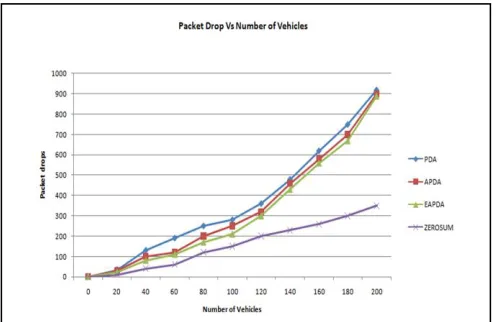
From the proposed game simulation, our results are compared with other methods like PDA, APDA, and EAPDA, which are projected in Fig.6, Fig.7, and Fig.8. The metrics allow us to evaluate the performance of the proposed game. The packet drop ratio of the proposed zero-sum game is proved to be minimized by 16.03%, 8.9%, and 5.9% when compared to PDA[11], APDA[12] and EAPDA[9] techniques. In comparison with PDA, APDA, and EAPDA techniques, the End to End delay of zero-sum games has been reduced to 16.25%, 10.1 %, and 7.15%. Likewise, The Throughput of the zero-sum game has been shown to increase in PDA, APDA, and EAPDA techniques by 15.9%, 10.09%, and 5.7%. The comparative analysis of the above three methods is projected in Table 2.
5 CONCLUSION
The Denial of Service attack detection in VANETs was discussed in this paper. We have provided a zero-sum security game concept for the detection of DoS attack. We have analyzed the behavior of the Vehicle by NE, which is obtained in the game to detect the DoS attack for securing the VANET environment. The performance of the zero-sum game is compared with PDA, APDA, and EAPDA technique. We trust this is very helpful in solving the DOS attack problem in VANETs.
TABLE2
COMPARATIVE ANALYSIS OF ZERO SUM GAME
Parameters PDA
(%)
APDA (%)
EAPDA (%)
ZERO SUM
(%)
Packet Drop Ratio
25.452 18.321 15.32 9.42
End to End Delay
18.512 12.363 9.41 2.26
Throughput 80.42 86.23 90.62 96.32
Proposed Zero Sum game achieved 9.42% of Packet Drop Ratio, 2,26%of End to End Delay,96.32% of Throughput when
compare to PDA,APDA & EAPDA
Fig. 6. Packet Drops vs Number of Vehicles.
Fig. 7. End to End Delay vs Number of Vehicles.
4834
6
REFERENCES
[1] Yu Liu, Cristina Comaniciu, and Hong Man, "A Bayesian Game Approach for Intrusion Detection in Wireless Ad Hoc Networks," ACM, ISBN: 1-59593-507-X, October 14, 2006.
[2] Yenumula B Reddy and S. Srivathsan, "Game Theory Model for Selective Forward Attacks in Wireless Sensor Networks," In the Proceedings of IEEE 17th Mediterranean Conference on Control and Automation, ISBN: 978-1-4244-4684-1, 24-26 June 2009.
[3] M. Felegyhazi and J.-P. Hubaux, "Game theory in wireless networks: A tutorial," Tech. Rep., 2006.
[4] T. Alpcan and S. Buchegger, "Security games for vehicular networks,"
[5] Mobile Computing, IEEE Transactions on, vol. 10, no. 2, pp. 280-290,
[6] 2011.
[7] H. Sedjelmaci, T. Bouali, and S. M. Senouci, "Detection and prevention from misbehaving intruders in vehicular networks," in Global Communications Conference (GLOBECOM), 2014 IEEE. IEEE, 2014, pp.39-44. [8] Yaser Taheri, HosseinGharaeeGarakani And
NaserMohammadzadeh, “A Game Theory Approach for Malicious Node Detection in MANETs” In the Proceedings of JISE, vol.32, ISSN 559-573, February 2016
[9] Basant Subba, Santosh Biswas, Sushant Karmakar, "A Game theory based multi layer intrusion detection framework for VANET," In Proceedings of Future
Generation Computer Systems, DOI:
https://doi.org/10.1016/j.future.2017.12.008, Dec 2017. [10] Muhammad Mohsin, Mehdi, Imran Raza,Syed Asad, "A
Game theory based trust model for vehicular Ad-hoc Networks,"In Proceedings of Computer Networks, DOI: http://dx.doi.org/10.1016/j.comnet.2017.04.024, April 2017
[11] Amarpreet , and Priya, “A novel mechanism for detecting DoS Attack in VANET using Enhanced Attacked Packet Detection Algorithm,” In Proceedings of RAECS UIET, Dec 2015.
[12] Viswacheda, Ali Chekima and Jamal, “Detection and Mitigation of DoS Attacks in VANET using Secured Minimum Delay Routing Protocol, In Proceedings of International conference on Soft Computing and Pattern Recognition, Advances in Intelligent Systems and Computing, DOI: 10.1007/978-3-319-60618-7_46,Springer, 2018
[13] Sushil Kumar, and Kulwinder, “Detection and Mitigation of Denial of Service Attacks in VANETs using Packet Detection Algorithm,” In Proceedings of International Journal for Research in Applied Science & Engineering Technology (IJRASET),ISSN:2321-9653,, Mar. 2018. [14] S. Roselin Mary, M. Thamaraiselvan and M.Maheshwari,