IJEDR1701012
International Journal of Engineering Development and Research (www.ijedr.org)68
Implementation of interleave Division Multiple
Access in Underwater Communication
Ankita Jhamb Student
AMITY University Gurugram
Abstract - A typical underwater communications has been established through transmission of acoustic waves. A challenge
in underwater acoustic communication is the long propagation delay, limited bandwidth, and signal fading issue. In recent years, several different techniques are used to resolve these challenges in underwater communication. In the paper, IDMA communication is implemented with QPSK modulation technique in underwater channel. In IDMA systems, the transmitter is required to transmit the interleaver matrix consisting of interleaving pattern along with spread data related to users, to the receiver. It is observed that IDMA has several advantages over CDMA and IDMA communication is far much better in terms of errors. Moreover, in this paper, different modulation techniques and different interleaving techniques is implemented for comparative analysis.
Keywords - IDMA, CDMA, Underwater communication, BER
I. INTRODUCTION
Since from the last few years, technologies have taken rapid growth to provide new methods and products for wireless communications. The ability to communicate with people on the move has evolved because of Guglielmo Marconi first demonstrated radios ability to provide continuous contact with ships sailing the English channel and since then new wireless communications methods and services have been adopted by people all over the world.
Cellular radio was mainly developed for offering phone services to mobile users. Now-a-days, it is engaged in even providing a variety of services, including video conferencing, music or movie appreciation, games, internet access, image processing. The demands and applications from subscribers stimulate the market and drive the technology for further growth. On the other hand, research and development department of communication engineering are undergoing a revolution due to rapid advances in technology. In India, cellular industry came into existence nearly in mid 1990s and since then the average growth rate per annum has been about 85 percent. By the end of 2002, the total number of cellular subscribers, in India, had increased to about 10 million subscribers. In addition to it, telecom customers have also been doubled during last two years from 300 million to 600 millio n. According to Reuters India, total mobile users in India, now, stand at 584.32 million, data from the sector regulator showed, behind only China that had 777 million at the end of March 2010.There is tremendous scope for researches in the area of wireless communication for improving the back-bone of communication systems as per the recommendations of International Telecommunication Union (ITU). One of the hot-cake areas for research is improvement in technology related to multiple access techniques with communication channels.
IJEDR1701012
International Journal of Engineering Development and Research (www.ijedr.org)69
II. RELATED WORK
Szczepanski et al.Today research interests in underwater (UW) communication and navigation technologies are steadily growing.
However, the design of robust UW communication and navigation systems demands a deep knowledge of the transmission medium. Acoustic UW (AUW) communication is widely used due to the good propagation characteristics of sound waves in water compared to electromagnetic waves that are highly attenuated. Besides its advantage - the low attenuation compared to electromagnetic waves - AUW communication suffers from multipath propagation, severe Doppler spread due to the low propagation speed of sound, and shadow zones, to name some of the most challenging effects. Evaluation of new communication devices under realistic conditions in sea trials is expensive and time-consuming. Therefore, a simulator modelling the AUW communication channel accurately is a valuable tool for development and evaluation of AUW communication devices. In this paper an Acoustic Underwater Channel and Network Simulator is proposed that uses ray tracing to model the AUW channel. It uses channel impulse responses (CIRs) generated by the BELLHOP ray tracing model to simulate multipath propagation. These CIRs for static constellations of receiver and transmitter are post-processed to be in agreement with the mobility of transmitters and receivers. Thereby, Doppler spread is introduced into the channel model. An empirical noise model is used to superimpose received signals with noise. Different modulation schemes can be evaluated using this AUW channel model in laboratory before expensive sea trials are conducted. In this paper a frequency hopping and an OFDM implementation are realized besides the channel model. Multiple mobile transmitters and receivers can be considered to simulate UW networks.
Andre Goalic et al, A highdata rate acoustic link has been developed by the GESMA. The Main objective of this project was to
create an acoustic communication link between anAWV(Autonomous Underwater Vehicle) and a surface vessel. This acoustic link must be sufficiently robust and improve underwater vehicles autonomy. The first years of this project were devoted to upstream studies .The goal was to choose the best solution able to deal with different perturbations generated by underwater acoustic channelAn equalizer developed and patented by the ENST Bretagne stood for a very good solution for thisapplication .An acoustic link was then developed to validate the whole communication between source dataemitter and receiver. Transmission part aswell asreception stage (hydrophones, amplifier) were designed by ORCA Instrumentation (SERCEL), a French company specialized in underwater acoustics modems. The receiver platform was developed by ENST Bretagne. The spatio-temporal equalizer called SOC-MI-DFE (Self Optimized Configuration Multiple Input Decision Feedback Equalizer) constitutes the receiver core. Some experiments were carried out in 2002 and 2003 to show some images, dataandtext transmissions. From now, GESMA plans to extend TRIDENT possibilities to low bit rate speech digital transmission. Existing andcommercial products are mostly based on analog communications; Digital transmission is expected to provide improved reliability. Duringour fistsea-trail, digitized speech by code excited linear predictive coding (CELP) clearly shown a better listening quality.
Clemens novarket al,Interleave-division multiple access (IDMA), recently proposed in, achieves user separation by means of user-specific interleavers combined with low-rate channel coding. The iterative IDMA multiuser detector derived in assumes perfect channel state information (CSI) at the receiver. In practice, however, pilot-assisted channel estimation is usually employed to obtain (imperfect) CSI. Here, we propose an iterative joint data detection and channel estimation algorithm for pilot-assisted IDMA for related work in the context of single-user systems). This algorithm is derived by applying the sum-product algorithm to the factor graph corresponding to the overall system. A low-complexity implementation of the receiver is obtained by means of Gaussian approximations to the messages propagated through the factor graph.
DeveePrasan.Uet al. At the end of 20th century, wireless sensor networks became hot research area. At starts, it covers only terrestrial applications, but we know the Earth is a water plant as more than 70 % of the surface is covered by the water and the largely unexplored vastness of the oceans has attracted human’s attention. From many decades, there have been significant interests in monitoring aquatic environments for scientific, commercial exploration and as well as for military operations. The largely unexplored vastness of the ocean, covering about two-thirds of the surface of Earth, has fascinated humans for as long as we have records. Recently, there has been a growing interest in monitoring aqueous environments (including oceans, rivers, lakes, ponds and reservoirs, etc.) for scientific exploration, commercial exploitation and attack protection. The ideal vehicle for this type of extensive monitoring is a networked underwater wireless sensor distributed system, referred to as Underwater Wireless Sensor Network (UWSN).
Evriclea Voudouri-Maniati et al. Bandwidth limitation in applications involving underwater acoustic communication networks
IJEDR1701012
International Journal of Engineering Development and Research (www.ijedr.org)70
and/or arrays of adaptive spatial-beamforming receivers that can also suppress inter-symbol interference. Power control is employed in radio communication to ensure that all user signals arrive at the base station with almost equal power. However, this approach is difficult to realize in underwater acoustics mainly due to the time-varying propagation properties and extensive latency of the channel, especially in shallow waters.Fang Xuet al, The underwater acoustic (UWA) channel is one of the most challenging environments to be encountered for the
communication. Multipath propagation and Doppler spread introduce time and frequency selective fades to the signals. Intersymbol interference (ISI) is seriously in UWA channel and it always extends over tens of milliseconds and it can affect several symbols. This dramatically limits the data rate achievable. In order to operate at higher data rate, there has been particular interest in the application of orthogonal frequency division multiplexing (OFDM) in UWA communication systems in the last ten years. In coded OFDM modulation and a block-data frequency domain equalizer based upon the minimum mean square error (MMSE) solution were studied. An outline of the COFDM UWA communication system and an adaptive receiver structure were investigated in. The author in presented design criteria for a practical OFDM UWA system. A 2D MMSE scheme was employed for channel estimation. In results of sea trials showed that OFDM was more robust in UWA channel than a direct sequence spread spectrum (DSSS) technique with the same environment parameters.
Lars Michael Wolffet al, in this paper a new AUW channel and network (AUWCN) simulator is proposed. The goal is to avoid
improper simplifications and to reproduce most effects existing in the physical AUW channel. Effects implemented in this simulator include, among others, attenuation, multipath propagation, Doppler spread, and shadow zones. Furthermore, long travel times of acoustic waves from transmitter to receiver call for special strategies in the development of network protocols for use in the AUW environment. Therefore, these travel times are considered by the AUWCN simulator in order to evaluate network protocols under this influence. This simulator also uses the BELLHOP ray tracing model, but instead of the transmission loss output, it uses the CIR option as in to model multipath propagation. These CIRs for fixed nodes are post-processed to simulate mobile nodes, differently. The remainder of this paper is organized as follows: gives a system overview. The AUW channel model with all realized effects is introduced.
Peter Kinget al introduced Developing a seabed underwater acoustic sensor network is a task filled with many challenges. One
challenge is providing reliable horizontal acoustic communication between nodes positioned in close proximity to the sea floor. To understand the potential communication rates between nodes, the theoretical limits that such communication links can support, as well as the factors that most affect these limits must be known. The channel capacity is a metric that is used to determine the theoretical maximum bit rate one can expect .The capacity of a communication link is directly calculated from its frequency dependant attenuation and noise characteristics. An underwater acoustic channel’s attenuation and noise are directly related to frequency, distance, transducer placement, and environmental characteristics. The goal of this work is to explore the theoretical capacity limits for a known environment and to determine how this capacity will react to changes in transducer placement and bottom bathymetry. The environment of interest in this study is in the North-Atlantic Ocean, off the coast of Newfoundland. This work also explores the use of the BELLHOP Gaussian beam tracing program to provide a more accurate model of a particular environment, through the use of available to ensure that a complete understanding of the target environment is attained, including the determination of possible performance expectations for the communication channel. The channel capacity can provide a theoretical maximum on what the channel performance will be although it is not currently attainable; it does serve as a means for comparison to other.
III. PROPOSED METHODOLOGY
A. IDMA scheme
In IDMA inter leavers as the only means in order to distinguish the users. Historical point of view, interleaving was employed in ordering block storage on disk-based storage devices including floppy disk and the hard disk systems. The primary preference of interleaving was to adjust the timing differences between the adjacent bits during data transmission between computer and storage media. Interleaving was very common prior to the 1990s, but, later, faded due to availability of high speed processors. Now-a-days, all the modern disk storage systems are not at all being interleaved. Multiple Access technique is one of the key techniques in the wireless communication system, especially in the cellular mobile communication systems .In communication systems, interleaving is commonly used to overcome correlated channel noise such as burst error or fading [2]. In interleaving mechanism, the input data streams rearranges itself such that consecutive data bits are split among different blocks and is swapped in a known pattern amongst them. At the receiver end, the interleaved data is arranged back into the original sequence with the help of de-inter leaver. As a result of de-interleaving, correlated noise introduced in the transmission channel appears to be statistically independent at the receiver and thus allows better error correction.
IJEDR1701012
International Journal of Engineering Development and Research (www.ijedr.org)71
defined correlation between inter leavers can be used to formulate a collision criterion, where zero cross-correlation (i.e., orthogonality) implies no collision .In case of IDMA systems, the transmitter is required to transmit the interleaver matrix consisting of interleaving pattern along with spread data related to users, to the receiver. So, greater the size of the interleaver, the more bandwidth and resources are consumed during transmission. Also, it is worth to be mentioned that greater the size of interleaver, more the orthogonality is achieved amongst interleaver.Fig.1:Block diagram of IDMA
IV. RESULT
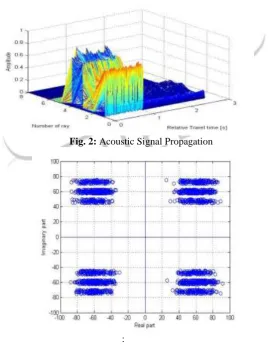
The implementation is done in the mathematical programming language MATLAB. In this paper, a system for underwater communications is presented. The system is based on the IDMA.MATLAB(.m) file scripting is learned and the implementation of IDMA on MATLAB scripting has been started and the IDMA transmitter has been successfully implemented. The acoustic signal propagation is characteristised as shown in fig.2. Also, BER rate for the Direct Path and QPSK States for Direct Path is shown in Fig2 respectively. The response behaviour of BER for Multi Path and QPSK state for underwater communication with IDMA are shown in Fig.3 and Fig. 4 respectively. CDMA BER and IDMA BER behaviour are shown in Fig. 5and Fig. 6 respectively.
Fig. 2: Acoustic Signal Propagation
:
IJEDR1701012
International Journal of Engineering Development and Research (www.ijedr.org)72
Fig. 4:BER for Multi Path and direct pathIn the multipath communication there is noise in the signal and the BER is also there but that is getting decreased to a good amount. When we transmit the data on direct path there will not be any noise present in the transmission, only there will attenuation of signal. So we have the BER equals to zero.
Fig. 4: QPSK state Minimal error QPSK states of the multi path communication
.
Fig 5.CDMA BER Fig.6 IDMA BER
V. CONCLUSION
IJEDR1701012
International Journal of Engineering Development and Research (www.ijedr.org)73
estimation was significantly refined by multiplexing the training symbols and multiuser signal. The receivers have been successfully tested and applied to experimental data transmitted over different ranges using QPSK. Extensive results at each scenario were compared and the adaptive IDMA demonstrated slightly improved performances compared to CDMA-based systems. Additionally, the iterative channel estimation is shown to be robust against severe channel fluctuation and it is limited with small processing gain. Therefore, the feasibility of using iterative receivers is worthy of further research as a strong candidate for Underwater communication.The BER (Bit Error rate) of CDMA underwater communication with reference to paper has been compared with the IDMA underwater channel result of our simulation in the current work. IDMA communication is far much better in terms of errors. IDMA demonstrated slightly improved performances compared to CDMA-based systems.In the present work we have implemented IDMA communication with QPSK modulation technique in underwater channel. The results are quite good as compared to the CDMA scheme. The further results can be improved using different modulation techniques and using different interleaving techniques. The comparative analysis can be proposed for different modulation and interleaving techniques.REFERENCE
[1] Wolff, Lars Michael, Erik Szczepanski, and Sabah Badri-Hoeher. "Acoustic underwater channel and network simulator."In 2012 Oceans-Yeosu, pp. 1-6.IEEE, 2012.
[2] Goalic, Andre, Joel Trubuil, and Nicolas Beuzelin. "Channel coding for underwater acoustic communication system." In OCEANS 2006, pp. 1-4.IEEE, 2006.
[3] Novak, Clemens, Franz Hlawatsch, and Gerald Matz. "MIMO-IDMA: Uplink multiuser MIMO communications using interleave-division multiple access and low-complexity iterative receivers." In 2007 IEEE International Conference on Acoustics, Speech and Signal Processing-ICASSP'07, vol. 3, pp. III-225.IEEE, 2007.
[4] Prasan, Devee U., and S. Murugappan. "Energy Efficient and QOS aware Ant Colony Optimization (EQ-ACO) Routing Protocol for Wireless Sensor Networks." International Journal of Distributed and Parallel Systems 3, no. 1 (2012): 257.
[5] Voudouri-Maniati, Evriclea. "Multiuser robust CDMA detection for underwater acoustic communication channels."In OCEANS'02 MTS/IEEE, vol. 1, pp. 612-618.IEEE, 2002.
[6] Bai, Li-yang, Fang Xu, RuXu, and Shao-yuZheng. "LDPC Application Based on CI/OFDM Underwater Acoustic Communication System."In 2009 First International Conference on Information Science and Engineering, pp. 2641-2644.IEEE, 2009.
[7] Wolff, Lars Michael, Erik Szczepanski, and Sabah Badri-Hoeher. "Acoustic underwater channel and network simulator."In 2012 Oceans-Yeosu, pp. 1-6.IEEE, 2012.