© 2017 IJEDR | Vo lu me 5, Issue 2 | ISSN: 2321-9939
IJEDR1702165 International Journal of Engineering Development and Research (www.ijedr.org) 979
Big Data Privacy Methods
Jayesh Surana
1, Akshay Khandelwal
2, Avani Kothari
3,
Himanshi Solanki
4, Meenal Sankhla
51
Assistant Professor (IT), Sri Vaishnav Institute of Technology & Science , M.P, India 2 Student,Sri Vaishnav Institute of Technology & Science, M.P, India
3 Student,Sri Vaishnav Institute of Technology & Science, M.P, India
4 Student,Sri Vaishnav Institute of Technology & Science, M.P, India 5Student,Sri Vaishnav Institute of Technology & Science, M.P, India
________________________________________________________________________________________________________
Abstract- Big data is a term use d for large and complex data sets that cannot be store d and pr ocessed using traditional data pr ocessing software. Since, big data re quire high computational power and storage, distri bute d syste m are use d. Big data Anal ytics is a ter m use d for deri vi ng some me aning ful and hi dden data fr om the l arge data sets. The data sets are collecte d fr om social me dia, he althc are centers, data governance, instituti ons, etc. Thus, pri vacy and security of the data bec ome the pri me concern. This paper focus on the pri vac y and security concerns and the proble ms in the pri vacy of big data. The pri vac y in big data is di vi de d into three stages -data generation, data storage and data processing. This paper also covers some tr aditi onal methods adopte d for pri vacy in big data, the challenges face d by these techni ques. The goal of this paper is to study the rece nt techni ques adopte d for pri vac y and dr aw their c omparison in or der to decl are the most efficient techni que among all of the m.
Index Terms-Big data Pri vac y and security Pri vac y preserving : k-anonymity: T-closeness, L-di versity, De-i de ntific ation.
________________________________________________________________________________________________________
I. IN TRO DUC TION
Big Data is used in many applications which use Predictive Intelligence that we humans exhibit in our everyday lives. The first and most prevalent exa mple is online advertising, where predicting our intent when we search or read documents on the web. Co mpanies use that data to provide focus add campaign and attract the target audience. For e xa mple if a user is surfing internet to buy a Came ra, web companies can look at your search patterns and publish an ad for nearby Camera stores and/or discounts available on Ca me ras in Online e-co mme rce portals.
II.PRIVACYANDS ECURITYCONCERNSINBIGDATA
Pri vac y: Information privacy is the privilege to have some control over how the personalinformat ion is collected and used.
Security: It is the practice of defending informat ion and informat ion assets through theuse of technology. S.
No.
Privacy Security
1. Privacy is the appropriate use of users information
Security is “confidentiality, Integrity, and availability” of data.
2. Privacy is the ability to decide what information goes where.
Security offers ability to be confident that decisions are respected.
3. The issue of privacy often applies to consumer rights to safeguard the data
Security may provide confidentiality. The overall goal of secured system is to protect an enterprise.
III. PRIVACY REQUIREMENTS IN B IG DATA
© 2017 IJEDR | Vo lu me 5, Issue 2 | ISSN: 2321-9939
IJEDR1702165 International Journal of Engineering Development and Research (www.ijedr.org) 980
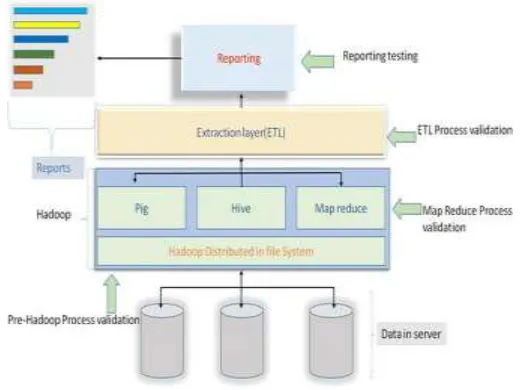
Fig. 1 Big data architecture and testing area ne w par adig ms for pri vac y confor mance testing to the four areas of the ETL (Extr act, Tr ansfor m, and Load) processes are shown here.
IV. BIG DATA PRIVACY IN DATA GENERATION PHAS E
Data generation can be classified into active data generation and passive data generation. The methods of privacy are as follows -
1. Access restriction.
If the data owner thinks that the data may uncover sensitive informat ion which is not supposed to be shared, it refuses to pr ovide such data.
2. Falsify ing data
By active data generation, we mean that the data owner will give the data to a third party, while passive data generation refers to the circumstances that the data are produced by data owner‟s online actions (e.g., browsing) and the data owner may not know about that the data are being gathered by a third party
V. BIG DATA PRIVACY IN DATA STORAGE PHASE
Due to the numerous technologies available to handle the enormous a mount of data, it is very challenging to store data privat ely.
Appr oaches to pri vac y preservati on storage on cloud
Attribute based encryption: Access control is based on the identity of a user to have wholesome access over all resources.
Ho mo morphic encryption: Can be deployed in ABE (Attribute Based Encryption in which key or c ipher te xt is dependent on attributes like residential address) scheme settings, updating cipher te xt rece iver is possible.
Usage of Hybrid clouds: Hybrid cloud is a cloud computing environment which utilizes a blend of on -premises, private cloud and third-party, public c loud services with organizat ion between two platforms.
VI. B IG DATA PRIVACY PRES ERVING IN DATA PROCESS ING
For privacy protection in data processing part, division can be done into two phases .In the first phase, the goal is to safeguard informat ion fro m unauthorized disclosure. In the second phase, the aim is to e xtract meaningful in formation fro m the da ta without violating the privacy.
Traditional Me thods of Pri vac y
De-i dentification is a tradit ional technique for privacy preserving data mining. In this method the data either go through the generalization or suppression method. In generalization the quasi-identifiers are replaced with more general but consistent values and in suppression some data is not revealed and is hidden by *. In order to prevent data from re-identification, the concepts of k-anonymity, l-diversity and t-closeness have been introduced.
Some co mmon terms used in privacy fields of these methods -
1. Identifie r Attribute- attributes that uniquely identify the individuals e.g.-PA N, no, na me , social security no etc.
© 2017 IJEDR | Vo lu me 5, Issue 2 | ISSN: 2321-9939
IJEDR1702165 International Journal of Engineering Development and Research (www.ijedr.org) 981 3. Sensitive attribute- The information wh ich is private and personal to the individual co mes under sensitive data e.g. salary, disease etc.
4. Equ ivalence classes - are the group of all records that have same value on the quasi-identifiers.
K-anonymity
The table is said to have k-anonymity if every record in the table is similar to at least k-1 other records with respect to every set of quasi-identifiers.
Non Anonymized table containing patient records
There are two regular technique for co mpleting K-anonymity for so me value of k
1 .Genera lization-The attribute „age‟ can be written in more general and broader form.eg age „19‟can be written as <=20.
2. Suppression- In this method some values of the attribute are hidden using * symbol. For e.g. some values of zip code can be hidden using astrik. Thus, the 4-anonymous version table of table-1 can be written as-
Table-1
Table-2 Li mitation-
1. K-anonymity is insufficient to prevent attribute disclosure.
2. It can suffer fro m Ho mogeneity attack and background knowledge attack.
L-di versity
An equivalence class is said to have L-diversity if there are at least “well-rep resented” values for the sensitive attribute.
If one knows Peter salary is in range of 3k-5k then one can conclude that he has some stomach -re lated disease. Thus, leakage of sensitive information occur wh ich give rise to more efficient method called t -closeness.
Li mitati ons:
1. L-d iversity is difficu lt to achieve
2. L-diversity is insufficient to prevent attribute disclosure.
Name Age Zip code Disease Priyash 29 47677 Heart Disease
Ram 24 47602 Heart Disease Rohan 28 47905 Flu Pranjal 27 47909 Cancer Aayush 24 47607 Cancer
Name Age Zip code Disease
Priyash 20 <age<=30 476** Heart Disease Ram 20 <age<=30 476** Heart Disease
Rohan 20 <age<=30 4790* Flu
© 2017 IJEDR | Vo lu me 5, Issue 2 | ISSN: 2321-9939
IJEDR1702165 International Journal of Engineering Development and Research (www.ijedr.org) 982 Table-3
Table-4(diverse version of table-3)
T-cl oseness
It is a fu rther imp rovement of l-diversity group based on annoymization that is used to preserve privacy in data sets by decreasing the granularity of a data representation
An equivalence class is said to have t-closeness if the distance between the distribution of a sensitive attribute in this class and the distribution of the attribute in the whole table is no more than a threshold .
Limitation-It does not deal with identity disclosure.
Comparison of the me thods -
VII. REC ENT TECHNIQUES IN B IG DATA PRIVACY Differential pri vacy
Diffe rential privacy is one of the effective methods to deal with privacy threats .In this model the personal information is not revealed or modified by the analyst to use. The analyst does not have any access to the informat ion directly instead an intermediary is used which serve as a privacy guard. The privacy guard takes up the queries from the analyst and gives the result with little distortion. When the privacy risk is low we can think of the distortion as inaccuracies that are small enough that it does not affect the quality of the answer but it is la rge enough to protect the individual privacy.
Steps in diffe rential privacy are as fo llo ws -
Step 1- The analyst can ma ke a query to the database through this intermediary privacy guard. Age Salary Disease
29 3k Gastric ulcer
22 4k gastritics 23 5k Stomach cancer
52 6k Flu
43 11k pneumonia 36 8k bronchitis
Age Salary Disease 2* 3k Gastric ulcer 2* 4k Gastritics 2* 5k Stomach cancer
>=40 6k Flu >=40 11k Pneumonia >=40 8k bronchitis
© 2017 IJEDR | Vo lu me 5, Issue 2 | ISSN: 2321-9939
IJEDR1702165 International Journal of Engineering Development and Research (www.ijedr.org) 983 Step 2- The privacy guard takes the queries and procees it using the databse.
Step 3-The privacy guard then gets the answer fro m the database.
Step 4- The privacy guard add little distortion to the data, then finally provide to the data analyst.
Advantages
1. The origina l data is not modified or revea led to th e end user.
2. There is no need of generalizat ion and suppression techniques.
3. The response is distorted based on the level of risk without affecting the quality of response.
4. The distortion is added in such a way that value hidden is useful to analyst.
VIII.CHALLENGES TO S ECURITY AND PRIVACY IN B IG DATA
Increased Potential for La rge-scale Theft or Breach of Data
Increased Potential for La rge-scale Theft or Breach of Data
Long Term Availab ility of Sensitive Datasets
Data Qua lity/Integrity and Provenance Issues
Unwanted Data Corre lation and Infe rences
Algorith mic Accountability
IX. MOST S IGNIFICANT PRIVACY RIS KS
1. Privacy breaches and embarrassments 2. Anonymizat ion could become impossible
3. Data masking could be defeated to reveal personal info. 4. Unethica l actions based on interpretations.
5. Big data analytics are not 100% accurate. 6. Discrimination.
7. Fe w legal protections exists for indiv iduals 8. Big data will probably e xist forever.
X CONCLUS ION
Big data is large amount of data which is unorganized and unstructured. Big data privacy is very important issue in while organizing big data. In this paper we have studied different methods of securing big data in three phases i.e. data generation, data storage and data processing and drawn a conclusion of best method among them. So, diffe rent methods of privacy preserving methods may be studied and imp le mented in future. There is the lot of future scope in the privacy of big data methods.
REFER ENC ES
[1] Han J, Ishii M , Makino H. A hadoop performance model fo r mu lti -rack clusters. In: IEEE 5th international conference on computer science and informat ion technology (CSIT). 2013
[2] Xu L, Jiang C, Wang J, Yuan J, Ren Y. In formation security in b ig data: privacy and data mining. IEEE Access. 2014
[3] Sokolova M, Mat win S. Personal privacy protection in time of big data. Berlin: Springer; 2015
[4] Li N, et al. t-Closeness: privacy beyond k-anonymity and L-diversity. In : Data engineering (ICDE) IEEE 23rd international conference; 2007.
[5] Machanavajjhala A, Gehrke J, Kife r D, Venkitasubramania m M. L-diversity: p rivacy beyond k-anonymity. In: Proc. 22nd international conference data engineering (ICDE); 2006
[6] http://download.microsoft.com/…/Differential_Privacy_for_ Everyone.pdf.