R E S E A R C H
Open Access
Optimization of a two-way MIMO
amplify-and-forward relay network
Ying Zhang
1*, Yinjiang Chen
1, Chuanyi Pan
1, Huapeng Zhao
2and Ning Kang
1Abstract
In this paper, we consider optimization of a two-way multiple-input multiple-output (MIMO) amplify-and-forward relay network which consists of a pair of transceivers and several relay nodes. Multiple antennas are equipped on the transceivers and relays. Multiple access broadcast scheme which finishes communication in two time slots is considered. In the first time slot, signals received by the relays are scaled by several beamforming matrices. In the second time slot, the relays transmit the scaled signals to the two transceivers. Upon receiving these signals, a MIMO equalizer is implemented at each transceiver to recover the desired signal. In this paper, zero forcing equalizers are used. Joint optimization of the beamforming matrices and the equalizers are realized using the following criteria: 1) the total relay transmission power is minimized subject to the minimal output signal-to-noise ratio (SNR) constraint at each transceiver, 2) the minimal output SNR of the two transceivers is maximized subject to total relay transmission power constraint, and 3) the minimal output SNR of the two transceivers is maximized subject to individual relay transmission power constraint. It is shown that the proposed optimization problems can be formulated as the second-order cone programming problems which can be solved efficiently. The validity of the proposed algorithm is verified by computer simulations.
Keywords: Amplify-and-forward; Beamforming; Multiple-input multiple-output; Relaying; Second-order cone programming; Zero-forcing
Introduction
Relaying technique is capable of extending communica-tion range and coverage by providing link to shadowed users via relay nodes, and it received extensive study in recent years. For collaborative relaying technique, the net-work with a single pair of users and multiple relay nodes equipped with single antenna has been widely investi-gated [1-7]. Zheng [1] assumed perfect knowledge of channel-state information (CSI) and proposed to opti-mize the beamforming vector by maximizing the desti-nation signal-to-noise ratio (SNR) subject to total and local relay transmission power constraints. In [2], sim-ilar optimization criterion was used in the case that only the second-order statistics of CSI are available. In [3,4], quantized CSI was considered. Quantizer at each relay and beamforming vectors at destination were opti-mized to minimize the uncoded bit error rate. In [5],
*Correspondence: [email protected]
1College of Electronic Engineering, University of Electronic Science and Technology of China, Xiyuan Avenue, 610066 Chengdu, China Full list of author information is available at the end of the article
the minimizing mean square error (MMSE) criterion was adopted to optimize the beamforming coefficients. The advantage of this algorithm lies in its ability to adap-tively allocate transmission power of each relay. In recent, a so-called filter-and-forward distributed beamforming technique was proposed in [6]. Different from previ-ous algorithms, this method solved the problem of relay beamforming in frequency selective environments, where a finite impulse response filter is used at each relay. Apart from the above mentioned one-way scheme, a two-way relaying strategy was proposed in [7]. In a two-two-way relaying scheme, the relays cooperate with each other to establish the connection between two transceivers. The design of the beamformer should simultaneously satisfy the requirements from the two transceivers. In [8], an optimization strategy was proposed to optimize the per-formance of a two-way single-input single-output relaying network.
Multiple relay nodes create a virtual multiple-input multiple-output (MIMO) environment at the relay layer.
With multiple antennas equipped at transmitting and receiving nodes, user nodes can also employ advantages of MIMO techniques, such as spatial multiplexing, space-time coding, and beamforming. Attracted by these mer-its, more and more algorithms are proposed to optimize MIMO relay networks [9-14] and virtual MIMO relay networks [15-18]. Most of these algorithms consider one-way communication scheme, where various optimization criteria are adopted, such as maximizing the destination SNR and minimizing the total system/relay transmission power, MMSE, ZF (zero force), etc. For a single pair of users and multiple relays, a unified algorithm which computes the optimal linear transceivers jointly at the source node and the relay nodes for two-way amplify-and-forward (AF) protocols was proposed [14]. The opti-mization algorithm was designed based on maxiopti-mization of sum rate and MMSE. In [16], a two-way scheme was considered for a relay network with multiple users and single relay. The network was optimized using MMSE criterion at the destination subject to power constraint on relays.
In this paper, we consider a two-way MIMO relay net-work with one pair of transceivers and multiple relays, where the two transceivers are each equipped with M
antennas, and every relay is equipped withN antennas. We assume that relays receive the mixture of signals from two transceivers in the first time slot. With perfect CSI, relays scale the received signals and then transmit these signals to the transceivers in the second time slot. Finally, a MIMO equalizer is used at each transceiver to recover the desired signal. To achieve power-efficient communi-cation, beamforming coefficient matrices are optimized based on three criteria which are designed based on the minimal output SNR and relay transmission power. Mean-while, the MIMO equalizer is optimized by imposing the ZF constraint. It is shown that the proposed optimiza-tion problems can be formulated as the second-order cone programming (SOCP) problems, which can be effi-ciently solved using the cvx toolbox [19]. Contributions of this paper are summarized as follows. First, two-way communication scheme of a MIMO relay network con-sists of multiple relays with multiple antennas is firstly considered. Second,the proposed optimization problem is formulated as an SOCP problem which can be solved efficiently.
The rest of this paper is organized as follows. The ‘Problem formulation’ section presents the problem for-mulation. The ‘Mathematical approximation’ section develops mathematical preparation for optimizing the considered relay network, and ‘Optimization of the proposed relay network’ section gives a detailed optimiza-tion procedure to derive the optimal beamforming and equalization matrices. In the ‘Computer simulations’ section, computer simulations are conducted to
demon-strate validity of the proposed algorithm. Finally, conclu-sions and discusconclu-sions are presented in the ‘Concluconclu-sions’ section.
Notation
Bold lower case is used for vectors, while bold capital let-ters for matrices.Idenotes the unit matrix,∗denotes the complex conjugate operation,Tdenotes the matrix trans-position operation, andHdenotes the complex conjugate transposition operation. tr(A) is the trace of matrix A. vec(A)stacks the columns ofAinto a single column vec-tor.⊗denotes the Kronecker product, and(A0⊕. . .⊕AN) yields a block diagonal matrix with block elements given byAi.
Problem formulation
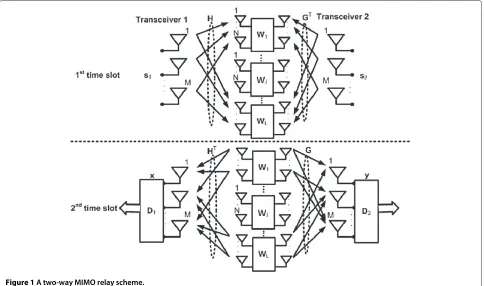
Figure 1 depicts a two-way MIMO relay scheme, where
Wi (i = 1, 2,. . .,L)is the beamforming matrix for the ith relay and Dj (j = 1, 2) is the equalizer for the jth transceiver. Transceiver 1 and transceiver 2 are both equipped with Mantennas. It is supposed that Lrelays equipped with N antennas are used. Flat fading chan-nels are considered. We assume that no direct link exists between the two transceivers. The channel matrix from transceiver 1 to the ith relay is denoted as Hi (i =
1, 2,. . .,L), and the one from theith relay to transceiver 2 is denoted asGi, whereHi ∈ CN×M andGi ∈ CM×N
consist of independent complex Gaussian variables. It is assumed that these channels are reciprocal, i.e., the channel matrix from the ith relay to transceiver 1 is
HTi , and the one from transceiver 2 to the ith relay is
GTi . In the first time slot, each transceiver sends mes-sages to theLrelays. With the knowledge of Hi andGi (which can be obtained via training), Wi is computed. In the second time slot, the relays scale the received signals according to Wi and then transmit these sig-nals to the two transceivers. After receiving sigsig-nals, a MIMO equalizer denoted as Dj, j = 1, 2 is used at each transceiver. The aim of this paper is to optimize the performance of the relay network by designing Wi
andDj.
The mixture of signals received by theith relay can be expressed as
ri=His1+GTi s2+vi, (1)
where s1ands2 are transmitted signals with covariance
Figure 1A two-way MIMO relay scheme.
In the second time slot, transceiver 1 and transceiver 2 each receives
x=
L
i=1
HTiWiri+vx, (2a)
= L
i=1
HTiWiHis1+
L
i=1
HTi WiGTis2
+ L
i=1
HTi Wivi+vx,
y =
L
i=1
GiWiri+vy (2b)
= L
i=1
GiWiHis1+ L
i=1
GiWiGTi s2
+ L
i=1
GiWivi+vy,
where vx and vy denote AGN at transceiver 1 and transceiver 2, and their covariance matrices are assumed to beσx2Iandσy2I, respectively.s1 ands2are known by
transceiver 1 and transceiver 2, respectively. If Gi, Hi, and Wi are available to transceivers, terms containing
s1 ands2 can be subtracted from Equations 2a and 2b,
respectively. Equations 2a and 2b are then rewritten as
x=
L
i=1
HTi WiGTi s2+ L
i=1
HTi Wivi+vx, (3a)
y=
L
i=1
GiWiHis1+ L
i=1
GiWivi+vy. (3b)
A MIMO equalizer is used at each transceiver; thereby, the restored signal after equalization is expressed as
s2=D1x, (4a)
s1=D2y. (4b)
Based on Equations 1 to 4, the total relay transmission power and terminal SNRs are defined as follows:
1) Total relay transmission power:
Pr =
L
i=1
EWiri22
(5)
= L
i=1
P1tr
WiHiHHi WHi
+ P2tr WiGTi G∗iWHi
+σ2 vtr
WiWHi
2) Terminal SNR at transceiver 1:
3) Terminal SNR at transceiver 2:
SNR2=
In subsequent sections,Pr, SNR1, and SNR2will be used
to optimize beamforming matrices and MIMO equalizers.
Mathematical approximation
From (5) to (7), it seems difficult to directly evaluateWi andDjbecause they appear in both signal and noise terms. Therefore, before designing beamformers, three lemmas are derived to makeWiandDjsolvable.
Lemma 1. Total relay transmission power can be ex-pressed as a quadratic function ofw:
Pr=P1wHHw+P2wHGw+σv2wHw, (8)
are defined. The notation ofhikandgikis given in the proof.
Proof. From (5), the kth column of (WiHi) can be expressed ashTik⊗IN
wi, wherehik denotes thekth col-umn of matrixHi. Therefore, the trace of
way of (9) and substituting it and (9) into (5) yield
Pr = P1
Using the definitions in Lemma 1, (8) can be derived.
SNR constraint is usually used in optimizing a relay net-work. For our problem, constraints on destination SNRs are expressed as
SNR1≥γ1, (10a)
SNR2≥γ2, (10b)
whereγ1andγ2 are required SNRs at transceiver 1 and
transceiver 2, respectively. From (6) and (7), it is seen that (10) is related toWiandDjin a complicated form. In the rest of this section, two lemmas are derived to transform (10) into a manageable form.
The ZF constraint requires that
D1
whereD1andD2are defined as the left pseudoinverse of L
i=1HTi WiGTi and L
Lemma 2. From definitions ofD1andD2given above, if
Proof.It is straightforward to show that
D1DH1 =
Suppose that the eigendecomposition ofH∗HTis given by
In (15), the diagonal ofconsists ofMnonzero eigen-values. The matrixUconsists of all the eigenvectors cor-responding to these nonzero eigenvalues.Uconsists of column vectors which are linearly dependent on columns ofU. The dependence of eigenvectors is caused by rank deficiency ofH∗HTwhose effective rank isM.
We define W = W GT, and assume that W can be represented by the complete orthogonal basis in theNL -dimensional space, whereUis contained in the complete orthogonal basis, i.e., Morthogonal basis of theNL-dimensional space, which can be obtained via Gram-Schmidt procedure based onU.
Substituting (15) and (16) into (14) yields
D1DH1 = H H⊥ U
From (17), it is seen that
tr|DH1D1
andUconsists of eigenvectors ofGHGcorresponding to its nonzero eigenvalues.
Lemma 3. Inequalities (10) can be relaxed as
σ2
i,hiandQare defined in the following proof.
Proof.With the ZF constraint, (6) and (7) can be
From the property of tr(.), we may relax the inequality Substituting (18) into (21) yields
SNR1≥
P2M
tr(B)Mi=1|φ1
ii|2σi
. (22)
From (16) and the definition ofW, we have
= UHW=UHW GT (23)
Therefore, the elements ofcan be represented by
φij=vec(W)H
Similarly, for SNR2, we have
SNR2≥ can be expressed by
φij=vec(W)H
I⊗u∗ihj, (26)
whereuidenotes theith column ofUandhjdenotes the
jth column ofH. It is assumed that the eigendecomposi-tion ofGHGisUUH.
Similar to Lemma 1, the trace of B and B can be expressed as
tr(B) = σv2wHHw+Mσx2, (27a) tr(B) = σv2wHGw+Mσy2, (27b)
where the definitions ofHandGare given inLemma 3.
Substituting (24) and (27a) into (22) and (26), and (27b) into (25) yields
From (28), (10) can be relaxed as
P2M
If every term on the right side of (29a) and (29b) is smaller thanP2
γ1 and
P1
γ2, respectively, i.e.,
P2
(29) can be satisfied.
BecauseWis block diagonal matrices, there are many zero elements in vec(W), which do not contribute to the calculation of (30). SupposeQis chosen such that
w=Qvec(W) (31)
holds.
To derive (30), we have make assumption thatDH1D1
andDH2D2should be diagonal. From (17), we may achieve this by forcingto be a diagonal matrix. Therefore, the following equations should be satisfied:
φij = vec(W)H
With (30) to (33) and definitions given in Lemma 3, (20) can be derived.
Optimization of the proposed relay network
Minimizing the total relay transmission power subject to individual minimal output SNR constraint and ZF constraint Using this criterion, the optimization problem is formu-lated as
min
w Pr, (34a)
subject to(SNR1)lower≥γ1, (SNR2)lower≥γ2. (34b)
where (SNR1)lower and (SNR2)lower denote the minimal
output SNR at transceiver 1 and transceiver 2, respec-tively.
Theorem 1. (34) can be approximated as an SOCP prob-lem given as
tor of the left side of (20a) can be represented as
U2w22. Similarly, we defineEi =
, the nominator of the left side
of (20b) can be represented as U3w22. Using these definitions, (20a) and (20b) can be expressed as
U2w22≤ w
Then, withLemma 3, (35) can be derived.
Maximizing the minimal output SNR of transceivers subject to total relay transmission power constraint and ZF constraint
Assuming that the minimum SNR required by the two transceivers is t, the optimization problem can be formulated as
max
w t, (38a)
subject to(SNR1)lower≥t, (SNR2)lower≥t, Pr≤P. (38b)
where P denotes the maximal total relay transmission power.
Proof. It can be easily obtained fromLemmas 1to3and
Theorem 1.
Because (39) is quasi-convex, for any given value oft, it becomes the following SOCP problem:
findw, (40a)
subject to (39b) to (39i). (40b)
The bisection search procedure can be applied to solve (40).
Maximizing the minimal output SNR of transceivers subject to individual relay transmission power constraint and ZF constraint
The optimization problem is given as
max
w t, (41a)
subject to(SNR1)lower≥t, (SNR2)lower≥t, (41b)
Pri≤Pi, i=1, ..,L, (41c)
where Pi denotes the maximal transmission power of the ith relay, and Pri = P1tr
WiHiHHi WHi
+ P2tr
WiGTi G∗iWHi +σv2trWiWHi .
Theorem 3. (41) can be approximated as an SOCP problem:
max
w t, (42a)
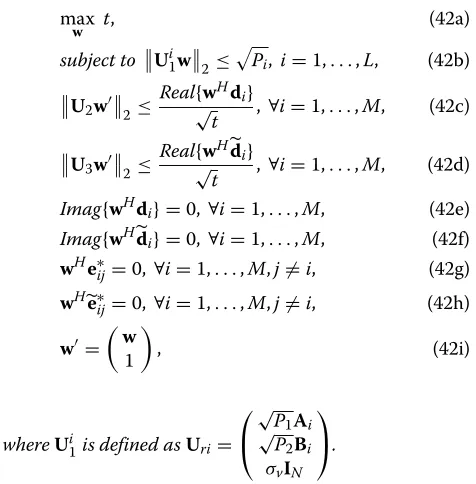
subject to Ui1w2≤Pi, i=1,. . .,L, (42b) U2w2≤ Real{w
Hd i} √
t , ∀i=1,. . .,M, (42c) U3w2≤ Real{w
Hd i} √
t , ∀i=1,. . .,M, (42d) Imag{wHdi} =0, ∀i=1,. . .,M, (42e) Imag{wHdi} =0, ∀i=1,. . .,M, (42f)
wHe∗ij=0, ∀i=1,. . .,M,j=i, (42g)
wHe∗ij=0, ∀i=1,. . .,M,j=i, (42h)
w=
w
1
, (42i)
whereUi1is defined asUri= ⎛ ⎝
√ P1Ai √
P2Bi
σvIN ⎞ ⎠.
Proof. It can be easily obtained fromLemmas 1to3and
Theorem 1.
For any given value oft, (42) reduces to the following SOCP probelm:
findw, (43a)
subject to (42b) to (42i). (43b)
Similar to the solution of (40), (43) is solved by the bisec-tion search procedure.
Computer simulations
In order to verify the validity of the proposed algorithm, we devise the following simulation scenario. The num-ber of antennas of transceiver 1, transceiver 2, and relays
is assumed to be M = N = 3, and the number of
relays is L = 10. The communication channel coeffi-cients are modeled by complex Gaussian variables with zero mean and varianceσh2andσg2. The two transceivers transmit independent data streams from different anten-nas with P1 = P2 = 0 dB. AGN on each antenna is
assumed to be complex Gaussian variable with zero mean and unit variance, i.e.,σx2 = σy2 = σv2 = 0 dB. Sources are generated from a QPSK constellation. The values of SNR are computed from 100 independent trials for each plot. Furthermore, the power consumption to increase the minimal output SNR2 for 2 dB becomes smaller as the
value ofγ1increases, which means the derived minimal
output SNR approaches the output SNR as the value of SNR increases. Therefore, less additional power consump-tion is needed to increase the same amount of output SNR. This phenomenon can also be demonstrated by Figure 2.
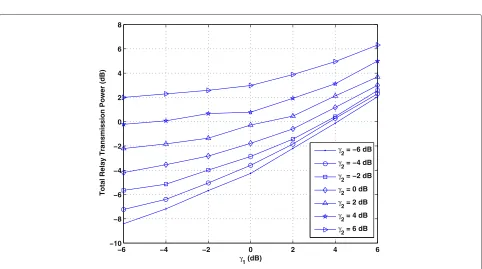
Minimizing the total relay transmission power subject to individual minimal output SNR constraint and ZF constraint We assume thatσh2=σg2=0 dB. Figure 3 depicts the total relay transmission powerPr against the value ofγ1. It is
observed that the required transmission power increases as the value ofγ1increases. Also, for a givenγ1, the total
relay transmission power increases with the increase ofγ2.
Figure 2 shows the cumulative distribution function (CDF) of the output SNR at transceiver 2 with different values ofγ2. In Figure 2, the value ofγ2is assumed to vary
from−6 to 6 dB with 2 dB stepsize. From the figure, we see that for a givenγ2, the output SNR at transceiver 2 does
not change significantly with the variation ofγ1, and the
output SNR2is about 2 to 3 dB higher than the value of
γ2with 90% probability. This is reasonable since the
pro-posed optimization problem uses the minimal output SNR instead of the real output SNR. It can be seen that the dif-ference between the real output SNR2andγ2decreases as
the value ofγ2increases, which is in accordance with the
phenomenon observed in Figure 3.
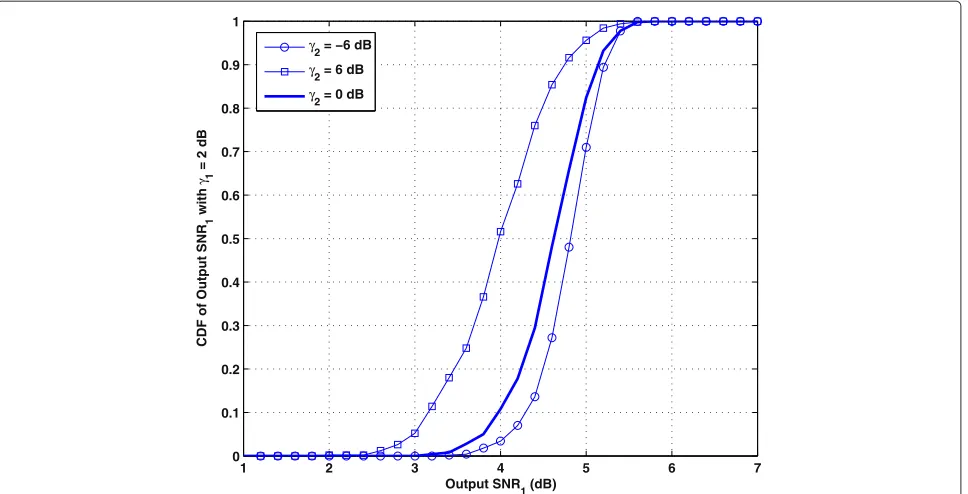
Figure 4 plots the CDF of output SNR1 with different
−4 −2 0 2 4 6 8 10 12 0
0.1 0.2 0.3 0.4 0.5 0.6 0.7 0.8 0.9 1
Output SNR
2 (dB)
CDF of Output SNR
2
(dB)
γ2 = −6 dB γ2 = −4 dB γ2 = −2 dB γ2 = 0 dB γ2 = 2 dB γ2 = 4 dB γ2 = 6 dB
Figure 2CDF of the output SNR at transceiver 2 with different values ofγ2.
−6 −4 −2 0 2 4 6
−10 −8 −6 −4 −2 0 2 4 6 8
γ1 (dB)
Total Relay Transmission Power (dB)
γ2 = −6 dB γ2 = −4 dB γ2 = −2 dB γ2 = 0 dB γ2 = 2 dB γ2 = 4 dB γ2 = 6 dB
1 2 3 4 5 6 7 0
0.1 0.2 0.3 0.4 0.5 0.6 0.7 0.8 0.9 1
Output SNR1 (dB)
CDF of Output SNR
1
with
γ1
= 2 dB
γ2 = −6 dB
γ2 = 6 dB γ2 = 0 dB
Figure 4CDF of the output SNR at transceiver 1 with different values ofγ2.
withγ2 = 6 dB is less than that with γ2 = −6 dB. It
is known that Pr is allocated to the relays such that the two transceivers can simultaneously meet the required SNR. It can be concluded from Figure 4 thatPrallocation tends to emphasize maximizing the output SNR which has higher requirement under the condition that the lower SNR requirement can be satisfied. Therefore, SNR1can
achieve a higher average value when γ2 = −6 dB than
whenγ2=6 dB.
Maximizing the minimal output SNR of transceivers subject to total relay transmission power constraint and ZF constraint
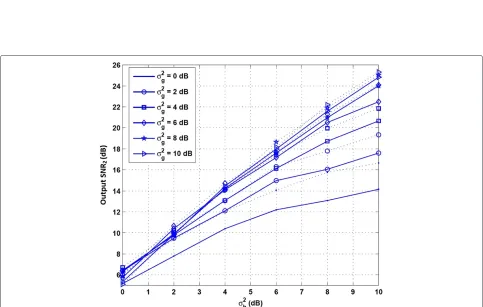
Figure 5 depicts the output SNR at transceiver 1 with the value of σh2 changing from 0 to 10 dB. Total relay transmission powers of 0 and 5 dB are considered. It is found that for a given σh2, the output SNR1 increases
with the increase of σg2, while for a given σg2, SNR1
does not keep increasing with the increase of σh2. This is because as the quality of channels between transceiver 1 and the relays improves, i.e.,σh2increases, the desired transmission power at transceiver 2 to guarantee its out-put SNR increases [2]. Due to limitation of total relay transmission power, the output SNR at transceiver 1 can not increase consistently. When the quality of channels between transceiver 2 and the relays improves, the output SNR1increases with the increase ofσh2.
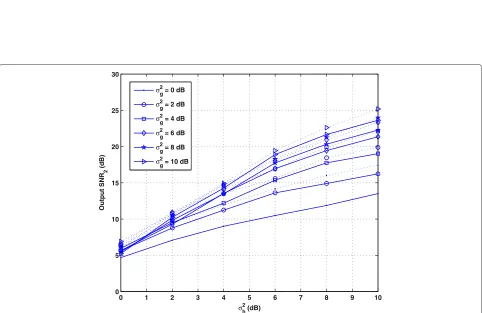
Figure 6 shows the same plot for output SNR2. It is
observed that the output SNR2increases with the increase
ofσh2, it while does not increase with the increase ofσg2 especially whenσg2 is high andσh2is relatively low. The reason is the same as that for SNR1versus σh2. Also, as
noticed from Figures 5 and 6, the output SNR1and SNR2
increases with the increase of the total relay transmission power.
Maximizing the minimal output SNR of transceivers subject to individual relay transmission power constraint and ZF constraint
In this simulation, we assume that the total relay transmis-sion power is uniformly allocated to the relays. Figures 7 and 8 show the output SNR versus the value of σh2 with individual relay powers of−10 and 0 dB. It is noted that these plots are similar to those with total relay transmis-sion power constraint. With the increase of individual relay transmission power, output SNRs at transceiver 1 and transceiver 2 increase. Compared with Figures 5 and 6, it is found that the output SNR1and SNR2are slightly
lower with individual power constraint than those with total power constraint. This is because individual power constraint is more restrictive than the total power con-straint.
Conclusions
Figure 5OutputSNR1versus the value ofσh2.Solid line: with total relay transmission power of 0 dB, dash line: with total relay transmission power of 5 dB.
Figure 6OutputSNR2versus the value ofσh2.Solid line: with total relay transmission power of 0 dB, dash line: with total relay transmission power
0 1 2 3 4 5 6 7 8 9 10 5
10 15 20 25 30
σh2 (dB)
Output SNR
1
(dB)
σg 2
= 0 dB
σg2 = 2 dB σg2
= 4 dB
σg2 = 6 dB σg2
= 8 dB
σga = 10 dB
Figure 7OutputSNR1versus the value ofσh2.Solid line: with individual relay transmission power of−10 dB, dash line: with individual relay
transmission power of 0 dB.
0 1 2 3 4 5 6 7 8 9 10
0 5 10 15 20 25 30
σh2 (dB)
Output SNR
2
(dB)
σg2 = 0 dB
σg2 = 2 dB σg2
= 4 dB
σg2 = 6 dB σg2
= 8 dB
σg 2
= 10 dB
Figure 8OutputSNR2versus the value ofσh2.Solid line: with individual relay transmission power of−10 dB, dash line: with individual relay
efficiently. Computer simulation demonstrates validity of the proposed algorithm. Furthermore, it is straightfor-ward to see that the proposed algorithm can be imple-mented distributively as long asUandUare broadcasted to all the relays. With w replaced by wi, U1 replaced
byUri,U2 replaced by
σvCi 0
0T σx
, and U3replaced by
σvDi 0
0T σy
, (35), (39), and (42) can be solved at each
relay. The performance of distributed implementation will be analyzed in our future work.
Competing interests
The authors declare that they have no competing interests.
Acknowledgements
The author wishes to acknowledge the financial support of the National Science Foundation of China through Grant No. 61101094 and No. 61201275.
Author details
1College of Electronic Engineering, University of Electronic Science and
Technology of China, Xiyuan Avenue, 610066 Chengdu, China.2Department
of Electronics and Photonics, Institute of High Performance Computing, Fusionopolis Way, Singapore 138632, Singapore.
Received: 12 May 2014 Accepted: 8 December 2014 Published: 30 December 2014
References
1. G Zheng, Collaborative-relay beamforming with perfect CSI: optimum and distributed implementation. IEEE Signal Process Lett.16(4), 257 (2009) 2. V Havary-Nassab, S Shahbazpanahi, A Grami, Z-Q Luo, Distributed
beamforming for relay networks based on second-order statistics of the channel information. IEEE Trans. Signal Process.56(9), 4306 (2008) 3. MM Abdallah, HC Pagadopoulos, Beamforming algorithms for
implementation relaying in wireless sensor networks. IEEE Trans. Signal Process.56(10), 4772 (2008)
4. E Koyuncu, Y Jing, H Jafarkhani, Distributed beamforming in wireless relay networks with quantized feedback. IEEE J. Selected Areas Commun.
26(8), 1429 (2008)
5. N Khajehnouri, AH Sayed, Distributed MMSE relay strategies for wireless sensor networks. IEEE Trans. Signal Process.55(7), 3336 (2007) 6. H Chen, AB Gershman, S Shahbazpanahi, Filter-and-forward distributed
beamforming in relay networks with frequency selective fading. IEEE Trans. Signal Process.58(3), 1251 (2010)
7. V Havary-Nassab, S Shahbazpanahi, A Grami, Optimal distributed beamforming for two-way relay networks. IEEE Trans. Signal Process.
58(3), 1238 (2010)
8. H Chen, Beamforming Optimization for Two-Way Relay Channel (2014). p. 28–31
9. Y Rong, Optimal joint source and relay beamforming for MIMO relays with direct link. IEEE Commun. Lett.14(5), 390 (2010)
10. B Khoshnevis, W Yu, R Adve, Grassmannian beamforming for MIMO amplify-and-forward relaying. IEEE J. Selected Areas Commun.
26(8), 1397 (2008)
11. W Guan, H Luo, Joint MMSE transceiver design in non-regenerative MIMO relay systems. IEEE Commun. Lett. J.12(7), 517 (2008)
12. Y Rong, F Gao, Optimal beamforming for non-regenerative MIMO relays with direct link. IEEE Commun. Lett. J.13(12), 927 (2009)
13. AS Behbahani, R Merched, AM Eltawil, Optimization of a MIMO relay network. IEEE Trans. Signal Process.56(10), 5063 (2008)
14. K-J Lee, H Sung, E Park, I Lee, Joint optimization for one and two-way MIMO AF multiple-relay systems. IEEE Trans. Wireless Commun.
9(12), 3671 (2010)
15. A El-Keyi, B Champagne, Adaptive linearly constrained minimum variance beamforming for multiuser cooperative relaying using the Kalman filter. IEEE Trans. Wireless Commun.9(2), 641 (2010)
16. J Joung, AH Sayed, Multiuser two-way amplify-and-forward relay processing and power control methods for beamforming systems. IEEE Trans. Signal Process.58(3), 1833 (2010)
17. R Zhang, C Choy Chai, Y-C Liang, Joint beamforming and power control for multiantenna relay broadcase channel with QoS constraints. IEEE Trans. Signal Process.57(2), 726 (2009)
18. O Oyman, AJ Paulray, Design and analysis of linear distributed MIMO relaying algorihms. IEEE Proc. Commun.153(4), 565 (2006) 19. M Grant, S Boyd, cvx user’s guide for cvx version 1.21 (build 790).
http://cvxr.com/cvx/. Accessed 16 July 2013
doi:10.1186/1687-6180-2014-184
Cite this article as:Zhanget al.:Optimization of a two-way MIMO amplify-and-forward relay network.EURASIP Journal on Advances in Signal Processing20142014:184.
Submit your manuscript to a
journal and benefi t from:
7Convenient online submission 7Rigorous peer review
7Immediate publication on acceptance 7Open access: articles freely available online 7High visibility within the fi eld
7Retaining the copyright to your article