Page 299
THE EFFECT OF INFORMATION SOURCES ON THE DIETARY HABITS OF THE ELDERLY PEOPLE WITH TYPE 2 DIABETES MELLITUS
Silvie Treterová1,2
1Palacký University Olomouc, Faculty of Health Sciences, Hněvotínská 976/3, 775 15 Olomouc, Czech Republic
2Tomas Bata University in Zlín, Faculty of Humanities, Department of Health Care Sciences, Štefánikova 5670, 760 01 Zlín, Czech Republic
Abstract
The purpose of this research was to establish the links between dietary habits, body composition and information sources in relation to seniors with type 2 diabetes mellitus in the Zlín Region in the Czech Republic. Selected sample (n = 100; 60 women and 40 men) with the medical diagnosis of type 2 diabetes mellitus. The average age of respondents was 76 years. A controlled interview was used and an InBody 270 bioimpedance analyser was used to evaluate body composition. The elderly people with type 2 diabetes mellitus are most often informed about the required nutritional regimen by their diabetes specialist, 59.0 % of respondents; 27.0 % of respondents believed that they adhere to the required nutritional regimen on a level of 90.0 %; 63.0 % regularly monitor their weight. According to calculation of their BMI index, 33.0 % of respondents were overweight and 46.0 % of respondents were obese. The amount of fat in the bodies of 72.0 % of respondents was evaluated as excessive by the InBody 270 bioimpedance analyser. Only one quarter of respondents were found to have dietary habits complying with the required nutritional regimen. The elderly people with type 2 diabetes mellitus must be repeatedly educated about their nutritional regimen and guided towards adopting improved dietary habits.
Keywords: dietary habits, diabetes mellitus 2. type, elderly people, information sources, education, diabetic diet
1. INTRODUCTION
Diabetes is a public health problem that is increasing worldwide. According to the International Diabetes Federation (IDF), there were 58 million individuals with diabetes in Europe in 2017. This number is expected to increase by 16 % by 2045, reaching a value of 67 million people with diabetes. The incidence of new cases of diabetes mellitus also shows a rising tendency, there were 113,734 patients in 2017 and the number of new cases is rising by approximately 4,447 year-on-year. Prevalence was 936,124 (88 per 1,000 persons) in 2017 and there is an average of 13 thousand new patients a year. Type 2 diabetes mellitus (DM) predominates among patients, and reached a value of 84.0 % in 2017 (International Diabetes Federation 2017).
The aetiology of diabetes is complex and linked to irreversible risk factors, such as age, genetics, race and ethnicity, and reversible factors, such as food, physical activity and smoking. Diabetes can be controlled by education, improvement of knowledge, the patient’s attitude and procedure and should be part of the complex care of these patients (Forouhi et al. 2018; Karen et al. 2018).
Page 300
complications, contributes towards reduction of the median life expectancy, on average by 3 to 7 years (Weber et al. 2014; Czech Statistical Office 2018).
The Czech Republic currently has a population of 10.5 million, two million of which are aged 65 and over (18.8 %). According to the demographic curve the number of seniors is increasing, the population is aging and the number of people living to a higher age is growing. At present more than one third of seniors suffer from diabetes mellitus, in most cases this concerns type 2 DM, up to 95.0 % of seniors aged over 70 suffer from this disease. A prevalence of diabetes of over 20.0 % is estimated in the population aged over 65 (Karen et al. 2018, p. 3; Czech Statistical Office 2018).
2. MATERIALS AND METHODS
The selected sample consisted of seniors suffering from type 2 diabetes mellitus living in the region of East Moravia in the Czech Republic, being treated at the diabetology clinics of regional hospitals and the surgeries of general physicians in the Zlín Region. A total of 100 (100.0 %) of respondents took part in the research, 60 (60.0 %) of whom were women and 40 (40.0 %) men. The youngest male and female respondents were aged 60, the oldest male respondent was aged 87 and the oldest female respondent was aged 89 years.
All the respondents had a record of education about their nutritional regimen in their medical documentation, at an interval of between 1 month and 1 year. It was established which of the healthcare workers educated the respondents about their dietary regimen (general practitioner, diabetes specialist and general nurse, educational nurse), and whether there were any links between the duration of treatment and influence of the dietary regimen. The links between the subjective indicator of adherence to a dietary regimen and the objectively established parameters obtained using bioimpedance analysis by an InBody 270 device, BMI and the percentage of fat, were also established.
Hypotheses
1H0 There is no link between the variables of adherence to dietary regimen according to the subjective
opinion of the respondents and the objective parameter of body mass index (BMI), at a level of significance of p = 0.05.
1HA There is a link between the variables of adherence to dietary regimen in the subjective evaluation
of the respondents and the objective parameter of BMI, at a level of significance of p= 0.05.
2H0 There is no link between the variables of adherence to dietary regimen according to the subjective
opinion of respondents and the objective parameter of percentage of body fat, at a level of significance of p=0.05.
2HA There is a link between the variables of adherence to a dietary regimen according to the subjective
evaluation of respondents and the objective parameter of the percentage of body fat, at a level of significance of p = 0.05.
Excel statistical functions and analytical tools were used for analysis. A scaling of qualitative variables was performed. The results were described using descriptive statistics. The position, variability and concentration characteristics were determined and the characteristics of the file were estimated. A normal probability distribution was used to balance statistical data, including statistical hypothesis testing using the Kolmogorov-Smirnov test for quantitative data and Chi-square for qualitative data.
3. RESULTS
Page 301
Age and sex Men Women Total
n % n % n %
60 - 64 years 10 25.0 28 46.0 37 38.0 65 - 69 years 10 25.0 20 34.0 30 30.0
70 - 74 years 12 30.0 7 12.0 19 19.0
75 - 79 years 5 12.0 2 3.0 7 7.0
80 - 84 years 2 5.0 1 2.0 3 3.0 85 – 89 years 1 3.0 2 3.0 3 3.0
Total 40 100.0 60 100.0 100 100.0
Table 1. Age and sex of respondents Source: Author 2019
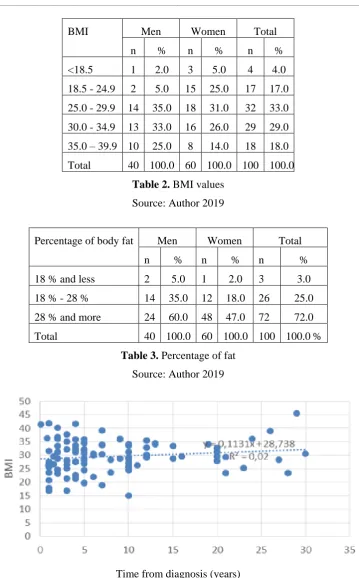
Even though the seniors state that they endeavour to follow dietary recommendations, they do not exceed 60.0 % statistically and their established objective parameters, BMI and the percentage of fat, show that their weight is increasing towards the boundary of obesity.
The youngest male and female respondents were aged 60 years, the oldest male respondent was aged 87 and the oldest female respondent was aged 89. The sample consisted of 9.0 % seniors who had been diagnosed with this disease the longest, over 20 years, 15-20 years - 8.0 %; 10-14 years – 17. 0 %; 5-9 years – 24.0 %, 39.0 % of the respondents were diagnosed 1-4 years ago; 3.0 % were diagnosed less than a year ago. 72.0 % of respondents were treated for type 2 diabetes mellitus at diabetology clinic, 28.0 % were treated at a general practitioner for adults; 81.0 % of respondents were acquainted with their required dietary regimen, 11.0 % of respondents stated that they had not been acquainted at all and 8.0 % of respondents did not remember any instruction on their nutritional regimen. Only 5.0 % of those who stated that they had been educated received a recommendation to lose weight.
Seniors were most often informed about their dietary treatment by their diabetology specialist in 59.0 % of cases; 28.0 % of respondents were treated by a general practitioner, but only 11.0 % of them stated that they had been educated; the general nurse at the diabetology clinic educated 14.0 % of respondents about nutritional recommendations and 4.0 % of respondents at the general practitioner’s surgery. None of the respondents stated that they had been educated by a nutritional therapist. 55.0 % of seniors, most often women in 63.0 % of cases, actively and independently sought out information about dietary recommendations; 33.0 % of respondents stated that they received knowledge from other sources than healthcare, without actively seeking this information themselves and it was provided by relatives. If seniors actively sought out information, 44.0 % of them found new information on the internet and 31.5 % of respondents in educational leaflets or brochures.
Page 302
BMI Men Women Total
n % n % n %
<18.5 1 2.0 3 5.0 4 4.0 18.5 - 24.9 2 5.0 15 25.0 17 17.0
25.0 - 29.9 14 35.0 18 31.0 32 33.0
30.0 - 34.9 13 33.0 16 26.0 29 29.0
35.0 – 39.9 10 25.0 8 14.0 18 18.0 Total 40 100.0 60 100.0 100 100.0
Table 2. BMI values Source: Author 2019
Percentage of body fat Men Women Total
n % n % n %
18 % and less 2 5.0 1 2.0 3 3.0
18 % - 28 % 14 35.0 12 18.0 26 25.0
28 % and more 24 60.0 48 47.0 72 72.0 Total 40 100.0 60 100.0 100 100.0 %
Table 3. Percentage of fat Source: Author 2019
Time from diagnosis (years)
Fig. 1. Correlation between the time from diagnosis and BMI Source: Author 2019
The variance is great in both surveys, there is no link between variables at a level of significance of p = 0.05. In both cases H0 remains valid. The coefficient of correlation between the time from diagnosis and
Page 303
and body fat percentage is not shown because of very similar results to the correlation between the time from diagnosis and BMI (Figure 1). We do not consider there to be a proven link between the variables in either of the cases.
4. DISCUSSION
Recommended dietary treatment procedures for patients with diabetes state that dietary regimen measures as part of a complex therapy are assured by the diabetes specialist in cooperation with a nutritional therapist and a general or educational nurse. The technical conditions for dietary treatment of diabetes are chiefly the appropriate educational materials. 80.0 % of our respondents were educated about dietary nutritional recommendations, the remaining respondents stated that they were not educated or did not remember the education process (Karen et al., 2018; Forouhi, 2018).
Seniors also stated that they were not educated by a nutritional therapist, even though a nutritional therapist does provide this education at the regional hospital and her record was in the patients’ documentation. We believe that the seniors either did not remember this meeting, or were not adequately informed that the education was being provided by a nutritional therapist. In the Czech Republic every healthcare worker is required to provide information according to competence based on specific acts and decrees (Act No. 372/211 Sb., Decree by the Ministry of Health of the Czech Republic No. 137/2018 Sb.) and also on the basis of Patient Rights and the Convention on Human Rights and Biomedicine. A record must also be made of provision of information in the medical documentation (Juřeníková 2018, p. 72). Effective communication with patients of senior age is a skill that it is difficult to prepare for within the terms of undergraduate education and this skill does not always receive sufficient attention. Communication is the route to effective provision of information and the basis of education. The terms “awareness” and “education” are sometimes confused in healthcare practice. Awareness means knowledge of something or possibly instruction about something. The availability of information and its completeness is objectively determined (Pokorná 2010). We consider education to mean a process of intentional influence of the behaviour and actions of an individual, with the goal of inducing changes to this individual’s knowledge, attitudes and habits, so that this individual is willing to positively influence to his health or maintain it on a level that keeps the quality of life as high as possible. The provided information should be objective, comprehensible and appropriate with regard to mental abilities, age and individual particularities (Krátká, 2017; Juřeníková 2018, p. 70).
An effective dietary regimen in relation to diabetes is conditional to the monitoring of weight, glycaemia and glycated haemoglobin, blood fat and blood pressure and kidney function. If the set goals cannot be achieved, the regimen must be modified in relation to other treatment measures. Most factors with a positive impact on human health are related to nutrition. A great number of the symptoms of type 2 diabetes in seniors can be positively affected by suitable nutrition and lifestyle, similarly to compensation of diabetes and its consequences. Incorrect nutrition, particularly excessive consumption of salt, the inappropriate composition of fats, excessive consumption of energy and insufficient consumption of fruit and vegetables all have a considerable impact on a number of diseases, affect human activity and increase the risk of premature death (Jirkovská et al. 2012; Pelikánová & Bartoš 2018, p. 28).
Our sample is a small sample and we are aware that the range of values of the measured results is too great, but we still feel the need to draw attention to this issue. The senior population is growing and the number of people suffering from diabetes is also increasing. If we do not change the attitudes of healthcare workers in relation to awareness and education, we will continue to encounter the problematic attitude of seniors suffering from diabetes not only towards the dietary regimen. It is necessary to establish the level of the knowledge, skills, habits and the attitude of seniors suffering from diabetes and to establish their needs. We need to compile data about the scope of the aforementioned steps, and purposefully plan education and require that all members of a multi-disciplinary team are involved on the basis of their competence (Abdelhafiz &Sinclair 2013; Špatenková & Smékalová 2015).
Page 304
compensation of diabetes, while following a diet complying with one’s own production of insulin, with pharmacological treatment of diabetes and physical activity, energy consumption leading to prevention and treatment of excess weight and obesity, management of catabolic situations in relation to the disease, prevention and treatment of acute complications, e.g. hypoglycaemia and later complications of diabetes, e.g. diabetic nephropathy, hypertension and other cardiovascular diseases. It is necessary to complexly focus on improvement of the overall state of health. In order to ensure an effective result, an individual approach to the dietary regimen is necessary with regard to personal preferences on the basis of cultural habits and life style for example. Dietary treatment fails most often if inadequate dietary education is provided and the diet is not individualised sufficiently. Lack of clear goals of the dietary treatment and their regular inspection by self-monitoring and insufficient regular physical activity may also be causes of failure. Psycho-social factors, for instance the patient’s distrust of dietary treatment, depression and social and economic factors, also play a role (Chentli et al. 2015, Wagner & Patlejchová 2017).
Following a diet often requires major changes to lifestyle, which can only be achieved by systematic education and potentially effective psychotherapy and the entire family’s involvement in dietary education. This is why the patient’s and his family’s cooperation with the physician, nutritional therapist and educational nurse is essential. Dietary recommendations must be individualised and their effectiveness must be regularly examined in the form of food diaries, changes to weight, compensation of diabetes, lipid levels and blood pressure. Use of modern technologies, computer teaching programmes and installation of the nutritional content of foods and dishes in a mobile telephone or tablet is also recommended. Education at an equipped educational centre for diabetes sufferers ensuring complex education of the diabetes sufferer is a higher level. Group education programmes focusing on diet, so-called conversion maps, possibly consultancy services provided by a nutritional therapist, should also be available at these educational centres (Jirkovská et al. 2015; Czech medical association of J. E. Purkyně, 2017; Štefánková & Lacigová 2017).
5. CONCLUSIONS
A major factor negatively affecting the willingness of patients to cooperate with us and be involved in their healthcare is lack of information and knowledge. Other factors may also be insufficient motivation and lack of knowledge of their importance to health. When endeavouring to improve compensation of diabetes by means of dietary measures it is essential to respect the quality of life of seniors suffering from diabetes, to individualise dietary recommendations according to the specific requirements placed on a specific senior with regard to the need for metabolic check-ups, the risk of diabetes complications and the quality of life. In order to improve the compliance of senior diabetes sufferers in relation to dietary treatment it is necessary to set individual treatment goals and take into consideration the person’s individual habits and therefore determine basic, re-educational and complex education. Longer-lasting improvements can be achieved by regular education, which all the members of a multi-disciplinary team will be involved in according to their competence.
REFERENCES
1. Abdelhafiz, AH & AJ Sinclair 2015, Management of Type 2 Diabetes in Older People, viewed 20 July 219, <https://www.ncbi.nlm.nih.gov/pmc/articles/PMC3687094/>.
2. Karen, I et al. 2018, Diabetes mellitus, Czech Medical Association of J. E. Purkyně, viewed 2 February 2019, <https://www.svl.cz/files/files/Doporucene-postupy/2017/DP-DM-2018.pdf. >. 3. Chentli, F et al. 2015, Diabetes Mellitus in Elderly, viewed 31 July 2019,
<http://www.ijem.in/article.asp?issn=22308210;year=2015;volume=19;issue=6;spage=744;epage =752;aulast=Chentli >.
Page 305
5. Juřeníková, P et al. 2018, “Selected Perioperative Problems of Vascularsurgical Patients”, Brno: Masaryk University, Czech Republic.
6. Krátká, A 2017, “Basics of Pedagogy and Education in Nursing”, Zlín: Thomas Bata University. 7. Jirkovská, A et al. 2012, Recommended Dietary Treatment for Diabetes Patients, viewed 18 April
2019-04, <http://www.diab.cz/dokumenty/standard_dietni_lecba.pdf>.
8. International Diabetes Federation 2017, IDF diabetes atlas. 8th ed. IDF, viewed 15 July 2019, <www.diabetesatlas.org>.
9. Czech Medical Association of J. E. Purkyně 2017, Recommended Dietary Treatment for Diabetes
Mellitus 2. Type, viewed 15 July 2019,
<http://www.diab.cz/dokumenty/standard_lecba_dm_typ_II.pdf>.
10. Forouhi, NG et al. 2018, Dietary and nutritional approaches for prevention and management of type 2 diabete, viewed 18 July 2019, <https://www.ncbi.nlm.nih.gov/pmc/articles/PMC5998736/>.
11. Pelikánová, T & V Bartoš 2018, “Practical diabetology“, Prague: Maxdorf. 12. Pokorná, A 2010, “Communication with seniors”, Prague: Grada.
13. Špaténková, N & L Smékalová 2015, “Education of seniors: geragogics and gerontodidactics”, Prague: Grada.