Page | 61 IMPLEMENTATION OF E-COMMERCE BASED ON CLOUD COMPUTING USING ASP.NET
TECHNOLOGY
Samson Oluwaseun Fadiya
Department of Management Information Systems Girne American University
University Drive, Girne Mail: [email protected]
Emeka Joshua Chukwuemeka
Department of Information and Communication Technologies in Education Eastern Mediterranean University
Gazimağusa
Mail: [email protected]
Odeh Acheme Okolobia
Department of Management Information Systems Girne American University
University Drive, Girne Mail: [email protected]
Turkey
Abstract:
In this paper, the client is given an e-commerce website that is utilized as a part of a cloud domain to discover the store and its locations online. To actualize this as a web application, we utilized ASP.NET as the Technology. ASP.NET has a few preferences, for example, improved execution, scalability, built-in security and simplicity.To build any web application utilizing ASP.NET we require a programming language, for example, C#, VB.NET, J# and so on. VB.NET was the language used to build this application. For the customer browser to associate with the ASP.NET engine, we utilized Microsoft's Internet Information Services (IIS) as the Web Server. ASP.NET utilizes ADO.NET to interact with the database as it gives in-memory caching that takes out the need to contact the database server as often as possible and it can without much of a stretch send and keep up an ASP.NET application. MSSQL was utilized as back-end database since it gives quick data access, easy installation, and simplicity.
Keyword: ASP.NET, Database, E-Commerce, Web Server, Visual Basic .NET.
1. Introduction:
The objective of this paper is to develop commerce store. In the previous paper titled “Business Impact of E-Commerce based on Cloud Computing”, the system analysis was done based on the concept developed in the journal titled “E-Commerce on Cloud Computing: Propose Concept Systems Analysis and Design”.
A Web store must be overseen as both a business and a website, and most e-commerce hosting companies offer software and services to offer us some assistance with doing only that. For example service providers can offer their customers Password and encryption insurance of Web store transactions and client records, and utilize firewalls and security monitors to repel hacker assaults and other security dangers if a sale with MasterCard is applicable.
Page | 62 opportunities for business innovation. Companies can use the Internet and related technologies extensively as a global and cost effective program for e-commerce. This paper focuses on the implementation of the system concept and design as previously discussed in paper 1 and two respectively.
2. Implementation of the System:
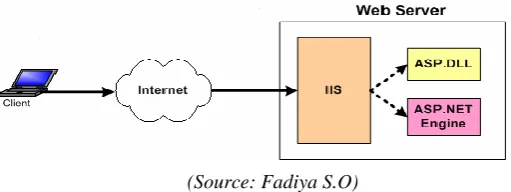
When the user types in the URL of the Store in the address field of the browser, a Web Server is contacted to get the requested data. The main thing IIS does when a request comes in is to decide how to handle the request. Its choice is based upon the requested file's extension. For instance, if the requested file has the .asp extension, IIS will route the call to be taken care of by asp.dll. If it has the extension of .aspx, .jx, and so on, it will route the call to be taken care of by the ASP.NET engine.
(Source: Fadiya S.O)
Figure 1. Client browser interacts with the Web Server
The ASP.NET Engine later receives the demanded file, and if significant connect the database within ADO.NET for the needed file and then the data is sent back to the Client’s browser. Figure 1 indicates how a client browser interacts with the Web server and how the Web server handles the request from the customer.
2.1. Internet Information Services (IIS):
IIS is an arrangement of Internet-based services for Windows machines. Originally supplied as a component of the Option Pack for Windows NT, they were subsequently blended with Windows 2000 and Windows Server 2003). The contemporary (Windows 2003) variant is IIS 6.0 and incorporates servers for FTP (a software model for assigning computer files connecting computers with broadly diverse operating systems). Simple Mail Transfer Protocol is the pattern for email communication over the Internet) and HTTP/HTTPS (is the protected version of HTTP, the communication protocol of the World Wide Web), Shklar, L., & Rosen, R. (2009).
Features: The web server itself cannot immediately implement server side processing but can assign the responsibility to ISAPI (Application Programming Interface of IIS) applications on the server. Microsoft contributes some these covering for Active Server Page and ASP.NET.
Compatibility: Internet Knowledge Services is intended to operate on Windows server operating systems. A modified variant that supports one website and a limited number of connections are also supplied with Windows XP Professional. Microsoft has likewise changed the server account that IIS keeps running on. In versions of IIS before 6.0, all the features were run under the System account, permitting exploits to operate wild on the system. Supporting 6.0 many of the methods have been caused by a Network Services account that has fewer privileges.
Specifically, this implies, if there were an exploit on that component, it would not necessarily compromise the entire system.
2.2. ASP.NET
Page | 63 to build powerful Web applications. ASP.NET has numerous points of interest – both for software engineers and for the end user because it is compatible with the.NET Framework. This similarity permits the clients to utilize the accompanying features through ASP.NET:
A. Effective database driven functionality: ASP.NET permits software engineers to create web applications that interface with a database. The advantage of ASP.NET is that it is object-oriented and has many programming tools that allow quicker improvement.
B. Active web applications: Two features of ASP.NET deliver it quick compiled the code and caching. In ASP.NET the code is compiled into "machine language" before a guest ever goes to the website. Caching is the warehouse of data in memory for high speed access in the future. ASP.NET enables programmers to establish pages or sections of pages that are regularly re-used to be accumulated for a set period to improve the performance of web applications. Likewise, ASP.NET permits the caching of data from a database, so the website is not backing off by successive visits to a database when the data does not change all the time. C. Memory leak and crash security: ASP.NET consequently recovers from memory leaks and errors to make sure that the website is always available to the visitors. ASP.NET also supports code written in more than 25.NET languages (including VB.NET and Jscript.Net).
2.3. Microsoft SQL Database:
In this, Microsoft SQL is utilized as the backend database. Microsoft SQL is an open source management system. The elements of Microsoft SQL are given below:
Microsoft SQL is a relational database management system. A relational database stores information in different tables, rather than in one giant table. These tables can be referenced to one another, to access and keep up information effortlessly.
Microsoft SQL is an open source database system. The database software can be utilized and modify by anybody as indicated by their needs.
It is fast, reliable and straightforward to utilize. To enhance the performance or execution, Microsoft SQL is a multithreaded database engine. A multithreaded application performs numerous tasks at the same time as if multiple instances of the application that were running at the same time (Simultaneously).
In being multithreaded Microsoft SQL has numerous advantages. A different string handles each incoming connection with an additional thread that is always running to manage the links. Multiple customers can perform read operations simultaneously, but while writing, only holds up another client that needs access to the data being updated. Despite the fact that the strings have the same process space, they execute separately and in light of this partition, multiprocessor machines can spread the thread across many CPUs as long as the host operating system supports multiple CPUs. Multithreading is the key element to bolster Microsoft SQL's performance design objectives. It is the core element around which Microsoft SQL is built.
Page | 64 2.4. Integrating IIS and ASP.NET:
At the point when a request comes into the IIS Web server, its extension is analyzed and, in light of this extension, the application is either taken care of straightforwardly by IIS or steered to an ISAPI expansion. An ISAPI extension is an accumulated class that is introduced on the Web server and whose obligation is to give back the markup for the requested file type. Khosravi, S. (2007) as a matter of course, IIS handles the request and just returns the contents of the required file. On the other hand, this makes sense for static files, like images, HTML pages, XML files, external.
JavaScript files, and so on. For example, when a request is made to a .html file, IIS, just returns the contents of the required HTML required.
For records whose content is dynamically generated, the ISAPI extension configured for the file extension is responsible for generating the content for the requested file. For example, a website that serves up excellent ASP pages has the .asp augmentation mapped to the asp.dll ISAPI expansion. ASP.DLL, ISAPI extension performs the requested for ASP page and returns it generates HTML markup. If the Web web page serves up ASP.NET Web pages, IIS has mapped the .aspx to aspnet_isapi.dll, an ISAPI extension that begins the process of producing the rendered HTML for the requested ASP.NET Web page as proposed by Nadkarni, P. M., Brandt, C. M., & Marenco, L. (2000). The ASP.NET engine strikingly like IIS in many points of view. Much the same as IIS has a directory mapping file extensions to ISAPI extensions; the ASP.NET engine maps file extensions to HTTP handlers. An HTTP handler is a bit of managed code that is responsible for producing the markup for a specific file type.
2.5. Integrating the Website and Database:
In a static Web page, content is determined at the time when the page is created. As clients access a static page, the page always displays the same information. An example of a static Web page is the page displaying company information. In a dynamic Web page, content shifts taking into account client input and data got from external sources. We utilize the expression "data-based Web pages" to refer to element Web pages determining a few or the greater part of their substance from information records or databases. A data based Web page is asked for when a client clicks a hyperlink or the submit button on a Web page structure. On the off chance that the request originates from clicking a hyperlink, the connection determines either a Web server program or a Web page that calls a Web server program. At times, the program plays out a static query, for example, "Show all things from the Store”. Despite the fact that this query requires no user input, the outcome changes relying upon when the query is made.
If the request is generated when the user clicks forms submit button, instead of a hyperlink, the Web server program typically uses the form inputs to create a query. For instance, the client may choose five books to be acquired and afterward, submit the contribution to the Web server program. The Web server program, then services the request, creating a dynamic Web page response to affirm the transaction. In either case, the Web server is in charge of formatting the query results by adding HTML tags. The Web server program then sends the program's output back to the customer's browser as a Web page.
2.5.1. Test Strategy:
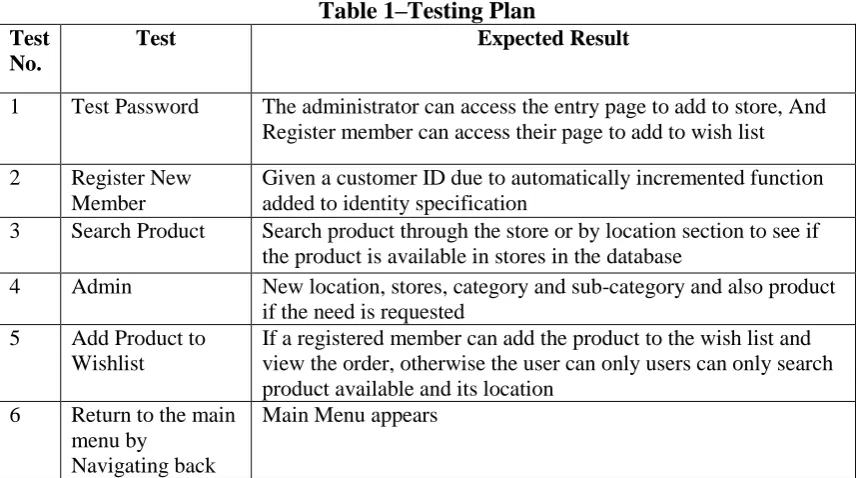
Before documenting this work, much testing was done to make sure the system functioned properly. This testing was done under the following heading:
Page | 65 B. Interface Testing: this involves the linking of the different pages that make up the e-commerce stores web based system. The hyperlinks must link to the right pages, which we tested and confirmed by working properly.
C. Component Testing: this is also called function testing; it uncovers errors in the web application. Each component level test case specifies all input values and expected component values to be provided.
D. Navigation Testing: navigation testing ensures the mechanisms that allow the user to travel through the web application and functionality.
2.5.1. Security
A password will be attached to the database so that it is only accessible to the administrator who knows the password. A different measure of access level is needed as the customer login page can only be restricted to its services, but the administrator will have overall access to the database.
Table 1–Testing Plan
Test No.
Test Expected Result
1 Test Password The administrator can access the entry page to add to store, And Register member can access their page to add to wish list
2 Register New
Member
Given a customer ID due to automatically incremented function added to identity specification
3 Search Product Search product through the store or by location section to see if the product is available in stores in the database
4 Admin New location, stores, category and sub-category and also product if the need is requested
5 Add Product to Wishlist
If a registered member can add the product to the wish list and view the order, otherwise the user can only users can only search product available and its location 6 Return to the main
menu by
Navigating back
Main Menu appears
2.6 Documentation:
The different aspect of the system showing how they work and what they entail. The web application serves as a platform for stores online learning by the user. It serves to ease the connection between customers and the stores applications.
2.6.1 Performance Requirements:
• It should take less than 5 seconds to produce any list (except for search-generated lists, see next performance requirement) described in the specific objectives.
• It should take less than 2 seconds to look up and show any record’s details as outlined in the objectives. • It should take less than 5 seconds to add or modify any record details as described in the objectives. • It should take less than 3 seconds to archive or unarchive documents.
• It should take less than 3 seconds to delete any record from the system. • It should take less than 2 seconds to create/modify a password for the system.
Page | 66 2.6.2 Performance Indicators:
The performance is indicated by the speed at which operations are carried out. For this particular application, speed is a critical factor in the system as this is the objective of the stores on a cloud. For this, the end user suggested a time frame of around 4 seconds for each operation. Thus, when designing and final testing the product the performance is to be judged using this yardstick as a rough guide to how well the system is performing.
2.6.3 Hardware Requirements:
The hardware required to run this program described in the overall and specific objectives will not need to be very powerful as the system is not very demanding on the processor.
A computer system should have the following minimum specifications:
• A Pentium class machine with 1GB RAMS or comparable is acceptable for the information to appear quickly.
• Internet connection of 1040b/Sec.
• Disk storage that has at least 1GB of free space will be required and the front-end to the system, written in MYSQL, is expected to take up around 2MB.
2.6.4 Software Requirements:
The minimum software requirements to run this website are as follows:
• The system must run on an IBM-Compatibility PC using a Windows 2000 operating system. • Internet Explorer should be Windows 8 or comparable, which is necessary for internet browsing.
3. Database Connectivity:
In e-commerce or business applications, it is very typical for the Web server to contact the database to get data as required. ASP.NET utilizes an innovation or technology called ActiveX Data Objects.NET (ADO.NET) to connect to the database.
3.1. ADO.NET:
Excellent ASP pages utilized ActiveX Data Objects (ADO) to access and change databases. ADO is a programming interface used to access information. This technique was proficient and genuinely simple for developers or engineers in learning and executing. In any case, ADO experienced a dated model for data access with many restrictions, for example, the inability to transmit data, so it is efficient and available. Combined with the move from standard SQL databases to more distributed types of data (such as XML), Microsoft presented ADO.NET. In ADO.NET to center objects permit us to work with data initially: the Data Reader and the Data Set. On any.NET data access page, before we connect to a database, we first need to import all the vital namespaces that will permit us to work with the objects required.
3.1.1. Dataset in-memory representation of data:
The dataset is a detached, in memory representation of information. It can be considered as a local duplicate of the relevant segments of the database. The Data Set resides in memory, and the data in it can be controlled or manipulated and updated independently of the database. If essential, changes made to the dataset can be applied to the central database. The data in the dataset can be loaded from any valid data
Page | 67 3.1.2. Data Provider:
The Data Provider is in charge providing and maintaining the connection to the database. A Data Provider is a set off of related components that cooperate to give data in a proficient and performance drove way. Each Data Provider comprises of the following classes:
• The Connection object which gives a connection to the database • The Command object which is utilized to execute a command
• The DataReader object which gives a read-only, connected record set
• The DataAdapter object which populates a disconnected DataSet with data and performs the update.
3.1.3. The Connection Object:
The Connection object makes the connection to the database. Microsoft Visual Studio.NET gives two types of Connection classes: the SqlConnection object, which is outlined specifically to connect to Microsoft SQL Server 7.0 or later, and the OleDbConnection object, which can give connections to a wide range of database types like Microsoft Access and Oracle. The Connection objects contain the majority of the data or information required to open a connection to the database.
3.1.4The Command Object:
The Command object is represented by two relating classes: SqlCommand and OleDbCommand. Command objects are utilized to execute commands on a database over a data connection. The Command objects can be used to execute stored methods on the database, SQL commands, or return complete tables directly. Command objects give three techniques that are used to execute commands on the database:
ExecuteNonQuery: Executes commands that have no return values, for example, UPDATE, INSERT or DELETE.
ExecuteScalar: Returns a single worth from a database query
ExecuteReader: Returns an outcome set by method for a DataReader object
3.1.5. The DataReader Object:
The DataReader object provides a read-only, associated stream recordset from a database. Unlike different components of the Data Provider, DataReader objects cannot be specifically instantiated. Maybe, the DataReader is returned as the aftereffect of the Command object's ExecuteReader strategy. The SqlCommand.ExecuteReader method gives back a SqlDataReader object, and the OleDbCommand. The ExecuteReader technique gives back an OleDbDataReader object. The DataReader can give the rows of data directly to application logic when one does not have to keep the data stored in memory.
Since only one row is in memory at once, the DataReader gives the most minimal overhead regarding system execution, however, requires the exclusive utilization of an open Connection object for the lifetime of the DataReader.
3.1.6. The DataAdapter Object:
The DataAdapter is the class at the center of ADO.NET's detached data access. It is the middle man encouraging all correspondence between the database and a DataSet. The DataAdapter is utilized either to fill a DataTable or DataSet with its Fill method. After the memory-resident data have been controlled, the DataAdapter can submit the changes to the database by calling the Update method.
The DataAdapter gives four properties that represent database commands to be specific SelectCommand,
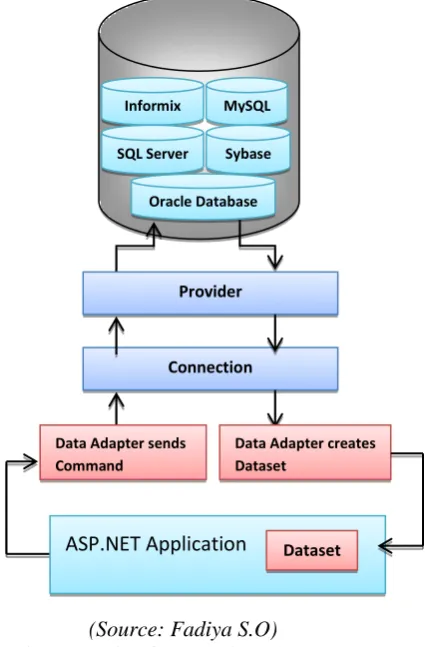
Page | 68 At the point when the Update method is called, changes in the DataSet are replicated back to the database and the appropriate InsertCommand, DeleteCommand, or Update Command is executed. ADO.NET takes after the below procedure, Figure 2, to connect to the database (MySQL, SQL Server, Infomix, Sybase, Oracle Database) and retrieve data to the application, Lowman, S. (2010).
(Source: Fadiya S.O)
Figure 2- ADO.NET Architecture
• At the point when an ASP.NET application needs to get to the database; it presents a proper request to ADO.NET through a DataAdapter object, which in turn sends a command to the Connection object.
• The Connection object builds a connection to the database and presents the request sent by DataAdapter.
• The Connection object connects to the database through a Provider, for example, ODBC.NET. The Provider goes about as a translator between the Connection object and the database. It deciphers the request for data to database's language and brings back the data, if necessary.
• The Provider sends the data back to the DataAdapter through the Connection object and DataAdapter places the data in a DataSet object residing in application's memory.
3.1.7. Connecting ASP.NET application to a Database:
We use Windows Authentication for the SQL connection. To set it up:
i. We make a domain account to use for the application.
MySQL Informix
Sybase SQL Server
Oracle Database
Provider
Connection
Data Adapter sends Command
Data Adapter creates Dataset
Page | 69 ii. Give the id the absolute minimum privileges necessary to host the site on the web server. For instance, it is added acceptable than not read access to the website itself, write access only to folders updated by the site.
iii. Change IIS so that the domain account is utilized to run the application. In IIS6 and IIS7, we do this through the application pool.
The below is the web.config strings for the process model through the application:
Figure 3-Web.config file
A web application's design is stored in the Web.config document and typically includes data about external resources, for example, database, the web, and email servers. It additionally spells out the conduct of the application in specific circumstances, such as the course of action to take when an unhandled exception occurs.
3.1.8. Connecting Database, Website to a cloud:
SQL Azure is one of the best solutions for hosting database in the cloud; SQL Azure requires that we enroll an account, read and acknowledge the Term of Use accepting so as to proceed to create SQL Azure Server the Terms of Use. After registering an account, it prompts the user to create a server by providing credentials the user will like to use for administration; Provide Administrator Username, Admin Password, select Location of central cloud server services intended and click on "Create Server" which shows up on the same pop-up windows.
The database on a cloud is consistently assembled compared with the physical database:
The SQL Azure server name will be automatically produced for us. Username and Password are the credentials to manage the server. It produces a location address of server name which will be a duplicate of the SQL SERVER Management Studio, SQL Server 2008R2 to be exact to be to connect with the SQL Azure Database in the cloud. After this, we can finish whatever details remain and test connection and when successful with our connection with SQL instances.
The accompanying steps in Visual Studio with SQL Azure server:
Page | 70 ii. Replace the code in the program file with the code from this example.
iii. Replace <ProvideUserName> with the name of an SQL Azure login that has been allocated the DB manager part. Note: in case we use the login@server username format, the server segment of the name must match the first section of the server's completely qualified name. For instance, if our server is servername.database.windows.net, our login name will look like loginname@servername. For more information about SQL Azure roles, see Managing Databases and Logins in SQL Azure.
iv. Replace <Provide Password> with the password connected with the login. Note: We recommend utilizing a strong password when creating a login. For more information, see Strong Passwords.
v. Replace <ProvideServerName> with the completely qualified domain name of your SQL Azure server. For instance: servername.database.windows.net
vi. Replace <ProvideDatabaseName> with the name of the database you need the code to make.
vii. Run the code.
Three stages of setting up Windows Azure Connect
i.Enable Windows Azure (WA) roles for External connectivity via service Model
ii. Enable local computers for connectivity by installing WA Connect Agent
iii. Design/Manage our system approach that characterizes which Azure parts and which Azure PCs can convey.
Defined utilizing the Connect Portal:
After the Configuration/Management of the Network Polity, Azure Connect consequently setups secure IP-level system between associated part occurrences and local PCs
• Select just the parts that ought to be empowered for external connectivity • Tunnel firewall/NAT/s through hosted relay service
• Secured via end-to-end IPSec • DNS name resolution
4. The Store Applications:
The objective of this application is to provide the user an online website where they can find products and its location from the comfort of their home. A store is used for the purpose. The user can select the desired products, place them in the shopping cart for a reserve and go to the location close to their city.
The website consists of the following web pages, namely Entry.aspx, Login.aspx, Search.aspx, Signup.aspx, Storesearch.aspx, Subcategory.aspx, Subproduct.aspx, Contact.aspx and Admin.aspx.
Page | 71 4.1StoreSearch (Entry):
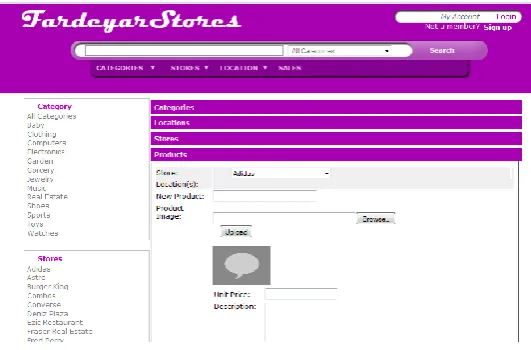
Figure 4 – StoreSearch (Entry)
In the above Figure 4, information about the product is stored in “Product” table. The user can know the location of the products, store name, the site of the product, and price of the product available at the warehouse. A link to add the product to the Wish list and also a pop window to review for the product selected. The user does not have to log in to browse the products available, but will have to log into reserve for a product.
Note: It is the only administrator that has the right to make changes to products and others here.
Codes for StoreSearch.aspx and Search.aspx: Partial Class asp_search
Inherits System.Web.UI.Page
Public Function getStore(ByVal storeid As Integer) As String
Dim storeTable As SampleDataSet.StoresDataTable = New SampleDataSet.StoresDataTable Dim storeAdapter As SampleDataSetTableAdapters.StoresTableAdapter = New
SampleDataSetTableAdapters.StoresTableAdapter
storeAdapter.FillByStoresID(storeTable, StoresID:=storeid)
Dim store As String = storeTable.Rows(0).Item(1)
Return store End Function
Public Function getLocation(ByVal StoreID As Integer, ByVal ProductID As Integer) As String Dim storeTable As SampleDataSet.ProductStoreLocationDataTable = New
SampleDataSet.ProductStoreLocationDataTable
Dim storeAdapter As SampleDataSetTableAdapters.ProductStoreLocationTableAdapter = New SampleDataSetTableAdapters.ProductStoreLocationTableAdapter
Page | 72 SampleDataSetTableAdapters.LocationTableAdapter
'there is a database complexity at the ProductStoreLocation Table. Finding Locations of products. Check it in Release Version
storeAdapter.FillByProductandStore(storeTable, StoreID:=StoreID, ProductID:=ProductID)
Dim LocationID As Integer = storeTable.Rows(0).Item(3)
LocationAdapter.FillByLocationID(LocationTable, LocationID:=LocationID)
Dim location As String = LocationTable.Rows(0).Item(1)
Return location End Function
Protected Sub Page_Load(ByVal sender As Object, ByVal e As System.EventArgs) Handles Me.Load Dim category As String = Request.QueryString("Cat")
If category = "All Categories" Then
DataList6.DataSourceID = "ProductObjectDataSource0" Else
DataList6.DataSourceID = "ProductObjectDataSource" End If
ProductObjectDataSource.Select() End Sub
End Class
4.2 Login:
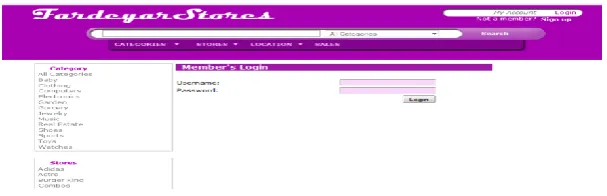
Figure 5 – Login (Entry)
In the above Figure 5, to view the “add product”, the user member will enter their username and password. If the user is already a member in the User table, the products bought is displayed in the wishlist.
Codes for Login.aspx:
PartialClassLogin
Inherits System.Web.UI.Page
ProtectedSub Button1_Click(ByVal sender AsObject, ByVal e As System.EventArgs) Handles Button1.Click Dim userTable AsSampleDataSet.UserDataTable = NewSampleDataSet.UserDataTable
Dim userAdapter As SampleDataSetTableAdapters.UserTableAdapter = New
SampleDataSetTableAdapters.UserTableAdapter
userAdapter.Fill(userTable)
Page | 73
If UsernameTextBox.Text = row.Item(1) Then
If PasswordTextBox.Text = row.Item(2) Then
Class1.username = row.Item(3) Class1.userid = row.Item(0)
Response.Redirect("~/Default.aspx") EndIf
EndIf
Next
StatusLabel.Text = "Wrong username or password."
EndSub EndClass
4.3 Search [By Preference]:
Figure 6 – Search [By Store, Product, and Category]
In the above Figure 6, Items can be searched based on the Product, Store, and Category. When searching for products by category “Clothing”, men and women clothing id displayed.
4.4Sign Up:
Figure 7 – Sign up
In the above Figure 7, if the user is searching a product with the website for the first time, they will be asked to enter the personal detail information if not a regular member.
Codes for SignUp.aspx: Partial Class SignUp
Inherits System.Web.UI.Page
Protected Sub Button1_Click(ByVal sender As Object, ByVal e As System.EventArgs) Handles Button1.Click
Page | 74 ObjectDataSource1.Insert()
MsgBox("Thank you for registering with us" & vbCrLf & "You can login with your username") Response.Redirect("~/Login.aspx")
Catch ex As Exception MsgBox(ex.Message) End Try
End Sub End Class
4.5Pop-up Window:
Figure 8 – Popup Window
In the above Figure 8, shows the pop-up window “Thank you for registering with us, you can now login your username” to check wishlist when to submit button is clicked.
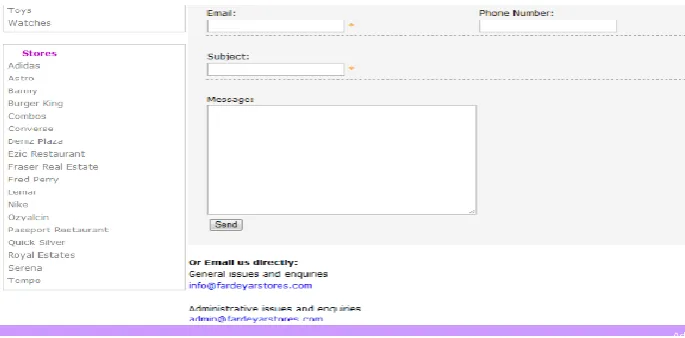
4.6Contact:
Figure 9 – Contact
In the above Figure 9, the customer will contact fardeyar Stores and identify their concerns. By providing their full name, address, telephone number, and Fardeyar Stores will respond to our email and will find a resolution to our questions and concerns.
Codes for Contact.aspx:
Partial Class Contact
Inherits System.Web.UI.Page
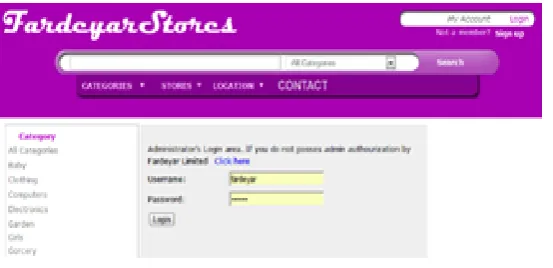
Page | 75 4.7Admin:
Figure 10 – Admin
In the above Figure 10, any un-authorization into contact fardeyar limited will be denied. So, only authorize administrator can login into the admin panel to make changes to the stores.
Codes for Admin.aspx: Partial Class Admin
Inherits System.Web.UI.Page
Protected Sub Button1_Click(ByVal sender As Object, ByVal e As System.EventArgs) Handles Button1.Click
If TextBox1.Text = "fardeyar" And TextBox2.Text = "samson" Then ErrorLabel.Text = ""
Threading.Thread.Sleep(2000) Response.Redirect("~/Entry.aspx") Else
ErrorLabel.Text = "Wrong username or password." End If
End Sub End Class
5. Managing a Web Store:
A Web store must be overseen as both a business and a website, and most e-commerce hosting companies offer software and services to offer us some assistance with doing only that. For example – service providers can offer their customers:
• An assortment of management reports that record and investigate Web store traffic, inventory, and sales results if appropriate.
• Build client lists for email and Web page advancements or gives client relationship management components to hold Web clients.
• Twenty-four hours a day and seven days a week operation throughout the entire year.
• Password and encryption protection of Web store transactions and client records, and utilize firewalls and security monitors to repel hacker assaults and other security threats if sales by credit card if pertinent.
Page | 76 6. Conclusion and Recommendations:
A good store design must be accompanied with easy to use shopping Wishlist logic. It ought to be helpful for the client to see the substance of their Wishlist and to have the capacity to view the contents of their Wishlist and to be able to remove or add items to their Wishlist.
This paper helps in understanding the creation of an intuitive web page and the technology advancements used to actualize it. The design of the journal, which incorporates Data Model and Process Model represents how the database is built with distinctive tables, how the data is getting to and processed from the charts. The building of the paper has given us an exact information about how ASP.NET is utilized to add and develop into a website, how it connect to the database to get to access the information and how the data and website pages are modified on the cloud to give the client a web application. There are some limitations of the current framework to which solutions can be given as a future advancement:
• The system is not designed for multi-clients right now. The idea of the transaction can be utilized to accomplish this.
• Credit Card for shopping and approval or validation is not done. The third party proprietary software can be used for a validation check.
Concerning other future developments or advancements, the following should be possible:
• The Administrator of the website can be given more functionality, such as looking at a particular client's profile, the store that must be reordered, and so on.
• Shopping carts can be permitted in future.
The Internet has turned into a major resource in present day business, in this way electronic stores have gained significance from the entrepreneur’s as well as from the client's perspective. For the contractor’s, electronic shopping creates new business opportunities and for the customer, it makes relative shopping conceivable. According to a study, most consumers of online stores are hasty and usually make a decision to stay on a site within the first few seconds. "Website design is similar to a shop interior.
If the shop looks poor or like several different shops the client is most likely to skip to the other site" as said by Klems, M., Nimis, J., & Tai, S. (2008, December). Subsequently, we have outlined the paper to furnish the customer with the simple route, retrieval of data and necessary feedback as much as possible.
References:
Khosravi, S. (2007). PROFESSIONAL IIS 7 AND ASP. NET INTEGRATED PROGRAMMING: COVERING ASP. NET 2.0 & ASP. NET 3.5. John Wiley & Sons.
Klems, M., Nimis, J., & Tai, S. (2008, December). Do clouds compute? a framework for estimating the value of cloud computing. In Workshop on E-Business (pp. 110-123). Springer Berlin Heidelberg.
Nadkarni, P. M., Brandt, C. M., & Marenco, L. (2000). WebEAV. Journal of the American Medical Informatics Association, 7(4), 343-356.
Lowman, S. (2010). The effect of file and disk encryption on computer forensics. http://lowmanio. co. uk/. Acesso em, 7(05), 2011.
![Figure 6 – Search [By Store, Product, and Category]](https://thumb-us.123doks.com/thumbv2/123dok_us/1436114.1657820/13.595.97.409.483.605/figure-search-store-product-category.webp)