Int. J. of Engg. Sci. & Mgmt. (IJESM), Vol. 5, Issue 4: October-December: 2015 95-99
Sushila Devi Bansal College Of Technology Indore (M.P.), India
ABSTRACT
Wireless Sensor Networking is a network of wireless sensor nodes deployed in an area. Wireless Sensor Network (WSN) system is built on an IEEE 802.15.4 wireless mesh network.The wireless sensor network consists of the sensor nodes. A wireless sensor network (WSN) is a wireless network using sensors to cooperatively monitor physical or environmental conditions such as humidity, pressure, temperature, sound, vibration. The reduction of energy overhead is a major challenge in wireless sensor networks. The idea of development of wireless sensor networks was initially motivated by military applications. A WSN provides a reliable, low maintenance, low power method for making measurements in applications where cabled sensors are impractical or otherwise undesirable. Wireless Sensor Networks are used for monitoring and collecting information from an unattended environment and for reporting events to the user. The communication overhead in cluster based protocol is much less than the Broadcast based method (BBM) based protocol as the velocity of nodes increases. The energy loss can be minimizing by reducing the communication overhead but it may lead to information loss during the transient behavior of WSN. We present work; the comparative evaluation of communication overhead for the wireless sensor network based of on clustering technique is carried out. Simulation a result indicates that cluster based protocol has low communication overheads compared with the BBM based protocol when sink mobility is high. The communication overheads can be reduced by increasing update time.
Keyword: WSN, BBM, Clustering etc.
I. INTRODUCTION
Int. J. of Engg. Sci. & Mgmt. (IJESM), Vol. 5, Issue 4: October-December: 2015 95-99
Fig.1: Basic WSN System with End Nodes, Ethernet Gateway, and Host PC
Recently, techniques of dynamic reconfiguration have attracted increasing attention from the research community. These techniques enable reconfiguration of the sensor network hardware at run time to adapt to external dynamics, providing an innovative approach to designing an energy-efficient WSN in a highly dynamic environment. Due to advances in hardware technology, several reconfiguration techniques have been developed on the sensor node level. These include Dynamic modulation scaling (DMS) (used to reconfigure modulation schemes in communication), dynamic voltage scaling (DVS) (used to reconfigure voltages and operating frequency of processors), adaptive sampling rate (used to change the sampling rate of sensors), and intelligent node activation (used to change sensor node status). The protocol design for WSNs in control applications encounters more challenges than traditional WSN applications, namely.
A. Reliability
Sensor readings must be sent to the sink of the network with a given probability of success, because missing sensor readings could prevent the correct execution of control actions or decisions. However, maximizing the reliability may increase the network energy consumption substantially [2] Hence, the network designers need to consider the tradeoff between reliability and energy consumption.
B. Delay
Sensor information must reach the sink within some deadline. Time delay is a very important QoS measurement since it influences performance and stability of control systems. The delay jitter can be difficult to compensate for, especially if the delay variability is large. Hence, a probabilistic delay requirement must be considered instead of using average packet delay. Furthermore, the packet delay requirement is important since the retransmission of data packet to maximize the reliability may increase the delay. Outdated packets are generally not useful for control applications.
C. Energy Efficiency
The lack of battery replacement, which is essential for affordable WSN deployment, requires energy-efficient operations. Since high reliability and low delay may require significant energy consumption, the re requirements. Note that controllers can usually tolerate a certain degree of packet losses and delays. Hence, the maximization of the reliability and minimization of the delay are not the optimal design strategies since these strategies will significantly decrease the network lifetime.
D. Sensor Traffic Patterns
Int. J. of Engg. Sci. & Mgmt. (IJESM), Vol. 5, Issue 4: October-December: 2015 95-99
the relation between the protocol parameters and performance indicators (reliability, delay, energy consumption, etc).
F. Scalability
Since the processing resources on WSN nodes are limited, the calculations necessary to implement the protocol must be computationally light. These operations should be performed within the network, to avoid the burden of too much communication with a central coordinator. Therefore, the tradeoff between tractability and accuracy of the analytical model is very important. The protocol should also be able to adapt to variation in the network size, for example, size variations caused by the addition of new nodes.
I. WSN Topology
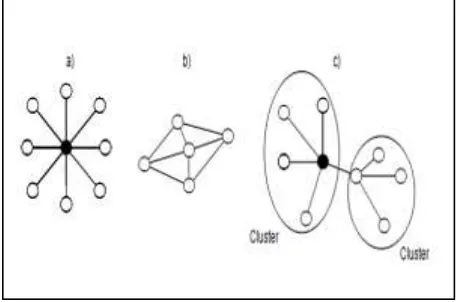
The possible topologies include star (single-hop), mesh (multi-hop) and hybrid (cluster-tree), presented in Fig. 2. The advantage of the star topology is energy efficiency and long lifetime, even if a node collapses. Namely, energy is not consumed on listening to network changes and relaying messages between the nodes, as in case of multi-hop architecture. As a disadvantage of the star topology, smaller number of nodes compared to the multi-hop network is allowed. However, this may not be a problem, if the coordinators use wired links. On the other hand, the multi-hop networks have a longer range and since all the nodes are identical, separate sink nodes are not necessarily needed. However, in addition to the aforementioned energy consumption, the network may suffer from increased latency. The hybrid architecture attempts to combine the low power and simplicity of the star topology as well as the longer range and self-healing of the mesh network. Also in this approach, nonetheless, the latency may still be a problem.
Fig. 2: WSN topologies. (a) Star, (b) mesh and (c) hybrid
II. PERFORMANCE MANAGEMENT IN WSN
Int. J. of Engg. Sci. & Mgmt. (IJESM), Vol. 5, Issue 4: October-December: 2015 95-99 Fig. 3: The performance manager consists of admission control and performance control. The performance meter
supports the manager with measurement data.
Figure 3 shows the relation ship between these functions. A request from a sensor node to join the network is handled by the admission control based on feedback from the meter. The performance control function is responsible for maintaining the desired quality of service once the sensors are allowed to use the wireless channel.
III. PERFORMANCE MONITORING AND CONTROL
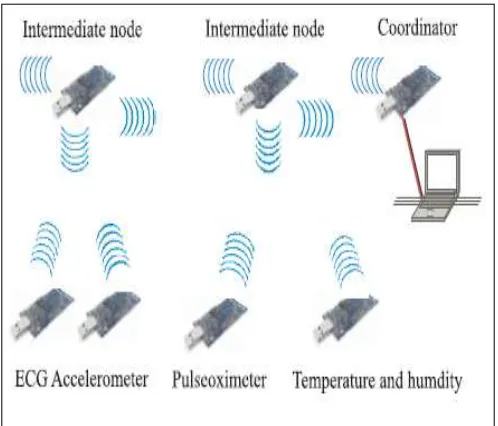
Figure 4 shows a configuration with a set of sensor nodes (e.g.
a combination of wearable sensors such as ECGs, accelerometers and pulse-oximeters, and fixed environment sensor nodes), a coordinator, one or several intermediate nodes with routing and forwarding capabilities. The application program, running in the coordinator, processes sensor data from the sources and sends the information along with an estimate of the information quality to the remote end-user application or presentation and storage. The information quality can be expressed in terms of e.g. the statistical uncertainty of estimated parameters and the highest frequency component in a signal to be recovered by the receiver.
Fig.4: A scenario where performance control is implemented in the coordinator and source nodes.
Int. J. of Engg. Sci. & Mgmt. (IJESM), Vol. 5, Issue 4: October-December: 2015 95-99 REFERENCES
I. Thomas Lindh, Ibrahim Orhan “Performance Monitoring and Control in Contention-Based Wireless
Sensor Networks” .
II. Ibrahim Orhan, Thomas Lindh “Measurement-Based Admission Control in Wireless Sensor Networks” The Third International Conference on Sensor Technologies and Applications, Sensorcomm 2010 July 2010, III. Shiv Prasad Kori1, Dr. R. K . Baghel “Evaluation of Communication Overheads in Wireless Sensor
Networks” International Journal of Engineering Research (ISSN : 2319-6890) Volume No.2, Issue No.2, pp :
167-171.
IV. Prof. Arivanantham Thangavelu, Prof. Abha Pathak “Clustering Techniques to Analyze Communication
Overhead in Wireless Sensor Network”ISSN (e): 2250 – 3005,Vol, 04, Issue, 5,May – 201.