ISSN (e): 2250-3021, ISSN (p): 2278-8719
Vol. 08, Issue 12 (December. 2018), ||V (V) || PP 08-12
Effect of Strain in Cold ECAP by Rota C in Mechanical Behavior
and Homogeneity of AA1070 AL Alloy
Gabriel Gonçalves Pessoa de Castro
1,a*, Jorgimara de Oliveira Braga
2,b,
Jefferson Fabricio Cardoso Lins
3,c, Fabiane Roberta F. Silva
4,d1,2,3,4 Av. dos Trabalhadores - Vila Santa Cecília, Volta Redonda – RJ - Brazil - Zip Code: 27255-125 Corresponding Author: Gabriel Gonçalves Pessoa de Castro
Abstract:
The aim of this study is evaluate the mechanical behavior of an Al AA1070 aluminum alloy produced from rolling hot process, by equal channel angular pressing (ECAP). The process is cold via route C with 5 consecutive passes and accumulated a total strain of ɛ5 = 5.95. The as received material has a coarse grain micro structure with grain size of 15.7 ± 17.5 µm and micro hardness Vickers 31.1 ± 2.5. The mechanical behavior and micro hardness Vickers of the samples were evaluated by tests of Vickers hardness, creation of hardness maps and force-deformation graph during the ECAP process. It was observed that the mechanical properties of the material changed with an increase of hardness approximately 50% from 31.1HVto 46.6 HV and increased strength of the material in view of the force required for the passage of the billet through the die was 40% higher in the later passes to the first. The hardness maps presented heterogeneously and became more uniform over the processing passes fact in agreement with the observed standard deviations. The ECAP process was effective only until the second pass processing.Keywords:
Pressing by equiangular channels (ECAP); Aluminum alloy; Severe plastic deformation; mechanical behavior; micro hardness Vickers.--- --- Date of Submission: 14-12-2018 Date of acceptance: 29-12-2018 ---
---I.
INTRODUCTION
The Equal channel angular pressing (ECAP), as illustrated by Figure 1, consists in the flow of the billet by channels with constant crosssections perpendicular toeachother. The material suffers simple shear deformation during the passage through of the intersection of channels which promotes changes in its microstructure and consequently on its mechanical properties.
The ECAP has fourfundamentals processing named routes A, BA, BC and C. The distinction between
the routes is the type of rotation in relation to the load application direction of the material after each pass of the deformation. These rotations favor the activation of different slip systems producing differences in the microstructure of the processed material [3].
The route used in the this study will be to route C, in which the material undergoes a rotation of 180 ° between in each pass.
International organization of Scientific Research
9 | Page
In this context, the AA1070 aluminum alloy research consisted of systematic analysis of its behavior after a deformation by ECAP along the 5 passes deformation using a route C, with the aid of micro printing for hardness tests in Vickers scale, generated data (force vs. displacement) during the ECAP Processing and by equation Hall-Petch, in order to quantify and compare the evolution of the mechanical properties after each pass deformation.
To laminyad and Dehghani [5] conducted a microstructural characterization and evaluated some mechanical properties of the same alloy processed by ECAP through the BC route. Were observed two types of
behavior: between the first and the fourth pass a microstructure evolved from elongated sub grains for fine and equiaxed grains and a contours fraction of high angle and crystallographic difference grew quickly until the fourth pass.Between the fourth and eighth pass the growth rate reduced and no significant change in grain size and mechanical properties was noted.
II.
MATERIALS
The samples of test are AA 1070 aluminum alloy, provided by Novel is Company of Brazil Ltda., whose chemical composition and presented in Table 1. The material was casted to production of a plate with 610 mm of thicknessand then smoothened down by hot rolling up to a thickness of 32 mm whose output temperature was estimated at above 380 ° C.
Table1. Chemical composition of AA1070 aluminum alloy (contents expressed in% by weight)
III.
EXPERIMENTAL
ECAP process
The ECAP processing consists of the passage of billets with 70x10x10 mm of dimensions throughthe die with equiangular channels of equal cross-section. The channels were lubricated with high performance grease of calcium sulfonate. In this study the route of processing usedis route C, which the sample is rotated 180º along its longitudinalaxis.
The ECAP processing was performed in the Laboratory ofmechanical tests atthe Federal Fluminense University (EEIMVR/UFF) using a traction and compression universal machine EMIC DL-60 with a maximum load capacity of 600 kN, a bipartite ECAP die steel H13 tool with two identical channels with dimensions 10x10 mm an angle of 90 ° and H13 tool steel punch.
The bend radius of the channels is 5 mm (Ψ≈37º) to facilitate the flow of the billet between the channels and reducing the pressing load. The deformation was performed at a speed of 5mm / min and a true strain accumulated ɛ5 = 5.95. During processing were generated graphs of force versus deformation in order to evaluate the mechanical behavior of the samples in the course of deformation passes.
Vickers Hardness
In order to determine the evolution of mechanical properties was performed Vickers hardness test machine, using a micro hardness tester of Shimadzu Brand and HVM-2T model installed in the LMME EEIMVR / UFF. It was conducted a total of 225 measurements, distributed in a 15x15 array, over the entire cross section of the samples. The Vickers micro prints were performed with load of 0.1 kgf for 30 seconds.
IV.
RESULTS AND DISCUSSION
In order to determine and quantify the strength of the material after each pass, we generate compressive strength curves x displacement. In the curve of force versus displacement of the ECAP process, Figure 2, it is shown an increasing compression force in the second pass from approximately 25KN to 35KN, resulting from growth of the mechanical strength of as received material, from the work hardening of the material caused by severe plastic deformation after the first pass. Note by the curves that in subsequent passes no significant changes in compressive strength, where it keeps constant. This suggests that the mechanical strength of the material has increased only up to the second pass, suggesting that this is effective pass to the ECAP Al AA1070 aluminum alloy.
Fig.2. Curve Force versus displacement of E CAP Processing after 5 consecutive passes.
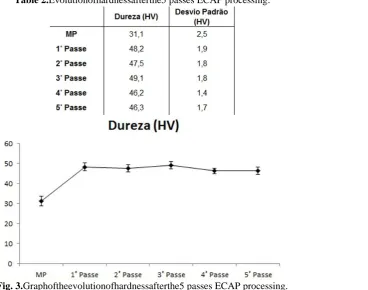
After the first pass was found an increase of approximately 50% of hardness compared to the as received material, result expected by the hardening arising from the E CAP process, found by Resende and Haugen [6, 7]. Table 2 shows the average of hardness values found in samples and Figure 3 shows the trend graph of the hardness of the material during the processing passes. It is observed that the values of the second to the fifth pass has virtually unchanged, featuring a steady state. Similar behavior was found by Resende and Haugen [6, 7] to evaluate the same league, but on different routes. This is a result which again leads to the thesis that the second pass is the effective pass to the Studied material.
Table 2.Evolutionofhardnessafterthe5 passes ECAP processing.
Fig. 3.Graphoftheevolutionofhardnessafterthe5 passes ECAP processing.
The steady state refers to theme chanical properties can be explained by Castro and Mendes [8, 9], which in their work, they presents trongevidence of micro structural competition between recry stallization and dynamic reco very during the E CAP deformation of the AA1070 Al alloy, stabilizing the process. Suchindications were found with greater intensity from the third pass. Soontheresults of Vickers hardness tests and the information generated during processing show is consistent with the micro structural evolution of the material.
International organization of Scientific Research
11 | Page
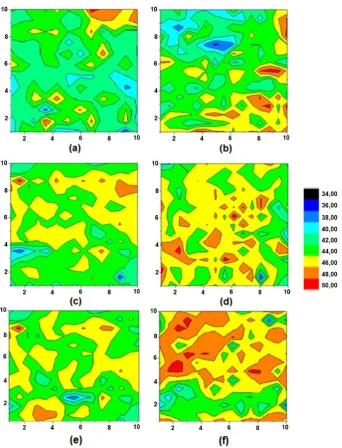
the evolution of aluminum homogeneity processed via ECAP made by Xu and Langdon [10] usingVickers hardness maps, suggest that after the first pass its hardness maps presented heterogeneously and became more homogeneous over the passes processing. Variousauthors [10, 11] alsoclaimthatthereis some difference between the hardness values and grains ize of the edges and the center of the samples in its crosssection. In ordertoclarifythesefacts were created hardness maps, with 225 measuresd is tributed evenly throughout the crosss ection of end to end sample. Figure 4 shows the obtained maps, which can be observed a tendency to homogenization when comparing the maps of the starting material with subsequent passes. This fact is according to the data found by Xu and Langdon [10], but is not observed any indication orevidence of hardness disparity between different regions of the sample seven significant differences in the2˚ mapsto 5˚ pass.
Fig. 4. Hardness maps (A) as received material and after (B) 1˚ Pass; (C) 2˚ Pass; (D) 3˚ Pass; (E) 4˚ Pass; (F) 5˚ Pass.
V.
CONCLUSION
International organization of Scientific Research
12 | Page
ACKNOWLEDGEMENT
Theauthors thanks CAPES, CNPQ and FAPERJ for financial support.
REFERENCES
[1]. Azushima A, Koop R, Korhonen A., Severe plastic deformations (SPD) processes for metals. CIRP Annals – Manufacturing Technology. 2008;57:716-735.
[2]. Lins J.F.C. CaracterizaçãoMicroe strutural da Liga AlAA1070 Deformada. Universidade Federal Fluminense, 2009.
[3]. Valiev RZ, Islamgaliev RK, Alexandrov IV. Bulk nanostructured materials from severe plastic deformation.Progress in Materials Science. 2000;45:103-189.
[4]. Langdom, T.G., The Principles of grain refinement in equal-channel angular pressing. Materials Science and Engineering A, v. 462, p. 3-11, 2007.
[5]. Tolaminejad, B.; Dehghani, K. Microstructural characterization and mechanical properties of nanostructured AA1070 aluminum after equal channel angular extrusion. Materials & Design, v. 34, p. 285-292, 2012.
[6]. Resende, M.C., CaracterizaçãoMicroestrutural e da TexturaCristalográfica de umaliga de alumínio AA1070 Deformada a Frio ViaPrensagememCanaisEquiangulares, dissertação de Mestrado, UFF, 2011. [7]. Haugen, C.G., CaracterizaçãoMicroestrutural da Liga Al AA1070 Deformada via
PrensagememCanaisEquiangulares a Frio Através das Rotas BA e BC. Dissertação de Mestrado, UFF, 2014.
[8]. Castro, G.G.P., CaracterizaçãoMicroestrutural da Liga Al AA1070 Deformada via PrensagememCanaisEquiangulares a Frio Através das Rota C. Dissertação de Mestrado, UFF, 2014. [9]. Mendes, R.S., CaracterizaçãoMicroestrutural da Liga Al AA1070 Deformada via
PrensagememCanaisEquiangulares a Frio Através das Rota A. Dissertação de Mestrado, UFF, 2014. [10]. Xu, C.; Langdon, T. G. The development of hardness homogeneity in aluminum and an aluminum alloy
processed by ECAP. Journal of materials science, v. 42, n. 5, p. 1542-1550, 2007
[11]. Valiev, R. Z.; Langdon, T. G. Principles of equal-channel angular pressing as a processing tool for grain refinement. Progress in Materials Science, v. 51, n. 7, p. 881-981, 2006.
![Fig. 1 : Die of ECAP and orientation plans. Adapted from [4].](https://thumb-us.123doks.com/thumbv2/123dok_us/7806344.1661629/1.595.218.525.567.757/fig-die-ecap-orientation-plans-adapted.webp)