An Improved Doppler Frequency Offset
Estimation Algorithm of OFDM System under
High-speed Movement Environment
Yunlv Hong
Department of Electronic Engineering, Shanghai Jiao Tong University, Shanghai, China Email: [email protected]
Di He
Department of Electronic Engineering, Shanghai Jiao Tong University, Shanghai, China Email: [email protected]
Abstract—Orthogonal frequency division multiplexing
(OFDM) is a multi-carrier digital modulation technique. It’s likely to be used in next generation high-speed railway communication system. When OFDM is used in the communication of high-speed railway user s, Doppler frequency shift will become an important technical barrier, because OFDM is sensitive to frequency offset. Especially in high-speed movement environment, Doppler frequency shift can destroy the orthogonal characteristic between sub-carriers in OFDM system. In this paper, we analyze the performance of OFDM system in high-speed movement environment and propose a new Doppler spread estimation algorithm to improve the bit error rate (BER) performance. Theoretical analysis and computer simulations present the advantages of the proposed approach, especially under high-speed railway environment.
Index Terms—High-speed movement environment, OFDM,
Doppler frequency shift, Frequency offset estimation
I. INTRODUCTION
OFDM [1][2] is a multi-carrier digital modulation technique. Its basic idea is to divide a high speed data string to some low speed data strings, and all sub-carriers are orthogonal to each other. It ensures very little interference among the sub-carriers. OFDM is widely used in popular modern communication system like LTE, WLAN, etc. Because of its advantages, OFDM is likely to be used in next generation high-speed railway communication.
However, OFDM has a big problem that the system is easy to be affected by frequency shift. Frequency shift occurs when an object is moving, especially in the high speed movement, for example the high-speed railway environment. This phenomenon is called Doppler shift. When a train runs at 350 km/h, and OFDM system (like LTE) operates at 2.4 G frequency point, the maximum Doppler frequency offset will be over 800 Hz. Because of the apparent Doppler shift, the orthogonal characteristic between sub-carriers in OFDM system will be destroyed, and serious inter-Carrier interference (ICI) [3] will be
caused. Finally, there will be a substantial increase in BER.
Main ideas in literatures to solve this problem are divided into two types. One is the design of the Doppler frequency offset estimation algorithm. In this type, the algorithm is based on the received information to obtain the estimated value of Doppler offset. Maximum likelihood estimation (MLE) and minimum estimation (ME) are often used in estimation algorithm [4-6]. But due to the fact that the accuracy or the complexity of calculation is not very perfect, the algorithm sometimes still can’t be well used in the OFDM systems.
Another type is to consider Doppler shift as a resource of diversity. Through designing diversity receivers, it can improve the system’s performance. It mainly includes Doppler frequency diversity and joint multi-path Doppler diversity [7]. It was applied in CDMA system, but its further application to OFDM system has not been studied yet.
In this paper, a novel Doppler frequency offset estimation algorithm is proposed, which uses the cyclic cumulative frequency offset estimator to make the estimation more accurate. Section II gives the channel of OFDM system under high-speed environment and discusses the useful S&C algorithm and its disadvantages. Section III presents the novel algorithm based on the improvement of S&C algorithm. Computer simulations are shown in Section IV. And Section V gives the conclusion.
II. OFDMPERFORMANCE IN HIGH-SPEED MOVEMENT
ENVIRONMENT
The main idea of OFDM is to convert high-speed input data to N road low-speed data, and modulate N low-speed data onto orthogonal sub-carriers. The transmitted signal’s baseband expression in a symbol is
1
2 ( ) / 0
( ) ( ) s , ( )
N
j k t t T
s s
k
x t s k e π t t t T
−
−
=
=
∑
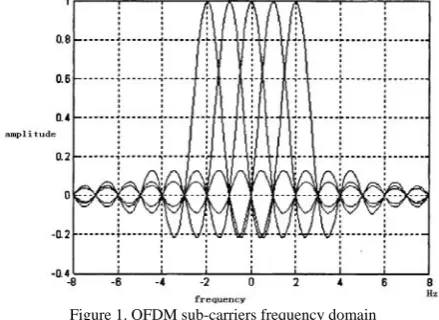
⋅ ≤ ≤ + (1)or t= +ts T, x t( )=s k( ). It is obvious that the adjacent sub-carriers of the centre frequency interval is 1/T. Then the orthogonality within sub-carriers can be ensured. Its
frequency domain is shown in Figure 1.
In the wireless environment, the frequency offset caused by the movement of objectives is known as Doppler shift, which can be expressed as
d cos c cos
v v
f f
c
θ θ
λ
= ⋅ = ⋅ ⋅ (2)
where c is the speed of light;
v
is the moving speed of the receiving antenna; fc is signal’s carrier frequency; θ is the angle between the moving directions of receiving antenna and electromagnetic wave. In OFDM system, we suppose the maximum carrier frequency could reach 2.6 G Hz. Nowadays, the speed of commercial high-speed air vehicle or railway can reach 350 km/h or even more. If the moving directions of high-speed objective and the electromagnetic waves are the same, it means that θmay be zero. At this time, the Doppler offset reaches its maximum value, and the maximum Doppler offset may reach 842 Hz. The high Doppler shift can destroy the orthogonal characteristic within sub-carriers in OFDM system, and it will certainly lead to serious ICI. Finally, there will be a substantial increase in BER, which is calculated byerror
transmitted
bit
BER
bit
=
(3) where biterror is the number of received error bits;
transmitted
bit is the total number of transmitted bits.
Generally speaking, talking about the Doppler shift in high mobility environment, the channel fading should be incorporated, and then the Doppler shift expends to a Doppler spectrum. In this paper, we think the high-speed objective mainly runs on the plains. In this environment, there should be only one strong direct trail and very little (maybe just one or two) reflector trails, so that the affect of Doppler shift should be mainly caused by the direct trail. On other words, when a lot of reflector trails occurs, which means that the train run in the city, the speed of train shouldn't be too fast. So at most time,
there is only one direct trail, and this paper mainly discusses how to detect the direct trail's Doppler shift.
Due to the sensitivity of OFDM systems to frequency shift, the frequency estimation problem mainly has three kinds of solutions in previous researches. They can be divided into the aided technique [8], the non data-aided technique [9] and those based on cyclic prefix (CP) [10]. The data-aided algorithm is to add some training sequence into data for transmission. At the receiver, one can complete the frequency correction by estimating the frequency offset of the specific training sequence. This kind of method has much faster processing speed and better estimation performance than the non data-aided technique. Based on the unique property stated above, in the following study, it is supposed that the data-aided estimation algorithm is more suitable for high-speed movement environment, as the objective runs fast and the environment changes rapidly.
To detect the direct trail's Doppler shift, Schmidl and Cox proposed an important algorithm in 1997 [11]. It’s a two-step algorithm and here we name it S&C algorithm for simplicity in the following analysis. It constructs a specific training sequence and it is sent on even sub-carriers. Its first half and second half are the same. When the frequency shift occurs, the estimation of the frequency offset can be realized according to the structural change of the received training sequence. A lot of researches have been carried out to the further improve this algorithm such as reference [12]. But the algorithm in reference [12] is much more complicated and is not suitable for a system which needs a rapid response. In a word, S&C based algorithm is still not good enough for OFDM system under high-speed railway environment.
The analysis details can be obtained from [11], here we just analyze the disadvantages for S&C algorithm applied in the high-speed OFDM system.
In [11] it does not give evidence that S&C can be applied in very high mobility environment. That is because the high ICI caused by high speed cannot be easily overcome by adding SNR.
There is a formula in [11]:
ˆ ( )
1 ( )
opt
opt M d SNR
M d
=
− (4)
In (4), M is involved in the received power. It is obviously that SNR and M are not seriously correlative. It means that increasing SNR will also enhance the ICI, so the system performance will not be linearly improved with the increasing of SNR.
Then we give the performance of OFDM system in high-speed movement environment. The BER performance comparison under different SNR environment with the following simulation parameters are given as well, as shown in Table 1.
Figure 2 shows that OFDM is not suitable for high-speed movement environment in the above model we proposed. The BER (red line) of the OFDM system increases to the level of 10−1 when SNR=10dB, which cannot be acceptable in real applications. This figure also
shows that S&C algorithm (blue line) does not work well in high mobility environment.
Based on Figure 2, improvement of SNR will still lead to very high BER without good enough frequency
correction algorithm. From above, it can be found that S&C algorithm still cannot meet the demand under high-speed movement (frequency offset is more than 800 Hz). In a word, we cannot get a big offset estimation range and accuracy at the same time. That’s the major contradiction of S&C algorithm under high-speed movement environment.
III. CYCLIC CUMULATIVE DOPPLER FREQUENCY OFFSET
ESTIMATION ALGORITHM
From last section, it is found that there is a contradiction between frequency estimation range and accuracy. That’s the biggest problem of S&C algorithm in the high-speed applications. Here we try to improve the algorithm combining with the high-speed movement scene. Generally, suppose the change of moving objective’s velocity is continuous. And the adjoint frames will be sent in several ms if their sub-carriers’ bandwidth is within several KHz. And the velocity of the objective will not change rapidly without crash, because the acceleration should not be over 10 g. So we can get the conclusion that the variation of Doppler offset between adjacent symbols will not be over 200 Hz. And within 200 Hz, it is found that the S&C algorithm always performs well.
According to above analysis, we design a cyclic cumulative frequency offset estimation algorithm to solve the problem that S&C algorithm has poor accuracy if the estimation range is beyond 200 Hz. If the accurate value of frequency offset in one symbol period cannot be got, in the next period, add an additional value to the old estimation value to make it closer to the accurate frequency point.
Then the problem is converted to a “one dimensional search” problem. We suppose the accurate Doppler offset
is between 0 and upper bound offset, and we search it from 0 to upper bound offset. As already known, if the objective runs in 350 km/h, the Doppler offset should be over 800 Hz and less than 900 Hz, so we can set upper bound offset to be 900 Hz. In one dimensional algorithm, golden section proves to be in useful and fast convergence in each iterations. In the following sections, we choose the golden section method to realize the estimation process. The details of the estimation algorithm are given as follows:
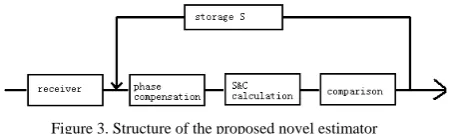
a) When the training sequence A is sent to the estimator, calculate the fractional frequency offset and integrate frequency offset with S&C algorithm. Set up a storage S, and put the first estimated offset fA to this storage S, and it will be used in the next round frequency estimation. Set bound fmin=0, fmax=900.
b) When the training sequence B is sent to the estimator, use S&C algorithm to get new estimated offset
b
f center around fA. Use golden section method in area [ fmin, fmax]:
b.1) If fb
≥
fA , set fmin = fA . Otherwise, set maxf = fA
b.2) Let λ1= fmin+0.328(fmax−fmin) (5) λ2 = fmin+0.618(fmax− fmin)
b.3) Compare the performances of offset
λ
1withλ
2 in S&C algorithm.b.4) If
λ
1performs better, let fB=λ
1. Otherwise, letB f =
λ
2.b.5) If
f
max−
f
min<
ε
, algorithm terminates, Otherwise go to step (b.2).As shown in (5), the proposed algorithm uses the golden section method to obtain the linear convergence. So after several rounds, we can get a good solution. Besides, as what analyzed above, the Doppler frequency offset between adjacent symbols doesn’t show significant changes. So the whole system does not produce obvious oscillations caused by frequency hopping. This algorithm is especially designed for high-speed movement environment. The structure of the proposed novel estimator is shown in Figure 3.
Now we discuss the performance of the novel designed algorithm.
The transmitted signal can be expressed in time domain by
1 2
0
( ) ( )
kt
N j
T
k
x t S k e π
−
=
=
∑
(6)SIMULATION PARAMETERS FOR FIGURE 2
Center frequency Sub-carrier bandwidth
Pilot number per symbol
2.6 GHz 15 KHz 10
IFFT number Symbol length Modulation mode
256 90 bits QPSK
Figure 2. BER performance comparison under different SNR environment with moving speed 350 km/h and still state
where T=NTs is the symbol period and Ts is the sampling interval; S(k) is the signal.
Assume Δfc is the frequency offset, ΔΦ is the phase offset. The signal at the receiver can be expressed by
2
( ) ( ) j f tc ( )
y t =x t e⋅ − πΔ +ΔΦ+η t (7)
where η( )t is the additive noise.
Remove the CP, and after the FFT change, we can get
1 ( 1)( )
0
( 1)
1 ( 1
0
sin[ ( )]
( ) ( ) '
sin[ ( )]
sin( )
( )
sin( )
sin[ ( )]
( )
sin[ ( )]
c s
c s
m k
j N c s j N f T
N m
c s j
j N f T c s
c s
j N c s j N
m
c s m k
m k
N f T
e N
R k S m e
m k
N f T
N N f T e
S k e
N f T
m k
N f T
e N
S m e
m k
N f T
N π π π π η π π π π π − − ΔΦ − − Δ = − ΔΦ − Δ − ΔΦ − − = ≠ − − Δ = ⋅ − ⋅ + − Δ Δ = ⋅ ⋅ ⋅ + Δ − − Δ ⋅ − ⋅ − Δ
∑
∑
)( ) ' c s m k f T N η −−Δ + (8) To focus on the Doppler frequency offset, simplify the problem by assuming the phase offset caused by the channel can be corrected at the receiver, so we haveΔΦ =0. Then the received signal R(k) should be( 1)
1 ( 1)( )
0
sin( )
1
( ) ( )
sin( )
sin[ ( )]
1
( ) '
sin[ ( )]
c s
c s j N f T
c s
c s
m k
N c s j N f T
N
m
c s m k
N f T
R k S k e
N f T
m k
N f T
N
S m e
m k
N f T
N π π π π π η π − Δ − − − −Δ = ≠ Δ = ⋅ ⋅ ⋅ + Δ − − Δ ⋅ − ⋅ + − Δ
∑
(9) According to the design, the proposed novel algorithm can improve the estimation of gˆ . In this formulaˆ [ˆ ( )] (2ˆ )
f πT g T
Δ = Φ + . The coefficient of the amplitude
sin( ) sin( )
c s c s N f T
f T π π Δ Δ is sin( ) sin( φ
φ/T), so the S&C algorithm and the
proposed approach have the same performances.
The same as ejπ(N− Δ1)f Tc s, by replacing c f
Δ , it is nearly
to be ejΦ
. And the two algorithms also have the same performances.
The second item in the right side of formula (9), say
1 ( 1)( )
0
sin[ ( )] 1
( )
sin[ ( )]
c s
m k
N c s j N f T
N m
c s m k
m k N f T
N
S m e
m k
N f T
N π π π − − − −Δ = ≠ − − Δ ⋅ − ⋅ − Δ
∑ , will lead to ICI. So,
we can get that system performance will not be linearly improved with the increase of SNR. That means this
variable will still be the problem by replacingΔfc. The SNR deterioration caused by the above formula is
2 2
0
sin( ) sin( )
10 log 1 1 10 log
sin( ) sin( )
b c s c s
nf
c s c s
E N f T N f T
D
N N f T N f T
π π π π ⎧ ⎡ Δ ⎤ ⎫ ⎡ Δ ⎤ ⎪ ⎪ ⎢ ⎥ = ⎨+ ⎢ − Δ ⎥ ⎬− Δ ⎢ ⎥ ⎣ ⎦ ⎪ ⎪ ⎣ ⎦
⎩ ⎭ (10)
According to (9), it should be
2 2
0
sin sin
" 10 log 1 10 log
ˆ ˆ
2 2
sin( ) sin( )
b nf
E D
g g
N N N
N N π π ⎧ ⎫ ⎡ ⎤ ⎪ Φ ⎪ ⎢ Φ ⎥ ⎪ ⎪ ⎢ ⎥ = ⎨ + Φ + ⎬− Φ + ⎢ ⎥ ⎪ ⎪ ⎢ ⎥ ⎪ ⎪
⎩ ⎭ ⎣ ⎦ (11)
Because the proposed novel algorithm uses golden
section method, so after 5 rounds, Δfc of the integer
frequency offset should decrease by 0.6184≈85% at least. Considering the oscillation and deviation of calculating integer offset, there is still much possibility to
decrease Δfc to a small range.
At this time, the SNR deterioration should be
2 2
nf
0
sin sin
' 10 log{1 Eb[1 | | ]} 10 log[| | ]
D N Φ Φ = + − − Φ Φ (12) Compare (12) with (11), it can be found that Dnf' in (12) is much better than Dnf" in (11). So the new algorithm can improve the estimation of integer offset, and decrease the SNR deterioration to improve the system performance.
Overall, the main idea of the proposed novel algorithm is to use several symbols to improve the accuracy gradually. In case the estimation value is not accurate immediately, the proposed algorithm can still ensure that the deviation will gradually reduce.
IV. COMPUTER SIMULATIONS
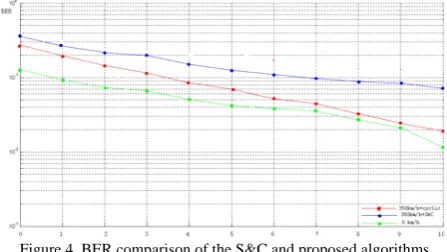
The computer simulation environment parameters are as follows: OFDM carrier frequency is 2.6 G Hz. The sub-carrier bandwidth is 15 kHz. The length of each symbol is 90 bits. The cyclic prefix length is 32. The pilot number in per symbol is 10. The FFT length is 256. The coding mode is interleaved coding and Viterbi coding. The modulation mode is QPSK. The channel is selected as AWGN flat channel. The highest movement speed is set to 350 km/h, equivalent to 842 Hz Doppler frequency offset. The speed rises from 60 km/h to 350 km/h gradually. When the speed reaches 350 km/h, keep the estimation offset unchanged, and set the SNR vary from 0dB to +10dB to draw the BER curve.
From the comparison in Figure 4, the performance of the proposed Cyclic Cumulative algorithm (red line) is still worse than curve of 0 km/h (green line), but it is very close to that at SNR=10. And comparing the red curve and blue curve, our proposed algorithm works much better in high-speed movement environment than the conventional S&C algorithm.
V. CONCLUSION
Through the theoretical analysis and computer simulations, it can be found the existing traditional Doppler frequency offset estimation algorithm often doesn’t work well in high-speed movement environment.
In this paper, a novel cyclic cumulative frequency offset estimator is proposed to improve the traditional OFDM system. It not only improves the performance of the traditional S&C algorithm, but also is much closer to the ideal state.
ACKNOWLEDGMENT
This research work is supported by the National Natural Science Foundation of China (NSFC) under Grant No. 60802058, and the Important National Science and Technology Specific Project of China under Grant No. 2013ZX03001028-005, and the National High Technology Research and Development Program of China under Grant No. 2013AA013602, and the ZTE Corporation and University Joint Research Project under Grant No. One1111150008, and the SMC-"Chen-Xing" Young Scholar Foundation of Shanghai Jiao Tong University.
REFERENCES
[1] E. ahlman. 3G evolution: HSPA and LTE for mobile
broadband. Elsevier Ltd., 2008.
[2] S. sesia, I. Toufik, “LTE - The UMTS Long Term
Evolution: From Theory to Practice”, WILEY, 2009.
[3] R.W. Chang, R.A. Gibby, “A Theoretical Study of
Performance of an Orthogonal Multiplexing Data Transmission Scheme”, IEEE Trans. Commu. Technol,vol.15, no.6, pp.529-540, 1968
[4] F. Daffara, A. Chouly, “Maximum likelihood frequency
detectors for orthogonal multicarrier systems”, In Proc. IEEE Int.Conf. Commun, pp.766-771, 1993.
[5] J.van de Beek, M. Sandell, P. Borjesson. “ML Estimation
of time and frequency offset in OFDM system”. IEEE Trans. Signal Processing, vol.45, no., pp.1800-1805, 1997.
[6] W.P. Hong, “A Frequency Offset Estimation Architecture
of OFDM System in Multipath Doppler Spread Channel”, Conference Record of the Thirty-Third Asilomar Conference on Signals Systems, and Computers, pp.1071-1075, 1999.
[7] A.M. Sayeed, B. Aazhang, “Joint multipath-Doppler
diversity in mobile wireless communications”. IEEE Trans. Commun., vol.47, no.1, pp.123-132, 1999.
[8] M.K. Simon, D. Divsalar, “Doppler-corrected differential
detection of MPSK”, IEEE Trans. Commun., vol.37, no.2, pp.99-109, 1989.
[9] U. Tureli, H. Liu, M. Zoltowski, “OFDM blind carrier
offset estimation:ESPRIT”, IEEE Trans. Commun., vol.48, no.9, pp.1459-1461, 2000.
[10] J.van de Beek, M. Sandell, P.O. Borjesson. “ML
Estimation of Time and Frequency Offset in OFDM System”, IEEE Trans. Commun., vol.45, no.7, pp.1800-1805, 1997.
[11] T.M. Schmidl, D.C. Cox. “Robust frequency and timing
synchronization for OFDM”. IEEE Trans. Commun., vol.45, no.12, pp.1621-1623,1997.
[12] P. Byungjoon, C. Hyunsoo, K. Changeon and H. Daesk.
“A novel timing estimation method for OFDM systems”, IEEE Globecom, vol.1, pp.17-21, 2002.
Yunlv Hong received the B.E. degree in information engineering from Shanghai Jiao Tong University, Shanghai, China, in 2010. And he is pursuing his M.E. degree also in information engineering from Shanghai Jiao Tong University, Shanghai, China.
His research interests are in the areas of wireless communications especially LTE.
Di He received the B.E. degree of information engineering from Huazhong University of Science and Technology, Wuhan, China, in 1996; the M.E. degree in communications and information systems from Nanjing University of Posts and Telecommunications, Nanjing, China, in 1999; the Ph.D. degree in circuits and systems from Shanghai Jiao Tong University, Shanghai, China, in 2002.