www.ijerd.com
38
MC CDMA PAPR Reduction Using Discrete Logarithmic
Method
B.Sarala
1, D.S.Venketeswarlu2, B.N.Bhandari
11
Department of ECE, M V S R Engineering College, JNTU, Hyderabad, India..
2
Department of ECE, Progressive Engineering College, Cheekati Mamidi, HMDA, JNTU, Hyderabad, India.
Abstract––High Peak to Average Power Ratio (PAPR) of the transmitted signal deteriorates Multi-Carrier Code Division
Multiple Access (MC CDMA) system performance, due to large number of subcarriers. This paper proposes a new technique to reduce PAPR of MC CDMA signal using Discrete Logarithm Method (DLM). Simulation results indicate reduction of PAPR by more than 5.0dB without increasing BER.
Keywords––PAPR, MC CDMA, DLM, BER.
I.
INTRODUCTION
Discrete Logarithmic Method (DLM) has earlier been used in cryptography [1]. If an air interface is used as a communication channel, the information of the communication may be exposed to an eavesdropper or system services can be fraudulently altered. In order to have good security over wireless channel, the DLM is proposed for MC CDMA PAPR reduction and security measures.
The DLM is the inverse of exponentiation in a finite cyclic group. For a given cyclic group DLM modulo p is to determine the integer x for a given pair g and h, h= gx. DLM is to find the smallest non-negative number integer x such that h=gx. The explosion of wireless devices has risen by the following issues: There is a need to eliminate signal interference from bandwidth congestion, there is increasing demand for higher frequencies, there is need to increase security and battery life. Using DLM, increased security, reduced power, and increased battery life [2].DLM exhibits two properties namely easy to compute in the transmission, where as inverse is hard to compute in the reception without special information. With special information, inverse is also easy to compute.
An n-bit encoding of the n-bit binary integer based on DLM allows integer multiplication to be reduced to addition and integer exponentiation to multiplication. When computing the exponentiation operation 𝛽e
mod (2n) of a base 𝛽 (𝛽=3), usually different methods are used for Discrete Logarithmic method encoding and decoding algorithms. The DLM encoding schemes are additive exponentiation modulo 2n, additive based DLM modulo 2n and unified
conversion and reconversion algorithm integer powering using intermediate DLM representation, feedback shift add algorithm (FSA), existing fast binary squaring algorithm, and look-up based structure [3, 4].
This paper proposes reduction in PAPR of MC CDMA system transmitted signal using DLM. The n-bit integer based discrete logarithm encoding from binary to DLM and DLM to binary encoding/decoding needs O(n) additions. Discrete logarithm modulo 2n with logarithm base 3 of A by dlg (A) has been used [5]. The exponent e is represented such that 3e is congruent with (A mod 2n) that is = .
The rest of the paper is organized as follows: Section II describes MC CDMA system and PAPR models. In section III related works are discussed. In section IV proposed system model of MC CDMA with Discrete Logarithm is discussed. Computer simulations are presented in section V. Finally, conclusions are listed in section VI.
II.
MC
CDMA
SYSTEM
&
PAPR
REDUCTION
Figure 2. Block Diagram of MC CDMA Receiver
Figure 2. Block Diagram of MC CDMA Receiver
The MC CDMA receiver model for kthuser is shown in figure (2). The received signal is first down converted, and the cyclic prefix or guard interval is removed. Then, the data is fed to serial to parallel converter. After that, the signal is transformed using FFT and fed to dispreading and demodulation blocks [6].
Generally, the PAPR of the MC CDMA signal x (t) is defined as the ratio between maximum instaneous power and its average power during the MC CDMA signal [7].
Where E [.] denotes expectation and complementary cumulative distribution function for MC CDMA signal can be written as CCDF = probability (PAPR> x0), where x0 is the Threshold.
PAPR of MC CDMA signal is mathematically defined as
An additional measure to determine the envelope variation is the crest factor (CF), which is CF = √PAPR.
III.
RELATED
WORK
Earlier we proposed a new technique for reduction in PAPR of the Multicarrier Code Division Multiple Access (MC CDMA) signals are based on combining the Discrete Cosine Transform (DCT) /multi-resolution Discrete Wavelet Transform (DWT) with companding is proposed [6]. It is analysed and implemented using MATLAB. This paper proposes a new technique using Discrete Logarithm Method to reduce PAPR of the transmitted signal of MC CDMA system.
IV.
DISCRETE
LOGARITHMIC
METHOD
In this paper uses n-bit encoding of the n-bit binary integer based on Discrete Logarithmic Method. The main objective of using DLM is to reduce the PAPR of MC CDMA transmitted signal and improves security. DLM is represented by any integer x is set of [0, 2n-1] by a triple (s, p, e), and use the term DLM for the n-bit encoding of the triple. The representation employs reduction modulo 2n of a three term product introduced by Benchhop [8]. The n-bit integer x = b n-1 b n-2 ...b 1 b 0 can be represented by an exponent triple (s, p, e) satisfying the factored expression.
Where s = sign bit, e = exponent, 2n = residue modulo 2n, p and e can be determined by n.
A. BINARYTODLMENCODING:
Binary to DLM algorithm is as follows:
Step1. A standard binary radix n bit string x = b n-1 b n-2 ...b 1 b 0.
Step2. The separable exponent triple binary integer bit strings (s, p, e), where s ∈ {0. 1}, and p and e are determined by n with
CDMATRANSMITTER
K USER
DATA
SPREADER QAM S/P IFFT MAPPER
P/S & CP DAC
&HPA OFDM TRANSMITTER
DE SPREAD DEMOD
P/S FFT
S/P ADCREMOVAL&CP
Received
40
B. DLMTOBINARYDECODING:DLM to binary inputs are n, e = en-3 en-4.... e2 e1 e0.
Deconversion algorithm is as follows:
Step1. Exponent e can be expressed as a sum of dlg (2i+1)’s termed the two-one discrete logs.
Since 3dlg (2i+1) = 2i+1, it follows that the corresponding multiplications can be performed as a series of shift and add operations.
Step2. Deconversion algorithm determines the unique set of dlg (2i+1)’s whose sum modulo 2n-2 = e.
V.
PROPOSED
MC
CDMA
SYSTEM
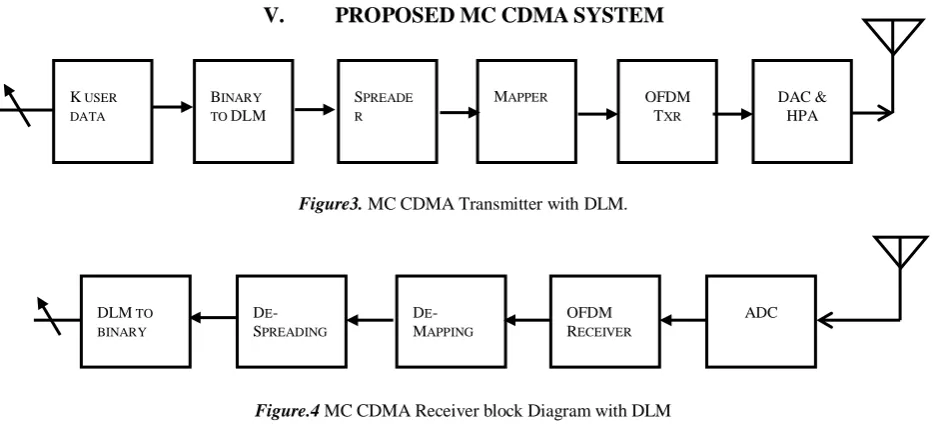
Figure3. MC CDMA Transmitter with DLM.
Figure.4 MC CDMA Receiver block Diagram with DLM
Figure 1 shows the block diagram of MC CDMA with proposed DLM system [6, 7]. The algorithm for MC CDMA with DLM is as follows:
1. The input binary sequence b(n) is applied to DLM encoding block prior to CDMA transmitter, i.e. an=dlg(b(n)).
2. DLM output an is multiplied with spreading code using Walsh Hadamard code Ck (s) in CDMA transmitter i.e.
Q = anCk (s).
3. The spreading sequences are mapped in CDMA transmitter, and then applied to an IFFT (Q).
Further q is up-converted by DAC and amplified using High Power Amplifier (HPA) prior to transmission.
Figure 2 shows the block diagrams of MC CDMA receiver with DLM. The receiver algorithm is as follows:
1. Introduce Additive white Gaussian Noise (AWGN) /multipath channel for transmitted signal. Channel output is converted from serial to parallel
bits, and then applied to a FFT transform and Parallel to Serial Converter (in OFDM receiver).
, where
.
2. The OFDM receiver output is applied to CDMA Receiver (de-mapper and de-spreader).
= Ck(s).
3. The CDMA receiver output is applied to inverse discrete logarithmic method to recover original binary
data i.e. = inverse dlg ( ).
K USER DATA
BINARY TO DLM
SPREADE R
MAPPER OFDM TXR
DAC& HPA
DLM TO BINARY
DE -SPREADING
DE -MAPPING
OFDM RECEIVER
VI.
SIMULATION
RESULTS
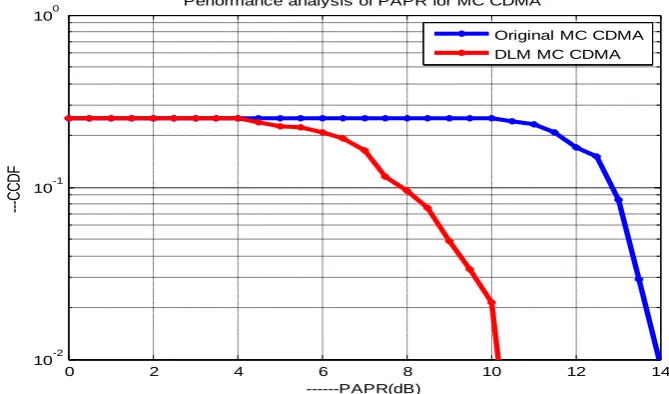
Original MC CDMA and MC CDMA with DLM systems are implemented using MATLAB with the following specifications: number of symbols is 512 and 4096, IFFT size is 128 and 256, and numbers of subcarriers are 16, 32 and 64 for DLM, spreading codes are Walsh Hadamard (WH) codes and modulation used is QPSK. The performance of PAPR can be evaluated using Complementary Cumulative Distribution Function (CCDF) of PAPR of MC CDMA with DLM. The results are compared with original MC CDMA (without DLM).
Figures 5, 6 show that the CCDF performance of a MC CDMA original system with and without DLM. At CCDF = 10-2, MC CDMA with DLM method, the PAPR is reduced by 4.0 dB when compared to the original MC CDMA system for 32 and 64 subcarriers, and symbols 512. Figures 7, 8 and 9 show that the CCDF performance of a MC CDMA original system with and without DLM. At CCDF = 10-2, MC CDMA with DLM method, the PAPR is reduced by 4.5 dB for 16 subcarriers, and 5.0 dB for 32 and 64 subcarriers, symbols 4096 and IFFT 256, when compared to the original MC CDMA system. The number of subcarriers increases to increase power of MC CDMA transmitted signal. As the number of symbols increases PAPR reduced further.
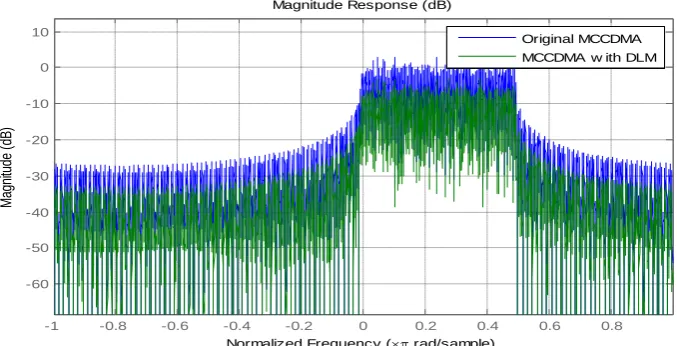
Using MC CDMA with DLM a very substantial amount of PAPR is reduced without decreasing BER performance as shown in figure 10. Figure 11 shows that the Power spectral Density of MC CDMA with DLM scheme reduces 10 dB in the main lobe and side lobe component when compared with the MC CDMA system.
0 2 4 6 8 10 12
10-2 10-1 100
---PAPR(dB)
---C
C
D
F
Performance analysis of PAPR for MC CDMA
Original MC CDMA DLM MC CDMA
Figure 5 MC CDMA PAPR performances with DLM and Walsh codes with 32 subcarriers, symbols 512, IFFT 128.
0 2 4 6 8 10 12 14
10-2 10-1 100
---PAPR(dB)
---C
C
D
F
Performance analysis of PAPR for MC CDMA
Original MC CDMA DLM MC CDMA
42
0 1 2 3 4 5 6 7
10-2
10-1
100
---PAPR(dB)
---CC
DF
Performance analysis of PAPR for MC CDMA
Original MC CDMA DLM MC CDMA
Figure 7 MC CDMA PAPR performances with DLM and Walsh codes with 16 subcarriers, symbols 4096, IFFT 256
0 1 2 3 4 5 6 7 8 9
10-2
10-1
100
---PAPR(dB)
---CC
DF
Performance analysis of PAPR for MC CDMA
Original MC CDMA DLM MC CDMA
Figure 8 MC CDMA PAPR performances with DLM and Walsh codes with 32 subcarriers, symbols 4096, IFFT 256
0 2 4 6 8 10 12
10-2 10-1 100
---PAPR(dB)
---C
C
D
F
Performance analysis of PAPR for MC CDMA
Original MC CDMA DLM MC CDMA
0 2 4 6 8 10 12 10-4
10-3 10-2 10-1 100
Performance analysis
---EbNo
----B
ER
original MCCDMA MCCDMA with DLS
Figure 10 MC CDMA BER performances with DLM and Walsh codes
-1 -0.8 -0.6 -0.4 -0.2 0 0.2 0.4 0.6 0.8
-60 -50 -40 -30 -20 -10 0 10
Normalized Frequency ( rad/sample)
M
ag
ni
tu
de
(
dB
)
Magnitude Response (dB)
Original MCCDMA MCCDMA w ith DLM
Figure 11 MC CDMA BER performances with DLM and Walsh codes
VII.
CONCLUSIONS
MC CDMA is used to combat channel distortion, and improves the spectral efficiency, supports high data rate, robust against multipath fading. In this paper, a MC CDMA system using DLM is implemented to reduce the PAPR, and improve security. DLM algorithm requires O(n) additions additionally in transmission and O(n/2) multiplications in reception.
In MC CDMA with DLM method, the PAPR is reduced by 4 dB and 5 dB when compared with the MC CDMA system for 512 and 4096 symbols. The proposed technique reduces PAPR, and improves the spectrum efficiency and security. The power spectral density has reduced by 10 dB without increasing BER. Proposed system has superior performance in terms of power spectral density and low PAPR.
REFERENCES
[1]. G.V.S Raju and Rehan Akbani, Elliptic curve cryptosystem and its application,, Proceedings of IEEE International conference on Systems, Man & Cybernetics, pp 1-4, 2003.
[2]. Robert Stewn Ower, John Hamilton, An Elloptical Cryptographic algorithm for Wireless devices. winter simulation conference @IEEE, pp.1424-1429, 2007.
[3]. Alexander Fit-Florea, Lien Li, Mitchell A, Thorton, and David W. Matula, A Discrete Logarithm number system for Integer Arithmetic Modulo 2k: Algorithms and lookup structures, IEEE Transactions on computers, vol.58, no.2, pp 163-174, 2009. [4]. A.Fit-Florea D.W.Matula and M.A Thomton, Addition based exponentiation modulo 2k, IEEE electronic letters, vol.41, no.2
2005.
[5]. Fit Florea, A, and Matula, D.W , A digit-serial algorithm for the discrete logarithm modulo 2k, IEEE 15th International
Conference on Application Specific Systems, architecture and processors, SAP, 2004.
[6]. B.Sarala, D.S. Venkateswarlu, MC CDMA PAPR Reduction Techniques using Discrete Transforms and Companding, IJDPS Nov.2011, Vol.2, No.6, PP 253-270, 2011.