Android Based Automation System for the next
Generation of Technology using Wi-Fi
Miss. Prachi Bhure Miss. Naziya Pathan
M Tech Student Assistant Professor
Department of Computer Science & Engineering Department of Computer Science & Engineering The Nuva College of Engineering, Nagpur, Maharashtra,
India
The Nuva College of Engineering, Nagpur, Maharashtra, India
Mr. Shyam Dubey Assistant Professor
Department of Computer Science & Engineering The Nuva College of Engineering, Nagpur, Maharashtra, India
Abstract
Automation is a technique or system of controlling a processor by electronic devices with reducing human involvement to a minimum. This paper presents a design of monitoring and controlling home automation system from an android application based on Raspeberry Pi. A system uses Wi-Fi technology as a communication protocol to connect system components. A home automation system consist of two main components; the first part is android application that can give orders to units that one wishes to control by locally or remotely and the second part is Raspberry Pi that has an appropriate interface to sensors and appliances of a home automation system and communicates with android application through wireless technology . The home automation system can have a vital role in reducing the total energy consumed by home appliances.
Keywords: IOT, Smart home, Raspberry Pi, Android application, Sensors, Wi-Fi)
________________________________________________________________________________________________________ I. INTRODUCTION
Home Automation or Domestics is the automation of household activities for the comfort and security of its residents. Home automation includes centralized control of appliances, lighting, HVAC (Heating, Ventilation, and Air Conditioning), resource management (water and energy) systems and security systems. Home automation may also include additional functions like automatic plant watering and pet feeding and automatic home care for the elderly or disabled people etc. There has been a significant increase in home automation in recent years due to reduced expenditure, higher affordability and advancement in Smart phones and tablets technologies which allows vast connectivity. Emerging concepts like Internet of Things (IoT), Cloud Computing and Big data are also incorporated with home automation to provide more advanced services and products in the field of Domestics. The overall objective is to provide sophisticated monitoring and control over the day to day household functions to improve convenience, comfort, energy efficiency and security.
In simple sense Home automation means to connect all electrical devices in the home to a central control system that control those devices according to user inputs. The connected electrical devices are intelligent in a sense that a programmable microcontroller with varies sensors and actuator can be attached with them to improve the automatic functioning. The concept of Internet of Things (IoT) can turns the automated home into a smart home. IoT connects everyday objects to the internet, enabling those objects to communicate with each other and complete tasks with the help of sensors and actuator with less user intervention. A smart home can be easily controlled through internet using a Smartphone, Tablet or Computer. The transition of the Internet towards IPv6 with an almost unlimited addressing capacity and
Emergence of Big data and Cloud computing capabilities further widens the scope of smart home concepts.
Future homes will be conscious about the day to day functioning like water consumption, energy consumption, and security issues like detecting theft, fire or unauthorized entry. The goal is to improve comfort level while reducing expenditure. The proposed system consists of a prototype model for a low cost wireless embedded gateway. The system can be extended to a fully fledged Smart Home System with two ways communication between Wireless Sensors and Actuators Modules (WSAM) attached with home appliances and Client module (Smart phone application) through the internet for remote home automation.
II. LITERATURE SURVEY
Internet of Things (IoT)
The Internet of Things (IoT) is a system of interrelated computing devices, mechanical and digital machines, objects, animals or people that are provided with unique identifiers and the ability to transfer data over a network without requiring human-to-human or human-to-computer interaction.
What is the internet of things (and why does it matter)?
The internet of things (or as it’s also known, IoT) isn’t new: tech companies and pundits have been discussing the idea for decades, and the first internet-connected toaster was unveiled at a conference in 1989.
Is it safe? Can the internet of things be secured?
Everything new and shiny has downsides, and security and privacy are the biggest challenges for IoT. All these devices and systems collect a lot of personal data about people – that smart meter knows when you’re home and what electronics you use when you’re there – and it’s shared with other devices and held in databases by companies.
How will the internet of things affect business and work?
This all depends on your industry: manufacturing is perhaps the furthest ahead in terms of IoT, as it’s useful for organizing tools, machines and people, and tracking where they are. Farmers have also been turning to connected sensors to monitor both crops and cattle, in the hopes of boosting production, efficiency and tracking the health of their herds
What does the internet of things mean for healthcare?
Smart pills and connected monitoring patches are already available, highlighting the life-saving potential of IoT, and many people are already strapping smart watches or fitness bands to their wrists to track their steps or heartbeat while on a run.
What is Raspberry Pi..?
A Raspberry Pi is a credit-card sized computer originally designed for education, inspired by the 1981 BBC Micro. Creator Eben Upton's goal was to create a low-cost device that would improve programming skills and hardware understanding at the pre-university level. But thanks to its small size and accessible price, it was quickly adopted by tinkerers, makers, and electronics enthusiasts for projects that require more than a basic microcontroller (such as Arduino devices).
Is the Raspberry Pi open hardware?
The Raspberry Pi is open hardware, with the exception of the primary chip on the Raspberry Pi, the BroadcommSoC (System on a Chip), which runs many of the main components of the board–CPU, graphics, memory, the USB controller, etc. Many of the projects made with a Raspberry Pi are open and well-documented as well and are things you can build and modify yourself.
What are the differences in Raspberry Pi models?
The Raspberry Pi Foundation has just recently released a new model, the Raspberry Pi 2, which supersedes some of the previous boards, although the older boards will still be produced as long as there is a demand for them. It is generally backwards compatible with previous versions of the board, so any tutorials or projects you see which were built for a previous version of the board should still work.
There are two Raspberry Pi models, the A and the B, named after the aforementioned BBC Micro, which was also released in a Model A and a Model B. The A comes with 256MB of RAM and one USB port. It is cheaper and uses less power than the B. The current model B comes with a second USB port, an Ethernet port for connection to a network, and 512MB of RAM.
The Raspberry Pi A and B boards been upgraded to the A+ and B+ respectively. These upgrades make minor improvements, such as an increased number of USB ports and improved power consumption, particularly in the B+. The A+ and B+ have been reviewed on Opensource.com here.
Tinkering with the Raspberry Pi A+ New open hardware: Raspberry Pi B+
If you have a Raspberry Pi and aren't sure which version you have, plug it in and from the terminal window, and run: cat /proc/cpuinfo
The output will include a revision code. The numbers indicate further differences, but if it is 0002-0006, it is an older Model B with 256MB of RAM. If it is 0007-0009, it is a Model A. The newer Model Bs are listed as 000d-000f. The B+ is 0010, and the A+ is 0012. (Revision 0011 was used for the Raspberry Pi Compute Module.).
What kind of operating system does the Raspberry Pi run?
The Raspberry Pi was designed for the Linux operating system, and many Linux distributions now have a version optimized for the Raspberry Pi.
What are alternatives to the Raspberry Pi?
The Raspberry Pi is not the only small computing device out there. In fact, there are many more options available than we could list here. We’ve reviewed some of the choices before, here, but let’s talk about some of the ones you may have heard of before.
The Arduino is another hobbyist board, which is geared towards those wanting to build out electronics projects. But, while the Raspberry Pi is a fully functional Linux computer, the Arduino is only a microcontroller. This means it does not run an operating system, but instead, runs very specific, small blocks of code written by the person using the device. There are numerous add-on boards that give it more capabilities, but out of the box, it’s less ready-to-go than a Raspberry Pi. Another option is the Beagle bone series of boards, which are more similar to the Raspberry Pi, but a little bit more powerful (and a little bit more costly, too).
III. RELATED WORK
The field of home automation is expanding and it has been researched by experts and industrialist. There are a number of do it yourself (DYY) platforms available that allow creating home automation system quickly and easily with low cost and high performance e.g. Raspberry Pi, Arduino, other microcontrollers. Various smart systems have been proposed where the different communication protocol was used e.g. DTMF, Bluetooth, email, and Wi-Fi, the Internet or SMS etc. [1].
Home automation control through email where the received email is read by the developed algorithm on raspberry Pi [2]. A system can access and send emails to consumer with the use of MODEM (Modulator-Demodulator). Memory space required is ejected by email based home automation system because it simply use the already existing web server service provided by Gmail and this technique is better than DTMF (dual tone multi-frequency) based home automation system [2]. A drawback of DTMF based home automation is that the number of appliances is limited by number of keys in the keypad. An ordinary phone usually has 12 keys only. SMS (Short Message Service) has been used communication protocol to control residential features. AT-commands have been applied and homeowners will be able to send and receive SMS and control home appliances from user’s mobile phones. Disadvantage of home automation using SMS are costs for the SMS and SMS depends on the networks [3]. An interaction between Arduino BT board and cell phone has been done through Bluetooth [4]. Python script supported mobile phone enables the user to access and control commands for the appliances. Bluetooth is password protected to ensure that the system is secure from any intruders. The Bluetooth has a range of 10 to 100 but access is limited to within the Bluetooth range.
Wi-Fi technology as a communication protocol to connecting system components [5]. Components are a web server to control users home using LAN (Local Area Network) or the internet and second part is Arduino board. IDE (integrated development environment) comes with the Arduino microcontroller. Java programming language using the android Software Development Kit (SDK) has been used for the development and implementation of the smart home application [6] [7].
Advantages of Home automation systems:
In recent years, wireless systems like Wi-Fi have become more and more common in home networking. Also in home and building automation systems, the use of wireless technologies gives several advantages that could not be achieved using a wired network only.
1) Reduced installation costs: First and foremost, installation costs are significantly reduced since no cabling is necessary. Wired solutions require cabling, where material as well as the professional laying of cables (e.g. into walls) is expensive. 2) System scalability and easy extension: Deploying a wireless network is especially advantageous when, due to new or
changed requirements, extension of the network is necessary. In contrast to wired installations, in which cabling extension is tedious. This makes wireless installations a seminal investment.
3) Aesthetical benefits: Apart from covering a larger area, this attribute helps to full aesthetical requirements as well. Examples include representative buildings with all-glass architecture and historical buildings where design or conservatory reasons do not allow lying of cables.
4) Integration of mobile devices: With wireless networks, associating mobile devices such as PDAs and Smartphone’s with the automation system becomes possible everywhere and at any time, as a device's exact physical location is no longer crucial for a connection (as long as the device is in reach of the network).For all these reasons, wireless technology is not only an attractive choice in renovation and refurbishment, but also for new installations
IV. SYSTEM ARCHITECTURE
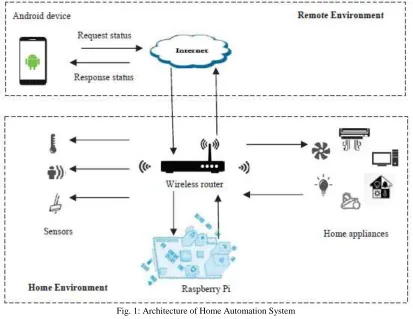
Fig. 1: Architecture of Home Automation System
1) Raspberry Pi: Raspberry Pi is a credit card sized single board computer developed in the UK by Raspberry Pi foundation [5]. It is used to eliminate the use of a personal desktop keeping the cost of the overall system to a Minimum Raspberry Pi is used to control flow between android device and sensors. Raspbian OS is used on Raspberry Pi and the server running on Raspberry Pi device is written in Python. Raspberry Pi has Python already installed on it.
2) Android Application: The application has installed on a Smartphone. A remote user can monitor and control the home environment from its android application on and communication is done via locally or remotely.
3) Router: A wireless router facilities the communication between the internal network and external network communication between the Raspberry Pi and home appliances is done over Wi-Fi network.
4) Sensor: All home appliances generate information about current status. Status information is generated by a sensor integrated with the device. A sensor can sense things like the presence of person for lighting control, movement, temperature etc.
5) Device: Devices such as light switches, power plugs, appliances of the house, which is compatible with the transmission mode, and connected to the control system.
V. METHODOLOGY
The system, which we have implemented fairly, takes a front seat from the rest of the implemented systems. Our Home Automation System (HAS) has been the interface of more than
One technology. The main advantage of this system is that it has the widest range, possibly the entire globe. This system can be extended to a properly a deployable HVAC (Heating, Ventilation and Air Conditioning) system. Our project can be studied by dividing it to the following parts:
Android:
Android is the operating system, which is based on Linux and developed by Google. Google releases android’s source code under open source licenses. The operating device, which we are
Java:
All our communication is between the Android and the Java Server. We have built a communicating module in Java with the help of Sockets. Normally, a server runs on a specific computer and has a socket that is bound to a specific port number. The server just waits,
Listening to the socket for a client to make a connection request.
Python:
Python is widely used high level, general purpose, interpreted, dynamic programming language. Its design philosophy emphasizes code readability, and its syntax allows programmers to express concepts in fewer lines of code than possible in language such as C++ or Java.
Microcontroller:
Intertwined between more than one technology. Now we give an experimental result as to what our project looks like through the mobile phone application.
Fig 1: Home Page Screenshot Fig 2: Fan Status Off
The Fig.1 shows the screenshot of the application of the mobile phone. Here we have correctly entered a static IP address. The next page directs us to the appliances connected to the pins of the microcontroller. The required appliance is selected. Here we have selected the fan icon (Fig. 2). As soon as the “Fan on” button is clicked, it soon gives a pop up message to the user. Next we can also control the speed of the fan in a limited measure
VI. CONCLUSION AND FUTURE WORK
Conclusion
The home automation using Internet of Things has been experimentally proven to work satisfactorily by connecting simple appliances to it and the appliances were successfully controlled remotely through internet. The designed system not only monitors the sensor data, like temperature, gas, light, motion sensors, but also actuates a process according to the requirement, for example switching on the light when it gets dark. It also stores the sensor parameters in the cloud (Gmail) in a timely manner. This will help the user to analyze the condition of various parameters in the home anytime anywhere.
Future work
ACKNOWLEDGEMENT
We acknowledge the efforts and hard work by the experts who have contributed towards development of the different home automation systems. We also acknowledge the efforts of Miss.Naziya Pathan (CSE) and Mr. Shyam Dubey HOD (CSE) for their constant support, suggestions and modifications to improve the quality of the paper and to help prepare the camera-ready copy of our paper.
REFERENCES
[1] Vaishnavi S. Gunge, Pratibha S. Yalagi, “Smart Home Automation: A Literature Review”, International Journal of Computer Applications (0975-8887)
National Seminar on Recent Trends in Data Mining(RTDM2016).
[2] Jain Sarthak, Vaibhav Anant and Goyal Lovevly, “Raspberry Pi based Interactive Home Automation System through E-mail.”, IEEE transaction,2014
International Conference Realibility, Optimization and Information TechnologyICROIT 2014, India, Feb 6-8 2014.
[3] Rozita Teymouzadeh, CEng Member IEEE//IET, Salah Addin Ahmed, Kok Wai Chan, and Mok Vee Hoong, “ Smart GSM Based Home Automation
System”, 2013 IEEE Conference on Systems, Process and Control(ICSPC2013),13-15 December 2013.
[4] R.Pivare, M Tazil, “Bluetooth Based Home Automation System Using Cell Phone”, 2011, IEEE 15th International Symposium on Consumer Electronics
Singapore, pp.192.
[5] Ahmed Alshafee, Karim Alaa Hamed,” Design and Implementation of a WiFi based Home Automayio System”, International Journal of Computer ,
Electrical, Automation, Control and Information Engineering V o1:6,No:8,2012.
[6] Hayet Lamine and Hafedh Abid, “Remote Control of domestic equipment from an Android application based on Raspberry Pi card”, IEEE transaction 15th
international conference on Sciences and Techniques of Automatic control and computer Engineering – STA’2014’, Hammamet, Tunisia, December21-23,2014.
[7] Shiu Kumar,”UBIQUITOS SMART HOME SYSTEM USING ANDROID APPLICATION”, International Journal of Computer Networks and