THE INTEGRATION OF EDUCATIONAL THEORY AND TEACHING PRATICE
BASED ON NETWORKED RURAL SCHOOLS
Ken Stevens
Faculty of Education, Victoria University of Wellington
ABSTRACT
In the Canadian province of Newfoundland and Labrador, rural schools are increasingly organised within digital environments, facilitating synergy between in-service and pre-service teachers. The integration of educational theory and teaching practice that is integral to the preparation of teachers for initial positions in rural schools is also facilitated by the digital environment in that face to face university classes can be extended to include virtual visitors who are practising teachers in the province’s schools. At the end of their teacher preparation program most pre-service teachers thought access to practising teachers in this way was of value to them as it enhanced their understanding of educational theories as they apply to the classroom. This paper reports on the use of technology to allow interactions between rural and preservice teachers and to bridge the gap between educational theory and practices as they relate to rural and regional settings.
Keywords: digital environment, integration of theory and practice, virtual visitors
INTRODUCTION
It has been recognized in Australia that access to and the quality of the preparation of teachers for rural schools is important for people who live beyond major centres of population (Kline, White, & Lock, 2013). For over two decades developments in distance education in Australia have had organisational implications for rural schools. Inter-institutional collaboration (Stevens, 1994b; Trinidad, Sharplin, Ledger, & Broadley, 2014), national experiments with satellite technology (Cruise, 1991), interactive television (Prain & Booth, 1993) and open learning (Stevens, 1994c) led to new ways of providing education in rural communities. The pedagogical implications of organisational changes in rural schools in Australia (Page, 2006) as well as in New Zealand and Canada (Stevens, 1995, 2011) have become important considerations in the education of teachers. Many pre-service teachers preparing for life in rural classrooms are now likely to spend part of their time teaching, not exclusively in classrooms, but in the space between networked schools.
developed world. The integration of educational theory and teaching practice by rural teachers provided a new dimension in the preparation of pre-service teachers to meet the changed realities of education in one of Canada’s most sparsely populated provinces.
THE BEGINNINGS OF NETWORKED RURAL SCHOOLS
Before the advent of the Internet and e-learning the researcher worked with rural New Zealand schools in a pre-digital environment, linking them with dedicated phone lines attached to electronic white boards so that senior students could hear one another and see what was being written in up to ten participating sites. In many cases the senior students were the only people in their classes and would otherwise have been denied access to specialised areas of the curriculum including sciences and languages. The educational change in this initiative for rural schools and their students was not technological, but conceptual. The organisation of small numbers of students in rural schools into networks linked by telephone and electronic whiteboards meant that classes could be formed spanning widely dispersed locations, taught by a teacher who was not on-site. Within these rudimentary, audio graphic networks, specialised areas of the curriculum were able to be provided by a teacher from one of the participating sites to students in small schools in dispersed locations (Stevens, 1994a, 1995).
A similar initiative in Iceland led to the creation of the Icelandic Educational Network (Stefansdottir, 1993). Iceland, like New Zealand, is an island state with many rural communities and a small population. In New Zealand and Iceland much of the national wealth is in primary production such as agriculture and fishing and located beyond major centres of population. In both societies rural schools are therefore vital parts of the national social and economic infrastructures. The Icelandic Educational Network and the New Zealand CantaTech project both attempted to bring to rural communities extended learning opportunities, particularly for senior high school students (Stevens, 2002).
The networking of rural New Zealand schools was influenced by developments in Iceland and, indirectly, by the implementation of distance education technologies in the provision of rural Australian education. Given the success of the New Zealand project, a decision was made to replicate the research that was linking schools in rural New Zealand, when the researcher took up an academic position in the Canadian province of Newfoundland and Labrador in 1997. By this time the Internet and e-learning were available and an initial group of eight rural schools in the Vista school district of Newfoundland were linked to form an intranet (Stevens, 2001). The Centre for Distance Learning and Innovation (CDLI) grew out of the Vista project (outlined below), following a Ministerial Inquiry (Government of Newfoundland and Labrador, 2000). CDLI today links schools throughout the province and provides extended learning opportunities for students at all levels of high schools.
Digital Beginnings in Rural Newfoundland and Labrador Schools
The Atlantic Canadian province of Newfoundland and Labrador is characterized by geographic isolation, rural lifestyles and a distinctive culture and history. Newfoundland and Labrador has a population of approximately 500,000 people of whom fewer than 30,000 live in Labrador. In Newfoundland, the island portion of the province, almost all of the population lives in coastal settlements, including the capital, St John’s. Approximately two thirds of schools in the province are located in small, rural coastal communities. With continuing out-migration most rural schools in Newfoundland and Labrador are decreasing in size and during the last decade many have closed and local students have had to travel to larger centres to continue their education.
than 100 students. Seventy of the small rural schools in this province were classified as ‘all-grade’ (K–12) which meant they had to somehow offer a senior high school program (Stevens, 2001). This presented teachers and educational administrators with a challenge.
The Vista School District at this time contained 18 schools ranging in student enrolment from 650 down to 40. The region in which the Vista School District was located extended from Bonavista in the north to the Burin Peninsula in the South. A large geographic area covering 7,000 square kilometres, the region had a population of about 35,000 people and an economy supported by a diverse infrastructure including fishing, forestry, farming, mining, aquaculture and tourism. There were 5,165 students enrolled in 18 schools in the Vista school district, taught by 366 teachers. This school district was approximately two hours by road from the capital city, St John’s, which is the location of Memorial University of Newfoundland.
From the eight schools that together comprised the Vista School District Intranet, 55 students enrolled in Advanced Placement (AP) Biology, Chemistry, Mathematics and Physics courses during the 1998-1999 school year. Advanced Placement courses enable students in their final year of High School throughout North America, to begin undergraduate degrees if these courses are passed at the minimum grade levels specified by the their university of choice. The challenge that this presented for the eight small rural schools in the Vista School District was to provide University-level instruction for small numbers of students. By linking students in each of these four AP subject areas across eight rural sites, an intranet was formed.
By participating in classes in real (synchronous) time using audio, video and electronic whiteboards over the Internet, combined with a measure of independent (asynchronous) learning, senior students were able to both interact with one another on-line as well as work off-line in their own community schools. The development of this new, electronic educational structure in rural Newfoundland was an attempt to use information and communication technologies to provide students with extended educational and career opportunities. Many students who were participants in the virtual classes learnt about the potential of information and communication technologies while studying their AP courses. Students in the Vista School District Intranet were frequently subject to scrutiny by their peers as they responded through chat-rooms, audio and video with their AP on-line teachers. The intranet provided students with access to multiple sites simultaneously as well as with the opportunity to work independently of a teacher for part of the day. The need to prepare for classes before going on-line became increasingly apparent to both teachers and students if the open, synchronous, science classes were to succeed. The advent of the intranet had implications for students who had to interact with teachers and their peers in a variety of new ways. From observations, it appeared that many students experienced difficulty expressing themselves and, in particular, asking questions in open electronic classes when they did not know their peers from other small communities. However, as the students became more comfortable with one another, on-line inhibitions such as asking questions were overcome. At the conclusion of this project a further study in another Newfoundland and Labrador school district was conducted, based on the Vista Intranet study.
THE STUDY
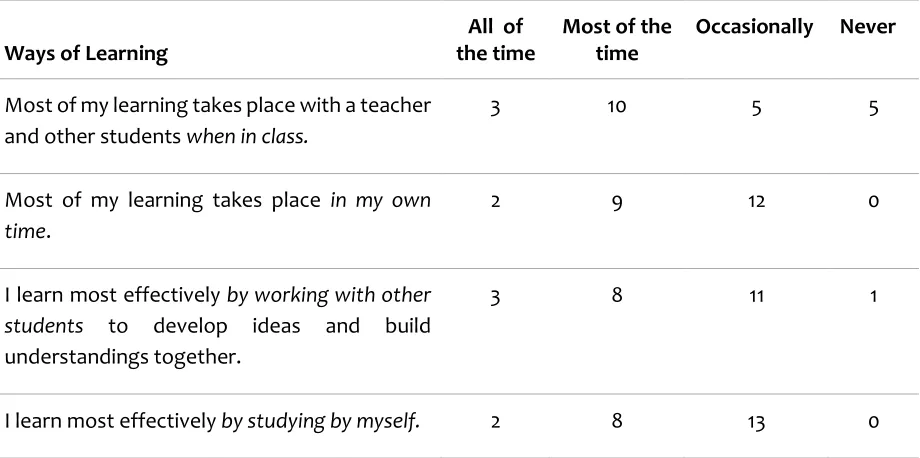
Table I: Ways of Learning
Ways of Learning
All of the time
Most of the time
Occasionally Never
Most of my learning takes place with a teacher and other students when in class.
3 10 5 5
Most of my learning takes place in my own time.
2 9 12 0
I learn most effectively by working with other students to develop ideas and build understandings together.
3 8 11 1
I learn most effectively by studying by myself. 2 8 13 0
While most of the above responses indicate that students preferred to have a teacher in a traditional class, there was a strong indication in these responses that working with other students was an effective way of learning. In networked school environments, collaborative learning is facilitated as students meet one another and their teachers online.
Students were also asked to assess the learning skills they had acquired as a result of taking the AP course. All 23 students responded to this item. Their responses to five specific skills that were presented to them are shown in Table 2 below. The totals exceed the number of respondents (N=23) since some students chose more than one skill.
Table 2: Acquisition of Learning Skills
Skill Frequency of Response
1. My writing skills have improved 3
2. I have learned to work better with other students 13
3. My study habits have improved 17
4. My listening habits have improved 6
5. My listening skills have been developed 14
Following a ministerial inquiry (Government of Newfoundland and Labrador, 2000) into the development of the Vista and subsequent intranets, the Centre for Distance Learning and Innovation (CDLI) was established. CDLI (https://www.cdli.ca) expanded the online learning that began with the Vista project to schools throughout the province, so that, regardless of location and, in spite of some less than satisfactory online access in more remote parts of Newfoundland and Labrador, schools today are enhanced by access to digital learning and, with it, extended curriculum options.
LEARNING TO TEACH IN NETWORKED RURAL SCHOOLS
A logical extension of the successful implementation of on line learning in the secondary schools was into the tertiary sector, particularly in the preparation of teachers. The intermediate– secondary preservice teacher education students at Memorial University of Newfoundland initially had little awareness of the changing digital educational environment in which they were likely to be employed, including the increasingly open nature of rural schools facilitating student collaborative learning in the province. The concepts of open and closed schools provided a way of introducing the new reality of actual and virtual classes and teaching in the digital environment (Furey & Stevens, 2008). Many pre-service teachers in the Faculty of Education acknowledged that their initial professional futures were likely to be in rural schools in which they could expect to have many and diverse responsibilities (Barter, 2008; Eppley, 2009; Lock, 2008; Wenger & Dinsmore, 2005).
From Closed to Open Schools
Traditionally schools have been established to serve geographically defined communities and, in rural areas, this relationship is often a particularly close one. Schools in each community, to a considerable extent, duplicate what schools are doing in other communities with students being taught by teachers assigned to them to teach face to face as whole classes, in small groups and, in some cases, individually. This is a closed model of the school. The closed model sees the school as an autonomous institution with its own students, its own teachers and located in a defined community. This is a model of the school in an enclosed and exclusive teaching and learning environment.
Educational Theory
At Memorial University of Newfoundland a relationship between sociological theories of education and teaching practice was organised based on practicing teachers who were recent graduates of the Bachelor of Education (BEd) (Intermediate-Secondary) program and who volunteered to become Professional Associates of the Faculty of Education. Professional Associates (PA) assisted in the teaching of selected courses for pre-service teachers from their schools. The professional associate program enabled classroom teachers to participate in lecture and seminar rooms at the university by sharing their practical skills and recent academic studies to enrich the preparation of pre-service teachers for classroom work in the near future.
The one-year professional educational program for graduates preparing to become intermediate and secondary teachers consisted of three semesters covering a full year. The program began in September and the first (‘fall’) semester ended in December, after which the winter semester (January to April) was spent as interns in predominantly rural schools. The third and final semester between May and August involved further coursework at the university. The professional program consisted of both coursework based on educational theory and a full semester of teaching practice in selected schools.
Pre-service teachers in the fall semester section of the professional program were introduced to a range of educational and sociological theories relating to schools and socialization, critical social theory, knowledge and the curriculum, conflict and consensus theories of school and classroom organisation as well as the organisation of teaching and learning. After their return to campus following the internship, these theories were revisited and examined in the light of recent classroom experiences. Pre-service teachers were asked to examine theories they were introduced to in the fall in relation to their teaching and classroom work during the winter semester. In considering the relationship between theory and practice, pre-service teachers were encouraged to engage with practicing teachers who were Professional Associates of the Faculty of Education.
Teaching Practice
In the final semester of the BEd (Intermediate-Secondary) program, following the winter internship, students completed additional academic courses including one that focused on sociological considerations of classrooms and schools. Learning circles were used to discuss intern experiences in schools and the sociological implications of their classroom teaching, classroom culture and school culture. Learning circles were heterogeneous in composition in that they each consisted of around eight students, as far as possible from different subject backgrounds. For example, history interns (teachers) sat with mathematicians, art educators, physical education specialists and others to find common sociological dimensions in their recent experiences in schools (Coady, Churchill, & Stevens, 2012). This involved reflection, discussion and academic reading as well as whole class presentations of their interpretations. In learning circles, collaboration was emphasized and students were encouraged to share their ideas and their readings on a range of sociological theories ranging from consensus and conflict, critical pedagogy and social and cultural reproduction and relate them to their recent internship experiences, most of which took place in rural schools. Members of learning circles were in this way expected to link their recent classroom experiences with academic reading and, if possible, relate both to an appropriate sociological perspective. To facilitate this, the concept of cybercells was introduced.
heard and, thereby, contribute to discussions. Spatially, cybercells make physical spaces larger by including within them, virtual visitors on demand. Cybercells challenge institutions by extending their physical space to include virtual members such as other students, specialists and experts. The location of teachers and learners in relation to one another reduces in significance as virtual and actual teaching and learning spaces interact and merge in pursuit of common interests. Cybercells can change classrooms and other physical spaces by facilitating new understandings between groups that are both actually and virtually present, encouraging collaborative teaching and collaborative learning.
For Newfoundland and Labrador pre-service teachers returning to the university from internships in mostly rural schools, face-to-face learning circles were extended to become cybercells with the inclusion of Professional Associates as virtual visitors from schools throughout the province. All professional associates were former members of the same intermediate-secondary teacher education course. The development of shared realities between university and school environments through cybercells was based on discussions of issues in classrooms, schools and teaching between pre-service and in-service teachers.
Integrating Theory and Practice
Before the internship pre-service intermediate/secondary teachers (N=160) undertook a compulsory course, ‘Teaching and the Contemporary Classroom’. After the internship in schools they were required to take a further sociological course that focused on classrooms. In the first year of teaching this course, the professor was assisted by 27 PAs. The following year the number of PAs increased to 66 and in the final year there were 49. Professional Associates, as graduates of the Memorial University’s teacher education program, were aware of its theoretical, as well as, practical content. Before the academic year began the professor consulted Professional Associates in the design of the course and each participant was provided with course details. By recruiting PAs each year there was a measure of continuity between current and former members of the above courses. Professional Associates were invited to comment on and contribute to the design of the course that was taught through learning circles in which teaching, classroom culture and school culture were examined, linking recent intern experiences with academic reading. In Newfoundland and Labrador the Professional Associate program enabled teachers in the province’s schools, most of which are located in rural communities, to participate in the preparation of pre-service teachers for work in classrooms. Pre-service teachers were asked to prepare portfolios of their internship experiences and to link these to their reading in the sociology of education. The development of portfolios began with an awareness of the increasingly open nature of teaching and learning in the province’s schools in which teachers and students were increasingly able to collaborate with one another across multiple sites. Collaboration was encouraged at the post-intern phase of teacher education through learning circles in which PAs from schools were in many cases engaged for discussion, feedback and critical comment.
Professional Associates and Cybercells
Pre-service teachers saw a number of advantages for themselves in online relationships, through cybercells, with practicing teachers who volunteered to be Professional Associates of the Faculty of Education. In the first year of the program pre-service teachers were asked in a questionnaire about the value of Professional Associates in their professional education. They were asked to comment, if possible, on the role of PAs in developing their understanding of educational and sociological theory. The responses at the end of the initial year were that Professional Associates had moderate value (51.5%) or high value (14%). Twenty percent of responses were neutral regarding the value of PAs, while 8.5 per cent of respondents considered they had ‘low value’ and the remaining 6 per cent thought they had no value at all in the course. Two years later, in the third year of the program, pre-service teachers were asked the same questions in a further questionnaire. Their responses were that Professional Associates had high value (62%) or moderate value (36%) and only 2 per cent were neutral about their role in the course (Stevens, 2013b).
One pre-service teacher perceived value in the fusion of academic and practical aspects of the professional education program. Another said she welcomed the opportunity to learn from another teacher’s style and experience and a third pre-service teacher thought there was value for him having a direct professional link between the university to schools so that he could be involved with current issues and trends in education. Another pre-service teacher saw the value of Professional Associates in exposure to new ideas if my knowledge is limited and another said simply that it enabled pre-service and practicing teachers to learn from one another and to create together. These and other comments can be summarized in the words of the pre-service teacher who wrote teacher collaboration is important for professional development.
The Integration of Rural Schools and Teacher Education
In a province in which the majority of schools are located in small communities, the digital environment, modelled by pre and post internship education courses at Memorial University of Newfoundland, provided students with enhanced access to teachers though open learning structures and extended learning opportunities. The digital educational environment that has developed in largely rural Newfoundland and Labrador was reflected in university courses for pre-service teachers. This involved synergy between pre-pre-service teachers (Thompson, Bakken, & Clark, 2001) engaging in cybercells that included face-to-face and virtual spaces - for the interpretation of sociological theories through discussion with practicing teachers in classrooms throughout the province of Newfoundland and Labrador.
Perhaps the most important feature of the integration of educational theory and teaching practice that took place in Newfoundland and Labrador’s digital environment was the collaboration that took place between in-service teachers, most of whom were in rural schools, and pre-service teachers in online communities of practice (Ertl & Plante, 2006; Herrington, Herrington, Kervin, & Ferry, 2006; Poole, 2000; Stevens, 2011). Collaboration between pre and in-service members of the teaching profession acknowledged that educational spaces are not confined to traditional, physical classrooms but, through cybercells, included spaces between participating sites. An important space for the university was the one between lecture rooms and school classrooms.
CONCLUSION
increasingly, in the ‘open’ classroom that is the space between schools. Finally, this study, conducted in a province in which most schools are located in small communities, suggests that an important future direction to consider in teacher education is access to rural teacher knowledge in schools to enhance understanding of educational theories taught in universities.
Acknowledgements
1. This study was supported by the Social Sciences and Humanities Research Council (SSHRC) of Canada through a Community-University Research Alliance (CURA) award.
REFERENCES
Barter, B. (2008). Rural education: Learning to be rural teachers. Journal of Workplace Learning, 20(7), 468–479.
Coady, A., Churchill, R., & Stevens K. (2012). From classrooms to lecture rooms - professional associates and the professional education of teachers. Bulletin of the Newfoundland and Labrador Teachers’ Association, 55(6) 20–21.
Cruise, R. J. (1991). A report on satellite education in the north-west of Victoria, Education in Rural Australia, 1(2), 1–6.
Ertl, H., & Plante, J. (2006). Connectivity and learning in Canada’s schools. Ottawa, Statistics Canada, Government of Canada.
Eppley, K. (2009). Rural schools and the highly qualified teacher provision of No Child Left Behind: A critical policy analysis. Journal of Research in Rural Education, 24(4), 1–11.
Furey, D., & Stevens, K. (2008). New systemic roles facilitating the integration of face-to-face and virtual learning. Online Journal of Distance Learning Administration 11(4), Winter.
http://www.westga.edu/~distance/ojdla/
Government of Newfoundland and Labrador (2000). Supporting learning: Report on the ministerial panel on educational delivery in the classroom. St John’s, NL, Department of Education.
Herrington, A., Herrington, J., Kervin, L., & Ferry, B. (2006). The design of an online community of practice for beginning teachers. Contemporary Issues in Technology and Teacher Education, 6(1), 120–132.
Kline, J., White, S., & Lock, G. (2013). The rural practicum: Preparing a quality teacher workforce for rural and regional Australia. Journal of Research in Rural Education, 28(3), 1–13.
Kynaslahti H., Stevens, K.J., & Salminen J. (1996). Some preliminary outcomes from networked classes in Finland and New Zealand. Kasvatus - The Finnish Journal of Education, 27(2), 196– 205.
Lock, G. (2008). Preparing teachers for rural appointments: Lessons from Australia. The Rural Educator, 29(2), 24–30.
Page, J. (2006). Teaching in rural and remote schools: Implications for pre-service teacher preparation pedagogies of place and their implication for pre-service teacher preparation. Education in Rural Australia, 16(1), 47–63.
Poole, M. J. (2000). Developing online communities of practice in pre-service teacher education. Retrieved from http://citeseer.ist.psu.edu/update/508413
Prain, V., & Booth, T. (1993). Using interactive television to deliver professional developments in rural Victoria. Education in Rural Australia, 3(2), 5–10.
Stefansdottir, L. (1993). The Icelandic educational network – Ismennt. In G. Davies & B. Samways (Eds), Teleteaching – Proceedings of the IFIP TC3 Third Teleteaching Conference (pp. 829–835), Amsterdam, Elsevier Science Publishers.
Stevens, K.J. (2013a). Teaching teachers to teach together between high schools. International Journal of Instruction, Vol. 6 (2), 5–14.
Stevens, K.J. (2013b). The integration of theory and practice in the education of Canadian teachers. International Journal for Cross-Disciplinary Subjects in Education, 4(3), 1251–1255. Stevens, K.J. (2011). Online learning communities for Canadian teachers. Distance Education
Stevens, K.J. (2002). Minnkandi heimur -Rafrænt net smárra skóla- Óvænt tengsl Íslenska menntanetsins við Nýja Sjáland og Kanada (Making the world smaller -the electronic
networking of small schools - some unseen connections of the Icelandic educational network in New Zealand and Canada), Skólavarðan - Málgagn Kennarasambands Íslands 2 (2), 22–24 [Introduction and translation into Icelandic by Karl Erlendsson].
Stevens, K (2001). The development of digital intranets for the enhancement of education in rural communities. Journal of Interactive Instruction Development, 13(3), 19–24.
Stevens, K.J. (1995). Geographic isolation and technological change: A new vision of teaching and learning in rural schools in New Zealand. The Journal of Distance Learning, 1(1), 32–38.
Stevens, K.J. (1994a). Some applications of distance education technologies and pedagogies in rural schools in New Zealand. Distance Education, 15(4), 318–326.
Stevens, K.J. (1994b). Australian developments in distance education and their implications for rural schools. Journal of Research in Rural Education, 10(1), 78–83.
Stevens, K.J. (1994c). Distance education and open learning in Australia: A New Zealand perspective. Open Learning – The Journal of Open and Distance Learning, Vol. 9(2), 29–35. Stevens, K., & Stewart, D. (2005). Cybercells – learning in actual and virtual groups.
Thomson-Dunmore Press, Melbourne.
Tella, S. (1995). Virtual school in a networking learning environment. Helsinki, University of Helsinki, Department of Teacher Education.
Thompson, J., Bakken, L. & Clark, F.L. (2001). Creating synergy: collaborative research within a professional development school partnership, The Teacher Educator, 37(1) 49–57.
Trinidad, S., Sharplin, E., Ledger, S., & Broadley, T. (2014). Connecting for innovation: Four universities collaboratively preparing pre-service teachers to teach in rural and remote Western Australia. Journal of Research in Rural Education, 29(2), 1–13.