Separating the Platinum
Group
Metals
by Liquid-Liquid
Extraction
NEW PROCESS HAS POTENTIAL ECONOMIC ADVANTAGES
OVER CONVENTIONAL SELECTIVE PRECIPITATION
By
P.
Charlesworth
Marthc.! Kuqtenhurg Refiners ( I ’ K ) Limited, Ro>ston, England
To extract the platinum group metals from the ore, and to refine them to the very high purity required for their many applications, requires a multitude of complex operations. A t present the final re.fining stage that produces the individual platinum group metals is carried out by selective precipitation from a solution of mixed platinum group metals, but this is inefficient as far as the degree of separation is concerned. A n improved process which makes use of
liquid-liquid extraction has been developed to a pilot plant stage, and this paper highlights some of the chemical and process principles that underlie this method of separation.
T h e platinum group metals platinum, palladium, rhodium, iridium, osmium and ruthenium together with silver and gold generally occur in nature associated with the major base metals iron, copper, nickel and cobalt and a wide range of minor elements such as lead, tellurium, selenium and arsenic, and both technical and commercial considerations demand that the individual platinum group metals be separated from the other metals and from each other to high purity, with high yield and with a high percentage recovery.
Refining of platinum group metals consists of several stages:
I . Ore concentration by physical techniques
such as flotation
2 . I’vrometallurgical concentration producing copper-nickel sulphide matte, and hydro- metallurgical concentration
3. Final refining to produce the individual platinum group metals.
This article concentrates on the last stage, the final refining stage, of this overall process.
Current refining processes are based on complex selective precipitation techniques, and
these are often inefficient in terms of the separation efficiency achieved. Interfering ele- ments can be co-precipitated, and filter cakes often contain entrained filtrate. Thorough washing of these cakes is difficult to achieve owing to their nature, and their structure, and they often have poor filtration characteristics. Processing is therefore complex, and repeated washing and filtration cycles are required, as each stage generates recycles and residues requiring recovery.
The large and complex recycles that are necessary result in low primary yields. The nature of the process, and the problems associated with corrosion and the engineering of these filtration and cake handling stages, makes plant unreliable, complicated and labour intensive.
identified as a technique capable of giving the desired separation characteristics, and satisfy- ing the process constraints.
Liquid-Liquid Extraction
Generally several requirements exist for a refining process, and major criteria include the avoidance of precipitates, high separation efficiency of the desired element, and good selectivity for the desired element.
Liquid-liquid extraction supplies these; as a technique it has long been recognised in the sphere of analytical chemistry. Industrial applications are more recent and are increas- ingly employed in the non-precious metals industry, for example during the extraction of uranium, plutonium, zirconium, hafnium, the rare earths, copper, cobalt and nickel. Currently liquid-liquid extraction is employed commercially by Matthey Rustenburg Refiners for the separation of copper, cobalt and gold.
The separation relies on the desired metal being selectively extracted from the aqueous phase by an immiscible organic solvent. It is often forgotten, but equally important, that the metal must also be capable of back-extraction with another suitable aqueous phase. The organic and aqueous phases used must be com- patible with process, health and safety, and cost considerations.
The ability of the solvent to extract the metal
is defined by a distribution coefficient, D, where
D(l -Concentration of element in the solvent phase Concentration of element in the aqueous phase
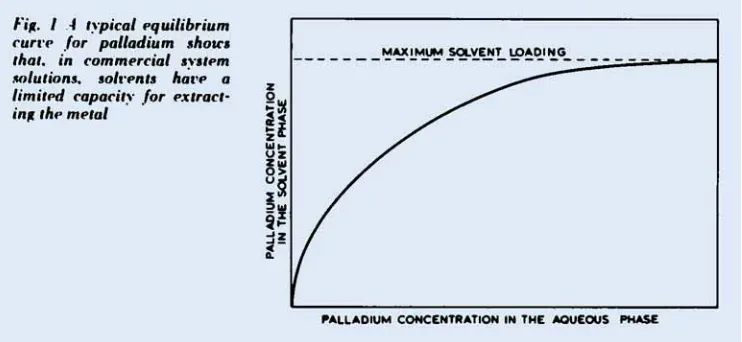
This applies at a given set of conditions for the system and is an equilibrium relationship, which is usually a constant for dilute solutions. However, in commercial systems solutions are not dilute and solvents have only a limited capacity for extracting metal.
A
typical plot is shown in Figure I.A
-Chemical Considerations
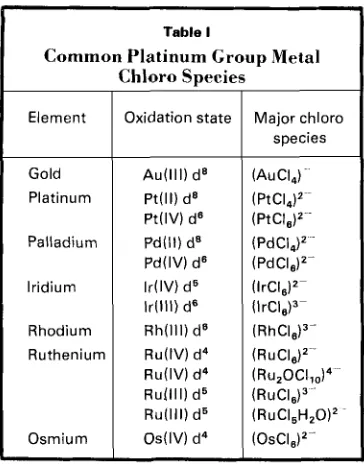
The process chemistry is the key to separa- tion ( I ) . It must allow separation of the platinum group metals from the base metals, where the major difference is in complex forma- tion, and also separation of individual platinum group metals from each other, to a high degree of purity.
Table I
Common Platinum Group Metal Chloro Species Element Gold Platinum Palladium Iridium Rhodium Ruthenium Osmium Oxidation state Au(lll) d8 Pt(l1) d8 Pt(lV) de Pd(ll) de Pd(lV) d e Ir(lV) d 6 Idlll) d6
Rh(lll) de Ru(IV) d4 Ru(lV) d 4 R u l l l l ) d 6
Ru(ll1) d6 O d l V ) d4
Major chloro species
metaldbase metals separation. Complexes con- taining the heavier donor atoms are more stable and the following overall order applies:
S - C
> I
>
Br> C1> N > 0
Although sulphur bonded systems have been used, and they give excellent distribution coefficients, the kinetics of the reaction are slow and the reverse reaction, stripping, is usually difficult. T h e chloride system, while having less favourable, but nonetheless acceptable, extrac- tion characteristics, gives the good overall extract-strip balance required for a commercial process.
The reaction mechanisms employed for the separation process fall into the following three categories: compound formation, solvation and ion pair formation.
Compound Formation
With compound formation extractants can be chelating agents, carboxylic or sulphonic acids, or acidic organophosphorus compounds. Important in this class are the oxime reagents. Substitution kinetics for the platinum group metals, for example platinum or palladium, are relatively slow compared to base metals such as
copper. A generalised form of this reaction is:
[MCIJ-
+
y S+
(M C1,-,SJy-"+
y C1-Solvating Systems
Solvating extractants are either carbon or phosphorus bonded oxygen bearing extractants, for example ketones and ethers, and react as follows:
(MC1,)"-
+
y S*
(M CIJ"-.y SThe basicity of such solvents is low, with equilibrium lying more to the left. Solvating systems particularly are effective for extraction of gold as (AuCld-.
Ion Pair Formation
Ion pair formation is of wide interest, and includes particularly the high molecular weight amines and quaternary ammonium compounds. In general the reaction is:
[MClJ"-
+
nRtX- + (Ri)JMCl,l"-+
nXand equilibrium depends on the basicity of R. Amine solvents can be used for the extraction of platinum and iridium.
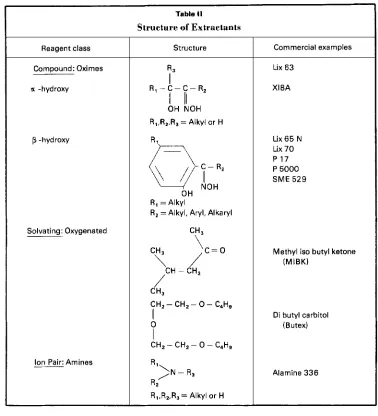
The structure of some commercially available extractants in each class is given in Table 11.
Platinum Group Metal
Separation Schemes
Various schemes can be postulated for extracting both primary and secondary materials, depending on starting feedstock and process constraints. Following dissolution, gold is usually removed at an early process stage, and is therefore considered first.
Solvent extraction for gold is well known (2)
and has been commercially operated for a number of years. Extraction as the [AuClJ ion with solvating reagents such as methyl is0 butyl ketone (MIBK) or dibutyl carbitol (Butex) is rapid and efficient. The gold is recovered as metal by direct reduction of the organic phase, following scrubbing to remove co-extracted impurities.
Platinum can be removed, in the absence of
palladium and gold, by ion exchange if iridium is in the Ir(II1) oxidation state. This is
illustrated in Figure 2 which shows the
(AuCI,) (PtCI,)* (PtC1,)2 -
(PdC1,)2 (Pd
( 1 r CI,)
*-
(lrCle)3- ( R h (RuCI,)~ (RU,OCI,,,)~Table II
Structure of Extractants
Reagent class
Compound: Oximes
rl -hydroxy
p
-hydroxySolvating: Oxygenated
Ion Pair: Amines
Structure
R3
I
R, - C - C - R,
I
I1
OH NOH
R,,Rz.R3 = Alkyl or H
NOH OH R, = Alkyl
R, = Alkyl, Aryl, Alkaryl
cT
,CH - CHZ 2 = OCH, - CH, - 0 - C4Hg
0
CH, - CH, - 0 - C4Hg
I
I
R,
R2
>N - R,
distribution of a range of platinum group metal chloroanions with tri-n-octyl amine. T h e reaction below lies well to the right.
2RH+ + [PtCl J”
=
(RH),(FtCl,)and consequently in the reverse, stripping, reac- tion it is difficult to break the ion pair unless strong acid or alkali are used.
Palladium extraction systems based on both long chain alkyl sulphides (3) and hydroxy- oximes have been reported in recent years. Oximes are produced commercially and widely available, particularly for copper extraction
Commercial examples
Lix 63
X18A
Lix 65 N
Lix 70 P 17
P 5000 SME 529
Methyl is0 butyl ketone (MIBK)
Di butyl carbitol (Butex)
Alamine 336
from leach liquors. These oximes have high distribution coefficients for palladium but suffer from slow reaction kinetics. T o overcome this, new accelerating additives based on organic amines and other organic compounds containing sulphur, phosphorus and arsenic are used. When these are coupled with a novel design of extractor they permit continuous commercial operation.
tion, or extraction as [RuNOClJ- with anion exchangers (4) have been reported.
Iridium can be oxidised to Ir(1V) and then
removed with platinum as illustrated in Figure
2, once palladium and gold have been removed.
Equally if iridium remains as Ir(III), platinum can be extracted leaving iridium in solution. It can then be oxidised to Ir(1V) and extracted. This ability to select iridium extraction by control of the iridium oxidation state gives great flexibility to the separation process. Amine solvents are preferred and extraction is similar to that for platinum. A high C1- con- centration suppresses extraction of rhodium and co-extracted impurities are removed by an acid scrub stream.
[IrC16]3- is less stable than [IrCl,]’- and stripping can be readily accomplished following reduction of the organic phase.
Rhodium recovery can be effected from the
resulting solution by conventional precipi- tation, cation exchange removal of base metals, or anion exchange removal.
Once all of the platinum group metals have been removed, the solution, containing base metals only, can be discharged for effluent treatment.
Ruthenium and osmium extraction from
chloro species is difficult owing to the complex series of equilibria that exist in solution. The removal of ruthenium and osmium as tetroxides using distillation or carbon tetrachloride extrac-
Process Considerations
Equipment falls into two classes, with sub-
divisions, as follows:
Mixer Settlers-Pump Mix or Hydraulic Flow; Columns-Packed, Pulsed and Multiple Mixer (agitated or disc).
Other types of equipment exist, but these are either variants of the above or not of normal commercial interest.
Mixer settlers are widely used as discrete stage contactors. The two phases are first mixed in a chamber, the size of which is deter-
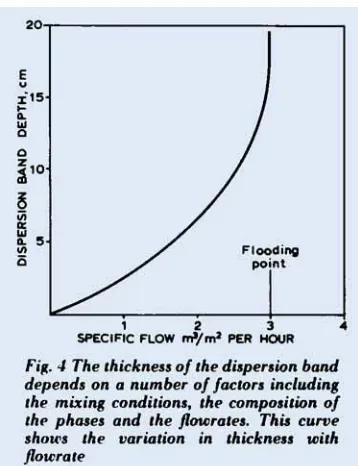
mined by consideration of the reaction kinetics of the process. A typical unit is illustrated in Figure 3. The unit is fed continuously and the dispersed phase flows into the settling chamber. This must be sized such that the settler is not flooded with dispersion. T h e dispersion-band thickness depends on several parameters such as mixing conditions, flowrates, phase continuity, and organic and aqueous phase composition.
A typical curve showing the variation of dispersion band thickness with flowrate is shown in Figure 4.
Not all of the desired metal is extracted in a single equilibrium contact, and several stages are usually needed. Also a practical stage is usually only about 90 per cent efficient. T h e number of actual stages required is derived from knowledge of the equilibrium curve as shown in Figure I , and of the efficiency and flowrate conditions required. This is shown gra- phically in Figure
5.
It can be demonstrated that the operating line has a slope equal to the phase flow ratio in the cascade. Mixer settlers can be readily banked into multi-stage units to give the desired flowsheet configuration.The cascade is operated with countercurrent aqueous and solvent flow. Both pump mix units, generally favoured by the copper industry, and hydraulic flow units favoured by the nuclear industry are used a t appropriate locations.
phase separation characteristics, needing relatively few theoretical stages.
Process Development
Separation schemes for platinum group metal refining have been examined at bench and pilot plant scale for several feedstocks of interest. The development pilot plant programme had several objectives:
(a) T o prove that the process technology would work on real solutions and could operate for an extended period.
(b) T o generate design and scale-up data for the eventual production refinery.
(c) To examine long term effects such as solvent poisoning and circuit accumula- tion.
(d) To examine process yields, efficiencies, refining time and operating costs.
(e) T o determine process flexibility with respect to feed-stocks, impurities, throughput, etc.
Significant quantities of platinum group metals were successfully processed during the pilot plant phase of the process.
Conclusions
Solvent extraction has a number of advantages over conventional precipitation processes. The research and development
programme has shown that solvent extraction processes can give:
(i) Operational safety due to enclosure of platinum solutions, which have some allergenic properties.
(ii) Reduction of wet solids handling. (iii) Improved primary yields and operating
(iv) Shortened pipeline times. (v) Improved intermediate products. (iv) Versatility.
The net result should, once capital invest- ment has been made, give improvements to refinery operation and costs.
Following the research by Johnson Matthey and development with pilot plant operation of this process at the Matthey Rustenburg Refiners (UK) Limited, Royston Refinery, Matthey Rustenburg Refiners has recently announced its decision to erect a Solvex produc- tion refinery on the Royston site ( 5 ) .
efficiencies.
References
I M. J. Cleare, P. Charlesworth and D. J. Bryson,
3.
Chem. Technol. Biotechnol., 1979,29, (4), 2 1 02 Y. Marcus and A. S. Kertes, “Ion Exchange and Solvent Extraction of Metal Complexes”, Interscience, London, I 969
3 R. I. Edwards, Proc. Int. Solvent Extr. Conf., ISEC 77, Toronto, September gth-16th, 1977, CIM Special Volume 21, Canadian Institute of Mining and Metallurgy, 1979, p. 24
4 US. Patent 4,105,442; 1978
5 Platinum Metals Rev., 1981,25, (I), 31
Catalyst Systems for Exhaust Emission Control
from Motor Vehicles, Past, Present and Future
The MacRobert Award lecture, with the above
title, was given in London last month by Dr. G. J. K. Acres, who together with Dr. B. J. Cooper, Mr. B. S. Cooper, Dr. W. D. J. Evans and Dr. D.
E. Webster, won the 1980 MacRobert Award for their contribution to the development of automo-
tive catalyst systems by the Johnson Matthey
Group (Platinum Metals Rev., 1981, 21, (1). 22).
In the 1960s the Inter-Industries Emission Control team, led by Ford and Mobil, defined the catalyst systems that would be required to meet
proposed legislation in the U.S.A., and Johnson Matthey considered that catalysts based upon
mixed platinum group metals could enable the
necessary major advances in technology to be made. Many of the improvements in activity,
selectivity and durability that were made in
platinum group metal catalysts for exhaust emission
control, during the work that resulted in the MacRobert Award, have been reported here already. However Dr. Acres also considered topics that may be of great future use to the car industry.
Two of these, namely the recent development of