Clinical Ophthalmology
Dove
press
E v i D E n C E T O P r A C T i C E
open access to scientific and medical research
Open Access Full Text Article
Bacterial conjunctivitis
Cindy Hutnik
1Mohammad H
Mohammad-Shahi
2 1ivey Eye institute, St JosephHealthcare, London, Ontario; 2Faculty
of Medicine, McGill University, Montreal, Quebec, Canada
Correspondence: Cindy Hutnik Department of Ophthalmology and Pathology, ivey Eye institute, St Joseph Health Care London, 268 Grosvernor Street, London, Ontario, n6A 4v2, Canada Tel +1 519 646 6272 Fax +1 519 646 6410
Email [email protected]
Clinical question: What is the best treatment for bacterial conjunctivitis?
Results: Topical antibiotics expedite recovery from bacterial conjunctivitis. The choice of antibiotic usually does not affect outcome.
Implementation: Recognition of key distinguishing features of bacterial conjunctivitis
• Pitfalls that can be recognized in the history and physical examination
• Choice of antibiotic
• When to refer for specialist treatment.
Keywords: bacterial conjunctivitis, topical antibiotics
Bacterial conjunctivitis
Definition: Bacterial conjunctivitis is inflammation of the conjunctiva as a result of bacterial infection.
Etiology: Most commonly Staphylococcus species in adults, and Streptococcus pneumonia and the Gram-negative organisms Haemophilus influenzae and Moraxella catarrhalis in children. Contact lens wearers are at particular risk for Gram-negative infections. such as Pseudomonas
aeruginosa. Neisseria gonorrhoeae is primarily a neonatal etiology.
Incidence: One recent study estimates an annual incidence rate of 135 per 10,000 in the US.1
Economics: The same study found the estimated total direct and indirect cost of treating bacterial conjunctivitis in the US to be $589 million annually. Accounting for a 20% variation in annual inci-dence rate and treatment cost resulted in an estimated cost range of $377 to $857 million per year.
Level of evidence used in this summary: Systematic reviews, meta-analyses, and random-ized controlled trials from 1990 to 2010.
Search sources: Ovid MEDLINE, PubMed, Cochrane Library, NHS evidence, Clinical Evidence.
Outcomes: From the patient perspective, the main outcomes are: 1. Speed of symptomatic resolution
2. Convenience of treatment 3. Avoidance of complications.
Consumer summary: Bacterial conjunctivitis is inflammation of the conjunctiva caused by direct contact with infected secretions. The most common organisms are Staphylococcus species, S. pneumonia, H. influenzae, and M. catarrhalis. It presents with conjunctival injection, mucopurulent discharge, and crusty eyelids. The diagnosis is usually clinical. The condition is often self-limiting, but there is good evidence that antibiotics improve remission rates. Most of
Clinical Ophthalmology downloaded from https://www.dovepress.com/ by 118.70.13.36 on 21-Aug-2020
For personal use only.
Number of times this article has been viewed
This article was published in the following Dove Press journal: Clinical Ophthalmology
Dovepress
Hutnik and Mohammad-Shahi
the current evidence suggests that the choice of topical antibiotics and the treatment regimen do not significantly affect the rate of recovery
The evidence
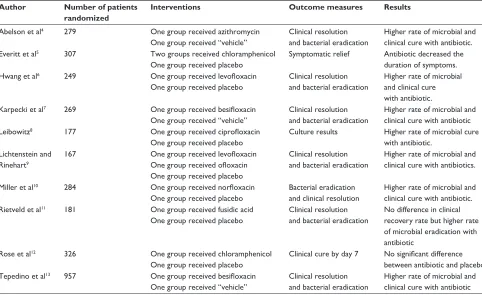
Table 1 randomized controlled trials comparing antibiotics with placebo
Author Number of patients randomized
Interventions Outcome measures Results
Abelson et al4 279 One group received azithromycin
One group received “vehicle”
Clinical resolution and bacterial eradication
Higher rate of microbial and clinical cure with antibiotic.
Everitt et al5 307 Two groups received chloramphenicol
One group received placebo
Symptomatic relief Antibiotic decreased the duration of symptoms.
Hwang et al6 249 One group received levofloxacin
One group received placebo
Clinical resolution and bacterial eradication
Higher rate of microbial and clinical cure with antibiotic. Karpecki et al7 269 One group received besifloxacin
One group received “vehicle”
Clinical resolution and bacterial eradication
Higher rate of microbial and clinical cure with antibiotic
Leibowitz8 177 One group received ciprofloxacin
One group received placebo
Culture results Higher rate of microbial cure with antibiotic.
Lichtenstein and rinehart9
167 One group received levofloxacin
One group received ofloxacin One group received placebo
Clinical resolution and bacterial eradication
Higher rate of microbial and clinical cure with antibiotics.
Miller et al10 284 One group received norfloxacin
One group received placebo
Bacterial eradication and clinical resolution
Higher rate of microbial and clinical cure with antibiotic. rietveld et al11 181 One group received fusidic acid
One group received placebo
Clinical resolution and bacterial eradication
no difference in clinical recovery rate but higher rate of microbial eradication with antibiotic
rose et al12 326 One group received chloramphenicol
One group received placebo
Clinical cure by day 7 No significant difference between antibiotic and placebo Tepedino et al13 957 One group received besifloxacin
One group received “vehicle”
Clinical resolution and bacterial eradication
Higher rate of microbial and clinical cure with antibiotic from infection. Failure to recognize and treat bacterial conjunctivitis may lead to complications, such as keratitis or anterior uveitis.
Do any interventions make a difference to
the resolution of bacterial conjunctivitis?
Systematic reviews:
2
Meta-analyses:
1
Randomized controlled trials: 10
The Cochrane systematic review,
2which includes a
meta-analysis, concluded that “acute bacterial
conjuncti-vitis is frequently a self-limiting condition, but the use of
antibiotics is associated with significantly improved rates
of clinical and microbiological remission”. The
system-atic review by Clinical Evidence
3concludes that topical
antibiotics are “beneficial” in people with culture-positive
nongonococcal bacterial conjunctivitis and “likely to be
beneficial” when used empirically in people with suspected
bacterial conjunctivitis within 1–2 days if symptoms do not
resolve on their own. Oral antibiotics, ocular decongestants,
warm compresses, and saline were found to be of “unknown
effectiveness”.
Most randomized controlled trials (see Table 1) showed
that topical antibiotics accelerate bacterial eradication
and help resolve the signs and symptoms of bacterial
conjunctivitis. However, in two trials,
4,5clinical recovery
at seven days after presentation was found to be unaffected
by the use of antibiotics, even though one of the two
tri-als
4still found an improvement in microbial cure rate with
antibiotics.
Which antibiotics are best for accelerating
resolution of bacterial conjunctivitis?
Systematic reviews:
1
Meta-analyses:
0
Randomized controlled trials:
26
Table 2 lists the antibiotics studied, along with their
microbial coverage, mechanism of action, and availability.
The systematic review
3concluded that “there is no clear
best choice for topical antibiotics – local microbiological
resistance patterns, cost, dosing regimens, and other patient
factors (such as allergies and compliance) are important
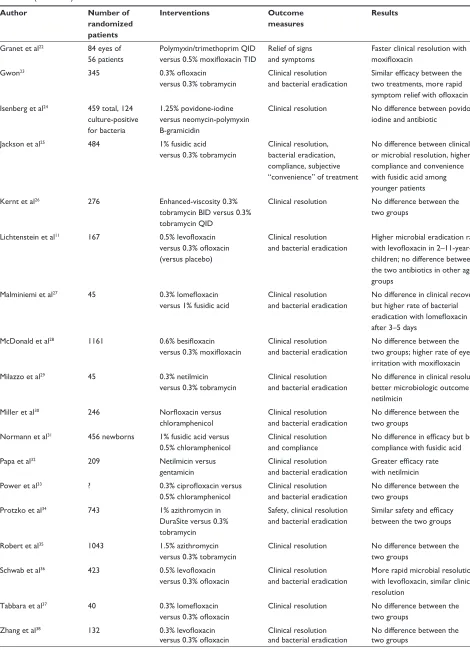
con-siderations in addition to efficacy”. Results from randomized
controlled trials (Table 3) are varied, but many found similar
Clinical Ophthalmology downloaded from https://www.dovepress.com/ by 118.70.13.36 on 21-Aug-2020
Dovepress Bacterial conjunctivitis
Table 2 Topical antibiotics used to treat bacterial conjunctivitis
Antibiotic Class Coverage Mechanism Availability
Azithromycin Macrolide Broad-spectrum Baceriostatic Azasite® 1% (inspire
Pharmaceuticals inc) Besifloxacin Fluoroquinolone Broad-spectrum Bactericidal Besivance® 0.6% (Bausch
and Lomb)
Chloramphenicol Chloramphenicol Broad-spectrum Bacteriostatic Topical drops not marketed in US
Optrex infected Eyes® 0.5% in UK
Ciprofloxacin Fluoroquinolone Broad-spectrum Bactericidal Ciloxan® 0.3% (Alcon Laboratories inc)
Ointment or drops Fusidic acid Protein synthesis
inhibitor
Primarily Gram-positive Bacteriostatic not available in US
Fucithalmic® 1% (Leo Pharma) in
Canada and UK
Gatifloxacin Fluoroquinolone Broad-spectrum Bactericidal Zymar 0.3% (Allergan inc)
Gentamicin Aminoglycoside Primarily Gram-negative Bactericidal Generic 0.3% drops
Levofloxacin Fluoroquinolone Broad-spectrum Bactericidal iquix® 1.5% (vistakon Pharmaceuticals)
Lomefloxacin Fluoroquinolone Broad-spectrum Bactericidal not available in US
Moxifloxacin Fluoroquinolone Broad-spectrum Bactericidal vigamox® 0.5% (Alcon Laboratories inc)
neomycin-polymyxin B-gramicidin
Aminoglycoside, polymyxin and gramicidin
Broad-spectrum Bactericidal neosporin® (King Pharmaceuticals inc)
netilmicin Aminoglycoside Primarily Gram-negative Bactericidal not available in US
Norfloxacin Fluoroquinolone Broad-spectrum Bactericidal Chibroxin 0.3% (Merck and Co inc)
not available in US
Ofloxacin Fluoroquinolone Broad-spectrum Bactericidal Generic 0.3% eye drops
Providone-iodine Broad-spectrum Bactericidal Betadine 5% (Alcon Laboratories inc)
rifamycin rifamycin Broad-spectrum Bactericidal not available in US
Tobramycin Aminoglycoside Primarily Gram-negative Bactericidal Tobrex® 0.3% (Alcon Laboratories inc)
ointment or drops
Table 3 randomized controlled trials comparing different topical antibiotics
Author Number of randomized patients
Interventions Outcome measures
Results
Adenis at al14 131 0.3% ciprofloxacin
versus 0.3% norfloxacin Clinical resolution and bacterial eradication no difference between the two antibiotics
Adenis et al15 41 0.3% ciprofloxacin
versus 1% rifamycin
Clinical resolution and bacterial eradication
Higher clinical cure rate with ciprofloxacin on day 7 (but below statistical significance: P= 0.061), no difference in microbial cure
Bloom et al16 464 Ciprofloxacin versus
tobramycin
Clinical resolution and bacterial eradication
no difference between the two antibiotics
Bremond-Gignac et al17 150 1.5% azithromycin
versus 0.3% tobramycin
Clinical resolution and bacterial eradication
Greater bacteriologic cure with azithromycin on day 3, no difference in clinical or bacteriologic cure on day 9
Chisari et al18 190 Ciprofloxacin versus
norfloxacin
Clinical resolution and bacterial eradication
no difference between the two antibiotics
Cochereau et al19 1043 1.5% azithromycin for
3 days versus 0.3% tobramycin for 7 days
Clinical resolution and bacterial eradication
Higher rate of clinical cure with azithromycin on day 3, no difference in clinical or bacteriologic cure on day 9
Denis et al20 1043 1.5% azithromycin for
3 days versus 0.3% tobramycin for 7 days
Microbiological resolution no difference between the two groups
Gallenga et al21 99 0.3% lomefloxacin BID
versus 0.3% tobramycin QiD
Clinical resolution and bacterial eradication
no difference between the two groups
(Continued)
Clinical Ophthalmology downloaded from https://www.dovepress.com/ by 118.70.13.36 on 21-Aug-2020
Dovepress
Hutnik and Mohammad-Shahi
Table 3 (Continued)
Author Number of randomized patients
Interventions Outcome measures
Results
Granet et al22 84 eyes of
56 patients
Polymyxin/trimethoprim QiD versus 0.5% moxifloxacin TID
relief of signs and symptoms
Faster clinical resolution with moxifloxacin
Gwon23 345 0.3% ofloxacin
versus 0.3% tobramycin
Clinical resolution and bacterial eradication
Similar efficacy between the two treatments, more rapid symptom relief with ofloxacin isenberg et al24 459 total, 124
culture-positive for bacteria
1.25% povidone-iodine versus neomycin-polymyxin B-gramicidin
Clinical resolution no difference between povidone-iodine and antibiotic
Jackson et al25 484 1% fusidic acid
versus 0.3% tobramycin
Clinical resolution, bacterial eradication, compliance, subjective “convenience” of treatment
no difference between clinical or microbial resolution, higher compliance and convenience with fusidic acid among younger patients
Kernt et al26 276 Enhanced-viscosity 0.3%
tobramycin BiD versus 0.3% tobramycin QiD
Clinical resolution no difference between the two groups
Lichtenstein et al11 167 0.5% levofloxacin
versus 0.3% ofloxacin (versus placebo)
Clinical resolution and bacterial eradication
Higher microbial eradication rate with levofloxacin in 2–11-year-old children; no difference between the two antibiotics in other age groups
Malminiemi et al27 45 0.3% lomefloxacin
versus 1% fusidic acid
Clinical resolution and bacterial eradication
no difference in clinical recovery but higher rate of bacterial eradication with lomefloxacin after 3–5 days
McDonald et al28 1161 0.6% besifloxacin
versus 0.3% moxifloxacin
Clinical resolution and bacterial eradication
no difference between the two groups; higher rate of eye irritation with moxifloxacin
Milazzo et al29 45 0.3% netilmicin
versus 0.3% tobramycin
Clinical resolution and bacterial eradication
no difference in clinical resolution, better microbiologic outcome with netilmicin
Miller et al30 246 Norfloxacin versus
chloramphenicol
Clinical resolution and bacterial eradication
no difference between the two groups
normann et al31 456 newborns 1% fusidic acid versus
0.5% chloramphenicol
Clinical resolution and compliance
No difference in efficacy but better compliance with fusidic acid
Papa et al32 209 netilmicin versus
gentamicin
Clinical resolution and bacterial eradication
Greater efficacy rate with netilmicin
Power et al33 ? 0.3% ciprofloxacin versus
0.5% chloramphenicol
Clinical resolution and bacterial eradication
no difference between the two groups
Protzko et al34 743 1% azithromycin in
DuraSite versus 0.3% tobramycin
Safety, clinical resolution and bacterial eradication
Similar safety and efficacy between the two groups
robert et al35 1043 1.5% azithromycin
versus 0.3% tobramycin
Clinical resolution no difference between the two groups
Schwab et al36 423 0.5% levofloxacin
versus 0.3% ofloxacin
Clinical resolution and bacterial eradication
More rapid microbial resolution with levofloxacin, similar clinical resolution
Tabbara et al37 40 0.3% lomefloxacin
versus 0.3% ofloxacin
Clinical resolution no difference between the two groups
Zhang et al38 132 0.3% levofloxacin
versus 0.3% ofloxacin
Clinical resolution and bacterial eradication
no difference between the two groups
Abbreviations: BiD, twice daily; TiD, three times daily; QiD, four times daily.
Clinical Ophthalmology downloaded from https://www.dovepress.com/ by 118.70.13.36 on 21-Aug-2020
Dovepress Bacterial conjunctivitis
Table 4 randomized controlled trials comparing different regimens of treatment
Author Number of randomized patients
Interventions Outcome measures Results
Friedlaender39 50 0.3% ofloxacin BID versus QID Clinical resolution
and bacterial eradication
no difference between the two groups Szaflik et al40 120 0.5% levofloxacin TID × 5 days
versus “standard regimen” (Q2H × 2 days, then Q4H × 3 days)
Clinical resolution and bacterial eradication
no difference between the two groups
Wald et al41 80 Oral cefixime + topical placebo
versus topical polymyxin- bacitracin + oral placebo
Clinical resolution and bacterial eradication
no difference between the two groups
Yee et al42 104 0.3% gatifloxacin BID versus QID Clinical resolution, bacterial
eradication and safety no difference between the two groups
Abbreviations: Q2H, two hourly; Q4H, four hourly; BiD, twice daily; TiD, three times daily; QiD, four times daily.
The practice
clinical and microbiologic efficacy among the topical
anti-biotics used. Some studies found faster bacterial eradication
and/or clinical recovery with fluoroquinolones, azithromycin,
or netilimicin compared with the more traditional antibiotics,
such as tobramycin or polymyxin B/trimethoprim or
gentami-cin. Some studies found differences in patient compliance
with different antibiotics. Microbiologic resistance patterns
can also vary and would affect efficacy rates.
Which treatment regimen works best for
bacterial conjunctivitis?
Systematic reviews:
0
Meta-analyses:
0
Randomized controlled trials:
4
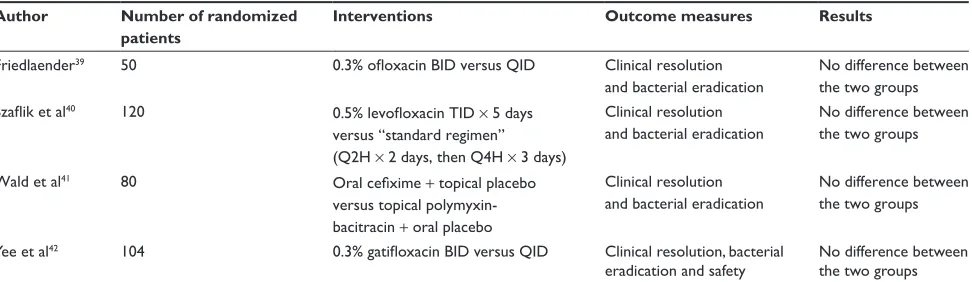
A few randomized controlled trials (Table 4) have focused
on the effect of the treatment regimen, such as dosing,
fre-quency, length of treatment, and route of administration, on
efficacy rates. None have found a significant change in cure
rate in association with the treatment regimen used.
Conclusions
Bacterial conjunctivitis often resolves on its own, but the
cur-rent evidence suggests that topical antibiotics help accelerate
recovery from this self-limiting disease. Topical antibiotics
used for treatment of bacterial conjunctivitis have similar
efficacy rates. The treatment regimen does not affect recovery
from bacterial conjunctivitis. Patients may prefer a simpler
regimen.
there may be itching, chemosis, or conjunctival
papillae
•
Ask about contact lens wear
•
Assess for corneal involvement and intraocular
involvement
•
Conjunctival swabs can be done for Gram stain, culture,
and sensitivity to clarify diagnosis, particularly in more
severe or refractory cases
•
Moderate to severe eye pain, photophobia, or change
in visual acuity should raise suspicion for more serious
causes.
Treatment
•
Uncomplicated cases can be treated with a topical
anti-biotic such as tobramycin, trimethoprim/polymyxin B,
a fluoroquinolone or chloramphenicol four times daily
for 5–7 days to accelerate recovery
•
Patients should be seen every 2–3 days until signs and
symptoms are resolved
Potential pitfalls
•
Contact lens wearers are predisposed to Gram-negative
infections, carrying a higher risk of complications, such
as bacterial keratitis. Pseudomonas and Acanthamoeba
infections in contact lens wearers can lead to serious,
sight-threatening complications if not recognized and
treated appropriately. The contact lens storage case may
be the nidus of the infection.
•
If there is an associated keratitis or anterior uveitis,
refer-ral to a specialist may be recommended
•
Beware of combination topical antibiotic agents that
contain steroids. These should be used with extreme
caution and monitored by a specialist.
Management
Bacterial conjunctivitis can be managed by nonspecialists.
Assessment
•
Redness, foreign body sensation and purulent/
mucopurulent discharge are common complaints;
Clinical Ophthalmology downloaded from https://www.dovepress.com/ by 118.70.13.36 on 21-Aug-2020
Dovepress
Hutnik and Mohammad-Shahi
•
Failure to respond to topical antibiotics may warrant
referral to a specialist.
indications for specialist referral
•
Change in visual acuity
•
Evidence of keratitis and/or anterior uveitis on slit-lamp
examination
•
Moderate-to-severe eye pain
•
Failure to improve or worsening of symptoms in spite of
treatment.
Further reading
Ehler JP, Shah CP, Fenton GL. The Wills Eye Manual: Office and Emergency
Room Diagnosis and Treatment of Eye Disease. Baltimore, MD: Lippincott,
Williams and Wilkins; 2008.
Epling J. Bacterial conjunctivitis (updated). Clin Evid. 2010:1–21. Available from http://clinicalevidence.bmj.com/ceweb/conditions/eyd/0704/0704_ I2.jsp. Accessed 2010 Oct 27.
Disclosure
The authors report no conflicts of interest in this work.
References
1. Smith AF, Waycaster C. Estimate of the direct and indirect annual cost of bacterial conjunctivitis in the United States. BMC Ophthalmol. 2009;9:13.
2. Sheikh A, Hurwitz B. Antibiotics versus placebo for acute bacterial conjunctivitis. Cochrane Database Syst Rev. 2006;2:CD001211. 3. Epling J. Bacterial conjunctivitis (updated). Clin Evid. 2010:1–21.
Available from http://clinicalevidence.bmj.com/ceweb/conditions/ eyd/0704/0704_I2.jsp. Accessed 2010 Oct 27.
4. Abelson MB, Heller W, Shapiro AM, et al. Clinical cure of bacterial conjunctivitis with azithromycin 1%: Vehicle-controlled, double-masked clinical trial. Am J Ophthalmol. 2008;145(6):959–965.
5. Everitt HA, Little PS, Smith PW. A randomised controlled trial of management strategies for acute infective conjunctivitis in general practice. BMJ. 2006;333(7563):321.
6. Hwang DG, Schanzlin DJ, Rotberg MH, Foulks G, Raizman MB. A phase III, placebo controlled clinical trial of 0.5% levofloxacin ophthalmic solution for the treatment of bacterial conjunctivitis.
Br J Ophthalmol. 2003;87(8):1004–1009.
7. Karpecki P, Depaolis M, Hunter JA, et al. Besifloxacin ophthalmic suspension 0.6% in patients with bacterial conjunctivitis: A multicenter, prospective, randomized, double-masked, vehicle-controlled, 5-day efficacy and safety study. Clin Ther. 2009;31(3):514–526.
8. Leibowitz HM. Antibacterial effectiveness of ciprofloxacin 0.3% ophthalmic solution in the treatment of bacterial conjunctivitis. Am J
Ophthalmol. 1991;112 Suppl 4:29S–33S.
9. Lichtenstein SJ, Rinehart M. Efficacy and safety of 0.5% levofloxacin ophthalmic solution for the treatment of bacterial conjunctivitis in pediatric patients. J AAPOS. 2003;7(5):317–324.
10. Miller IM, Wittreich J, Vogel R, Cook TJ. The safety and efficacy of topical norfloxacin compared with placebo in the treatment of acute, bacterial conjunctivitis. The Norfloxacin-Placebo Ocular Study Group.
Eur J Ophthalmol. 1992;2(2):58–66.
11. Rietveld RP, ter Riet G, Bindels PJ, Bink D, Sloos JH, van Weert HC. The treatment of acute infectious conjunctivitis with fusidic acid: A randomised controlled trial. Br J Gen Pract. 2005;55(521): 924–930.
12. Rose PW, Harnden A, Brueggemann AB, et al. Chloramphenicol treatment for acute infective conjunctivitis in children in primary care: A randomised double-blind placebo-controlled trial. Lancet. 2005; 366(9479):37–43.
13. Tepedino ME, Heller WH, Usner DW, et al. Phase III efficacy and safety study of besifloxacin ophthalmic suspension 0.6% in the treat-ment of bacterial conjunctivitis. Curr Med Res Opin. 2009;25(5): 1159–1169.
14. Adenis JP, Brasseur G, Demailly P, et al. Comparative evaluation of efficacy and safety of ciprofloxacin and norfloxacin ophthalmic solu-tions. Eur J Ophthalmol. 1996;6(3):287–292.
15. Adenis JP, Colin J, Verin P, Saint-Blancat P, Malet F. Ciprofloxacin ophthalmic solution versus rifamycin ophthalmic solution for the treat-ment of conjunctivitis and blepharitis. Eur J Ophthalmol. 1995;5(2): 82–87.
16. Bloom PA, Leeming JP, Power W, Laidlaw DA, Collum LM, Easty DL. Topical ciprofloxacin in the treatment of blepharitis and blepharocon-junctivitis. Eur J Ophthalmol. 1994;4(1):6–12.
17. Bremond-Gignac D, Mariani-Kurkdjian P, Beresniak A, et al. Efficacy and safety of azithromycin 1.5% eye drops for purulent bacterial conjunctivitis in pediatric patients. Pediatr Infect Dis J. 2010;29(3): 222–226.
18. Chisari G, Sanfilippo M, Reibaldi M. Treatment of bacterial conjuntivitis with topical ciprofloxacin and norfloxacin: A comparative study. Infez
Med. 2003;11(1):25–30. Italian.
19. Cochereau I, Meddeb-Ouertani A, Khairallah M, et al. 3-Day treatment with azithromycin 1.5% eye drops versus 7-day treatment with tobramycin 0.3% for purulent bacterial conjunctivitis: Multicentre, randomised and controlled trial in adults and children. Br J Ophthalmol. 2007;91(4):465–469. 20. Denis F, Chaumeil C, Goldschmidt P, et al. Microbiological efficacy of
3-day treatment with azithromycin 1.5% eye-drops for purulent bacterial conjunctivitis. Eur J Ophthalmol. 2008;18(6):858–868.
21. Gallenga PE, Lobefalo L, Colangelo L, et al. Topical lomefloxacin 0.3% twice daily versus tobramycin 0.3% in acute bacterial conjunctivitis: A multicenter double-blind phase III study. Ophthalmologica. 1999; 213(4):250–257.
22. Granet DB, Dorfman M, Stroman D, Cockrum P. A multicenter com-parison of polymyxin B sulfate/trimethoprim ophthalmic solution and moxifloxacin in the speed of clinical efficacy for the treatment of bacterial conjunctivitis. J Pediatr Ophthalmol Strabismus. 2008;45(6):340–349. 23. Gwon A. Ofloxacin vs tobramycin for the treatment of external ocular
infection. Ofloxacin Study Group II. Arch Ophthalmol. 1992;110(9): 1234–1237.
24. Isenberg SJ, Apt L, Valenton M, et al. A controlled trial of povidone-iodine to treat infectious conjunctivitis in children. Am J Ophthalmol. 2002;134(5):681–688.
25. Jackson WB, Low DE, Dattani D, Whitsitt PF, Leeder RG, MacDougall R. Treatment of acute bacterial conjunctivitis: 1% fusidic acid viscous drops vs 0.3% tobramycin drops. Can J Ophthalmol. 2002;37(4): 228–237.
26. Kernt K, Martinez MA, Bertin D, et al; International Tobrex2x Group (Eu). A clinical comparison of two formulations of tobramycin 0.3% eyedrops in the treatment of acute bacterial conjunctivitis. Eur J
Ophthalmol. 2005;15(5):541–549.
27. Malminiemi K, Kari O, Latvala ML, Voutilainen R, Miettinen A, Jauch A. Topical lomefloxacin twice daily compared with fucidic acid in acute bacterial conjunctivitis. Acta Ophthalmol Scand. 1996;74(3): 280–284.
28. McDonald MB, Protzko EE, Brunner LS, et al. Efficacy and safety of besifloxacin ophthalmic suspension 0.6% compared with moxifloxacin ophthalmic solution 0.5% for treating bacterial conjunctivitis.
Ophthal-mology. 2009;116(9):1615–1623.e1.
29. Milazzo G, Papa V, Carstocea B, et al. Topical netilmicin compared with tobramycin in the treatment of external ocular infection. Int J Clin
Pharmacol Ther. 1999;37(5):243–248.
Clinical Ophthalmology downloaded from https://www.dovepress.com/ by 118.70.13.36 on 21-Aug-2020
Clinical Ophthalmology
Publish your work in this journal
Submit your manuscript here: http://www.dovepress.com/clinical-ophthalmology-journal Clinical Ophthalmology is an international, peer-reviewed journal covering all subspecialties within ophthalmology. Key topics include: Optometry; Visual science; Pharmacology and drug therapy in eye diseases; Basic Sciences; Primary and Secondary eye care; Patient Safety and Quality of Care Improvements. This journal is indexed on
PubMed Central and CAS, and is the official journal of The Society of Clinical Ophthalmology (SCO). The manuscript management system is completely online and includes a very quick and fair peer-review system, which is all easy to use. Visit http://www.dovepress.com/ testimonials.php to read real quotes from published authors.
Dovepress
Dove
press
Bacterial conjunctivitis
30. Miller IM, Wittreich JM, Cook T, Vogel R. The safety and efficacy of topical norfloxacin compared with chloramphenicol for the treatment of external ocular bacterial infections. The Norfloxacin-Chloramphenicol Ophthalmic Study Group. Eye. 1992;6(Pt 1):111–114.
31. Normann EK, Bakken O, Peltola J, et al. Treatment of acute neonatal bacterial conjunctivitis: A comparison of fucidic acid to chlorampheni-col eye drops. Acta Ophthalmol Scand. 2002;80(2):183–187. 32. Papa V, Aragona P, Scuderi AC, et al. Treatment of acute bacterial
conjunctivitis with topical netilmicin. Cornea. 2002;21(1):43–47. 33. Power WJ, Collum LM, Easty DL, et al. Evaluation of efficacy and
safety of ciprofloxacin ophthalmic solution versus chloramphenicol.
Eur J Ophthalmol. 1993;3(2):77–82.
34. Protzko E, Bowman L, Abelson M, Shapiro A. Phase 3 safety com-parisons for 1.0% azithromycin in polymeric mucoadhesive eye drops versus 0.3% tobramycin eye drops for bacterial conjunctivitis. Invest
Ophthalmol Vis Sci. 2007;48(8):3425–3429.
35. Robert PY, Bourcier T, Meddeb-Ouertani A, et al. Efficacy assessment of azithromycin 1.5% eye drops versus tobramycin 0.3% on clinical signs of purulent bacterial conjunctivitis. J Fr Opthalmol. 2010;33(4): 241–248.
36. Schwab IR, Friedlaender M, McCulley J, Lichtenstein SJ, Moran CT. A phase III clinical trial of 0.5% levofloxacin ophthalmic solution ver-sus 0.3% ofloxacin ophthalmic solution for the treatment of bacterial conjunctivitis. Ophthalmology. 2003;110(3):457–465.
37. Tabbara KF, El-Sheikh HF, Islam SM, Hammouda E. Treatment of acute bacterial conjunctivitis with topical lomefloxacin 0.3% compared to topical ofloxacin 0.3%. Eur J Ophthalmol. 1999;9(4): 269–275.
38. Zhang M, Hu Y, Chen F. Clinical investigation of 0.3% levofloxacin eyedrops on the treatment of cases with acute bacterial conjunctivitis and bacterial keratitis. Yan Ke Xue Bao. 2000;16(2):146–148. 39. Friedlaender MH. Twice-a-day versus four-times-a-day ofloxacin
treat-ment of external ocular infection. CLAO J. 1998;24(1):48–51. 40. Szaflik J, Szaflik JP, Kaminska A. Levofloxacin Bacterial Conjunctivitis
Dosage Study G. Clinical and microbiological efficacy of levofloxacin administered three times a day for the treatment of bacterial conjunc-tivitis. Eur J Ophthalmol. 2009;19(1):1–9.
41. Wald ER, Greenberg D, Hoberman A. Short term oral cefixime therapy for treatment of bacterial conjunctivitis. Pediatr Infect Dis J. 2001; 20(11):1039–1042.
42. Yee RW, Tepedino M, Bernstein P, Jensen H, Schiffman R, Whitcup SM; Gatifloxacin BID/QID Study Group. A randomized, investigator-masked clinical trial comparing the efficacy and safety of gatifloxacin 0.3% administered BID versus QID for the treatment BID versus QID for the treatment of acute bacterial conjunctivitis of acute bacterial con-junctivitis. Curr Med Res Opin. 2005;21(3):425–431.
Clinical Ophthalmology downloaded from https://www.dovepress.com/ by 118.70.13.36 on 21-Aug-2020