3761
Mathematical Module Design To Improve
Creative Thinking Skills Based On
Problem-Based Learning
Mondia Nova Pratiwi, Suparman
Abstract: Learning resources or teaching materials that can help students learn independently are one of the important roles in the learning process. One of the goals in learning is that students can understand the concepts of learning material being delivered. The Mathematical module design of the Problem-based learning module to improve the creative thinking skills of freedom class students had to develop the purpose of this study. This research uses the 4-D method that is designed, developed, developed, and disseminated. Data collection in this study used two instruments, namely interviews about the material discussed in the module and tests given to students. The results showed that there were no mathematical modules to improve students' creative thinking, so the research proved a problem-based learning module which was then validated by material experts and media experts. The results of the validation show that the design of this module can be carried out with revisions that are consistent with the advice given by material experts and media experts.
Keywords: Creative Thinking Skills, Module, Problem Based Learning.
—————————— ——————————
1.
INTRODUCTION
The The 21st-century learning process is a student-centered learning process. In the learning process, students are required to think critically and creatively in solving problems [1]. Creativity is one of the most important features because of industrial and economic dependence on innovation [2]. The level of creativity is still at a basic level [3]. The teacher as a facilitator of students can build knowledge for themselves. In the process of learning mathematics, some students choose to be quiet and wait for the teacher to explain. Mastery of the material being studied is still low and the activity of discussion is also lacking [4]. Teachers must teach teaching materials to improve student creativity [5]. Modules are a book written with the aim that students can learn independently without or with teacher guidance [6]. One important role in the learning process is the existence of learning resources or teaching materials that can help students understand the material easily and learn independently. Learning resources are materials that can be utilized and needed to help teachers and students in the learning process [7]. One of the goals in mathematics learning is that students can solve problems so that the problem-solving process becomes an important part of the learning process. The ability to think creatively has an important role in life because creativity is a powerful source of human resources to drive human progress in terms of tracing, development, and discoveries in the fields of science and technology and all fields of human endeavor [8].
During the learning process, there is an interaction between the teacher and students so that the teacher becomes one of the important elements to student mathematics learning achievement [9]. The process of learning activities that are rational, fun, and challenge is governed by the process of
learning activities; it must motivate students not to be passive, facilitate students to be creative, and become independent in accordance with the wishes and abilities of students, and the physical and psychological development of students [10]. Problem-Based Learning is one learning model that is suitable for active learning and independent learning [11]. Problem-based learning is centered on student learning [12] and can make mathematics learning more effective and innovative because students tend to focus on their interests and talents and are more active in the learning process [13]. Problem Based Learning is learner-centered learning to collaborate between theory and practice, develop knowledge and skills, and develop appropriate solutions to existing problems [14]. Problem-based learning is used to support learning in solving problems [15], and problem-based learning that can improve learning, students who have difficulty in learning [16] are centralized, the process of answering students looking for better learning solutions with help, planning, solving the problem, and answer solving [17].
2
METHOD
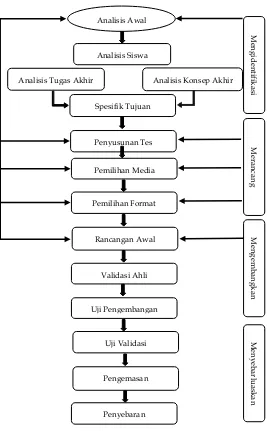
This research is a research development that aims to produce learning tools in the form of modules. Modules designed are modules with a problem-based learning approach. Stages carried out by researchers are defining, designing, developing, and disseminating. These stages are the stages of research development with the 4-D research method [18] are shown in chart 1.
————————————————
Mondia Nova Pratiwi is currently taking of Master degree program in mathematics education in Ahmad Dahlan University, Indonesia, PH +6287837252346, E-mail: [email protected]
Chart 1. Development Stages of 4-D researchers
This research was conducted at the Abu Bakar IT Middle School in Yogyakarta on VIII grade students. Analysis of instructional material needs using interview instruments and using the results of student work on mid-semester assessment in the form of a description of the problem. To find out the problem during the learning interview conducted [19], and the results of student work during the midterm assessment to ensure the truth of the problem. The module validation sheet and student response questionnaire are instruments used at the development stage. the module will be validated by material expert lecturers and media experts and student responses are used to determine the usefulness of the modules developed in the learning process. The instrument used is adjusted to the curriculum, then the validator evaluates the product being developed. The validator fills in the form of product ratings and revisions are made if the validator provides qualitative advice. Module validity level is seen from the score given by the validator after evaluating the module.
3
RESULT
AND
DISCUSSION
Research and development (R & D) is a type of research and aims to produce products in the form of modules. Module development in this study was carried out using the 4D Model (Define, Design, Develop, and Disseminate). The results of the study are explained as follows:
3.1 Analysis
This stage is carried out to obtain information regarding the products to be developed as well as the problems that underlie the importance of module development.
3.1.1 Initial Analysis
Researchers examine the curriculum used by the school in the learning process. Based on the results of the study, learning in schools refers to the 2013 curriculum.
3.1.2 Student Analysis
To obtain information relating to the students' character and abilities of students, an analysis of students is carried out as a basis for developing the module. Students' creative thinking ability is still lacking as a result of this study.
3.1.3 Material Analysis
One material that requires creative thinking skills is Coordinates and Cartesians. So in this study, the development of coordinate and courtesies material was found in class VIII.
3.2DESIGN STAGE
The design stage is the module design stage. The main parts in making modules are introduction, contents, and covers.
3.2.1 Introduction
In the introductory section the module includes cover, introduction, and table of contents.
Fig. 1. Cover
Fig. 1. Explains the module identity
Analisis Awal
Analisis Siswa
Spesifik Tujuan
Penyusunan Tes
Pemilihan Media
Pemilihan Format
Rancangan Awal
Validasi Ahli
Uji Pengembangan
Uji Validasi
Pengemasan
Penyebaran
Analisis Tugas Akhir Analisis Konsep Akhir
M
eng
iden
ti
fik
as
i
M
eng
em
ba
ng
ka
n
M
eny
eba
rlu
as
ka
n
M
er
anc
3763 Fig. 2. Foreword
Fig. 2. Describes the description of the created module
Fig. 3. Table of Contents
Fig. 3. Explains the material contained in the module and
makes it easier for students to look for material to be studied.
3.2.2 The and Contents
Content is a core part of the module developed which includes the Basic Competencies, Learning Objectives, and Apperception.
Fig 4. Basic Competencies
Fig. 4. Explains basic competencies that aim to make the
learning process work in accordance with the learning objectives and learning materials specifically.
Fig 5. Concept Map
Fig. 5. Explains the concept map that maps the material to be
studied.
Fig. 6. Materials
Fig. 6. Explains the material in the module.
Fig. 7. Questions
Fig. 7. Display material in practice questions that are in accordance with the material to measure students'
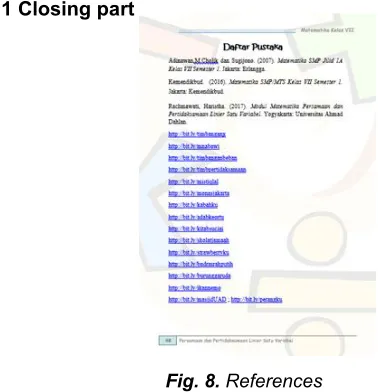
3.2.1 Closing part
Fig. 8. References
Fig. 8. Above is a library list used by the author as a reference material about the material in the module.
The next design, task analysis, which is an activity to identify the main skills needed in learning following the curriculum, and analyze the skills to be developed in the module, in this case, the development of modules aims to improve students' creative thinking skills. After that, at the validation stage, to determine the validity of the module design to be developed, an assessment is carried out. After the module design was approved, it was then validated by material expert lecturers and media experts. The validation module design uses assessment tools and instruments in the form of questions and questionnaires that have been reviewed by lecturers and teacher, Mr. Puguh Wahyu Prasetyo, S.Si., M.Sc. and Mrs. Ismawati, S.Pd. After a valid instrument that can be used by media experts to assess the modules developed. Here is some feedback and advice from subject matter experts are summarized in Table 1.
TABLE 1 Comments and Suggestions from be Expert Media
Comments and
Suggestions Follow
The design offered has described a good concept. There are no covers and small form concept maps.
The concept map has been revised and the cover already exists.
The design made is good and add
interesting module covers. The cover already exist.
Comments and suggestions from media experts then revised. Furthermore, the feasibility of the design of modules assessed by expert media. The following is ideal assessment criteria category and the calculation results of the questionnaire design validation modules are shown in Table 2 and Table 3.
TABLE 2 Category Rating Criteria Idea
Score range Calculation Classifi cation
𝑋̅ + 1,8 𝑆𝐵 < 𝑋 16,9 < 𝑋 Very good
𝑋̅ + 0,6 𝑆𝐵 < 𝑋 ≤ 𝑋̅ + 1,8 𝑆𝐵 13,6 < 𝑋 ≤ 16,9 Well
𝑋̅ − 0,6 𝑆𝐵 < 𝑋 < 𝑋̅ + 0,6 𝑆𝐵 10,4 < 𝑋 ≤ 13,6 Pretty good
𝑋̅− 1,8 𝑆𝐵 < 𝑋 ≤ 𝑋̅ − 0,6 𝑆𝐵 7,1 < X ≤ 10,4 Less
𝑋 ≤ 𝑋̅ − 1,8 𝑆𝐵 𝑋 ≤ 7,1 Very less
TABLE 3 Results Calculation Questionnaire Design Validation
Module
Evaluator Position Score Quantitative Data Criteria To
Dr. Puguh Wahyu Prasetyo, S.Si., M.Sc
Lecturer in Mathematics Education UAD
20 Very good
Ismawati, S.Pd
Mathematics Teacher in Junior High School ABY
20 Very good
Based on Table 3, it can be seen that the average score is 18. The media expert assessment these results indicate that the design of teaching materials in the form of modules that will be developed in the excellent category.
4
CONCLUSION
Based on the description above, the purpose of this study has been answered, namely the teacher needs teaching materials in the form of modules with certain approaches to support the learning process of students in the classroom. The approach is problem-based learning. In making the module, before the module is validated by the validator, the researcher makes the module design first. Based on the results of the validation, the development of this module design can be continued with the revised module requirements in accordance with the advice given by the validator.
ACKNOWLEDGMENT
The researcher thanked Ahmad Dahlan University for encouraging and facilitating researchers to complete this research. Thanks also to Dr. Puguh Wahyu Prasetyo, S.Si., M.Sc as a supervisor who teaches and motivates researchers to learn more about research in mathematics education. Thanks also to the validator who was willing to comment on the improvement of the module to be developed. Finally, the researchers also thanked the teachers at the Abu Bakar Yogyakarta Junior High School for helping this research by facilitating researchers with their students as research subjects.
REFERENCES
[1] M. Talvio, M. Berg, T. Litmanen, K. Lonka, ―The Benefits of Teachers’ Workshops on Their Social and Emotional Intelligence in Four Countries‖, Creative Education, 07(18), pp 2803–2819., (2016).
[2] L. Semmler, S. Uchinokura, V. Pietzner,‖Comparison of German and Japanese student teachers’ views on creativity in chemistry class‖, Asia-Pacific Science Education, 4(1), pp 9, (2018).
[3] Aizikovitsh, E. Udi,‖The Extent of Mathematical Creativity and Aesthetics in Solving Problems among Students Attending the Mathematically Talented Youth Program‖, Creative Education, 05(04), pp 228–241., (2014).
3765 (2015).
[5] M. Maulana, ―Development of Students Worksheet based on Realistic Mathematics Education in Indonesia‖, International Journal of Engineering & Technology. www.sciencepubco.com/index.php/IJET D.S. Coming and O.G. Staadt, "Velocity-Aligned Discrete Oriented Polytopes for Dynamic Collision Detection," IEEE Trans. Visualization and Computer Graphics, vol. 14, no. 1, pp. 1-12, (2018).
[6] S. Temel, ―The Effects of Problem Based Learning on Pre-Service Teachers’ Critical Thinking Dispositions and Perception of Problem Solving Ability‖, South African Journal of Education, vol.34, no.1, pp.1– 19, (2014). [7] Munir, Curriculum Based On Information and
Communication Technologies (Bandung: Alfabeta,), pp 132, (2008).
[8] N. Ghufron, and R. S. Rini, ―Psychology Theories‖ (Yogyakarta: Ar-Ruzz media), pp 101, (2014).
[9] Hasbullah, B Wibawa, ―Analysis of Mathematics Students Ability in Learning Metacognitive Strategy Type IDEAL (Identify, Define, Explore, Act, Look)‖, IEJME Mathematics Education, Vol.12, No.10, pp 859-872, (2017).
[10]Yuniarti, Yeni, et al. "The Effectiveness of Open-Ended Problems Based Analytic-Synthetic Learning on the Mathematical Creative Thinking Ability of Pre-Service Elementary School Teachers." International Electronic Journal of Mathematics Education 12.3, pp 655-666, (2017).
[11]T. Akma, ―The Design of Student Worksheet Problem based Learning to Improve Problem Solving Ability of the Eighth-Grade Students Junior High School in Indonesia‖, International Journal of Engineering & Technology, pp. 11-15, (2018).
[12]C. M. Bergstrom, K J Pugh, M M Phillips, M Machlev, ―Effects of Problem-Based Learning on Recognition Learning and Transfer Accounting for GPA and Goal Orientation‖, J. Exp. Educ., vol. 84, no. 4, pp. 764–786, (2016).
[13]M. B. Harahap, ―The Effect of Problem-Based Learning Assisted Concept Map to Problem-Solving Ability and Critical Thinking Ability‖, J. Educ. Pract., vol. 8, no. 19, pp. 60–65, (2017).
[14]J. R. Savery, ―Overview of Problem-based Learning: Definitions and Distinctions Origins of PBL‖, Interdiscip. J. Probl. Learn, vol. 1, no. 1, pp. 9–20, (2006).
[15]D. Jonassen, ―Supporting Problem Solving in PBL‖, Int. J. Probl. Learn. Vol., vol. 5, no. 2, pp. 9–27., (2011).
[16]R. E. Simamora, D. R. Sidabutar, E. Surya, ―Improving Learning Activity and Students’ Problem Solving Skill through Problem Based Learning (PBL) in Junior High School‖ Int. J. Sci. Basic Appl. Res., vol. 33, no. 2, pp. 321–331, (2017). [17]S. Saragih, W. L. Habeahan, ―The Improving of Problem
Solving Ability and Students’ Creativity Mathematical by Using Problem Based Learning in SMP Negeri 2 Siantar‖ J. Educ. Pract., vol. 5, no. 35, pp. 123–133, (2014).
[18]Buckley, ]ennifer, et al. "Embedding quantitative skills into the Social Science curriculum: Case studies from Manchester." International Journal of Social Research Methodology, vol 18, no. 5, pp. 495-510, (2015).
[19]Yoon, Heojeong, et al. "The efficacy of problem-based learning in an analytical laboratory course for pre-service chemistry teachers." International Journal of Science Education 36.1, pp. 79-102.English, Lyn D, (2014).