Infants With Normal Placental Function
WHAT’S KNOWN ON THIS SUBJECT: IUGR is associated with behavioral, sensorial, and cognitive dysfunctions in childhood and adolescence. Several studies on preterm infants correlated these difficulties with behavioral disruptions already present in the neonatal period.
WHAT THIS STUDY ADDS: This study extends the neurobehavioral effects of being SGA to term neonates with no signs of placental insufficiency, a subgroup of neonates traditionally considered to be at one end of the size spectrum of normal infants.
abstract
OBJECTIVE:The goal was to evaluate the neurobehavioral outcomes of term, small-for-gestational age (SGA) newborns with normal placental function.
METHODS:A cohort of consecutive term SGA newborns with normal prenatal umbilical artery Doppler ultrasound findings was created and compared with a group of term infants with size appropriate for ges-tational age, who were sampled from our general neonatal population. Neonatal behavior was evaluated at corrected age of 40⫾1 weeks with the Neonatal Behavioral Assessment Scale. The effect of the study group on each Neonatal Behavioral Assessment Scale area was ad-justed, through multivariate analysis of covariance, for smoking dur-ing pregnancy, maternal BMI, socioeconomic level, onset of labor, mode of delivery, use of epidural anesthetic medication, gestational age at delivery, postnatal age (in days) at evaluation, and gender.
RESULTS:A total of 202 newborns (102 SGA and 100 appropriate for gestational age) were included. All of the neurobehavioral areas stud-ied were poorer in the SGA group, with significance for attention, ha-bituation, motor, social-interactive, and regulation of state. The aver-age mean differences in scores between the study groups were 0.77 (95% confidence interval: 0.38 –1. 14) for attention, 0.64 (95% confi-dence interval: 0.13–1.14) for habituation, 0.52 (95% conficonfi-dence inter-val: 0.31– 0.74) for motor, 0.95 (95% confidence interinter-val: 0.54 –1.37) for social-interactive, and 0.68 (95% confidence interval: 0.23–1.13) for regulation of state. These differences remained significant after ad-justment for potential confounders.
CONCLUSION:Term SGA newborns with no signs of placental insuffi-ciency had poorer neurobehavioral competencies, which suggests de-layed neurologic maturation.Pediatrics2009;124:e934–e941
AUTHORS:Francesc Figueras, MD,a,b,cDaniel Oros, MD,b
Rogelio Cruz-Martinez, MD,bNelly Padilla, MD,bEdgar
Hernandez-Andrade, MD,bFrancesc Botet, MD,b,c,dCarme
Costas-Moragas, PhD,eand Eduard Gratacos, PhDa,b,c
aMaternal-Fetal Medicine anddNeonatology Departments, Hospital Clinic, andcCIBER-ER, University of Barcelona, Barcelona, Spain;bFetal and Perinatal Research Group, August Pi i Sunyer Institute for Biomedical Research, Barcelona, Spain; andeDepartment of Clinical and Health Psychology, Autonomous University of Barcelona, Barcelona, Spain
KEY WORDS
small for gestational age, intrauterine growth restriction, neurobehavioral outcome, Doppler ultrasonography
ABBREVIATIONS
SGA—small for gestational age AGA—appropriate for gestational age IUGR—intrauterine growth restriction NBAS—Neonatal Behavioral Assessment Scale
www.pediatrics.org/cgi/doi/10.1542/peds.2008-3346
doi:10.1542/peds.2008-3346
Accepted for publication Jun 4, 2009
Address correspondence to Francesc Figueras, MD, Maternal-Fetal Medicine Department, Hospital Clinic, Barcelona, Spain. E-mail: ffi[email protected]
PEDIATRICS (ISSN Numbers: Print, 0031-4005; Online, 1098-4275).
Copyright © 2009 by the American Academy of Pediatrics
Small for gestational age (SGA) and in-trauterine growth restriction (IUGR) have been used interchangeably. The 2 terms are not synonymous, however; not all small newborns have IUGR, and not all infants with IUGR are small.1
Most instances of true IUGR corre-spond to cases of placental insufficien-cy.2 Intrauterine placental function
evaluation through umbilical artery Doppler ultrasonography is the clini-cal standard used to distinguish be-tween SGA and IUGR.3–5 In addition,
there is evidence that umbilical artery Doppler ultrasound use in these preg-nancies improves a number of obstet-ric care outcomes and reduces peri-natal deaths.6 Although abnormal
umbilical artery Doppler ultrasound findings are associated with adverse perinatal and neurodevelopmental outcomes,7–10 small fetuses with
nor-mal umbilical artery Doppler ultra-sound findings are considered to rep-resent one end of the normal size spectrum, and the importance of treat-ing them in a completely different man-ner, compared with infants with true IUGR, has been stressed.11,12
Many studies have found associations between prematurity with IUGR and later behavioral,13–15sensorial,16,17and
cognitive18–21 dysfunctions. Long-term
outcomes for such infants reveal a specific profile of neurocognitive diffi-culties, with poor executive function-ing, cognitive inflexibility, poor creativ-ity, and language problems.18,19 Other
studies also reported long-term cogni-tive disadvantages for term SGA in-fants.22,23Some studies on preterm
in-fants with IUGR correlated these difficulties during childhood with be-havioral disruptions already present in the neonatal period,13,14,24 a time
when environmental influences are still minimal. Behavioral competencies in newborns are mainly related to neu-rologic maturation, and increasing ev-idence supports a neurobiological
ba-sis for infant behavior.25Furthermore,
several studies demonstrated correla-tions between neonatal neurobehavioral skills and later neurocognitive develop-ment for preterm13,14,24and term26,27
in-fants. There is no information on the neo-natal behavior of term SGA newborns with normal placental function.
Preliminary evidence suggested indi-rectly that a proportion of term SGA infants without Doppler ultrasound signs of placental insufficiency might have been exposed to mild hypoxia in utero,8,28,29 but the effects of this on
brain maturation have not been investi-gated. The hypothesis of this study is that term SGA infants with normal placental function might have neurobehavioral disruptions attributable to abnormal brain maturation. Accordingly, this study was aimed at evaluating the neurobe-havior of term SGA newborns with nor-mal placental function.
METHODS
Subjects
A cohort was created of consecutive, suspected SGA, singleton infants deliv-ered at gestational ages of⬎37 weeks between November 2006 and August 2008, with confirmed birth weights of ⬍10th percentile according to local standards.30 Pregnancies were dated
according to the first-trimester crown-rump length measurement.31 Exclusion
criteria included congenital malforma-tions (including chromosomopathies and infections) and umbilical artery pulsatility index values of⬎95th per-centile.32 Control subjects were
de-fined as singleton term infants with size appropriate for gestational age (AGA) (ⱖ10th percentile, according to local standards30) and were sampled
from our general neonatal population during the same period; they were matched with case subjects according to the date of delivery (⫾7 days). A to-tal of 108 SGA newborns fulfilled the inclusion criteria and were matched
with 108 AGA infants. The study proto-col was approved by the ethics com-mittee, and parents provided written informed consent.
Neurobehavioral Outcomes
Neurobehavioral performance was evaluated at corrected age of 40⫾1 weeks with the Neonatal Behavioral As-sessment Scale (NBAS),33 which
as-sesses both cortical and subcortical functions by evaluating 35 items; the items are rated on a scale of 1 to 9 (with 9 being the best performance) except for 8 curvilinear scale items, which, according to the manual, are rescored as linear on a 5-, 6-, or 8-point scale. Items are grouped into 6 clus-ters, including habituation (habitua-tion to light, rattle, bell, and tactile stimulation of the foot), motor (gen-eral tone, elicited activity, spontane-ous activity, and motor maturity), social-interactive (responses to visual, animate, and inanimate auditory stim-uli and alertness), organization of state (irritability, state lability, maxi-mal excitation, and reaction time), reg-ulation of state (self-quieting and hand-to-mouth responses), and auto-nomic nervous system. The social-interactive cluster was subscored for visual and auditory stimuli. In addition, as reported recently by the authors of the NBAS,34an aggregation of
individ-ual items (alertness, qindivid-uality of the alert responsiveness, and cost of at-tention) was used to evaluate the ca-pacity of infant attention.
All evaluations were performed by 1 of 3 trained examiners accredited by the Brazelton Institute (Harvard Medical School, Boston, MA); they had been tested previously for reliability and achieved an interrater reliability level of⬎90%. The examiners were blinded to the study group and perinatal out-comes. Neonates were assessed in the afternoon, between feedings, in a small, semidark, quiet room with a
Placental Function Assessment
In all cases, prenatal Doppler ultra-sound examinations were performed by 1 of 3 experienced observers (Drs Figueras, Oros, and Cruz-Martinez), with an Acuson Antares Premium Edi-tion ultrasound system (Siemens, Mountain View, CA) equipped with a 2.3-to 4-MHz transabdominal transducer. The umbilical artery pulsatility index was calculated fromⱖ3 consecutive wave-forms obtained from a free-floating por-tion of the umbilical cord during the ab-sence of fetal movement, at insonation angles of⬍30°. All case subjects under-went a Doppler ultrasound examination within 7 days after delivery.
Statistical Analyses
Student’sttest for independent sam-ples and Pearson’s2test were used
to compare quantitative and qualita-tive data, respecqualita-tively. Multivariate analyses were conducted through mul-tivariate analysis of covariance in which a model was run for each differ-ent set of skills (attdiffer-ention, habituation, motor, state organization, state regu-lation, and autonomic nervous sys-tem), with the study group included as a factor and the following variables as covariates: (1) smoking during preg-nancy (no smoking, 1–9 cigarettes per day, orⱖ10 cigarettes per day); (2) maternal BMI at booking; (3) low socio-economic level (routine occupations, long-term unemployment, or never worked; United Kingdom National Sta-tistics Socio-economic Classification); (4) onset of labor (spontaneous versus induction); (5) mode of delivery (vagi-nal delivery versus cesarean section); (6) number of doses of epidural anes-thetic medication (bupivacaine, 1.2– 1.8 mg) during labor (none, 1–3 doses, or ⱖ4 doses); (7) gestational age at delivery; (8) postnatal age (in days) at evaluation; and (9) gender. For each
model, assumptions for the multivari-ate analysis of covariance were checked and the multivariate signifi-cance of the F value was assessed with Wilks’Pvalue. Also, the2value was
provided, which could be interpreted as the proportion of the total variance of the dependent variables explained by each factor and covariate. To rule out an expectation bias, the associa-tion between birth weight and NBAS scores was evaluated through Pear-son correlation within each study group. The software package SPSS 14.0 (SPSS, Chicago, IL) was used for the statistical analyses.
RESULTS
For all of the 216 included infants, a neurobehavioral assessment visit was scheduled at corrected age of 40⫾1 weeks. Parents of 6 case subjects and
8 control subjects later declined to participate, leaving a final population of 202 infants (102 SGA and 100 AGA). The habituation area could not be as-sessed for 50 newborns (21 SGA and 29 AGA) because of the absence of a sleeping period during the evaluation.
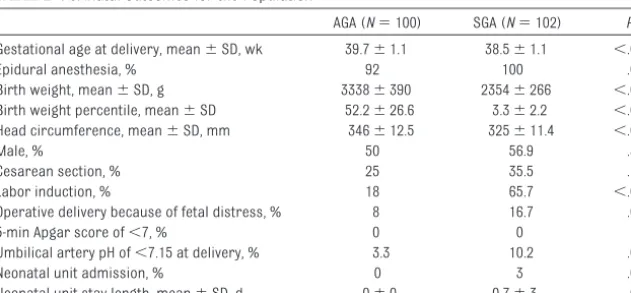
Table 1 depicts the clinical character-istics of the population. It is notewor-thy that the mothers in the SGA group had a lower body weight and more fre-quently were from a low socioeco-nomic level. There were no cases of drug consumption other than tobacco or alcohol. Table 2 shows the perinatal outcomes of the population. As ex-pected, SGA newborns had a lower birth weight and a smaller head cir-cumference. Delivery in the SGA group was at an earlier gestational age (SGA: 38.5 weeks; AGA: 39.7 weeks) and more
Primiparity, % 61 67.6 .32
Nonwhite ethnicity, % 21.2 16 .34
Maternal age, mean⫾SD, y 31.8⫾4.9 33.6⫾4.9 .79
Maternal age of⬍21 y, % 5 2 .28
BMI at booking, mean, kg/m2 23.4 21.9 .003
Low socioeconomic level, %b 31 52 .003
Smoking, %
Nonsmoking 85 83.3 .75
1–9 cigarettes per d 12 5.9
11–19 cigarettes per d 2 7.8
ⱖ20 cigarettes per day 1 2.9
Alcohol consumption of⬎170 g/wk, % 5 3.9 .71
aStudent’sttest for independent samples or Pearson’s2test.
bRoutine occupations, long-term unemployment, or never worked (United Kingdom National Statistics Socio-economic
Classification).
TABLE 2 Perinatal Outcomes for the Population
AGA (N⫽100) SGA (N⫽102) Pa
Gestational age at delivery, mean⫾SD, wk 39.7⫾1.1 38.5⫾1.1 ⬍.001
Epidural anesthesia, % 92 100 .004
Birth weight, mean⫾SD, g 3338⫾390 2354⫾266 ⬍.001
Birth weight percentile, mean⫾SD 52.2⫾26.6 3.3⫾2.2 ⬍.001
Head circumference, mean⫾SD, mm 346⫾12.5 325⫾11.4 ⬍.001
Male, % 50 56.9 .33
Cesarean section, % 25 35.5 .11
Labor induction, % 18 65.7 ⬍.001
Operative delivery because of fetal distress, % 8 16.7 .06
5-min Apgar score of⬍7, % 0 0
Umbilical artery pH of⬍7.15 at delivery, % 3.3 10.2 .07
Neonatal unit admission, % 0 3 .08
Neonatal unit stay length, mean⫾SD, d 0⫾0 0.7⫾3 .025
frequently was induced. Operative de-livery because of fetal distress was twice as frequent in the SGA group. Al-though no infants in the AGA group were admitted to the neonatal unit 3% in the SGA group were.
Neonatal neurobehavior was assessed at 7.8⫾7.2 and 10.5⫾9.6 days of life
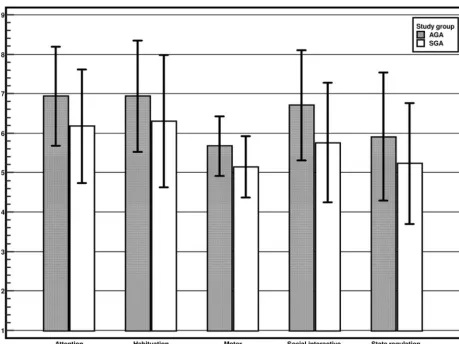
in the AGA and SGA groups, respec-tively. Table 3 and Fig 1 detail the neu-robehavioral outcomes according to NBAS area. Interestingly, all of the neu-robehavioral areas studied were poorer in the SGA group, with univari-ate significance being achieved for at-tention, habituation, motor,
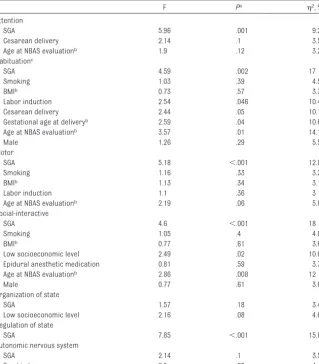
social-interactive, and regulation of state areas. As Table 4 shows, these differ-ences remained significant after ad-justment for potential confounders (smoking during pregnancy, maternal BMI, low socioeconomic level, onset of labor, mode of delivery, use of epidural anesthetic medication, gestational age at delivery, postnatal age at evaluation, and gender). Of these covariates, in-duction of labor and cesarean delivery significantly accounted for lower ha-bituation scores; gestational age at de-livery for higher habituation scores; low socioeconomic level for lower social-interactive scores; and age at NBAS evaluation for higher habituation and social scores. Within each study group, no significant correlations were observed between birth weight and any of the neurobehavioral scores,
FIGURE 1
NBAS scores according to study group (mean and SD). Only significant associations are displayed (adjustedPvalue).
TABLE 3 NBAS Scores According to Study Group
Score, Mean⫾SD Pa
AGA (N⫽100) SGA (N⫽102)
Attention 6.94⫾1.3 6.17⫾1.4 ⬍.0001
Habituationb 6.94⫾1.4 6.3⫾1.7 .014
Motor 5.67⫾0.8 5.15⫾0.8 ⬍.0001
Social-interactive 6.71⫾1.4 5.76⫾1.5 ⬍.0001
Visual 6.71⫾1.5 5.35⫾1.8 ⬍.0001
Auditory 7.03⫾1.4 6.15⫾1.6 ⬍.0001
Organization of state 4.09⫾0.8 4.02⫾0.8 .48
Regulation of state 5.91⫾1.6 5.23⫾1.5 .003
Autonomic nervous system 7.23⫾0.9 7⫾0.99 .08
aStudent’sttest.
bN⫽152 (81 SGA and 71 AGA).
except for organization of state (R⫽ 0.24;P⫽.03) in the SGA group.
DISCUSSION
It is well known that premature SGA infants with abnormal umbilical artery Doppler ultrasound findings, as a sur-rogate sign of placental insufficiency, are at high risk of neurobehavioral and neurocognitive outcomes.35–37Our
study extends the neurobehavioral ef-fects of being SGA to term newborns with no signs of placental insuffi-ciency, a subgroup of newborns tradi-tionally considered to be at one end of
the size spectrum of normal infants. Our findings challenge the concept that umbilical artery Doppler ultra-sonography is a reliable tool to identify prenatally the constitutional term SGA infants at low risk. Subtle degrees of neurologic injury seem to occur before umbilical artery Doppler ultrasound waveforms become abnormal. In fact, animal38 and mathematical39
experi-mental models of placental vessel obliteration suggested that umbilical artery Doppler ultrasound findings be-come abnormal only in advanced stages of placental dysfunction.
tween fetal well-being and later neuro-developmental problems and lays the basis for possible preventive interven-tions. Infant early temperament and behavior have been demonstrated to have an impact on breastfeeding dur-ing the first 6 months of life.40 The
poorer regulation and organization of state observed in our series and oth-ers27may negatively influence
adher-ence to breastfeeding, which has been proved to be a protective mechanism with respect to neurodevelopmental outcomes at 2 years for SGA infants, independent of the presence of signs of placental insufficiency.41Therefore,
promoting and supporting breastfeed-ing may be of special importance for these infants. In addition, because these infants are at risk of poorer neurodevelopmental outcomes, they might benefit from early educational in-terventions. Early educational interven-tions have been documented to improve cognitive outcomes42and, in some cases,
to reduce antisocial behavior early in the school experience.43For low-risk
prema-ture infants, it has been reported that individualized developmental interven-tions prevent short-term neurobehav-ioral dysfunction.44 It is not known
whether interventions also could be ef-fective for term SGA infants and would influence long-term outcomes.
We found poorer neonatal responses to both visual and auditory stimuli in SGA newborns. Long-term follow-up studies with preterm and term SGA in-fants found impaired processing of visual-spatial stimuli.19Animal models
of chronic IUGR demonstrated reduced myelogenesis in the optic nerve45and
reduced synaptogenesis in the visual cortex.46These factors could restrict
the integration of cerebral cortical in-puts. In addition, mistimed cell migration in premature infants could have an ef-fect on synaptic plasticity, with
func-Attention
SGA 5.96 .001 9.2
Cesarean delivery 2.14 .1 3.5
Age at NBAS evaluationb 1.9 .12 3.2
Habituationc
SGA 4.59 .002 17
Smoking 1.03 .39 4.5
BMIb 0.73 .57 3.3
Labor induction 2.54 .046 10.4
Cesarean delivery 2.44 .05 10.1
Gestational age at deliveryb 2.59 .04 10.6
Age at NBAS evaluationb 3.57 .01 14.1
Male 1.26 .29 5.5
Motor
SGA 5.18 ⬍.001 12.8
Smoking 1.16 .33 3.2
BMIb 1.13 .34 3.1
Labor induction 1.1 .36 3
Age at NBAS evaluationb 2.19 .06 5.8
Social-interactive
SGA 4.6 ⬍.001 18
Smoking 1.05 .4 4.8
BMIb 0.77 .61 3.6
Low socioeconomic level 2.49 .02 10.6
Epidural anesthetic medication 0.81 .59 3.7
Age at NBAS evaluationb 2.86 .008 12
Male 0.77 .61 3.6
Organization of state
SGA 1.57 .18 3.4
Low socioeconomic level 2.16 .08 4.6
Regulation of state
SGA 7.85 ⬍.001 15.8
Autonomic nervous system
SGA 2.14 .1 3.5
Smoking 2.5 .06 4
The adjusted effect of the study group (SGA versus AGA) on each NBAS area is shown. Adjustment for smoking during pregnancy, maternal BMI, socioeconomic level, onset of labor, mode of delivery, use of epidural anesthetic medication, gestational age at delivery, postnatal age at evaluation, and gender was performed. Covariates that explained⬎3% of the total variance of dependent variables (2) also are presented.
aWilks’.
tional and behavioral consequences.47
Visual-spatial competencies also play a role in the neonatal capacity to select en-vironmental stimuli to process and to act on, which provides important scaffold-ing on which attention skills are con-structed through early childhood.48
IUGR also is associated with the develop-ment of attention-deficit/hyperactivity disorder symptoms in childhood and early adolescence.49Our finding of lower
attention capacities in SGA newborn is in line with this finding. Two previous stud-ies13,24 found impaired attention skills
among premature SGA infants. Struc-tural correlations were made between attention scores and cortical gray mat-ter13and hippocampal24volumes in the
neonatal period. Whether NBAS findings predict attention later in childhood is not clear. However, some studies have found that, for term infants, attention is predic-tive of intelligence in childhood and ado-lescence.50,51A study of temperament in
early infancy (5– 6 months) performed with infants born at term reported sig-nificant prediction of attention deficits among 8-year-old children.26
There is substantial overlap between childhood attention disorders and the diagnosis of motor impairment, with poor movement skills.52Our finding of
lower motor performance among SGA newborns is consistent with this asso-ciation. With a series of 40 SGA prema-ture neonates, Feldman and Eidelman14
studied the correlation of neurobehavior with later cognitive function, as mea-sured with the Bayley Scales of Infant De-velopment. They found that neonatal motor maturity was correlated with Psychomotor Developmental Index val-ues at 24 months.
Another interesting finding of our study was the lower level of self-regulation among SGA newborns, as reflected by the regulation of state NBAS cluster. For a series of 38 healthy term infants, Lundqvist-Persson27
re-ported that levels of self-regulation
were correlated with the infants’ levels of cognitive development (personal-social development, speech develop-ment, and eye-hand coordination,
sub-variables in Griffiths’ Mental
Development Test) and with sleeping disorders at 2 years of age. We found no difference in autonomic nervous system functioning in SGA infants. This finding is consistent with previous stud-ies that showed preserved sympathova-gal balance in term SGA infants.53
Auto-nomic nervous system problems are more likely to occur in preterm infants with acute and more-severe hypoxia.54
One strength of our study is that it in-cluded only term SGA infants without signs of placental dysfunction or con-genital malformations, as low-risk SGA infants are defined in everyday clinical practice. No previous studies aimed at analyzing the effect of IUGR on neu-robehavior reported the proportion of cases with placental insufficiency. This is a potential source of misinterpreta-tion of results, because an unknown proportion of the newborns might have been exposed to a very prolonged period of intrauterine hypoxia. This study also has some limitations. Firstly, although NBAS assessment is a standard method for evaluating new-borns’ capacity to respond to the envi-ronment, reflecting brain maturation, it assesses only neurobehavior and not cognitive function.55However,
sev-eral studies demonstrated correla-tions between neonatal neurobehavior and later neurocognitive development in preterm13,14,24and term26,27 infants.
Secondly, it could be argued the differ-ences between SGA and AGA infants are likely to be clinically irrelevant, al-beit statistically significant. However, because behavioral clusters are rated on a scale of 1 to 9, where 9 represents the best performance in some areas and 5 in others, a 1-point difference in absolute values represents a relative difference of 10% to 25%. Thirdly, it
could be argued that the study design is prone to an expectation bias, be-cause the examiners might have been influenced by the size of the infants during the neurobehavioral assess-ments. Within each study group, how-ever, no significant correlations were found between birth weights and NBAS scores, except for organization of state in the SGA group. This makes it unlikely that this potential bias could explain the observed differences between SGA and AGA newborns in the other areas. In addition, our findings would be more valid if we had repeated the NBAS examinations to show that the behav-ior was consistent over time. Finally, mothers in the 2 study groups did not match with respect to sociodemo-graphic conditions. It is likely that other factors associated with SGA also were different for these mothers. Although the effect of the study group on neurobehav-ior was adjusted with some of these po-tential confounders, we cannot rule out the possibility that some residual con-founding is biasing our results.
CONCLUSIONS
We found poorer neurobehavioral com-petencies, suggesting delayed neuro-logic maturation, in a well-defined co-hort of term SGA infants with no signs of placental insufficiency. Whether earlier markers of placental insufficiency or hypoxia could be used to identify high-risk infants and whether timely interven-tions for these infants could be of benefit require further investigation.
ACKNOWLEDGMENTS
Funding was provided by the Fund for Health Research (Spain) (grant PI/ 060347), the Cerebra Foundation for the Brain-Injured Child (Carmarthen, Wales, United Kingdom), and the Thrasher Re-search Fund (Salt Lake City, UT). R.C. and N.P. were supported by European Com-mission Marie Curie Host Fellowships for Early Stage Researchers, FETAL-MED-019707-2.
et al. International Small for Gestational Age Advisory Board consensus develop-ment conference statedevelop-ment: managedevelop-ment of short children born small for gestational age, April 24 –October 1, 2001.Pediatrics. 2003;111(6):1253–1261
2. Lackman F, Capewell V, Gagnon R, Richard-son B. Fetal umbilical cord oxygen values and birth to placental weight ratio in rela-tion to size at birth.Am J Obstet Gynecol.
2001;185(3):674 – 682
3. Royal College of Obstetrics and Gynaecol-ogy.The Investigation and Management of the Small-for-Gestational-Age Fetus. Lon-don, England: Royal College of Obstetrics and Gynaecology; 2002. Green-top guideline 31
4. Gagnon R, Van den Hof M; Society of Obste-tricians and Gynaecologists of Canada, Di-agnostic Imaging Committee and Council. The use of fetal Doppler in obstetrics.J Ob-stet Gynaecol Can.2003;25(7):601– 614
5. American College of Obstetricians and Gy-necologists, Committee on Obstetric Prac-tice. Utility of antepartum umbilical artery Doppler velocimetry in intrauterine growth restriction: number 188, October 1997 (re-places no. 116, November 1992).Int J Gynae-col Obstet.1997;59(3):269 –270
6. Neilson JP, Alfirevic Z. Doppler ultrasound for fetal assessment in high risk pregnan-cies.Cochrane Database Syst Rev.2000;(2): CD000073
7. McCowan LM, Harding JE, Stewart AW. Um-bilical artery Doppler studies in small for gestational age babies reflect disease se-verity.BJOG.2000;107(7):916 –925
8. Figueras F, Eixarch E, Gratacos E, Gardosi J. Predictiveness of antenatal umbilical ar-tery Doppler for adverse pregnancy out-come in small-for-gestational-age babies according to customised birthweight centiles: population-based study.BJOG.2008;115(5): 590 –594
9. Valcamonico A, Danti L, Frusca T, et al. Ab-sent end-diastolic velocity in umbilical artery: risk of neonatal morbidity and brain damage.Am J Obstet Gynecol.1994;170(3): 796 – 801
10. Soothill PW, Ajayi RA, Campbell S, Nicolaides KH. Prediction of morbidity in small and nor-mally grown fetuses by fetal heart rate vari-ability, biophysical profile score and umbil-ical artery Doppler studies.Br J Obstet Gynaecol.1993;100(8):742–745
11. Soothill PW, Bobrow CS, Holmes R. Small for gestational age is not a diagnosis. Ultra-sound Obstet Gynecol.1999;13(4):225–228
velocity: a cautionary tale. Lancet.1999; 353(9163):1460
13. Tolsa CB, Zimine S, Warfield SK, et al. Early alteration of structural and functional brain development in premature infants born with intrauterine growth restriction. Pedi-atr Res.2004;56(1):132–138
14. Feldman R, Eidelman AI. Neonatal state orga-nization, neuromaturation, mother-infant interaction, and cognitive development in small-for-gestational-age premature in-fants.Pediatrics.2006;118(3). Available at: www.pediatrics.org/cgi/content/full/118/ 3/e869
15. Schothorst PF, van Engeland H. Long-term behavioral sequelae of prematurity.J Am Acad Child Adolesc Psychiatry.1996;35(2): 175–183
16. Scherjon S, Brie¨t J, Oosting H, Kok J. The discrepancy between maturation of visual-evoked potentials and cognitive outcome at five years in very preterm infants with and without hemodynamic signs of fetal brain-sparing.Pediatrics.2000;105(2):385–391
17. Scherjon SA, Smolders-DeHaas H, Kok JH, Zondervan HA. The “brain-sparing” effect: antenatal cerebral Doppler findings in rela-tion to neurologic outcome in very preterm infants.Am J Obstet Gynecol.1993;169(1): 169 –175
18. Leitner Y, Fattal-Valevski A, Geva R, et al. Neurodevelopmental outcome of children with intrauterine growth retardation: a lon-gitudinal, 10-year prospective study.J Child Neurol.2007;22(5):580 –587
19. Geva R, Eshel R, Leitner Y, Fattal-Valevski A, Harel S. Memory functions of children born with asymmetric intrauterine growth re-striction.Brain Res.2006;1117(1):186 –194
20. Geva R, Eshel R, Leitner Y, Valevski AF, Harel S. Neuropsychological outcome of children with intrauterine growth restriction: a 9-year prospective study.Pediatrics.2006; 118(1):91–100
21. McCarton CM, Wallace IF, Divon M, Vaughan HG Jr. Cognitive and neurologic develop-ment of the premature, small for gesta-tional age infant through age 6: comparison by birth weight and gestational age. Pediat-rics.1996;98(6):1167–1178
22. Larroque B, Bertrais S, Czernichow P, Le´ger J. School difficulties in 20-year-olds who were born small for gestational age at term in a regional cohort study.Pediatrics.2001; 108(1):111–115
23. O’Keeffe MJ, O’Callaghan M, Williams GM, Najman JM, Bor W. Learning, cognitive, and attentional problems in adolescents born
112(2):301–307
24. Lodygensky GA, Seghier ML, Warfield SK, et al. Intrauterine growth restriction affects the preterm infant’s hippocampus.Pediatr Res.2008;63(4):438 – 443
25. Herschkowitz N, Kagan J, Zilles K. Neurobio-logical bases of behavioral development in the first year.Neuropediatrics.1997;28(6): 296 –306
26. Olson SL, Bates JE, Sandy JM, Schilling EM. Early developmental precursors of impul-sive and inattentive behavior: from infancy to middle childhood.J Child Psychol Psychi-atry.2002;43(4):435– 447
27. Lundqvist-Persson C. Correlation between level of self-regulation in the newborn in-fant and developmental status at two years of age.Acta Paediatr.2001;90(3):345–350
28. Eixarch E, Meler E, Iraola A, et al. Neurode-velopmental outcome in 2-year-old infants who were small-for-gestational age term fe-tuses with cerebral blood flow redistribu-tion.Ultrasound Obstet Gynecol.2008;32(7): 894 – 899
29. Hershkovitz R, Kingdom JC, Geary M, Rodeck CH. Fetal cerebral blood flow redistribution in late gestation: identification of compro-mise in small fetuses with normal umbilical artery Doppler.Ultrasound Obstet Gynecol.
2000;15(3):209 –212
30. Figueras F, Meler E, Iraola A, et al. Custom-ized birthweight standards for a Spanish population.Eur J Obstet Gynecol Reprod Biol.2008;136(1):20 –24
31. Robinson HP, Fleming JE. A critical evalua-tion of sonar “crown-rump length” mea-surements.Br J Obstet Gynaecol. 1975; 82(9):702–710
32. Arduini D, Rizzo G. Normal values of pulsatility index from fetal vessels: a cross-sectional study on 1556 healthy fetuses.J Perinat Med.
1990;18(3):165–172
33. Nugent JK, Brazelton TB. Preventive infant mental health: uses of the Brazelton scale. In: Osofsky JD, Fitzgerald HE, eds.WAIMH Handbook of Infant Mental Health, Vol 2: Early Intervention, Evaluation and Assess-ment. New York, NY: Wiley; 2000:157–202
34. Sagiv SK, Nugent JK, Brazelton TB, et al. Pre-natal organochlorine exposure and mea-sures of behavior in infancy using the Neo-natal Behavioral Assessment Scale (NBAS).
Environ Health Perspect. 2008;116(5): 666 – 673
weeks of gestation with absent or reversed end-diastolic flow velocities in the umbilical artery.Eur J Pediatr.2001;160(2):128 –134
36. Montenegro N, Santos F, Tavares E, Matias A, Barros H, Leite LP. Outcome of 88 preg-nancies with absent or reversed end-diastolic blood flow (ARED flow) in the um-bilical arteries.Eur J Obstet Gynecol Reprod Biol.1998;79(1):43– 46
37. Schreuder AM, McDonnell M, Gaffney G, Johnson A, Hope PL. Outcome at school age following antenatal detection of absent or reversed end diastolic flow velocity in the umbilical artery.Arch Dis Child Fetal Neona-tal Ed.2002;86(2):F108 –F114
38. Morrow RJ, Adamson SL, Bull SB, Ritchie JW. Effect of placental embolization on the um-bilical arterial velocity waveform in fetal sheep.Am J Obstet Gynecol.1989;161(4): 1055–1060
39. Thompson RS, Stevens RJ. Mathematical model for interpretation of Doppler velocity waveform indices. Med Biol Eng Comput.
1989;27(3):269 –276
40. Niegel S, Ystrom E, Hagtvet KA, Vollrath ME. Difficult temperament, breastfeeding, and their mutual prospective effects: the Nor-wegian Mother and Child Cohort Study.
J Dev Behav Pediatr.2008;29(6):458 – 462
41. McCowan LM, Pryor J, Harding JE. Perinatal predictors of neurodevelopmental outcome
in small-for-gestational-age children at 18 months of age.Am J Obstet Gynecol.2002; 186(5):1069 –1075
42. Barnett WS. Long-term effects of early child-hood programs on cognitive and school out-comes.Future Child.1995;5(3):25–50
43. Yoshikawa H. Long-term effects of early childhood programs on social outcomes and delinquency.Future Child.1995;5(3): 51–75
44. Buehler DM, Als H, Duffy FH, McAnulty GB, Liederman J. Effectiveness of individualized developmental care for low-risk preterm infants: behavioral and electrophysiologic evidence.Pediatrics.1995;96(5):923–932
45. Rees S, Bainbridge A. The structural and neurochemical development of the fetal guinea pig retina and optic nerve in experi-mental growth retardation.Int J Dev Neuro-sci.1992;10(1):93–108
46. Bisignano M, Rees S. The effects of intra-uterine growth retardation on synapto-genesis and mitochondrial formation in the cerebral and cerebellar cortices of fetal sheep.Int J Dev Neurosci.1988;6(5): 453– 460
47. Hutton JL, Pharoah PO, Cooke RW, Steven-son RC. Differential effects of preterm birth and small gestational age on cognitive and motor development.Arch Dis Child Fetal Neonatal Ed.1997;76(2):F75–F81
48. Smith SE, Chatterjee A. Visuospatial atten-tion in children.Arch Neurol.2008;65(10): 1284 –1288
49. Hultman CM, Torrång A, Tuvblad C, Cnattin-gius S, Larsson JO, Lichtenstein P. Birth weight and attention-deficit/hyperactivity symptoms in childhood and early ado-lescence: a prospective Swedish twin study.
J Am Acad Child Adolesc Psychiatry.2007; 46(3):370 –377
50. Sigman M, Cohen S, Beckwith L. Why does infant attention predict adolescent intelli-gence?Infant Behav Dev.1997;20(2):133–140
51. Sigman M, Cohen S, Beckwith L. Infant atten-tion in relaatten-tion to intellectual abilities in childhood.Dev Psychol. 1986;22(6):788 –792
52. Pitcher TM, Piek JP, Hay DA. Fine and gross motor ability in males with ADHD.Dev Med Child Neurol. 2003;45(8):525–535
53. Scha¨ffer L, Burkhardt T, Mu¨ller-Vizentini D, et al. Cardiac autonomic balance in small-for-gestational-age neonates.Am J Physiol Heart Circ Physiol.2008;294(2):H884 –H890
54. De Rogalski Landrot I, Roche F, Pichot V, et al. Autonomic nervous system activity in premature and full-term infants from theo-retical term to 7 years. Auton Neurosci.
2007;136(1–2):105–109
55. Brazelton TB. Neonatal Intensive Care Unit Network Neurobehavioral Scale: preface.
Pediatrics.2004;113(3):632– 633
DOI: 10.1542/peds.2008-3346 originally published online October 26, 2009;
2009;124;e934
Pediatrics
Hernandez-Andrade, Francesc Botet, Carme Costas-Moragas and Eduard Gratacos
Francesc Figueras, Daniel Oros, Rogelio Cruz-Martinez, Nelly Padilla, Edgar
Services
Updated Information &
http://pediatrics.aappublications.org/content/124/5/e934 including high resolution figures, can be found at:
References
http://pediatrics.aappublications.org/content/124/5/e934#BIBL This article cites 50 articles, 9 of which you can access for free at:
Subspecialty Collections
sub
http://www.aappublications.org/cgi/collection/fetus:newborn_infant_
Fetus/Newborn Infant
following collection(s):
This article, along with others on similar topics, appears in the
Permissions & Licensing
http://www.aappublications.org/site/misc/Permissions.xhtml in its entirety can be found online at:
Information about reproducing this article in parts (figures, tables) or
Reprints
DOI: 10.1542/peds.2008-3346 originally published online October 26, 2009;
2009;124;e934
Pediatrics
Hernandez-Andrade, Francesc Botet, Carme Costas-Moragas and Eduard Gratacos
Francesc Figueras, Daniel Oros, Rogelio Cruz-Martinez, Nelly Padilla, Edgar
Placental Function
Neurobehavior in Term, Small-for-Gestational Age Infants With Normal
http://pediatrics.aappublications.org/content/124/5/e934
located on the World Wide Web at:
The online version of this article, along with updated information and services, is
by the American Academy of Pediatrics. All rights reserved. Print ISSN: 1073-0397.