2018 International Conference on Applied Mechanics, Mathematics, Modeling and Simulation (AMMMS 2018) ISBN: 978-1-60595-589-6
Research on Pipeline Defect Detection Based on Optimized
Faster R-cnn Algorithm
Zi-jin ZHANG
1,*, Bao-an LI
1, Xue-qiang LV
1and Ke-hui LIU
21
Beijing Key Laboratory of Internet Culture and Digital Dissemination Research Beijing Information Science & Technology University Beijing 100101, China
2Beijing Institute of New Technology 100080, China
*Corresponding author
Keywords: Pipeline defects, Faster R-CNN K-Means, Automatic detection.
Abstract. Aiming at the problem of low efficiency and high labor intensity in manual inspection of drainage pipes, a method of defect inspection of drainage pipes based on optimized Faster-Rcnn algorithm is proposed. Faster R-CNN is an algorithm proposed for target detection this year, which is based on the deep learning network model of region-based recommendation network (RPN). This paper analyzes the implementation of RPN network in Faster R-CNN algorithm, optimizes the network and introduces K-Means clustering method. By clustering all Anchors in the training set and inputting the clustering results into the RPN network, the training of the network can be accelerated and the recognition accuracy of the algorithm can be improved. The experimental results show that the accuracy of the algorithm is up to 92.4%, which has great application value. This research has important reference significance to promote the automatic detection of sewage pipeline defects.
Introduction
The drainage pipe is an important part of the urban drainage system, in the use process, the environmental factors caused by the pipeline functional defects and structural defects, resulting in the drainage pipe cannot work normally. When the rainstorm comes, the rainwater cannot be removed in time, which brings inconvenience to the city construction and people's life. In order to maximize the drainage capacity of the existing pipelines, the periodic inspection of the existing drainage pipelines is an effective measure to discover the hidden dangers of the drainage pipelines in time.
At present, CCTV (Closed Circuit Television) detection technology is widely used in the pipeline internal detection, operators do not need to go down the well to accurately detect the pipeline condition. Pipeline robots carry cameras down the well to take video and images, and operators manually calibrate images containing defects. Due to the dim light inside the pipe and the complex situation, the operator working for a long time is easy to affect the visual fatigue detection accuracy. Therefore, the detection of pipeline defects is a very challenging work. Traditional pipeline detection methods are mainly based on the manual design of feature extraction, usually take the manual selection of features and features are expressed as feature vectors to detect the image. However, this method is not universal. It is difficult to find a set of features that can describe all types of images and is therefore not suitable for complex situations. In recent years, with the development of depth learning, object detection technology is widely used in the field of image. Neural network can learn the features of image and locate the object accurately.
Related Work
[3,4] proposed a morphological method, which used differences in brightness of objects in focus as a basis to segment ROIs. Their method used histograms of oriented gradients (HOG) and an SVM classifier, trained with 1000 images to classify the ROIs as containing or not containing defects.
In the past five years, the depth learning algorithm has achieved good results in the field of image target detection. It is proved that the neural network has better generalization ability than the previous methods. At present, the mainstream depth-learning target detection algorithms can be divided into two types: one is based on YOLO depth-learning framework, YOLO can simultaneously predict the type and location of the detection object, the target detection is regarded as a simple regression problem, and it is a real-time detection method. The advantage of this method is that it can detect dozens of frames per second, but the detection accuracy is low, and it is not sensitive to small targets such as obstacles and cracks in drainage pipes. In this paper, Faster R-CNN target detection algorithm is introduced into the complex scene of drainage pipeline defect detection. The light inside the drainage pipe is dim and the situation is complicated, so the feature can be extracted well by using the deep convolution neural network. The disadvantage of the Faster R-CNN algorithm is that it runs slower than SSD [5]and YOLO[6]. Because the RPN generates nine candidate boxes without size and size in the final feature map. In this paper, K-Means clustering algorithm is introduced to cluster the Anchor labeled artificially in this training set, and the center coordinates of clustering are replaced by the candidate boxes which are preset by the original method. The purpose of this method is to accelerate the convergence speed of the algorithm and predict the candidate frames more accurately.
Introduction to Faster RCNN
Faster R-CNN target detection network is divided into two steps, first locating the target, and then classifying the specific category of the target. Firstly, a feature map (feature map) is extracted from an image by a series of convolution and pooling operations using a feature extraction network. The RPN locates the candidate targets on the feature map, uses softmax classifier to judge whether the candidate targets belong to the foreground or the background, and uses range box regressor to modify the position of the candidate targets, and finally generates the candidate target region. Classification network uses the candidate regions generated by feature map and RPN network to detect the target categories. In this paper, the detection of drainage pipeline defects is realized, and the candidate regions belong to a kind of defect or background.
Algorithm Flow
At first, that pipeline defect image is input. The whole image is inputted into VGG-16 convolution neural network to extract ROI (Region of Interest) image features. A suggestion window (proposals) is generated using a region suggestion network (RPN), 300 windows are generated per image and the suggestion window is mapped to the last feature map of the CNN. Then the SPP-Net algorithm improved by Faster R-CNN algorithm-ROI Pooling is used to generate a fixed-size feature map for each ROI. Finally, Softmax Loss and Smooth L1 Loss are used to train classification probability and boundary box.
Proposed Method
K-Means Clustering Algorithm
K-Means clustering algorithm is a typical unsupervised learning algorithm, which is mainly used to classify samples into K categories. The steps of K-Means clustering algorithm are:
(1) First, n samples are input, and the number of sorted species k is set, and k points are randomly extracted from n samples as the center points of the first clustering.
Proposed Method flow
Compared with the traditional method, Faster R-CNN algorithm has a great improvement in detection speed and detection accuracy, but the disadvantage is that the detection speed is relatively slow, because the traditional Faster R-CNN generated too many Anchor box. In this paper, the number and size of Anchors are reset by K-Means clustering algorithm. So that that convergence of the network can be accelerate. The specific measures proposed in this paper are as follows:
(1) Position all training data. Save as an xml file.
(2) Read the calibration information in the XML file, read the coordinates of the lower left corner and upper right corner of all the targets, calculate the size of the detection box, as the input of K-Means algorithm, clustering all the detection boxes by training K-Means algorithm.
(3) In this paper, by analyzing the experimental data, K should be taken as 5.
(4) Five clustering centers are used as Faster R-CNN algorithm to set them to the initial size of the detection box. And then training.
Experimental Results and Discussion
Dataset
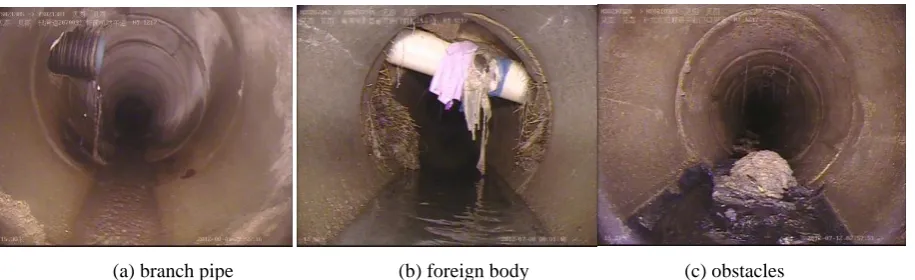
The data set used in this method are three kinds of pipeline defect images collected in real scene, including foreign body, obstacles and branch pipe. CCTV (Closed Circuit Television), the most commonly used testing tool at present, is collected from underground drainage pipes in several big cities in China. The picture format is jpg and the resolution is 700 × 572. Fig 2 shows some sample images used for training and testing.
[image:3.595.73.531.393.533.2](a) branch pipe (b) foreign body (c) obstacles Figure 2. Sample images used for training and testing.
In order to avoid over-fitting, we usually need to input enough data to train the neural network. In the case of insufficient data, data enhancement technology is used to enlarge the data set by using one or more combinations through the geometric transformation of the image. This paper adopts the method of flip and highlight to expand the dataset. First, the image is flipped from left to right, and the effect is shown in Figure 6 (a). The image is then highlighted as shown in Figure 3
(b) Highlight Figure 3. Data enhancement.
Training
According to the standard strategy of the current depth-learning-based target detection methods, the training network is initialized by selecting the pre-trained model on the ImageNet classification task. The VGG16 convolution neural network obtained from ImageNet classification is used to initialize the weights of the convolution layer of the feature extraction network. The training process of the whole network uses SGD back propagation to optimize the whole network model. The learning rate was 0.001, momentum was 0.9, weight-decay was 0.0005, attenuation factor was 0.1, and 7000 iterations were performed. The equipment used in the experiment was ubuntu 15.04, NVIDIA Titan 1080 GPU for acceleration.
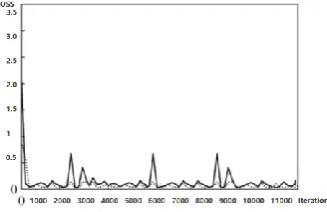
[image:4.595.164.435.74.195.2]As shown in Fig. 4, that loss function of the Faster R-CNN algorithm and the improved algorithm train in the same dataset versus the number of training time is plot. The solid line is the training result of the traditional Faster R-CNN algorithm, and the broken line is the training result of the improved Faster R-CNN algorithm. From the graph, we can clearly see that the loss value of this algorithm is lower than that of the unimproved Faster R-CNN algorithm, and it can quickly converge to the stable state. This is because K-Means clustering algorithm is introduced in this paper, which makes the prediction box in the training project adjust to the true candidate region more quickly, and makes the training of the candidate frame closer to the real candidate region more quickly. Therefore, proposed algorithm has lower loss and faster convergence rate.
Figure 4. Loss function line chart of training.
Result
The traditional Faster R-CNN algorithm framework and the improved Faster R-CNN algorithm framework proposed in this paper are tested by test set images, and the detection accuracy (i.e. MAP value) of the two methods is recorded, as shown in Table 1.
Table 1. Comparison for different algorithms.
Method mAP
Faster R-CNN 0.913
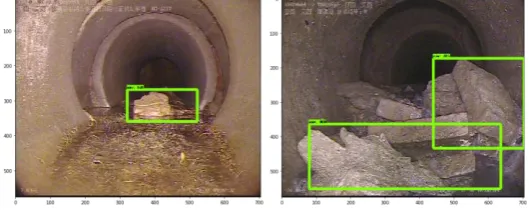
[image:4.595.216.380.497.603.2]From the experimental results in Table 1, it can be seen that the traditional Faster-Rcnn algorithm can be used to detect and identify the defects of drainage pipes. Through the improvement of Faster-Rcnn algorithm, the training of the algorithm can be shortened and the detection accuracy can be improved. The clustering algorithm can save the time of generating nine prediction frames corresponding to each feature map element, And the K-Means clustering generated anchor and training data samples are more similar, which can make the prediction box trained in the algorithm can be better trained, so it can improve the speed of image recognition and also improve the accuracy of recognition. Fig 5 shows some detection result.
Figure 5. Detection result.
Conclusion and Future Works
The improved Faster R-CNN pipeline defect detection method proposed in this paper significantly improves the accuracy of pipeline defect detection. In this paper, K-means clustering algorithm is used to cluster the prediction box of training data, and the clustering results are applied to RPN network in Faster R-CNN. Comprehensive analysis shows that the size of defects in the clustering prediction frame and image is more similar. Can accelerate the learning of the network, so that my network as soon as possible convergence. At the same time, the recognition accuracy is also improved. The method proposed in this paper can not only improve the efficiency of automatic detection of defects in drainage pipes, but also reduce the labor intensity of labors to locate defects. Satisfactory results have been obtained by this method, which can be used as a technical reference for pipeline defect detection workers.
Acknowledgement
This project was supported by the Funding Project for Natural Science Foundation of China (Grant No. 61671070) and the Opening Project of Beijing Key Laboratory of Internet Culture and Digital Dissemination Research (Grant No.ICDD201708).
References
[1] Sinha S K, Fieguth P W. Neuro-fuzzy network for the classification of buried pipe defects [J]. Automation in Construction, 2006, 15(1):73-83.
[2] Sinha S K, Fieguth P W. Segmentation of buried concrete pipe images [J]. Automation in Construction, 2006, 15(1):47-57.
[3] M.R. Halfawy, J. Hengmeechai, Integrated vision-based system for automated defect detection in sewer closed circuit television inspection videos, J. Comput. Civ. Eng. 29 (2015) 1–16.
[5] Redmon J, Divvala S, Girshick R, et al. You only look once: Unified, real-time object detection [C]//Proceedings of the IEEE Conference on Computer Vision and Pattern Recognition. 2016: 779- 788.