ARTICLE
Impact of Singular Excessive Computer Game and
Television Exposure on Sleep Patterns and Memory
Performance of School-aged Children
Markus Dworak, DiplSportwiss (MSc)a, Thomas Schierl, PhDb, Thomas Bruns, PhDb, Heiko Klaus Stru¨der, PhDa
aInstitute of Motor Control and Movement Technique andbInstitute of Sports, Media and Communications, German Sport University Cologne, Cologne, Germany
The authors have indicated they have no financial relationships relevant to this article to disclose.
ABSTRACT
OBJECTIVE.Television and computer game consumption are a powerful influence in the lives of most children. Previous evidence has supported the notion that media exposure could impair a variety of behavioral characteristics. Excessive television viewing and computer game playing have been associated with many psychiatric symptoms, especially emotional and behavioral symptoms, somatic complaints, attention problems such as hyperactivity, and family interaction problems. Nev-ertheless, there is insufficient knowledge about the relationship between singular excessive media consumption on sleep patterns and linked implications on chil-dren. The aim of this study was to investigate the effects of singular excessive television and computer game consumption on sleep patterns and memory per-formance of children.
METHODS.Eleven school-aged children were recruited for this polysomnographic study. Children were exposed to voluntary excessive television and computer game consumption. In the subsequent night, polysomnographic measurements were conducted to measure sleep-architecture and sleep-continuity parameters. In addition, a visual and verbal memory test was conducted before media stimulation and after the subsequent sleeping period to determine visuospatial and verbal memory performance.
RESULTS.Only computer game playing resulted in significant reduced amounts of slow-wave sleep as well as significant declines in verbal memory performance. Prolonged sleep-onset latency and more stage 2 sleep were also detected after previous computer game consumption. No effects on rapid eye movement sleep were observed. Television viewing reduced sleep efficiency significantly but did not affect sleep patterns.
CONCLUSIONS.The results suggest that television and computer game exposure affect children’s sleep and deteriorate verbal cognitive performance, which supports the hypothesis of the negative influence of media consumption on children’s sleep, learning, and memory.
www.pediatrics.org/cgi/doi/10.1542/ peds.2007-0476
doi:10.1542/peds.2007-0476
Key Words
television, computer game, children, sleep patterns, cognitive performance, polysomnographic study
Abbreviations
VVM—visual and verbal memory test TST—total sleep time
SWS—slow-wave sleep REM—rapid eye movement SOL—sleep-onset latency ADHD—attention-deficit/hyperactivity disorder
Accepted for publication May 23, 2007
Address correspondence to Markus Dworak, DiplSportwiss (MSc), Institute of Motor Control and Movement Technique, German Sport University Cologne, Carl-Diem-Weg 6, 50933 Cologne, Germany. E-mail: [email protected]
I
N WESTERN INDUSTRIALcountries, television and com-puter game consumption take up a large part of chil-dren’s time awake. The proportion of television users among children who are aged 9 to 16 years ranges from 98% to 100%.1Some studies have indicated that exces-sive television and video game consumption could result in psychiatric symptoms such as aggressive behavior,2–4 attention problems,5 hyperactivity,6 scholastic prob-lems,7,8 and somatic complaints.3,9,10Despite this knowl-edge, average media consumption of the children in this age group is⬎4 hours/day.7Furthermore, these seden-tary activities are frequently associated with significant behavioral consequences,9,11–13 including decreased physical activity and physical fitness,14poor eating hab-its,15 and obesity,3 and could impair development in childhood and adolescence.10,16–19Despite the enormous progress in media research, there is insufficient knowledge about the effects of sin-gular excessive media exposure on behavioral states and sleep patterns in children. Most examinations focused on long-term effects of media exposure on children’s well-being, and only a few studies examined the effects of television and computer consumption on children’s sleep quality.20–23 Negative effects on sleeping behavior, such as sleep-onset delay,20,21night waking,22sleep anx-iety,24and shortened sleep duration,22,23were observed in recent studies and suggest that media exposure could impair sleep quality. Finally, watching television ⱖ3 hours/day during adolescence elevates the risk for fre-quent sleep problems in early adulthood.25
Sleep is essential for children’s health and develop-ment and possibly plays an important role in learning and memory.4,26Neuroscientific theories support the no-tion that emono-tions could influence learning processes.27 Especially recently acquired knowledge is very sensitive in the subsequent consolidation period, and what the children emotionally experience within the hours after learning influences it decisively. The influence of inter-active media consumption on emotions was also estab-lished. Thus, it could be hypothesized that television and computer game consumption after a learning period could impair memory consolidation and performance. The purpose of this polysomnographic study was to eval-uate direct short-term effects of singular excessive tele-vision and computer game consumption on sleeping patterns and cognitive performance of school-aged chil-dren.
METHODS
Participants
Eleven male children volunteered to participate in this study (age: 13.45⫾1.04 years; height: 1.64⫾0.09 m; weight: 48.23⫾5.97 kg; BMI: 17.82⫾1.29 [all means
⫾SD]). Children and their parents for this study were volunteers from 8599 families who previously were
re-cruited for and participated in the Healthy Sleep for Cologne Children study, an epidemiologic study of sleeping behavior and sleep complaints in children. All participants were junior high school children in the first grade. Participants were selected in random order after fulfillment of the following criteria: age between 12 and 14 years, great health, no medications, German nation-ality, and male gender. Only male participants were selected for this study because previous studies indicated that menstrual cycle phase as well as oral contraceptive could influence sleeping behavior. In precocious girls, these factors could influence nocturnal sleep. In addi-tion, media research studies indicate that boys spend more than twice as much time playing video games as girls do; therefore, video game playing is a greater impact factor in boys’ leisure time. After consideration of the mentioned criteria, 3580 children were contacted with detailed information regarding the study setting; a total of 1321 consenting children gave a response rate of 36.9%. All participants and parental authorities signed informed consent forms and completed a medical ques-tionnaire before the experiment. They were informed that they could quit the study at any stage. All partici-pants showed good health status and had no sleep com-plaints. Participants were instructed to refrain from ad-ditional physical activity, passive body warming (eg, taking a warm bath or shower), and sleep during the day on the experimental days. They did not consume any kinds of caffeine, nicotine, or alcohol, and they were not exposed to a large stress load.
Experimental Design
Each participant underwent 3 investigation days in a randomized, crossover manner. The interval between the experiments was exactly 1 week. On 2 different experimental days, children were exposed to 2 types of media. On 1 occasion, they played interactively a com-puter game (Need for Speed—Most Wanted; Electronic Arts, Redwood City, CA) for 60 minutes. Recent studies sug-gest that this is nearly the average time per day that children spend playing computer games.21Furthermore, the participants watched a subjectively exciting video film on television. Every participant could choose from among 3 films (Harry Potter and the Prisoner of Azkaban, Star Trek: Nemesis, and Mary Higgins Clark’sLoves Music, Loves to Dance) but was not allowed to have seen the film before the experimental day. Media exposure occurred between 6:00 PM and 7:00 PM (2–3 hours before
bed-time). This time of day was selected because the children have usually finished their homework at that time and start their leisure time. Under control conditions, the participants adhered to their normal daily patterns but were not allowed to watch television or play computer games.
test (VVM) was conducted on each experimental day (Swets Test Services, Frankfurt am Main, Germany). The test served to determine the short-term and longer-term memory of visuospatial and verbal materials and was subdivided into 2 subtests. For examination of the mem-ory performance in the visually spatial area, a map with a marked path was shown to the children for 2 minutes. Immediately after this, the participants were asked to draw the path on such a map from memory. The second subtest served to examine the memory of facts. In this case, text that included names, numbers, and terms was presented for 2 minutes. After the presentation, the facts were immediately (T1) asked for in writing. Both tests were repeated after each experimental day within a 24-hour interval (T2) without renewed attraction. The raw analyzed results of the 2 subtests were intended for the 2 test times. A calculation of the loss of memory performance for every subtest was conducted by the following formula:T1⫺T2⫽[(T2⫺T1)/T1]⫻100.
Data Recording and Analysis
Before participant went to bed, polysomnographic mea-surements were conducted using a portable sleep data recorder (Varioport-SLP 2.0; Becker Meditec, Karlsruhe, Germany). An expert affixed the electrodes between 7:30PMand 8:30PMand removed them after participants
awoke in the morning. The participants were also in-structed to adhere to their normal evening routines and to go to bed and to get up at their usual time. General bedtime was between 8:30 PM and 9:30PM, when the
room light was turned off. Morning waking was be-tween 6:00AMand 7:00AM. During the study nights, the
participants slept in their own homes and always under the same timing and temperature conditions to stan-dardize sleeping conditions for each participant. They were also instructed to adhere to their normal evening routines and fill in a sleep diary. The sleep diary contains questions about daytime sleepiness, subjectively rated sleepiness, and subjectively rated awakenings. An adap-tation night was assigned on the day before the experi-ment to reduce the possible “first-night effect.”
The monitoring montage consisted of 3 electroen-cephalograph channels (C3-A2, C4-A1, and Oz-A2), bi-lateral electrooculograph, and submental chin electro-myography. The measuring procedure followed the standards for performance and evaluation of polysom-nographic studies of the pediatric group in the German Sleep Society.28
Each polysomnograph was scored by Somnolyzer 24x7 (Siesta Group, Vienna, Austria). The system in-cluded a raw data quality check, a feature extraction algorithm (density and intensity of sleep/wake-related patterns, eg, sleep spindles, ␦ waves, slow eye move-ments, and rapid eye movements), a feature matrix plausibility check, a classifier designed as an expert sys-tem, and a rule-based smoothing procedure for start and
ending of stages. In addition, a structured quality control by 2 experts including a visual correction was accom-plished. Studies showed that 2 Somnolyzer 24x7 analy-ses revealed an inter-rater reliability close to 1, repre-senting an overall agreement of 99.4% (Cohen’s : 0.991). This confirms that the variability induced by the quality control procedure, whereby⬃1% of the epochs are changed, could be neglected.29
For each polysomnograph, a number of measure-ments of sleep architecture and sleep continuity were derived. Measurements of sleep architecture included minutes and percentage of total sleep time (%TST) of stage 1 sleep, minutes and %TST of stage 2 sleep, min-utes and %TST of stage 3 sleep, minmin-utes and %TST of stage 4 sleep, minutes and %TST of slow-wave sleep (SWS; stages 3 ⫹ 4 sleep), and minutes and %TST of rapid eye movement (REM) sleep. Continuity measure-ments consisted of TST, sleep-onset latency (SOL), la-tency of stage 1, lala-tency of stage 2, lala-tency of stage 3, latency of stage 4 and REM sleep, wake time after sleep onset and sleep efficiency.
Statistical Analysis
Statistical analyses for significant differences of the nat-ural sleep cycle data were performed by using repeated-measurements analysis of variance and Bonferroni test as a posthoc test. A paired t test was used to analyze vigilance test (VVM) data. We used SPSS 12.0 (Sigma-Stat (Sigma-Statistical Software, Chicago, IL) and (Sigma-Statistica 7.1. software (StatSoft, Tulsa, OK) for Microsoft Windows. The significance level of all statistical tests was set atP⬍ .05.
RESULTS
All sleep parameters showed normal distributions. Be-cause 1 of the children was dyslexic, only the tests and polysomnographs of the 10 healthy participants were analyzed. TST remained unchanged among the 3 exper-imental nights. Mean TST was 511.80⫾44.44 minutes. The results showed a significant (P ⬍.05) decrease in sleep efficiency after only television exposure (Table 1). SOL increased significantly (P ⬍ .05) after computer game stimulation compared with basal conditions. Un-der baseline conditions, SOL was 10.83⫾8.33 minutes. Significant increases to 32.50⫾25.67 minutes (P⬍.05) were detected after computer game playing. No effect was found after television exposure. Also, significant prolongations in latent periods to stage 2 and stage 4 were observed only after interactive computer game playing (P⬍.05).
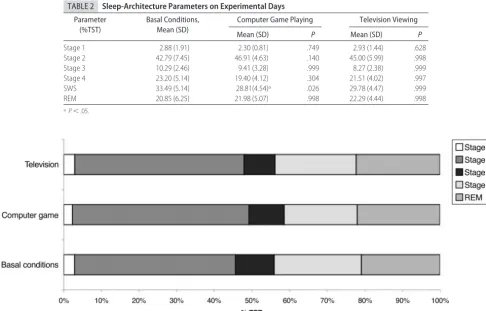
considerable increases over 50.0 minutes of stage 2 sleep in 7 children. In contrast, after television exposure, none of the participants showed increases 50.0 minutes in stage 2 sleep compared with basal conditions. Further-more, percentage distribution of sleep stages showed a significant decrease in SWS after computer game con-sumption related to basal conditions (P ⬍ .05; Fig 3). Also, a more detailed analysis of case-wise data supports the explicit effects of computer game consumption on SWS. Declines of SWS⬎5.0% were observed in 7 par-ticipants; 2 of these reached ⬎10.0% (10.02% and 13.27%). Conversely, only 1 participant showed de-creased SWS proportions ⬎5.0% after television
con-sumption compared with basal conditions. There were no significant changes in either the absolute duration or the relative proportion of REM sleep. Also, the evalua-tion of the sleep diary resulted in no significant differ-ences among the experimental days (Fig 3).
Visual and Verbal Memory Test
The evaluation of the visual and verbal memory test yielded a negative influence of the computer game ex-posure on the verbal memory for facts. Computer game playing led to a significant (P⬍.01) decline of the verbal memory performance (⫺46.83⫾18.32) compared with basal conditions (⫺18.09 ⫾ 24.78). In addition,
case-TABLE 1 Sleep-Continuity Parameters on Experimental Days
Parameter Basal Conditions, Mean (SD)
Computer Game Playing Television Viewing
Mean (SD) P Mean (SD) P
Sleep efficiency (%TST) 94.81 (2.86) 92.70 (4.23) .210 90.74 (3.19)a .005
Wake time after sleep onset, min 8.60 (8.60) 10.90 (17.53) .997 16.65 (17.85) .773
SOL, min 10.83 (8.33) 32.50 (25.99)a .034 24.61 (21.04) .939
Stage 1 10.83 (8.33) 28.89 (21.90) .053 21.11 (14.33) .817
Stage 2 12.83 (8.67) 34.83 (25.99)a .032 28.28 (20.00) .999
Stage 3 22.61 (9.59) 43.94 (25.62) .052 36.22 (20.74) .996
Stage 4 25.00 (10.11) 47.39 (26.46)a .049 39.11 (21.85) .998
REM 119.39 (44.79) 157.00 (36.55) .058 130.06 (47.20) .244
aP⬍.05.
TABLE 2 Sleep-Architecture Parameters on Experimental Days
Parameter (%TST)
Basal Conditions, Mean (SD)
Computer Game Playing Television Viewing Mean (SD) P Mean (SD) P
Stage 1 2.88 (1.91) 2.30 (0.81) .749 2.93 (1.44) .628
Stage 2 42.79 (7.45) 46.91 (4.63) .140 45.00 (5.99) .998
Stage 3 10.29 (2.46) 9.41 (3.28) .999 8.27 (2.38) .999
Stage 4 23.20 (5.14) 19.40 (4.12) .304 21.51 (4.02) .997
SWS 33.49 (5.14) 28.81(4.54)a .026 29.78 (4.47) .999
REM 20.85 (6.25) 21.98 (5.07) .998 22.29 (4.44) .998
aP⬍.05.
FIGURE 1
wise data showed declines⬎20.0% in 8 participants. In contrast, no significant changes were observed after tele-vision exposure after which only 2 participants showed a decline of verbal memory performance⬎20.0%. Cog-nitive performance in the visuospatial area did not differ among the experimental days (Fig 4).
DISCUSSION
This study demonstrates that singular excessive media exposure affects children’s sleep architecture, sleep
con-tinuity, and verbal memory performance. Particularly, interactive computer game consumption resulted in pro-longed SOL, more sleep time in stage 2, less SWS as a percentage of TST in subsequent sleep, and declines in verbal memory performance; therefore, our results pro-vide supplementary epro-vidence for a negative influence of excessive media consumption on children’s sleep, health, and performance.
Most previous studies observed long-term term cor-relations between television viewing, computer game playing, and Internet use and general health problems, whereas our study proves singular excessive short-term effects; nevertheless, our findings are consistent with previous studies and support that there is a negative influence of excessive media consumption on health and well-being. Excessive media consumption was associ-ated with an elevassoci-ated risk for psychiatric and social problems such as aggressive behavior,2,4,30 attention problems,5 hyperactivity,2 and scholastic problems.8 Also, links have been suggested with certain somatic complaints10 resulting from the sedentary execution of media consumption in children’s leisure time, including decreased levels of physical activity and physical fit-ness,12 poor eating habits,23 and an increased risk for obesity.7
Unfortunately, only a few studies have assessed the effects of media consumption on children’s sleep.20–24 Recent results showed increased SOL,20,21 an elevated risk for midnight waking,20 difficulties in falling asleep, and a reduced sleep quality22,24,25 after television and computer game consumption. Poor sleep quality was associated with mental health problems, inferior school performance, and somatic complaints. Sleep difficulties were significantly associated with both behavioral prob-lems, such as school attendance probprob-lems, and higher levels of tiredness.22It has also been found that excessive television viewing may be connected with diverse sleep disturbances during adolescence.22 The presence of a television in the child’s bedroom results in significant modifications of sleep–wake parameters, especially re-lated to bedtime and sleep duration,22 and thus is the most powerful predictor of overall sleep disturbance and bedtime resistance.24,31
To our knowledge, only 1 study32 previously exam-ined the effects of media consumption (computer game playing) on sleep patterns in children. In accordance with Higuchi et al,32 we used polysomnographic mea-surements to define sleep stages and sleep latencies. In both studies, a significant increased SOL after singular excessive computer game playing was observed com-pared with control conditions. Contrary results were detected in sleep stages. Whereas Higuchi et al32noticed less REM sleep and no changes in SWS after computer games, we detected more sleep in stage 2 and reduced amounts of SWS but no effects on REM sleep. The decrease in SWS after computer game playing in this FIGURE 2
Average (⫾SE) minutes of non-REM stage 2 sleep at basal conditions and after playing computer games and viewing television.aP⬍.05.
FIGURE 3
study may reflect children’s high arousal state. Differ-ences in the age of the participants, type of computer game, place and type of polysomnographic measure-ments, and sleep time may be reasons for the different observation.
Possibly, different claims of television and computer game consumption on the central nervous system were decisive for alterations of children sleep. Previous studies showed different effects of television viewing and video game playing on several physiologic parameters.33 Un-like television viewing, which expends the same energy as sitting quietly, interactive video game consumption results in significant increases in various physiologic and metabolic variables in young children, including heart rate, blood pressure, respiratory rate, energy expendi-ture, and ventilation, and thus a higher arousal state of the central nervous system.33 The magnitude of these changes was below standard physical exercise and na-tional health recommendations and did not affect met-abolic, cardiovascular, pulmonary, homodynamic, and endocrine systems in the whole body and the brain as physical activity does.34A higher arousal state within the hours before sleeping could influence subsequent sleep. Another interesting finding was a significant decline of verbal memory performance after computer game playing compared with basal conditions. Modern neuro-scientific theories support the notion that strong emo-tional experiences, such as computer games and thrilling films, could decisively influence learning processes. Be-cause recently acquired knowledge is very sensitive in the subsequent consolidation period, emotional experi-ences within the hours after learning could influence memory consolidation considerably.26,35 Interactive video games are challenging, sometimes frustrating, ex-citing, and often surprising, and during playing, individ-uals may experience a range of emotions accompanied by physiologic changes. In addition, studies with positron emission tomography scans showed a
signifi-cant release of the neurotransmitters dopamine and nor-epinephrine in the brain during video game playing.36 Dopamine as well as norepinephrine are thought to be involved in learning, reinforcement of behavior, emo-tion, and sensorimotor coordination and thus able to influence memory processing decisively.
Evidence in molecular genetics, neurophysiology, and the cognitive neuroscience supports an important role for sleep in learning and reprocessing of memo-ries.35,37 Only a single night of restricted sleep led to impaired cognitive functions, such as abstract thinking and verbal creativity in children.38 Presumably, both REM and SWS are involved in the consolidation process, in which SWS is particularly favorable to explicit mem-ory traces.37It has been proposed that during SWS, the lower acetylcholine levels facilitate the transmission of information from the hippocampus back to the cortex. High acetylcholine levels during REM sleep would allow the neocortex to undergo a process of reanalysis and thereby develop new feed-forward representations for behavior.39Because computer game exposure resulted in likewise reduced amounts of SWS, our observations sup-port the hypothesis for the role of SWS in explicit mem-ory consolidation.
Video viewing did not affect visuospatial and verbal memory performance. It could be assumed that the me-dia content is responsible for subsequent effects on sleep and memory performance. Afterward, none of the par-ticipants judged the chosen film as very thrilling, indi-cating that the thrilling factor of the selected films was not high enough for the children. Results showing that exposure to adult media content may have a stronger impact than media exposure time supported this no-tion.8In general, just 13% of the young people in this age group have parental control with rules about the content of their media consumption.7 Especially adult (violent/sexual) media content and associated individual excitement could affect sleep and learning in children.40 FIGURE 4
It could be hypothesized that media exposure influ-ences memory processing in decisive ways: temporary through emotional influences on the consolidation pro-cess as well as disrupted SWS and in the long-term by a chronic diminution of physical activity. An inverse rela-tionship between time spent using video games and daily physical activity has already been observed. Posi-tive effects of physical exercise on brain structures, func-tions, and memory processing34were examined in recent studies and supported by cross-sectional observations that showed a positive association between physical ac-tivity and academic and accompanied improvements of concentration and classroom behavior.18Finally, our re-sults could provide a plausible explanation concerning the effects of media exposure on poor school completion and especially poor reading skills, derived from the re-sults of the VVM.
This study supports the influence of singular exces-sive media consumption on both sleep and cognitive performance in children. In addition, the impact of me-dia on children’s health and well-being is widely recog-nized and considered a serious problem in modern soci-ety. Our results were supported by previous studies that observed that movie, television, and video game use during the middle school years was uniformly associated with a negative impact on school performance.8 Also, children with lowest grades spend more time playing video games and less time reading than those with the best grades.7 Additional examinations confirmed that excessive television viewing in early childhood was as-sociated with a higher subsequent risk for development of attention-deficit/hyperactivity disorder (ADHD).5
Limiting young children’s exposure to television as a medium during formative years of brain development may reduce children’s subsequent risk for developing ADHD and social and scholastic problems.5,8 Children spend one third of their life in sleep, indicating the importance of sleep for children’s development and health; therefore, the negative effects of excessive media consumption may be a significant concern. Our findings add experimental support to the importance of parental limits on media content and time. Additional work is needed to determine relationships among time, content, and type of media affecting children’s health, sleep, and memory and to give advice for useful contact with en-tertainment media.
CONCLUSIONS
Our data indicate that excessive media consumption, especially computer game playing, impairs sleep patterns and verbal cognitive performance in children. Because children’s sleep-related problems seem to be highly per-sistent; prevalent; and associated with somatic com-plaints, psychiatric symptoms, especially behavioral and emotional symptoms, attention problems such as hyper-activity, and scholastic problems, they constitute a
con-siderable and growing health problem among children and therefore should receive more attention. This study demonstrates that more effort should be directed to screening sleep disturbances after media consumption, helping parents to perceive the negative effects of media consumption on health and sleep and to provide ade-quate guidance for their children when needed.
ACKNOWLEDGMENTS
This work was supported by the Institute of Motor Con-trol and Movement Technique and the Institute of Sports, Media and Communications and performed at the Institute of Motor Control and Movement Technique (German Sport University Cologne).
REFERENCES
1. Beentjes JW, Koolstra CM, Marseille N, Voort TH. Children’s use of different media: for how long and why? In: Livingstone S, Bovill M, eds.Children and Their Changing Media Environment: A European Comparative Study. Mahwah, NJ: Lawrence Erlbaum Associates; 2001:85–112
2. Johnson JG, Cohen P, Smailes EM, Kasen S, Brook JS. Televi-sion viewing and aggressive behavior during adolescence and adulthood.Science.2002;295:2468 –2471
3. Robinson TN. Television viewing and childhood obesity.Pediatr Clin North Am.2001;48:1017–1025
4. Singer MI, Slovak K, Frierson T, York P. Viewing preferences, symptoms of psychological trauma, and violent behaviors among children who watch television.J Am Acad Child Adolesc Psychiatry.1998;37:1041–1048
5. Christakis DA, Zimmermann FJ, DiGiuseppe D, McCarty CA. Early television exposure and subsequent attentional problems in children.Pediatrics.2004;113:708 –713
6. Gupta RK, Saini DP, Acharya U, Miglani N. Impact of television on children.Indian J Pediatr.1994;61:153–159
7. Rideout V, Roberts DF, Foehr UG. Generation M: media in the lives of 8 –18 year-olds. Available at: www.kff.org/entmedia/ entmedia030905pkg.cfm. Accessed March 14, 2007
8. Sharif I, Sargent JD. Association between television, movie, and video game exposure and school performance.Pediatrics.
2006;118(4). Available at: www.pediatrics.org/cgi/content/ full/118/4/e1061
9. Tazawa Y, Okada K. Physical signs associated with excessive television-game playing and sleep deprivation. Pediatr Int.
2001;43:647– 650
10. Toyran M, Ozmert E, Yurdakok K. Television viewing and its effect on physical health of schoolage children.Turk J Pediatr.
2002;44:194 –203
11. Villani S. Impact of media on children and adolescents: a 10-year review of the research.J Am Acad Child Adolesc Psychi-atry.2001;40:392– 401
12. Subrahmanyam K, Greenfield P, Kraut R, Gross E. The impact of computer use on children’s and adolescents’ development.
J Appl Dev Psychol.2001;22:7–30
13. Bernard-Bonnin AC, Gilbert S, Rousseau E, Masson P, Maheux B. Television and the 3- to 10-year-old-child.Pediatrics.1991; 88:48 –54
14. DuRant RH, Baranowski T, Johnson M, Thompson WO. The relationship among television watching, physical activity, and body composition of young children. Pediatrics. 1994;94: 449 – 455
16. Janz KF, Burns TL, Torner JC, et al. Physical activity and bone measures in young children: the Iowa bone development study.Pediatrics.2001;107:1387–1393
17. Rasmussen F, Lambrechtsen J, Siersted HC, Hansen HS, Han-sen NC. Low physical fitness in childhood is associated with the development of asthma in young adulthood: the Odense schoolchild study.Eur Respir J.2000;16:866 – 870
18. Strong WB, Malina RM, Blimkie CJ, et al. Evidence based physical activity for school children. J Pediatr. 2005;146: 731–737
19. Ozmert E, Toyran M, Yurdakok K. Behavioral correlates of television viewing in primary school children evaluated by the child behavior checklist.Arch Pediatr Adolesc Med. 2002;156: 910 –914
20. Alexandru G, Michikazu S, Shimako H, et al. Epidemiological aspects of self-reported sleep onset latency in Japanese junior high school children.J Sleep Res.2006;15:266 –275
21. Paavonen EJ, Pennonen M, Roine M, Valkonen S, Riita Lahi-kainen A. TV exposure associated with sleep disturbances in 5-to 6-year-old children.J Sleep Res.2006;15:154 –161
22. Van den Bulck J. Television viewing, computer game playing, and internet use and self-reported time to bed and time out of bed in secondary-school children.Sleep.2004;27:101–104 23. Weissbluth M, Poncher J, Given G, Schwab J, Mervis R,
Rosen-berg M. Sleep duration and television viewing.J Pediatr.1981; 99:486 – 488
24. Owens J, Maxim R, McGuinn M, Nobile C, Msall M, Alario A. Television-viewing habits and sleep disturbance in school chil-dren.Pediatrics.1999;104(3). Available at: www.pediatrics.org/ cgi/content/full/104/3/e27
25. Johnson JG, Cohen P, Kasen S, First MB, Brook JS. Association between television viewing and sleep problems during adoles-cence and early adulthood.Arch Pediatr Adolesc Med.2004;158: 562–568
26. Maquet P. The role of sleep in learning and memory.Science.
2001;294:1048 –1052
27. Dolan RJ. Emotion, cognition and behavior.Science.2002;298: 1191–1194
28. Niewerth HJ, Wiater A. Polysomnographic studies for infants and children: laboratory instructions.Somnology.2000;4:43–52 29. Anderer P, Gruber G, Parapatics S, et al. An e-health solution for autonomic sleep classification according to Rechtschaffen and Kales: validation study of the somnolyzer 24 x 7 utilizing the Siesta database.Neuropsychobiology.2005;51:115–133 30. Robinson TN, Wilde ML, Navracruz LC, Haydel KF, Varady A.
Effects of reducing children’s television and video game use on aggressive behavior: a randomized controlled trial.Arch Pediatr Adolesc Med.2001;155:17–23
31. Christakis DA, Ebel BE, Rivara FP, Zimmermann FJ. Televi-sion, video, and computer game usage in children under 11 years of age.J Pediatr.2004;145:652– 656
32. Higuchi S, Motohashi Y, Liu Y, Maeda A. Effects of playing a computer game using a bright display on presleep physiological variables, sleep latency, slow wave and REM sleep.J Sleep Res.
2005;14:267–273
33. Wang X, Perry AC. Metabolic and physiologic responses to video game play in 7- to 10-year old boys.Arch Pediatr Adolesc Med.2006;160:411– 415
34. Cotman CW, Engesser-Cesar C. Exercise enhances and protects brain function.Exerc Sport Sci Rev.2002;30:75–79
35. Stickgold R, Hobson JA, Fosse R, Fosse M. Sleep, learning, and dreams: off-line memory reprocessing. Science. 2001;294: 1052–1057
36. Koepp MJ, Gunn RN, Lawrence AD, et al. Evidence for striatal dopamine release during a video game. Nature. 1998;393: 266 –268
37. Gais S, Born J. Declarative memory consolidation: mechanisms acting during human sleep.Learn Mem.2004;11:679 – 685 38. Radazzo AC, Muehlbach MJ, Schweitzer PK, Walsh JK.
Cog-nitive function following acute sleep restriction in children ages 10 –14.Sleep.1998;21:861– 868
39. Hasselmo ME. Neuromodulation: acetylcholine and memory consolidation.Trends Cogn Sci.1999;3:351–359
40. Brady SS, Matthews KA. Effect of media violence on health-related outcomes among young men.Arch Pediatr Adolesc Med.
2006;160:341–347-DOI: 10.1542/peds.2007-0476
2007;120;978
Pediatrics
Markus Dworak, Thomas Schierl, Thomas Bruns and Heiko Klaus Strüder
Patterns and Memory Performance of School-aged Children
Impact of Singular Excessive Computer Game and Television Exposure on Sleep
Services
Updated Information &
http://pediatrics.aappublications.org/content/120/5/978 including high resolution figures, can be found at:
References
http://pediatrics.aappublications.org/content/120/5/978#BIBL This article cites 36 articles, 11 of which you can access for free at:
Subspecialty Collections
http://www.aappublications.org/cgi/collection/media_sub
Media
following collection(s):
This article, along with others on similar topics, appears in the
Permissions & Licensing
http://www.aappublications.org/site/misc/Permissions.xhtml in its entirety can be found online at:
Information about reproducing this article in parts (figures, tables) or
Reprints
DOI: 10.1542/peds.2007-0476
2007;120;978
Pediatrics
Markus Dworak, Thomas Schierl, Thomas Bruns and Heiko Klaus Strüder
Patterns and Memory Performance of School-aged Children
Impact of Singular Excessive Computer Game and Television Exposure on Sleep
http://pediatrics.aappublications.org/content/120/5/978
located on the World Wide Web at:
The online version of this article, along with updated information and services, is
by the American Academy of Pediatrics. All rights reserved. Print ISSN: 1073-0397.