“Who Is Sitting Across From Me?” Immigrant Mothers’ Knowledge of
Parenting and Children’s Development
Marc H. Bornstein, PhD, and Linda R. Cote, PhD, CFLE
ABSTRACT. Objective. Although parents’ knowl-edge about child development and child rearing is rele-vant to pediatric practice, very little is known about immigrant parents’ knowledge. To fill this gap in re-search, this study investigated parenting knowledge in 2 groups of mothers who had immigrated to the United States.
Design. Japanese and South American immigrant
mothers of 2-year-olds completed a standardized survey of parenting knowledge and provided information about sociodemographic and infant health status. Their data were compared with European American mothers in the United States.
Results. Immigrant mothers scored ⬃70% on the
evaluation of parenting knowledge, significantly lower than multigenerational US mothers. The majority of im-migrant mothers did not know correct answers for 25% of the items, and their incorrect answers were mostly to questions about normative child development.
Conclusions. Parents’ knowledge is relevant to pedi-atricians’ evaluations of the health and welfare of chil-dren as understood by their parents. Gaps in parenting knowledge have implications for clinical interactions with parents, child diagnosis, pediatric training, and par-ent education.Pediatrics2004;114:e557–e564. URL: www. pediatrics.org/cgi/doi/10.1542/peds.2004-0713; pediatrics, child-development knowledge, child health, child develop-ment, parenting, acculturation, immigration, parent edu-cation.
ABBREVIATIONS. KIDI, Knowledge of Infant Development In-ventory; CODQ, Concepts of Development Questionnaire.
P
arenting knowledge encompassesunderstand-ing how to care for children, how children develop, and the diverse roles parents play in children’s lives.1,2 The general state of knowledge
that parents possess in these domains constitutes a vital frame of reference from which parents interpret their children’s behaviors. Parenting knowledge af-fects parents’ everyday decisions about their chil-dren’s care and upbringing,1–6which in turn affects
children’s development.4,5,7 For example, mothers
who are appropriately informed of the need for
im-munization usually act accordingly.8Moreover,
par-ents’ descriptions of their children’s behavior can influence physician decision-making.9 However,
parents are most likely to report behavior that they deem as unusual, and knowledge of child develop-ment is basic to parents’ understanding of what is and is not normal behavior for a child of a certain age. In a nutshell, the study of parenting knowledge is important because such knowledge affects parent-ing decisions and practices that in turn affect child development.
In this study, we examined more closely what mothers know substantively about child develop-ment and child rearing. Whereas beliefs, attitudes, and values may or may not be factual, knowledge is thought to draw on the science base and to be valid and reliable by members of the clinical and research communities. Because parents are the main caregiv-ers of infants and young children, investigating the amount and types of knowledge parents possess about child development and child rearing is a nec-essary early step to increasing and improving the dissemination and utilization of parenting knowl-edge and thereby to improving children’s quality of life.
THE SIGNIFICANCE OF PARENTING KNOWLEDGE TO CLINICIANS
Parenting knowledge of child development and child rearing is especially relevant to pediatric prac-tice.10During child health visits, clinicians must ask
about and interpret parents’ expectations, concerns, and opinions about their children’s health and de-velopment.11Accurate and complete developmental
anamnesis and surveillance depend on eliciting and properly construing parents’ reports and obtaining relevant developmental histories, among other things. Clearly, the validity of clinical impressions is improved when pediatricians and other clinical prac-titioners incorporate parental appraisals into their decision-making. After all, parents have the most experience with the child, are thought to know the child best, and are the clinician’s primary source of long-standing and outside information about the child.
Because clinicians routinely draw on parents’ knowledge during interviews, clinicians need to be aware that parents’ replies to the questions they pose are mediated by parents’ knowledge about children’s development and parents’ own child rearing. In other words, when interpreting the information par-ents provide, clinicians must take the sources and
From the National Institute of Child Health and Human Development, Bethesda, Maryland.
Accepted for publication Jun 2, 2004. doi:10.1542/peds.2004-0713
Address correspondence to Marc H. Bornstein, PhD, Child and Family Research, National Institute of Child Health and Human Development, Suite 8030, 6705 Rockledge Dr, Bethesda, MD 20892-7971. E-mail: marc㛭h㛭[email protected]
contexts of parents’ cognitions into consideration. One especially noteworthy context of parenting knowledge is culture (MH Bornstein, PhD, CS Hahn, PhD, MA Suizzo, EdD, LR Cote, PhD, and OM Haynes, PhD, Cultural, Sociodemographic, and Experi-ential Factors Predicting Mothers’ Knowledge About Child Development and Child Rearing: National Immi-grant and Cross-National Studies, unpublished data, 2004). It is widely accepted that parenting knowl-edge, from children’s attainment of developmental milestones and skills to parents’ responsibilities and activities, differs across cultural groups; awareness of such differences is requisite to physicians accu-rately interpreting parents’ reports about child health, development, and behavior during health-supervision visits. In attempting to understand the contemporary “health care gap” in the United States, Geiger12warned that “on the physician’s side, poor
communication, lack of cultural understanding, and subconscious negative, ethnic stereotyping can be involved.”
PARENTING KNOWLEDGE IN IMMIGRANT POPULATIONS
The study of cultural differences in immigrant par-ents’ knowledge of child rearing and child develop-ment is particularly germane today. The growing influx of immigrants to the United States in the past decade has made the study of immigrant parents a matter of heightened contemporary concern. The 2000 US Census indicates that⬃1 in 5 children in the United States, or⬃14 million children, lives with at least 1 immigrant parent (defined as a parent who was born outside the United States13). This situation
has led to “systematic deficiencies and inequities” in health care as well as “disparities in...diagnosis and treatment for this country’s most vulnerable popula-tions.”12The Department of Health and Human
Ser-vices Agency for Healthcare Research and Quality14
recently documented these disparities in care associ-ated with race, ethnicity, and socioeconomic status.
In this study, we focused on this vulnerable pop-ulation of immigrants. Research on immigrant fami-lies suggests that the belief systems of the majority group are not always readily adopted and that cul-turally significant parenting beliefs and norms are among the most resistant to change in a culture.15,16
Thus, such government initiatives as the National Institute of Child Health and Human Development “Back to Sleep” campaign may be even less well known among immigrant parents. Unfortunately, lit-tle is understood about parenting knowledge among immigrant families. Asian and Latino people, sub-groups of which we studied here, are currently the majority immigrant groups in the United States,17
but they have received comparatively little research attention.18,19Moreover, the Asian and Latino
popu-lations in the United States are expected to triple by midcentury,20making it increasingly important that
clinicians better understand Asian and Latino par-ents. To begin to address the paucity of knowledge on this subject, the main goal of the present study was to determine the nature and composition of immigrant mothers’ knowledge of child
develop-ment and child rearing. Taking parental knowledge and cultural background into consideration adds to the subtlety and scope of the clinician’s task, but overlooking the knowledge-culture nexus risks los-ing access to vital information about the patient.
QUESTIONS ABOUT PARENTING KNOWLEDGE These considerations of the cultural significance of parenting knowledge to clinical decision-making, competence in parenting, and children’s healthy and successful growth and development gave rise to the general question that motivated this research: How complete and accurate is immigrant mothers’ knowl-edge of child development and child rearing? To address this question, we studied 2 different ethnic groups migrating to the United States at the same point in time. Recruiting 2 comparison groups al-lowed us to examine generalities and specificities in the acculturation of parenting knowledge among im-migrants to the United States. We recruited groups that were intentionally similar and different on a number of demographic and psychosocial character-istics. Both the Japanese and South American accul-turating samples were immigrants and not refugees, an important distinction because psychologic diffi-culties known to affect parenting frequently accom-pany refugee status.21,22Mothers in all samples were
metropolitan, middle class, similar in age, and had comparable levels of education. However, these comparison groups also differed on a number of psychologic, social, and historical dimensions: Japan and Latin America represent Eastern and Western cultures, respectively, that vary in terms of history, beliefs, and values.23–27For example, Japan was
iso-lated from the rest of the world until relatively mod-ern times and as a result developed insular and unique ways of thinking and learning.18,28,29In
con-trast, South America shares with North America a certain heritage and history that is not shared with Japan, in particular their colonization by Europeans, which has resulted in many common political, cul-tural, and religious beliefs and institutions.23,26Thus,
we expected different patterns of knowledge for these 2 distinct immigrant groups despite their equivalent levels of acculturation to US society.
METHOD Participants
One hundred fourteen mothers of 20-month-old infants from 3 cultural groups participated: Japanese immigrants to the United States (n⫽38), South American immigrants to the United States (n
⫽36), and European Americans living in the United States (n⫽
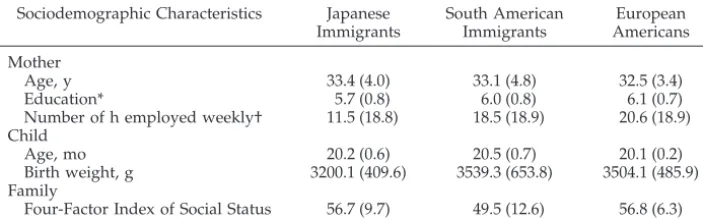
40). Participants lived in the Washington, DC, metropolitan area. Mothers were recruited to be demographically similar and to be representative samples of middle-class mothers in their particular ethnic group; US mothers were chosen from a larger sample to achieve sample size and demographic comparability with the Japanese and South American immigrant mothers and yet still be representative of the population of middle-class European Amer-ican mothers living in and around Washington, DC. Table 1 shows sociodemographic information for the mothers in each ethnic group. Both groups of immigrant mothers were bicultural, as indicated by their scores on a 5-point acculturation scale30(M⫽
(nonsignificant). European American mothers were either fourth-or fifth-generation Americans (ie, most fourth-or all of their grandparents were born in the United States).
South American immigrant mothers were primarily from Ar-gentina, Peru, and Colombia, and their first language was Span-ish.31 In areas of the United States in which there are several
Latino groups and not a large concentration of 1 particular Latino group, as is the case in the Washington, DC, area,31,32people tend
to identify themselves as Latino or by their regional affiliation rather than by their country of origin.33Mothers participating in
this study self-identified as South American by responding to an advertisement for South American families/familias de origen Sud Americano, an important methodologic issue for research with Latina participants.34Empirically, there were no differences
within the South American immigrant group on the dependent variables. Similarly, Japanese immigrant mothers self-identified as Japanese American, and their first language was Japanese. Our immigrant samples are demographically representative of immi-grants from South America and Japan living in US metropolitan areas,31,32 and they are representative of Japanese and South
American immigrants to the United States, who during the last 2 decades have been well educated, are from the urban middle class, and immigrated primarily for economic reasons.35–37
All data were collected in compliance with the National Insti-tutes of Health Internal Review Board human assurance guide-lines.
Procedure
Participating mothers were recruited from hospital and news-paper birth announcements and mass mailings. Parenting knowl-edge data were collected directly from mothers. Data collection on parenting knowledge took place toward the end of the child’s second year when the children were⬃20 months old. We studied parenting knowledge at that time for several reasons. First, the instrument we used to assess parenting knowledge covered the child’s first 2 years. Moreover, we wanted information from moth-ers who were settled in the maternal role and whose cognitions about parenting had time to stabilize. Soon after parturition, many women experience fluctuations in mood38 and level of marital
satisfaction,39,40and we scheduled the collection of data on
par-enting knowledge to avoid these transient vicissitudes.
Instruments
The Knowledge of Infant Development Inventory (KIDI) (D MacPhee, PhD, Manual for the Knowledge of Infant Development Inventory, unpublished data, 1981) was the principal measure in the study. The first criterion established for the KIDI was that it provides broad coverage of information. It assesses knowledge of effective parenting practices that promote children’s healthy psy-chosocial development, developmental processes, health and safety guidelines, and developmental norms and milestones rele-vant to children from birth to 2 years of age. The inventory contains 75 items, 48 of which ask respondents to indicate whether they agree, disagree, or are unsure about a series of statements (eg, “You must stay in the bathroom when your infant is in the tub”). An additional 20 items ask parents to choose among 4 responses (agree, younger, older, or unsure) in relation to a statement about when a child should be able to achieve a particular milestone (eg,
“Most infants are ready to be toilet trained by 1 year of age”). The remaining 7 items are either questions or sentence completions with 5 possible answers (eg, “The average newborn sleeps a total of: (a) 22 hours a day, (b) 17 hours a day, (c) 12 hours a day, (d) 7 hours a day, (e) not sure”). All items were worded so that they would be accessible to individuals with no more than a 6th-grade education and so as to be free of sociocultural biases (D MacPhee, PhD, Manual for the Knowledge of Infant Development Inventory, unpublished data, 1981). Responses were scored as incorrect (0) or correct (1). As a result of an instrument-validation process (see below) and to increase scale reliability,41,424 items were omitted
from the analyses (items 1, 31, 39, and 40), and the proportion of total correct across the remaining 71 items was calculated for each mother. Because the data were binary, we performed principal component analyses by using binary similarity coefficients ob-tained from the 71 items used in larger US and cross-cultural data sets (n⫽331 and 322, respectively). The analyses revealed a single dominant factor for data sets with eigenvalues for the first and second factors 51.5 and 4.1 for the US and 44.1 and 5.1 for the cross-cultural data. Extracting a single factor explained 72.5% and 62.1% of the total variance for the US and the cross-cultural data, respectively. The KIDI has good internal and test-retest reliability and construct validity (ie, it was positively related to degree of practical and professional experience with children [D MacPhee, PhD, Manual for the Knowledge of Infant Development Inventory, unpublished data, 1981]).
The KIDI is a widely used measure of knowledge of children’s development,3,10,43,44 and it is used in the Early Head Start
Re-search and Evaluation Project, currently being conducted by the Administration for Children and Families, US Department of Health and Human Services. The KIDI is also related to another widely used measure of mothers’ knowledge of children’s devel-opment: the Concepts of Development Questionnaire (CODQ) (ie, the KIDI was significantly positively related to the Perspectivistic subscale of the CODQ and significantly negatively related to the Categorical subscale of the CODQ7).
Sociodemographic information was gathered by using a Family Description Questionnaire (MH Bornstein, PhD, CS Tamis-LeM-onda, PhD, JTD Suwalsky, MS, and OM Haynes, PhD, Family Description Questionnaire, unpublished data, 1991) and the Holl-ingshead Four-Factor Index of Social Status (AB HollHoll-ingshead, PhD,The Four-Factor Index of Social Status, unpublished data, 1975). Because differences exist between countries in the duration, qual-ity, and content of schooling, bicultural researchers adjusted mothers’ years of schooling so that the scales were equivalent to the Hollingshead scale. Several steps were taken to promote the validity and cultural appropriateness of all the instruments used, because we aimed to arrive at translations that had “adapted equivalence” across cultures from a psychologic perspective.45
The questionnaires, originally constructed and written in English, were first translated into Spanish and Japanese and then back-translated by bilingual bicultural South American and Japanese natives using standard back-translation techniques.46,47The
trans-lated instruments next were checked for preservation of meaning and cultural appropriateness by professional psychologists or pe-diatricians from each country. Professionals and bilingual mothers from each culture who lived in the United States and were not participants in the study were then interviewed regarding the
TABLE 1. Descriptive Statistics for Sample Sociodemographic Characteristics
Sociodemographic Characteristics Japanese Immigrants
South American Immigrants
European Americans
Mother
Age, y 33.4 (4.0) 33.1 (4.8) 32.5 (3.4)
Education* 5.7 (0.8) 6.0 (0.8) 6.1 (0.7)
Number of h employed weekly† 11.5 (18.8) 18.5 (18.9) 20.6 (18.9) Child
Age, mo 20.2 (0.6) 20.5 (0.7) 20.1 (0.2)
Birth weight, g 3200.1 (409.6) 3539.3 (653.8) 3504.1 (485.9) Family
Four-Factor Index of Social Status 56.7 (9.7) 49.5 (12.6) 56.8 (6.3)
M(SD) is shown for all columns.
* On the Four-Factor Index of Social Status477-point scale.
cultural validity of items in the instruments. Finally, pilot testing was undertaken to ensure that the instruments were comprehen-sible and ethnographically valid.45
RESULTS Data-Screening Procedures
Data were examined for univariate and influential bivariate outliers by using scatter plots and numeric statistics: the studentized deleted residual, leverage, and Cook’s SD. Initial estimates of optimal transfor-mations were sought by evaluating inverse fitted-value plots and output from Box-Cox methods.48The
KIDI proportion-correct score was raised to the third power to approximate normality and reduce the number and influence of outliers.48,49 Transformed
variables were used in all analyses; however, un-transformed values are reported to facilitate interpre-tation. Sociodemographic variables appearing in Ta-ble 1 were examined as covariates. To qualify as a covariate, a sociodemographic variable had to corre-late significantly (P⬍.05) and meaningfully (explain at least 5% of the variance) with mothers’ KIDI score as well as have a significant effect in the analysis of covariance (P ⬍.05). Only 1 covariate, mothers’ ed-ucation level, met these criteria. Because the assump-tion of homogeneity of regression slopes was not met for the analysis of covariance, different regression slopes were fitted for each cultural group by using mean-deviated scores.
What Mothers Know
An analysis of variance with 1 dependent variable (mothers’ KIDI score) and 1 between-subjects factor (cultural group) with 3 levels (Japanese immigrant, South American immigrant, European American) compared immigrant mothers’ knowledge of parent-ing to that of European American mothers. There
was a significant main effect for cultural group on proportion-correct KIDI scores (F[2,111]⫽23.62,P⬍
.001, and p2 ⫽ 0.30), indicating that both Japanese immigrant mothers (M⫽0.72; SD⫽0.09) and South American immigrant mothers (M⫽0.75; SD⫽0.11) scored significantly lower than European American mothers (M⫽ 0.84; SD⫽0.05) on parenting knowl-edge, all Tukey’s honestly significantly different (P⬍
.05). These group differences remained when moth-ers’ education level was controlled (F[2,108]⫽19.04,
P⬍ .001, andp2⫽ 0.26).
What Mothers Do Not Know
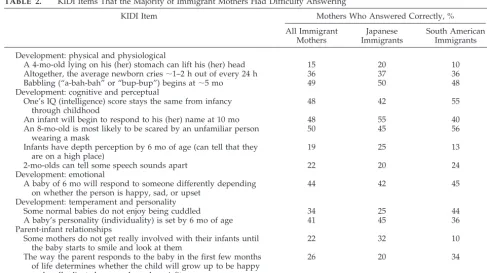
What kinds of questions do immigrant mothers specifically fail to answer correctly? We identified 18 questions (25% of the inventory) for whichⱖ50% of immigrant mothers either answered incorrectly or said they did not know what the answer was. Of these 18 items, 13 (⬃20% of the inventory) were ones that both Japanese and South American immigrant mothers tended to answer incorrectly. These items appear in Table 2. Nearly all the questions that Jap-anese immigrant and South American immigrant mothers experienced difficulty answering concerned normative aspects of children’s development and parent-child relationships during infancy; none con-cerned children’s physical health or safety.
DISCUSSION
Although 2 distinct groups of immigrant mothers were sampled, their overall scores on the KIDI were similar, and with a few exceptions, immigrant moth-ers answered correctly and failed to answer correctly the same sets of questions. Specifically, immigrant mothers experienced difficulty answering questions concerned with normative aspects of children’s
de-TABLE 2. KIDI Items That the Majority of Immigrant Mothers Had Difficulty Answering
KIDI Item Mothers Who Answered Correctly, %
All Immigrant Mothers
Japanese Immigrants
South American Immigrants
Development: physical and physiological
A 4-mo-old lying on his (her) stomach can lift his (her) head 15 20 10
Altogether, the average newborn cries⬃1–2 h out of every 24 h 36 37 36
Babbling (“a-bah-bah” or “bup-bup”) begins at⬃5 mo 49 50 48
Development: cognitive and perceptual
One’s IQ (intelligence) score stays the same from infancy through childhood
48 42 55
An infant will begin to respond to his (her) name at 10 mo 48 55 40
An 8-mo-old is most likely to be scared by an unfamiliar person wearing a mask
50 45 56
Infants have depth perception by 6 mo of age (can tell that they are on a high place)
19 25 13
2-mo-olds can tell some speech sounds apart 22 20 24
Development: emotional
A baby of 6 mo will respond to someone differently depending on whether the person is happy, sad, or upset
44 42 45
Development: temperament and personality
Some normal babies do not enjoy being cuddled 34 25 44
A baby’s personality (individuality) is set by 6 mo of age 41 45 36
Parent-infant relationships
Some mothers do not get really involved with their infants until the baby starts to smile and look at them
22 32 10
The way the parent responds to the baby in the first few months of life determines whether the child will grow up to be happy and well-adjusted or moody and a misfit.
velopment and parent-child relationships during in-fancy but had less trouble answering questions about children’s physical health or safety. In many ways, it is reassuring that parents tended to answer items concerning children’s physical health or safety cor-rectly. For example, because the use of excessive bedding such as soft pillows and blankets is associ-ated with a higher incidence of sudden infant death syndrome,50and because leaving an infant alone in a
bathtub may put the child at risk for drowning, it is reassuring that the majority of Japanese and South American immigrant mothers we sampled knew to avoid these practices (94% and 98%, respectively). Similarly, because immunizations are essential to maintaining health and preventing disease in the infant’s first year of life, that a majority (96%) of immigrant mothers report knowing this fact is also very positive. However, a majority (85%) of immi-grant mothers do not know the age at which an infant can lift his/her head while lying on his/her stomach, which has direct implications for sudden infant death syndrome and the Back-to-Sleep pro-gram. This suggests that immigrant mothers gener-ally may be unfamiliar with particular issues, and these areas may be ripe for intervention by pediatri-cians, development specialists, and parent educators. The gaps in parents’ knowledge about normative child development and the role of parents in their children’s development indicate that more needs to be done in educating parents. For example, only⬃1 of 3 immigrant mothers knew that the average new-born cries⬃1 to 2 hours out of every 24 hours;⬃1 of 3 mothers thought the infant cried for 3 to 6 hours a day, and⬃1 of 3 did not know. Because crying is one of the primary ways newborn infants communicate their needs to their caregivers, if parents think that several hours of crying per day is normal, they may be less likely to respond to their infants’ distress. Other questions immigrant mothers did not know have to do with infants’ perceptual development (eg, “Infants have depth perception by 6 months of age [can tell that they are on a high place]”). Infants who crawl before they have depth perception might be more likely to find themselves in dangerous circum-stances without closer parental surveillance.
Immigrant mothers also lacked some basic knowl-edge about infants’ cognitive development. For ex-ample,⬍50% were able to answer the question: “An 8-month-old is most likely to be scared by: (a) dreams, (b) large animals, (c) being alone in the dark, (d) an unfamiliar person wearing a mask.” This kind of knowledge can help a mother understand why her child, who loves to watch Barney on television, was afraid to go near the character when he made an appearance at the local mall. Similarly, mothers may not understand why their toddler is wary of them after they treat themselves to a change in hair style or color. Similarly, less than half of immigrant mothers were aware of developmental milestones for the on-set of babbling and the age at which an infant can respond to his/her name. A mother who is aware of when the onset of babbling should occur and the age at which an infant can respond to his/her name will be more likely to identify potential hearing problems
and bring them to the attention of her pediatrician than a mother who is unaware of such developmen-tal markers. Immigrant mothers to Canada show similar patterns of ethnic variation. Pomerleau et al51
asked 3 ethnic groups in Montre´al about normal ages of attainment of typical developmental milestones during the first 3 years of life: Although responses fit within a normative developmental range, significant differences emerged among ethnic groups for⬎1 of every 3 developmental milestones. Knowledge of de-velopmental milestones is important because it is widely agreed that early intervention is key to pre-venting long-term problems in children. If parents are unaware of what those milestones are, they will be less likely to recognize and raise problems with their pediatrician.
Knowledge of normative infant behavior can also impact the mother-infant relationship and the moth-ers’ feelings of investment in parenting and sense of competence. For example, if a mother is expecting a cuddly infant and does not realize that some normal infants do not enjoy being cuddled (as 2 of 3 immi-grant mothers in our sample did not), she may feel that her infant is rejecting her. Similarly, only 22% of immigrant mothers in our sample were aware that it may take them time to become truly engaged with their infants and that their engagement with the infant may be regulated by infant behaviors such as infant smiling and eye contact. It is important for parents to realize that infant behavior also influences the parent-child relationship so that they do not put undue pressure on themselves in their new role as parents. That over 1 of 3 immigrant mothers thought that the way the parent responds to the infant in the first few months of life determines whether the child will grow up to be happy and well-adjusted, or moody and a misfit, and another 1 of 3 were not sure further illustrates the unnecessary pressure these mothers may be putting on themselves in their role as new parents.
Formal learning opportunities such as schooling and reading about child development and child rear-ing are likely to provide mothers with more accurate parenting knowledge than other common sources of parenting support such as family members or friends. Opportunities to glean such knowledge are commonplace52and include taking parenting classes.
Maternal education bears a close relation to individ-ual variation in parenting53–55and, through this
re-lation, exerts an impact on child health56and
devel-opment57–59 even across a wide range of child age
and ethnic-group membership.53,60,61
The process of acculturation involves exposure to and absorbing new parenting information. In the United States, European American mothers reference their education and tend to rely on expert advice, particularly in the form of published child-rearing materials.12,52,62However, written materials are not a
norms for child development and child rearing in comparison to immigrant mothers.
Previous research has shown that, for Japanese American mothers living in the United States, accul-turation level is predictive of parenting knowledge (ie, the higher the acculturation level, the more knowledge of child development).63 This suggests
that although much of the knowledge base evaluated by the KIDI is universal because it is based on scien-tific research and clinical experience, cultural cogni-tions about parenting around the world, and espe-cially outside the developed world, accord more or less harmoniously with this knowledge base.64
Par-ents in some cultures hold beliefs about child devel-opment or what constitutes ideal parenting that con-flict with contemporary scientific knowledge, and future comparative studies of parenting knowledge might reflect on these differences.6,65Parents’ “naive
theories” of development66are an important source
of variability in the timing and style of caregiving and can have consequences for children’s develop-ment.67,68
Implications for Parenting Education and Pediatric Practice
Our findings have explicit implications for parent-ing education and pediatrics. Before we turn to them, however, a few caveats deserve mention. The results we report may not be relevant to multiparas or to mothers with children who were not healthy at birth or normally developing. Mothers with⬎1 child score marginally higher on the KIDI than mothers with only 1 child (MH Bornstein, PhD, CS Hahn, PhD, MA Suizzo, EdD, LR Cote, PhD, and OM Haynes, PhD,
Cultural Sociodemographic and Experiential Factors Pre-dicting Mothers’ Knowledge About Child Development and Child Rearing: National Immigrant and Cross-Na-tional Studies, unpublished data, 2004) and mothers score higher on the KIDI when their infants are 20 months old than when they are 5 months old.30
How-ever, these differences in KIDI scores are not large. Moreover, other research comparing primiparous and multiparous parents surprisingly suggests that neither parity nor children’s birth order is associated
with parenting knowledge (D MacPhee, PhD,
Man-ual for the Knowledge of Infant Development Inventory, unpublished data, 1981, and refs 3 and 44) although first-borns are presumably reared by “inexperi-enced” parents who may still be ill at ease in their new role, and later-borns are reared by parents who are thought to be more experienced, relaxed, and competent.69 Finally, our samples were restrictive
and our sample sizes are not large (⬃40 mothers in each group); however, the provocative nature of the findings merits replication with other, larger immi-grant samples.
Lack of knowledge of basic childcare is common (eg, the erroneous belief held by some parents that feeding of solid foods too early can lead to stomach discomfort and a more colicky infant) and can even be detrimental (as among maltreating parents).70
“Parenting education describes a range of teaching and support programmes which focus on the skills, feelings, and tasks of being a parent,”71(p222) and
parenting educators are concerned, among other top-ics, with knowledge of child development and child rearing.72Parent education is therefore opportunely
positioned to influence the satisfaction and function-ing of families by communicatfunction-ing knowledge about child development and child rearing that increases understanding by providing alternative models of parenting that widen parents’ choices, teach new skills, and facilitate access to community services. However, parenting programs have traditionally met with mixed success in improving parents’ knowledge.73There is much information about child
development and child rearing available today, but it is often poorly explained, frequently unusable, and commonly delivered in confidence-undermining ways. The need for readily accessible information that will both teach parents about their child’s devel-opment and help parents cope with the challenges of parenting cannot be overstated. Perhaps specifying more exactly the areas of parenting knowledge to which they need to attend can improve this record.
Previous studies have found that pediatricians do not talk with parents enough about child develop-ment or child rearing but instead usually focus on basic care and health-maintenance issues.11,43,74,75
Reciprocally, parents generally do not view visits to the pediatrician as opportunities to learn about child development or child rearing in other than the phys-ical health domain. This is a long-standing and con-tinuing problem. Forty years ago mothers were sur-veyed concerning pediatric care and why parents sought well care76: Obtaining immunizations was
mentioned as very important (96%), followed by having a complete physical examination (85%), and reassurance of normal growth and development (72%). Only 29% of mothers expressed a desire for information concerning child-rearing practices. Twenty years ago, patients viewed physicians as their main source of medical information, but⬎20% felt that physicians were not helpful.77 Physicians
and patients disagreed on the amount and type of information that is desirable. Ten years ago, a nation-wide survey of⬎2000 parents of children ⬍3 years old found that only 42% of mothers discussed non-medical concerns with their children’s pediatri-cians.52
Mothers of young children may not provide pedi-atricians with sufficient incentives to initiate discus-sions about development, and pediatricians may not feel comfortable or qualified to discuss these issues with parents because they may receive insufficient training in developmental or parenting science to do so. Pediatricians themselves may not be aware of what parents know, think, and believe and how they cope with their children’s development. And yet, 79% of mothers report that they could use more information in at least 1 area of child rearing, and 53% indicate wanting more information in ⱖ3 ar-eas.52 More advanced parenting knowledge would
to their efforts. Pediatricians could provide more written or visual materials in their waiting rooms, they could more often initiate age-appropriate devel-opmental discussions during regular office visits, or they could simply broaden their consultations on the child’s physical health to include these other devel-opmental domains. Alternatively, for physicians who wonder where they will find the time to do all of this, certified family life educators or developmen-tal specialists working in cooperation with pediatri-cians might supply the answer for which both par-ents and pediatricians are looking.74,78 Specifically,
Zero-to-Three’s Developmental Specialist in Pediat-ric Practice Project74reported that parents and
pedi-atricians alike found developmental specialists to be a valuable addition to their pediatrics practices.79
Similarly, the Johns Hopkins University–American Healthway report “Defining the Patient-Physician Relationship for the 21st Century”80offers additional
recommendations for physicians and patients, in-cluding enhancing a sense of partnership and par-ents’ assuming ultimate responsibility for managing their condition and use of care opportunities pro-vided physicians.
The work of pediatricians can be enhanced by a better understanding of the state of parents’ knowl-edge. Clinicians who know more about maternal expectations will be better able to interpret mothers’ expressed concerns and opinions about their chil-dren’s development10as well as more accurately
ap-praise their child patients. Insofar as expectations or the actual attainment of developmental skills and behaviors or illness states differ among members of diverse cultural groups, awareness of such differ-ences will also help clinicians accurately interpret the significance of parents’ reports about their children’s health and development. Parents’ reports should be understood as culturally value-laden, and physi-cians’ interpretations of parents’ opinions and con-cerns about their children will best be understood within the context of parents’ cultural belief systems. In consequence, physician assessments will be more accurate and their use of resources more efficient and effective. Considering parental knowledge level and cultural background inevitably introduces a layer of complexity to the clinician’s task, but to eschew or negate such considerations risks access to vital infor-mation about the child patient.
ACKNOWLEDGMENTS
We thank H. Azuma, C. Galperı´n, K. Painter, L. Pascual, S. Toda, and C. Varron for collaboration, comments, and assistance.
REFERENCES
1. Goodnow JJ, Collins WA.Development According to Parents: The Nature Sources and Consequences of Parents’ Ideas. London, United Kingdom: Erlbaum; 1990
2. Sigel IE, McGillicuddy-De Lisi AB. Parental beliefs and cognitions: the dynamic belief systems model. In: Bornstein MH, ed.Handbook of Par-enting.Volume 3: Status and Social Conditions of Parenting. Mahwah, NJ: Lawrence Erlbaum Associates; 2002:485–508
3. Conrad B, Gross D, Fogg L, Ruchala P. Maternal confidence knowledge and quality of mother-toddler interactions: a preliminary study.Infant Ment Health J.1992;13:353–362
4. Miller S. Parents’ beliefs about children’s cognitive development.Child Dev.1988;59:259 –285
5. Murphy DA. Constructing the child: relations between parents’ beliefs and child outcomes.Dev Rev.1992;12:199 –232
6. Harkness S, Super CM, eds.Parents’ Cultural Belief Systems: Their Ori-gins, Expressions, and Consequences. New York, NY: Guilford Press; 1996 7. Benasich AA, Brooks-Gunn J. Maternal attitudes and knowledge of child-rearing: associations with family and child outcomes.Child Dev.
1996;67:1186 –1205
8. Brown D. Polio spreads in West Africa in blow to eradication effort.
Washington Post. September 27, 2003:A03
9. Sices L, Feudtner C, McLaughlin J, Drotar D, Williams M. How do primary care physicians manage children with possible developmental delays? A national survey with an experimental design.Pediatrics.2004; 113:274 –282
10. Patcher LM, Dworkin PH. Maternal expectations about normal child development in 4 cultural groups.Arch Pediatr Adolesc Med.1997;151: 1144 –1150
11. Hickson GB, Clayton EW. Parents and their children’s doctors. In: Bornstein MH, ed. Handbook of Parenting. Vol 5: Practical Parenting. Mahwah, NJ: Lawrence Erlbaum Associates; 2002:439 – 462
12. Geiger HJ. Why is HHS obscuring a health care gap?Washington Post. 27 January 2004:A17
13. Federal Interagency Forum on Child and Family Statistics.America’s Children: Key National Indicators of Well-Being. Washington, DC: US Government Printing Office; 2002
14. Department of Health and Human Services Agency for Healthcare Research and Quality. National healthcare disparities report. 2004. Available at: www.ahrq.gov/qual/nhdr03/nhdrsum03.htm. Accessed August 30, 2004
15. LeVine RA. Human parental care: universal goals, cultural strategies, and individual behavior. In: LeVine RA, Miller PM, West MM, eds.
Parental Behavior in Diverse Societies. San Francisco, CA: Jossey-Bass; 1988:5–12
16. Ngo PYL, Malz TA. Cross-cultural and cross-generational differences in Asian Americans’ cultural and familial systems and their impact on academic striving. In: McCubbin HI, Thompson EA, eds.Resiliency in Family Series. Vol 2: Resiliency in Native American and Immigrant Families. Thousand Oaks, CA: Sage; 1998:265–274
17. Jacoby T, ed.Reinventing the Melting Pot: The New Immigrants and What it Means to be American. New York, NY: Basic Books; 2004
18. Chao R, Tseng V. Parenting in Asians. In: Bornstein MH, ed.Handbook of Parenting. Vol 4: Applied Parenting. Mahwah, NJ: Lawrence Erlbaum Associates; 2002:59 –93
19. Harwood R, Leyendecker B, Carlson V, Asencio M, Miller A. Parenting among Latino families in the US. In: Bornstein MH, ed.Handbook of Parenting. Vol 4: Applied Parenting. Mahwah, NJ: Lawrence Erlbaum Associates; 2002:21– 46
20. Reuters. Rise in Hispanics and Asian-Americans is predicted.New York Times. March 18, 2004:A20
21. Berry JW, Sam DL. Acculturation and adaptation. In: Berry JW, Segall MH, Kagitc¸ibasi C, eds.Handbook of Cross-Cultural Psychology. Vol 3: Social Behavior and Applications. Boston, MA: Allyn and Bacon; 1997: 291–326
22. Suarez-Orozco C, Suarez-Orozco M.Children of Immigration. Cambridge, MA: Harvard University Press; 2001
23. Aguinis M. A Fictive Country [in Spanish]. Buenos Aires, Argentina: Editorial Planeta; 1988
24. Befu H. Social and cultural background for child development in Japan and the United States. In: Stevenson HW, Azuma H, Hakuta K, eds.
Child Development and Education in Japan. New York, NY: WH Freeman; 1986:13–27
25. Doi T. The Anatomy of Dependence. Tokyo, Japan: Kodansha Interna-tional; 1973
26. Fillol TR. Social Factors in Economic Development: The Argentine Case. Westport, CT: Greenwood Press; 1961
27. Kojima H. Japanese concepts of child development from the mid-17th to mid-19th century.Int J Behav Dev.1986;9:315–329
28. DeVos GA. A cross-cultural perspective: the Japanese family as a unit in moral socialization. In: Cowan PA, Field D, Hansen DA, Skolnick A, Swanson GE, eds.Family, Self, and Society: Toward a New Agenda for Family Research. Hillsdale, NJ: Erlbaum; 1993:115–142
29. Stevenson HW, Azuma H, Hakuta K, eds.Child Development and Edu-cation in Japan. New York, NY: WH Freeman; 1986
30. Cote LR, Bornstein MH. Cultural and parenting cognitions in accultur-ating cultures: I. Cultural comparisons and developmental continuity and stability.J Cross Cult Psychol.2003;34:323–349
32. Whoriskey P, Cohen S. Immigrants arrive from far and wide: suburbs see surge from range of areas.Washington Post. November 23, 2001:B01 33. Winn P.Americas: The Changing Face of Latin America and the Caribbean.
Berkeley, CA: University of California Press; 1992
34. Marı´n G, Marı´n BV.Applied Social Research Methods Series. Vol 23: Re-search With Hispanic Populations. Newbury Park, CA: Sage; 1991 35. Fuligni AJ, Yoshikawa H. Socioeconomic resources poverty and child
development among immigrant families. In: Bornstein MH, Bradley RH, eds.Socioeconomic Status, Parenting, and Child Development. Mah-wah, NJ: Lawrence Erlbaum Associates; 2002:107–124
36. Levinson D, Ember M, eds.American Immigrant Cultures: Builders of a Nation. Vols 1 and 2. New York, NY: Macmillan; 1997
37. US Census Bureau.Profile of the Foreign-Born Population in the United States: 2000. Washington, DC: Government Printing Office; 2001 38. Cooper PJ, Murray L. Postnatal depression.BMJ.1998;316:1884 –1886 39. Belsky J, Hertzog C, Rovine M. Casual analyses of multiple
determi-nants of parenting: empirical and methodological advances. In: Lamb ME, Brown AL, Rogoff B, eds.Advances in Developmental Psychology, Vol 4. Hillsdale, NJ: Erlbaum; 1986:153–202
40. Cowan CP, Cowan PA, Heming G, et al. Transitions to parenthood: his, hers, and theirs.J Fam Issues.1985;6:451– 481
41. Triandis HC. Individualism and Collectivism. Boulder, CO: Westview Press; 1995
42. Ward C, Kennedy A. The measurement of sociocultural adaptation.Int J Intercult Relat.1999;23:659 – 677
43. MacPhee D. The pediatrician as a source of information about child development.J Pediatr Psychol.1984;9:87–100
44. Dichtelmiller M, Meisels SJ, Plunkett JW, Bozynski MA, Claflin C, Mangelsdorf SC. The relationship of parental knowledge to the devel-opment of extremely low birth weight infants.J Early Intervention.
1992;16:210 –220
45. van de Vijver FJR, Leung K.Methods and Data Analysis for Cross-Cultural Research. Thousand Oaks, CA: Sage; 1997
46. Brislin RW. Translation and content analysis of oral and written mate-rial. In: Triandis HC, Berry JW, eds.Handbook of Cross-Cultural Psychol-ogy. Vol 1. Boston, MA: Allyn & Bacon; 1980:389 – 444
47. Brislin RW. The wording and translation of research instruments. In: Lonner WJ, Berry JW, eds.Field Methods in Cross-Cultural Research. Newbury Park, CA: Sage; 1986:137–164
48. Cook RD, Weisberg S.Applied Regression Including Computing and Graph-ics. New York, NY: Wiley; 1999
49. Fox J.Applied Regression Analysis Linear Models and Related Methods. Thousand Oaks, CA: Sage; 1997
50. American Academy of Pediatrics, Task Force on Infant Sleep Position and Sudden Infant Death Syndrome. Changing concepts of sudden infant death syndrome: implications for infant sleeping environment and sleep position.Pediatrics.2000;105:650 – 656
51. Pomerleau A, Malcuit G, Sabatier C. Child-rearing practices and paren-tal beliefs in three cultural groups of Montre´al: Que´be´cois, Vietnamese, Haitian. In: Bornstein MH, ed.Cultural Approaches to Parenting. Hills-dale, NJ: Lawrence Erlbaum Associates; 1991:45– 68
52. Young KT. What parents and experts think about infants. In: Kessel FS, Bornstein MH, Sameroff AJ, eds.Contemporary Constructions of the Child. Hillsdale, NJ: Erlbaum; 1991
53. Kelly ML, Sanchez-Hucles J, Walker R. Correlates of disciplinary prac-tices in working- to middle-class African-American mothers.Merrill Palmer Q.1993;39:252–264
54. Kohn ML. Social class and parent-child relationships: an interpretation.
Am J Sociol.1963;68:471– 480
55. Wright JD, Wright SR. Social class and parental values for children: a partial replication and extension of the Kohn thesis.Am Sociol Rev.
1976;41:527–537
56. Green IW. Manual for scoring socioeconomic status for research on health behavior.Public Health Rep.1970;85:815– 827
57. Dollaghan CA, Campbell TF, Paradise JL, et al. Maternal education and measures of early speech and language.J Speech Lang Hear Res.1999;42: 1432–1443
58. Hitchcock DC, Oliver LI. Intellectual development and school achieve-ment of youths 12–17 years: demographic and socioeconomic factors.
Vital Health Stat 11.1976;Series 11(158):i–iv, 1– 65
59. Hoff E, Laursen B, Tardif T. Socioeconomic status and parenting. In: Bornstein MH, ed.Handbook of Parenting. Vol 2: Biology and Ecology of Parenting. Mahwah, NJ: Lawrence Erlbaum Associates; 2002:231–252 60. Sandqvist K. Verbal boys and mathematical girls: family background
and educational careers.Scand J Educ Res.1995;39:5–36
61. Terrisse B, Roberts DSL, Palacio-Quintin E, MacDonald BE. Effects of parenting practices and socioeconomic status on child development.
Swiss J Psychol.1998;57:114 –123
62. Clarke-Stewart KA. Historical shifts and underlying themes in ideas about rearing young children in the United States: Where have we been? Where are we going?Early Dev Parenting.1998;7:101–117 63. Bornstein MH, Cote LR. Cultural and parenting cognitions in
accultur-ating cultures: II. Patterns of prediction and structural coherence.J Cross Cult Psychol.2003;34:350 –373
64. DeLoache JS, Gottlieb A.A World of Babies: Imagined Childcare Guides for Seven Societies. Cambridge, MA: Cambridge University Press; 2001 65. Palacios J. Parents’ ideas about the development and education of their
children: answers to some questions.Int J Behav Dev.1990;13:137–155 66. Ninio A. The naı¨ve theory of the infant and other maternal attitudes in
two subgroups in Israel.Child Dev.1979;50:976 –980
67. Hopkins B, Westra T. Maternal handling and motor development: an intracultural study.Genet Soc Gen Psychol Monogr.1988;114:379 – 408 68. Hopkins B, Westra T. Maternal expectations of their infants’
develop-ment: some cultural differences.Dev Med Child Neurol.1989;31:384 –390 69. Kreppner K. Development in a developing context: rethinking the fam-ily’s role for children’s development. In: Winegar LT, Valsiner J, eds.
Children’s Development Within Social Context. Vols 1 and 2. Hillsdale, NJ: Erlbaum; 1992:161–182
70. Feldman MA. Parents with intellectual disabilities. In: Jutzker JR, ed.
Handbook of Child Abuse Research and Treatment. New York, NY: Plenum Press; 1998:401– 420
71. Einzig H. Parenting education and support. In: Bayne R, Horton I, eds.
New Directions in Counseling. London, United Kingdom: Routledge; 1996:220 –234
72. DeBord K, Smith C, Mulroy M, Tanner P, Silliman B.The Emergence of the Parenting Profession. Arlington, VA: National Council for Family Relations; 1997
73. Brooks-Gunn J, Berlin L, Fuligni A. Early childhood intervention programs: what about the family? In: Shonkoff JP, Meisels SJ, eds.
Handbook of Early Intervention. New York, NY: Cambridge University Press; 2000:549 –588
74. Eggbeer L, Littman CL, Jones M. Zero to Three’s developmental spe-cialist in pediatric practice report: an important support for parents and young children.Zero to Three.1997;176:3– 8
75. Wirth B, Hausman CL. Physicians’ attitudes toward and knowledge of child care.Clin Pediatr (Phila).1993;32:718 –724
76. Deisher RW, Engel WL, Spielholz R, Standfast SJ. Mothers’ opinions of their pediatric care.Pediatrics.1965;35:82–90
77. Faden RR, Becker C, Lewis C, Freeman J, Faden A. Disclosure of information to patients in medical care.Med Care.1981;19:718 –733 78. Huff S. The role of the FLE in infant mental health.National Council on
Family Relations Report.2004;491:F11
79. Eggbeer E, Littman CL, Jones M. Zero to Three’s Developmental Spe-cialist in Pediatric Practice Project: an important support for parents and young children. 1997. Available at: www.zerotothree.org/bulletin/ Vol17-6p1.pdf. Accessed August 30, 2004
DOI: 10.1542/peds.2004-0713
2004;114;e557
Pediatrics
Marc H. Bornstein and Linda R. Cote
Parenting and Children's Development
''Who Is Sitting Across From Me?'' Immigrant Mothers' Knowledge of
Services
Updated Information &
http://pediatrics.aappublications.org/content/114/5/e557
including high resolution figures, can be found at:
References
http://pediatrics.aappublications.org/content/114/5/e557#BIBL
This article cites 32 articles, 4 of which you can access for free at:
Subspecialty Collections
_management_sub
http://www.aappublications.org/cgi/collection/administration:practice Administration/Practice Management
following collection(s):
This article, along with others on similar topics, appears in the
Permissions & Licensing
http://www.aappublications.org/site/misc/Permissions.xhtml
in its entirety can be found online at:
Information about reproducing this article in parts (figures, tables) or
Reprints
http://www.aappublications.org/site/misc/reprints.xhtml
DOI: 10.1542/peds.2004-0713
2004;114;e557
Pediatrics
Marc H. Bornstein and Linda R. Cote
Parenting and Children's Development
''Who Is Sitting Across From Me?'' Immigrant Mothers' Knowledge of
http://pediatrics.aappublications.org/content/114/5/e557
located on the World Wide Web at:
The online version of this article, along with updated information and services, is
by the American Academy of Pediatrics. All rights reserved. Print ISSN: 1073-0397.