ADOPTION OF CLOUD COMPUTING BY SMES –
A SWOT ANALYSIS
Kamal Kulshreshtha
1, Usha Jain
2 1.2Associate Professor, Dept. of Computer Applications, MIMT, Kota (India)
ABSTRACT
The phenomenal growth of internet user over the last decade has brought a major change in the functionalities and working of various organizations. The emergence of Cloud Computing has remarkably made advancement in the IT industry by putting forward an ‘everything as a service’ idea. Cloud Computing is a fastest growing technology by giving so many benefits to businesses by its latest and advanced functions. Companies are paying their interest to adopt Cloud computing throughout the world. But due the many barriers associated in Cloud Computing adoption, should be removed properly. The aim of this paper is to explore the Cloud Computing and converse the drivers and inhibitors of its adoption. Moreover, an effort has been created to recognize the key stakeholders of Cloud Computing and draw the security threats. An analysis that consists of Strengths, Weaknesses, Opportunities and Threats (SWOT) has also conceded in which Cloud Computing adoption for Small and Medium-sized Enterprises (SMEs) is evaluated. This paper concludes with some other research areas in Cloud Computing.
Keywords: Adoption, Cloud Computing, Service Level Agreements, Stakeholders, SMEs, Cloud
Security, SWOT.
I. INTRODUCTION
Over the last decade, technology has become a key differentiator and enabler for enterprises. All big
and small enterprises have made a paradigm shift in the way they do business by employing new
technologies and are able to tap into new markets of opportunity across industry verticals. The cloud
computing is one among these technologies; it is an emerging new computing paradigm for delivering
computing services [1]. Cloud computing is the combing together the Internet, virtualization and grid
computing [1]. Like enterprises, cloud computing can prove commercially viable for many Small and
Medium-sized Enterprises (SMEs) due to its flexibility and pay-as-you-go cost structure. This makes
SMEs lively, quick and agile, and facilitates them to conduct business faster and better. Those who
understand cloud computing do not deem it necessary to adopt the technology [1].
In the shine of cloud technology, principally it would be a great prospect for SMEs; as they do not
have a significant quantity of resources and technical capability to set up the suitable infrastructure to
compete with their competitors. It appears that the most dramatic gain that Cloud Computing provides
for SMEs, is to returns on investment which has never been possible earlier. The Cloud Computing
liveliness [2]. Even though there is a huge potential for success, SMEs have to to attentive of the risks
concerned. Outsourcing for other kinds, there is a strong requirement of accuracy and concern for
enterprises to be informed of the inbuilt risks and have the ability of conquer them [4]. The Cloud
Computing decrease the obstacles to conduct data method intensive activities; so, individuals don't got
to maintain their own technology infrastructure as they transfer the load of system management and
data protection to the cloud service provider [5,6]. Certainly, Cloud Computing provides visible
chance for enterprises; however lot of time is required to be taken for its development within the IT
Company and indeed Cloud Computing may be a recently introduced development. The salient
feature in Cloud Computing‘s adoption is the applicable value reduction structure that causes SMEs to
be capable of launching and continued their IT trends with the less expenses [6].
II. DEFINITION OF CLOUD COMPUTING
The Cloud computing is a completely unique model wherever it doesn‘t need user‘s possession of
necessary resources like hardware and software system, and instead the users will use them over the
internet. A straightforward definition of Cloud Computing confirmed by several authors is: In Cloud
Computing, the possession, management upgrade and maintenance of resources square measure duties
of third parties and end user‘s involvement isn't required. [7]. The technology of Clouds is
hardware-based and hardware management is separated from the client. Cloud services deliver 3 sorts of
capability together with computer, network and storage [8]. Vaquero in [9] reports that clouds are a
large pool of readily, usable and available virtualized services. Such resources have the power to be
dynamically reconfigured to regulate to a changeable load (scale), permitting more associate in
tending optimized resource consumption. This pool of resources is typically extracted by a
pay-per-use model in which guarantees are offered by the Infrastructure Provider through customized Service
Level Agreements (SLA)‖. Buyya in [10] expresses another definition as ―Cloud is a parallel and
distributed computing system comprising a group of inter-connected and virtualized computers that
are vigorously provisioned and conferred as one or more unified computing resources based upon
SLA developed via negotiation between the service provider and client‖.
According to National Institute of Standards and Technology (NIST) definition ―the Cloud
Computing is a model for providing easy accessibility based on end user‘s requirement via Internet to
set of configurable cloud resources like networks, servers, application and storage capacities in such a
how that the access may be provided efficiently while not intense want of resources management or
direct involvement of service provider. NIST presents another scope of basic services that are
A. Categories of Cloud Computing Models
Cloud Computing is classically categorized on either its deployment or service models. Moreover,
deployment models of clouds and cloud service models are listed:
Deployment Models of Clouds are
1. Public cloud
: Its ownership is by a service provider and all the resources are accessible publicly. End usershave the option of renting and adjusting resources based upon their requirement.
Figure 1.Public Cloud
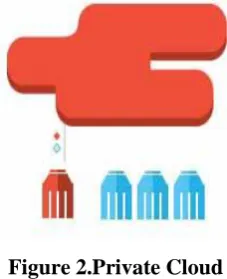
2. Private Cloud
:
Is owned or rented by single organization for its private use only.Figure 2.Private Cloud
3. Community cloud
:
It is similar to Private cloud but here resources are shared between members of aclosed group who have the same needs.
4. Hybrid cloud
:
Combing two or more cloud infrastructures (public , private or community ) provide extraresources in cases of high demand.
Figure 4 Hybrid Cloud
Cloud Service Models are:
5. SaaS
:
Software as a Service (SaaS)—run on distant computers ―in the cloud‖ that are owned and operatedby others and that connect to users‘ computers via the Internet and, usually, a web browser. Such as ERP, CRM,
and HRM. [13][14].
Figure 4 Software as a Service (SaaS)
6. PaaS:
Platform as a service provides a cloud-based environment with everything required to support thecomplete life cycle of building and delivering web-based (cloud) applications—without the cost and complexity
of buying and managing the underlying hardware, software, provisioning and hosting. Google Apps is an
example of PaaS.
Figure 5 Platforms as a Service (PaaS)
7. IaaS :
Infrastructure as a service (IaaS) Infrastructure as a service provides companies with computingB. Features of Cloud Computing
The Cloud Computing proposes a convincing value scheme for organizations to outsource their
Information and Communications Technology (ICT) infrastructures [15]. Miller[12], [16]
recommends that Cloud Computing is user-centric and task-centric, and distributed computing can
provide more helpfulness for sharing resources and associations in a group. The report of NIST
further presents five necessary characteristics of Cloud Computing, which are available on demand. It
is self-service, broad network access, resource pooling, rapid elasticity, and measured service.
Other features of cloud computing are listed in Table 1.
Parameters Cloud Computing
Access Via web
virtualization Essential
Switching cost High ,due to
Incompatibilities
Ease of use Easy
Business model Pricing (based on rent rate)
Application development In the cloud
control Centralized
openness Low
Service level agreements Essential
Table1. Features of Cloud Computing
III. CLOUD COMPUTING: KEY STAKEHOLDERS
In spite of the usual approach that just has two major groups of stakeholders encompassing service providers
and consumers, Stakeholders are more detailed in Cloud Computing.
1.
Providers:
Vendors who Perform the maintenance and upgrade of the system and are responsible for protecting consumer‘s data. Providers include well established companies such as Google, Microsoft, IBM,Oracle, Amazon, Sun, Salesforce.
2.
Consumers:
Subscribers who purchase and make use of system3.
Regulators:
International entities that permeate across the other stakeholders4.
Enablers:
Organizations which are responsible for selling services, facilitating the delivery, adoption andutilization of cloud computing [26].
It also includes two other groups like regulators and enablers. The role of different traditional stakeholders can
be altered in Cloud Computing. In the traditional computing, consumer is responsible for maintenance and
IV. KEY DRIVERS FOR ADOPTION OF CLOUD COMPUTING IN SMEs
Making use of a cloud service can cause lower capital investments and needed prices, nevertheless services area
unit provided in real-time; besides, as point out previous, vendors become accountable for all the upkeep tasks
together with change and upgrading. As per Rayport and author [15], major drivers of cloud services area unit as
below: anyplace / anytime accessibility to cloud primarily based software system, cloud enabled storage as a
omnipresent service, specialization and customization applications, association among users and price benefit
expected on cloud efficiencies, warehouse-size, energy potency, information centers and everything as a
service.
Moreover, other drivers of cloud services are detailed as follows:
1. Cost Reduction Structure
:
Cloud computing approach amazingly reduces the price of starting for SMEsthat making an attempt to get benefit from compute-intensive business analytics which were hither to accessible
only to the biggest of organizations.. As SMEs lacked the adequate needed resources and also cannot afford the
more expenditure, Cloud Computing may offer varied occasions for SMEs. Furthermore, it can facilitate
developing countries through a good cost reduction structure to fight more in business world and to recommend
their new IT resolutions worldwide.
2. Quick Accessibility
:
Cloud Computing can present an almost urgent access to hardware resources that notonly doesn‘t require much upfront capital investments for users, but also results in a faster time to market in
many businesses. The users are thoroughly separated from each other.
3. Innovation Incentive Structure
:
Cloud Computing may play a significant position in encouraginginnovation and declining hurdles associated to innovation in IT field through social networks.
4. On Demand Structure
: Cloud computing creates it suitable for SMEs to balance their services as per theclient requirement. When they report to require renting new resources, then required resources are send rapidly
thru internet [18].
V. KEY INHIBITORS FOR ADOPTION OF CLOUD COMPUTING IN SMES
Although there are several benefits to adopting cloud computing, but there are also some considerable obstacles
associated with its acceptance that would be addressed. Associated with its acceptance that may be
self-addressed. Obviously, security is one among the leading crucial issues within the adoption of Cloud Computing
in order that lack of enough security may result in impeding the adoption method for SMEs; but, there are some
solutions giving by cloud suppliers which may maximize the safety level convincingly such asUser-centric IdM
and united IdM solutions. once security, outage (temporary loss of service), ability (portability or ability to vary
provider ), and also the dependability are the foremost important ones [19] , [20].
The inhibitors of cloud computing‗s adoption are detailed as follows:
1. Connectivity and open access
:
The full realization of Cloud Computing relies on the accessibility ofhigh-speed access. In fact, open access to computing resources ought to be just like water and electricity power
accessibility.
interruption. Further costs may be pertaining to the necessary levels of reliability; nevertheless, the business can
do simply so much to decrease risks and the failure cost. Developing a track record of reliability will be a
necessity for the extensive adoption.
3. Interoperability
:
In this Cloud Computing adoption procedure by SMEs, it's critical to exist associateapplicable level of capability between public and private clouds. Associate oversize styles of companies have
created remarkably growth toward regulating their systems, processes and data by means of realization of ERPs.
Standardization desires associate extensible infrastructure succeeding to a totally incorporated association
among occurrences. Software as a Service (SaaS) applications delivered via the cloud acquire a low-capital,
fast-deployment selection. Relying upon the applying, it is very important to integrate with existing applications
which will be resident in an extremely separate cloud or on ancient technology. Customary is as associate
enabler or associate obstacle for ability that every of them yield connect sincere maintenance of information and
process‘s incorporation. [21], [22].
4. Security and Privacy
:
Cloud Computing approach is a kind of a novel delivering model of IT solutions, itappears that there's a comparatively high rate of insecurity related to its entrance towards the business world. It‘s noticeable that there's lack of enough certainty and security attended with the appearance of each new
technology or innovation and it's inevitable. The aptitude of Cloud Computing to sufficiently address privacy
laws has been referred to as into question. These days, organizations stumble upon to myriad totally different
requisites creating effort to safeguard the privacy of individuals‘ data.
5. Political Issues Due to Global Boundaries
: In the Cloud Computing, there is inconsistency in terms ofwhere the physical data resides, where processing takes place, as well regulations may employ. Apparently, due
to the inconsistent environment of rules, politics and direct involvement of government turn out to be more
outstanding in the adoption of Cloud Computing. Cloud Computing to persistently evolve into a limitless and
global tool, it necessitates to be separated from politics. Presently, this will have an inverse impact on
development of the cloud solutions globally [20]. Suppliers be unable to assure the placement of a company's
info on specific set of servers in an exceedingly specific location. Notwithstanding, cloud computing service
suppliers square measure fleetly using measures to deal with this issue. Shortly toward politic problems, Cloud
Computing is very smitten by international politics to survive. Providing open access property and enough
information measure and additionally allocating enough capital for ICT field square measure all beneath the
management of state and influenced by the politics.
6. Economic Value
:
It sounds spontaneous that by sharing resources to disembarrass peaks, payingexclusively for what's used, and cutting direct capital investment in using IT solutions, the quantity are there.
There‘ll be a necessity to accurately balance all prices and advantages relevant to Cloud Computing—in each the short and long runs. Hidden prices may cover support, disaster recovery, application modification, and
knowledge loss insurance. Since usage expands and ability needs for the business method become additional
taxing, a unique approach is needed.
VI. SECURITY CHALLENGES OF COMPUTING CLOUD
1. Authentication of gained information
:
Once cloud user rents cloud software, the whole data are in theis the likelihood of doing any modification in the user‘s data without his consent. So, the authentication of the
data in this case is extremely crucial, and so needs must be bonded to guaranteed [21].
2. Multi tenancy issue
:
The ability of using the similar software and interfaces to arrange resources andseparate customer- explicit traffic data and information. It appears like a sensor which is responsive to any unauthorized or illegal access from other users that are running procedures on the same physical servers [26].
3. Resource location
:
End users utilize the services obtained from the cloud suppliers without by representsof being notified about the correct location of resources . This could cause a possible drawback that is typically
over the control-domain of cloud suppliers [22].
4. Cloud standards
:
Standards are important across completely different normal developing companies toachieve ability among clouds and to reinforce their solidity and safety [23].
5. System monitoring and logs
:
As a lot of business crucial applications area unit remodeled to the cloudsetting, customers could imply a lot of observance and log knowledge from suppliers for his or her personnel.
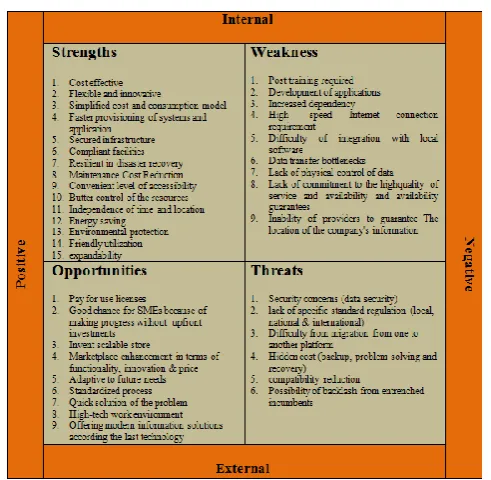
VII. SWOT ANALYSIS OF ADOPTING CLOUD COMPUTING IN SMES
Analysis a proficient tool used to recognize environmental circumstances and intra organizational abilities
involved in every project and have been used extensively in various decision making procedures. In this
analysis, firstly the goal of project and secondly its internal and external determinant factors are identified. This
method can make a contribution in investigating and evaluating issues from all main characteristics in which
every issue is analyzed comprehensively supported the mentioned issues [15]. In order to assess the adoption of
Cloud Computing for SMEs in a comprehensive mode, a SWOT analysis is conducted in Figure 1.
VIII. CONCLUSION
The practices of SMEs devoting in innovative technologies, such as Cloud Computing, ought to make available
additional substantiation concerning patterns of adoption. In this we attempted to explore the key stakeholders
of Cloud Computing and examine the various issues related with Cloud Computing as well as pros and cons of
its adoption. To realize this, a SWOT analysis was accomplished in which S-strengths, W-weaknesses,
O-opportunities as well as T-threats of cloud computing implementation was evaluated. It becomes obvious from
the analysis that the emerging systems of Cloud Computing contain the potential to multiply the efficiency,
profitability, and productivity of small scale enterprises (smes).
The outcomes of this analysis point out that SMEs may formulate growth noticeably in the business drift all the
way through cost decrease structure and faster software upgrade. Minor speculation on infrastructure and
hardware, easier scale up of applications and additional well-organized use of computing capital are other
benefits of cloud computing solutions for SMEs. A Monthly - based fees structure is a significant factor for
SMEs to adopt cloud approach. Thus, deploying policies in the direction of as long as more security can directly
power on raising the acceptance rate.
REFERENCES
[1] Rajesh Rege, Senior VP, Cisco India and SAARC, 2013 Cloud: Making SMEs Nimble, url:
http://www.cisco.com/web/IN/about/network/making_sme.html.
[2] Kochut, A., 2013 ―Evolution of the IBM cloud: enabling an enterprise cloud services Ecosystem", IBM J.
Res .Dev ., 55.
[3] Amato, F.; Mazzeo, A.; Moscato, V.; Picariello, A., 2014 ―Exploiting Cloud Technologies and Context
information for recommending touristic paths", In Intelligent Distributed Computing VII, Springer, pp.
281–287.
[4] Vouk, M.A., 2014 "cloud computing –issues, research and implementations", Journal of Computing and
Information Technology.
[5] Jaeger, P.T.; Lin .J. Grimes, J.M., 2008 "Cloud computing and information policy: computing In a policy
cloud?", journal of information technology & politics.
[6] Christensen, C.M.; Anthony, S.D.; Roth, E. A., 2004 "Seeing what‘s next: using theories of Innovation to
predict industry change", Boston,MA :Harvard Business School Press.
[7] Staten, J., 2013 "Hollow out the MOOSE: Reducing cost With Strategic Right sourcing", Forrester
Research, Inc.
[8] Iyer, B.; Henderson, J. C., 2011 ―Preparing for the future— understanding the seven capabilities Of
Cloud Computing", MIS Quarterly Executive, pp. 117–131.
[9] McKinsey & Co., , 2013 "Clearing the Air on Cloud Computing", Technical Report.
[10] Vaquero, LM; Rodero-Merino, L.; Caceres J.; Lindner, M., 2009 ―A break in the clouds: Towards a cloud
definition", SIGCOMM Computer.
[11] Buyya, R.; Yeo, CS.; Venugopal, S.; Broberg, J.; Brandic, I., 2012 ―Cloud computing and Emerging IT
platforms: Vision, hype, and reality for delivering computing as the 5th utility", Future Generation
[12] National institute of Standards and Technology, 2011. "The NIST definition of cloud Computing‖.
[13] Cusumano, M., , 2014 "Cloud computing and SaaS as new computing platforms", Communications of the
ACM.
[14] http://www.ibm.com/cloud-computing/in/en/what-is-cloud-computing.html
[15] [15] Haynie, M., 2012 "Enterprise cloud services: Deriving business value from cloud computing", Micro
Focus, Tech. Rep.,.
[16] Miller, M., , 2011 "Cloud Computing: Web-Based Applications That Change the Way You Work and
Collaborate Online", Indianapolis, Indiana: QUE.
[17] Rayport, J.F; Heyward, A., 2013 "Envisioning the cloud: The Next Computing Paradigm And Its
Implication For Technology Policy".
[18] Dubey, A.; Wagle, 2011 "Delivering software as a service", The Mckinsey Quaterly.
[19] Voorsluys, W.; Broberg J.; Buyya, R., 2011 "Cloud Computing Principles and Paradigm", John Wiley
And Sons.
[20] Zissis, D.; Lekkas, D., 2013. "Addressing cloud computing security issues", Future Generation Computer
Systems, 28(3), pp.583–592.
[21] AlZain, M. A.; Pardede, E.; Soh, B.; Thom, J. A, , 2013 "Cloud Computing security: From single to
multi-clouds", In Proceed-ings of the HICSS, pp. 5490–5499.
[22] Chunming, R.; Nguyen Son, T., 2014 "Cloud trends and security challenges", In: Proceedings of the 3rd
international workshop on security and computer networks (IWSCN 2011).
[23] Karin, B.; Gilje, JM.; Håkon, MP., 2013 "Undheim Astrid. Security SLAs for federated cloud services",
In: Proceedings of the 6th international conference on availability, reliability and Security.
[24] Kamal Kulshreshtha, Dr. N.K. Joshi, 2014 ―Managed Network Security Services in the Cloud‖, IJRSI,
Volume I, Issue III, pp. 26-30.
[25] Kamal Kulshreshtha, 2012 ―Service Oriented Query Management System‖, In: Proceeding of
International Conference on Recent Trends of Computer Technology in Academia (ICRTCTA 2012) at
JRNRV University, Udaipur.
[26] Kimia Ghaffari, Mohammad Soltani Delgosha and Neda Abdolvand, 2014, ―Cloud Computing: A Swot
Analysis On Its Adoption In SMEs‖, International Journal of Information Technology Convergence and