Trans. Emerging Tel. Tech.0000;00:1–13 DOI: 10.1002/ett
RESEARCH ARTICLE
Towards the network of the future: from enabling
technologies to 5G concepts
Dario Bega1,2,Marco Gramaglia2, Carlos J. Bernardos2, Albert Banchs1,2, and Xavier Costa-Perez3
1Institute IMDEA Networks, Spain2Universidad Carlos III de Madrid, Spain3NEC Laboratories Europe, Germany
ABSTRACT
There is a wide consensus by the research community and the industry that it will not be possible to satisfy future mobile
traffic demand and applications’ requirements by simply evolving the current 4G architecture. Instead, there is the need for a considerable revision of the mobile network system: such an effort is commonly referred to as the future “5G
architecture”, and large-scale initiatives all around the globe have been launched world-wide to address this challenge. While these initiatives have not yet defined the future 5G architecture, the research community has already invested a very
substantial effort on the definition of new individual technologies. The fact that all new proposals are tagged as 5G has created a lot of confusion on what 5G really is. The aim of this article is to shed some light on the current status of the 5G
architecture definition and the trends on the required technologies. Our key contributions are the following: (i) we review
the requirements for 5G identified by the different world-wide initiatives, highlighting similarities and differences; (ii) we discuss current trends in technologies, showing that there is a wide consensus on the key enablers for 5G; and (iii) we
make an effort to understand the new concepts that need to be devised, building on the enablers, to satisfy the desired requirements. Copyright c0000 John Wiley & Sons, Ltd.
∗Correspondence
E-mail:{dario.bega}@imdea.org;{cjbc,banchs,mgramagl}@it.uc3m.es; [email protected]
1. INTRODUCTION
It is well known that mobile data consumption is
exploding, driven by the increased penetration of smart devices, better screens, and compelling services, among
other factors. At the same time, emerging communication
services impose new requirements on the network: use cases such as tactile Internet, vehicular communications,
high-resolution video streaming, road safety, or real-time control place have stringent requirements on throughput,
latency, reliability, and robustness. It is widely agreed that all these new requirements and demands cannot be
provided by simply evolving the current 4G architecture. Therefore, novel architectural patterns and solutions must
be introduced. The core network will be especially impacted by this re-engineering, but also the access will
incorporate new technologies. The new architecture that
will result from this re-designing effort is commonly referred to as the “5G architecture”.
Driven by the above trends, there is currently a huge ongoing worldwide effort towards the definition of the new
5G architecture, with initiatives such as (i) 5G-PPP [1] in
Europe, (ii) 5G America’s [2] in America; (iii) IMT-2020 (5G) PG [3] in China, (iv) 5GForum [4] in Korea, and
(v) 5GMF [5] in Japan.
Standardization activities such as 3GPPP SA2 [6],
SA5 [7] and TGS-RAN [?] are the other side of the coin. These activities that we will detail further, range from the
definition of the technologies that improve the underlying wireless interfaces to other that, by leveraging on ongoing
of these proposals are tagged by the 5G label has
produced some confusion on what 5G is and which are the technologies that will actually conform the future 5G
network.
The aim of this paper is to review the major ongoing
activities in this area and put some order on the current flood of supposedly 5G building blocks. While the 5G
architecture has not yet been defined, and hence any
attempt to define its technological components is a mere speculation, we provide a thorough review of the current
trends identifying the Key Performance Indicators (KPIs), new concepts and their enabling technologies considered
necessary for the future 5G network. The remainder of this paper is organized as follows. Section 2 presents a view
of the consolidated performance that 5G systems should satisfy, highlighting the similarities and discrepancies
between the requirements provided by the different initiatives deriving the KPIs proposed. Section 3 describes
the technologies upon which the new 5G concepts rely in
order to enable the expected requirements. In Section 4, the 5G concepts, i.e. the approaches the 5G architecture will
based on, have been identified, while in Section 5 we detail the ongoing worldwide activities concluding our work in
Section 6.
2. THE NEED FOR 5G
As in the design of any system, the objectives in terms of KPIs are key for the deployment of future 5G systems.
To this end, the main driving bodies behind 5G have
recently dedicated a very substantial effort towards not only identifying, but also quantifying the objectives of the
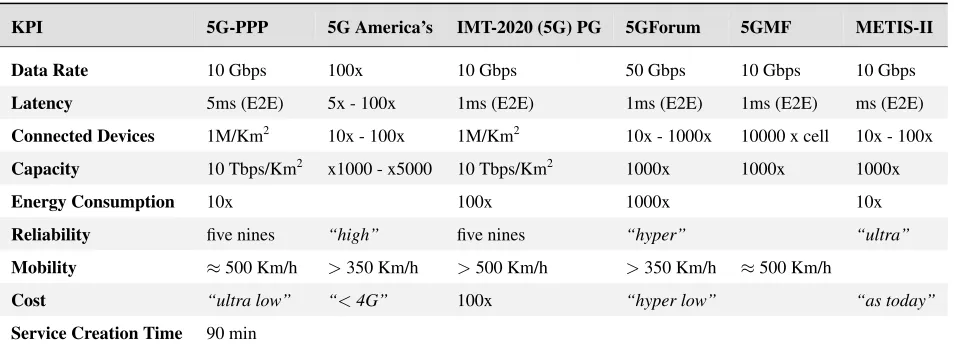
5G technology in terms of KPIs. Table I depicts the key KPIs that have been proposed by the main driving actors
of the 5G technology, including Europe (i. e., 5G-PPP, METIS-II [9]), America (i. e., 5G America’s), China (i. e.,
IMT-2020 (5G) PG), Korea (i. e., 5GForum), and Japan (i. e., 5GMF).
We observe from the table that, in addition to traditional KPIs for network performance, 5G also includes some
additional indicators that are crucial for the upcoming
network. Indeed, classical indicators for network design such as peak data rates, average and cell-edge user
throughput and overall cell throughput will continue to be
important for the 5G network design. However, additional
KPIs also need to be defined:
• Due to the massive uptake of machine-type traffic supporting new vertical user groups in industry, public administration, and business, KPIs such as
network availability, coverage (both deep indoors and for sparse rural areas), robustness and reliability
play a very important role.
• The current trends towards Internet-of-Things (IoT), which is one of the fundamental use cases
of 5G, point towards the support for dramatically increased numbers of almost zero-complexity
devices with long stand-by times, all of them essential to support such a use case.
• Other very important use cases in 5G such as tactile Internet and vehicular communications require
extremely low latencies, which is one of the most stringent KPIs included in the table.
• Another major challenge is energy-efficiency, driven by the need to support growing mobile data volumes without increasing the energy
consumption, which translates to greener operations and the corresponding cost savings.
• Finally, due to the broad adoption of flat rates, mobile operators will have to support the growth
in mobile data volume resulting from the above KPI without increases in subscription fees;
cost-efficiency will thus remain a key challenge for future network developments.
When comparing the data provided in Table I for the
different actors, the main observation is that they all largely agree on the target performance of 5G systems. While
the parameters provided by some of these actors are more concrete than others, and there may be a slight deviations
in some of the parameters, the numbers provided by different fora fall within the same order of magnitude in
almost all of the cases. Therefore, the main conclusion is that there is a wide consensus on the performance
requirements of future 5G systems.
It is worth noting that there is one of the KPIs in Table I
which is only indicated by 5G-PPP and no other forum:
the service creation time. Indeed the flexibility of easily customizing the network infrastructure to new services
Table I.5G Key Performance Indicators (KPI) according to the different initiatives. 10x means ten times better
KPI 5G-PPP 5G America’s IMT-2020 (5G) PG 5GForum 5GMF METIS-II Data Rate 10 Gbps 100x 10 Gbps 50 Gbps 10 Gbps 10 Gbps
Latency 5ms (E2E) 5x - 100x 1ms (E2E) 1ms (E2E) 1ms (E2E) ms (E2E)
Connected Devices 1M/Km2 10x - 100x 1M/Km2 10x - 1000x 10000 x cell 10x - 100x
Capacity 10 Tbps/Km2 x1000 - x5000 10 Tbps/Km2 1000x 1000x 1000x
Energy Consumption 10x 100x 1000x 10x
Reliability five nines “high” five nines “hyper” “ultra”
Mobility ≈500 Km/h >350 Km/h >500 Km/h >350 Km/h ≈500 Km/h
Cost “ultra low” “<4G” 100x “hyper low” “as today”
Service Creation Time 90 min
it is somehow surprising that such a KPI is ignored by the other actors.
At a more general level, the KPIs provided in this table refer mostly to the data plane performance, and
little emphasis is placed on the flexibility of adapting the network behavior to the specific requirements of the
different operators and the services they are providing. Given the current trends towards virtualization and
softwarization of the network driven by the need for
flexibility, it seems that future networks should place much more emphasis on this kind of KPI.
3. ENABLING TECHNOLOGIES
The requirements that need to be addressed by the
future 5G networks clearly demand new technologies and architectures, as simply evolving existing 4G deployments
would not be enough. While these new technologies, which we refer to as 5G enablers in this article, are essential
pieces of the future 5G technology, they will not suffice by themselves to satisfy the requirements identified. The
new concepts required, along with the mapping between 5G enablers, concepts and requirements, are studied in
Section 4.
We next identify and describe the main 5G enablers
based on the existing components being considered by the
most relevant players in the research and standardization communities. It is important to highlight that there is
quite a rough consensus on the technologies that are
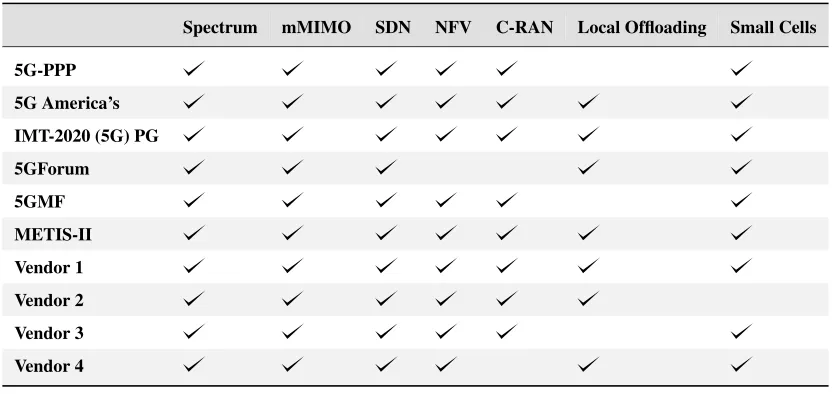
considered fundamental enablers for 5G among these key players [1]- [20]. Table II∗ graphically details which of
the identified 5G enablers are considered by each of these players. We blinded and aggregated the selected vendors
(NEC, Huawei, Ericsson, Samsung, Nokia) to emphasize this point: we are not claiming to interpret future
strategies of network equipment vendors nor providing their comprehensive vision of 5G. Our goal is to present
distilled information from their white papers to provide
useful insight on the relevant technological trends in 5G.
3.1. Spectrum & Massive MIMO (mMIMO)
Future networks will need to cope not only with higher data rates, but will also need to provide extremely low latencies
and support a substantially larger number of connected devices. In order to address this, a combination of new
advanced spectrum efficiency mechanisms (e.g. carrier aggregation techniques) and use of new frequency bands
(such as 60 GHz, mmWave, etc.) are required. Unlicensed
spectrum, for instance, can be used in combination with licensed spectrum (for critical control signalling and
mobility handling) to boost capacity. More spectrum can also be obtained with authorized-shared access, in which
the cellular system can access additional free spectrum otherwise apportioned for use by other (non-telecom)
services. The use of high-frequency bands also allows for
∗We remark that we solely used the information available in each player 5G
Table II.There is rough consensus among different 5G players on the enabling technologies.
Spectrum mMIMO SDN NFV C-RAN Local Offloading Small Cells 5G-PPP
5G America’s IMT-2020 (5G) PG 5GForum
5GMF METIS-II Vendor 1 Vendor 2 Vendor 3 Vendor 4
mMIMO technique that, by exploiting antenna arrays with
a few hundred antennas simultaneously, can serve many tens of terminals in the same time-frequency resource,
increasing the capacity 10 times or more, and enables a significant reduction of latency on the air interface
[21]. Those new access technologies in the actual LTE
network paradigm would be implemented separately since it does not allow multiple connection utilizing different
technologies. In this way is not possible to exploit completely their benefits.
3.2. Software Defined Networking (SDN)
Currently, it is extremely complex to express operators’ high-level network policies, since it is needed to configure
each individual network device separately using low-level
and often vendor-specific commands. Besides, networks are vertically integrated. The control plane and the data
plane are bundled inside the networking devices, reducing flexibility and hindering innovation and evolution of the
networking infrastructure.
The SDN paradigm [22] separates the control and
the data forwarding planes. Such separation allows for quicker provisioning and configuration of network
connections. With SDN, network administrators can program the behaviour of both the traffic and the network
in a centralized way, without requiring independently
accessing and configuring each of the network hardware devices. This approach decouples the system that makes
decisions about where traffic is sent (i.e., control plane)
from the underlying system that forwards traffic to
the selected destination (i.e., data plane). Among other advantages, this simplifies networking as well as the
deployment of new protocols and applications. In addition, by enabling programmability on the traffic and the devices,
an SDN network might be much more flexible and efficient
than a traditional one.
3.3. Network Function Virtualization (NFV)
In today’s networks, every time a new service has to be
deployed, operators have to buy proprietary devices, which often require a lot of time to be produced due to carrier
grade quality requirements. In addition, this equipment needs physical space for its installation and energy to run.
Last, but not least, trained personnel is required to setup,
configure and operate it.
The new 5G requirements for more diverse and new
(short-lived) services with high data rates has made operators even more reluctant to continue following the
current networks’ operation model. They are excited and hopeful with the advent of virtualization techniques in
the field of networks, what is widely known as network function virtualization (NFV) [23].
The key concept of NFV is the decoupling of physical network equipment from the functions that run on them
(decoupling the intelligence from the raw capacity). With
this approach, network functions (e.g., a load balancer) are now dispatched as software components, allowing for
high, COTS-based, volume servers, switches and storage,
which could be located in data centers, distributed network nodes and at end user premises. The virtual network
functions (VNFs) that provide network services can be flexibly reimplemented and relocated to different network
locations as needed since they may run on general purpose hardware, thus makes it faster and cheaper to put into
operation new services. Besides, combined with SDN, it
enables multi-tenant and sliced networks in which multiple service providers share the physical resources, reducing the
time and costs to deploy a new service.
3.4. Centralized RAN (C-RAN)
C-RAN is one possible way to efficiently centralize
computational resources, by connecting multiple sites to a central data center where all the baseband processing
is performed. Radio signals are exchanged over dedicated transmission lines (called fronthaul) between remote radio
heads and the data center. With a pure C-RAN approach, only fiber links are today capable of supporting the
required data rates, (e.g., about 10 Gb/s for TD-LTE with 20 MHz bandwidth and eight receiver antennas) being this
need for a high-capacity fronthaul the main drawback of C-RAN [24]. The trade-off between centralized processing
requiring high capacity fronthaul links, and decentralized
processing using traditional backhaul to transport the user and control data to/from the radio access points
has triggered the design of cloud RAN approaches. This allows flexible and adaptive software deployment, taking
advantage of the enormous potential of cloud computing. In a flexible cloud RAN environment, different RAN
functions can be optimally and dynamically allocated, and moved between the radio access points and data centers
deployed within the network, even at the core.
C-RAN is therefore a key 5G enabler as it allows to flexibly move functions within the network, facilitating
the achievement of lower latencies and the use of more efficient mobility mechanisms (e.g., depending of the
nature of the traffic, mobility anchors might be deployed closer to the end-user devices).
3.5. Local offloading
5G networks are foreseen to share resources to cope with disparate traffic demands from heterogeneous
users/applications (e.g., IoT and 4K high definition video
streaming). Additionally, some services may benefit from
local processing capabilities at the edge of the network, whereas other services might demand a centralized
processing because of privacy or legal concerns.
In this heterogeneous environment, local offloading
strategies are needed to flexibly and opportunistically (i) allow for extremely high bit rates, low delays and
low power consumption exploiting the UEs proximity;
(ii) reduce network load and improve spectrum efficiency exploiting direct transmission among devices [25]. For
mobile networks, the more promising technique is network assisted D2D communications, where two nearby devices
can communicate with each other with limited BS involvement. Besides all the advantages, for both service
providers and users, D2D raises new challenges as security and interference management, requiring also new pricing
models [26]. ETSI, recognizing the important role of local offloading strategies, has standardized a new technology
called Mobile Edge Computing (MEC) [27] - [29] with
the aim of improving its efficiency. MEC provides an IT service environment and cloud-computing capabilities
within the RAN thus, in close proximity to mobile subscribers. In this way, it is able to reduce latency, ensure
highly efficient network operation and service delivery, and computing agility in the computation offloading process.
Finally, in this heterogeneous environment, it is needed to flexibly and opportunistically allow to locally
break-out selected traffic closer to the edge (i.e., offloading
the network core) and exploiting the use of different gateways for traffic with different connectivity and
mobility requirements.
3.6. Small Cells
It is well known that increased spatial reuse (i.e., denser
networks and smaller cells) has been the dominant factor in the increase of the system throughput of cellular networks,
as compared to new physical layer techniques. Therefore, the use of very dense, low-power, small-cell networks is a
clear option to cope with future data rate demands. Ultra-dense deployments exploit two fundamental effects:(i)the
distance between the radio access point and the user is reduced, leading to higher achievable data rates, and(ii)
the spectrum is more efficiently utilized due to the reuse of
time-frequency resources across multiple cells.
Small cells do not replace but complement existing
provide coverage for fast-moving users and in areas with
low user density. The denser the network is, the higher the probability that an individual access point just carries a
light load. Therefore, smart coordination and management mechanisms are required to achieve a more efficient use of
spectral and energy resources [30].
Since both higher individual per-flow data rates, and
aggregated offered loads are expected in the near future,
small cells, together with new spectrum and MIMO, are key 5G enablers.
4. 5G CONCEPTS
Pushed by the rising of new technologies (what we refer to as 5G enablers in Section 3), new solutions need to
be devised. Indeed, new algorithms and protocols are
needed in order to exploit the above technologies towards achieving the goals identified in Section 2. Throughout this
section we review and classify the most important ones available in the literature. Figure 1 provides a graphical
representation of the proposed taxonomy†. It shows the enablers that we have identified in the previous section,
highlighting the new 5G concepts they mainly contribute to enable. Then, we disclose which requirements can be
satisfied by means of the new concepts (we present only the principal connections among the actors in order to focus on
their main role).
4.1. Service Chaining
A fundamental component towards achieving the
flexibil-ity needed in the future 5G networks is the self-adaptation capacity. Usually, network services are built on top of
sev-eral, well defined, functions (e.g., firewalls, load balancers, . . . ). In the legacy networking concepts, the placement of
these functions was tightly coupled with the underlying network topology. The development of the SDN and NFV
concepts has substantially changed the game. The pos-sibility of running a network function almost anywhere
in a data-center (on general purpose server hardware) decouples the sequence of network functions needed by a
service from the physical topology. Network functions are
†Note that the colours are used to highlight how the enablers on the left hand side
relate to the concepts in the middle, and how these cooperate to meet the 5G goals represented on the right hand side.
hence not deployed according to their functionality (e.g.,
placing load balancers close to the servers), but are defined and chained in an abstract fashion [31].
The main advantage provided by this approach is
flexibility. Chains can not only be instantiated in the
network, but they can also be modified according to the QoS demands of the users. For example, a Video Optimizer
or a CDNmiddleboxcan be easily placed inside the chain
on the fly if needed by the current network conditions. Therefore, service function chaining (SFC) allows the
rapid development of new services: new function chains can be deployed on demand, rather than forcing the
modification of the network topology to insert a new function needed by the targeted service.
4.2. Coalesced access architecture
Having to face the current trends in mobile data
consumption, the requests of new services (e.g., massive
Machine to Machine communications) and the always increasing number of connected devices, the current
cellular-based network architecture clearly shows its shortcomings. Providing very heterogeneous services
using the same infrastructure will not be feasible anymore in the near future, even with very efficient modulations
and coding schemes. For this reason, future 5G Networks will be based on a ductile access architecture, leveraging
also on small cells and on smart flow offloading whenever it is possible. This fine-grained wireless access structure
requires a very careful coordination among all the elements
of the network: something unlikely achievable with the legacy architecture, but possible by using new 5G concepts
as Flexible Mobile Network Controller (FMNC).
The optimized spectrum utilization, in exchange, will
provide increased performance (in terms of available bandwidth and capacity) with an increased efficiency from
an energy point of view. Moreover, having small, high capacity cells will certainly improve the signal quality
received by the user device, helping to reach the envisioned goals for reduced energy consumption and the overall
reliability of the system. Figure 2 shows an example of
how the future 5G Networks provide and unified interface for the management and control of heterogeneous access
Service Chaining
New Architecture New Air Interface
Network Slicing
Function Allocation and Placement Flexible Controller Spectrum - MIMO
SDN NFV
C-RAN
Local Offloading Small Cells
Reduced Latency Improved Cost Efficiency Reduced Service Creation Time
High Data Rate High Connectivity Enhanced Mobility Reduced Energy Consumption
Ultra Reliability
Enablers
New Concepts
Requirements
Figure 1.5G new concepts, enablers and requirements. The figure identifies the enablers upon which each concept relies, and which requirements it contributes to satisfy.
Virtual and Physical Resources
5G Verticals Radio Access Technologies
Figure 2.The future coalesced architecture: several 5G vertical employ heterogeneous access technologies. The 5G core
provides an unified API for their management
4.3. New Air Interfaces
In 4G networking, the available radio access technologies were somehow limited to cellular ones: LTE-A and
WiMAX. In 5G networking, the intrinsic flexibility of the
proposed architectures allows for the deployment of more heterogeneous radio access technologies. The raise of new
communication techniques at PHY and MAC layers fosters the research on new air interfaces. The availability of more
and faster communications channels enables three of the envisioned goals of 5G: reduced latency, higher data rates
and reduced energy consumption.
The current structure of LTE-A was designed to be an
enhancement of 3G networking. The targeted KPIs were related to the voice and data communications from mobile
terminals use cases (i.e., throughput, capacity, blocking
probability during calls). As time went by, the need for new services arose: some of them required very diverse
characteristics that were just not targeted by the initially
envisioned KPIs. Although the support for more enhanced service is currently being provided in LTE-A, a focused
revision of the access network (that is an evolution of 2G and 3G) is needed.
5G networks hence propose a complete paradigm
switch: not just making more bandwidth available to the users, but also achieving it through the seamless integration
of new frequency bands in the 6-100 GHz range (made available using massive MIMO deployments), advanced
spectrum efficiency management methods (especially in the legacy, sub 6 GHz band) and their integration [32].
Among the considered innovations, there will be evolved waveforms, but also wireless network coding will
play a major role during the definition of the new 5G air interfaces. This also tackles the MAC layer, with
the definition of an integrated frame structure capable of
allowing very diverse traffic types.
The key point is not only implement new access
technologies but exploit them allowing multi-connectivity, thus the possibility to connect the same user using different
access technologies such as 5G, Wi-Fi, LTE, 6 GHz, mmWave or visible light communications at the same time.
The main innovation is not to develop new technologies but to utilize them together, improving in this way their
efficiency.
The current consensus is that the 5G in order to provide a very considerable high data rate and reduce the latency,
needs to combine the use of new frequency bands (higher frequencies), advanced spectrum efficiency enhancement
4.4. Network Slicing
Nowadays, very different applications share the same com-munication infrastructure, but comcom-munication networks
were not designed with this in mind. With the trend of increased heterogeneity, 5G networks must be designed
embracing this from the very beginning. Moreover, the final goal of 5G is not only to support very heterogeneous
services, but also to reduce the costs (OPEX and CAPEX).
Theoretically, this goal can be achieved by having several physical networks deployed, one for each service
(or even one for each business). Isolated services can hence use their resources in an optimal way, avoiding difficult
re-configuration of hardware and network entities. Clearly, this approach cannot be applied to real networks, and calls
for a solution that allows both the efficient resource sharing (i.e.,multi-tenancy) and utilization.
A mild approach to multi-tenancy, mostly passive, is already standardized and applied by many operators that
currently share cell sites. However, the equipment still
belongs to each operator, limiting hence the cost reduction. 5G networks will go one step further, pushing for the active
sharing of resources among different tenants, allowing for the so-called “verticals”, where also non operators may
need the use of the network.
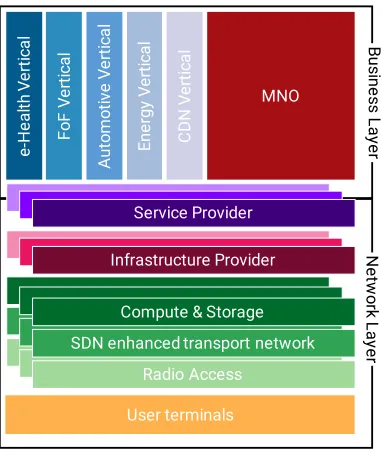
e-He al th V er tic al Fo F Ve rt ic al CD N V er tic al En er gy V er tic al Au to m ot iv e V er tic al MNO User terminals Compute & Storage SDN enhanced transport network
Radio Access Bu sin es s L ay er Ne tw or k L ay er Service Provider Infrastructure Provider
Figure 3.Multi-tenancy in a network sliced representation.
This kind of approach can be reached due to the
programmabilityfeature of future 5G networks, that will
be heavily based on the NFV and SDN paradigms.
Hence, different tenants can share the same general purpose hardware to provide all the needed functionality
to the final users. A first approach in this sense was proposed by NGMN with the introduction of the Network
Slice concept [33]. Softwarization techniques paved the way towards the virtualization of network resources, so,
fully decoupled networks can be built on top of virtual
infrastructure laying on a shared physical infrastructure. Therefore, a network slice can be defined as a subset
of virtual network infrastructure resources dedicated to a specific tenant, which can use it to provide its envisioned
service. The virtualization layer between different slices and the physical infrastructure ensures the economy of
scale that suggests the viability of the network slicing approach.
Network slices are created mostly with a business purpose: following also the 5G verticals spirit, an
infrastructure provider will assign one or more network
slices to each service of a service provider portfolio (e.g., the vehicular network slice, the factory of the future slice,
the health net slice, see Figure 3). The required KPIs are provided just when needed and where needed, allowing
hence a better network utilization with the consequent running cost reduction.
Network slicing calls for a flexible architecture capable of orchestrating and configuring all the entities used by a
network slice. This role is played by the FMNC described
in Section 4.6.
4.5. Function Allocation and Placement
If SFC defines the set of network functions (or
middleboxes in the legacy jargon) that have to be traversed by the data traffic in a network slice and how to chain them
(i.e., how to ensure that the traffic traverses the different functions in the right order), their actual instantiation in
the network is another part of the problem. Currently, with hardware middleboxes and their fixed location in the
infrastructure network, flows are routed through the chain using static configurations. This approach clearly lacks
flexibility and it is certainly prone to configuration errors. The emerging NFV technology enables the paradigm
switch from hardware to software packet processing, with
the possibility of deploying a network function everywhere in the network. The flexibility provided by NFV (and SDN)
problems were tackled by over-provisioning the network,
using the NFV/SDN approach the QoS management can be managed in a more efficient (but complex) way.
The increased flexibility can be used for many purposes, ranging from cost reduction due to a better infrastructure
utilization, to more efficient and fine-grained network features. Enhanced mobility management schemes, for
example, can be more effectively implemented by using
this approach. Specific mobility-related functions may be located closer to the actual user locations and possibly
re-located upon massive user mobility in order to always provide the best possible QoS.
Also radio functions may be allocated and moved flexibly across different network locations. Traditionally,
service function chains in mobile networks just include elements that come down-line the P-GW (e.g., firewalls,
TCP optimizers, . . . ), because the digital signal processing hardware could not be detached from the physical base
stations. The C-RAN concept extends the possibility of
having function chains also for the baseband part. The ecosystem of possible VNFs that have to be
orchestrated within a network slice, each one with heterogeneous constraints to be fulfilled, calls for
QoS-aware VNF orchestrators. A QoS-QoS-aware VNF orchestrator should place VNF into the right physical machines of a
data-center, in order to minimize the used resources while guaranteeing the Service-Level agreed for a given network
slice.
4.6. Flexible Control
With the introduction of Flexible Mobile Network
Controllers FMNCs, future 5G networks will bring the
concept ofnetwork programmabilitybeyond SDN. While SDN splits routing and forwarding capabilities in a switch
using a SDN controller, the FMNC perform such split betweenlogicandagentfor any network function in the
network. That is, the SDN principles are extended to all control,data plane and management functions usually
deployed in mobile wireless networks, that can ultimately be divided into three categories: (i) control plane functions,
(ii) data plane functions and (iii) wireless control functions. The former points are a rather natural extension
of the application of SDN principles, while the latter
captures the key aspect of a FMNC: wireless control functions will not be implemented any more in specialized
hardware (e.g., LTE eNB), but rather be a piece
of software. Therefore, many functions like channel
selection, scheduling, Modulation and coding scheme (MCS) selection and power control will be provided
using a software-defined approach. All these functions are performed by a (virtualized) programmable central control,
which provides very important benefits for the operation of the mobile network.
The advantages are manifold. The first one concerns
the increased flexibility of the network: one of the current problems that network operators are facing today
in their wireless equipment (besides high associated cost). By leveraging the programmability of the FMNC
approach, operators will be able to match their needs by simply re-programming the controller, thus reducing costs.
This approach also allows to scale-up and down virtual functions, enhancing reliability as well. The flexibility is
not just exposed to network operators, but also to third parties, that can acquire network resources fulfilling a
pre-defined Service Level Agreement (SLA). Programmability
also allows to customize the network, enhancing the QoE perceived by users.
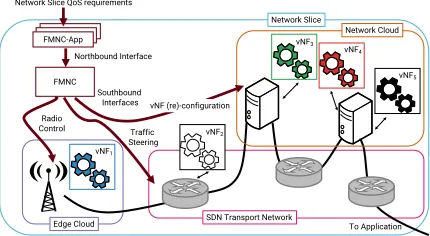
The FMNC approach implies to have a unique manage-ment point for the network: a logical centralized controller
that homogenizes different network technologies (see Fig-ure 4). By controlling a reduced number of FMNCs,
network operators reduce the complexity of the network management. Dense wireless networks, as envisioned in
5G, are especially favored by the FMNC approach: the
management of user mobility schemes and dynamic radio characteristics are in charge of the FMNC, that can employ
especially tailored algorithms according to the network slice they are deployed in. Moreover, if needed VNFs can
be deployed close to the users (i.e., an Automotive network slice) reducing their experienced latency.
New services can hence be enabled by just modifying the controller functions: services that were not initially
included by an operator in its architecture design, can now be introduced by implementing service-specific
enhancements. The FMNC behaviour can also be modified
to meet specific needs of the application or to better adapt to a specific scenario. A good example is the management
of base station schedulers: as the FMNC has a global view of the network slice, it can optimize the scheduling
algorithms and the resource allocation across them. This concept can be extended to the resource control across
Northbound Interface
Southbound Interfaces
vNF3 vNF 4
vNF5
vNF1
vNF2
SDN Transport Network
Network Cloud
Edge Cloud FMNC
Radio
Control Traffic Steering
vNF (re)-configuration Network Slice QoS requirements
Network Slice
To Application FMNC-App
Figure 4.An example of the Flexible Mobile Network Controller.
utilization: a network infrastructure provider may allocate
unused resources to demanding network slices, provided that the SLA is satisfied for all the hosted network slices.
Another possible usage of the FMNC is mobility management. As stated above, the FMNC is an extension
of the SDN concept to any kind of network function in
the mobile network. So, a straightforward amendment of the SDN dialect, capable of directly handling GTP tunnels,
may be used to directly control the S-/and P-GW entities of the network. However, the same idea can be used to
directly control other low-level user flows, steering traffic through network functions implementing the C-RAN
architecture (see Section 3.4). That is, one centralized, flexible application logic can control heterogeneous
network functions through specialized interfaces.
Therefore, the FMNC, following the SDN princi-ples, has a northbound and southbound interface. The
northbound interface is used by FMNC-applications to exchange high-level messages with the controller. The
FMNC applies these high level commands to the underly-ing SDN/NFV-based networks through southbound ones,
that are used to actually configure them. With FMNC, service providers will be able to fit the equipment to their
needs by simply re-programming the controller using well-defined APIs, and thus enabling new service within a very
reduced implementation, test and deployment footprint.
5. CURRENT ACTIVITIES
The attention and the efforts around 5G networks have hugely increased in the last years with the emergence of
worldwide initiatives with the aim of defining the new
architecture, specific technologies and solutions by the
2020. The most relevant ongoing projects are:
5G-PPP, an European joint initiative between the European ICT industry and the European Commission with the aim to rethink the infrastructure and to create the
Next Generation of communication networks and services
that will provide ubiquitous super-fast connectivity and seamless service delivery in all circumstance. It is
composed by 19 different projects (Flex5Gware, 5G-XHaul, 5G-Ensure, METIS II, Euro 5G, 5GNORMA,
Charisma, Sesame, Selfnet, CogNet, Virtuwind, 5GEx, Fantastic 5G, Coherent, SONATA, Superfluidity, 5G
Crosshaul, mmMagic and Speed5G) where industries and academia’s members collaborate. On July 2016
they released a white paper [34] focused in particular
on the definition of the key points of the overall 5G architecture. After identifying the 5G requirements,
it provides a first preliminary logical and functional architecture ranging from the physical to the management
and orchestration layer. Wider attention is placed on softwarization (including NFV/SDN) in 5G, seen as an
important enabler for the next communication network.
5G America’s, a wireless industry trade organization com-posed by leading telecommunications service providers and manufactures and voice of 5G and LTE for the
Americas. It focuses its efforts in order to advocate the
advancement of LTE wireless technology and its evolution beyond to 5G, throughout the ecosystem’s networks,
ser-vices, applications and wirelessly connected devices in the Americas. On November 2016 5G America’s released a
white paper [35] that details network slicing implemen-tation relative to 5G technologies, recognising this new
the different 5G’s use cases and requirements including
scalability and flexibility.
IMT-2020 (5G) PG in China is a program embarked by ITU-R to develop the new International Mobile Telecommunications system and 5G. It is the major
platform to promote the research of 5G in China and its member include the leading operators, vendors,
universities, and research institutes in the field of mobile
communications. On September 2016 they released a first-round results of the 5G Technology R&D Trial focused
on the main key technologies for 5G, such as massive MIMO, novel multiple access, new multi-carrier,
high-frequency communication, network slicing, mobile edge computing, C/U Plane separation and network function
reconstruction. The results proves that the implementation of the above technologies lead to support the diverse 5G
requirements, such as Gbps user experienced data rate, ms-level end-to-end latency, and 1 million of connections
per square kilometer. The next step will be focused on
technical schemes of 5G air interface and network and system trial. The second-round results is expected by the
end of 2017 [36].
5GForum is an organization founded in 2013 in Korea. It is composed by mobile networks operators, global manufacturer, research institutes, universities and
governments. Its goal is to assist in the development of the standard and contribute to its globalization. By 2020 the
South Korean government intends to commercially deploy
5G mobile telecommunication technology for the first time in the world, and they are planning to test five core 5G
services during the Pyeongchang 2018 Winter Olympics such as mobile 3D imaging, artificial intelligence,
high-speed services and ultra- and high-definition resolution capabilities.
5GMF is a Japanese entity founded in 2014 with the aim of contributing to the development of the use
of telecommunications. On July 2016 they released an updated White Paper [37] proposing two key concepts
for 5G: Satisfaction of End-to-End (E2E) quality and
Extreme Flexibility. The former means providing every user satisfactory access to any application, anytime,
anywhere, and under any circumstance while the latter is the feature of communications systems which will
allow 5G to always achieve E2E quality. Furthermore, it identifies two key technologies to support the proposed
concepts: Advanced Heterogeneous Network and Network
Softwarization and Slicing.
3GPP SA2, SA5 and TGS RANhave grown in parallel to the above mentioned large-scale initiatives working groups those standardization activities are focusing on
specific technologies and solutions that aim at addressing some specific requirements imposed on mobile networks
by new services or scenario. In particular, SA2 is in
charge of identifying the main functions and entities of the networks, how these entities are linked to each other
and the information exchanged. SA5 will specify the requirements, architecture and solutions for provisioning
and management of the future 5G network (RAN, CN, IMS) and its services. Their consistent integration with the
radio architecture elements defined by TGS RAN. We can easily understand that the worldwide attentions
and efforts on defining and developing the new 5G network is enormous. It is worth noticing that the more relevant
ongoing projects agree on the key requirements the new
network will need to provide and on the key technologies and enablers, even if each of them targets a different goal.
6. CONCLUSION
The architecture and the operation of future 5G networks has yet to be defined. However, there is already rough
consensus on what the fundamental building technologies will be and where future 5G network should lead us. We
have reviewed the most important enabling technologies,
describing how they can be used to achieve the goals envisioned for 5G networking by the most prominent fora.
The goals of 5G networks are being addressed by applying novel concepts to the legacy wireless networks.
We have listed many of them, underlining the interaction between the enabling technologies and the final goal.
Despite that many current softwarization and virtualization technologies are considered to be over-hyped, we remark
their fundamental contribution towards the goals of 5G by placing them into the new 5G concepts landscape.
This landscape is, however, still blurred. In this paper
we made an effort to specify the current research works, shedding light on the future trends that will eventually
ACKNOWLEDGEMENT
This work has been performed in the framework of
the H2020-ICT-2014-2 project 5G NORMA. The authors would like to acknowledge the contributions of their
colleagues. This information reflects the consortium’s view, but the consortium is not liable for any use that
may be made of any of the information contained therein.
This work has also been performed in the framework of the H2020-ICT-2014 project 5GEx (Grant Agreement
no. 671636), which is partially funded by the European Commission. This information reflects the consortiums
view, but neither the consortium nor the European Commission are liable for any use that may be done of the
information contained therein.
REFERENCES
1. 5G-PPP white paper, “5G Vision. The 5G
Infrastruc-ture Public Private Partnership: the next generation
of communication networks and services,” available onlinehttp://bit.ly/1GZuqHW, Feb. 2015.
2. 4G America’s white paper, “4G Americas’ Rec-ommendations on 5G Requirements and Solutions,”
available onlinehttp://bit.ly/2pCiGvv, Oct. 2014.
3. IMT white paper, “5G Vision and Requirements,” May 2015.
4. 5GForum white paper, “5G Vision and Requirements of 5G Forum,” Feb. 2014.
5. 5GMF white paper, “5GMF activities for 2020 and
beyond in Japan,” Sep. 2015.
6. 3GPP SA2 - Architecture, http://www.
3gpp.org/specifications-groups/
sa-plenary/sa2-architecture
7. 3GPP SA5 - Telecom Management, http://
www.3gpp.org/specifications-groups/
sa-plenary/sa5-telecom-management
8. 3GPP TSG - Radio Access Network, http://
www.3gpp.org/specifications-groups/
ran-plenary
9. J. F. Monserrat et al., “METIS Research Advances
towards the 5G Mobile and Wireless System Definition,” Journals of Wireless Communications
and Networking, Mar. 2015, 2015(1):53-68.
10. A. Osseiran et al., “Scenarios for 5G Mobile and
Wireless Communications: The Vision of the METIS Project,” IEEE Communications Magazine, May
2014, 52(5):26-35.
11. Nokia Networks white paper, “Network architecture
for the 5G era,” available onlinehttp://bit.ly/
2qugPsC, Mar. 2015.
12. V. Ziegler et al., “Architecture vision for the
5G era,” 2016 IEEE International Conference on Communications Workshops (ICC), May 2016.
13. Ericsson Review white paper, “5G radio access,” available onlinehttp://bit.ly/2qurxzn, Jun.
2014.
14. Samsung white paper, “5G Vision,” available online
http://bit.ly/2quqvTX, Feb. 2015.
15. Huawei white paper, “5G Network Architecture-A
High-Level Perspective,” available onlinehttp://
bit.ly/2q4PZ9B, Jul. 2016.
16. P. Rost et al., “Mobile network architecture evolution
toward 5G,” IEEE Communications Magazine, May 2016, 54(5):84-91.
17. P. Marsch et al., “5G Radio Access Network Archi-tecture: Design Guidelines and Key
Considera-tions,” IEEE Communications Magazine, Nov. 2016, 54(11):24-32.
18. J. F. Monserrat et al., “Rethinking the mobile and wireless network architecture: The METIS research
into 5G,” 2014 European Conference on Networks
and Communications (EuCNC), Jun. 2014.
19. P. K. Agyapong et al., “Design Considerations for
a 5G Network Architecture,” IEEE Communications Magazine, Nov. 2014.
20. NEC white paper, “Network Evolution toward 2020 and Beyond,” available online http://bit.ly/
1JCRP4n, Mar. 2015.
21. E. G. Larsson et al., “Massive MIMO for Next
Gen-eration Wireless Systems,” IEEE Communications Magazine, Feb. 2014, 52(2):186-195.
22. Open Networking Foundation white paper,
“Software-Defined Networking: The New Norm for Networks,” available online https:
//www.opennetworking.org, Apr. 2012.
23. NFV ISG white paper, “Network Functions
Virtual-isation (NFV) - Network Operator Perspectives on Industry Progress,” available onlinehttp://bit.
24. NGMN Alliance white paper, “Suggestion on
potential solutions for C-RAN,” available online
http://bit.ly/2qJnpLN, Jan. 2013.
25. G. Fodor et al., “Design Aspects of Network Assisted Device-to-Device Communications,” IEEE
Communications Magazine, Mar. 2012, 50(3):170-177.
26. M. N. Tehrani et al., “Device-to-Device
Communica-tion in 5G Cellular Networks: Challenges, SoluCommunica-tions, and Future Directions,” IEEE Communications
Mag-azine, May 2014, 52(5):86-92.
27. ETSI GS MEC 001, “Mobile Edge Computing
(MEC); Terminology,” Mar. 2016.
28. ETSI GS MEC 002, “Mobile Edge Computing
(MEC); Technical Requirements,” Mar. 2016. 29. ETSI GS MEC 003, “Mobile Edge Computing
(MEC); Framework and Reference Architecture,” Mar. 2016.
30. NGMN Alliance, “SmallCells: Recommendations
For Small Cell Development and Deployment,” Deliverable D5, Sep. 2015, http://bit.ly/
2qjr95M.
31. W. John et al., “Research Directions in Network
Service Chaining,” IEEE SDN for Future Networks and Services, Nov. 2013.
32. ICT-317669 METIS project, “Components of A New Air Interface Building Blocks
and Performance,” Deliverable D2.3, Apr.
2014, https://www.metis2020.com/
documents/deliverables.
33. NGMN Alliance white paper, “NGMG 5G WHITE PAPER,” available online http:
//bit.ly/19gv3jU, Feb. 2015.
34. 5G-PPP white paper, “View on 5G Architecture,”
available onlinehttp://bit.ly/2qJpvvr, Jul. 2016.
35. 5G America’s white paper, “Network Slicing for 5G Networks and Services,” available onlinehttp://
bit.ly/2ri7twt, Nov. 2016.
36. IMT-2020 (5G) Promotion Association, http://
www.imt-2020.cn
37. 5GMF white paper, “5G Mobile Communications Systems for 2020 and beyond,” available online