
1765 | P a g e
5g Nanocore Technologies
Rajesh Yadav
Department of Computer Science
BML Munjal University (India)
ABSTRACT
The 5G technology which is expected to be launched by 2020 it is an upgraded version of the existing and
establishing network 4G known as LTE (Long Term Evolution) network, this technology started an era of
highly-efficient information society. It is expected that the wireless technologies will become wider and deeper
in the coming years. The main contribution of this paper is definition of 5G i.e. Fifth Generation mobile network
concept which will be technically touching the real Heights and also covers technologies like Nanotechnology,
Cloud Computing, Flat IP concept, BDMA and more.
Keywords: BDMA, Nanotechnology, Cloud Computing.
I. INTRODUCTION
5G will be the one which will change the face of the mobile communication the Major distinguishing features of
5G are wide network availability with the high throughput which basically works on the packet switched
wireless system. OFDMA will be the salient feature which will be used in 5G so as to achieve the high speed
data transfer touching the rate of around 1Gbps also another feature that can be envisaged is the emergence of a
network which is capable of supporting World Wide Wireless Web (wwww) which is expected by 2020.
Technology which will be used in the 5G network is the most powerful as well as demanding also the
challenging part will be the integration of the wide range of technologies into a small device. High Resolution is
the main feature offered by 5G for the high end users. Bidirectional huge bandwidth is another milestone to be
achieved by the upcoming technology [1]. Error free transmission will be ensured due to the policy based
Quality of Service. Unequalled steadiness is guaranteed by the transporter type gateway. Sustainability can be
figured out up to 60,000 connections and can be counted more as expected. The paper has been organized
according to the following sections: Section-1 is the introduction to the research. Section-2 consists of 5G
wireless communication system. Section-3 Nanotechnology. Section-4 contains cloud computing. Section-5 all
IP Network. Section-6 contains BDMA. Section-7 contains comparison between 5G and 4G. Section-8
conclusion followed by references.
II. 5G WIRELESS COMMUNICATION SYSTEM
The 5G wireless communication system will be a converged system with multiple radio access technologies
integrated together. 5G can support a wide range of applications and services to comprehensively satisfy the
1766 | P a g e
5G uses Nanotechnology as a defensive tool for security concern that arises due to the flat IP. Surely the Flat IPnetwork is the key to make 5G acceptable for all kind of technologies.
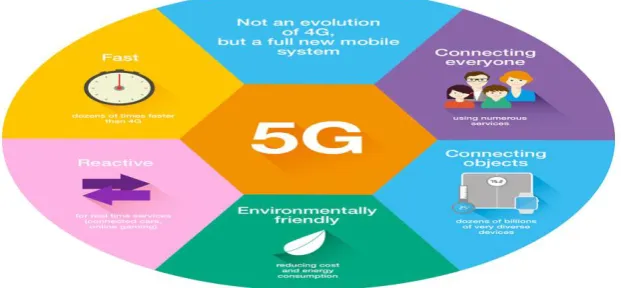
Figure 1: 5G Technology
The main advantage of Flat IP is that it provides a new way to identify devices using the symbolic names unlike
the hierarchical architecture method that has been used by the normal IP address; this will help wireless
operators in many ways as given below:
Lower costs.
Reduced system latency.
Decoupled radio access and core network evolution.
Reduce the number of network elements in the data path to lower operations costs and capital expenditure. Partially decouple the cost of delivering service from the volume of data transmitted to align infrastructure
capabilities with emerging application requirements.
Minimize system latency and enable applications with a lower tolerance for delay; upcoming latency
enhancements on the radio link can also be fully realized.
Evolve radio access and packet core networks independently of each other to a greater extent than in the past,
creating greater flexibility in network planning and deployment.
Develop a flexible core network that can serve as the basis for service innovation across both mobile and
generic IP access networks.
Create a platform that will enable mobile broadband operators to be competitive, from a price/performance
perspective, with wired network.
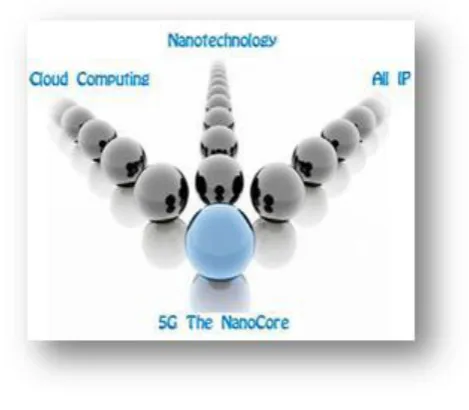
The 5G Nancore is a convergence of below mention technologies. These technologies have their own impact on
exiting wireless network which makes them in to 5G.
Nanotechnology.
Cloud Computing.
1767 | P a g e
.Figure 2: 5G Nanocore components
III. NANOTECHNOLOGY
This is the application of nano science to make the control process to a nano meter scale which will be in
between 0.1 and 100nm. This particular field is known as Molecular Nano Technology (MNT) [2]. Atom by
atom and molecule by molecule based control of the structure of matter. The telecommunication industry will
radically get changed into the latest Nanotechnology in little year time. Putting the impact in both mobile as well
as core network is the mode of operation of the nanotechnology. Perfection in security and the better impact on
the sensor makes the nanotechnology the most significant in its row. The most common and general identity of a
human being nowadays is the mobile device. The nano equipment in the 5G nano core is the mobile phone itself
as they are geared up with the nanotechnology. Wireless industry mainly aims at the implementation of the
intelligence which will ensure that the computation and communication are available as desired. The
introduction of intelligence in the mobile devices will help in embedding the devices in the human environments
that can create a new platform which will enable the ubiquitous sensing, computing and communication. The
nano equipments will be loaded with some of the core features like self-cleaning, self-powered, sensible to the
environment with which it is been interacting, flexible and also transparent. Introduction of the Graphene’s
transistor is the milestone to be achieved [3]. A transistor which is been built using the new material by name
Graphene, mainly consists of a form of graphite that consists of a single layer of carbon atoms which has been
arranged in the form of honeycomb pattern. The particular structure will help the electrons to travel through it
very quickly and gives greater efficiency than the commonly existing transceiver chip material. The latest
achieved frequency by the Graphene’s transistor is 26GHz which is miles away from the current technology
standards. Frequencies above 1THz are been used for the military for seeing the concealed weapons and medical
uses for imaging without using harmful x-rays. At conventional frequencies, transceivers based on grapheme
will be able to make both the cell phone and base stations more sensitive for the betterment in picking weak
1768 | P a g e
mobile device with a better signal to noise ratio will be able to take better advantage of the signal available fromthe nearest cell tower. Cell phones enhanced with the carbon nanotube will be introduced soon which comes
under the nanotechnology. In 5G Nanocore these mobile are referred as NanoEquipment as they are geared up
with nanotechnology. One of the central visions of the wireless industry aims at ambient intelligence:
computation and communication always available and ready to serve the user in an intelligent way. This
requires that the devices are mobile. Mobile devices together with the intelligence that will be embedded in
human environments – home, office, public places, will create a new platform that enables ubiquitous sensing,
computing, and communication Specs of Nano Equipments given as follow:
Self Cleaning – the phone cleans by itself
Self powered – the phone derives its energy/power from the sun, water, or air.
Sense the environment – the phone will tell you the weather, the amount of air pollution present, etc. Flexible – bend but not break
IV. CLOUD COMPUTING
Technology used for maintaining data and applications that uses the internet and central remote server is known
as Cloud Computing. In 5G, the central remote server will be the main provider of content. Clouding will
introduce a layer in which the consumers can use the applications without installation and also personal files can
be accessed with the use of internet access. In Nanocore the same concept will be used in which the user tries to
access his private account from a global content provider in the form of cloud. 5G will add on the real time
applications through the Nanocore clouding.
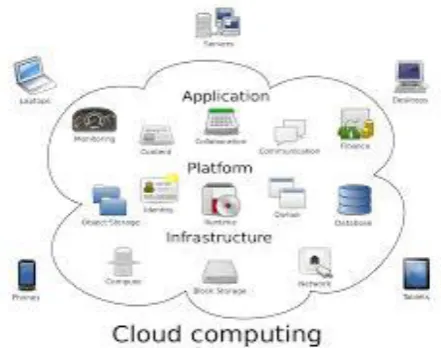
Figure 3: Segments of Cloud Computing
The Cloud computing has three segments as follows:
1769 | P a g e
Applications means, software services on demand. The products which are used to deploy internet is generallyreferred to as the platform segment of cloud computing. The infrastructure and is the backbone of the entire
concept. The infrastructure vendors will allow the user to build applications in this platform. Satisfying the
customer demand is attained in 5G by the mutual integration of all the three segments. The CAPEX (Capital
Expenditure) of 5G has been reduced by the cloud computing deployment
V. ALL IP NETWORK
A common platform is required to interact for the convergence of different technologies to form a single 5G
Nanocore. The essential part of the 5G network will be the Flat IP architecture. So as to meet the increasing
requirement of the mobile telecommunication market, All IP Network (AIPN) has been introduced by the 3GPP
system. Migrating into AIPN will meet the requirements of the customer for the real time data applications
delivered over the mobile broadband networks. Provision of the complete edge performance in terms of both
performance and costs is the primary focus of the enhanced packet switched technology. The touched benefits of
the IP architectures are reduction of the system latency, improved user experience, globally seamless access,
core network evolution, and decoupled radio access, cost effectiveness and much more. Placement of the
stringent performance demands on IP based equipments and devices, which leads to the growing demand of the
multicore technology. Strong demands have been seen in the Next Generation Network (NGN) infrastructures
both in wired and wireless layers.
Another important challenge in the telecommunication field is that the network should be in such a way that it
should be flexible and improved to provide larger number of connections to multiple users without losing the
quality within the limited frequency spectrum available with the increased system capacity. Communication
made possible within limited spectrum and time is the biggest challenge to be tackled properly without any loop
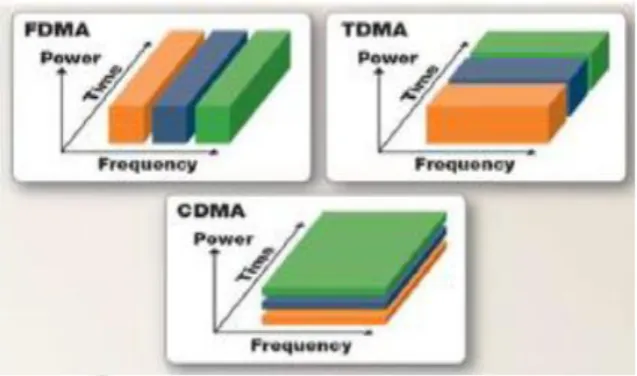
holes. Meeting this target is achieved by the implementation of multiple access techniques like OFDMA,
FDMA, TDMA, CDMA, etc. OFDMA (Orthogonal Frequency Division Multiple Access) technique divides and
allocates the available frequency resources to maximize the resource utility efficiency. In OFDMA, the
multiuser capability is achieved by assigning each user a subset of OFDM (Orthogonal Frequency Division
Multiplexing) subcarriers. OFDM is a digital transmission technique that uses a large number of carriers spaced
apart at slightly different frequencies. In FDMA the corresponding frequency division and allocation will take
place and in CDMA and TDMA, code and time division multiplexing will happen accordingly. FDMA
(Frequency Division Multiple Access) is a technology by which the total bandwidth available to the system is
divided into frequencies. Unlike FDMA, CDMA (Code Division Multiple Access) separates calls by code.
Every bit of a conversation is been tagged with a specific and unique code. The system gets a call, it allocates a
unique code to that particular conversation, and now the data is split into small parts and is tagged with the
unique code given to the conversation of which they are part of. In TDMA (Time Division Multiple Access) the
division of calls happens on time basis. The system first digitizes the calls, and then combines those
conversations into a unified digital stream on a single radio channel. Now it divides each cellular channel into
1770 | P a g e
during the conversation, a regular space in a digital stream. The users transmit in rapid succession, one after theother, each using its own time slot. This allows multiple stations to share the same transmission medium (e.g.
radio frequency channel) while using only a part of its channel capacity. In near future it is expected that the
capacity required in a mobile communication network will keep on climbing as the number of mobile stations
are increased and apparently the data required in respective mobile stations is increased.
Figure 4: Access Techniques
VI. BDMA
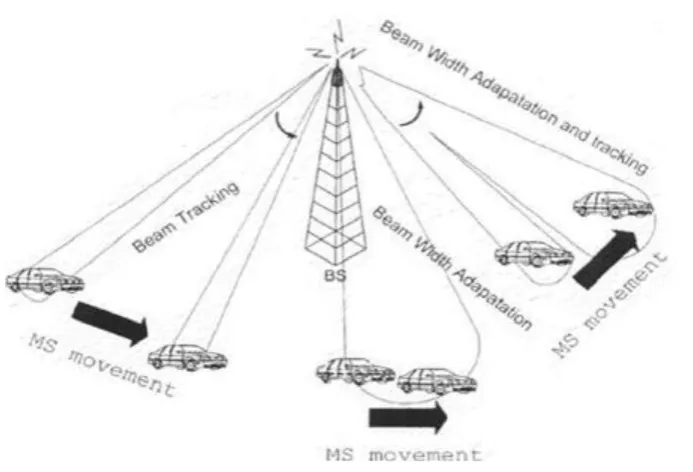
BDMA refers to Beam Division Multiple Access is the latest allocation technique in which an orthogonal beam
is allocated to each mobile station. In this technique, an antenna beam will get divided and allocated into the
locations of the mobile stations to provide multiple accesses and thereby increasing the capacity of the system.
Since mobile stations and the base stations are in Line of Sight state, they can transmit beams which directed to
each other’s position for proper communication, without making any kind of interference with cell edge mobile
stations. When the mobile stations are positioned at different angles compared to the base station, the base
station will transmit the beams in such a way that different angles will be covered and at the same time multiple
mobile stations will be taken care. The working is like one mobile station does not use one beam exclusively,
but the mobile stations positioned at similar angles will keep on sharing the one beam to communicate with the
base station. Mobile stations that are sharing the same beam will divide the same frequency or time resources
1771 | P a g e
Figure 5: BDMA
According to the mobile communication environment, a base station can change the direction, number and
respective widths of the beams adaptively with the almost easiness. Three dimensional mode of division will
happen in the case of beams and hence a spatial reuse of frequency or time resources can be maximized. The
first slot of communication is the base station and the mobile station does not know each other’s position. The
mobile station will detect their positions and the moving speeds and will transmit the entire information to the
base station. The second stage is taken care by the base station. The base station will calculate the direction
along with the width of a downlink beam which is based on the position and moving speed information received
from the mobile station. After the calculation part is over, the base station will transmit the downlink beam to
the mobile station with all the calculations regarding the direction and width [4].
VII. COMPARISON BETWEEN 5G AND 4G
1772 | P a g e
Figure 7: 5G Services vs 4G Services[5]
VIII. CONCLUSION
The future is becoming more difficult to predict with each passing year but we are on the right road towards the
upcoming era, 5G is made possible by the above explained technologies which includes Nanotechnology, Cloud
Computing and all IP Network. This paper tried to help to promote much stronger links between people who
will be working and dealing with the very latest future concepts of communication networks, clouding, Internet
services and moreover all the functionalities of Nanotechnologies.
REFERENCES
[1] Xichun Li, Abdullah Gani, Lina Yang, Omar Zakaria, Badrul Jumaat. “Mix-Bandwidth Data Path Design for
5G Real Wireless World”. The Proceeding of WSEAS 13th International Conferences on Multimedia and
Communication, Crete Island, Greece, 21- 23, July 2008. pp. 216-221.
[2] Nanotechnology applications to Telecommunications and Networking, by Daniel Minoli, 2005.
[3] Nanotechnologies for Future Mobile Devices by TAPANI RYHA¨ NEN Nokia Research Center, Cambridge,
2007.
[4] Imthiyaz Ali.A. 5G The Nano Core. International Journal of Engineering and Innovative Technology
(IJEIT), 2(3): 2277-3754, 2012.
![Figure 7: 5G Services vs 4G Services[5]](https://thumb-us.123doks.com/thumbv2/123dok_us/7782634.1286206/8.595.129.470.118.380/figure-g-services-vs-g-services.webp)
