Human Body Unit Practice Test
Modified True/False
Indicate whether the statement is true or false. If false, change the identified word or phrase to make the statement true.
____ 1. Organs of the nervous system include the brain and spinal cord. _________________________
Figure 30–3
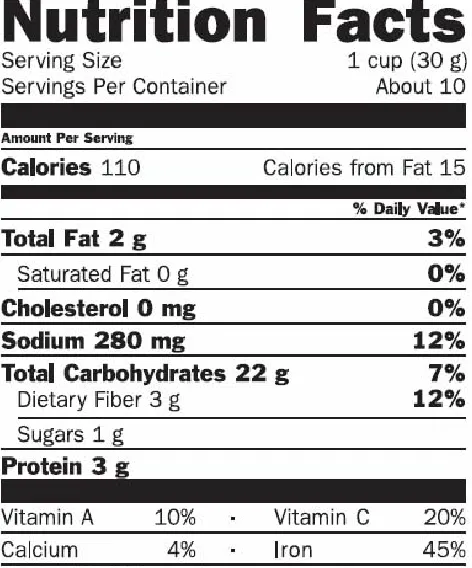
____ 2. Figure 30–3 shows the amount of dietary “Calories,” or kilocalories, per serving. The number of actual calories in this product is 110. _________________________
____ 3. A diet high in saturated fats and trans fats decreases the risk for developing heart disease._________________________
____ 4. Proteins are polymers of amino acids. _________________________
____ 5. Oxidizing a gram of fat releases more energy than does oxidizing a gram of carbohydrate. _________________________
____ 6. Peristalsis causes food to travel through the small intestines into the stomach. _________________________
____ 8. While the pancreas processes cellulose and other materials in some mammals, in humans it is only noticed when it is inflamed or infected. _________________________
____ 9. The skin, lungs, and kidneys are examples of organs that make up the excretory system. _________________________
____ 10. Blood enters the kidneys through the renal veins. _________________________
____ 11. When you are dehydrated, the pituitary gland releases antidiuretic hormone (ADH), which causes the kidneys to reabsorb less water. _________________________
____ 12. Your nervous system receives information that a baseball is being thrown in your direction. After the information is processed by your brain, your central nervous system stimulates the muscles in your hands to catch the ball. _________________________
____ 13. Spreading out from the cell body of a neuron are short, branched extensions called axons that gather information. _________________________
____ 14. Myelin sheaths can be damaged by strokes or nutritional deficiencies. If a neuron has a damaged myelin sheath, impulses move faster through the axon than they would in a healthy neuron.
_________________________
____ 15. When a stimulus is weaker than the threshold of a neuron, it will not produce an impulse. _________________________
____ 16. Densely packed nerve cell bodies found in the cerebral cortex are called white matter. ______________________________
____ 17. Sensory receptors that alert your brain when it is cold outside are called thermoreceptors. _________________________
____ 18. The muscles in your stomach responsible for churning and mixing food are controlled by the somatic nervous system. _________________________
____ 19. During brain surgery, patients are sometimes kept awake. This is possible because the brain does not contain chemoreceptors. ______________________________
____ 20. All of your taste buds are found on your tongue. ____________________
____ 21. The hammer, anvil, and stirrup and the two tiny sacs located behind them help the body maintain its equilibrium. ______________________________
____ 22. When walking into a dimly lit room, the cones in your eyes help you find your way around. ____________________
____ 24. A common injury among elderly people is a broken hip. This type of injury occurs in the appendicular skeleton. _________________________
____ 25. Red marrow is made up primarily of fat cells. _________________________
____ 26. Smooth muscle contractions are responsible for pushing a baby out of its mother’s uterus during childbirth. _________________________
____ 27. ATP supplies the energy for muscle contraction. _________________________
____ 28. When astronauts are in space, their muscles tend to strengthen due to the lack of gravity. _________________________
____ 29. Sunlight is needed for one of the chemical reactions that allows skin cells to produce vitamin C. _________________________
____ 30. The outer layer of the epidermis is shed every four to five weeks. _________________________
____ 31. Excessive exposure to infrared radiation in sunlight and tanning beds can cause changes in skin cells that may lead to skin cancer.
Figure 33–3
____ 33. In Figure 33–3, when the leg muscle contracts, blood in the veins is pushed away from the heart. _________________________
____ 34. When your body is exposed to the bacteria that cause strep throat, B lymphocytes produce antibodies that fight the infection._________________________
____ 35. Lymph vessels have pumps that move lymph through the body and prevent it from flowing backward. _________________________
____ 36. If a person has a blood pressure reading of 150/90, he or she has normal blood pressure. _________________________
____ 37. HDL is the cholesterol carrier that is most likely to cause trouble in the circulatory system because it becomes part of plaque. _________________________
____ 38. The process by which oxygen and carbon monoxide are exchanged between cells, the blood, and air in the lungs is known as respiration. _________________________
____ 39. In your lungs, diffusion of oxygen from alveoli into capillaries stops when oxygen concentrations in the blood are equal to oxygen concentrations in the alveoli. _________________________
____ 40. The brain controls breathing in a center located in the medulla oblongata. _________________________
____ 41. Nicotine is an addictive stimulant that decreases heart rate and blood pressure. _________________________
____ 42. Exocrine glands release their secretions into the bloodstream. _________________________
____ 43. The pancreas produces hormones that help to keep your blood glucose levels stable after eating an ice cream sundae. _________________________
____ 44. While standing outside waiting for the school bus on a cold day, your body maintains its core temperature by decreasing the amount of thyroxine in your blood. ______________________________
____ 45. The pituitary gland produces the hormones FSH and LH, which affect the development of gonads during puberty. _________________________
____ 46. Glands lining the male reproductive tract produce a nutrient-rich fluid called sperm. _________________________
____ 47. In a 28-day menstrual cycle, menstruation usually begins on the 14th day of the menstrual cycle. _________________________
____ 48. During ovulation, an increased estrogen level triggers a decrease in LH and FSH from the pituitary. _________________________
____ 50. The process in which the blastocyst attaches to the wall of the uterus and begins to grow in the tissues of the mother is called gastrulation. _________________________
____ 51. If an egg is present in the vagina, its chances of being fertilized by a sperm released during ejaculation are good. _________________________
____ 52. Babies can have breathing problems as a result of incomplete lung development during months 7–9. _________________________
____ 53. Within a few hours after birth, the pituitary hormone oxytocin stimulates the production of milk in the breast tissues of the mother. _________________________
____ 54. Washing your hands frequently can prevent the spread of many vectors. _________________________
Figure 35–4
____ 55. Figure 35–4 shows the structures on which the entire cell-mediated immune response depends. _________________________
____ 56. In humoral immunity, memory B cells respond quickly to the body being exposed to the chickenpox virus for the second time. _________________________
____ 57. Passive immunity lasts for only a short time because the immune system eventually destroys the foreign antibody. _________________________
____ 58. One reason for the emergence of new diseases is the increase in domestic animal trade. _________________________
____ 59. Histamines can reduce the symptoms of an allergic reaction. _________________________
Completion
Complete each statement.
61. Specialized ____________________ are the basic unit of structure in living things that are uniquely suited to perform a particular function.
62. ____________________ is the process by which organisms maintain a relatively stable internal environment.
63. Molecules in food contain chemical energy that cells use to produce ____________________.
64. Calcium, iron, and magnesium are all examples of the group of nutrients called ____________________.
65. ____________________ provide information such as the amount of sodium and Calories per serving found in food products.
66. A mixture of enzymes and partially digested food known as ____________________ is produced in the stomach.
67. Teeth are extremely important in ____________________ digestion because they physically break down large pieces of food into smaller ones.
68. The pancreas produces _________________________, a base that neutralizes stomach acid so that the enzymes can be effective.
69. Tiny, finger-like structures called villi and microvilli increase the stomach’s ____________________, allowing it to absorb more nutrient molecules.
70. If a person eats salty food, his or her kidneys respond by excreting excess salt into the ____________________.
71. During a ____________________, a patient receives a kidney from a compatible donor.
72. The myelin sheath that surrounds a single long axon leaves many gaps, called ____________________, where the axon membrane is exposed.
73. When a person loses consciousness due to a head injury from a car crash, the ____________________ keeps the body functioning by regulating the flow of information between the brain and the rest of the body.
74. Drugs produce changes in one particular group of synapses that use the neurotransmitter ____________________.
75. The turning of your head is controlled by the ____________________ nervous system, which is part of the peripheral nervous system’s motor division.
76. The ____________________ contains thermoreceptors that sense changes in blood temperature.
78. The ____________________ are the sense organs that can distinguish both pitch and loudness in vibrations that move through air.
79. Small muscles attached to the ____________________ of your eye change its shape to allow you to focus on near or distant objects.
80. A person who has a low concentration of ____________________ may have difficulty distinguishing one color from another.
81. Multicellular animals have ____________________, which provide structure and support within their individual cells.
82. The separate bones of a newborn infant’s skull grow until they are fused together and connected by ____________________ joints.
83. The concept used to explain the action of filaments in muscle contraction is the _________________________.
84. The point of contact between a motor neuron and a muscle fiber is called a(an) _________________________.
85. The muscle that bends, or flexes, the elbow joint is the ____________________.
86. Hair and nails are part of the _________________________ system.
87. A person with darker skin produces more ____________________ than a person with lighter skin.
88. The ____________________ is the layer of skin that contains blood vessels and nerve endings.
89. If someone has an allergic reaction to a food that they eat, such as peanuts, part of the body’s reaction is the release of the chemical ____________________.
Figure 33–4
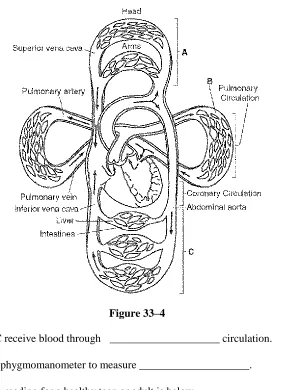
91. In Figure 33–4, A and C receive blood through ____________________ circulation.
92. Medical workers use a sphygmomanometer to measure ____________________.
93. A typical blood pressure reading for a healthy teen or adult is below ____________________.
94. The iron-containing protein called ____________________ binds to oxygen in the lungs and transports it to tissues throughout the body where the oxygen is released.
95. Plasma consists mostly of ____________________.
96. When your doctor feels your neck for “swollen glands” he or she is checking for swelling in the _________________________.
97. Fatty deposits called plaque build up in the walls of arteries, causing a condition known as ____________________.
98. Drugs such as ____________________ help people with high cholesterol by blocking the synthesis of cholesterol in liver cells.
100. Breathing is such an important function that your ____________________ system will not let you have complete control over it.
101. The ____________________ system is made up of glands that release their products into the ____________________.
102. Because steroid hormones are made of ____________________, they can easily cross cell membranes.
103. The thyroid gland is controlled by the ____________________ and the ____________________.
104. ____________________ is a period of rapid growth and sexual maturation during which the reproductive system becomes fully functional.
105. Cryptorchidism is a disorder in which one or both of the testes have not descended into the _________________________ by the time of birth.
106. In the female body, each egg is surrounded by a ____________________, which breaks open when the egg is mature.
107. If a woman is not ovulating, there is no chance of ____________________.
108. During ____________________, three germ layers form. They are called ____________________, ectoderm, and mesoderm.
109. Almost everything that the mother takes into her body passes through the ____________________ to the embryo.
110. Chickenpox, tetanus, and malaria are all examples of ____________________ diseases.
111. Mosquitoes that carry disease-causing organisms from person to person are called ____________________.
112. Any opening in the skin is a potential entrance for ____________________.
113. Chemicals known as ____________________ increase the flow of blood and fluids to the affected area as part of the body’s inflammatory response.
114. When your body is infected with the cold virus, antibodies tag the pathogen’s ____________________, which are found on their outer surface, for destruction by immune cells.
115. A ____________________ T cell activates other T cells and B cells, whereas a killer T cell binds to infected cells.
116. Humoral immunity is activated when ____________________ embedded on a few existing B cells bind to antigens on the surface of invading pathogens.
117. An English physician named ____________________ performed an experiment in which he developed a vaccine for smallpox.
119. Rheumatoid arthritis occurs when the immune system attacks the body’s tissues around joints. This is an example of a(an) _________________________ disease.
120. A person who has ____________________ is likely to suffer from a number of other rare infections because the virus that causes the disease attacks the immune system.
Short Answer
121. Compare and contrast tissues and organs.
122. What are two reasons why eating is important to your body?
A B
Figure 30–4
123. In Figure 30–4, which structure represents unsaturated fat? Which structure represents saturated fat? At room temperature, what state is each type of fat? State whether each fat is associated with heart problems. Give an example of each type of fat.
124. What is fiber and why is it important?
Figure 30–5
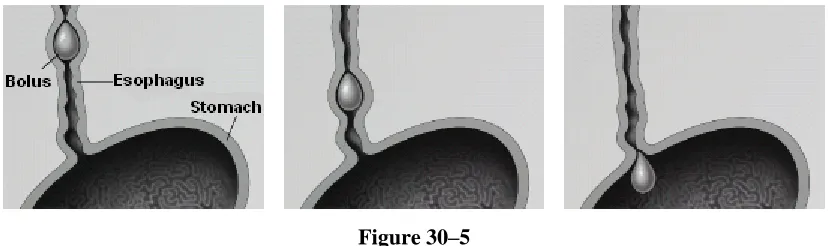
125. Name and describe the digestive process that is taking place in Figure 30–5.
126. Using the following terms, design and label a flow chart showing the path through which blood and waste flow in the kidney: ureter, renal vein, renal artery, glomerulus, nephron, and collecting duct.
128. A 16 year-old girl is diagnosed with kidney failure. Despite receiving dialysis treatments for three months, her doctor tells her that she needs a kidney transplant. Her brother volunteers to donate his kidney. How will he be able to survive if he donates his kidney?
129. What are three ways that kidneys maintain homeostasis?
130. What is the role of myelin sheaths in the nervous system?
131. In patients with Alzheimer’s disease, early damage to the synapses in the brain can lead to short-term memory loss. If the synapse between a neuron and another cell is damaged, how will it affect an impulse?
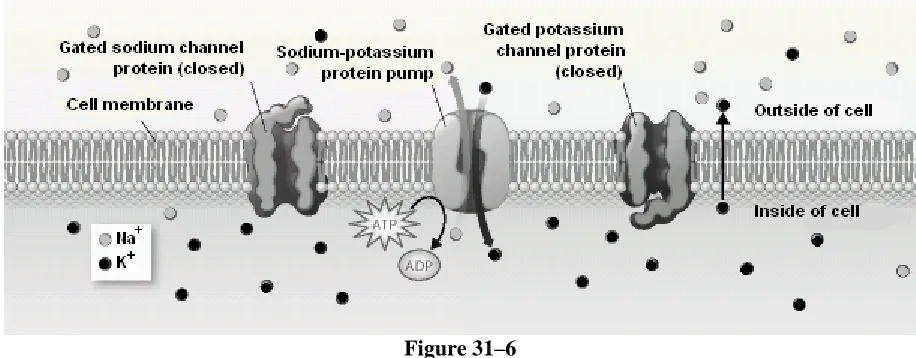
Figure 31–6
132. Figure 31–6 shows the cell membrane of a resting neuron. How do you know that the neuron is at rest?
133. Why are impulses always transmitted across the synapse in one direction?
134. Why is a severe injury to the brain stem often fatal?
135. What causes a drug user to keep increasing the amount of drug they abuse?
136. When you visit an amusement park or fair, your body is exposed to various stimuli. Describe how three sensory receptors are activated in this environment.
137. Why does your mouth feel hot when you eat a jalapeno pepper?
138. Sometimes at the end of a television cooking show, the chef describes how the final product he or she made “tastes.” Why is it incorrect for him or her to refer only to the “taste” of food?
139. Describe the role of the cochlea in hearing.
140. Compare and contrast the functions of rods and cones.
142. How would the body be affected if spongy bones had a dense, solid structure like compact bone rather than a latticework structure?
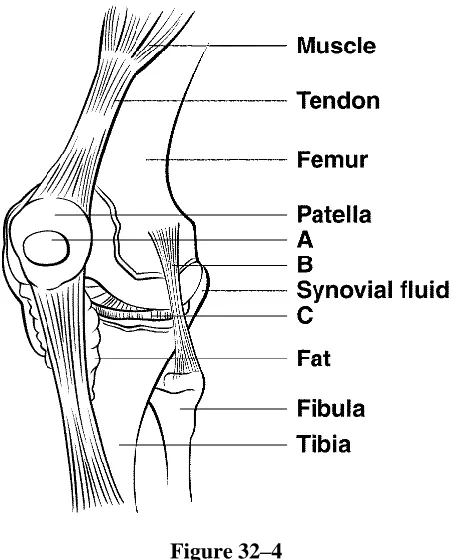
Figure 32–4
143. Briefly explain how motion would be affected if the structure labeled A in Figure 32–4 wasn’t present in some moveable joints?
144. Explain which type of muscle is involved when you tie your shoelaces.
145. Each muscle fiber has an all-or-none response. How, then, can the strength of a muscle contraction vary?
146. In a left-handed person, which hand would probably have more strength? Why?
147. Based on what you know about muscles and movement, evaluate the following statement as true or false. Then briefly explain your answer.
Musicians must train their muscles in order to play instruments, just as athletes must train their muscles in order to play sports.
148. Evaluate the following statement as true or false. Briefly defend your answer.
The skin is nothing more than the outer covering of the body.
149. Compare the structures found in the epidermis with the structures found in the dermis.
151. Why is it important to avoid tanning salons and wear a hat, sunglasses, and protective clothing whenever you spend time outside?
152. Why do larger organisms need a circulatory system?
153. Compare and contrast pulmonary circulation with systemic circulation. You may use a Venn diagram to plan your response.
154. Construct a table that shows the functions of the three types of blood vessels.
155. If the lymphatic system did not function, what would be the immediate effects on the human body?
156. Why is LDL (low-density lipoprotein) referred to as “bad” cholesterol while HDL (high-density lipoprotein) is referred to as “good” cholesterol?
157. Explain the relationship between air pressure outside the body (atmospheric pressure) and the movement of air into and out of the lungs.
158. Evaluate the following statement as true or false. Then defend your answer.
Smokers not only put their own health at risk, but also the health of their family and friends.
159. Define target cell and explain why all cells are not target cells for all hormones.
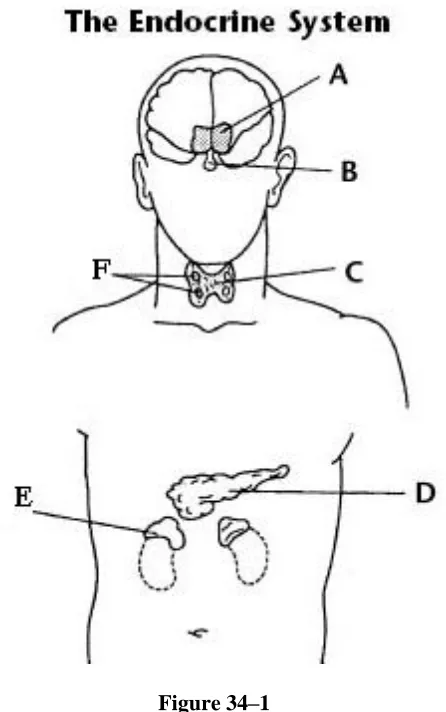
Figure 34–1
161. A woman visits her doctor with symptoms of low body temperature, lack of energy, and weight gain.What condition may be causing these symptoms? A problem with which organ in Figure 34–1 is the result of this condition?
162. How are the actions of glands and hormones in the endocrine system like a thermostat in a home heating system?
163. Construct a flow chart that shows the path through which sperm travels from the time they are produced until they are expelled from the male body.
164. Construct a Venn diagram in which you compare and contrast bacterial and viral sexually transmitted diseases. Include examples of each.
165. Many sperm may reach an egg in a Fallopian tube at the same time. What prevents more than one sperm from fertilizing an egg?
166. Sometimes during pregnancy, the placenta forms over the cervix. Why might this be a serious condition for the mother and fetus?
168. Construct a graphic organizer based on the types of organisms that cause infectious diseases. The graphic organizer should include the pathogens’ classification, how they infect an organism, and examples of each.
169. What are four ways you can help avoid contracting and spreading infectious diseases?
170. Construct a graphic organizer based on your body’s nonspecific defenses.
171. What role do interferons play in the immune system? Are they effective against all pathogens?
172. Measles (rubeola) and German measles (rubella) are caused by different viruses. If you have recovered from rubeola, are you protected against infection with rubella? Why or why not?
173. Helper T cells are critical to the function of the immune system. If they are destroyed by an HIV infection, how will this affect the body’s humoral immunity?
174. In general, what is the difference between the body’s primary immune response and the body’s secondary immune response?
175. Is a vaccination an example of active or passive immunity? Defend your answer.
176. Acyclovir is sometimes used to treat chickenpox and mononucleosis. This drug works by inhibiting the synthesis of viral DNA. Is acyclovir an antibiotic? Why or why not?
177. What can happen when an immune system overreacts to harmless pathogens?
178. Why is lupus classified as an autoimmune disease?
Figure 35–5
180. Figure 35–5 shows how HIV infects a cell. Fill in the boxes with a description of each step.
Other
Figure 30–6
Figure 30–7
182. Apply Concepts Figure 30–7 shows a small intestine and two magnified pictures of its structure.What is the function of the small intestine?
183. Interpret Visuals In Figure 30–7, what structures are labeled A?
184. Interpret Visuals In Figure 30–7, what structures are labeled B?
185. Apply Concepts Based on your knowledge of the four tissues found in the body, which type of tissue, labeled C in Figure 30–7, would you expect to find inside the lining of the small intestine? Explain your answer.
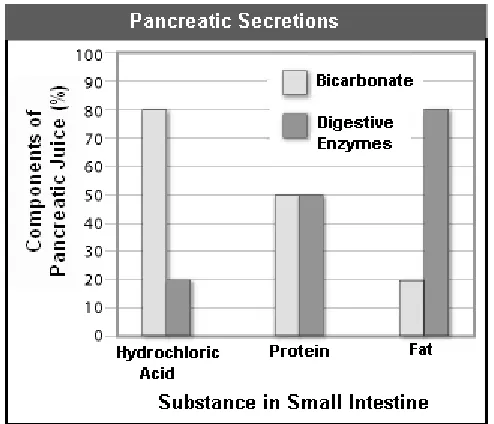
Figure 30–8
186. Interpret Graphs Figure 30–8 shows the secretions of the pancreas in response to three different substances in chyme. Each pair of bars represents the response of the pancreas to a different variable. What are the three variables?
187. Interpret Graphs In Figure 30–8, what is the specific variable that is being measured?
188. Draw Conclusions In response to which variable do digestive enzymes make up the highest percentage of secretions in Figure 30–8? What is the percentage?
189. Apply Concepts How would you explain why bicarbonate and digestive enzymes respond differently in two of the variables in Figure 30–8?
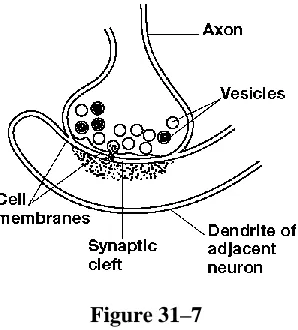
Figure 31–7
190. Interpret Visuals In Figure 31–7, which structures release neurotransmitters?
191. Apply Concepts What causes neurotransmitters to be released in Figure 31–7?
192. Apply Concepts Referring to Figure 31–7, after the neurotransmitters are released from the receptors on the receiving cell, what happens to the neurotransmitters?
Alcohol is a legal drug that is classified as a depressant because it causes the brain to slow down heart rate and breathing rate, lower blood pressure, and relax muscles. Blood alcohol concentration (BAC) is a measure of the amount of alcohol in the bloodstream. The following graphs illustrate how many alcoholic drinks consumed in one hour result in different levels of BAC in individuals of different masses. In some states, an adult driving with a BAC of 0.08% or higher is considered to be legally drunk.
Figure 31–8
193. Interpret Graphs An individual has a mass of 45 kg and has had one drink. According to Figure 31–8, how long would it take for his or her BAC to be 0.04% or lower?
195. Interpret Graphs Based on Figure 31–8, how is the mass of an individual related to BAC levels?
196. Apply Concepts A 58-kg person has two cocktails just before dinner and a glass of wine with dinner 30 minutes later. According to Figure 31–8, how long would the individual be in the “Definitely illegal” category?
Figure 31–9
197. Applying Concepts Referring to Figure 31–9, which lettered structure is the control center for recognition and analysis of hunger, thirst, fatigue, anger, and body temperature?
Distribution of Bones in Adult Human Body
Axial skeleton Appendicular skeleton
Vertebral column: Forelimbs:
Cervical region . . . 7 Hands . . . 38
Thoracic region . . . 12 Wrists . . . 16
Lumber region . . . 5 Arms . . . 6
Sacrum . . . 1 Shoulder girdle . . . 4
Coccyx . . . 1 Hindlimbs: Skull: Feet . . . 38
Cranium . . . 8 Ankles . . . 14
Facial portion . . . 14 Legs . . . 6
Middle ear bones . . . 6 Kneecaps . . . 2
Neck and chest regions: Hip girdle . . . 2
Sternum . . . 1
Ribs . . . 24
Figure 32–5
198. Apply Concepts Look at Figure 32–5. Which part of the skeleton, the axial or appendicular, protects the internal organs of the body?
199. Interpret Tables Based on Figure 32–5, which two structures contain the most bones?
Figure 32–6
200. Compare and Contrast In Figure 32–6, which structures are labeled B and D? How do they compare?
201. Apply Concepts In Figure 32–6, which structure contains tissues that store fat? What are these tissues called?
202. Interpret Visuals Identify structure F in Figure 32–6. What does this structure contain?
Figure 32–7
204. Apply Concepts How can the structure labeled E in Figure 32-7 lead to a pimple?
205. Apply Concepts In Figure 32–7, how does structure D help the body maintain homeostasis?
206. Draw Conclusions Use Figure 32–7 to explain why a slight scratch will probably not bleed.
Figure 33–5
207. Apply Concepts What type of muscle makes up the organ shown in Figure 33–5? Why is structure F more muscular than structure G?
208. Apply Concepts What are the roles of the structures L and I in Figure 33-5?
Figure 33–6
209. Interpret Visuals When you take a deep breath, into which structure(s) in Figure 33–6 does air move after leaving the trachea? Into what organ does the structure lead?
Figure 34–4
211. Interpret Visuals Based on Figure 34–4, what happens as the level of thyroxine increases in the blood?
Figure 34–5
Figure 34–6
213. Interpret Graphs On which day or days in the cycle shown in Figure 34–6 is fertilization most likely to occur?
214. Infer When during the cycle shown in Figure 34–6 does a woman menstruate?
215. Predict How would the curve of progesterone levels in Figure 34–6 change if the egg were fertilized?
Figure 35–6
Figure 35–7
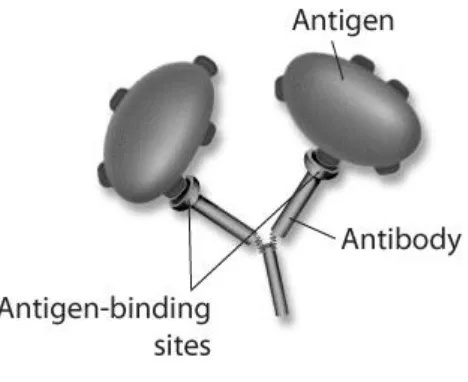
217. Apply Concepts Based on Figure 35–7, how is an antibody able to recognize a specific antigen?
218. Apply Concepts How do antibodies act as “signal flags” to other part of the immune system?
A scientist used a mathematical model that describes the interaction of the human immune system with HIV to simulate the effect of HIV drugs on HIV-infected patients. Her goal was to determine the optimal time to begin treating HIV-infected patients. Graphs A, B, and C show some of the results of the scientist’s
Figure 35–8
219. Interpret Graphs What do the two lines on Graph A in Figure 35–8 represent?
220. Interpret Graphs Based on Graphs A and B in Figure 35–8, what happens to T cell concentration between days 800 and 1200 during an HIV infection?
Essay
221. Name six of the body’s systems and describe their functions.
222. Explain how scratching an itch is an example of feedback inhibition.
223. Write a paragraph evaluating whether your eating habits represent a balanced diet.
224. Rattlesnake venom breaks down the walls of the glomerulus. Why does a rattlesnake bite cause blood to appear in the urine?
225. How do the kidneys respond to an increased intake of water? Of salt?
central nervous system, sensory division, somatic nervous system, nervous system, peripheral nervous system, motor division, autonomic nervous system
227. When you hear the phone ring, you pick it up to answer it. Many neurons are involved in this action. Write a paragraph describing how each type of neuron is involved.
228. Construct a table in which you describe the four types of lobes in the brain. The information in the table should include their location and function.
229. Do you think your fingertips or the palms of your hands have the greatest concentration of sensory receptors? Explain your answer.
230. Female gymnasts perform an Olympic event called the “balance beam.” In this event, they must demonstrate skills on a piece of equipment that is only four inches wide and forty-eight inches off the ground. To do this, they need a strong sense of balance. How do their bodies use their ears to determine motion and position?
231.
How is an eye like a camera? How is it different?
232. Evaluate this statement as true or false: “The skeletal system is a rigid, lifeless support system for the rest of the body.” Defend your answer.
233. Why might a doctor X-ray the elbow of a very short 17-year-old boy, even if there has been no injury?
234. Getting ready for school each morning requires your body to move in a variety of ways. Each motion involves different types of joints. Describe three examples of how joints help you get ready for school. Be sure to identify the type of joint and the motion each joint produces.
235. Compare and contrast the three types of muscle tissue. Be sure to include their structures, their functions, and an example of each.
236. When a musician is playing the violin, the muscles in the upper arms are working in pairs. Describe this dual action.
237. How is the body’s circulatory system like a major transportation system in a city?
238. Just after a car accident, a teenage boy suffers from low blood pressure. Based on what you know about his blood pressure reading, what are two things his body will naturally do to help return his blood pressure back to normal?
239. Hemophilia is an inherited blood disorder in which an affected person may bleed continuously even after a minor injury. For people with hemophilia B, the disease is caused by a lack of the protein thromboplastin. Why would the lack of thromboplastin cause a person to bleed for a longer time than normal?
Figure 34–7
241. Using the diagrams in Figure 34–7, compare and contrast the ways that steroid and nonsteroid hormones act on target cells.
242. Explain the difference between the relationship of the hypothalamus and the anterior pituitary and the hypothalamus and posterior pituitary.
243. When you exercise vigorously, your body loses water in the form of sweat. How do feedback mechanisms in the endocrine system help you to maintain water balance?
244. Trace the path of an egg from its follicle. How does the path of a fertilized egg differ from that of an unfertilized egg?
245. Create a public service announcement that will be heard on the radio or read on the Internet in which you tell teens about the dangers of sexually transmitted diseases. Include the most common bacterial STD as well as those caused by other bacteria and viruses. State how they are spread, the damage they cause, and the way to treat and prevent them.
246. Compare and contrast human development during months 4–6 and months 7–9 after fertilization.
247. What is the germ theory of disease? Why is it incorrect to use the word “germ”? What do you think would be a better name for the theory?
248. Part of the body’s nonspecific response to disease is chemical in nature. Describe the body’s nonspecific chemical responses to pathogens.
Human Body Unit Practice Test
Answer Section
MODIFIED TRUE/FALSE
1. ANS: T PTS: 1 DIF: L1
REF: p. 863 | p. 864 OBJ: 30.1.1 Describe how the human body is organized. STA: UT.BIO.3.2.a | UT.BIO.3.2.b | UT.BIO.3.2.c BLM: comprehension
2. ANS: F, 110,000
PTS: 1 DIF: L3 REF: p. 868
OBJ: 30.2.1 Explain how food provides energy. BLM: analysis 3. ANS: F, increases
PTS: 1 DIF: L2 REF: p. 873
OBJ: 30.2.1 Explain how food provides energy. | 30.2.3 Explain how to plan a balanced diet. BLM: comprehension
4. ANS: T PTS: 1 DIF: L1
REF: p. 870
OBJ: 30.2.2 Identify the essential nutrients your body needs and tell how each is important to the body.
STA: UT.BIO.2.1.b BLM: knowledge
5. ANS: T PTS: 1 DIF: L2
REF: p. 873 OBJ: 30.2.3 Explain how to plan a balanced diet. BLM: evaluation
6. ANS: F, esophagus
PTS: 1 DIF: L2 REF: p. 877
OBJ: 30.3.2 Explain what happens during digestion.
STA: UT.BIO.3.2.a | UT.BIO.3.2.b | UT.BIO.3.2.c BLM: comprehension 7. ANS: F, diarrhea
PTS: 1 DIF: L2 REF: p. 881
OBJ: 30.3.2 Explain what happens during digestion. | 30.3.3 Describe how nutrients are absorbed into the bloodstream and wastes are eliminated from the body.
STA: UT.BIO.3.2.a | UT.BIO.3.2.b | UT.BIO.3.2.c BLM: comprehension 8. ANS: F, appendix
PTS: 1 DIF: L2 REF: p. 882
OBJ: 30.3.3 Describe how nutrients are absorbed into the bloodstream and wastes are eliminated from the body. STA: UT.BIO.3.2.a | UT.BIO.3.2.b | UT.BIO.3.2.c
BLM: knowledge
9. ANS: T PTS: 1 DIF: L2
REF: p. 883
OBJ: 30.4.1 Describe the structures of the excretory system and explain their functions. STA: UT.BIO.3.2.a | UT.BIO.3.2.b | UT.BIO.3.2.c BLM: comprehension 10. ANS: F, arteries
OBJ: 30.4.2 Explain how the kidneys clean the blood. STA: UT.BIO.3.1.b | UT.BIO.3.1.c BLM: knowledge
11. ANS: F, more
PTS: 1 DIF: L2 REF: p. 886
OBJ: 30.4.2 Explain how the kidneys clean the blood. | 30.4.3 Describe how the kidneys maintain homeostasis. STA: UT.BIO.3.1.b | UT.BIO.3.1.c | UT.BIO.3.2.b
BLM: application
12. ANS: F, peripheral nervous system
PTS: 1 DIF: L2 REF: p. 896 | p. 907
OBJ: 31.1.1 Identify the functions of the nervous system. | 31.3.2 Describe the functions of the motor division of the peripheral nervous system.
STA: UT.BIO.3.2.a | UT.BIO.3.2.b | UT.BIO.3.2.c | UT.BIO.3.1.b | UT.BIO.3.1.c TOP: Foundation Edition BLM: analysis
13. ANS: F, dendrites
PTS: 1 DIF: L1 REF: p. 897
OBJ: 31.1.2 Describe the function of neurons. TOP: Foundation Edition BLM: knowledge
14. ANS: F, slower
PTS: 1 DIF: L2 REF: p. 897
OBJ: 31.1.3 Describe how a nerve impulse is transmitted. TOP: Foundation Edition BLM: analysis
15. ANS: T PTS: 1 DIF: L2
REF: p. 899 OBJ: 31.1.3 Describe how a nerve impulse is transmitted. TOP: Foundation Edition BLM: analysis
16. ANS: F, gray matter
PTS: 1 DIF: L2 REF: p. 902
OBJ: 31.2.1 Discuss the functions of the brain and spinal cord. STA: UT.BIO.3.1.b | UT.BIO.3.1.c TOP: Foundation Edition BLM: knowledge
17. ANS: T PTS: 1 DIF: L1
REF: p. 906
OBJ: 31.3.1 Describe the functions of the sensory division of the peripheral nervous system. | 31.4.1 Discuss the sense of touch and identify the various types of sensory receptors in the skin.
STA: UT.BIO.3.1.b | UT.BIO.3.1.c | UT.BIO.3.1.c TOP: Foundation Edition BLM: application
18. ANS: F, autonomic
PTS: 1 DIF: L2 REF: p. 904
OBJ: 31.3.2 Describe the functions of the motor division of the peripheral nervous system. STA: UT.BIO.3.1.b | UT.BIO.3.1.c TOP: Foundation Edition
BLM: application 19. ANS: F, pain receptors
PTS: 1 DIF: L2 REF: p. 909
BLM: analysis 20. ANS: F, Most
PTS: 1 DIF: L2 REF: p. 910
OBJ: 31.4.2 Explain the relationship between smell and taste. STA: UT.BIO.3.1.c TOP: Foundation Edition BLM: knowledge
21. ANS: F, semicircular canals
PTS: 1 DIF: L2 REF: p. 911
OBJ: 31.4.3 Identify the parts of the ears that make hearing and balance possible. STA: UT.BIO.3.1.c TOP: Foundation Edition
BLM: comprehension 22. ANS: F, rods
PTS: 1 DIF: L2 REF: p. 913
OBJ: 31.4.4 Describe the major parts of the eye and explain how the eye enables us to see. STA: UT.BIO.3.1.c TOP: Foundation Edition
BLM: application
23. ANS: T PTS: 1 DIF: L2
REF: p. 912 | p. 913
OBJ: 31.4.4 Describe the major parts of the eye and explain how the eye enables us to see. STA: UT.BIO.3.1.c TOP: Foundation Edition
BLM: comprehension
24. ANS: T PTS: 1 DIF: L2
REF: p. 922 OBJ: 32.1.1 List the structures and functions of the skeletal system. STA: UT.BIO.3.2.b TOP: Foundation Edition
BLM: application 25. ANS: F, Yellow
PTS: 1 DIF: L1 REF: p. 924
OBJ: 32.1.2 Describe the structure of a typical bone. STA: UT.BIO.3.2.b TOP: Foundation Edition BLM: comprehension
26. ANS: T PTS: 1 DIF: L2
REF: p. 929
OBJ: 32.2.1 Describe the structure and function of each of the three types of muscle tissue. STA: UT.BIO.3.2.b | UT.BIO.3.2.d BLM: application
27. ANS: T PTS: 1 DIF: L1
REF: p. 930 OBJ: 32.2.2 Describe the mechanism of muscle contraction. STA: UT.BIO.3.2.d TOP: Foundation Edition
BLM: knowledge 28. ANS: F, weaken
PTS: 1 DIF: L2 REF: p. 933
OBJ: 32.2.3 Describe the interaction of muscles, bones, and tendons to produce movement. STA: UT.BIO.3.2.c BLM: comprehension
29. ANS: F, vitamin D
PTS: 1 DIF: L1 REF: p. 935
30. ANS: T PTS: 1 DIF: L2
REF: p. 936 OBJ: 32.3.2 Identify the structures of the integumentary system.
STA: UT.BIO.3.2.b BLM: knowledge
31. ANS: F, ultraviolet
PTS: 1 DIF: L1 REF: p. 939
OBJ: 32.3.3 Describe some of the problems that affect the skin. TOP: Foundation Edition BLM: knowledge
32. ANS: T PTS: 1 DIF: L2
REF: p. 951
OBJ: 33.1.2 Describe the structure of the heart and explain how it pumps blood through the body. STA: UT.BIO.3.1.a | UT.BIO.3.1.b | UT.BIO.3.1.c BLM: comprehension
33. ANS: F, toward
PTS: 1 DIF: L2 REF: p. 952
OBJ: 33.1.3 Name three types of blood vessels in the circulatory system. BLM: comprehension
34. ANS: T PTS: 1 DIF: L2
REF: p. 955
OBJ: 33.2.1 Explain the functions of blood plasma, red blood cells, white blood cells, and platelets. BLM: application
35. ANS: F, valves
PTS: 1 DIF: L2 REF: p. 956
OBJ: 33.2.2 Describe the role of the lymphatic system. STA: UT.BIO.3.2.b | UT.BIO.3.2.c BLM: comprehension
36. ANS: F, high
PTS: 1 DIF: L2 REF: p. 959
OBJ: 33.2.3 List three common circulatory diseases. BLM: evaluation 37. ANS: F, LDL
PTS: 1 DIF: L2 REF: p. 959
OBJ: 33.2.4 Describe the connection between cholesterol and circulatory disease. BLM: comprehension
38. ANS: F, carbon dioxide
PTS: 1 DIF: L1 REF: p. 963
OBJ: 33.3.1 Identify the structures of the respiratory system and describe their functions. STA: UT.BIO.3.1.b | UT.BIO.3.1.c | UT.BIO.3.2.a BLM: comprehension
39. ANS: T PTS: 1 DIF: L2
REF: p. 966 OBJ: 33.3.2 Describe gas exchange. BLM: analysis
40. ANS: T PTS: 1 DIF: L2
REF: p. 967 OBJ: 33.3.3 Describe how breathing is controlled.
STA: UT.BIO.3.1.b | UT.BIO.3.1.c | UT.BIO.3.2.a BLM: knowledge 41. ANS: F, increases
PTS: 1 DIF: L2 REF: p. 968
42. ANS: F, Endocrine
PTS: 1 DIF: L1 REF: p. 979
OBJ: 34.1.1 Describe the structure and function of the endocrine system. STA: UT.BIO.3.2.b TOP: Foundation Edition BLM: knowledge
43. ANS: T PTS: 1 DIF: L2
REF: p. 984 OBJ: 34.2.1 Identify the functions of the major endocrine glands. STA: UT.BIO.3.2.a TOP: Foundation Edition
BLM: application 44. ANS: F, increasing
PTS: 1 DIF: L3 REF: p. 985
OBJ: 34.2.2 Explain how endocrine glands are controlled. STA: UT.BIO.3.2.a BLM: application
45. ANS: T PTS: 1 DIF: L2
REF: p. 988 OBJ: 34.3.1 Describe the effects the sex hormones have on development. TOP: Foundation Edition BLM: comprehension
46. ANS: T, seminal fluid
PTS: 1 DIF: L2 REF: p. 990
OBJ: 34.3.2 Name and discuss the structures of the male reproductive system. STA: UT.BIO.3.2.a | UT.BIO.3.2.b TOP: Foundation Edition
BLM: knowledge 47. ANS: F, first
PTS: 1 DIF: L2 REF: p. 993
OBJ: 34.3.3 Name and discuss the structures of the female reproductive system. STA: UT.BIO.3.2.a | UT.BIO.3.2.b BLM: comprehension
48. ANS: F, an increase
PTS: 1 DIF: L3 REF: p. 993
OBJ: 34.3.3 Name and discuss the structures of the female reproductive system. STA: UT.BIO.3.2.a | UT.BIO.3.2.b BLM: comprehension
49. ANS: F, before
PTS: 1 DIF: L1 REF: p. 994
OBJ: 34.3.4 Describe some of the most common sexually transmitted diseases. TOP: Foundation Edition BLM: comprehension
50. ANS: F, implantation
PTS: 1 DIF: L2 REF: p. 995
OBJ: 34.4.1 Describe fertilization and the early stages of development. TOP: Foundation Edition BLM: knowledge
51. ANS: F, Fallopian tubes
PTS: 1 DIF: L2 REF: p. 995
OBJ: 34.4.1 Describe fertilization and the early stages of development. TOP: Foundation Edition BLM: comprehension
REF: p. 999 OBJ: 34.4.2 Identify the major events of later stages of development. TOP: Foundation Edition BLM: application
53. ANS: F, prolactin
PTS: 1 DIF: L2 REF: p. 1000
OBJ: 34.4.2 Identify the major events of later stages of development. TOP: Foundation Edition BLM: knowledge
54. ANS: F, pathogens
PTS: 1 DIF: L1 REF: p. 1012
OBJ: 35.1.2 Explain how infectious diseases are spread. TOP: Foundation Edition BLM: comprehension
55. ANS: F, humoral
PTS: 1 DIF: L1 REF: p. 1017
OBJ: 35.2.3 List the body's specific defenses against pathogens. STA: UT.BIO.3.2.b TOP: Foundation Edition BLM: comprehension
56. ANS: T PTS: 1 DIF: L1
REF: p. 1018 | p. 1019 OBJ: 35.2.3 List the body's specific defenses against pathogens. STA: UT.BIO.3.2.b TOP: Foundation Edition
BLM: application
57. ANS: T PTS: 1 DIF: L1
REF: p. 1020 OBJ: 35.3.1 Distinguish between active immunity and passive immunity. TOP: Foundation Edition BLM: comprehension
58. ANS: F, exotic
PTS: 1 DIF: L1 REF: p. 1022
OBJ: 35.3.3 Describe why patterns of infectious disease have changed. TOP: Foundation Edition BLM: comprehension 59. ANS: F, Antihistamines
PTS: 1 DIF: L2 REF: p. 1024
OBJ: 35.4.1 Explain what happens when the immune system overreacts to harmless pathogens. STA: UT.BIO.3.2.b BLM: comprehension
60. ANS: T PTS: 1 DIF: L2
REF: p. 1025
OBJ: 35.4.1 Explain what happens when the immune system overreacts to harmless pathogens. STA: UT.BIO.3.2.b TOP: Foundation Edition
BLM: knowledge
COMPLETION
61. ANS: cells
PTS: 1 DIF: L2 REF: p. 862
OBJ: 30.1.1 Describe how the human body is organized.
PTS: 1 DIF: L1 REF: p. 865 OBJ: 30.1.2 Explain homeostasis.
STA: UT.BIO.3.2.b BLM: knowledge
63. ANS: ATP
PTS: 1 DIF: L1 REF: p. 865
OBJ: 30.2.1 Explain how food provides energy. BLM: knowledge 64. ANS: minerals
PTS: 1 DIF: L1 REF: p. 872
OBJ: 30.2.2 Identify the essential nutrients your body needs and tell how each is important to the body. STA: UT.BIO.2.1.b BLM: comprehension
65. ANS: Food labels
PTS: 1 DIF: L2 REF: p. 873
OBJ: 30.2.3 Explain how to plan a balanced diet. BLM: application 66. ANS: chyme
PTS: 1 DIF: L2 REF: p. 877
OBJ: 30.3.1 Describe the organs of the digestive system and explain their functions. | 30.3.2 Explain what happens during digestion. STA: UT.BIO.3.2.a | UT.BIO.3.2.b | UT.BIO.3.2.c
BLM: comprehension 67. ANS: mechanical
PTS: 1 DIF: L2 REF: p. 876
OBJ: 30.3.1 Describe the organs of the digestive system and explain their functions. | 30.3.2 Explain what happens during digestion. STA: UT.BIO.3.2.a | UT.BIO.3.2.b | UT.BIO.3.2.c
BLM: comprehension 68. ANS: sodium bicarbonate
PTS: 1 DIF: L2 REF: p. 878
OBJ: 30.3.1 Describe the organs of the digestive system and explain their functions. | 30.3.2 Explain what happens during digestion. STA: UT.BIO.3.2.a | UT.BIO.3.2.b | UT.BIO.3.2.c
BLM: knowledge 69. ANS: surface area
PTS: 1 DIF: L3 REF: p. 880
OBJ: 30.3.2 Explain what happens during digestion.
STA: UT.BIO.3.2.a | UT.BIO.3.2.b | UT.BIO.3.2.c BLM: comprehension 70. ANS: urine
PTS: 1 DIF: L1 REF: p. 886
OBJ: 30.4.1 Describe the structures of the excretory system and explain their functions. | 30.4.3 Describe how the kidneys maintain homeostasis.
STA: UT.BIO.3.2.a | UT.BIO.3.2.b | UT.BIO.3.2.c | UT.BIO.3.2.b BLM: application
71. ANS: kidney transplantation
PTS: 1 DIF: L1 REF: p. 887
BLM: knowledge 72. ANS: nodes
PTS: 1 DIF: L2 REF: p. 897
OBJ: 31.1.2 Describe the function of neurons. TOP: Foundation Edition BLM: knowledge
73. ANS: brain stem
PTS: 1 DIF: L2 REF: p. 903
OBJ: 31.2.1 Discuss the functions of the brain and spinal cord. STA: UT.BIO.3.1.b | UT.BIO.3.1.c TOP: Foundation Edition BLM: application
74. ANS: dopamine
PTS: 1 DIF: L2 REF: p. 904
OBJ: 31.2.2 Describe the effects of drugs on the brain. TOP: Foundation Edition BLM: knowledge
75. ANS: somatic
PTS: 1 DIF: L2 REF: p. 907
OBJ: 31.3.2 Describe the functions of the motor division of the peripheral nervous system. STA: UT.BIO.3.1.b | UT.BIO.3.1.c TOP: Foundation Edition
BLM: application 76. ANS: hypothalamus
PTS: 1 DIF: L3 REF: p. 909
OBJ: 31.4.1 Discuss the sense of touch and identify the various types of sensory receptors in the skin. STA: UT.BIO.3.1.c TOP: Foundation Edition
BLM: knowledge 77. ANS: taste buds
PTS: 1 DIF: L1 REF: p. 910
OBJ: 31.4.2 Explain the relationship between smell and taste. STA: UT.BIO.3.1.c TOP: Foundation Edition BLM: knowledge
78. ANS: ears
PTS: 1 DIF: L1 REF: p. 911
OBJ: 31.4.3 Identify the parts of the ears that make hearing and balance possible. STA: UT.BIO.3.1.c TOP: Foundation Edition
BLM: comprehension 79. ANS: lens
PTS: 1 DIF: L2 REF: p. 912
OBJ: 31.4.4 Describe the major parts of the eye and explain how the eye enables us to see. STA: UT.BIO.3.1.c TOP: Foundation Edition
BLM: comprehension 80. ANS: cones
PTS: 1 DIF: L2 REF: p. 913
BLM: application 81. ANS: cytoskeletons
PTS: 1 DIF: L3 REF: p. 922
OBJ: 32.1.1 List the structures and functions of the skeletal system.
STA: UT.BIO.3.2.b BLM: knowledge
82. ANS: immovable
PTS: 1 DIF: L1 REF: p. 926
OBJ: 32.1.3 List the different kinds of joints and describe the range of motion of each. STA: UT.BIO.3.2.b TOP: Foundation Edition
BLM: comprehension 83. ANS: sliding-filament model
PTS: 1 DIF: L2 REF: p. 930
OBJ: 32.2.2 Describe the mechanism of muscle contraction. STA: UT.BIO.3.2.d TOP: Foundation Edition BLM: knowledge
84. ANS: neuromuscular junction
PTS: 1 DIF: L2 REF: p. 931
OBJ: 32.2.2 Describe the mechanism of muscle contraction. STA: UT.BIO.3.2.d BLM: knowledge
85. ANS: triceps
PTS: 1 DIF: L2 REF: p. 932
OBJ: 32.2.3 Describe the interaction of muscles, bones, and tendons to produce movement. STA: UT.BIO.3.2.c TOP: Foundation Edition
BLM: application 86. ANS: integumentary
PTS: 1 DIF: L1 REF: p. 935
OBJ: 32.3.1 State the functions of the integumentary system. STA: UT.BIO.3.2.a TOP: Foundation Edition BLM: knowledge
87. ANS: melanin
PTS: 1 DIF: L1 REF: p. 936
OBJ: 32.3.2 Identify the structures of the integumentary system. STA: UT.BIO.3.2.b TOP: Foundation Edition BLM: application
88. ANS: dermis
PTS: 1 DIF: L1 REF: p. 937
OBJ: 32.3.2 Identify the structures of the integumentary system. STA: UT.BIO.3.2.b TOP: Foundation Edition BLM: knowledge
89. ANS: histamine
PTS: 1 DIF: L2 REF: p. 938
90. ANS: oxygen
PTS: 1 DIF: L2 REF: p. 948
OBJ: 33.1.1 Identify the functions of the human circulatory system. STA: UT.BIO.3.2.b BLM: comprehension 91. ANS: systemic
PTS: 1 DIF: L2 REF: p. 950
OBJ: 33.1.2 Describe the structure of the heart and explain how it pumps blood through the body. STA: UT.BIO.3.1.a | UT.BIO.3.1.b | UT.BIO.3.1.c BLM: comprehension
92. ANS: blood pressure
PTS: 1 DIF: L1 REF: p. 953
OBJ: 33.1.3 Name three types of blood vessels in the circulatory system. BLM: knowledge
93. ANS: 120/80
PTS: 1 DIF: L1 REF: p. 953
OBJ: 33.1.3 Name three types of blood vessels in the circulatory system. BLM: knowledge
94. ANS: hemoglobin
PTS: 1 DIF: L2 REF: p. 954
OBJ: 33.2.1 Explain the functions of blood plasma, red blood cells, white blood cells, and platelets. BLM: knowledge
95. ANS: water
PTS: 1 DIF: L1 REF: p. 954
OBJ: 33.2.1 Explain the functions of blood plasma, red blood cells, white blood cells, and platelets. BLM: comprehension
96. ANS: lymph nodes
PTS: 1 DIF: L1 REF: p. 957
OBJ: 33.2.2 Describe the role of the lymphatic system. STA: UT.BIO.3.2.b | UT.BIO.3.2.c BLM: application
97. ANS: atherosclerosis
PTS: 1 DIF: L1 REF: p. 958
OBJ: 33.2.3 List three common circulatory diseases. BLM: knowledge 98. ANS: statins
PTS: 1 DIF: L3 REF: p. 961
OBJ: 33.2.4 Describe the connection between cholesterol and circulatory disease. BLM: knowledge
99. ANS: larynx
PTS: 1 DIF: L1 REF: p. 964
PTS: 1 DIF: L1 REF: p. 967 OBJ: 33.3.3 Describe how breathing is controlled.
STA: UT.BIO.3.1.b | UT.BIO.3.1.c | UT.BIO.3.2.a BLM: comprehension 101. ANS: endocrine, blood
PTS: 1 DIF: L1 REF: p. 979
OBJ: 34.1.1 Describe the structure and function of the endocrine system. STA: UT.BIO.3.2.b TOP: Foundation Edition BLM: knowledge
102. ANS: lipids
PTS: 1 DIF: L2 REF: p. 980
OBJ: 34.1.2 Explain how hormones work. TOP: Foundation Edition BLM: comprehension
103. ANS: hypothalamus, anterior pituitary gland
PTS: 1 DIF: L2 REF: p. 987
OBJ: 34.2.2 Explain how endocrine glands are controlled. STA: UT.BIO.3.2.a BLM: comprehension
104. ANS: Puberty
PTS: 1 DIF: L1 REF: p. 988
OBJ: 34.3.1 Describe the effects the sex hormones have on development. TOP: Foundation Edition BLM: knowledge
105. ANS: scrotum
PTS: 1 DIF: L1 REF: p. 989
OBJ: 34.3.2 Name and discuss the structures of the male reproductive system. STA: UT.BIO.3.2.a | UT.BIO.3.2.b TOP: Foundation Edition
BLM: application 106. ANS: follicle
PTS: 1 DIF: L1 REF: p. 993
OBJ: 34.3.3 Name and discuss the structures of the female reproductive system. STA: UT.BIO.3.2.a | UT.BIO.3.2.b TOP: Foundation Edition
BLM: comprehension 107. ANS:
fertilization pregnancy
PTS: 1 DIF: L2 REF: p. 995
OBJ: 34.4.1 Describe fertilization and the early stages of development. TOP: Foundation Edition BLM: analysis
108. ANS: gastrulation, endoderm
PTS: 1 DIF: L2 REF: p. 997
PTS: 1 DIF: L2 REF: p. 998 | p. 1001
OBJ: 34.4.1 Describe fertilization and the early stages of development. | 34.4.2 Identify the major events of later stages of development. BLM: comprehension
110. ANS: infectious
PTS: 1 DIF: L1 REF: p. 1010
OBJ: 35.1.1 Identify the causes of infectious disease. TOP: Foundation Edition BLM: knowledge
111. ANS: vectors
PTS: 1 DIF: L1 REF: p. 1013
OBJ: 35.1.2 Explain how infectious diseases are spread. TOP: Foundation Edition BLM: application
112. ANS: pathogens
PTS: 1 DIF: L1 REF: p. 1014
OBJ: 35.2.1 Describe the body's nonspecific defenses against invading pathogens. STA: UT.BIO.3.2.b TOP: Foundation Edition
BLM: comprehension 113. ANS: histamines
PTS: 1 DIF: L2 REF: p. 1014
OBJ: 35.2.1 Describe the body's nonspecific defenses against invading pathogens. STA: UT.BIO.3.2.b TOP: Foundation Edition
BLM: knowledge 114. ANS: antigens
PTS: 1 DIF: L1 REF: p. 1016
OBJ: 35.2.2 Describe the function of the immune system's specific defenses. STA: UT.BIO.3.2.b TOP: Foundation Edition BLM: application
115. ANS: helper
PTS: 1 DIF: L1 REF: p. 1018 | p. 1019 OBJ: 35.2.3 List the body's specific defenses against pathogens. STA: UT.BIO.3.2.b TOP: Foundation Edition BLM: comprehension
116. ANS: antibodies
PTS: 1 DIF: L1 REF: p. 1016
OBJ: 35.2.3 List the body's specific defenses against pathogens. STA: UT.BIO.3.2.b TOP: Foundation Edition BLM: comprehension
117. ANS: Edward Jenner
PTS: 1 DIF: L2 REF: p. 1020
OBJ: 35.3.1 Distinguish between active immunity and passive immunity. TOP: Foundation Edition BLM: knowledge
PTS: 1 DIF: L1 REF: p. 1021
OBJ: 35.3.2 Describe how public health measures and medications fight disease. TOP: Foundation Edition BLM: knowledge
119. ANS: autoimmune
PTS: 1 DIF: L2 REF: p. 1024
OBJ: 35.4.1 Explain what happens when the immune system overreacts to harmless pathogens. STA: UT.BIO.3.2.b TOP: Foundation Edition
BLM: application 120. ANS: AIDS
PTS: 1 DIF: L1 REF: p. 1026
OBJ: 35.4.2 Describe how HIV is transmitted and how it affects the immune system. STA: UT.BIO.3.2.b TOP: Foundation Edition
BLM: comprehension
SHORT ANSWER
121. ANS:
A tissue is a group of similar cells that perform a single function. An organ is a group of tissues that work together to perform a complex function.
PTS: 1 DIF: L2 REF: p. 862 | p. 863 OBJ: 30.1.1 Describe how the human body is organized.
STA: UT.BIO.3.2.a | UT.BIO.3.2.b | UT.BIO.3.2.c BLM: analysis 122. ANS:
Molecules in food contain chemical energy that cells use to produce ATP. Food also supplies raw materials your body needs to build and repair tissue.
PTS: 1 DIF: L1 REF: p. 868
OBJ: 30.2.1 Explain how food provides energy. BLM: comprehension 123. ANS:
Structure A is unsaturated fat and Structure B is saturated fat. Saturated fat is solid at room temperature and is associated with heart problems. An example is butter. Unsaturated fat is liquid at room temperature and is not associated with heart problems. An example is olive oil.
PTS: 1 DIF: L2 REF: p. 870
OBJ: 30.2.2 Identify the essential nutrients your body needs and tell how each is important to the body.
STA: UT.BIO.2.1.b BLM: synthesis
124. ANS:
Fiber is a complex carbohydrate called cellulose. It is important because it helps muscles move food and wastes through your digestive system.
PTS: 1 DIF: L2 REF: p. 869
OBJ: 30.2.2 Identify the essential nutrients your body needs and tell how each is important to the body. STA: UT.BIO.2.1.b BLM: comprehension
125. ANS:
PTS: 1 DIF: L2 REF: p. 877
OBJ: 30.3.1 Describe the organs of the digestive system and explain their functions. | 30.3.2 Explain what happens during digestion. STA: UT.BIO.3.2.a | UT.BIO.3.2.b | UT.BIO.3.2.c
BLM: comprehension 126. ANS:
The flow chart should show an understanding that waste-filled blood enters the kidney through the renal artery into the nephron. Inside the nephron it is filtered in the glomerulus. Cleaned blood leaves the kidney through the renal vein. Waste products leave the kidney through the collecting duct, then the ureter.
PTS: 1 DIF: L3 REF: p. 885
OBJ: 30.4.1 Describe the structures of the excretory system and explain their functions. | 30.4.2 Explain how the kidneys clean the blood.
STA: UT.BIO.3.2.a | UT.BIO.3.2.b | UT.BIO.3.2.c | UT.BIO.3.1.b | UT.BIO.3.1.c BLM: synthesis
127. ANS:
The doctor might recommend that you drink more fluids because the water level in your blood is low.
PTS: 1 DIF: L2 REF: p. 886
OBJ: 30.4.3 Describe how the kidneys maintain homeostasis. STA: UT.BIO.3.2.b BLM: application
128. ANS:
Her brother is able to survive after donating his kidney because he has two and he can still survive with only one.
PTS: 1 DIF: L2 REF: p. 887
OBJ: 30.4.3 Describe how the kidneys maintain homeostasis. STA: UT.BIO.3.2.b BLM: evaluation
129. ANS:
They maintain homeostasis by removing waste products from the blood, maintaining blood pH, and regulating water content.
PTS: 1 DIF: L2 REF: p. 886
OBJ: 30.4.3 Describe how the kidneys maintain homeostasis. STA: UT.BIO.3.2.b BLM: comprehension
130. ANS:
Impulses travel faster down axons that have myelin sheaths than they travel down axons without them.
PTS: 1 DIF: L2 REF: p. 897
OBJ: 31.1.2 Describe the function of neurons. TOP: Foundation Edition BLM: evaluation
131. ANS:
An impulse will not be able to pass from one cell to another.
PTS: 1 DIF: L2 REF: p. 900
OBJ: 31.1.3 Describe how a nerve impulse is transmitted. TOP: Foundation Edition BLM: analysis
132. ANS:
PTS: 1 DIF: L3 REF: p. 898
OBJ: 31.1.3 Describe how a nerve impulse is transmitted. BLM: analysis 133. ANS:
Impulses are always transmitted in one direction across the synapse because axons, not dendrites, release neurotransmitters.
PTS: 1 DIF: L2 REF: p. 900
OBJ: 31.1.3 Describe how a nerve impulse is transmitted. TOP: Foundation Edition BLM: analysis
134. ANS:
The brain stem controls or is involved in some of the body’s most important functions, including breathing, heart rate, and blood pressure regulation.These involuntary processes are essential to life, so the disruption of any of these processes can cause death.
PTS: 1 DIF: L3 REF: p. 903
OBJ: 31.2.1 Discuss the functions of the brain and spinal cord. STA: UT.BIO.3.1.b | UT.BIO.3.1.c BLM: analysis
135. ANS:
A drug user’s brain reacts to excessive dopamine by reducing the number of receptors for the
neurotransmitter. Because there are fewer receptors, larger amounts of the drug are required to produce the same high.
PTS: 1 DIF: L3 REF: p. 904
OBJ: 31.2.2 Describe the effects of drugs on the brain. BLM: analysis 136. ANS:
Smells from food activate the chemoreceptors. Going on amusement rides activates mechanoreceptors. Photoreceptors are stimulated by the sunshine or flashing lights.
PTS: 1 DIF: L2 REF: p. 906
OBJ: 31.3.1 Describe the functions of the sensory division of the peripheral nervous system. STA: UT.BIO.3.1.b | UT.BIO.3.1.c TOP: Foundation Edition
BLM: analysis 137. ANS:
The chemical substances that make jalapeno peppers taste “hot” actually bind to thermoreceptors in the mouth.
PTS: 1 DIF: L2 REF: p. 909
OBJ: 31.4.1 Discuss the sense of touch and identify the various types of sensory receptors in the skin.
STA: UT.BIO.3.1.c BLM: analysis
138. ANS:
It is incorrect because technically most of what we perceive as “taste” is actually the smell of food.
PTS: 1 DIF: L2 REF: p. 910
OBJ: 31.4.2 Explain the relationship between smell and taste. STA: UT.BIO.3.1.c TOP: Foundation Edition BLM: evaluation
139. ANS:
PTS: 1 DIF: L3 REF: p. 911
OBJ: 31.4.3 Identify the parts of the ears that make hearing and balance possible.
STA: UT.BIO.3.1.c BLM: synthesis
140. ANS:
Both rods and cones are photoreceptors in the retina. Rods are sensitive to light but do not distinguish colors. Cones are less sensitive to light than rods, but cones respond to light of different colors.
PTS: 1 DIF: L2 REF: p. 913
OBJ: 31.4.4 Describe the major parts of the eye and explain how the eye enables us to see. STA: UT.BIO.3.1.c TOP: Foundation Edition
BLM: analysis 141. ANS:
In osteoporosis, osteoclasts break down bone faster than osteoblasts rebuild it. This leads to a decrease in bone density and therefore makes bones weaker.
PTS: 1 DIF: L2 REF: p. 925
OBJ: 32.1.2 Describe the structure of a typical bone. STA: UT.BIO.3.2.b TOP: Foundation Edition BLM: application
142. ANS:
If spongy bone had a solid structure rather than a latticework structure, it would be more dense, and therefore it would have more mass. This would make the body heavier.
PTS: 1 DIF: L3 REF: p. 924
OBJ: 32.1.2 Describe the structure of a typical bone. STA: UT.BIO.3.2.b BLM: synthesis
143. ANS:
Without bursae, there would be an increase in friction between the bones of a joint and any tissue in which they come in contact. This would make motion painful and in some cases difficult.
PTS: 1 DIF: L2 REF: p. 927
OBJ: 32.1.3 List the different kinds of joints and describe the range of motion of each.
STA: UT.BIO.3.2.b BLM: synthesis
144. ANS:
Tying shoelaces requires moving the arms and the fingers. This type of movement is done by skeletal muscles.
PTS: 1 DIF: L2 REF: p. 929
OBJ: 32.2.1 Describe the structure and function of each of the three types of muscle tissue. STA: UT.BIO.3.2.b | UT.BIO.3.2.d TOP: Foundation Edition
BLM: application 145. ANS:
A muscle is made up of many muscle fibers. The strength of a muscle contraction varies depending upon the total number of individual muscle fibers that contract.
PTS: 1 DIF: L3 REF: p. 930 | p. 931
OBJ: 32.2.2 Describe the mechanism of muscle contraction. STA: UT.BIO.3.2.d BLM: analysis
146. ANS:
PTS: 1 DIF: L2 REF: p. 933
OBJ: 32.2.3 Describe the interaction of muscles, bones, and tendons to produce movement. STA: UT.BIO.3.2.c TOP: Foundation Edition
BLM: analysis 147. ANS:
This statement is true. Any type of controlled movement requires muscles to work in opposing pairs. In order to hold a violin, strum a guitar, or play the piano the brain must learn how to work muscle groups in just the right ways to make the involved joints move precisely.
PTS: 1 DIF: L2 REF: p. 932
OBJ: 32.2.3 Describe the interaction of muscles, bones, and tendons to produce movement. STA: UT.BIO.3.2.c TOP: Foundation Edition
BLM: evaluation 148. ANS:
The skin has many different functions. They include acting as a barrier against infection and injury, helping to regulate body temperature, removing waste products from the body, and providing protection against
ultraviolet radiation from the sun. The skin also produces vitamin D and gathers sensory information from the environment.
PTS: 1 DIF: L2 REF: p. 935
OBJ: 32.3.1 State the functions of the integumentary system. STA: UT.BIO.3.2.a TOP: Foundation Edition BLM: evaluation
149. ANS:
The epidermis is made up of layers of epithelial cells and contains pigment-producing melanocytes. The dermis contains nerve endings, blood vessels, smooth muscle, sweat glands, sebaceous glands, and hair follicles.
PTS: 1 DIF: L2 REF: p. 936 | p. 937 OBJ: 32.3.2 Identify the structures of the integumentary system. STA: UT.BIO.3.2.b TOP: Foundation Edition BLM: analysis
150. ANS:
Answers should show an understanding that acne develops when sebum and dead skin cells form plugs in hair follicles, which leads to infection and inflammation. Answers could also address the fact that high hormone levels during puberty lead to increased sebum production or that acne can be caused by bacteria.
PTS: 1 DIF: L2 REF: p. 938
OBJ: 32.3.3 Describe some of the problems that affect the skin. TOP: Foundation Edition BLM: synthesis 151. ANS:
It is important to do these things because they protect you from excessive exposure to ultraviolet radiation, which causes melanoma and other types of skin cancer.
PTS: 1 DIF: L1 REF: p. 939
Larger organisms need a circulatory system because their cells are not in direct contact with the environment. They require delivery of nutrients and oxygen. In addition, the circulatory system transports substances that are made in one part of the organism to another part of the organism where they may be needed.
PTS: 1 DIF: L2 REF: p. 948
OBJ: 33.1.1 Identify the functions of the human circulatory system. STA: UT.BIO.3.2.b BLM: comprehension 153. ANS:
The heart is involved in both circuits of circulation. In pulmonary circulation, the right side of the heart pumps oxygen-poor blood to the lungs, where it is oxygenated and returned to the heart. In systemic
circulation, the left side of the heart pumps oxygen-rich blood to the rest of the body. The cells absorb oxygen and load the blood with carbon dioxide, which is returned to the right side of the heart.
PTS: 1 DIF: L2 REF: p. 950
OBJ: 33.1.1 Identify the functions of the human circulatory system. | 33.1.2 Describe the structure of the heart and explain how it pumps blood through the body.
STA: UT.BIO.3.2.b | UT.BIO.3.1.a | UT.BIO.3.1.b | UT.BIO.3.1.c BLM: analysis
154. ANS:
Arteries carry blood from the heart to the tissues of the body. Capillaries bring nutrients and oxygen to the tissues and absorb carbon dioxide and waste products. Veins return blood from the tissues of the body to the heart.
PTS: 1 DIF: L2 REF: p. 952
OBJ: 33.1.3 Name three types of blood vessels in the circulatory system. BLM: analysis
155. ANS:
The body would swell with fluid, a condition called edema.
PTS: 1 DIF: L2 REF: p. 956
OBJ: 33.2.2 Describe the role of the lymphatic system. STA: UT.BIO.3.2.b | UT.BIO.3.2.c BLM: analysis
156. ANS:
LDL is the cholesterol carrier that is most likely to cause trouble in the circulatory system because it becomes part of plaque. HDL is the cholesterol carrier that generally carries excess cholesterol from tissues and arteries to the liver for removal from the body.
PTS: 1 DIF: L2 REF: p. 959
OBJ: 33.2.4 Describe the connection between cholesterol and circulatory disease. BLM: evaluation
157. ANS:
When the atmospheric pressure is higher than the air pressure in the chest cavity, air rushes into the lungs. When the atmospheric pressure is lower than the air pressure inside the chest cavity, air rushes out of the lungs.
PTS: 1 DIF: L3 REF: p. 967
OBJ: 33.3.3 Describe how breathing is controlled.
The statement is true. Secondhand smoke exposes people to cancer-causing chemicals such as formaldehyde, arsenic, and ammonia. It also aggravates asthma and causes an increase in ear infections in children. In addition, secondhand smoke causes sticky platelets and damage to blood vessels, in some cases leading to death from heart disease.
PTS: 1 DIF: L2 REF: p. 969
OBJ: 33.3.4 Describe the effects of smoking on the respiratory system. BLM: evaluation
159. ANS:
A target cell is a cell that has receptors for a particular hormone. If a cell does not have receptors for a particular hormone, the hormone has no effect on it. Since only certain cells have receptors for specific hormones, all cells are not target cells for all hormones.
PTS: 1 DIF: L2 REF: p. 978
OBJ: 34.1.1 Describe the structure and function of the endocrine system. STA: UT.BIO.3.2.b TOP: Foundation Edition BLM: comprehension
160. ANS:
Steroid hormones can enter the nucleus of a cell and change the pattern of gene expression in a target cell. Nonsteroid hormones bind to receptors on cell membranes and cause the release of secondary messengers that affect cell activities.
PTS: 1 DIF: L2 REF: p. 980 | p. 981
OBJ: 34.1.2 Explain how hormones work. TOP: Foundation Edition BLM: comprehension
161. ANS:
hypothyroidism, G (thyroid)
PTS: 1 DIF: L2 REF: p. 985
OBJ: 34.2.1 Identify the functions of the major endocrine glands. STA: UT.BIO.3.2.a BLM: evaluation 162. ANS:
Home heating systems are controlled by thermostats. This system is an example of a feedback loop. In a feedback loop, an increase in something such as heat “feeds back” and inhibits the process that produced the heat in the first place. The actions of glands and hormones are biological examples of feedback loops.
PTS: 1 DIF: L2 REF: p. 986
OBJ: 34.2.2 Explain how endocrine glands are controlled. STA: UT.BIO.3.2.a TOP: Foundation Edition BLM: analysis
163. ANS:
Answer should show that sperm are produced in the seminiferous tubules. From there, they travel through the epididymis, vas deferens, and urethra (in the penis).
PTS: 1 DIF: L2 REF: p. 989
OBJ: 34.3.2 Name and discuss the structures of the male reproductive system. STA: UT.BIO.3.2.a | UT.BIO.3.2.b TOP: Foundation Edition
BLM: synthesis 164. ANS:
Sample Answer: